ricojakezander@gmail.com
FINANCIAL
PLANNING
ricojakezander@gmail.com
Learning Competency:
•Create a financial plan
ricojakezander@gmail.com
Financial Plan
A financial plan is a comprehensive overview of your
financial goals and the steps you need to take to achieve
them. It involves evaluating your current financial
situation, identifying your objectives, and then developing
and implementing relevant recommendations.
Financial planning covers various areas, including budgeti
ng, investing, taxes, retirement planning, estate planning,
and risk management1
2. Here are some essential components of a financial
plan:
ricojakezander@gmail.com
Budgeting:
1.Create a cash flow statement showing
your income sources and expenses.
2.Review your assets and liabilities through
a balance sheet.
3.Assess the positives and negatives of your
current financial situation.
ricojakezander@gmail.com
Investing:
1.Monitor your investment portfolio
return reports.
2.Develop an asset allocation plan.
3.Understand your retirement
account investments.
ricojakezander@gmail.com
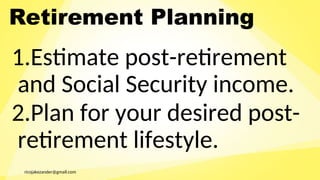
Retirement Planning
1.Estimate post-retirement
and Social Security income.
2.Plan for your desired post-
retirement lifestyle.
ricojakezander@gmail.com
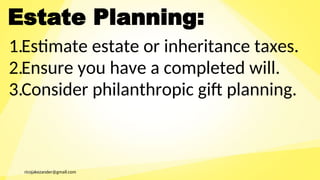
Estate Planning:
1.Estimate estate or inheritance taxes.
2.Ensure you have a completed will.
3.Consider philanthropic gift planning.
ricojakezander@gmail.com
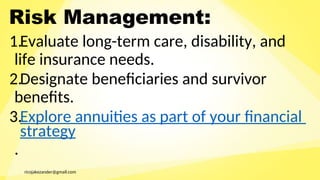
Risk Management:
1.Evaluate long-term care, disability, and
life insurance needs.
2.Designate beneficiaries and survivor
benefits.
3.Explore annuities as part of your financial
strategy
.
ricojakezander@gmail.com
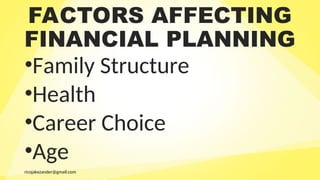
FACTORS AFFECTING
FINANCIAL PLANNING
•Family Structure
•Health
•Career Choice
•Age
ricojakezander@gmail.com
Family
Structure
Marital Status and
dependents, such as
children, parents or siblings,
determine whether you are
planning only for yourself or
for others as well.
ricojakezander@gmail.com
Health
Your health is another defining
circumstance that will affect your
expected income needs and risk
tolerance and thus your personal
financial planning. Personal financial
planning should include some
protection against the risk of chronic
illness, accident or long term disability.
ricojakezander@gmail.com
Career Choice
Career choice affects your financial
planning, specially through
educational requirements, income
potential and characteristics of the
occupation or profession your
choose.
ricojakezander@gmail.com
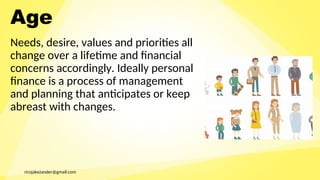
Age
Needs, desire, values and priorities all
change over a lifetime and financial
concerns accordingly. Ideally personal
finance is a process of management
and planning that anticipates or keep
abreast with changes.
ricojakezander@gmail.com
Factors Affecting
Financial Thinking
•Business cycle
•Employment rate
•Other indicators of economic health
•Currency value
ricojakezander@gmail.com
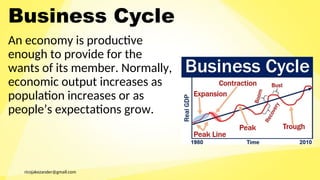
Business Cycle
An economy is productive
enough to provide for the
wants of its member. Normally,
economic output increases as
population increases or as
people’s expectations grow.
ricojakezander@gmail.com
Employment rate
An economy produces not just
goods and services to satisfy its
members but also jobs, because
most people participate in the
market economy by trading their
labor and most rely on wages as
their primary source of income.
ricojakezander@gmail.com
Other Indicators of
Economic Health
Other economic indicators give us clues as
to how successful our economy is, how
well it is growing or how well positioned it
is for future growth. This includes
statistics, consumer confidence, producer
prices and so on.
ricojakezander@gmail.com
Currency Value
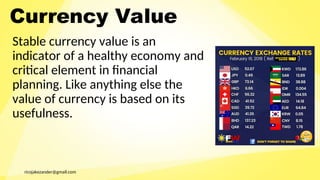
Stable currency value is an
indicator of a healthy economy and
critical element in financial
planning. Like anything else the
value of currency is based on its
usefulness.
ricojakezander@gmail.com
Purchasing power
A currency usefulness is
based on what it can buy
the more currency you
can buy the more useful
and valuable it is.
ricojakezander@gmail.com
Inflation
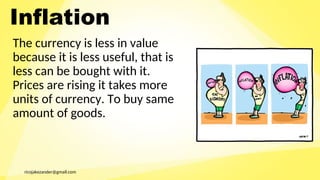
The currency is less in value
because it is less useful, that is
less can be bought with it.
Prices are rising it takes more
units of currency. To buy same
amount of goods.
ricojakezander@gmail.com
Deflation
When the value of the currency
increases, prices are falling thus
currency is worth more and buys
more.
ricojakezander@gmail.com
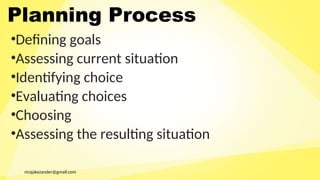
Planning Process
•Defining goals
•Assessing current situation
•Identifying choice
•Evaluating choices
•Choosing
•Assessing the resulting situation
ricojakezander@gmail.com
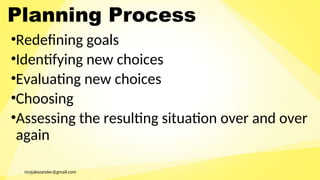
•Redefining goals
•Identifying new choices
•Evaluating new choices
•Choosing
•Assessing the resulting situation over and over
again
Planning Process
ricojakezander@gmail.com
Defining Goals
Figuring out where you want to
go.
ricojakezander@gmail.com
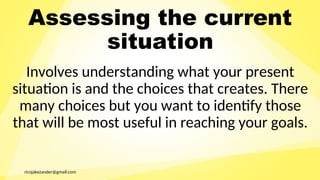
Assessing the current
situation
Involves understanding what your present
situation is and the choices that creates. There
many choices but you want to identify those
that will be most useful in reaching your goals.
ricojakezander@gmail.com
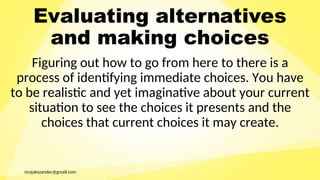
Evaluating alternatives
and making choices
Figuring out how to go from here to there is a
process of identifying immediate choices. You have
to be realistic and yet imaginative about your current
situation to see the choices it presents and the
choices that current choices it may create.
ricojakezander@gmail.com
Answer the ff. questions:
1.The Role of Goal Setting in Financial Planning: Discuss the importance
of setting clear, measurable, and achievable financial goals. How do
these goals influence the structure and focus of a financial plan?
2.Assessing Financial Health as a Foundation for Planning: Explain the
significance of assessing one’s financial health, including assets,
liabilities, income, and expenses, before creating a financial plan. How
does this assessment impact the strategies included in the plan?
3.Risk Management in Financial Planning: Evaluate the role of risk
management in financial planning. What are the different types of risks
to consider, and how can a financial plan mitigate these risks?

math 7 q1 9FINANCIAL PLAN.ppt Grade 7 Lesson