W1
Teacher EDNA REGIEG. BANAGLORIOSO Subject Math 10
Quarter 3rd Date 12/10/2024
I. LESSON TITLE PERMUTATIONS
II. MOST ESSENTIAL
LEARNING
COMPETENCIES
(MELCs)
• Illustrates the permutations – M10SP-IIIa-1
• Solves problems involving permutaions -M10SP-IIIb-1
III. CONTENT/CORE
CONTENT
Understand the concepts of permutation and solve problems
involving these concepts
IV. LEARNING PHASES Learning Activites
A. Introduction Introductory question:
A. Cite some visible situation/scenario in your place that shows
arrangement.
(Students’ Responses)
A. B.
B. What can you say based on the given illustration? (Students’
Responses)
Illustrate the permutation using a tree diagram, systematic listing,
and tabular.
In this Lesson you are going to illustrate the different
arrangements of objects; in doing so, you can be able to
determine the number of ways of possible arrangements.
We can also know the number of permutations by assessing
your knowledge of the basic counting technique called the
Fundamental Counting Principle. Using this principle you will also
learn the different permutation formulas and how to apply them in
2.
solving problems
As yougo along with this lesson here is the guide question that
you need to answer.
How does the concept of permutation help in forming conclusions
and in making wise
B. Development Illustration of
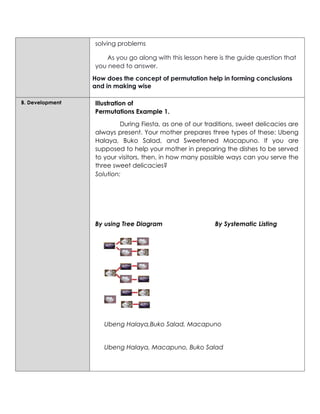
Permutations Example 1.
During Fiesta, as one of our traditions, sweet delicacies are
always present. Your mother prepares three types of these: Ubeng
Halaya, Buko Salad, and Sweetened Macapuno. If you are
supposed to help your mother in preparing the dishes to be served
to your visitors, then, in how many possible ways can you serve the
three sweet delicacies?
Solution:
By using Tree Diagram By Systematic Listing
Ubeng Halaya,Buko Salad, Macapuno
Ubeng Halaya, Macapuno, Buko Salad
3.
Buko Salad, UbengHalaya, Macapuno
Buko Salad, Macapuno, Ubeng Halaya
Macapuno, Ubeng Halaya, Buko Salad
Macapuno, Buko Salad, Ubeng Halaya
As you can see from the Tree Diagram and Systematics Listing,
there
are 6 possible ways that you can serve sweet delicacies.
However, if we use our knowledge and skills about FCP
(Fundamental Counting Principle), then it is easy for us to determine
the number of arrangements.
Fundamental Counting Principle
If there are m ways to do one thing, n ways to do another,
and o ways to do another, then, there are m x n x o of doing
those things.
We have : m x n x o = (3)(2)(1) = 6 possible ways of serving the
sweet delicacies
In this example you notice that the factors are decreasing.
Another way of writing (3)(2)(1) is 3! ( read as 3 factorial ).
Therefore, 3! = (3)(2)(1) = 6; 3! = 6
Factorial Notation
! What symbol is this?
In English “!” is called an exclamation point. Exclamation marks were
originally called the “note of admiration, exaggeration”. They are
still, to this day, used to express excitement. They are also used to
express surprise, astonishment, or any other such strong emotion. Any
exclamatory sentence can be properly followed by an exclamation
mark, to add additional emphasis.
In Filipino, “!” it is read as “Tandang Padamdam” bantas na
tumutulong upang maiparamdam sa mambabasa ang isang
masidhing damdamin.
Mathematicians use an exclamation point to indicate the
product by writing n!.
4.
In mathematics, thesymbol represents the factorial operation. The
expression n! means “the product of the integers from 1 to n”…(4!
Read as four factorial) is 4 x 3 x 2 x 1 = 24. (0! Is defined as 1, which is
a neutral element in multiplication, not multiplied by anything.
PERMUTATION
An arrangement of objects or events similar to activity in which the
order is important.
In general, if n is a positive integer, then n factorial denoted by n! is
the product of all integers less than or equal to n.
n! = n(n-1)(n-2)…..(2)(1)
Example 2.
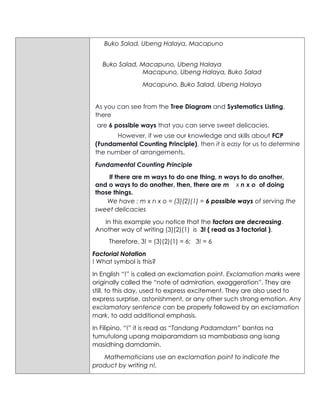
Mother has taken fresh sitaw, lagkitang mais (white corn), saging
matsing (banana), and macapuno from the farm where they lived
before in some part Brgy. Conalum, Inopacan, Leyte.
1. Sitaw
2. Sitaw and Lagkitang Mais
3. Sitaw, Lagkitang Mais and Sging Maatsing
4. Sitaw, Lagkitang Mais, Saging Matsing
and Macapuno
Solution:
Therefore, the number of permutations of objects taken all at a time
is n!
Then, the formula for Permutations of objects taken all a time is
P(n,n) = n! where n is the number of objects taken.
Example 3.
There are 5 sweet delicacies that your mother prepared for fiesta
and these were: Ubeng Halaya, Buko Salad, Sweetened Macapuno,
5.
Leche Flan, andBuko Pandan. If you are supposed to help your
mother in preparing the dishes to be served to your visitors, then, in
how many possible ways can you arrange the 5 delicacies if three
sweet delicacies are served at a time?
Solution:
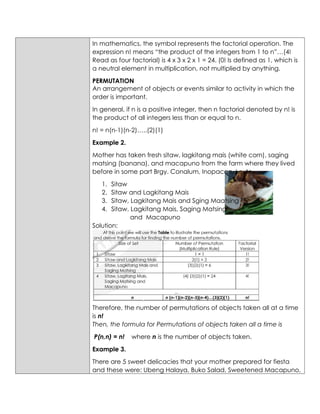
Let n= 5, r = 3. Therefore, P(n, r) is the number of permutations of n
objects taken r at a time.
Formula:
Answer : 151, 200 ways
Example 4.
In how many distinguishable permutations are possible with the
letters of the word CONALUMNON?
Solution:
There are 10 letters in the word. 2 O’s are alike, 3 N’s are
alike , 1 C,A,L,U,M are alike, therefore, we have:
P=
10!
2!3! 1!
=
(10)(9)(8)(7)(6)(5)(4)(3)(2)(1)
(2)(1)(3)(2)(1)(1)
=302,400
Example 5.
There is a JHS Math Camp in the Division of Leyte held at the oval of
Visayas State University. Many students are participating from the
different secondary schools. The Math Campers are grouped into 10
groups with 8 members each. Each group is asked to form a circle
and they will be sitting on the ground. If the seating arrangement is
circular, in how many possible ways can the 8 members be
seated?
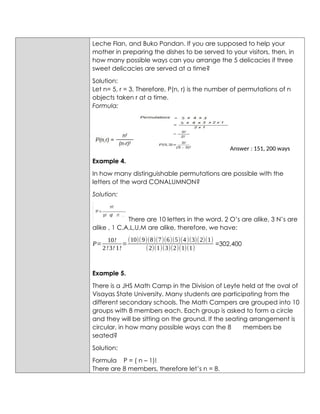
Solution:
Formula P = ( n – 1)!
There are 8 members, therefore let’s n = 8.
6.
By using theformula
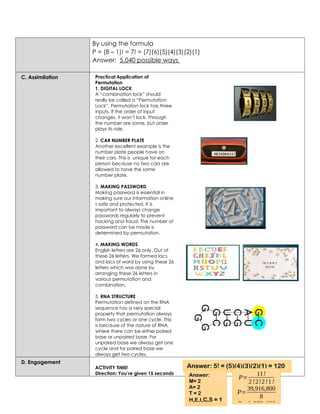
P = (8 – 1)! = 7! = (7)(6)(5)(4)(3)(2)(1)
Answer: 5,040 possible ways
C. Assimilation Practical Application of
Permutation
1. DIGITAL LOCK
A “combination lock” should
really be called a “Permutation
Lock”. Permutation lock has three
inputs. If the order of input
changes, it won’t lock. Through
the number are some, but order
plays its role.
2. CAR NUMBER PLATE
Another excellent example is the
number plate people have on
their cars. This is unique for each
person because no two cars are
allowed to have the same
number plate.
3. MAKING PASSWORD
Making password is essential in
making sure our information online
s safe and protected. It is
important to always change
passwords regularly to prevent
hacking and fraud. The number of
password can be made is
determined by permutation.
4. MAKING WORDS
English letters are 26 only. Out of
these 26 letters. We formed lacs
and lacs of word by using these 26
letters which was done by
arranging these 26 letters in
various permutation and
combination.
5. RNA STRUCTURE
Permutation defined on the RNA
sequence has a very special
property that permutation always
form two cycles or one cycle. This
is because of the nature of RNA,
where there can be either paired
base or unpaired base. For
unpaired base we always get one
cycle and for paired base we
always get two cycles.
D. Engagement
ACTIVITY TIME!
Direction: You’re given 15 seconds
Answer: 5! = (5)(4)(3)(2)(1) = 120
Answer:
M= 2
A= 2
T = 2
H,E,I,C,S = 1
P=
11!
2!2!2!1!
P=
39,916,800
8
P=4,989,600
7.
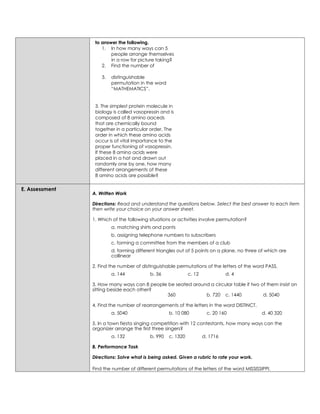
to answer thefollowing.
1. In how many ways can 5
people arrange themselves
in a row for picture taking?
2. Find the number of
3. distinguishable
permutation in the word
“MATHEMATICS”.
3. The simplest protein molecule in
biology is called vasopressin and is
composed of 8 amino aaceds
that are chemically bound
together in a particular order. The
order in which these amino acids
occur is of vital importance to the
proper functioning of vasopressin.
If these 8 amino acids were
placed in a hat and drawn out
randomly one by one, how many
different arrangements of these
8 amino acids are possible?
E. Assessment
A. Written Work
Directions: Read and understand the questions below. Select the best answer to each item
then write your choice on your answer sheet.
1. Which of the following situations or activities involve permutation?
a. matching shirts and pants
b. assigning telephone numbers to subscribers
c. forming a committee from the members of a club
d. forming different triangles out of 5 points on a plane, no three of which are
collinear
2. Find the number of distinguishable permutations of the letters of the word PASS.
a. 144 b. 36 c. 12 d. 4
3. How many ways can 8 people be seated around a circular table if two of them insist on
sitting beside each other?
360 b. 720 c. 1440 d. 5040
4. Find the number of rearrangements of the letters in the word DISTINCT.
a. 5040 b. 10 080 c. 20 160 d. 40 320
5. In a town fiesta singing competition with 12 contestants, how many ways can the
organizer arrange the first three singers?
a. 132 b. 990 c. 1320 d. 1716
B. Performance Task
Directions: Solve what is being asked. Given a rubric to rate your work.
Find the number of different permutations of the letters of the word MISSISSIPPI.