Peritoneal Dialysis Indications and Limitations
By
Mostafa Abd_Elsalam, MD
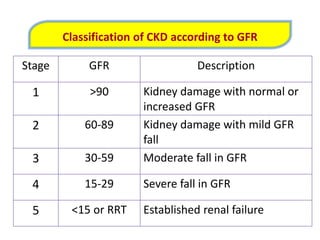
Stage GFR Description
1 >90 Kidney damage with normal or
increased GFR
2 60-89 Kidney damage with mild GFR
fall
3 30-59 Moderate fall in GFR
4 15-29 Severe fall in GFR
5 <15 or RRT Established renal failure
Classification of CKD according to GFR
.
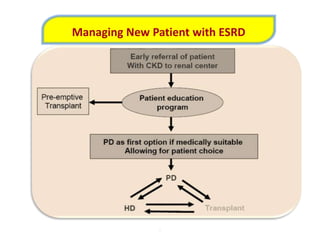
Managing New Patient with ESRD
Prof. MacLeod:
4
“Patients whose kidney fail require life-saving treatment with
dialysis or with a kidney transplant.
Although dialysis is now very advanced, allowing more
patients to be treated successfully, it is also very expensive.
It is essential, therefore, to ensure that resources are used as
effectively as possible.”[1]
[1] Khan I., MacLeod A. Towards cost-effective dialysis therapy in Europe: the need for a multidisciplinary
approach. Nephrol Dial Transplant 1997; 12: p. 2483
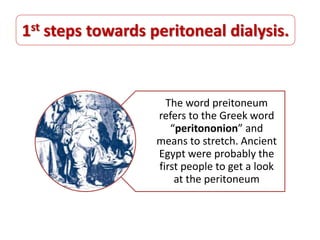
The word preitoneum
refers to the Greek word
“peritononion” and
means to stretch. Ancient
Egypt were probably the
first people to get a look
at the peritoneum
1st steps towards peritoneal dialysis.
Preservation of RRF
Higher Hb concentration
Less risk of acquiring blood
borne infections e.g. HCV
Better quality of life
Why to start with PD ?
Travel , employment
It allows expansion with
limited resources
Lower staff / patient
ratio
saves vascular
access
preferred for
children (APD)
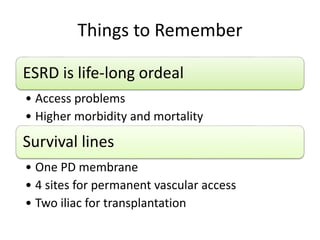
Things to Remember
ESRD is life-long ordeal
• Access problems
• Higher morbidity and mortality
Survival lines
• One PD membrane
• 4 sites for permanent vascular access
• Two iliac for transplantation
“The right modality at the right time.”
Peter Blake, MD, John Burkart, MD
“Complementary Not Competitive”
Coles 1998
PD versus HD
Which is best?
• PD may best be seen as a therapy for early
years of dialysis with HD being used as a
back up if or when PD fails
• This approach which has recently been called
“integrated dialysis care” has economic as
well as medical advantages
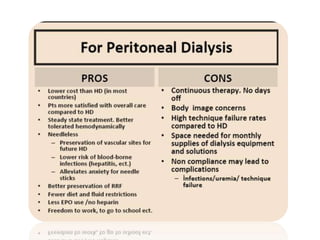
CAPD Advantages
• Medical
• Lifestyle
• Economic
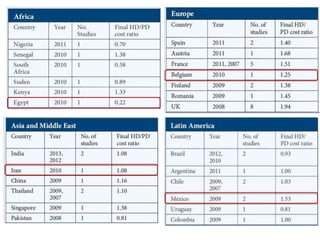
Economic
• Paradoxically, however the
difference is greater in poorer
developing countries and least in
wealthier countries .
LIFESTYLE
• Given free choice , because it involves
less daytime procedures and so less
disruptive .
• Exceptions are people who are
nervous about machines or who have
difficulty staying in bed .
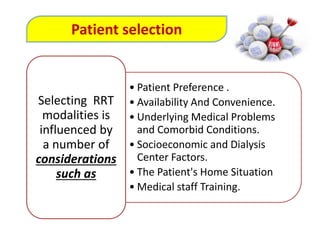
• Patient Preference .
• Availability And Convenience.
• Underlying Medical Problems
and Comorbid Conditions.
• Socioeconomic and Dialysis
Center Factors.
• The Patient's Home Situation
• Medical staff Training.
Selecting RRT
modalities is
influenced by
a number of
considerations
such as
Patient selection
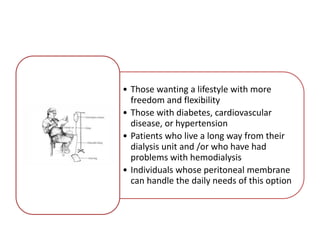
• Those wanting a lifestyle with more
freedom and flexibility
• Those with diabetes, cardiovascular
disease, or hypertension
• Patients who live a long way from their
dialysis unit and /or who have had
problems with hemodialysis
• Individuals whose peritoneal membrane
can handle the daily needs of this option
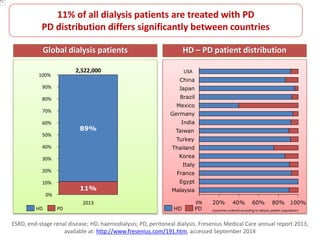
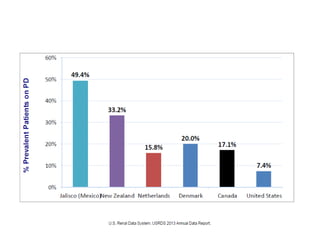
11% of all dialysis patients are treated with PD
PD distribution differs significantly between countries
Global dialysis patients HD – PD patient distribution
100%
90%
80%
70%
60%
50%
40%
30%
20%
10%
0%
2013
2,522,000
11%
89%
100%0% 80%40% 60%20%
USA
China
Japan
Thailand
Egypt
Korea
France
Italy
Turkey
Malaysia
Brazil
Germany
Mexico
Taiwan
India
PDHD (countries ordered according to dialysis patient population)PDHD
ESRD, end-stage renal disease; HD, haemodialysis; PD, peritoneal dialysis. Fresenius Medical Care annual report 2013,
available at: http://www.fresenius.com/191.htm, accessed September 2014
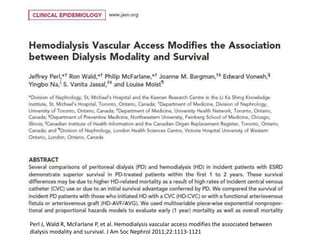
Perl J, Wald R, McFarlane P, et al. Hemodialysis vascular access modifies the associated between
dialysis modality and survival. J Am Soc Nephrol 2011;22:1113-1121
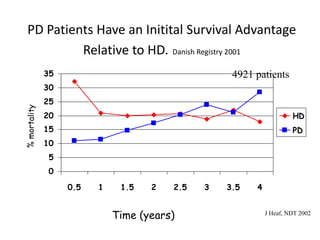
PD Patients Have an Initital Survival Advantage
Relative to HD. Danish Registry 2001
0
5
10
15
20
25
30
35
0.5 1 1.5 2 2.5 3 3.5 4
HD
PD
Time (years) J Heaf, NDT 2002
4921 patients
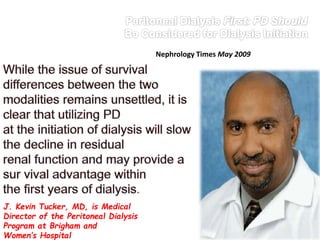
J. Kevin Tucker, MD, is Medical
Director of the Peritoneal Dialysis
Program at Brigham and
Women’s Hospital
Nephrology Times May 2009
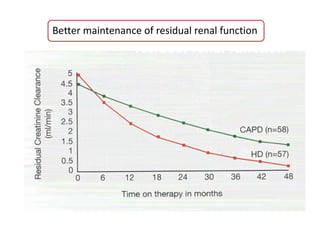
better maintenance of
residual renal function
Better maintenance of residual renal function
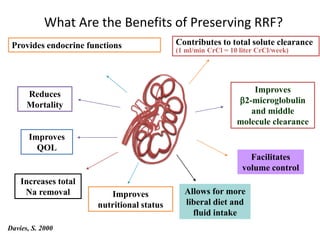
What Are the Benefits of Preserving RRF?
Reduces
Mortality
Contributes to total solute clearance
(1 ml/min CrCl = 10 liter CrCl/week)
Facilitates
volume control
Allows for more
liberal diet and
fluid intake
Provides endocrine functions
Improves
2-microglobulin
and middle
molecule clearance
Improves
nutritional status
Improves
QOL
Increases total
Na removal
Davies, S. 2000
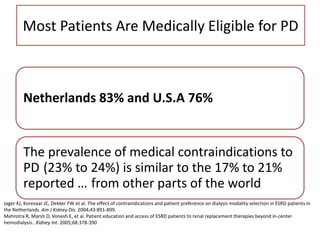
Most Patients Are Medically Eligible for PD
Netherlands 83% and U.S.A 76%
The prevalence of medical contraindications to
PD (23% to 24%) is similar to the 17% to 21%
reported … from other parts of the world
Jager KJ, Korevaar JC, Dekker FW et al. The effect of contraindications and patient preference on dialysis modality selection in ESRD patients in
the Netherlands. Am J Kidney Dis. 2004;43:891-899.
Mehrotra R, Marsh D, Vonesh E, et al. Patient education and access of ESRD patients to renal replacement therapies beyond in-center
hemodialysis.. Kidney Int. 2005;68:378-390
7%
13%
16%
19%
23%
31%
44%
47%
50%
35%
25%
5%
2%2%
0%
17%
8%
12%
34%
5%
15%
20%
0%
20%
40%
60%
M
cIntyre
Brugnano
C
han
Jonas
C
antu
D
ussol
Barril
N
eto
Selgas
H
uang
Yoshida
HD PD
Pereira KI 1997;51:981-999
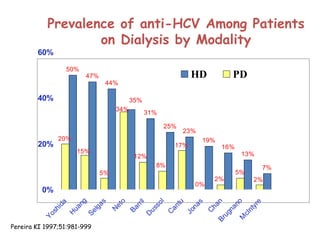
Prevalence of anti-HCV Among Patients
on Dialysis by Modality
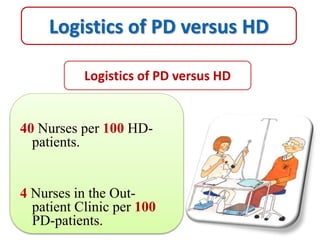
40 Nurses per 100 HD-
patients.
4 Nurses in the Out-
patient Clinic per 100
PD-patients.
Logistics of PD versus HD
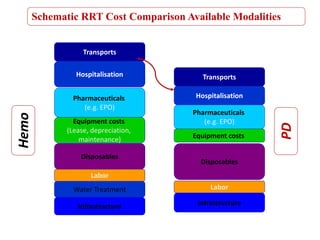
Transports
Hospitalisation
Pharmaceuticals
(e.g. EPO)
Equipment costs
(Lease, depreciation,
maintenance)
Disposables
Labor
Water Treatment
Infrastructure
Transports
Hospitalisation
Pharmaceuticals
(e.g. EPO)
Equipment costs
Disposables
Labor
Infrastructure
Schematic RRT Cost Comparison Available Modalities
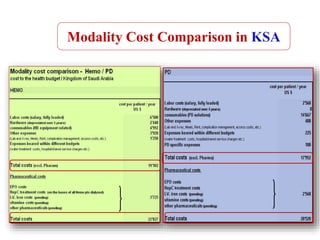
Modality Cost Comparison in KSA
peritoneal dialysis
peritoneal dialysis
peritoneal dialysis
peritoneal dialysis

peritoneal dialysis

  • 1.
    Peritoneal Dialysis Indicationsand Limitations By Mostafa Abd_Elsalam, MD
  • 2.
    Stage GFR Description 1>90 Kidney damage with normal or increased GFR 2 60-89 Kidney damage with mild GFR fall 3 30-59 Moderate fall in GFR 4 15-29 Severe fall in GFR 5 <15 or RRT Established renal failure Classification of CKD according to GFR
  • 3.
  • 4.
    Prof. MacLeod: 4 “Patients whosekidney fail require life-saving treatment with dialysis or with a kidney transplant. Although dialysis is now very advanced, allowing more patients to be treated successfully, it is also very expensive. It is essential, therefore, to ensure that resources are used as effectively as possible.”[1] [1] Khan I., MacLeod A. Towards cost-effective dialysis therapy in Europe: the need for a multidisciplinary approach. Nephrol Dial Transplant 1997; 12: p. 2483
  • 5.
    The word preitoneum refersto the Greek word “peritononion” and means to stretch. Ancient Egypt were probably the first people to get a look at the peritoneum 1st steps towards peritoneal dialysis.
  • 6.
    Preservation of RRF HigherHb concentration Less risk of acquiring blood borne infections e.g. HCV Better quality of life Why to start with PD ?
  • 7.
    Travel , employment Itallows expansion with limited resources Lower staff / patient ratio
  • 8.
  • 9.
    Things to Remember ESRDis life-long ordeal • Access problems • Higher morbidity and mortality Survival lines • One PD membrane • 4 sites for permanent vascular access • Two iliac for transplantation
  • 10.
    “The right modalityat the right time.” Peter Blake, MD, John Burkart, MD “Complementary Not Competitive” Coles 1998
  • 11.
    PD versus HD Whichis best? • PD may best be seen as a therapy for early years of dialysis with HD being used as a back up if or when PD fails • This approach which has recently been called “integrated dialysis care” has economic as well as medical advantages
  • 12.
    CAPD Advantages • Medical •Lifestyle • Economic
  • 13.
    Economic • Paradoxically, howeverthe difference is greater in poorer developing countries and least in wealthier countries .
  • 14.
    LIFESTYLE • Given freechoice , because it involves less daytime procedures and so less disruptive . • Exceptions are people who are nervous about machines or who have difficulty staying in bed .
  • 15.
    • Patient Preference. • Availability And Convenience. • Underlying Medical Problems and Comorbid Conditions. • Socioeconomic and Dialysis Center Factors. • The Patient's Home Situation • Medical staff Training. Selecting RRT modalities is influenced by a number of considerations such as Patient selection
  • 16.
    • Those wantinga lifestyle with more freedom and flexibility • Those with diabetes, cardiovascular disease, or hypertension • Patients who live a long way from their dialysis unit and /or who have had problems with hemodialysis • Individuals whose peritoneal membrane can handle the daily needs of this option
  • 17.
    11% of alldialysis patients are treated with PD PD distribution differs significantly between countries Global dialysis patients HD – PD patient distribution 100% 90% 80% 70% 60% 50% 40% 30% 20% 10% 0% 2013 2,522,000 11% 89% 100%0% 80%40% 60%20% USA China Japan Thailand Egypt Korea France Italy Turkey Malaysia Brazil Germany Mexico Taiwan India PDHD (countries ordered according to dialysis patient population)PDHD ESRD, end-stage renal disease; HD, haemodialysis; PD, peritoneal dialysis. Fresenius Medical Care annual report 2013, available at: http://www.fresenius.com/191.htm, accessed September 2014
  • 20.
    Perl J, WaldR, McFarlane P, et al. Hemodialysis vascular access modifies the associated between dialysis modality and survival. J Am Soc Nephrol 2011;22:1113-1121
  • 22.
    PD Patients Havean Initital Survival Advantage Relative to HD. Danish Registry 2001 0 5 10 15 20 25 30 35 0.5 1 1.5 2 2.5 3 3.5 4 HD PD Time (years) J Heaf, NDT 2002 4921 patients
  • 23.
    J. Kevin Tucker,MD, is Medical Director of the Peritoneal Dialysis Program at Brigham and Women’s Hospital Nephrology Times May 2009
  • 24.
    better maintenance of residualrenal function Better maintenance of residual renal function
  • 25.
    What Are theBenefits of Preserving RRF? Reduces Mortality Contributes to total solute clearance (1 ml/min CrCl = 10 liter CrCl/week) Facilitates volume control Allows for more liberal diet and fluid intake Provides endocrine functions Improves 2-microglobulin and middle molecule clearance Improves nutritional status Improves QOL Increases total Na removal Davies, S. 2000
  • 27.
    Most Patients AreMedically Eligible for PD Netherlands 83% and U.S.A 76% The prevalence of medical contraindications to PD (23% to 24%) is similar to the 17% to 21% reported … from other parts of the world Jager KJ, Korevaar JC, Dekker FW et al. The effect of contraindications and patient preference on dialysis modality selection in ESRD patients in the Netherlands. Am J Kidney Dis. 2004;43:891-899. Mehrotra R, Marsh D, Vonesh E, et al. Patient education and access of ESRD patients to renal replacement therapies beyond in-center hemodialysis.. Kidney Int. 2005;68:378-390
  • 28.
  • 29.
    40 Nurses per100 HD- patients. 4 Nurses in the Out- patient Clinic per 100 PD-patients. Logistics of PD versus HD Logistics of PD versus HD
  • 30.
    Transports Hospitalisation Pharmaceuticals (e.g. EPO) Equipment costs (Lease,depreciation, maintenance) Disposables Labor Water Treatment Infrastructure Transports Hospitalisation Pharmaceuticals (e.g. EPO) Equipment costs Disposables Labor Infrastructure Schematic RRT Cost Comparison Available Modalities
  • 31.