CRRT And AKI
Overview
Mostafa Abdel_Salam Mohamed, MD
Consultant of Nephrology
• Sudden interruption of kidney function
resulting from obstruction, reduced
circulation, or disease of the renal tissue;
• Results in retention of toxins, fluids, and
end products of metabolism;
• Usually reversible with medical treatment;
• May progress to end stage renal disease,
uremic syndrome, and death without
treatment.
definitions
of AKI
RIFLE criteria for diagnosis of AKI based on The “Acute
Dialysis Quality Initiative”
Increase in SCr Urine output
Risk of renal injury
Injury to the kidney
Failure of kidney
function
0.3 mg/dl increase
2 X baseline
3 X baseline OR
> 0.5 mg/dl increase if
SCr >=4 mg/dl
< 0.5 ml/kg/hr for > 6 h
< 0.5 ml/kg/hr for >12h
Anuria for >12 h
Loss of kidney function
End-stage disease
Persistent renal failure
for > 4 weeks
Persistent renal failure
for > 3 months
Am J Kidney Dis. 2005 Dec;46(6):1038-48
Stage Increase in Serum
Creatinine
Urine Output
1 1.5-2 times baseline
OR
0.3 mg/dl increase from
baseline
<0.5 ml/kg/h for >6 h
2 2-3 times baseline <0.5 ml/kg/h for >12 h
3 3 times baseline OR
0.5 mg/dl increase if
baseline>4mg/dl
OR
Any RRT given
<0.3 ml/kg/h for >24 h
OR
Anuria for >12 h
Definition of Acute Kidney Injury (AKI) based on “Acute
Kidney Injury Network”
Epidemiology
AKI occurs in
•≈ 7% of hospitalized patients.
•36–67% of critically ill patients
(depending on the definition).
•5-6% of intensive care unite (ICU)
patients with AKI require renal
replacement therapy (RRP).
Mortality according to RIFLE
Mortality increases proportionately with
increasing severity of AKI (using RIFLE).
Mortality in pts with AKI requiring RRT
50-70%.
Even small changes in serum creatinine
are associated with increased mortality.
CRITICALCARENURSE Vol 27, No. 2, APRIL 2007
• In 1977 Kramer in Göttingen (Germany)
developed the continuous
arteriovenous hemofiltration
(CAVH) technique, which used a
systemic arteriovenous pressure difference in
an extracorporeal circuit to continuously
produce an ultrafiltrate.
• In the 1980s, a blood pump, such as those
used in intermittent hemodialysis, and a
double-lumen catheter in a large vein were
used to provide a consistent
blood-flow rate without
the risks associated
with the arteriovenous approach.
The Acute Disease Quality Initiative (ADQI)
Published online: August 26, 2016
When should acute RRT be initiated? (includes AKI
and non-AKI indications)
What is the most appropriate therapy to meet a
demand–capacity imbalance for a specific patient?
How should RRT be integrated into other
extracorporeal therapies?
When should transition of modalities be considered
(CRRT, IRRT, hybrid therapy)?
How should patients be liberated from RRT?
When should acute RRT be initiated?
Consensus statement 1.1:
•Acute RRT should be considered
when metabolic and fluid
demands exceed total kidney
capacity.
Individual
Renal
function
Clinical
context
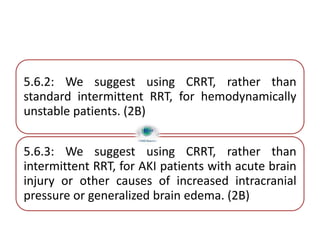
5.6.2: We suggest using CRRT, rather than
standard intermittent RRT, for hemodynamically
unstable patients. (2B)
5.6.3: We suggest using CRRT, rather than
intermittent RRT, for AKI patients with acute brain
injury or other causes of increased intracranial
pressure or generalized brain edema. (2B)
Indications for CRRT
•CRRT is an effective method to
remove fluid and to achieve a target
fluid balance in patients with fluid
overload, including those with
congestive cardiac failure (CCF) or
acute lung injury.
RRT is also effective at removing
biologically active substances,
including cytokines but
there is still insufficient
evidence to recommend the routine
use of CRRT for the treatment of
sepsis.
When should acute RRT be initiated?
Consensus statement 1.2
•Demand for kidney function is
determined by non-renal
comorbidities, the severity of
the acute disease and solute and
fluid burden
When should acute RRT be initiated?
Consensus statement 1.3
•Total kidney function is measured
using a variety of different methods.
Changes in kidney function and
duration of kidney dysfunction can
be anticipated by markers of kidney
damage.
When should acute RRT be initiated?
Consensus statement 1.4:
•The demand–capacity
imbalance is dynamic
and should be evaluated
regularly.
When should acute RRT be initiated?
Consensus statement 1.5:
•For patients requiring multiple
types of organ support, decisions
about initiating or withholding
RRT should be considered
together with other therapies.
When should acute RRT be initiated?
Consensus statement 1.6:
•Once the decision to initiate
RRT has been made, the
therapy should be started as
soon as possible, typically
within less than 3 h.
What is the most appropriate therapy to meet a demand–capacity imbalance for a specific patient?
Consensus statement 2.1:
• Selection of RRT modality depends on the
capability/availability of the technology
• Different RRT modalities provide different
capabilities.
• different machines may provide some but
not all modalities
What is the most appropriate therapy to meet a demand–capacity imbalance for a specific patient?
Consensus statement 2.2:
•CRRT recommended in situations where
shifts in fluid balance and metabolic
fluctuations are poorly tolerated.
•Intermittent and prolonged intermittent
types of RRT have a role when fluid and
metabolic fluctuations can be tolerated.
Both CRRT and IHD
achieve adequate
metabolic control, and
neither modality has
been shown to be
superior in terms of
survival
What is the most appropriate therapy to meet a demand–capacity imbalance for a specific patient?
Consensus statement 2.3:
•Availability of technologies is
determined by local regulations,
local resources, including staff,
their training/experience and
laboratory support and financial
constraints.
•SCUF (slow continuous ultrafiltration)
•CVVH (continuous veno-venous haemofiltration
•CVVHD (continuous veno-venous haemodialysis)
•CVVHDF (continuous veno-venous haemodiafiltration
How should RRT be integrated into other extracorporeal therapies?
• Consensus statement 3.1:
In situations where other extracorporeal
therapies are required, continuous RRT is
recommended and integrated systems are
preferred over parallel systems.
extracorporeal liver assist devices (ELADs)
ECLS in Cardiac Failure
When should transition of modalities be considered (CRRT, IRRT, hybrid therapy)?
Consensus statement 4.1:
•Transition of modalities should be
considered if the demand–capacity
imbalance or treatment priorities
have changed and can be met
better by an alternative technique.
How should patients be liberated from RRT?
RRT should be
discontinued if
kidney function
has recovered.
Consensus
statement
5.1:
How should patients be liberated from RRT?
Consensus statement 5.2:
•To determine sustained
recovery of kidney function,
we recommend monitoring of
urine output and SCr during
RRT.
How should patients be liberated from RRT?
C onsensus statement 5.3:
•For patients requiring multiple
types of organ support,
decisions about withdrawing
RRT should be considered
together with other therapies
Before
Before CRRT is started, patients should have
a complete nursing assessment.
• Fluid status
• Fluid input
• Blood pressure
• Dosages of any vasopressors
• Weight
• Presence of edema
• CVP
• Na,K and ABGs
Nursing Management
During
Once CRRT is started
• Blood pressure, central venous pressure and
weight monitoring
• The bedside nurse should discuss the possibility
of reducing intake to minimal volumes of fluids
if at all possible and concentrating medications
and infusions to minimize fluid intake if the
target not acheived
• Mechanical failures can occur if alarms are
ignored or bypassed without determining the
cause of the alarms.
• If scales are not properly calibrated, the
volumes of fluid administered and removed
may not be the programmed volumes.
5.4.1: We suggest initiating RRT in patients with AKI via
an uncuffed non tunneled dialysis catheter, rather than
a tunneled catheter. (2D)
5.4.2: When choosing a vein for insertion of a dialysis
catheter in patients with AKI, consider these preferences
(Not Graded):
• First choice: right jugular vein;
• Second choice: femoral vein;
• Third choice: left jugular vein;
• Last choice: subclavian vein with preference for the dominant side.
Anticoagulation
CRRT can be performed with or without
anticoagulation.
The choice of anticoagulant depends on
• The physician’s preference
• The patient’s condition
• The familiarity of the nursing staff with anticoagulation
regimens.
The bedside nurse is responsible
for monitoring any adverse effects
of anticoagulation, including
hemorrhage, formation of
hematomas, thrombocytopenia,
and allergic reactions.
Heparin
• The least expensive
anticoagulant
• Either systemically or
regionally.
When heparin is used
• The hemofilter may be
flushed with a dilute
heparin solution
continuously or
intermittently.
Systemic heparinization
includes
• Infusing heparin into a
separate intravenous
access or into the
arterial side of the
CRRT circuit.
• Mixing of the heparin
with the blood from
the patient before the
blood reaches the
filter
• Anticoagulation of the
circuit as well as for
the patient.
Argatroban and lepirudin
•Direct thrombin inhibitors.
•HIT.
Lepirudin is cleared by the
kidneys and therefore may
not be the drug of choice
for patients in ARF.
Argatroban is eliminated by
the liver and is therefore
more suitable for use in
patients with renal failure.
Citrate
excellent anticoagulant ability and potential to prolong circuit
life.
• Calcium is an essential component of the clotting cascade.
• Citrate binds to the calcium in the patient’s blood within the CRRT system and
prevents clotting.
Citrate is infused prefilter into the CRRT system, and calcium is
typically infused via another intravenous line outside the circuit.
Ionized calcium levels are routinely monitored
􀂄Heparin
• 250:500 U/hr
􀂄HIT: Argatroban
• 􀂄0.5:1 mg/hr
􀂄Bleeding risk:
• 􀂄Citrate
• 􀂄No anticoagulation
Dialysate
Conculsions
Critically ill patients AKI occurs in up to 30% of all ICU
admissions
CRRT is almost exclusively applied to patients in (ICU).
Restrict monitoring and follow up of the patients during
CRRT is mandatory
Well trained nurse is the corner stone of adequate CRRT
CRRT and AKI

CRRT and AKI

  • 1.
    CRRT And AKI Overview MostafaAbdel_Salam Mohamed, MD Consultant of Nephrology
  • 3.
    • Sudden interruptionof kidney function resulting from obstruction, reduced circulation, or disease of the renal tissue; • Results in retention of toxins, fluids, and end products of metabolism; • Usually reversible with medical treatment; • May progress to end stage renal disease, uremic syndrome, and death without treatment. definitions of AKI
  • 4.
    RIFLE criteria fordiagnosis of AKI based on The “Acute Dialysis Quality Initiative” Increase in SCr Urine output Risk of renal injury Injury to the kidney Failure of kidney function 0.3 mg/dl increase 2 X baseline 3 X baseline OR > 0.5 mg/dl increase if SCr >=4 mg/dl < 0.5 ml/kg/hr for > 6 h < 0.5 ml/kg/hr for >12h Anuria for >12 h Loss of kidney function End-stage disease Persistent renal failure for > 4 weeks Persistent renal failure for > 3 months Am J Kidney Dis. 2005 Dec;46(6):1038-48
  • 5.
    Stage Increase inSerum Creatinine Urine Output 1 1.5-2 times baseline OR 0.3 mg/dl increase from baseline <0.5 ml/kg/h for >6 h 2 2-3 times baseline <0.5 ml/kg/h for >12 h 3 3 times baseline OR 0.5 mg/dl increase if baseline>4mg/dl OR Any RRT given <0.3 ml/kg/h for >24 h OR Anuria for >12 h Definition of Acute Kidney Injury (AKI) based on “Acute Kidney Injury Network”
  • 9.
    Epidemiology AKI occurs in •≈7% of hospitalized patients. •36–67% of critically ill patients (depending on the definition). •5-6% of intensive care unite (ICU) patients with AKI require renal replacement therapy (RRP).
  • 10.
    Mortality according toRIFLE Mortality increases proportionately with increasing severity of AKI (using RIFLE). Mortality in pts with AKI requiring RRT 50-70%. Even small changes in serum creatinine are associated with increased mortality.
  • 12.
    CRITICALCARENURSE Vol 27,No. 2, APRIL 2007
  • 13.
    • In 1977Kramer in Göttingen (Germany) developed the continuous arteriovenous hemofiltration (CAVH) technique, which used a systemic arteriovenous pressure difference in an extracorporeal circuit to continuously produce an ultrafiltrate.
  • 14.
    • In the1980s, a blood pump, such as those used in intermittent hemodialysis, and a double-lumen catheter in a large vein were used to provide a consistent blood-flow rate without the risks associated with the arteriovenous approach.
  • 15.
    The Acute DiseaseQuality Initiative (ADQI) Published online: August 26, 2016
  • 16.
    When should acuteRRT be initiated? (includes AKI and non-AKI indications) What is the most appropriate therapy to meet a demand–capacity imbalance for a specific patient? How should RRT be integrated into other extracorporeal therapies? When should transition of modalities be considered (CRRT, IRRT, hybrid therapy)? How should patients be liberated from RRT?
  • 17.
    When should acuteRRT be initiated? Consensus statement 1.1: •Acute RRT should be considered when metabolic and fluid demands exceed total kidney capacity.
  • 18.
  • 19.
    5.6.2: We suggestusing CRRT, rather than standard intermittent RRT, for hemodynamically unstable patients. (2B) 5.6.3: We suggest using CRRT, rather than intermittent RRT, for AKI patients with acute brain injury or other causes of increased intracranial pressure or generalized brain edema. (2B)
  • 21.
    Indications for CRRT •CRRTis an effective method to remove fluid and to achieve a target fluid balance in patients with fluid overload, including those with congestive cardiac failure (CCF) or acute lung injury.
  • 22.
    RRT is alsoeffective at removing biologically active substances, including cytokines but there is still insufficient evidence to recommend the routine use of CRRT for the treatment of sepsis.
  • 23.
    When should acuteRRT be initiated? Consensus statement 1.2 •Demand for kidney function is determined by non-renal comorbidities, the severity of the acute disease and solute and fluid burden
  • 24.
    When should acuteRRT be initiated? Consensus statement 1.3 •Total kidney function is measured using a variety of different methods. Changes in kidney function and duration of kidney dysfunction can be anticipated by markers of kidney damage.
  • 25.
    When should acuteRRT be initiated? Consensus statement 1.4: •The demand–capacity imbalance is dynamic and should be evaluated regularly.
  • 26.
    When should acuteRRT be initiated? Consensus statement 1.5: •For patients requiring multiple types of organ support, decisions about initiating or withholding RRT should be considered together with other therapies.
  • 27.
    When should acuteRRT be initiated? Consensus statement 1.6: •Once the decision to initiate RRT has been made, the therapy should be started as soon as possible, typically within less than 3 h.
  • 28.
    What is themost appropriate therapy to meet a demand–capacity imbalance for a specific patient? Consensus statement 2.1: • Selection of RRT modality depends on the capability/availability of the technology • Different RRT modalities provide different capabilities. • different machines may provide some but not all modalities
  • 31.
    What is themost appropriate therapy to meet a demand–capacity imbalance for a specific patient? Consensus statement 2.2: •CRRT recommended in situations where shifts in fluid balance and metabolic fluctuations are poorly tolerated. •Intermittent and prolonged intermittent types of RRT have a role when fluid and metabolic fluctuations can be tolerated.
  • 32.
    Both CRRT andIHD achieve adequate metabolic control, and neither modality has been shown to be superior in terms of survival
  • 33.
    What is themost appropriate therapy to meet a demand–capacity imbalance for a specific patient? Consensus statement 2.3: •Availability of technologies is determined by local regulations, local resources, including staff, their training/experience and laboratory support and financial constraints.
  • 35.
    •SCUF (slow continuousultrafiltration) •CVVH (continuous veno-venous haemofiltration •CVVHD (continuous veno-venous haemodialysis) •CVVHDF (continuous veno-venous haemodiafiltration
  • 40.
    How should RRTbe integrated into other extracorporeal therapies? • Consensus statement 3.1: In situations where other extracorporeal therapies are required, continuous RRT is recommended and integrated systems are preferred over parallel systems. extracorporeal liver assist devices (ELADs) ECLS in Cardiac Failure
  • 41.
    When should transitionof modalities be considered (CRRT, IRRT, hybrid therapy)? Consensus statement 4.1: •Transition of modalities should be considered if the demand–capacity imbalance or treatment priorities have changed and can be met better by an alternative technique.
  • 42.
    How should patientsbe liberated from RRT? RRT should be discontinued if kidney function has recovered. Consensus statement 5.1:
  • 43.
    How should patientsbe liberated from RRT? Consensus statement 5.2: •To determine sustained recovery of kidney function, we recommend monitoring of urine output and SCr during RRT.
  • 44.
    How should patientsbe liberated from RRT? C onsensus statement 5.3: •For patients requiring multiple types of organ support, decisions about withdrawing RRT should be considered together with other therapies
  • 46.
    Before Before CRRT isstarted, patients should have a complete nursing assessment. • Fluid status • Fluid input • Blood pressure • Dosages of any vasopressors • Weight • Presence of edema • CVP • Na,K and ABGs
  • 47.
  • 50.
    During Once CRRT isstarted • Blood pressure, central venous pressure and weight monitoring • The bedside nurse should discuss the possibility of reducing intake to minimal volumes of fluids if at all possible and concentrating medications and infusions to minimize fluid intake if the target not acheived
  • 51.
    • Mechanical failurescan occur if alarms are ignored or bypassed without determining the cause of the alarms. • If scales are not properly calibrated, the volumes of fluid administered and removed may not be the programmed volumes.
  • 55.
    5.4.1: We suggestinitiating RRT in patients with AKI via an uncuffed non tunneled dialysis catheter, rather than a tunneled catheter. (2D) 5.4.2: When choosing a vein for insertion of a dialysis catheter in patients with AKI, consider these preferences (Not Graded): • First choice: right jugular vein; • Second choice: femoral vein; • Third choice: left jugular vein; • Last choice: subclavian vein with preference for the dominant side.
  • 56.
    Anticoagulation CRRT can beperformed with or without anticoagulation. The choice of anticoagulant depends on • The physician’s preference • The patient’s condition • The familiarity of the nursing staff with anticoagulation regimens.
  • 57.
    The bedside nurseis responsible for monitoring any adverse effects of anticoagulation, including hemorrhage, formation of hematomas, thrombocytopenia, and allergic reactions.
  • 58.
    Heparin • The leastexpensive anticoagulant • Either systemically or regionally. When heparin is used • The hemofilter may be flushed with a dilute heparin solution continuously or intermittently. Systemic heparinization includes • Infusing heparin into a separate intravenous access or into the arterial side of the CRRT circuit. • Mixing of the heparin with the blood from the patient before the blood reaches the filter • Anticoagulation of the circuit as well as for the patient.
  • 59.
    Argatroban and lepirudin •Directthrombin inhibitors. •HIT.
  • 60.
    Lepirudin is clearedby the kidneys and therefore may not be the drug of choice for patients in ARF. Argatroban is eliminated by the liver and is therefore more suitable for use in patients with renal failure.
  • 61.
    Citrate excellent anticoagulant abilityand potential to prolong circuit life. • Calcium is an essential component of the clotting cascade. • Citrate binds to the calcium in the patient’s blood within the CRRT system and prevents clotting. Citrate is infused prefilter into the CRRT system, and calcium is typically infused via another intravenous line outside the circuit. Ionized calcium levels are routinely monitored
  • 62.
    􀂄Heparin • 250:500 U/hr 􀂄HIT:Argatroban • 􀂄0.5:1 mg/hr 􀂄Bleeding risk: • 􀂄Citrate • 􀂄No anticoagulation
  • 63.
  • 64.
    Conculsions Critically ill patientsAKI occurs in up to 30% of all ICU admissions CRRT is almost exclusively applied to patients in (ICU). Restrict monitoring and follow up of the patients during CRRT is mandatory Well trained nurse is the corner stone of adequate CRRT