








Mostafa Abdel_Salam Mohamed, MD
Consultant of Nephrology
Adherents of Islam constitute the world's second
largest religious group. According to a study in 2015,
Islam has 1.8 billion adherents, making up over 24.1%
of the world population.[
Why Muslims are the world's fastest-growing religious group". Pew Research Centre. April 2017. Retrieved 24 April 2017
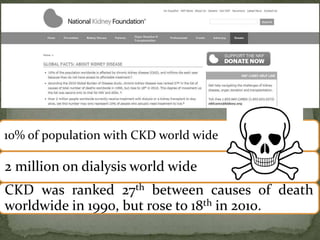
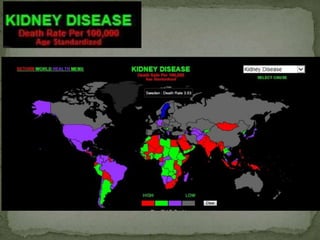
10% of population with CKD world wide
2 million on dialysis world wide
CKD was ranked 27th between causes of death
worldwide in 1990, but rose to 18th in 2010.
Data Source: Published By WHO 2014
WHO Excludes Cause of Death Data For the following countries: Andorra, Antigua and
Barbuda, Cook Islands, Dominica, Grenada, Kiribati, Marshall Islands, Micronesia,
Monaco, Nauru, Niue, Palau, Saint Kitts, Saint Lucia, Saint Vincent, Samoa, San Marino,
Sao Tome, Seychelles, Tonga, Tuvalu, Vanuatu.
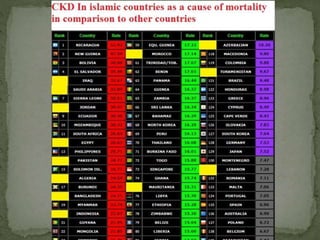
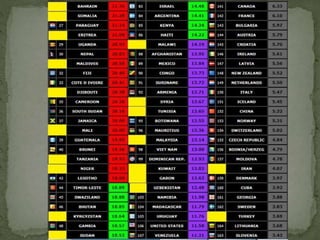
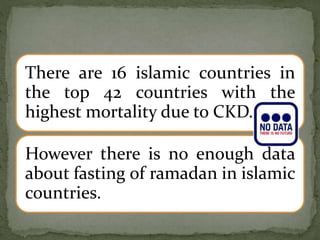
There are 16 islamic countries in
the top 42 countries with the
highest mortality due to CKD.
However there is no enough data
about fasting of ramadan in islamic
countries.
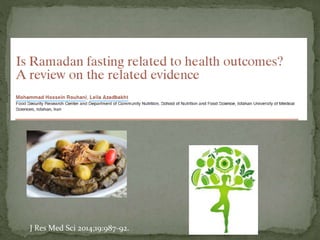
J Res Med Sci 2014;19:987-92.
MEDLINE (http://www. pubmed.com) was
searched by using “Ramadan” as keyword.
Found articles were categorized as original
or review article.
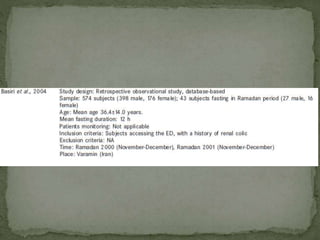
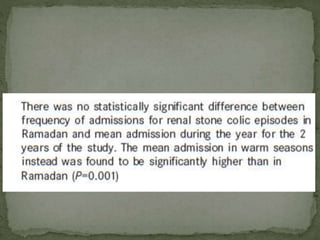
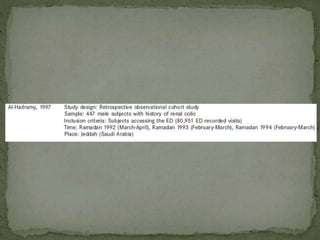
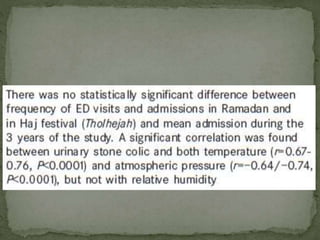
Reviewed articles have been published since
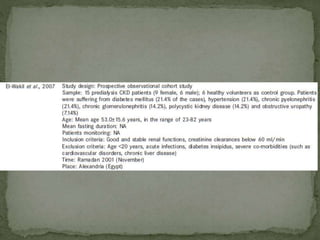
2009 until February 2014
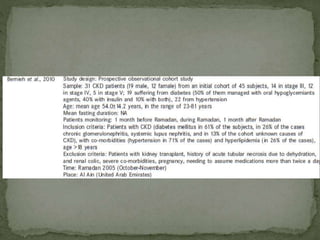
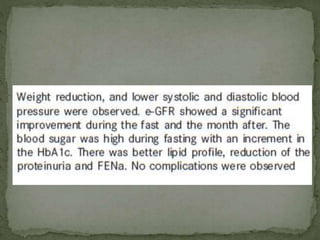
Based on the results of a
currently published
meta-analysis included 21
articles, 531 men and 299
women.
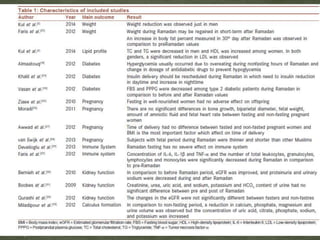
although studies showed that
Ramadan fasting has health
protective effects (BW, Lipid
profile, Immune state, renal
markers, pregnancy, Diabetic
state)
Patient should consult their
medical team for fasting during
Ramadan.
More precise studies should be
conducted for more reliable
conclusion.
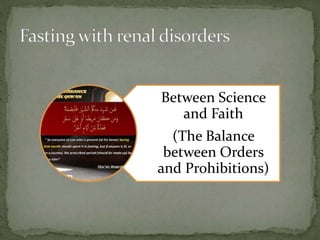
Between Science
and Faith
(The Balance
between Orders
and Prohibitions)
Agree
Disagree
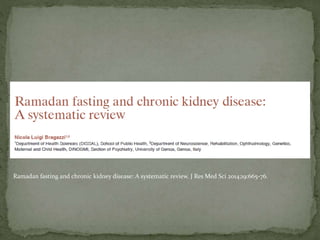
Ramadan fasting and chronic kidney disease: A systematic review. J Res Med Sci 2014;19:665-76.
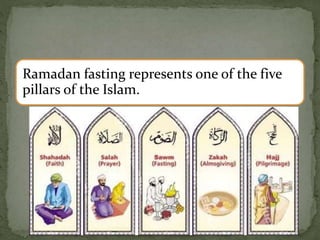
Ramadan fasting represents one of the five
pillars of the Islam.
Even though patients are
exempted from observing this
religious duty, they may be
eager to share this particular
moment of the year with their
family and peers.
However, there are no guidelines or
standardized protocols that can
help physicians to properly address
the issue of patients with chronic
kidney disease (CKD) fasting in
Ramadan and to correctly advise
them.
Moreover, in a more
interconnected and globalized
society, in which more and more
Muslim patients live in the
Western countries, this topic is of
high interest also for the general
practitioner.
For this purpose, this
systematic review was
done and included articles
written in Arabic, Turkish,
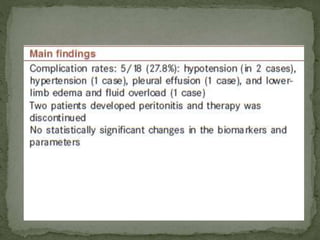
and Persian languages.
ISI Web of Science (WoS), Scopus,
MEDLINE/PubMed, Google Scholar,
Directory of Open Access Journals (DOAJ),
EbscoHOST, Scirus, and ProQuest.
A proper string made up of a combination
of key-words such as “fasting,” “CKD” and
“chronic renal failure.”
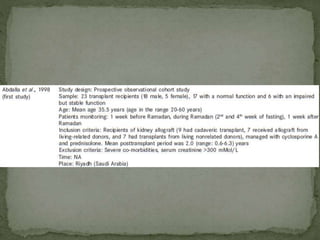
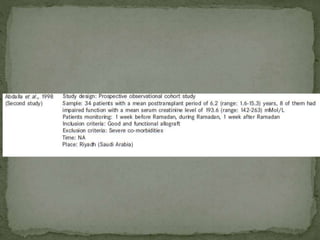
25 original articles describing 26 studies (I add 5 new
original articles since 2014)
Fifteen studies as described in 14 manuscripts focused
on kidney transplant (1 new original article since 2014)
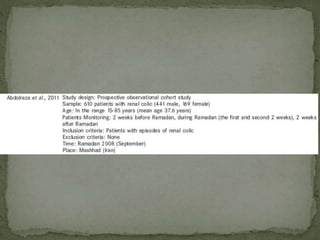
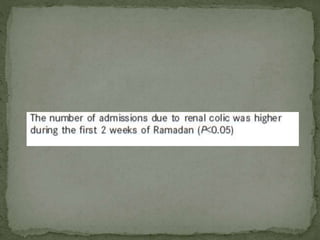
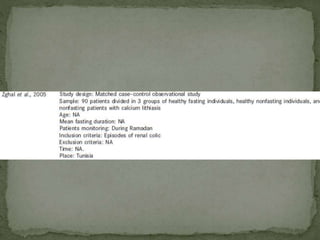
6 on renal colic (1 new original article since 2014)
5 studies concerned CKDs (3 new original articles since
2014)
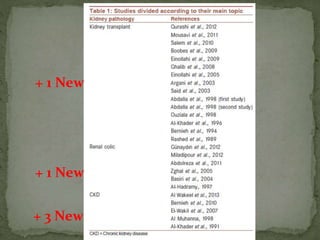
+ 3 New
+ 1 New
+ 1 New
Most studies were prospective
and observational, with the
exceptions of that by Basiri et
al., which is a retrospective,
database-based study as well as
that by Al-Hadramy.
Al-Hadramy MS. Seasonal variations of urinary stone colic in Arabia. J Pak Med Assoc 1997;47:281-4.
Basiri A, Moghaddam SM, Khoddam R, Nejad ST, Hakimi A. Monthly variations of urinary stone colic in Iran and
its relationship to the fasting month of Ramadan. J Pak Med Assoc 2004;54:6-8.
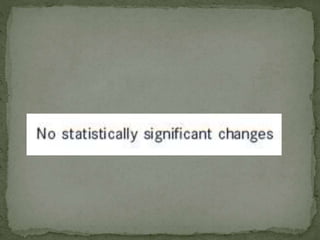
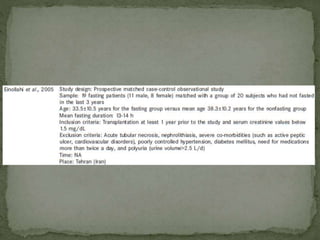
Most studies did not find
any differences between
fasters and not fasters, or
between before and after
Ramadan fasting???????
The study by Bernieh et al. they found
improvements during the fasting and after
Only three studies presented
mixed evidences of an
increased risk for fasting
patients during Ramadan???
(plus 2 new studies)
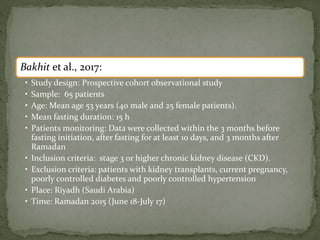
Bakhit et al., 2017:
• Study design: Prospective cohort observational study
• Sample: 65 patients
• Age: Mean age 53 years (40 male and 25 female patients).
• Mean fasting duration: 15 h
• Patients monitoring: Data were collected within the 3 months before
fasting initiation, after fasting for at least 10 days, and 3 months after
Ramadan
• Inclusion criteria: stage 3 or higher chronic kidney disease (CKD).
• Exclusion criteria: patients with kidney transplants, current pregnancy,
poorly controlled diabetes and poorly controlled hypertension
• Place: Riyadh (Saudi Arabia)
• Time: Ramadan 2015 (June 18-July 17)
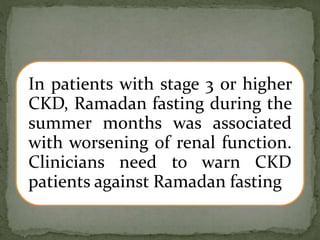
In patients with stage 3 or higher
CKD, Ramadan fasting during the
summer months was associated
with worsening of renal function.
Clinicians need to warn CKD
patients against Ramadan fasting
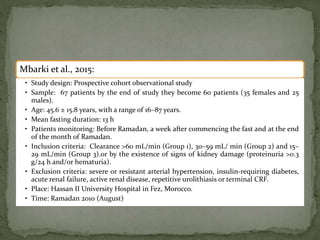
Mbarki et al., 2015:
• Study design: Prospective cohort observational study
• Sample: 67 patients by the end of study they become 60 patients (35 females and 25
males).
• Age: 45.6 ± 15.8 years, with a range of 16–87 years.
• Mean fasting duration: 13 h
• Patients monitoring: Before Ramadan, a week after commencing the fast and at the end
of the month of Ramadan.
• Inclusion criteria: Clearance >60 mL/min (Group 1), 30–59 mL/ min (Group 2) and 15–
29 mL/min (Group 3).or by the existence of signs of kidney damage (proteinuria >0.3
g/24 h and/or hematuria).
• Exclusion criteria: severe or resistant arterial hypertension, insulin-requiring diabetes,
acute renal failure, active renal disease, repetitive urolithiasis or terminal CRF.
• Place: Hassan II University Hospital in Fez, Morocco.
• Time: Ramadan 2010 (August)
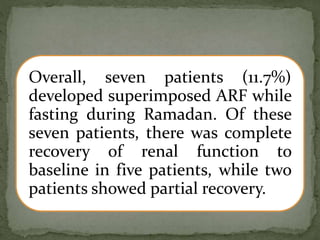
Overall, seven patients (11.7%)
developed superimposed ARF while
fasting during Ramadan. Of these
seven patients, there was complete
recovery of renal function to
baseline in five patients, while two
patients showed partial recovery.
The small sample of our study
does not allow us to conclude
with certainty that fasting
during Ramadan is safe and
not associated with renal
injury among CKD patients
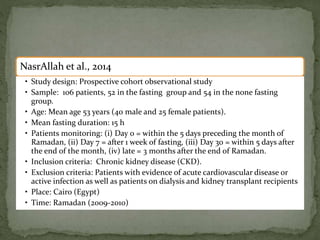
NasrAllah et al., 2014
• Study design: Prospective cohort observational study
• Sample: 106 patients, 52 in the fasting group and 54 in the none fasting
group.
• Age: Mean age 53 years (40 male and 25 female patients).
• Mean fasting duration: 15 h
• Patients monitoring: (i) Day 0 = within the 5 days preceding the month of
Ramadan, (ii) Day 7 = after 1 week of fasting, (iii) Day 30 = within 5 days after
the end of the month, (iv) late = 3 months after the end of Ramadan.
• Inclusion criteria: Chronic kidney disease (CKD).
• Exclusion criteria: Patients with evidence of acute cardiovascular disease or
active infection as well as patients on dialysis and kidney transplant recipients
• Place: Cairo (Egypt)
• Time: Ramadan (2009-2010)1)
MACE occurred more
frequently among fasting CKD
patients with pre-existing
cardiovascular disease and
were predicted by an early rise
of serum creatinine.
Ramadan and chronic kidney
disease
• Summarizing all the studies, 140 subjects
with CKD (plus 238 patients from new 3
new studies=378) have been investigated:
40 on hemodialysis, 18 on peritoneal
dialysis (PD), 82 on predialysis (plus 238
patients from new 3 studies=320)
No severe adverse effects have been
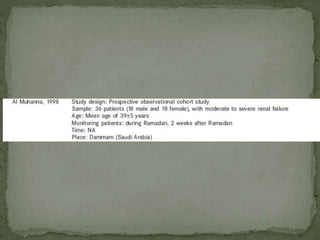
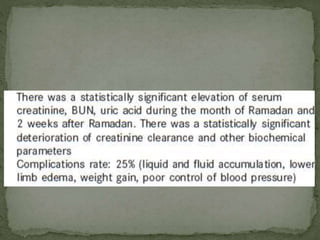
recorded, apart from those described by Al-
Muhanna.???? However, the group of
patients recruited in this study included
also patients suffering from severe renal
failure and this could have an impact on
the findings of the author.
Al-Muhanna et al., 1998
However two new studies (Bakhit et al.,
2017, NasrAllah et al., 2014) confirmed that
patients with stage 3 or higher CKD or
those with history of cardiovascular events
Ramadan fasting was associated either
with worsening of renal function and/or
MACE.
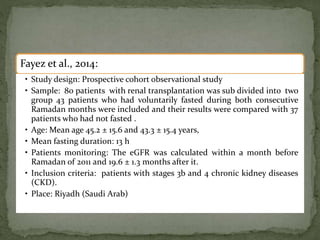
Fayez et al., 2014:
• Study design: Prospective cohort observational study
• Sample: 80 patients with renal transplantation was sub divided into two
group 43 patients who had voluntarily fasted during both consecutive
Ramadan months were included and their results were compared with 37
patients who had not fasted .
• Age: Mean age 45.2 ± 15.6 and 43.3 ± 15.4 years,
• Mean fasting duration: 13 h
• Patients monitoring: The eGFR was calculated within a month before
Ramadan of 2011 and 19.6 ± 1.3 months after it.
• Inclusion criteria: patients with stages 3b and 4 chronic kidney diseases
(CKD).
• Place: Riyadh (Saudi Arab)ia)
• Time: Ramadan 2010 (August)
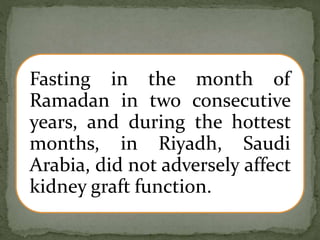
Fasting in the month of
Ramadan in two consecutive
years, and during the hottest
months, in Riyadh, Saudi
Arabia, did not adversely affect
kidney graft function.
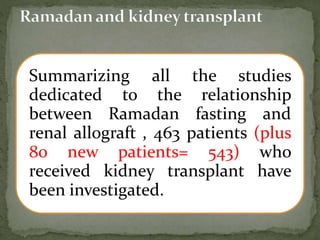
Summarizing all the studies
dedicated to the relationship
between Ramadan fasting and
renal allograft , 463 patients (plus
80 new patients= 543) who
received kidney transplant have
been investigated.
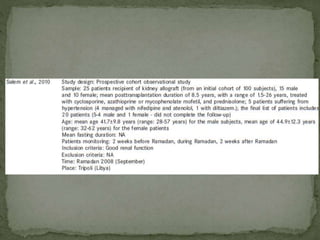
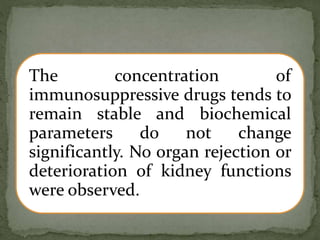
The concentration of
immunosuppressive drugs tends to
remain stable and biochemical
parameters do not change
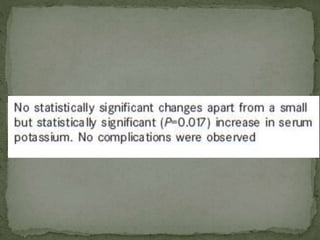
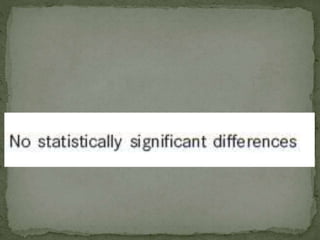
significantly. No organ rejection or
deterioration of kidney functions
were observed.
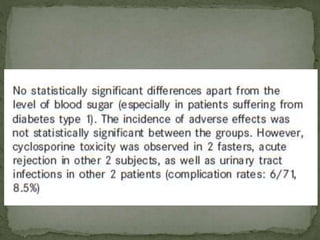
Only one author reported of adverse
effects due to cyclosporine toxicity (2
cases), acute rejection episodes(2
cases), and urinary infections (2
cases). No kidney loss has been
documented
Said et al., 2003 (6/71=8.5%)
Cevik et al., 2016
• Study design: Prospective cohort observational study
• Sample: 176 patients (n:89 in before Ramadan, n:87 in Ramadan
• Mean fasting duration: 14 h
• Inclusion criteria: patients who were admitted to our ED; age 18
years or older with renal colic
• Exclusion criteria: age younger than 18 years; patients who refused to
be involved in the study; patients whose renal colic diagnoses were
unclear, patients with co-morbid diseases such as chronic kidney
disease, metabolic disorder, cardiovascular disease, liver or endocrine
disorder.
• Place: Ankara (Turkey).
• Time: May 28 and July 27, 2014 during 2-month period
This study has shown that
fasting in Ramadan does
not change the number of
renal colic visits.
Summarizing all the collected
evidences, 1,262 subjects (plus 176
from one new study= 1438) have
been studied using both
prospective studies and
retrospective database-based
surveys.
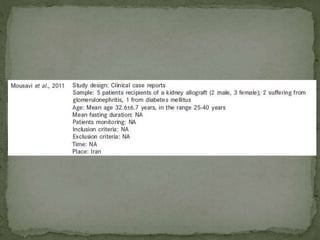
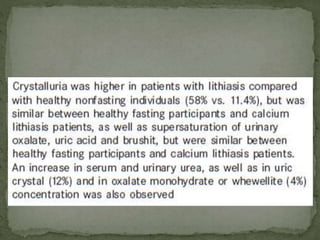
Ramadan fasting does not seem to deteriorate
health condition in subjects with renal colic,
does not cause hypercalciuria and does not
impair in a statistically significant and
clinically relevant way the balance between
lithogenic promotors (that is to say, oxalate,
calcium, uric acid, phosphates) and inhibitors
(citrate, magnesium).
Moreover, any renal
changes are fully
reversible after 10 days
from the end of the
fasting
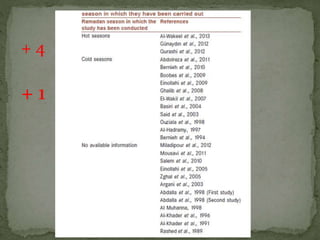
+ 4
+ 1
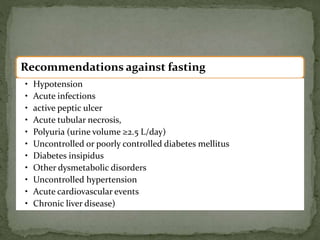
Recommendations against fasting
• Hypotension
• Acute infections
• active peptic ulcer
• Acute tubular necrosis,
• Polyuria (urine volume ≥2.5 L/day)
• Uncontrolled or poorly controlled diabetes mellitus
• Diabetes insipidus
• Other dysmetabolic disorders
• Uncontrolled hypertension
• Acute cardiovascular events
• Chronic liver disease)
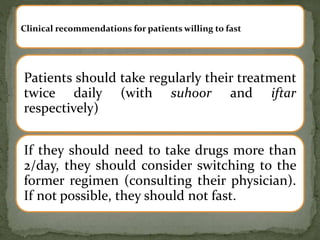
Patients should take regularly their treatment
twice daily (with suhoor and iftar
respectively)
If they should need to take drugs more than
2/day, they should consider switching to the
former regimen (consulting their physician).
If not possible, they should not fast.
Clinical recommendations for patients willing to fast
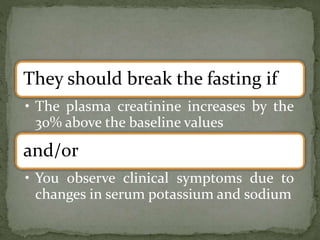
They should break the fasting if
• The plasma creatinine increases by the
30% above the baseline values
and/or
• You observe clinical symptoms due to
changes in serum potassium and sodium
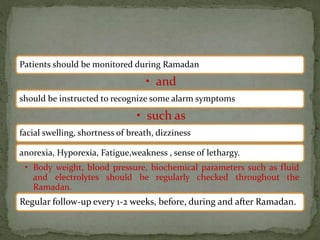
Patients should be monitored during Ramadan
• and
should be instructed to recognize some alarm symptoms
• such as
facial swelling, shortness of breath, dizziness
anorexia, Hyporexia, Fatigue,weakness , sense of lethargy.
• Body weight, blood pressure, biochemical parameters such as fluid
and electrolytes should be regularly checked throughout the
Ramadan.
Regular follow-up every 1-2 weeks, before, during and after Ramadan.
When breaking the fasting, they should avoid high
potassium and phosphorous diet (such as dates,
apricots, fried food, nuts, cheese, juices and drinks, tea,
coffee).
Moreover, they should drink up to 1-2.5 L of water in
order to re-hydrate themselves and compensate a fluid
depletion, but avoid exceeding in liquid amount, thus
occurring into fluid imbalance and overload
Water drinking is indeed a good method for preventing
and treating both nephrolithias and recurrent renal
colic, as proven by a recent systematic review and
meta-analysis of randomized clinical trials.
Most of the authors of the studies included in this
systematic review agree that suggesting and advising
patients to take an adequate amount of fluids during
the breaks of the fasting is a good clinical practice.
If they have a tendency to
hyperkalemia, they should
take some calcium
resonium powder (30 g/die
with lactulose once a day).
Particular attention should
be paid to infections, since
some fasting patients are
on immunosuppressive
therapy.
Clinical consultations with
pharmacologists and
infectious diseases specialists
are highly recommended in
these cases.
There are now a debate that Ramadan is
injurious for patients with CKD willing to fast
specially in those with advanced CKD and
further high quality research is welcome.
Randomized clinical trials are particularly
encouraged since there is a lack of evidence
based guidelines and protocols which
correctly address the issue of the impact of
the fasting on CKD patients and proper
counsel and advise them.
In conclusion, if stable and at the least for
the categories included in the reviewed
studies
Patient’s eagerness to fast should be taken
into account and even encouraged, since
spirituality plays a key role in CKDs.
The patient feels indeed himself/herself
more active being involved in the religious
activities, and less depressed and isolated
For those with renal
transplantation and
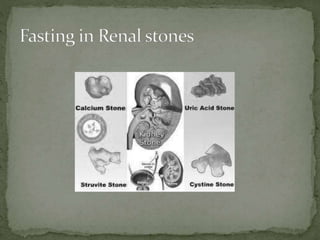
history of renal stones
there is no
contraindication of
fasting with
precautionS
Fasting and ramadan
Fasting and ramadan

Fasting and ramadan

  • 1.
    Mostafa Abdel_Salam Mohamed,MD Consultant of Nephrology
  • 2.
    Adherents of Islamconstitute the world's second largest religious group. According to a study in 2015, Islam has 1.8 billion adherents, making up over 24.1% of the world population.[ Why Muslims are the world's fastest-growing religious group". Pew Research Centre. April 2017. Retrieved 24 April 2017
  • 3.
    10% of populationwith CKD world wide 2 million on dialysis world wide CKD was ranked 27th between causes of death worldwide in 1990, but rose to 18th in 2010.
  • 4.
    Data Source: PublishedBy WHO 2014 WHO Excludes Cause of Death Data For the following countries: Andorra, Antigua and Barbuda, Cook Islands, Dominica, Grenada, Kiribati, Marshall Islands, Micronesia, Monaco, Nauru, Niue, Palau, Saint Kitts, Saint Lucia, Saint Vincent, Samoa, San Marino, Sao Tome, Seychelles, Tonga, Tuvalu, Vanuatu.
  • 8.
    There are 16islamic countries in the top 42 countries with the highest mortality due to CKD. However there is no enough data about fasting of ramadan in islamic countries.
  • 10.
    J Res MedSci 2014;19:987-92.
  • 11.
    MEDLINE (http://www. pubmed.com)was searched by using “Ramadan” as keyword. Found articles were categorized as original or review article. Reviewed articles have been published since 2009 until February 2014
  • 13.
    Based on theresults of a currently published meta-analysis included 21 articles, 531 men and 299 women.
  • 14.
    although studies showedthat Ramadan fasting has health protective effects (BW, Lipid profile, Immune state, renal markers, pregnancy, Diabetic state)
  • 15.
    Patient should consulttheir medical team for fasting during Ramadan. More precise studies should be conducted for more reliable conclusion.
  • 16.
    Between Science and Faith (TheBalance between Orders and Prohibitions)
  • 17.
  • 18.
    Ramadan fasting andchronic kidney disease: A systematic review. J Res Med Sci 2014;19:665-76.
  • 19.
    Ramadan fasting representsone of the five pillars of the Islam.
  • 20.
    Even though patientsare exempted from observing this religious duty, they may be eager to share this particular moment of the year with their family and peers.
  • 21.
    However, there areno guidelines or standardized protocols that can help physicians to properly address the issue of patients with chronic kidney disease (CKD) fasting in Ramadan and to correctly advise them.
  • 22.
    Moreover, in amore interconnected and globalized society, in which more and more Muslim patients live in the Western countries, this topic is of high interest also for the general practitioner.
  • 23.
    For this purpose,this systematic review was done and included articles written in Arabic, Turkish, and Persian languages.
  • 24.
    ISI Web ofScience (WoS), Scopus, MEDLINE/PubMed, Google Scholar, Directory of Open Access Journals (DOAJ), EbscoHOST, Scirus, and ProQuest. A proper string made up of a combination of key-words such as “fasting,” “CKD” and “chronic renal failure.”
  • 25.
    25 original articlesdescribing 26 studies (I add 5 new original articles since 2014) Fifteen studies as described in 14 manuscripts focused on kidney transplant (1 new original article since 2014) 6 on renal colic (1 new original article since 2014) 5 studies concerned CKDs (3 new original articles since 2014)
  • 26.
    + 3 New +1 New + 1 New
  • 27.
    Most studies wereprospective and observational, with the exceptions of that by Basiri et al., which is a retrospective, database-based study as well as that by Al-Hadramy. Al-Hadramy MS. Seasonal variations of urinary stone colic in Arabia. J Pak Med Assoc 1997;47:281-4. Basiri A, Moghaddam SM, Khoddam R, Nejad ST, Hakimi A. Monthly variations of urinary stone colic in Iran and its relationship to the fasting month of Ramadan. J Pak Med Assoc 2004;54:6-8.
  • 28.
    Most studies didnot find any differences between fasters and not fasters, or between before and after Ramadan fasting???????
  • 29.
    The study byBernieh et al. they found improvements during the fasting and after
  • 30.
    Only three studiespresented mixed evidences of an increased risk for fasting patients during Ramadan??? (plus 2 new studies)
  • 31.
    Bakhit et al.,2017: • Study design: Prospective cohort observational study • Sample: 65 patients • Age: Mean age 53 years (40 male and 25 female patients). • Mean fasting duration: 15 h • Patients monitoring: Data were collected within the 3 months before fasting initiation, after fasting for at least 10 days, and 3 months after Ramadan • Inclusion criteria: stage 3 or higher chronic kidney disease (CKD). • Exclusion criteria: patients with kidney transplants, current pregnancy, poorly controlled diabetes and poorly controlled hypertension • Place: Riyadh (Saudi Arabia) • Time: Ramadan 2015 (June 18-July 17)
  • 32.
    In patients withstage 3 or higher CKD, Ramadan fasting during the summer months was associated with worsening of renal function. Clinicians need to warn CKD patients against Ramadan fasting
  • 33.
    Mbarki et al.,2015: • Study design: Prospective cohort observational study • Sample: 67 patients by the end of study they become 60 patients (35 females and 25 males). • Age: 45.6 ± 15.8 years, with a range of 16–87 years. • Mean fasting duration: 13 h • Patients monitoring: Before Ramadan, a week after commencing the fast and at the end of the month of Ramadan. • Inclusion criteria: Clearance >60 mL/min (Group 1), 30–59 mL/ min (Group 2) and 15– 29 mL/min (Group 3).or by the existence of signs of kidney damage (proteinuria >0.3 g/24 h and/or hematuria). • Exclusion criteria: severe or resistant arterial hypertension, insulin-requiring diabetes, acute renal failure, active renal disease, repetitive urolithiasis or terminal CRF. • Place: Hassan II University Hospital in Fez, Morocco. • Time: Ramadan 2010 (August)
  • 34.
    Overall, seven patients(11.7%) developed superimposed ARF while fasting during Ramadan. Of these seven patients, there was complete recovery of renal function to baseline in five patients, while two patients showed partial recovery.
  • 35.
    The small sampleof our study does not allow us to conclude with certainty that fasting during Ramadan is safe and not associated with renal injury among CKD patients
  • 36.
    NasrAllah et al.,2014 • Study design: Prospective cohort observational study • Sample: 106 patients, 52 in the fasting group and 54 in the none fasting group. • Age: Mean age 53 years (40 male and 25 female patients). • Mean fasting duration: 15 h • Patients monitoring: (i) Day 0 = within the 5 days preceding the month of Ramadan, (ii) Day 7 = after 1 week of fasting, (iii) Day 30 = within 5 days after the end of the month, (iv) late = 3 months after the end of Ramadan. • Inclusion criteria: Chronic kidney disease (CKD). • Exclusion criteria: Patients with evidence of acute cardiovascular disease or active infection as well as patients on dialysis and kidney transplant recipients • Place: Cairo (Egypt) • Time: Ramadan (2009-2010)1)
  • 37.
    MACE occurred more frequentlyamong fasting CKD patients with pre-existing cardiovascular disease and were predicted by an early rise of serum creatinine.
  • 48.
    Ramadan and chronickidney disease • Summarizing all the studies, 140 subjects with CKD (plus 238 patients from new 3 new studies=378) have been investigated: 40 on hemodialysis, 18 on peritoneal dialysis (PD), 82 on predialysis (plus 238 patients from new 3 studies=320)
  • 49.
    No severe adverseeffects have been recorded, apart from those described by Al- Muhanna.???? However, the group of patients recruited in this study included also patients suffering from severe renal failure and this could have an impact on the findings of the author. Al-Muhanna et al., 1998
  • 50.
    However two newstudies (Bakhit et al., 2017, NasrAllah et al., 2014) confirmed that patients with stage 3 or higher CKD or those with history of cardiovascular events Ramadan fasting was associated either with worsening of renal function and/or MACE.
  • 52.
    Fayez et al.,2014: • Study design: Prospective cohort observational study • Sample: 80 patients with renal transplantation was sub divided into two group 43 patients who had voluntarily fasted during both consecutive Ramadan months were included and their results were compared with 37 patients who had not fasted . • Age: Mean age 45.2 ± 15.6 and 43.3 ± 15.4 years, • Mean fasting duration: 13 h • Patients monitoring: The eGFR was calculated within a month before Ramadan of 2011 and 19.6 ± 1.3 months after it. • Inclusion criteria: patients with stages 3b and 4 chronic kidney diseases (CKD). • Place: Riyadh (Saudi Arab)ia) • Time: Ramadan 2010 (August)
  • 53.
    Fasting in themonth of Ramadan in two consecutive years, and during the hottest months, in Riyadh, Saudi Arabia, did not adversely affect kidney graft function.
  • 78.
    Summarizing all thestudies dedicated to the relationship between Ramadan fasting and renal allograft , 463 patients (plus 80 new patients= 543) who received kidney transplant have been investigated.
  • 79.
    The concentration of immunosuppressivedrugs tends to remain stable and biochemical parameters do not change significantly. No organ rejection or deterioration of kidney functions were observed.
  • 80.
    Only one authorreported of adverse effects due to cyclosporine toxicity (2 cases), acute rejection episodes(2 cases), and urinary infections (2 cases). No kidney loss has been documented Said et al., 2003 (6/71=8.5%)
  • 82.
    Cevik et al.,2016 • Study design: Prospective cohort observational study • Sample: 176 patients (n:89 in before Ramadan, n:87 in Ramadan • Mean fasting duration: 14 h • Inclusion criteria: patients who were admitted to our ED; age 18 years or older with renal colic • Exclusion criteria: age younger than 18 years; patients who refused to be involved in the study; patients whose renal colic diagnoses were unclear, patients with co-morbid diseases such as chronic kidney disease, metabolic disorder, cardiovascular disease, liver or endocrine disorder. • Place: Ankara (Turkey). • Time: May 28 and July 27, 2014 during 2-month period
  • 83.
    This study hasshown that fasting in Ramadan does not change the number of renal colic visits.
  • 96.
    Summarizing all thecollected evidences, 1,262 subjects (plus 176 from one new study= 1438) have been studied using both prospective studies and retrospective database-based surveys.
  • 97.
    Ramadan fasting doesnot seem to deteriorate health condition in subjects with renal colic, does not cause hypercalciuria and does not impair in a statistically significant and clinically relevant way the balance between lithogenic promotors (that is to say, oxalate, calcium, uric acid, phosphates) and inhibitors (citrate, magnesium).
  • 98.
    Moreover, any renal changesare fully reversible after 10 days from the end of the fasting
  • 99.
  • 100.
    Recommendations against fasting •Hypotension • Acute infections • active peptic ulcer • Acute tubular necrosis, • Polyuria (urine volume ≥2.5 L/day) • Uncontrolled or poorly controlled diabetes mellitus • Diabetes insipidus • Other dysmetabolic disorders • Uncontrolled hypertension • Acute cardiovascular events • Chronic liver disease)
  • 101.
    Patients should takeregularly their treatment twice daily (with suhoor and iftar respectively) If they should need to take drugs more than 2/day, they should consider switching to the former regimen (consulting their physician). If not possible, they should not fast. Clinical recommendations for patients willing to fast
  • 102.
    They should breakthe fasting if • The plasma creatinine increases by the 30% above the baseline values and/or • You observe clinical symptoms due to changes in serum potassium and sodium
  • 103.
    Patients should bemonitored during Ramadan • and should be instructed to recognize some alarm symptoms • such as facial swelling, shortness of breath, dizziness anorexia, Hyporexia, Fatigue,weakness , sense of lethargy. • Body weight, blood pressure, biochemical parameters such as fluid and electrolytes should be regularly checked throughout the Ramadan. Regular follow-up every 1-2 weeks, before, during and after Ramadan.
  • 104.
    When breaking thefasting, they should avoid high potassium and phosphorous diet (such as dates, apricots, fried food, nuts, cheese, juices and drinks, tea, coffee). Moreover, they should drink up to 1-2.5 L of water in order to re-hydrate themselves and compensate a fluid depletion, but avoid exceeding in liquid amount, thus occurring into fluid imbalance and overload
  • 105.
    Water drinking isindeed a good method for preventing and treating both nephrolithias and recurrent renal colic, as proven by a recent systematic review and meta-analysis of randomized clinical trials. Most of the authors of the studies included in this systematic review agree that suggesting and advising patients to take an adequate amount of fluids during the breaks of the fasting is a good clinical practice.
  • 106.
    If they havea tendency to hyperkalemia, they should take some calcium resonium powder (30 g/die with lactulose once a day).
  • 107.
    Particular attention should bepaid to infections, since some fasting patients are on immunosuppressive therapy.
  • 108.
    Clinical consultations with pharmacologistsand infectious diseases specialists are highly recommended in these cases.
  • 109.
    There are nowa debate that Ramadan is injurious for patients with CKD willing to fast specially in those with advanced CKD and further high quality research is welcome. Randomized clinical trials are particularly encouraged since there is a lack of evidence based guidelines and protocols which correctly address the issue of the impact of the fasting on CKD patients and proper counsel and advise them.
  • 110.
    In conclusion, ifstable and at the least for the categories included in the reviewed studies Patient’s eagerness to fast should be taken into account and even encouraged, since spirituality plays a key role in CKDs. The patient feels indeed himself/herself more active being involved in the religious activities, and less depressed and isolated
  • 111.
    For those withrenal transplantation and history of renal stones there is no contraindication of fasting with precautionS