PERITONEAL DIALYSIS SOLUTIONS
Dr. Dinesh Katre
MD Medicine , DNB Nephrology
•Peritoneal dialysis solutions consist of
•water,
•osmotic agents,
•electrolytes , minerals
• and buffer
 IDEAL SOLUTION —
 Have a sustained and a predictable solute
clearance with minimal absorption of the osmotic
agents
 Provide deficient electrolytes and nutrients, if
required
 Correct acid base problems without interacting
with other solutes in the peritoneal dialysis fluid
 Be free of and inhibit the growth of pyrogens and
microorganisms
 Be free of toxic metals
 Be inert to the peritoneum
 Two major types of osmotic agents that are
currently used
 high molecular weight :
 glucose polymers, polypeptides, dextran , gelatin and
polycations
 range in weight from 20,000 to 350,000 DA
 low molecular weight
 dextrose (eg, glucose containing solutions), amino
acids,
xylitol and glycerol
 have weights of 90 to 200 DA.
 Glucose-containing solutions —
 Glucose is the most commonly used agent
 It comes in three different dextrose
monohydrate concentrations:
 1.5, 2.5, and 4.25 percent
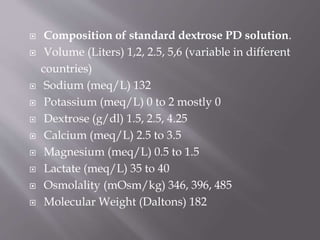
 Composition of standard dextrose PD solution.
 Volume (Liters) 1,2, 2.5, 5,6 (variable in different
countries)
 Sodium (meq/L) 132
 Potassium (meq/L) 0 to 2 mostly 0
 Dextrose (g/dl) 1.5, 2.5, 4.25
 Calcium (meq/L) 2.5 to 3.5
 Magnesium (meq/L) 0.5 to 1.5
 Lactate (meq/L) 35 to 40
 Osmolality (mOsm/kg) 346, 396, 485
 Molecular Weight (Daltons) 182
 Buffers:
 the source of bicarbonate for correction of
acidosis.
 acetate, lactate or bicarbonate.
 The first two gets metabolised in the liver to
bicarbonate.
 Acetate frequently causes pain during inflow.
 Bicarbonate is not compatible with calcium and
magnesium containing solutions
 Dextrose solution usually contains lactate as
buffer , which is quite safe.
Physiology and Use
•Ultrafiltration with dextrose dialysate
occurs across the aquaporin 1 channels.
• Removes fluid down an osmotic gradient
•Higher the concentration of dextrose,
higher is the ultrafiltration.
•In 4 hours dwell, urea is > 90 %
equilibrated and creatinine is > 60 %
equilibrated.
 The ultrafiltration is maximum in the initial
hour of dwell. This leads to ‘sodium sieving’
in the initial hours of dialysis.
 The peritoneal membranes can be classified
into ‘fast’ and ‘slow’ transporters based on
D/P (dialysate to plasma creatinine) ratio in 4
hour dwell with 2.5% dextrose exchange.
 The main advantage - cheap, safer, and easily
available
DISADVANTAGES
 Glucose is not the ideal osmotic agent because it is
easily absorbed, leading to short-lived
ultrafiltration.
 absorption can lead to hyperinsulinemia,
hyperglycemia, hyperlipidemia, and weight gain
 the high glucose concentration, low pH, glucose
degradation products (GPDs) of these solutions
can affect peritoneal host defense mechanisms.
 formation of advanced glycation end products
(AGEs) which results in local peritoneal
membrane damage.
 Glucose polymer-containing solutions
 Glucose polymers (eg, icodextrin) are
mixtures of oligo/polysaccharides of variable
chain lengths.
 Icodextrin dialysate (Extraneal™) is the major
glucose polymer utilized in peritoneal
dialysis.
 commonly used as a 7.5 percent solution.
 Advantages of decreased absorption of solute
and increased ultrafiltration for a longer
period of time.
 Used in patients whose ultrafiltration capacity
may need to be enhanced
 Reduced carbohydrate load may provide
long-term metabolic advantage.
 Substitute for glucose solutions, particularly in
diabetics.
 Disadvantages
 Increased concentrations of maltose, maltotriose and
other oligo/polysaccharides possibly resulting in adverse
reactions.
 Several studies have reported incidence of cutaneous reactions
due to its structural similarity to dextran.
 Icodextrin and maltose can interfere with or cause falsely
elevated glucose results, possibly leading to inappropriate
therapy.
 With the enhanced UF provided by icodextrin, patients may be
at risk for hypovolemia and even hypotension.
 Incidence of dilutional hyponatremia resulting
from blood levels of icodextrin metabolites.
 The reported incidence of culture-negative
peritonitis .This is thought to be due to
contamination of some batches with a
bacterial wall breakdown product,
peptidoglycan.
 Hypertonic in relation to
the plasma
 Transport through the
ultra-small pores , sodium
seiving.
 Removes fluid down an
osmotic gradient
 Isotonic in relation to the
plasma (282 mOsm/kg)
 Transport through small
pores of small solutes
along with water , less
sodium seiving.
 induce transcapillary
ultrafiltration through the
process of colloid osmosis
(principle -water is
transported from the
capillaries in the direction
of relative excess of
impermeable large
solutes)
 Amino acid-containing solutions
 Peritoneal dialysis patients tend to lose significant
amounts of protein in the dialysate.
 1.1 percent amino acid solutions are as effective an
osmotic agent as 1.36 percent dextrose solutions
 The pH of this solution is 6.7 and osmolality is
365 mosmol/kg
 improve nutritional status by contributing to protein
synthesis especially when administered with a non-
protein energy source.
 common side effects include worsening of acidosis
and a rise in BUN.
 guidelines while prescribing amino acid peritoneal
dialysis solutions
 indicated for use only in malnourished or diabetic
patients, and/or those with recurrent peritonitis.
 1.1 percent amino acid solution consisting of
predominantly essential amino acids (required by
dialysis patients) should be used.
 Sufficient alternative caloric intake should be
guaranteed.
 Xylitol-containing solution — Xylitol has
been tried as an osmotic agent in diabetic
patients.
 However, it is not currently used because of
several potentially serious side effects,
including lactic acidosis, hyperuricemia,
carcinogenicity, and deteriorating liver
function
 Glycerol-containing solution —
 gained interest because of its smaller
molecular weight, relatively high osmolality
per unit mass, and a higher pH than glucose
solutions
 However, because of rapid diffusion into
blood, it produces less ultrafiltration than
glucose
 Accumulation may cause hyperosmolality of
the plasma and hypertriglyceridemia
 Modified solutions
 standard solution has been found to be
associated with hypermagnesemia and
hypercalcemia
 low magnesium (0.5 meq/L) and low calcium
(2.5meq/L) dialysate solutions are used
depending upon patient profile
 Other additives
 Insulin is frequently added to control
hyperglycemia and glucose load from the
dextrose containing solutions.
 Heparin frequently added to prevent the
formation of fibrin in the PD fluid
,particularly during peritonitis episodes
 Antibiotics are added to the peritoneal fluid
to treat peritonitis.
Peritoneal dailysis soltutions

Peritoneal dailysis soltutions

  • 1.
    PERITONEAL DIALYSIS SOLUTIONS Dr.Dinesh Katre MD Medicine , DNB Nephrology
  • 2.
    •Peritoneal dialysis solutionsconsist of •water, •osmotic agents, •electrolytes , minerals • and buffer
  • 3.
     IDEAL SOLUTION—  Have a sustained and a predictable solute clearance with minimal absorption of the osmotic agents  Provide deficient electrolytes and nutrients, if required  Correct acid base problems without interacting with other solutes in the peritoneal dialysis fluid  Be free of and inhibit the growth of pyrogens and microorganisms  Be free of toxic metals  Be inert to the peritoneum
  • 4.
     Two majortypes of osmotic agents that are currently used  high molecular weight :  glucose polymers, polypeptides, dextran , gelatin and polycations  range in weight from 20,000 to 350,000 DA  low molecular weight  dextrose (eg, glucose containing solutions), amino acids, xylitol and glycerol  have weights of 90 to 200 DA.
  • 5.
     Glucose-containing solutions—  Glucose is the most commonly used agent  It comes in three different dextrose monohydrate concentrations:  1.5, 2.5, and 4.25 percent
  • 6.
     Composition ofstandard dextrose PD solution.  Volume (Liters) 1,2, 2.5, 5,6 (variable in different countries)  Sodium (meq/L) 132  Potassium (meq/L) 0 to 2 mostly 0  Dextrose (g/dl) 1.5, 2.5, 4.25  Calcium (meq/L) 2.5 to 3.5  Magnesium (meq/L) 0.5 to 1.5  Lactate (meq/L) 35 to 40  Osmolality (mOsm/kg) 346, 396, 485  Molecular Weight (Daltons) 182
  • 7.
     Buffers:  thesource of bicarbonate for correction of acidosis.  acetate, lactate or bicarbonate.  The first two gets metabolised in the liver to bicarbonate.  Acetate frequently causes pain during inflow.  Bicarbonate is not compatible with calcium and magnesium containing solutions  Dextrose solution usually contains lactate as buffer , which is quite safe.
  • 8.
    Physiology and Use •Ultrafiltrationwith dextrose dialysate occurs across the aquaporin 1 channels. • Removes fluid down an osmotic gradient •Higher the concentration of dextrose, higher is the ultrafiltration. •In 4 hours dwell, urea is > 90 % equilibrated and creatinine is > 60 % equilibrated.
  • 9.
     The ultrafiltrationis maximum in the initial hour of dwell. This leads to ‘sodium sieving’ in the initial hours of dialysis.  The peritoneal membranes can be classified into ‘fast’ and ‘slow’ transporters based on D/P (dialysate to plasma creatinine) ratio in 4 hour dwell with 2.5% dextrose exchange.  The main advantage - cheap, safer, and easily available
  • 10.
    DISADVANTAGES  Glucose isnot the ideal osmotic agent because it is easily absorbed, leading to short-lived ultrafiltration.  absorption can lead to hyperinsulinemia, hyperglycemia, hyperlipidemia, and weight gain  the high glucose concentration, low pH, glucose degradation products (GPDs) of these solutions can affect peritoneal host defense mechanisms.  formation of advanced glycation end products (AGEs) which results in local peritoneal membrane damage.
  • 11.
     Glucose polymer-containingsolutions  Glucose polymers (eg, icodextrin) are mixtures of oligo/polysaccharides of variable chain lengths.  Icodextrin dialysate (Extraneal™) is the major glucose polymer utilized in peritoneal dialysis.  commonly used as a 7.5 percent solution.
  • 12.
     Advantages ofdecreased absorption of solute and increased ultrafiltration for a longer period of time.  Used in patients whose ultrafiltration capacity may need to be enhanced  Reduced carbohydrate load may provide long-term metabolic advantage.  Substitute for glucose solutions, particularly in diabetics.
  • 13.
     Disadvantages  Increasedconcentrations of maltose, maltotriose and other oligo/polysaccharides possibly resulting in adverse reactions.  Several studies have reported incidence of cutaneous reactions due to its structural similarity to dextran.  Icodextrin and maltose can interfere with or cause falsely elevated glucose results, possibly leading to inappropriate therapy.  With the enhanced UF provided by icodextrin, patients may be at risk for hypovolemia and even hypotension.
  • 14.
     Incidence ofdilutional hyponatremia resulting from blood levels of icodextrin metabolites.  The reported incidence of culture-negative peritonitis .This is thought to be due to contamination of some batches with a bacterial wall breakdown product, peptidoglycan.
  • 15.
     Hypertonic inrelation to the plasma  Transport through the ultra-small pores , sodium seiving.  Removes fluid down an osmotic gradient  Isotonic in relation to the plasma (282 mOsm/kg)  Transport through small pores of small solutes along with water , less sodium seiving.  induce transcapillary ultrafiltration through the process of colloid osmosis (principle -water is transported from the capillaries in the direction of relative excess of impermeable large solutes)
  • 16.
     Amino acid-containingsolutions  Peritoneal dialysis patients tend to lose significant amounts of protein in the dialysate.  1.1 percent amino acid solutions are as effective an osmotic agent as 1.36 percent dextrose solutions  The pH of this solution is 6.7 and osmolality is 365 mosmol/kg  improve nutritional status by contributing to protein synthesis especially when administered with a non- protein energy source.  common side effects include worsening of acidosis and a rise in BUN.
  • 17.
     guidelines whileprescribing amino acid peritoneal dialysis solutions  indicated for use only in malnourished or diabetic patients, and/or those with recurrent peritonitis.  1.1 percent amino acid solution consisting of predominantly essential amino acids (required by dialysis patients) should be used.  Sufficient alternative caloric intake should be guaranteed.
  • 18.
     Xylitol-containing solution— Xylitol has been tried as an osmotic agent in diabetic patients.  However, it is not currently used because of several potentially serious side effects, including lactic acidosis, hyperuricemia, carcinogenicity, and deteriorating liver function
  • 19.
     Glycerol-containing solution—  gained interest because of its smaller molecular weight, relatively high osmolality per unit mass, and a higher pH than glucose solutions  However, because of rapid diffusion into blood, it produces less ultrafiltration than glucose  Accumulation may cause hyperosmolality of the plasma and hypertriglyceridemia
  • 20.
     Modified solutions standard solution has been found to be associated with hypermagnesemia and hypercalcemia  low magnesium (0.5 meq/L) and low calcium (2.5meq/L) dialysate solutions are used depending upon patient profile
  • 21.
     Other additives Insulin is frequently added to control hyperglycemia and glucose load from the dextrose containing solutions.  Heparin frequently added to prevent the formation of fibrin in the PD fluid ,particularly during peritonitis episodes  Antibiotics are added to the peritoneal fluid to treat peritonitis.