PERFORMANCE-
BASED
ASSESSMENT
CONTENT OF THE PRESENTATION
Definitions, Features,
and Distinctions of
Performance-based
Assessment
01
Domains, Types,
and Focus of
Performance-based
Assessment
03
Performance Task
and Performance
Criteria
02
Advantages and
Limitations;
Developing
Performance-based
Assessment
04
CONTENT OF THE PRESENTATION
Scoring Rubrics
05
Errors in
Performance-based
Assessment
07 References
06
Conclusions and
Learning
Takeaways
08
Definitions,
Features, and
Distinctions of
Performance-
based
Assessment
01
Definitions of Performance-based Assessment
It is a direct and systematic observation of the actual
performance of students based on a predetermined performance
criteria (Zimmaro, 2003, as cited by Gabuyo, 2012).
It is an alternative form of assessing the performance of students
that represents a set of strategies for the application of
knowledge, skills, and work habits through the performance of
tasks that are meaningful and engaging to them (Hibbard, 1996).
It provides the teacher the information on how the students
understand and apply knowledge and it allows the teacher to
integrate performance assessment in the instructional process to
provide additional learning activities (Brualdi, 1996).
Features of Performance-based Assessment
Greater realism
of the tasks
Greater
complexity of the
tasks
Greater use of
judgment in
scoring
Greater time needed for
assessment
Emphasis on
doing open-
ended activities
Self-assessment Assessment of group
and individual
performance
Difference between Traditional and Performance-based Assessment
Measures learning indirectly
Used for measuring factual
knowledge and solving
mathematical problems
Usually assess low level
thinking skills, or beyond
recall levels.
Direct measure of learning or
competence
Teacher observes and rate the
students based on their
performance
Teacher provides feedback
immediately on how the students
performed to carry out their
performance task
Traditional
Assessment
Performance-based
Assessment
Domains,
Types, and
Focus of
Performance-
based
Assessment
02
Domains of Performance-based Assessment
Psychomotor
Skills
Athletic
Skills
Affective
Skills
Communication
Skills
Concept
Acquisition
Types of Performance-based Assessment
TYPE OF TASK COMPLEX LEARNING OUTCOMES
Restricted-response Performance Task
(Highly structured with limited scope)
Ability to:
Construct a graph
Read a story aloud
Type an application letter
Use Engineering Instruments
Extended-response Performance Task
(Less structured with broader scope)
Ability to:
Write a thesis
Create a regression model
Repair a Television
Organize ideas
Make an oral presentation about research
Focus of Performance-based Assessment
According to Gronlund (1998),
use the process when:
No product
Process is orderly and directly observable
Correct procedures are crucial to later
success
Different procedures result in an
equally good product
Procedures not available for
observation
Procedures have been mastered already
Analysis of procedural steps can help in
improving the product
Learning is at the early stage
According to Gronlund (1998),
use the product when:
Products have qualities that can be
identified and judged
Four types of accomplishments of learners using performance-
based assessment
Despite being red, Mars is a cold
place. It’s full of iron oxide dust
Mental and behavioral
habits
Observable
Performance
Habit of the
mind and
social skills
Product
Complex cognitive
processes
Physical performance, focusing microscope
in laboratory classes, cooking procedures,
etc.
Skills in acquiring, organizing, and using
information
Poems, essays, charts, graphs, exhibits,
drawings, maps, etc.
Accomplishments Examples
03
Advantages
and
Limitations;
Developing
Performance-
based
Assessment
Time Consuming
Scoring is often
questionable
Limited scope of
learning objectives
• Assess own growth
• Assess complex learning outcomes
• Recognize what they know and can do
• Availability of student information to
parents
• Evaluate “whole student”
• Enhance professional skills
• Framework for observation
• Meaningful curriculum planning
• Designing educational interventions
Process Product
⇒
Progress Performance
⇒
Goals Real-world context
⇒
Performance-based
Assessment
Performance-based
Assessment
Student
Teacher
Define the
purpose of the
assessment
STEP 1 STEP 2
Determine the skills,
learning outcomes,
and taxonomy level
Design and develop
activity or
performance task
STEP 3
Steps in Developing Performance-based Assessment
Define the
performance
criteria
STEP 4 Creating a
scoring rubrics
STEP 5
Assess the Performance i.e.
(teacher observation, peer
evaluation, and student self-
report)
STEP 6
Specify the
Constraints in
Testing
STEP 7
04
Performance
Task and
Performance
Criteria
Features of effective performance assessment task
Clear Intended Learning Outcomes
Availability of
rubrics
Students as
active
participants
Clear and
logical
activities
Demonstration of
ability in real-life
situation
It provides a common means of assessment. The students will be asked to do something
SUGGESTIONS AND GUIDELINES FOR PERFORMANCE TASK
Focus on complex
cognitive skills and
performances
Represent both content
and skills
Minimize the dependence
of task performance on
skills
Scaffolding
Clear task directions
Clear performance
expectations
Congruent to purpose
Elicits behaviors at the
levels stated in
instructional outcomes
Interesting, challenging,
and fair
Authentic
Includes only important
outcomes
Reflects intended learning
outcomes
Appropriate for
developmental level of
students
Includes what is done,
how it is done, and what
condition it is done
Directions should give
enough information and
context
SUGGESTIONS FOR CONSTRUCTING PERFORMANCE TASK
GUIDELINES FOR GOOD
PERFORMANCE TASK
• Identify the overall task and imagine you are
performing it
• List the important aspects and limit no. of
performance criteria
• Have group of teachers
• Express performance criteria in terms of
observable pupil behaviors
• Avoid ambiguities
• Arrange criteria in order
• Check for existing criteria before
constructing
Performance criteria
• Communicate essential achievement
standard
• Operationalize the outcome
• Apply across context that calls for similar
behavior
• Focus on current instruction
• Observable
• Essential for judging performance of the
task adequately and must be appropriate
for students
• Communicate to others
Guidelines for Stating
Performance Criteria
Guidelines for Good
Judging Criteria
Specific behaviors that students should perform to properly carry out a performance or produce a
product.
• Impact of the performance
• Work quality and craftmanship
• Adequacy of method and
behavior
• Validity of content
• Sophistication of knowledge
employed
Types of
Performance Criteria
Scoring
Rubrics
05
Used when judging the quality of the work of learners on performance
assessments
Forms of scoring guide that are used in evaluating the level of
performance of students or products resulting from the performance task
Descriptive scoring schemes that are developed by teachers or other
evaluators (Moskal, 2000).
Rating system by which teachers can determine at what level of
proficiency a student is able to perform a task or display knowledge of a
concept (Airasian, 2000).
Scoring Rubrics
Types of Rubrics
Holistic and Analytic Rubrics
Holistic Rubric
• Requires the teacher to score an overall process or product as a
whole (Nitko and Merter, 2001).
• The evaluator provides the overall quality of the performance of
students by yielding a single score to represent a specific
category or accomplishment
• All traits are efficiently combined; the work is quickly scored and it
provides one-score result
Template for Holistic Rubric
Score Description
5 Demonstrates complete understanding of the problem. All requirements of task are
included in response
4 Demonstrates considerable understanding of the problem. All requirements of task
are included in response.
3 Demonstrates partial understanding of the problem. All requirements of task are
included in response.
2 Demonstrates little understanding of the problem. All requirements of task are
included in response.
1 Demonstrates no understanding of the problem. All requirements of task are
included in response.
0 No response/ task not attempted.
Analytic Rubric
Analytic Rubric provides information regarding performance in each
component parts of a task, making it useful for diagnosing
strengths and weaknesses of the learners (Gareis and Grant
2008). In this type of rubric, the evaluator evaluates each criterion
separately.
Template of Analytic Rubric
Beginning 1 Developing 2 Accomplished 3 Exemplary 4 Score
Criteria 1 Description
reflecting
beginning level
of performance
Description
reflecting
movement toward
mastery level of
performance
Description reflecting
movement achievement
of mastery level of
performance
Description reflecting
highest level of
performance
Criteria 2 Description
reflecting
beginning level
of performance
Description
reflecting
movement toward
mastery level of
performance
Description reflecting
movement achievement
of mastery level of
performance
Description reflecting
highest level of
performance
Criteria 3 Description
reflecting
beginning level
of performance
Description
reflecting
movement toward
mastery level of
performance
Description reflecting
movement achievement
of mastery level of
performance
Description reflecting
highest level of
performance
Criteria 4 Description
reflecting
beginning level
of performance
Description
reflecting
movement toward
mastery level of
performance
Description reflecting
movement achievement
of mastery level of
performance
Description reflecting
highest level of
performance
Use of Rubrics in the Assessment Process
Rubrics are
powerful tools for
both teaching and
assessment
Rubrics are useful in
that they help students
become more
thoughtful judges of
the quality of their own
and others’ work
Rubrics reduce the
amount of time
teachers spend
evaluating students’
work
Teachers appropriate
rubrics because their
“accordion” nature
allows them to
accommodate
heterogenous classes,
and rubrics are easy to
understand and explain
Rubrics are easy to use and to explain
Advantages of using
rubrics
Development of Scoring Rubrics
Be sure the criteria focus on important aspects
of the performance
Match the type of rating with the purpose of
the assessment
The descriptions of the criteria should be
directly observable
The criteria should be written so that students,
parents, and others understand them
The characteristics and traits used in the scale
should be clearly and specifically defined
Take appropriate steps to minimize scoring
error
The scoring system needs to be feasible
• Allow consistency and objectivity in scoring across
the given criteria;
• Clarify the criteria in specific terms and students
can identify the basis
• Allow the students to assess their own
performance, product, or works;
• Teachers can use as a small amount of time to
evaluate the performance of students
• Students can evaluate their own performance and
their classmates
• Provide specific feedbacks on performance and
serve as standards when preparing the tasks
• Provide students feedback about their strengths
and weaknesses
RUBRIC FOR RESEARCH PROPOSAL STAGE
. CRITERIA POINTS EVALUATOR’S ASSESSMENT
I. Presentation and Organization (Clarity of the
objective/problem, logical, and coherent write-up)
20
II. Research Problem (Specific, Measurable, Attainable,
Realistic, Time-bound)
20
III. Originality and Creativity (Sustainable input of the
author, relevance and novelty of the study, with sound
theoretical framework)
20
IV. Research Methodology (Appropriateness of the design
and procedure, validity and reliability of data gathering,
instrument/tools, methods of data analysis and
interpretation)
20
V. Contribution of the Discipline (Significance of the study,
futuristic implication on the description, replicability of
the research, significant of the conclusion, feasible
20
DESCRIPTION RANGE INTERPRETATION
High Merit 90-100 The research is considered meritorious and
is recommended for
implementation/conduct.
Medium Merit 80-89 The research is most likely to be
recommended for implementation subject
to minor revision and improvement.
Low Merit 75-79 The research is recommended for major
revision and improvement.
No Merit Below 75 The research is not recommended for
implementation/conduct.
1. Performance Assessment Scoring
2. Scoring Rubrics: What, When, & How?
3. RubiStar Rubric Generator
4. Rubrics from the Staff Room for Ontario
Teachers
5. Teacher Rubric Maker
Resources for Rubrics in Web
Checklists – Observation instrument that defines performance whether it is
certain or uncertain, or present or not present. It works with describing what
students can perform and for checking the process of learning. Two parts of
checklists: (1) the elements and (2) check boxes/lines.
Narrative/Anecdotal – It is a continuous description of student behavior as it
occurs, recorded without judgment or interpretation.
Rating Scale – It is a checklist that allows an evaluator to record information
on a scale, noting the finer distinction like the presence or absence of a
behavior. The teacher can indicate to what degree the standards are met.
Memory Approach – It is an approach where the teacher observes the
students when performing the tasks without taking any notes. The teacher
uses his memory to determine whether or not the students are successful.
Types of Scoring instruments for Performance
Assessments
EXAMPLE OF CHECKLIST FOR MATHEMATICAL SKILLS
DIRECTION: Check YES if skills have been demonstrated by the students or check NO
if not.
SKILLS YES NO
1. Identifies fraction less than one.
2. Arranges fraction according to ascending order or
descending order.
3. Expresses mixed fraction to improper fraction and vice
versa.
4. Reduces fraction to improper fraction and vice versa.
5. Adds fraction incorrectly.
6. Subtracts fraction correctly.
7. Multiplies fraction correctly.
EXAMPLE OF RATING SCALE IN DELIVERING A SPEECH
Criteria 1 (Below class
standard)
2 (Acceptable;
Meets class
standard
3 (Good 4 (Very
Good)
5
(Outstanding)
The speech is well organized. 1 2 3 4 5
The student shows
persuasiveness in delivering
the speech.
1 2 3 4 5
The student uses proper
diction in the delivery of the
speech.
1 2 3 4 5
The student shows proper
posture.
1 2 3 4 5
The student establishes eye
contact in the whole duration
in the delivery of the speech.
1 2 3 4 5
Errors in
Performance
-based
Assessment
07
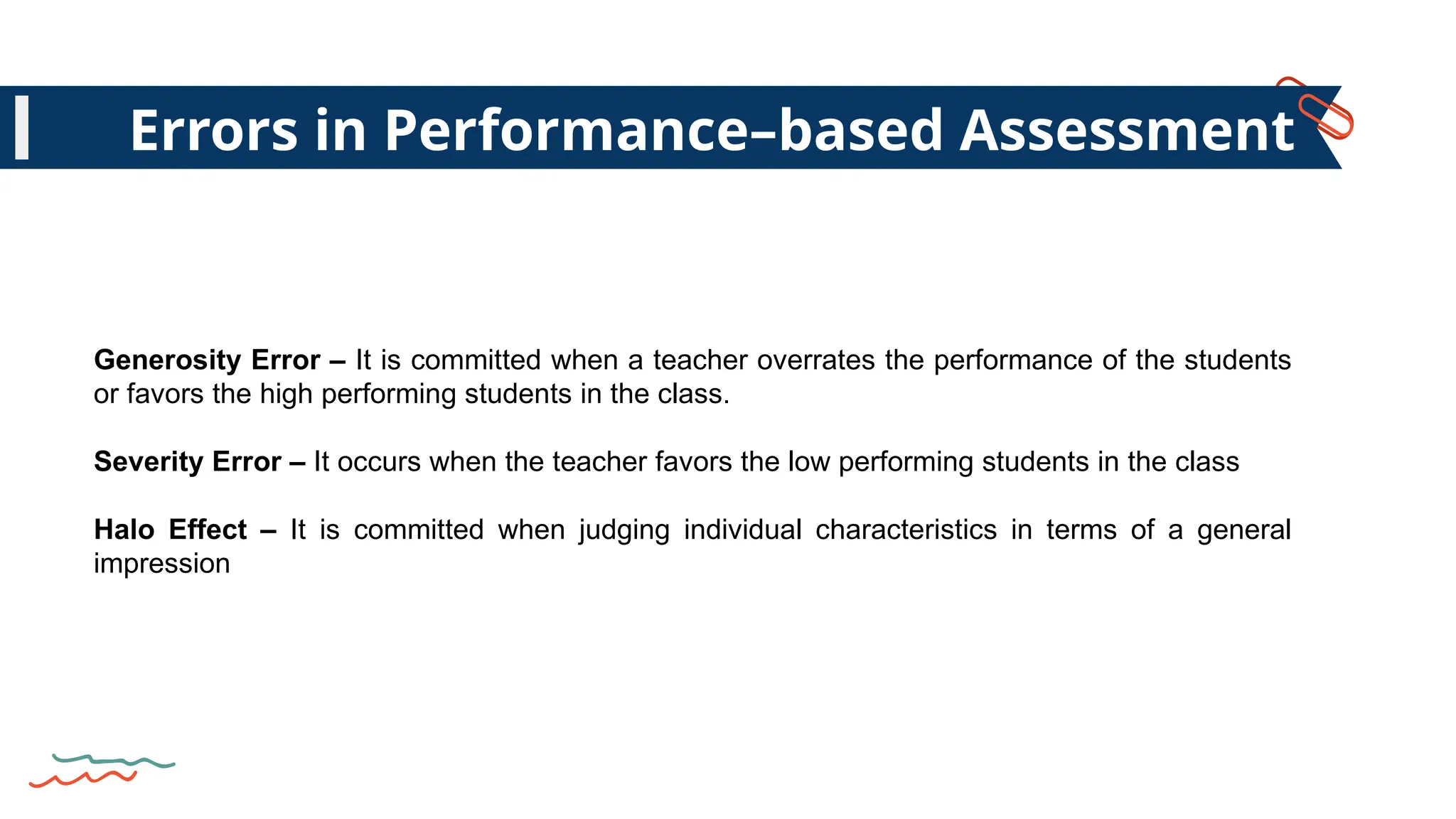
Errors in Performance–based Assessment
Generosity Error – It is committed when a teacher overrates the performance of the students
or favors the high performing students in the class.
Severity Error – It occurs when the teacher favors the low performing students in the class
Halo Effect – It is committed when judging individual characteristics in terms of a general
impression
Conclusion
Changing assessment
forms and formats
without changing the
ways in which
assessments are used will
not change the outcomes
of education
01
The assessment we
use determines the
way we see children
and make
educational decisions
03
Interconnectedness
of assessment
practice, goals,
design, and effective
teaching
02
Simulation of real-
world conditions
04
On assessment, measure what you
value instead of valuing only what you
can measure
–Andy Hargreaves
References
Corpuz, B. 2021. Assessment in Learning 2: Authentic Assessment 3rd
edition. Lorimar
Publishing Inc.
Gabuyo, Y.A. & Dy, G.C. 2013. Assessment of Learning II Textbook and Reviewer 1st
edition.
Rex Book Store, Inc. Sampaloc, Manila, Philippines
Executive Summary. (n.d.). FRAMEWORK OF APPROACHES TO PERFORMANCE ASSESSMENT.
Research & Innovation. Retrieved April 18, 2022.
Executive summary. (n.d.). SEVEN APPROACHES TO PERFORMANCE ASSESMEN. Research
& Innovation. Retrieved April 18, 2022.

PERFORMANCE-BASED-ASSESSMENT REPORT.pptx

  • 1.
  • 2.
    CONTENT OF THEPRESENTATION Definitions, Features, and Distinctions of Performance-based Assessment 01 Domains, Types, and Focus of Performance-based Assessment 03 Performance Task and Performance Criteria 02 Advantages and Limitations; Developing Performance-based Assessment 04
  • 3.
    CONTENT OF THEPRESENTATION Scoring Rubrics 05 Errors in Performance-based Assessment 07 References 06 Conclusions and Learning Takeaways 08
  • 4.
  • 5.
    Definitions of Performance-basedAssessment It is a direct and systematic observation of the actual performance of students based on a predetermined performance criteria (Zimmaro, 2003, as cited by Gabuyo, 2012). It is an alternative form of assessing the performance of students that represents a set of strategies for the application of knowledge, skills, and work habits through the performance of tasks that are meaningful and engaging to them (Hibbard, 1996). It provides the teacher the information on how the students understand and apply knowledge and it allows the teacher to integrate performance assessment in the instructional process to provide additional learning activities (Brualdi, 1996).
  • 6.
    Features of Performance-basedAssessment Greater realism of the tasks Greater complexity of the tasks Greater use of judgment in scoring Greater time needed for assessment Emphasis on doing open- ended activities Self-assessment Assessment of group and individual performance
  • 7.
    Difference between Traditionaland Performance-based Assessment Measures learning indirectly Used for measuring factual knowledge and solving mathematical problems Usually assess low level thinking skills, or beyond recall levels. Direct measure of learning or competence Teacher observes and rate the students based on their performance Teacher provides feedback immediately on how the students performed to carry out their performance task Traditional Assessment Performance-based Assessment
  • 8.
  • 9.
    Domains of Performance-basedAssessment Psychomotor Skills Athletic Skills Affective Skills Communication Skills Concept Acquisition
  • 10.
    Types of Performance-basedAssessment TYPE OF TASK COMPLEX LEARNING OUTCOMES Restricted-response Performance Task (Highly structured with limited scope) Ability to: Construct a graph Read a story aloud Type an application letter Use Engineering Instruments Extended-response Performance Task (Less structured with broader scope) Ability to: Write a thesis Create a regression model Repair a Television Organize ideas Make an oral presentation about research
  • 11.
    Focus of Performance-basedAssessment According to Gronlund (1998), use the process when: No product Process is orderly and directly observable Correct procedures are crucial to later success Different procedures result in an equally good product Procedures not available for observation Procedures have been mastered already Analysis of procedural steps can help in improving the product Learning is at the early stage According to Gronlund (1998), use the product when: Products have qualities that can be identified and judged
  • 12.
    Four types ofaccomplishments of learners using performance- based assessment Despite being red, Mars is a cold place. It’s full of iron oxide dust Mental and behavioral habits Observable Performance Habit of the mind and social skills Product Complex cognitive processes Physical performance, focusing microscope in laboratory classes, cooking procedures, etc. Skills in acquiring, organizing, and using information Poems, essays, charts, graphs, exhibits, drawings, maps, etc. Accomplishments Examples
  • 13.
  • 14.
    Time Consuming Scoring isoften questionable Limited scope of learning objectives • Assess own growth • Assess complex learning outcomes • Recognize what they know and can do • Availability of student information to parents • Evaluate “whole student” • Enhance professional skills • Framework for observation • Meaningful curriculum planning • Designing educational interventions Process Product ⇒ Progress Performance ⇒ Goals Real-world context ⇒ Performance-based Assessment Performance-based Assessment Student Teacher
  • 15.
    Define the purpose ofthe assessment STEP 1 STEP 2 Determine the skills, learning outcomes, and taxonomy level Design and develop activity or performance task STEP 3 Steps in Developing Performance-based Assessment Define the performance criteria STEP 4 Creating a scoring rubrics STEP 5 Assess the Performance i.e. (teacher observation, peer evaluation, and student self- report) STEP 6 Specify the Constraints in Testing STEP 7
  • 16.
  • 17.
    Features of effectiveperformance assessment task Clear Intended Learning Outcomes Availability of rubrics Students as active participants Clear and logical activities Demonstration of ability in real-life situation It provides a common means of assessment. The students will be asked to do something
  • 18.
    SUGGESTIONS AND GUIDELINESFOR PERFORMANCE TASK Focus on complex cognitive skills and performances Represent both content and skills Minimize the dependence of task performance on skills Scaffolding Clear task directions Clear performance expectations Congruent to purpose Elicits behaviors at the levels stated in instructional outcomes Interesting, challenging, and fair Authentic Includes only important outcomes Reflects intended learning outcomes Appropriate for developmental level of students Includes what is done, how it is done, and what condition it is done Directions should give enough information and context SUGGESTIONS FOR CONSTRUCTING PERFORMANCE TASK GUIDELINES FOR GOOD PERFORMANCE TASK
  • 19.
    • Identify theoverall task and imagine you are performing it • List the important aspects and limit no. of performance criteria • Have group of teachers • Express performance criteria in terms of observable pupil behaviors • Avoid ambiguities • Arrange criteria in order • Check for existing criteria before constructing Performance criteria • Communicate essential achievement standard • Operationalize the outcome • Apply across context that calls for similar behavior • Focus on current instruction • Observable • Essential for judging performance of the task adequately and must be appropriate for students • Communicate to others Guidelines for Stating Performance Criteria Guidelines for Good Judging Criteria Specific behaviors that students should perform to properly carry out a performance or produce a product.
  • 20.
    • Impact ofthe performance • Work quality and craftmanship • Adequacy of method and behavior • Validity of content • Sophistication of knowledge employed Types of Performance Criteria
  • 21.
  • 22.
    Used when judgingthe quality of the work of learners on performance assessments Forms of scoring guide that are used in evaluating the level of performance of students or products resulting from the performance task Descriptive scoring schemes that are developed by teachers or other evaluators (Moskal, 2000). Rating system by which teachers can determine at what level of proficiency a student is able to perform a task or display knowledge of a concept (Airasian, 2000). Scoring Rubrics
  • 23.
    Types of Rubrics Holisticand Analytic Rubrics
  • 24.
    Holistic Rubric • Requiresthe teacher to score an overall process or product as a whole (Nitko and Merter, 2001). • The evaluator provides the overall quality of the performance of students by yielding a single score to represent a specific category or accomplishment • All traits are efficiently combined; the work is quickly scored and it provides one-score result
  • 25.
    Template for HolisticRubric Score Description 5 Demonstrates complete understanding of the problem. All requirements of task are included in response 4 Demonstrates considerable understanding of the problem. All requirements of task are included in response. 3 Demonstrates partial understanding of the problem. All requirements of task are included in response. 2 Demonstrates little understanding of the problem. All requirements of task are included in response. 1 Demonstrates no understanding of the problem. All requirements of task are included in response. 0 No response/ task not attempted.
  • 26.
    Analytic Rubric Analytic Rubricprovides information regarding performance in each component parts of a task, making it useful for diagnosing strengths and weaknesses of the learners (Gareis and Grant 2008). In this type of rubric, the evaluator evaluates each criterion separately.
  • 27.
    Template of AnalyticRubric Beginning 1 Developing 2 Accomplished 3 Exemplary 4 Score Criteria 1 Description reflecting beginning level of performance Description reflecting movement toward mastery level of performance Description reflecting movement achievement of mastery level of performance Description reflecting highest level of performance Criteria 2 Description reflecting beginning level of performance Description reflecting movement toward mastery level of performance Description reflecting movement achievement of mastery level of performance Description reflecting highest level of performance Criteria 3 Description reflecting beginning level of performance Description reflecting movement toward mastery level of performance Description reflecting movement achievement of mastery level of performance Description reflecting highest level of performance Criteria 4 Description reflecting beginning level of performance Description reflecting movement toward mastery level of performance Description reflecting movement achievement of mastery level of performance Description reflecting highest level of performance
  • 28.
    Use of Rubricsin the Assessment Process Rubrics are powerful tools for both teaching and assessment Rubrics are useful in that they help students become more thoughtful judges of the quality of their own and others’ work Rubrics reduce the amount of time teachers spend evaluating students’ work Teachers appropriate rubrics because their “accordion” nature allows them to accommodate heterogenous classes, and rubrics are easy to understand and explain Rubrics are easy to use and to explain
  • 29.
    Advantages of using rubrics Developmentof Scoring Rubrics Be sure the criteria focus on important aspects of the performance Match the type of rating with the purpose of the assessment The descriptions of the criteria should be directly observable The criteria should be written so that students, parents, and others understand them The characteristics and traits used in the scale should be clearly and specifically defined Take appropriate steps to minimize scoring error The scoring system needs to be feasible • Allow consistency and objectivity in scoring across the given criteria; • Clarify the criteria in specific terms and students can identify the basis • Allow the students to assess their own performance, product, or works; • Teachers can use as a small amount of time to evaluate the performance of students • Students can evaluate their own performance and their classmates • Provide specific feedbacks on performance and serve as standards when preparing the tasks • Provide students feedback about their strengths and weaknesses
  • 30.
    RUBRIC FOR RESEARCHPROPOSAL STAGE . CRITERIA POINTS EVALUATOR’S ASSESSMENT I. Presentation and Organization (Clarity of the objective/problem, logical, and coherent write-up) 20 II. Research Problem (Specific, Measurable, Attainable, Realistic, Time-bound) 20 III. Originality and Creativity (Sustainable input of the author, relevance and novelty of the study, with sound theoretical framework) 20 IV. Research Methodology (Appropriateness of the design and procedure, validity and reliability of data gathering, instrument/tools, methods of data analysis and interpretation) 20 V. Contribution of the Discipline (Significance of the study, futuristic implication on the description, replicability of the research, significant of the conclusion, feasible 20
  • 31.
    DESCRIPTION RANGE INTERPRETATION HighMerit 90-100 The research is considered meritorious and is recommended for implementation/conduct. Medium Merit 80-89 The research is most likely to be recommended for implementation subject to minor revision and improvement. Low Merit 75-79 The research is recommended for major revision and improvement. No Merit Below 75 The research is not recommended for implementation/conduct.
  • 32.
    1. Performance AssessmentScoring 2. Scoring Rubrics: What, When, & How? 3. RubiStar Rubric Generator 4. Rubrics from the Staff Room for Ontario Teachers 5. Teacher Rubric Maker Resources for Rubrics in Web
  • 33.
    Checklists – Observationinstrument that defines performance whether it is certain or uncertain, or present or not present. It works with describing what students can perform and for checking the process of learning. Two parts of checklists: (1) the elements and (2) check boxes/lines. Narrative/Anecdotal – It is a continuous description of student behavior as it occurs, recorded without judgment or interpretation. Rating Scale – It is a checklist that allows an evaluator to record information on a scale, noting the finer distinction like the presence or absence of a behavior. The teacher can indicate to what degree the standards are met. Memory Approach – It is an approach where the teacher observes the students when performing the tasks without taking any notes. The teacher uses his memory to determine whether or not the students are successful. Types of Scoring instruments for Performance Assessments
  • 34.
    EXAMPLE OF CHECKLISTFOR MATHEMATICAL SKILLS DIRECTION: Check YES if skills have been demonstrated by the students or check NO if not. SKILLS YES NO 1. Identifies fraction less than one. 2. Arranges fraction according to ascending order or descending order. 3. Expresses mixed fraction to improper fraction and vice versa. 4. Reduces fraction to improper fraction and vice versa. 5. Adds fraction incorrectly. 6. Subtracts fraction correctly. 7. Multiplies fraction correctly.
  • 35.
    EXAMPLE OF RATINGSCALE IN DELIVERING A SPEECH Criteria 1 (Below class standard) 2 (Acceptable; Meets class standard 3 (Good 4 (Very Good) 5 (Outstanding) The speech is well organized. 1 2 3 4 5 The student shows persuasiveness in delivering the speech. 1 2 3 4 5 The student uses proper diction in the delivery of the speech. 1 2 3 4 5 The student shows proper posture. 1 2 3 4 5 The student establishes eye contact in the whole duration in the delivery of the speech. 1 2 3 4 5
  • 36.
  • 37.
    Errors in Performance–basedAssessment Generosity Error – It is committed when a teacher overrates the performance of the students or favors the high performing students in the class. Severity Error – It occurs when the teacher favors the low performing students in the class Halo Effect – It is committed when judging individual characteristics in terms of a general impression
  • 38.
    Conclusion Changing assessment forms andformats without changing the ways in which assessments are used will not change the outcomes of education 01 The assessment we use determines the way we see children and make educational decisions 03 Interconnectedness of assessment practice, goals, design, and effective teaching 02 Simulation of real- world conditions 04
  • 39.
    On assessment, measurewhat you value instead of valuing only what you can measure –Andy Hargreaves
  • 40.
    References Corpuz, B. 2021.Assessment in Learning 2: Authentic Assessment 3rd edition. Lorimar Publishing Inc. Gabuyo, Y.A. & Dy, G.C. 2013. Assessment of Learning II Textbook and Reviewer 1st edition. Rex Book Store, Inc. Sampaloc, Manila, Philippines Executive Summary. (n.d.). FRAMEWORK OF APPROACHES TO PERFORMANCE ASSESSMENT. Research & Innovation. Retrieved April 18, 2022. Executive summary. (n.d.). SEVEN APPROACHES TO PERFORMANCE ASSESMEN. Research & Innovation. Retrieved April 18, 2022.