


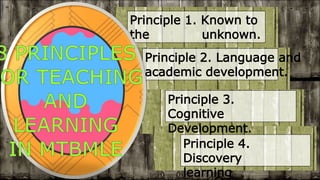




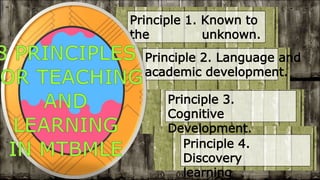








Principle 1. Known to
the unknown.
Principle 2. Language and
academic development.
Principle 3.
Cognitive
Development.
Principle 4.
Discovery
learning
Principle 5. Active
learning
Principle 6. Meaning and
Accuracy
Principle 7. Language
Learning/Language
Transfer
Principle 8. Affective
component: Valuing the
home language/culture
Principle 1. Known to the unk
Learning requires
meaning. We learn
when we use what we
already know to help
us understand what is
new.
“The most important
single factor influencing
learning is what the
learner already knows.
Ascertain this and teach
him accordingly.”
Ausubel, D.P.(1968).
Application: Start with what
the learners already know
about a topic and use that to
introduce the new concept.
Beginning with the learners’
first language and culture will
better facilitate mastery of
the curriculum content.
Principle 1. Known to the unk
Second language learners
use what they know in
their own language to
help develop other
languages. This positive
transfer effect has been
found to be significant in
reading.
Application: Develop
an awareness of how
the L1 works to
support learning the
L2, L3.
Claude Goldenberg
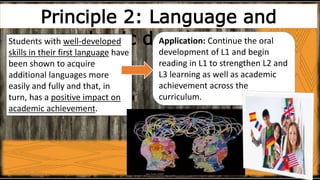
Principle 2: Language and
academic development.Students with well-developed
skills in their first language have
been shown to acquire
additional languages more
easily and fully and that, in
turn, has a positive impact on
academic achievement.
Application: Continue the oral
development of L1 and begin
reading in L1 to strengthen L2 and
L3 learning as well as academic
achievement across the
curriculum.
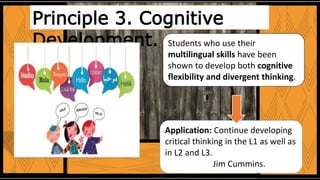
Students who use their
multilingual skills have been
shown to develop both cognitive
flexibility and divergent thinking.
Application: Continue developing
critical thinking in the L1 as well as
in L2 and L3.
Jim Cummins.
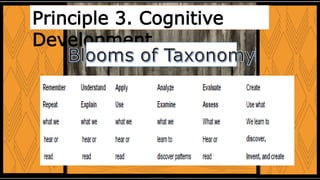
Principle 3. Cognitive
Development.
Principle 3. Cognitive
Development.
Higher Order Thinking Skills
When we truly learn
something, we can explain it,
apply it, analyze it, evaluate
it, and use it to create new
ideas and information
Application: In all subjects,
focus on activities that build
understanding and that
encourage students to apply,
analyze, and evaluate what
they have learned to create
new knowledge
Principle 3. Cognitive
Development.
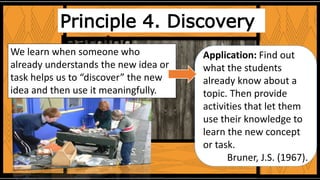
Principle 4. Discovery
learning
Application: Find out
what the students
already know about a
topic. Then provide
activities that let them
use their knowledge to
learn the new concept
or task.
Bruner, J.S. (1967).
We learn when someone who
already understands the new idea or
task helps us to “discover” the new
idea and then use it meaningfully.
Principle 1. Known to
the unknown.
Principle 2. Language and
academic development.
Principle 3.
Cognitive
Development.
Principle 4.
Discovery
learning
LET’S
RESUME
ALLRIGHT!!!
Principle 5. Active
learning
Principle 6. Meaning and
Accuracy
Principle 7. Language
Learning/Language
Transfer
Principle 8. Affective
component: Valuing the
home language/culture
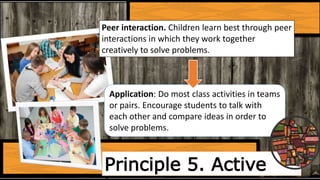
Principle 5. Active
Peer interaction. Children learn best through peer
interactions in which they work together
creatively to solve problems.
Application: Do most class activities in teams
or pairs. Encourage students to talk with
each other and compare ideas in order to
solve problems.
Principle 5. Active
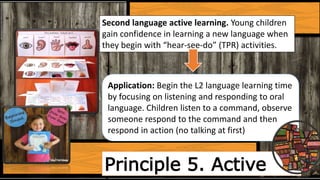
Second language active learning. Young children
gain confidence in learning a new language when
they begin with “hear-see-do” (TPR) activities.
Application: Begin the L2 language learning time
by focusing on listening and responding to oral
language. Children listen to a command, observe
someone respond to the command and then
respond in action (no talking at first)
Principle 5. Active
Purposeful Talk. Talking helps us make sense of
new ideas and information.
Application: 1) Ask a lot of “higher level”
questions and give students time to think and
then respond. 2) Provide plenty of opportunities
for students to work in teams, sharing and
comparing their ideas.
Principle 6. Meaning and
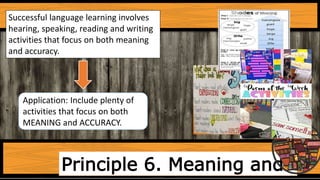
Successful language learning involves
hearing, speaking, reading and writing
activities that focus on both meaning
and accuracy.
Application: Include plenty of
activities that focus on both
MEANING and ACCURACY.
Principle 7. Language
Learning/
We learn a new language best
when the learning process is
non-threatening and
meaningful and when we can
take “small steps” that help us
gain confidence in our ability
to use the language
meaningfully.
Application: Begin the L2 language
learning time by focusing on “hear-
see-do” activities than enable
students to build up their “listening
vocabulary” before they are
expected to talk. Introduce reading
and writing in L2 only when they
have built up a good hearing and
speaking vocabulary.
Principle 7. Language
Learning/
Research in second-language acquisition indicates it
takes a minimum of 2 years to learn basic
communicative skills in a second language when society
supports that learning. It takes five years or more to
learn enough L2 for learning complex academic
concepts.
Thomas & Collier; 2003, Cummins, 2006
Principle 7. Language
Learning/
“Errors” are a normal part of second-
language learning. Second language
learners benefit from opportunities to
receive feedback in a respectful and
encouraging way. It is helpful when
teachers respond first to the content of
what the student is saying or writing…
focusing on one or two errors at a time.
Patsy M. Lightbown and Nina Spada
I made a
mistake
I made an
error
Principle 7. Language
Learning/
We learn a new language best
when the learning process is
non-threatening and
meaningful and when we can
take “small steps” that help us
gain confidence in our ability
to use the language
meaningfully.
Application: Begin the L2 language
learning time by focusing on “hear-
see-do” activities than enable
students to build up their “listening
vocabulary” before they are
expected to talk. Introduce reading
and writing in L2 only when they
have built up a good hearing and
speaking vocabulary.
Principle 8. Affective
component: Valuing the
Valuing students with talents
in their home language more
powerfully enables learning
than just valuing learners of
English whose home language
is irrelevant to academic
success.
Principle 8. Affective
component: Valuing the
Application: Learners are
encouraged when they know
they are valued in the classroom
and their language and heritage
are seen as resources.
Jim Cummins
Principle 8. Affective
component: Valuing the
The classroom environment
should also give a sense of
belongingness and
acceptance to the learners
Principle 8. Affective
component: Valuing the home

Guiding principles for

  • 4.
    Principle 1. Knownto the unknown. Principle 2. Language and academic development. Principle 3. Cognitive Development. Principle 4. Discovery learning
  • 5.
    Principle 5. Active learning Principle6. Meaning and Accuracy Principle 7. Language Learning/Language Transfer Principle 8. Affective component: Valuing the home language/culture
  • 6.
    Principle 1. Knownto the unk Learning requires meaning. We learn when we use what we already know to help us understand what is new. “The most important single factor influencing learning is what the learner already knows. Ascertain this and teach him accordingly.” Ausubel, D.P.(1968). Application: Start with what the learners already know about a topic and use that to introduce the new concept. Beginning with the learners’ first language and culture will better facilitate mastery of the curriculum content.
  • 7.
    Principle 1. Knownto the unk Second language learners use what they know in their own language to help develop other languages. This positive transfer effect has been found to be significant in reading. Application: Develop an awareness of how the L1 works to support learning the L2, L3. Claude Goldenberg
  • 8.
    Principle 2: Languageand academic development.Students with well-developed skills in their first language have been shown to acquire additional languages more easily and fully and that, in turn, has a positive impact on academic achievement. Application: Continue the oral development of L1 and begin reading in L1 to strengthen L2 and L3 learning as well as academic achievement across the curriculum.
  • 9.
    Students who usetheir multilingual skills have been shown to develop both cognitive flexibility and divergent thinking. Application: Continue developing critical thinking in the L1 as well as in L2 and L3. Jim Cummins. Principle 3. Cognitive Development.
  • 10.
    Principle 3. Cognitive Development. HigherOrder Thinking Skills When we truly learn something, we can explain it, apply it, analyze it, evaluate it, and use it to create new ideas and information Application: In all subjects, focus on activities that build understanding and that encourage students to apply, analyze, and evaluate what they have learned to create new knowledge
  • 11.
  • 12.
    Principle 4. Discovery learning Application:Find out what the students already know about a topic. Then provide activities that let them use their knowledge to learn the new concept or task. Bruner, J.S. (1967). We learn when someone who already understands the new idea or task helps us to “discover” the new idea and then use it meaningfully.
  • 14.
    Principle 1. Knownto the unknown. Principle 2. Language and academic development. Principle 3. Cognitive Development. Principle 4. Discovery learning
  • 15.
  • 16.
    Principle 5. Active learning Principle6. Meaning and Accuracy Principle 7. Language Learning/Language Transfer Principle 8. Affective component: Valuing the home language/culture
  • 17.
    Principle 5. Active Peerinteraction. Children learn best through peer interactions in which they work together creatively to solve problems. Application: Do most class activities in teams or pairs. Encourage students to talk with each other and compare ideas in order to solve problems.
  • 18.
    Principle 5. Active Secondlanguage active learning. Young children gain confidence in learning a new language when they begin with “hear-see-do” (TPR) activities. Application: Begin the L2 language learning time by focusing on listening and responding to oral language. Children listen to a command, observe someone respond to the command and then respond in action (no talking at first)
  • 19.
    Principle 5. Active PurposefulTalk. Talking helps us make sense of new ideas and information. Application: 1) Ask a lot of “higher level” questions and give students time to think and then respond. 2) Provide plenty of opportunities for students to work in teams, sharing and comparing their ideas.
  • 20.
    Principle 6. Meaningand Successful language learning involves hearing, speaking, reading and writing activities that focus on both meaning and accuracy. Application: Include plenty of activities that focus on both MEANING and ACCURACY.
  • 21.
    Principle 7. Language Learning/ Welearn a new language best when the learning process is non-threatening and meaningful and when we can take “small steps” that help us gain confidence in our ability to use the language meaningfully. Application: Begin the L2 language learning time by focusing on “hear- see-do” activities than enable students to build up their “listening vocabulary” before they are expected to talk. Introduce reading and writing in L2 only when they have built up a good hearing and speaking vocabulary.
  • 22.
    Principle 7. Language Learning/ Researchin second-language acquisition indicates it takes a minimum of 2 years to learn basic communicative skills in a second language when society supports that learning. It takes five years or more to learn enough L2 for learning complex academic concepts. Thomas & Collier; 2003, Cummins, 2006
  • 23.
    Principle 7. Language Learning/ “Errors”are a normal part of second- language learning. Second language learners benefit from opportunities to receive feedback in a respectful and encouraging way. It is helpful when teachers respond first to the content of what the student is saying or writing… focusing on one or two errors at a time. Patsy M. Lightbown and Nina Spada I made a mistake I made an error
  • 24.
    Principle 7. Language Learning/ Welearn a new language best when the learning process is non-threatening and meaningful and when we can take “small steps” that help us gain confidence in our ability to use the language meaningfully. Application: Begin the L2 language learning time by focusing on “hear- see-do” activities than enable students to build up their “listening vocabulary” before they are expected to talk. Introduce reading and writing in L2 only when they have built up a good hearing and speaking vocabulary.
  • 25.
    Principle 8. Affective component:Valuing the Valuing students with talents in their home language more powerfully enables learning than just valuing learners of English whose home language is irrelevant to academic success.
  • 26.
    Principle 8. Affective component:Valuing the Application: Learners are encouraged when they know they are valued in the classroom and their language and heritage are seen as resources. Jim Cummins
  • 27.
    Principle 8. Affective component:Valuing the The classroom environment should also give a sense of belongingness and acceptance to the learners
  • 28.