Washoe Tribe of Nevada & California Performance  Improvement
Course Content Performance management Initial exchange of expectations Ongoing performance feedback Annual reviews Performance appraisals Employee recognition
What is a performance appraisal?
What is performance management?
Performance management includes: Initial exchange of ____________ _________ performance  feedback Annual ________ Performance appraisals
Performance management includes: Initial exchange of  expectations Ongoing  performance  feedback Annual  reviews Performance appraisals
Initial exchange of expectations Between a new employee and supervisor Discussion on expectations
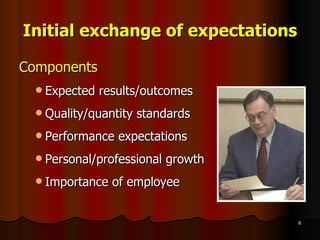
Initial exchange of expectations Components Expected results/outcomes Quality/quantity standards Performance expectations Personal/professional growth Importance of employee
Ongoing performance feedback Clear _________ of current reality Opportunity to ______ behavior Give and _____ exchange
Ongoing performance feedback Clear  picture  of current reality Opportunity to  adjust  behavior Give and  take  exchange
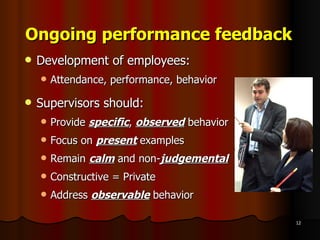
Ongoing performance feedback Development of employees: Attendance, performance, behavior Supervisors should: Provide _______, ________ behavior Focus on ________examples Remain ____ and non-___________ Constructive = Private Address ___________ behavior
Ongoing performance feedback Development of employees: Attendance, performance, behavior Supervisors should: Provide  specific ,  observed  behavior Focus on  present   examples Remain  calm  and non- judgemental Constructive = Private Address  observable  behavior
Ongoing performance feedback Most valuable opportunities = Successes Increase likelihood of _________ behavior ____________ ongoing feedback Provide _________  _________ in  the moment Timeliness will increase  effectiveness
Ongoing performance feedback Most valuable opportunities = Successes Increase likelihood of  repeated  behavior Document  ongoing feedback Provide  immediate   feedback  in  the moment Timeliness will increase  effectiveness
Repeat performances Remember… What gets  __________ … gets done! What gets  __________ …gets  _______ !
Repeat performances Remember… What gets  rewarded … gets done! What gets  recognized …gets  repeated !
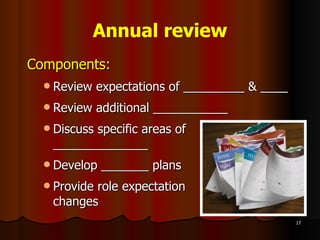
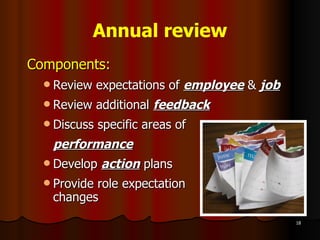
Annual review Components: Review expectations of _________ & ____ Review additional ___________ Discuss specific areas of  ______________ Develop _______ plans Provide role expectation  changes
Annual review Components: Review expectations of  employee  &  job Review additional  feedback Discuss specific areas of  performance Develop  action  plans Provide role expectation  changes
How good are they? Would you use them at home? Dear (spouse),  It is time for your annual performance appraisal. For the sake of our relationship and the well-being of the family unit, I want you to prepare for a discussion of your strengths and weaknesses and the ways you have fallen short of your goals for the year. ‘ Also, honey, I would like you to define some stretch goals for the coming year.’ Love, Yours truly
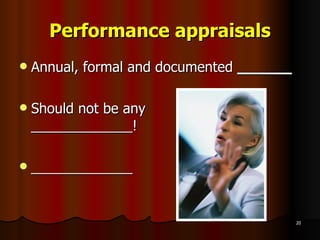
Performance appraisals Annual, formal and documented  ______ Should not be any  _____________! _____________
Performance appraisals Annual, formal and documented  event Should not be any  surprises ! Should be  balanced
Performance appraisals Components: Business _____ achieved _____ the results were achieved What was ____ achieved _____ setting
Performance appraisals Components: Business  results  achieved How  the results were achieved What was  not  achieved Goal  setting
Repeat performances Remember… What gets  _________ … gets done! What gets  __________ …gets  _______ !
Repeat performances Remember… What gets  rewarded … gets done! What gets  recognized …gets  repeated !
Performance appraisal tips _____  ______ Solicit _________ Do not _________  the conversation Gain __________ ______ document
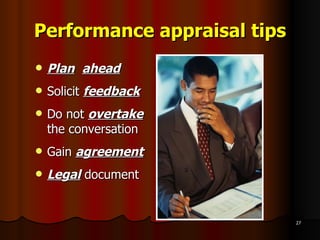
Performance appraisal tips Plan   ahead Solicit  feedback Do not  overtake   the conversation Gain  agreement Legal  document
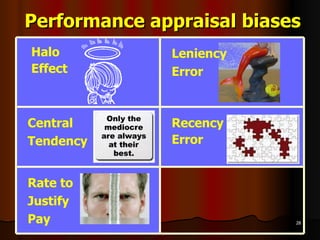
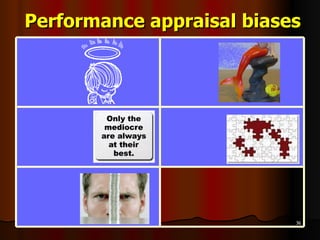
Performance appraisal biases Rate to Justify Pay Recency Error Central  Tendency Leniency Error Halo  Effect
Performance appraisal biases
Performance appraisal biases Halo  Effect
Performance appraisal biases Leniency Error Halo  Effect
Performance appraisal biases Central  Tendency Leniency Error Halo  Effect
Performance appraisal biases Recency Error Central  Tendency Leniency Error Halo  Effect
Performance appraisal biases Rate to Justify Pay Recency Error Central  Tendency Leniency Error Halo  Effect
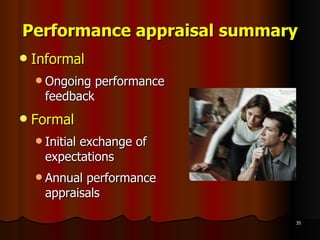
Performance appraisal summary Informal Ongoing performance feedback Formal Initial exchange of expectations Annual performance appraisals
Performance appraisal biases
Employee Recognition  Training for Supervisors Finally, the recognition I deserve!
"The greatest good you can do for another is not just to share your riches but to reveal to him his own."   ~ Benjamin Disraeli 
Why employee recognition? The goals of employee recognition: show ___________ for achievement _________ employees encourage repeat performances encourage loyalty  retain key employees keep employees _______
Why employee recognition? The goals of employee recognition: show  appreciation  for achievement motivate  employees encourage repeat performances encourage loyalty  retain key employees keep employees  happy
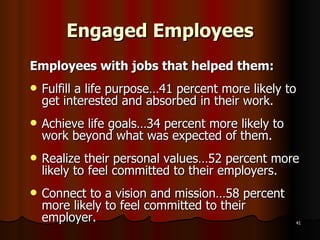
Engaged Employees Employees with jobs that helped them: Fulfill a life purpose…41 percent more likely to get interested and absorbed in their work. Achieve life goals…34 percent more likely to work beyond what was expected of them. Realize their personal values…52 percent more likely to feel committed to their employers. Connect to a vision and mission…58 percent more likely to feel committed to their employer.
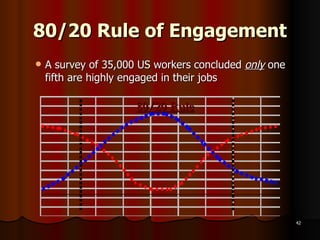
80/20 Rule of Engagement A survey of 35,000 US workers concluded  only  one fifth are highly engaged in their jobs 80/20 Rule
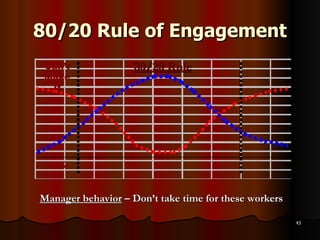
80/20 Rule of Engagement Can’t Make It 10% Manager behavior  – Don’t take time for these workers 80/20 Rule
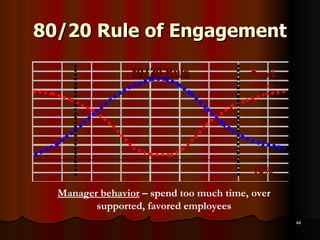
80/20 Rule of Engagement Can’t Miss 10% Manager behavior  – spend too much time, over supported, favored employees 80/20 Rule
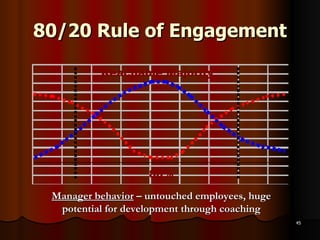
80/20 Rule of Engagement Reachable Majority 80% Manager behavior  – untouched employees, huge potential for development through coaching
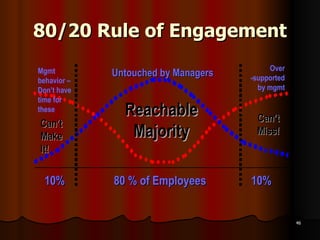
80/20 Rule of Engagement 10% 10% 80 % of Employees Mgmt behavior – Don’t have time for these Can’t Make It! Over -supported by mgmt Can’t Miss! Reachable Majority Untouched by Managers
What should you know about recognition? Reasons for recognition. Types of employee recognition. Why is recognition important? Other ideas for recognizing your employees?
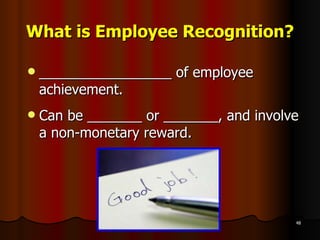
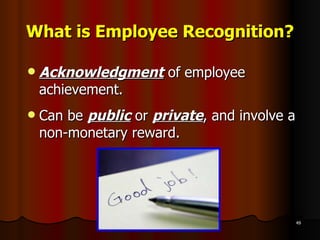
What is Employee Recognition? _________________ of employee achievement.  Can be _______ or _______, and involve a non-monetary reward.
What is Employee Recognition? Acknowledgment  of employee achievement.  Can be  public  or  private , and involve a non-monetary reward.
Types of Employee Recognition Years of Service Safety  Attendance Certifications  Customer Service Public Service Employee of the month, year Retirement Suggestion Program Performance This presentation focuses on  Performance  recognition.
Why is Employee Recognition  Important? Helps to ______ and ______ key  employees. ___________ employees to  perform at higher levels. Increases employee _____________. Can increase employee ______________. Can increase tribal revenues and profitability.
Why is Employee Recognition  Important? Helps to  attract  and  retain  key  employees. Motivates  employees to  perform at higher levels. Increases employee  productivity . Can increase employee  competitiveness . Can increase tribal revenues and profitability.
Why is Employee Recognition  Important? (cont’d) Improves ________ of service. Improves safety. May lower ______ levels. Reduces ________ism and ________ costs. Encourages employees to continue ___________ and _________. Fosters employment ___________.
Why is Employee Recognition  Important? (cont’d) Improves  quality  of service. Improves safety. May lower  stress  levels. Reduces  absentee ism and  turnover  costs. Encourages employees to continue  education   and  training . Fosters employment  longevity .
Examples of Deserving Performance Employee goes ______ and _______ what is expected in their job. Employee suggests a new process or idea that saves _____ or _______, or positively impacts department or team. Completes a significant  project ahead of ________  or exceptionally _____.
Examples of Deserving Performance Employee goes  above  and  beyond  what is expected in their job. Employee suggests a new process or idea that saves  time  or  effort , or positively impacts department or team. Completes a significant  project ahead of  schedule   or exceptionally  well .
Recognition Tips for Managers Offer employee reward options.  Identify what's meaningful to your employees.  Keep employee recognition fresh.  Recognize all levels of employees.  Make sure recognition is given consistently. Keep it simple. Keep it adaptable. Make it timely.
Best motivator Money goes to bills… Kudos go to the heart Never underestimate the power of simple recognition
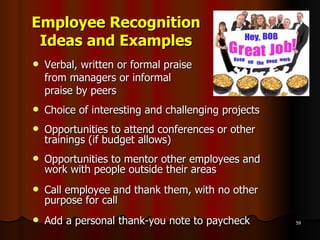
Employee Recognition Ideas and Examples Verbal, written or formal praise  from managers or informal  praise by peers Choice of interesting and challenging projects Opportunities to attend conferences or other trainings (if budget allows) Opportunities to mentor other employees and work with people outside their areas  Call employee and thank them, with no other purpose for call Add a personal thank-you note to paycheck
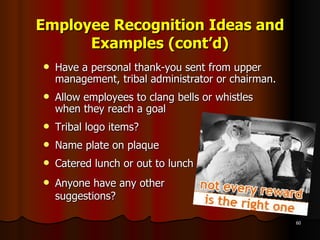
Employee Recognition Ideas and Examples (cont’d) Have a personal thank-you sent from upper management, tribal administrator or chairman. Allow employees to clang bells or whistles when they reach a goal  Tribal logo items? Name plate on plaque Catered lunch or out to lunch Anyone have any other  suggestions?
Employee Performance  Recognition Eligibility  – all employees should be eligible for   non-monetary recognition Awards should be made as close to the performance or result as possible.  Award criteria should be consistent with tribal, department and employee goals and objectives.  When appropriate, employee will be recognized at next staff meeting. Non-monetary rewards are encouraged and do not require a completed form or special approval.
Employee Performance  Recognition When does the majority of recognition happen? 80 to 100% of recognition is through  informal ,  regular   ongoing  feedback!
Repeat performances Remember… What gets _________ … gets done! What gets  __________ …gets  _______ !
Repeat performances Remember… What gets  rewarded … gets done! What gets  recognized …gets  repeated !
Please be sure to complete and leave the evaluation sheet you received with your handouts.  Thank you for your attention and interest!

Performance & Recognition

  • 1.
    Washoe Tribe ofNevada & California Performance Improvement
  • 2.
    Course Content Performancemanagement Initial exchange of expectations Ongoing performance feedback Annual reviews Performance appraisals Employee recognition
  • 3.
    What is aperformance appraisal?
  • 4.
  • 5.
    Performance management includes:Initial exchange of ____________ _________ performance feedback Annual ________ Performance appraisals
  • 6.
    Performance management includes:Initial exchange of expectations Ongoing performance feedback Annual reviews Performance appraisals
  • 7.
    Initial exchange ofexpectations Between a new employee and supervisor Discussion on expectations
  • 8.
    Initial exchange ofexpectations Components Expected results/outcomes Quality/quantity standards Performance expectations Personal/professional growth Importance of employee
  • 9.
    Ongoing performance feedbackClear _________ of current reality Opportunity to ______ behavior Give and _____ exchange
  • 10.
    Ongoing performance feedbackClear picture of current reality Opportunity to adjust behavior Give and take exchange
  • 11.
    Ongoing performance feedbackDevelopment of employees: Attendance, performance, behavior Supervisors should: Provide _______, ________ behavior Focus on ________examples Remain ____ and non-___________ Constructive = Private Address ___________ behavior
  • 12.
    Ongoing performance feedbackDevelopment of employees: Attendance, performance, behavior Supervisors should: Provide specific , observed behavior Focus on present examples Remain calm and non- judgemental Constructive = Private Address observable behavior
  • 13.
    Ongoing performance feedbackMost valuable opportunities = Successes Increase likelihood of _________ behavior ____________ ongoing feedback Provide _________ _________ in the moment Timeliness will increase effectiveness
  • 14.
    Ongoing performance feedbackMost valuable opportunities = Successes Increase likelihood of repeated behavior Document ongoing feedback Provide immediate feedback in the moment Timeliness will increase effectiveness
  • 15.
    Repeat performances Remember…What gets __________ … gets done! What gets __________ …gets _______ !
  • 16.
    Repeat performances Remember…What gets rewarded … gets done! What gets recognized …gets repeated !
  • 17.
    Annual review Components:Review expectations of _________ & ____ Review additional ___________ Discuss specific areas of ______________ Develop _______ plans Provide role expectation changes
  • 18.
    Annual review Components:Review expectations of employee & job Review additional feedback Discuss specific areas of performance Develop action plans Provide role expectation changes
  • 19.
    How good arethey? Would you use them at home? Dear (spouse), It is time for your annual performance appraisal. For the sake of our relationship and the well-being of the family unit, I want you to prepare for a discussion of your strengths and weaknesses and the ways you have fallen short of your goals for the year. ‘ Also, honey, I would like you to define some stretch goals for the coming year.’ Love, Yours truly
  • 20.
    Performance appraisals Annual,formal and documented ______ Should not be any _____________! _____________
  • 21.
    Performance appraisals Annual,formal and documented event Should not be any surprises ! Should be balanced
  • 22.
    Performance appraisals Components:Business _____ achieved _____ the results were achieved What was ____ achieved _____ setting
  • 23.
    Performance appraisals Components:Business results achieved How the results were achieved What was not achieved Goal setting
  • 24.
    Repeat performances Remember…What gets _________ … gets done! What gets __________ …gets _______ !
  • 25.
    Repeat performances Remember…What gets rewarded … gets done! What gets recognized …gets repeated !
  • 26.
    Performance appraisal tips_____ ______ Solicit _________ Do not _________ the conversation Gain __________ ______ document
  • 27.
    Performance appraisal tipsPlan ahead Solicit feedback Do not overtake the conversation Gain agreement Legal document
  • 28.
    Performance appraisal biasesRate to Justify Pay Recency Error Central Tendency Leniency Error Halo Effect
  • 29.
  • 30.
  • 31.
    Performance appraisal biasesLeniency Error Halo Effect
  • 32.
    Performance appraisal biasesCentral Tendency Leniency Error Halo Effect
  • 33.
    Performance appraisal biasesRecency Error Central Tendency Leniency Error Halo Effect
  • 34.
    Performance appraisal biasesRate to Justify Pay Recency Error Central Tendency Leniency Error Halo Effect
  • 35.
    Performance appraisal summaryInformal Ongoing performance feedback Formal Initial exchange of expectations Annual performance appraisals
  • 36.
  • 37.
    Employee Recognition Training for Supervisors Finally, the recognition I deserve!
  • 38.
    "The greatest goodyou can do for another is not just to share your riches but to reveal to him his own." ~ Benjamin Disraeli 
  • 39.
    Why employee recognition?The goals of employee recognition: show ___________ for achievement _________ employees encourage repeat performances encourage loyalty retain key employees keep employees _______
  • 40.
    Why employee recognition?The goals of employee recognition: show appreciation for achievement motivate employees encourage repeat performances encourage loyalty retain key employees keep employees happy
  • 41.
    Engaged Employees Employeeswith jobs that helped them: Fulfill a life purpose…41 percent more likely to get interested and absorbed in their work. Achieve life goals…34 percent more likely to work beyond what was expected of them. Realize their personal values…52 percent more likely to feel committed to their employers. Connect to a vision and mission…58 percent more likely to feel committed to their employer.
  • 42.
    80/20 Rule ofEngagement A survey of 35,000 US workers concluded only one fifth are highly engaged in their jobs 80/20 Rule
  • 43.
    80/20 Rule ofEngagement Can’t Make It 10% Manager behavior – Don’t take time for these workers 80/20 Rule
  • 44.
    80/20 Rule ofEngagement Can’t Miss 10% Manager behavior – spend too much time, over supported, favored employees 80/20 Rule
  • 45.
    80/20 Rule ofEngagement Reachable Majority 80% Manager behavior – untouched employees, huge potential for development through coaching
  • 46.
    80/20 Rule ofEngagement 10% 10% 80 % of Employees Mgmt behavior – Don’t have time for these Can’t Make It! Over -supported by mgmt Can’t Miss! Reachable Majority Untouched by Managers
  • 47.
    What should youknow about recognition? Reasons for recognition. Types of employee recognition. Why is recognition important? Other ideas for recognizing your employees?
  • 48.
    What is EmployeeRecognition? _________________ of employee achievement. Can be _______ or _______, and involve a non-monetary reward.
  • 49.
    What is EmployeeRecognition? Acknowledgment of employee achievement. Can be public or private , and involve a non-monetary reward.
  • 50.
    Types of EmployeeRecognition Years of Service Safety Attendance Certifications Customer Service Public Service Employee of the month, year Retirement Suggestion Program Performance This presentation focuses on Performance recognition.
  • 51.
    Why is EmployeeRecognition Important? Helps to ______ and ______ key employees. ___________ employees to perform at higher levels. Increases employee _____________. Can increase employee ______________. Can increase tribal revenues and profitability.
  • 52.
    Why is EmployeeRecognition Important? Helps to attract and retain key employees. Motivates employees to perform at higher levels. Increases employee productivity . Can increase employee competitiveness . Can increase tribal revenues and profitability.
  • 53.
    Why is EmployeeRecognition Important? (cont’d) Improves ________ of service. Improves safety. May lower ______ levels. Reduces ________ism and ________ costs. Encourages employees to continue ___________ and _________. Fosters employment ___________.
  • 54.
    Why is EmployeeRecognition Important? (cont’d) Improves quality of service. Improves safety. May lower stress levels. Reduces absentee ism and turnover costs. Encourages employees to continue education and training . Fosters employment longevity .
  • 55.
    Examples of DeservingPerformance Employee goes ______ and _______ what is expected in their job. Employee suggests a new process or idea that saves _____ or _______, or positively impacts department or team. Completes a significant project ahead of ________ or exceptionally _____.
  • 56.
    Examples of DeservingPerformance Employee goes above and beyond what is expected in their job. Employee suggests a new process or idea that saves time or effort , or positively impacts department or team. Completes a significant project ahead of schedule or exceptionally well .
  • 57.
    Recognition Tips forManagers Offer employee reward options. Identify what's meaningful to your employees. Keep employee recognition fresh. Recognize all levels of employees. Make sure recognition is given consistently. Keep it simple. Keep it adaptable. Make it timely.
  • 58.
    Best motivator Moneygoes to bills… Kudos go to the heart Never underestimate the power of simple recognition
  • 59.
    Employee Recognition Ideasand Examples Verbal, written or formal praise from managers or informal praise by peers Choice of interesting and challenging projects Opportunities to attend conferences or other trainings (if budget allows) Opportunities to mentor other employees and work with people outside their areas Call employee and thank them, with no other purpose for call Add a personal thank-you note to paycheck
  • 60.
    Employee Recognition Ideasand Examples (cont’d) Have a personal thank-you sent from upper management, tribal administrator or chairman. Allow employees to clang bells or whistles when they reach a goal Tribal logo items? Name plate on plaque Catered lunch or out to lunch Anyone have any other suggestions?
  • 61.
    Employee Performance Recognition Eligibility – all employees should be eligible for non-monetary recognition Awards should be made as close to the performance or result as possible. Award criteria should be consistent with tribal, department and employee goals and objectives. When appropriate, employee will be recognized at next staff meeting. Non-monetary rewards are encouraged and do not require a completed form or special approval.
  • 62.
    Employee Performance Recognition When does the majority of recognition happen? 80 to 100% of recognition is through informal , regular ongoing feedback!
  • 63.
    Repeat performances Remember…What gets _________ … gets done! What gets __________ …gets _______ !
  • 64.
    Repeat performances Remember…What gets rewarded … gets done! What gets recognized …gets repeated !
  • 65.
    Please be sureto complete and leave the evaluation sheet you received with your handouts. Thank you for your attention and interest!

Editor's Notes

  • #2 Welcome to Performance Improvement. Managing employee performance is the most important part of a managers job. A manager, by definition, does not get paid for what he does, but for what the employees who work for him do. Recognizing this, good managers do everything in their power to help employees succeed. Yet, even for successful managers, some employees are simply more difficult. Successful managers recognize that there are far fewer truly difficult employees than there are problematic behaviors. A managers job is not actually managing people, but managing peoples behavior within the restricted parameters of the business environment. Q: What percentage of recognition would you say is through the informal process of regular, frequent feedback? A: 80 % to 100 % For those who are on time …share “Improving Accountability ”
  • #3 During this course, we will explore the following topics: Performance management, Initial exchange of expectations, Ongoing performance feedback, Annual reviews, Performance appraisals, and Employee recognition
  • #4 A performance appraisal is an annual, formal, and documented event during which a supervisor provides an employee with a summary of his or her performance for the previous year. A performance appraisal is one of the tools that is utilized in performance management. SPEAKERS NOTES : Refer to … “ Performance Review Checklist” – something to help you and to share with your employees to make the annual appraisal a great experience. “ Documenting Your Accomplishments ” – for employees to track their own accomplishments or for managers to make notes for the next appraisal, Should employees do self appraisals? – “The Benefits of Self Appraisal” “ Performance Objectives ” - planning tool to use with employees to keep them focused and on track, “ Coaching Log ” - for supervisor’s note taking on employees conversations about what was discussed and “Performance Appraisal ” – for your annual formal appraisals HANDOUT: “ An Alternative Performance Appraisal” “ Take the Pain out of Conducting Employee Evaluations” in workbook
  • #5 Performance management is a process that allows a supervisor and an employee the opportunity to manage the performance of the employee. Specifically, performance management addresses all the contributions the employee has made toward moving the tribe forward as well as their own progress fulfilling personal and professional development goals. A performance management process should be designed with the tribe’s needs, goals, and values in mind. Who is familiar with the Vision Statement of the Washoe Nation? Vision Statement of the Washoe Nation Preserving, reviving and living the Washoe culture and traditions Where respect for one another and tribal values promote our spiritual, physical and environmental wellness Where educational opportunities are available for all tribal members and descendants Where a solid economic foundation ensures self-sufficiency for tribal success Where responsive government promotes teamwork, professionalism and accountability On safe and secure tribal lands SPEAKER NOTES: Refer to “ Benefits of Performance Management”
  • #6 Unlike a performance appraisal, performance management is a process and not a one-time event. Performance management includes the following components: Initial exchange of expectations , Ongoing performance feedback, Annual reviews , and Performance appraisals.
  • #7 Unlike a performance appraisal, performance management is a process and not a one-time event. Performance management includes the following components: Initial exchange of expectations , Ongoing performance feedback, Annual reviews , and Performance appraisals.
  • #8 An exchange of expectations should occur during the initial meeting between a new employee and a supervisor. The employee may be a new hire at the tribe or may have transferred from another department. The initial exchange of expectations should take place soon after the employee begins his or her new role. The purpose of the discussion relates to expectations for performance, objectives, and interpersonal relationships. The initial exchange of expectations should be a mutual exchange highlighting what the supervisor is expecting from the employee, as well as what the employee can expect from the supervisor. This dialogue will ensure that there are clear expectations prior to the employee’s first performance review. This allows the supervisor and employee relationship to begin with the same expectations.
  • #9 During the initial exchange, expectations should be discussed and agreed on. When setting expectations, consider including the following components: The results or outcomes that the employee is expected to achieve The quality and quantity standards of the role; Performance expectations and the standard of the job, team, supervisor, and how the employee fits in; Expectations for personal and professional development; and The importance of the employee’s role to customers, tribal members, their team, and the overall organization.
  • #10 The purpose of ongoing performance feedback is to provide a clear picture of the current reality of an employee’s performance. Ongoing performance feedback is required for employees to determine whether or how to adjust their behavior to meet expectations and goals. Ongoing performance feedback should be a give-and- take exchange that provides the employee with a clear picture of what behavior he was observed doing.
  • #11 The purpose of ongoing performance feedback is to provide a clear picture of the current reality of an employee’s performance. Ongoing performance feedback is required for employees to determine whether or how to adjust their behavior to meet expectations and goals. Ongoing performance feedback should be a give-and- take exchange that provides the employee with a clear picture of what behavior he was observed doing. SPEAKERS NOTES : Refer to “Is the Way You’re Working Working?”
  • #12 Supervisors provide ongoing feedback in an effort to help the development of an employees’ attendance, performance, and behavior. In addition, supervisors should solicit performance feedback from their employees in an effort to continue their own development. When providing ongoing performance feedback, supervisors should: Provide examples of specific , observed actions or behaviors without interpreting the employee’s intent; Focus on the present examples, not examples from the past; Remain calm and non- judgmental ; When delivering constructive feedback, make it a private conversation; and Address observable behavior that the employee can change.
  • #13 Supervisors provide ongoing feedback in an effort to help the development of an employees’ attendance, performance, and behavior. In addition, supervisors should solicit performance feedback from their employees in an effort to continue their own development. When providing ongoing performance feedback, supervisors should: Provide examples of specific , observed actions or behaviors without interpreting the employee’s intent; Focus on the present examples, not examples from the past; Remain calm and non- judgmental ; When delivering constructive feedback, make it a private conversation; and Address observable behavior that the employee can change.
  • #14 Contrary to misconceptions, ongoing performance feedback is not only meant to fix problem behavior. In fact, the most valuable opportunities for providing ongoing performance feedback are when employees have successes. Positive performance feedback increases the likelihood the behaviors that brought the success will be repeated because the employee was recognized. So increase the likelihood of repeated behavior. What gets rewarded gets done…what gets recognized gets repeated. Without ongoing performance feedback, directed to reinforce or eliminate behavior, employees may be uncertain about repeating behaviors or developing new ones, even if the supervisor wants the behaviors repeated. It is important to document ongoing performance feedback since it will assist the employee and the supervisor when conducting annual reviews and performance appraisals. Lastly, immediate feedback has the greatest impact because it allows the employee to understand what behavior is being observed. Although the feedback may need to be discussed in a private place, it doesn’t need to be scheduled in advance. When performance feedback cannot be given at the moment, provide it as soon as possible . Timeliness increases the effectiveness of the performance feedback for development purposes. SPEAKER NOTES: Refer to “ Performance Management Exercise #1 ” – Methods of ongoing performance feedback
  • #15 Contrary to misconceptions, ongoing performance feedback is not only meant to fix problem behavior. In fact, the most valuable opportunities for providing ongoing performance feedback are when employees have successes. Positive performance feedback increases the likelihood the behaviors that brought the success will be repeated because the employee was recognized. So increase the likelihood of repeated behavior. What gets rewarded gets done…what gets recognized gets repeated. Without ongoing performance feedback, directed to reinforce or eliminate behavior, employees may be uncertain about repeating behaviors or developing new ones, even if the supervisor wants the behaviors repeated. It is important to document ongoing performance feedback since it will assist the employee and the supervisor when conducting annual reviews and performance appraisals. Lastly, immediate feedback has the greatest impact because it allows the employee to understand what behavior is being observed. Although the feedback may need to be discussed in a private place, it doesn’t need to be scheduled in advance. When performance feedback cannot be given at the moment, provide it as soon as possible . Timeliness increases the effectiveness of the performance feedback for development purposes. FACT : 80 – 100% of Recogniton is through informal and regular ongoing feedback SPEAKER NOTES: Refer to “ Performance Management Exercise #1 ” – Methods of ongoing performance feedback
  • #16 Remember… if you want some type of behavior repeated the best rule of thumb is… What gets rewarded …gets done! What gets recognized …gets repeated !
  • #17 Remember… if you want some type of behavior repeated the best rule of thumb is… What gets rewarded …gets done! What gets recognized …gets repeated !
  • #18 The purpose of a annual review is to go over the expectations set in the initial exchange and monitor progress toward those expectations. The annual review is a formal event. Annual reviews allow supervisors and employees to monitor, track, and manage ongoing development and goal obtainment. Recommended components of the annual review include: Review the expectations of the employee and the job as discussed during the initial exchange of expectations, or the deliverables and goals discussed during the previous year’s performance appraisal, whichever is most recent ; Review any additional feedback that has been provided to the employee since the last formal performance management discussion; Discuss specific areas where performance has met or exceeded the expectation and areas that require future improvement; Develop action plans for ongoing development or performance improvements as needed; and Provide the employee with changes to the expectations of the role, if any, that were driven by a change in business needs, etc.
  • #19 The purpose of a annual review is to go over the expectations set in the initial exchange and monitor progress toward those expectations. The annual review is a formal event. Annual reviews allow supervisors and employees to monitor, track, and manage ongoing development and goal obtainment. Recommended components of the annual review include: Review the expectations of the employee and the job as discussed during the initial exchange of expectations, or the deliverables and goals discussed during the previous year’s performance appraisal, whichever is most recent ; Review any additional feedback that has been provided to the employee since the last formal performance management discussion; Discuss specific areas where performance has met or exceeded the expectation and areas that require future improvement; Develop action plans for ongoing development or performance improvements as needed; and Provide the employee with changes to the expectations of the role, if any, that were driven by a change in business needs, etc.
  • #20 If the appraisal process is so useful, maybe we should consider using it in our personal lives. Would we say something like this to our spouse or significant other… Dear (spouse), It is time for your annual performance appraisal. For the sake of our relationship and the well-being of the family unit, I want you to prepare for a discussion of your strengths and weaknesses and the ways you have fallen short of your goals for the year. ‘ Also, honey, I would like you to define some stretch goals for the coming year.’ Some people may feel performance appraisals are a waste of time and that they’re actively harmful to motivation and happiness at work. They aren’t …if they are done right. That’s why we’re here today. What is wrong with the way this one is done.
  • #21 As stated earlier, a performance appraisal is an annual, formal, and documented event during which supervisors provide employees with summaries of their performances for the previous year. When the supervisor has shared ongoing feedback throughout the year, there shouldn’t be any surprises during the performance appraisal discussion. It’s common to overemphasize recent events and de-emphasize earlier ones when writing a performance review. This is a mistake . It should be balanced for the entire year’s events If an employee previously shined in his job and has lately had more trouble, the annual performance review should address both periods.
  • #22 As stated earlier, a performance appraisal is an annual, formal, and documented event during which supervisors provide employees with summaries of their performances for the previous year. When the supervisor has shared ongoing feedback throughout the year, there shouldn’t be any surprises during the performance appraisal discussion. It’s common to overemphasize recent events and de-emphasize earlier ones when writing a performance review. This is a mistake . It should be balanced for the entire year’s events If an employee previously shined in his job and has lately had more trouble, the annual performance review should address both periods.
  • #23 Recommended components of the performance appraisal in this order include: Make a note that it is always good to start off on a positive note and ease into the negative and how they can improve the negative. Business results achieved — make a list of which goals, objectives, expectations, and results were achieved. Also, explain how each impacted the tribe if possible. How the results were achieved — Provide specific, dated explanations of each goal, objective, expectation, or result achieved. Describe the behaviors that were demonstrated or the actions taken that led to the achievements. What was not achieved — Review what didn’t go well during the prior period. Specifically, what goals, objectives, expectations, or results were not achieved? Why weren’t they met? Goal setting — The performance appraisal discussion should focus on planning for future development and goal achievement. Limit time spent on judging past performance. This discussion should include new business goals, objectives, or results that are to be achieved during the next review period. Effective business goals support the goals and objectives of the team, the department, and the tribe.
  • #24 Recommended components of the performance appraisal in this order include: Make a note that it is always good to start off on a positive note and ease into the negative and how they can improve the negative. Business results achieved — make a list of which goals, objectives, expectations, and results were achieved. Also, explain how each impacted the tribe if possible. How the results were achieved — Provide specific, dated explanations of each goal, objective, expectation, or result achieved. Describe the behaviors that were demonstrated or the actions taken that led to the achievements. What was not achieved — Review what didn’t go well during the prior period. Specifically, what goals, objectives, expectations, or results were not achieved? Why weren’t they met? Goal setting — The performance appraisal discussion should focus on planning for future development and goal achievement. Limit time spent on judging past performance. This discussion should include new business goals, objectives, or results that are to be achieved during the next review period. Effective business goals support the goals and objectives of the team, the department, and the tribe.
  • #25 Let’s re-visit repeat performances…Fill-in the blanks. How do we get good things repeated. What gets rewarded …gets done. What gets recognized … gets repeated .
  • #26 Let’s re-visit repeat performances…Fill-in the blanks. How do we get good things repeated. What gets rewarded …gets done. What gets recognized … gets repeated .
  • #27 As you begin to conduct your performance appraisal discussions, consider the following: Plan ahead — The general rule of thumb is to schedule a performance appraisal discussion 30 days in advance. This allows you time to prepare and, if requested, allows the employee time to complete his or her self-appraisal prior to the discussion. The self appraisal can help you determine if the employee understands how they are doing in your eyes. It also allows them to feel good about providing input for their own appraisal. You must get it back and review it before you complete your appraisal. The self-appraisal must be used in a positive light to get the employee’s buy-in to how they are doing and what needs to be accomplished. The self-appraisal can backfire if not used properly. If the self –appraisal is totally off base it will have the opposite affect. You must find ways to use it in a positive light. Thank them for their input and let them know that it helps you to better understand their view of their own accomplishments and challenges. Solicit feedback — Soliciting feedback from the employee’s co-workers, other departments, customers and/or tribal members will help to create an overall picture of the employee’s performance. This is called a 360 degree evaluation. This feedback must be kept anonymous and confidential to be effective. You may want to read them over but you probably shouldn’t share them with the employee. Do not use these against the employee as it will have a negative affect. Instead, try to gain insights from them of how other people perceive the employee. You are getting input from all sides which helps you evaluate them more objectively. Do not take overtake the conversation — The performance appraisal discussion is about the employee and how he or she is doing in the role. The conversation should be, at a minimum, a 50 / 50 discussion. Ask the employee leading questions, and build on his or her ideas and comments. Gain agreement — At the end of the performance appraisal discussion, reiterate the key points to ensure that there is a clear understanding of what is expected prior to the next review period. Clarify any action items and assign deadlines to items. Legal document — All performance documents, including the performance appraisal form, are considered legal documents. Document only observable, performance-based behaviors. Comments on the performance appraisal should not be subjective or personal, only performance-related.
  • #28 As you begin to conduct your performance appraisal discussions, consider the following: Plan ahead — The general rule of thumb is to schedule a performance appraisal discussion 30 days in advance. This allows you time to prepare and, if requested, allows the employee time to complete his or her self-appraisal prior to the discussion. The self appraisal can help you determine if the employee understands how they are doing in your eyes. It also allows them to feel good about providing input for their own appraisal. You must get it back and review it before you complete your appraisal. The self-appraisal must be used in a positive light to get the employee’s buy-in to how they are doing and what needs to be accomplished. The self-appraisal can backfire if not used properly. If the self –appraisal is totally off base it will have the opposite affect. You must find ways to use it in a positive light. Thank them for their input and let them know that it helps you to better understand their view of their own accomplishments and challenges. Solicit feedback — Soliciting feedback from the employee’s co-workers, other departments, customers and/or tribal members will help to create an overall picture of the employee’s performance. This is called a 360 degree evaluation. This feedback must be kept anonymous and confidential to be effective. You may want to read them over but you probably shouldn’t share them with the employee. Do not use these against the employee as it will have a negative affect. Instead, try to gain insights from them of how other people perceive the employee. You are getting input from all sides which helps you evaluate them more objectively. Do not overtake the conversation — The performance appraisal discussion is about the employee and how he or she is doing in the role. The conversation should be, at a minimum, a 50 / 50 discussion. Ask the employee leading questions, and build on his or her ideas and comments. Gain agreement — At the end of the performance appraisal discussion, reiterate the key points to ensure that there is a clear understanding of what is expected prior to the next review period. Clarify any action items and assign deadlines to items. Legal document — All performance documents, including the performance appraisal form, are considered legal documents. Document only observable, performance-based behaviors. Comments on the performance appraisal should not be subjective or personal, only performance-related.

  • #29 To ensure the most effective performance appraisals and a performance management process that is fair and consistent, it is important to understand some biases that may interfere with providing performance feedback. Supervisors need to be aware of these biases and avoid them when evaluating employee performance. Halo effect — The halo effect refers to the tendency to rate an employee’s overall performance on an evaluation based on only one trait or characteristic . Leniency error — A leniency error occurs when a supervisor evaluates all employees at the high end of the performance scale. The effects of the leniency error are two-fold. First, it skews the results of the employee’s performance so drastically that the data is not valuable. Second, it creates unrealistic employee confidence in performance areas where improvement is needed. It puts them all on a pedestal and makes them out to be something they’re not. Central tendency — Occurs when all employees are evaluated at the center or average mark on the performance scale. This happens when the supervisor fails to collect enough detailed performance data to differentiate employees, or because it is easier to mark everyone in the middle . Recency error — The recency error occurs when performance feedback is not captured throughout the entire review period. When data is not collected throughout the entire period, the supervisor creates a performance appraisal based only on the last couple of months or whatever events he or she can remember. This error happens when the only performance data used for the review is data that has occurred recently. You don’t have all the pieces of the puzzle so you can’t see the whole picture. Rate to justify pay — Occurs when the supervisor rates the employee’s performance to match whatever pay increase is being given . When possible, separate the performance appraisal discussion from the wage review. Often times, pay is tied to budget or other financial considerations and not to performance only. This separation will lead to the elimination of the rate to justify pay error.
  • #30 To ensure the most effective performance appraisals and a performance management process that is fair and consistent, it is important to understand some biases that may interfere with providing performance feedback. Supervisors need to be aware of these biases and avoid them when evaluating employee performance. Halo effect — The halo effect refers to the tendency to rate an employee’s overall performance on an evaluation based on only one trait or characteristic. Leniency error — A leniency error occurs when a supervisor evaluates all employees at the high end of the performance scale. The effects of the leniency error are two-fold. First, it skews the results of the employee’s performance so drastically that the data is not valuable. Second, it creates unrealistic employee confidence in performance areas where improvement is needed. It puts them all on a pedestal and makes them out to be something they’re not. Central tendency — Occurs when all employees are evaluated at the center or average mark on the performance scale. This happens when the supervisor fails to collect enough detailed performance data to differentiate employees, or because it is easier to mark everyone in the middle. Recency error — The recency error occurs when performance feedback is not captured throughout the entire review period. When data is not collected throughout the entire period, the supervisor creates a performance appraisal based only on the last couple of months or whatever events he or she can remember. This error happens when the only performance data used for the review is data that has occurred recently. You don’t have all the pieces of the puzzle so you can’t see the whole picture. Rate to justify pay — Occurs when the supervisor rates the employee’s performance to match whatever pay increase is being given. When possible, separate the performance appraisal discussion from the wage review. Often times, pay is tied to budget or other financial considerations and not to performance only. This separation will lead to the elimination of the rate to justify pay error.
  • #31 To ensure the most effective performance appraisals and a performance management process that is fair and consistent, it is important to understand some biases that may interfere with providing performance feedback. Supervisors need to be aware of these biases and avoid them when evaluating employee performance. Halo effect — The halo effect refers to the tendency to rate an employee’s overall performance on an evaluation based on only one trait or characteristic. Leniency error — A leniency error occurs when a supervisor evaluates all employees at the high end of the performance scale. The effects of the leniency error are two-fold. First, it skews the results of the employee’s performance so drastically that the data is not valuable. Second, it creates unrealistic employee confidence in performance areas where improvement is needed. It puts them all on a pedestal and makes them out to be something they’re not. Central tendency — Occurs when all employees are evaluated at the center or average mark on the performance scale. This happens when the supervisor fails to collect enough detailed performance data to differentiate employees, or because it is easier to mark everyone in the middle. Recency error — The recency error occurs when performance feedback is not captured throughout the entire review period. When data is not collected throughout the entire period, the supervisor creates a performance appraisal based only on the last couple of months or whatever events he or she can remember. This error happens when the only performance data used for the review is data that has occurred recently. You don’t have all the pieces of the puzzle so you can’t see the whole picture. Rate to justify pay — Occurs when the supervisor rates the employee’s performance to match whatever pay increase is being given. When possible, separate the performance appraisal discussion from the wage review. Often times, pay is tied to budget or other financial considerations and not to performance only. This separation will lead to the elimination of the rate to justify pay error.
  • #32 To ensure the most effective performance appraisals and a performance management process that is fair and consistent, it is important to understand some biases that may interfere with providing performance feedback. Supervisors need to be aware of these biases and avoid them when evaluating employee performance. Halo effect — The halo effect refers to the tendency to rate an employee’s overall performance on an evaluation based on only one trait or characteristic. Leniency error — A leniency error occurs when a supervisor evaluates all employees at the high end of the performance scale. The effects of the leniency error are two-fold. First, it skews the results of the employee’s performance so drastically that the data is not valuable. Second, it creates unrealistic employee confidence in performance areas where improvement is needed. It puts them all on a pedestal and makes them out to be something they’re not. Central tendency — Occurs when all employees are evaluated at the center or average mark on the performance scale. This happens when the supervisor fails to collect enough detailed performance data to differentiate employees, or because it is easier to mark everyone in the middle. Recency error — The recency error occurs when performance feedback is not captured throughout the entire review period. When data is not collected throughout the entire period, the supervisor creates a performance appraisal based only on the last couple of months or whatever events he or she can remember. This error happens when the only performance data used for the review is data that has occurred recently. You don’t have all the pieces of the puzzle so you can’t see the whole picture. Rate to justify pay — Occurs when the supervisor rates the employee’s performance to match whatever pay increase is being given. When possible, separate the performance appraisal discussion from the wage review. Often times, pay is tied to budget or other financial considerations and not to performance only. This separation will lead to the elimination of the rate to justify pay error.
  • #33 To ensure the most effective performance appraisals and a performance management process that is fair and consistent, it is important to understand some biases that may interfere with providing performance feedback. Supervisors need to be aware of these biases and avoid them when evaluating employee performance. Halo effect — The halo effect refers to the tendency to rate an employee’s overall performance on an evaluation based on only one trait or characteristic. Leniency error — A leniency error occurs when a supervisor evaluates all employees at the high end of the performance scale. The effects of the leniency error are two-fold. First, it skews the results of the employee’s performance so drastically that the data is not valuable. Second, it creates unrealistic employee confidence in performance areas where improvement is needed. It puts them all on a pedestal and makes them out to be something they’re not. Central tendency — Occurs when all employees are evaluated at the center or average mark on the performance scale. This happens when the supervisor fails to collect enough detailed performance data to differentiate employees, or because it is easier to mark everyone in the middle. Recency error — The recency error occurs when performance feedback is not captured throughout the entire review period. When data is not collected throughout the entire period, the supervisor creates a performance appraisal based only on the last couple of months or whatever events he or she can remember. This error happens when the only performance data used for the review is data that has occurred recently. You don’t have all the pieces of the puzzle so you can’t see the whole picture. Rate to justify pay — Occurs when the supervisor rates the employee’s performance to match whatever pay increase is being given. When possible, separate the performance appraisal discussion from the wage review. Often times, pay is tied to budget or other financial considerations and not to performance only. This separation will lead to the elimination of the rate to justify pay error.
  • #34 To ensure the most effective performance appraisals and a performance management process that is fair and consistent, it is important to understand some biases that may interfere with providing performance feedback. Supervisors need to be aware of these biases and avoid them when evaluating employee performance. Halo effect — The halo effect refers to the tendency to rate an employee’s overall performance on an evaluation based on only one trait or characteristic. Leniency error — A leniency error occurs when a supervisor evaluates all employees at the high end of the performance scale. The effects of the leniency error are two-fold. First, it skews the results of the employee’s performance so drastically that the data is not valuable. Second, it creates unrealistic employee confidence in performance areas where improvement is needed. It puts them all on a pedestal and makes them out to be something they’re not. Central tendency — Occurs when all employees are evaluated at the center or average mark on the performance scale. This happens when the supervisor fails to collect enough detailed performance data to differentiate employees, or because it is easier to mark everyone in the middle. Recency error — The recency error occurs when performance feedback is not captured throughout the entire review period. When data is not collected throughout the entire period, the supervisor creates a performance appraisal based only on the last couple of months or whatever events he or she can remember. This error happens when the only performance data used for the review is data that has occurred recently. You don’t have all the pieces of the puzzle so you can’t see the whole picture. Rate to justify pay — Occurs when the supervisor rates the employee’s performance to match whatever pay increase is being given. When possible, separate the performance appraisal discussion from the wage review. Often times, pay is tied to budget or other financial considerations and not to performance only. This separation will lead to the elimination of the rate to justify pay error.
  • #35 To ensure the most effective performance appraisals and a performance management process that is fair and consistent, it is important to understand some biases that may interfere with providing performance feedback. Supervisors need to be aware of these biases and avoid them when evaluating employee performance. Halo effect — The halo effect refers to the tendency to rate an employee’s overall performance on an evaluation based on only one trait or characteristic. Leniency error — A leniency error occurs when a supervisor evaluates all employees at the high end of the performance scale. The effects of the leniency error are two-fold. First, it skews the results of the employee’s performance so drastically that the data is not valuable. Second, it creates unrealistic employee confidence in performance areas where improvement is needed. It puts them all on a pedestal and makes them out to be something they’re not. Central tendency — Occurs when all employees are evaluated at the center or average mark on the performance scale. This happens when the supervisor fails to collect enough detailed performance data to differentiate employees, or because it is easier to mark everyone in the middle. Recency error — The recency error occurs when performance feedback is not captured throughout the entire review period. When data is not collected throughout the entire period, the supervisor creates a performance appraisal based only on the last couple of months or whatever events he or she can remember. This error happens when the only performance data used for the review is data that has occurred recently. You don’t have all the pieces of the puzzle so you can’t see the whole picture. Rate to justify pay — Occurs when the supervisor rates the employee’s performance to match whatever pay increase is being given. When possible, separate the performance appraisal discussion from the wage review. Often times, pay is tied to budget or other financial considerations and not to performance only. This separation will lead to the elimination of the rate to justify pay error.
  • #36 Performance feedback is critical to an employee’s development and success; therefore, it needs to be provided on an ongoing basis. Performance management provides informal performance feedback through ongoing performance feedback. In addition, formal performance feedback tools include: The initial exchange of expectations, Annual performance appraisals SPEAKER NOTES: Refer to “Performance Management Exercise #2” – Performance Scenarios Refer to Performance Management Exercise #3 - “ Intent of Performance Management”
  • #37 Let’s Revisit Performance Appraisal Biases Refer to the worksheet in your workbook and fill in what you remember.
  • #38 So let’s learn more about recognition for employees. Regular employee recognition can improve general overall morale and in turn makes you a better supervisor.
  • #40 The goal of employee recognition is to show appreciation for an employee’s achievement and motivate employees to continue with good performance and loyalty to the tribe. Recognition also encourages employees to repeat the same performance. Successful employee recognition will help the organization to retain key employees and keep employees happy along the way. Keeping employees happy has been proven to improve performance and productivity as well, and it works in retaining employees much longer term than employees who are not happy. Speaker’s note: refer to article in workbook At Work, Feeling Good Matters for future reading. Engagement definition: meaningful work… OR …fulfilling one’s purpose, realizing personal values and achieving life goals through work… realizing one’s full potential, even having a social impact.
  • #41 The goal of employee recognition is to show appreciation for an employee’s achievement and motivate employees to continue with good performance and loyalty to the tribe. Recognition also encourages employees to repeat the same performance. Successful employee recognition will help the organization to retain key employees and keep employees happy along the way. Keeping employees happy has been proven to improve performance and productivity as well, and it works in retaining employees much longer term than employees who are not happy. Speaker’s note: refer to article in workbook At Work, Feeling Good Matters for future reading. Engagement definition: meaningful work… OR …fulfilling one’s purpose, realizing personal values and achieving life goals through work… realizing one’s full potential, even having a social impact.
  • #42 SPEAKERS NOTES : Show “ Engagement PPT”
  • #43 80/20 Rule of Engagement 2600 US workers surveyed: Only one in every four (25%) employees indicated that their managers coach them to improve performance. Forty two percent (42%) say that their manager gives them regular feedback on their performance Just 29% say that they are rewarded when they do a good job. A survey of 35,000 US workers concluded only one fifth are highly engaged in their jobs
  • #44 The bottom 10% don’t need help since they’ll never make it. Don’t give up on anybody since you don’t know for sure who will make the cut-off.
  • #45 The top 10 % don’t need your help since they are self driven. They can’t miss. Everything they do, they do good.
  • #46 The red line represents how managers typically coach. They coach the worst because they need the most help and they coach the best because they are the favorites, the top performers, the bosses pet.
  • #47 80 % of your workers should get the majority of your time for coaching and effort to engage them. The bottom 10% don’t need help since they’ll never make it. Don’t give up on anybody since you don’t know for sure who will make the cut-off. The top 10 % don’t need your help since they are self driven. They can’t miss. Everything they do, they do good. The red line represents how managers typically coach. They coach the worst because they need the most help and they coach the best because they are the favorites, the top performers, the bosses pet. 2600 US workers surveyed: Only one-fourth of employees indicated that their managers coach them to improve performance. Forty two percent say that their manager gives them regular feedback on their performance Just 29% say that they are rewarded when they do a good job. Of 35,000 US workers surveyed only one-fifth say they are highly engaged in their jobs.
  • #48 Participant involvement…Use flip charts to get input Give examples of reasons for recognition. List some types of employee recognition. Why is employee recognition important? What are some other ideas for recognizing your employees?
  • #49 What is employee recognition? Acknowledgment of employee achievement or accomplishment Can be public or private . Sometimes it’s as simple as telling them what a “ good job they are doing ” or that you are “ happy to have them as part of your team ”. What is the best non-monetary reward? Do you know what your employees likes and dislikes are????? Build a relationship, get to know them.
  • #50 What is employee recognition? Acknowledgment of employee achievement or accomplishment Can be public or private . Sometimes it’s as simple as telling them what a “ good job they are doing ” or that you are “ happy to have them as part of your team ”. What is the best non-monetary reward? Do you know what your employees likes and dislikes are????? Build a relationship, get to know them.
  • #51 There are a lot of different reasons to give praise and recognize your employees. Almost any reason is a good reason to recognize them for accomplishments that benefit the tribe in some form or another. Of all the different reasons we are going to focus on recognition for their performance.
  • #52 Why is recognition important? It helps to attract key employees when the word gets out that the tribe treats their employees well. It also helps retain employees that we don’t want to lose. Helps attract and retain key employees. It motivates employees to do better, higher quality work and perform a higher levels. It also motivates them be more productive ( increases employee productivity) which, in turn, can increase employee competitiveness . Increased competitiveness can, in turn, result in even higher productivity levels. Overall, this can all contribute to the tribe’s bottom line profitability. When that happens we all win!
  • #53 Why is recognition important? It helps to attract key employees when the word gets out that the tribe treats their employees well. It also helps retain employees that we don’t want to lose. Helps attract and retain key employees. It motivates employees to do better, higher quality work and perform a higher levels. It also motivates them be more productive ( increases employee productivity) which, in turn, can increase employee competitiveness . Increased competitiveness can, in turn, result in even higher productivity levels. Overall, this can all contribute to the tribe’s bottom line profitability. When that happens we all win!
  • #54 Employee recognition improves the overall quality of service we provide which improves the tribe’s public image. Recognition can also improve safety and security through a caring workforce. While positive recognition can lower stress levels it can also reduce absentee ism and turnover costs. It all makes for a healthier environment to work in. And finally, it encourages employees to continue education and training which fosters employment longevity and produces a more quality workforce.
  • #55 Employee recognition improves the overall quality of service we provide which improves the tribe’s public image. Recognition can also improve safety and security through a caring workforce. While positive recognition can lower stress levels it can also reduce absentee ism and turnover costs. It all makes for a healthier environment to work in. And finally, it encourages employees to continue education and training which fosters employment longevity and produces a more quality workforce.
  • #56 Some examples of performance that is deserving of recognition are: The employee goes above and beyond what is expected in their job. For this there is an outstanding service award submitted by directors. It includes a 2.5% pay increase. The employee suggests a new process or idea that saves time or effort , or positively impacts their department or team. The employee completes a significant project ahead of schedule or they do exceptionally well at their assignment.
  • #57 Some examples of performance that is deserving of recognition are: The employee goes above and beyond what is expected in their job. For this there is an outstanding service award submitted by directors. It includes a 2.5% pay increase. The employee suggests a new process or idea that saves time or effort , or positively impacts their department or team. The employee completes a significant project ahead of schedule or they do exceptionally well at their assignment.
  • #58 Offer employee reward options. Identify what's meaningful to your employees. Keep employee recognition fresh. Recognize all levels of employees. Make sure recognition is given consistently. Keep it simple. Keep it adaptable. Make it timely.
  • #60 Some examples and ideas of employee recognition are very simple. So simple, in fact that you can’t cite lack of time as an excuse to not be using some of these all the time . And the more you use them the better and more loyal your team will become. Verbal, written or formal praise from managers from time to time is excellent reinforcement. Informal praise by peers should be encouraged when appropriate. Recognition from peers can go a long way to improve a stressful environment or just improve the overall employee morale. Whenever you can afford to offer your employees a choice of assignments as recognition it can serve as a huge motivator. Allowing an employee to attend a simple class that they want to take is a great way to recognize them. Allowing them to attend a conference or other trainings especially serves as significant recognition. Try giving them an opportunity to mentor other employees and work with people outside their department whenever possible. Call employee and thank them, with no other purpose for call…this is huge and it is so simple! Add a personal thank-you note to paycheck or just a thank you for your hard work on a sticky note has a big impact.
  • #61 Have a personal thank-you sent from upper management, tribal administrator or chairman. Allow employees to clang bells or whistles when they reach a goal Tribal logo items? Name plate on plaque Catered lunch or out to lunch Anyone have any other suggestions? SPEAKER NOTES : Survey information “What do employees really want?”
  • #62 Eligibility – all employees should be eligible for non-monetary recognition Awards should be made as close to the performance or result as possible. Award criteria should be consistent with tribal, department and employee goals and objectives. When appropriate, employee will be recognized at next staff meeting. Non-monetary rewards are encouraged and do not require a completed form or special approval.
  • #64 Remember… What gets rewarded…gets done! What gets recognized …gets repeated !
  • #65 Remember… What gets rewarded…gets done! What gets recognized …gets repeated !