Performance Management

MSHRD UWI -2006
Performance Management

Identify

the major determinants of individual performance.
Discuss the three general purposes of performance
management.
Identify the five criteria for effective performance-management
systems.
Discuss the four approaches to performance management, the
specific techniques used in each approach, and the way these
approaches compare with the criteria for effective performancemanagement systems.
Performance Management
Choose

the most effective approach to performance
measurement for a given situation.
Discuss the advantages and disadvantages of the different
sources of performance information.
Choose the most effective source(s) for performance
information for any situation.
Distinguish types of rating errors and explain how to minimize
each in a performance evaluation.
Performance Management
Understand

the performance appraisal process
Conduct an effective performance feedback session.
Identify the characteristics of a performance measurement
system that follows legal guidelines.
Introduction
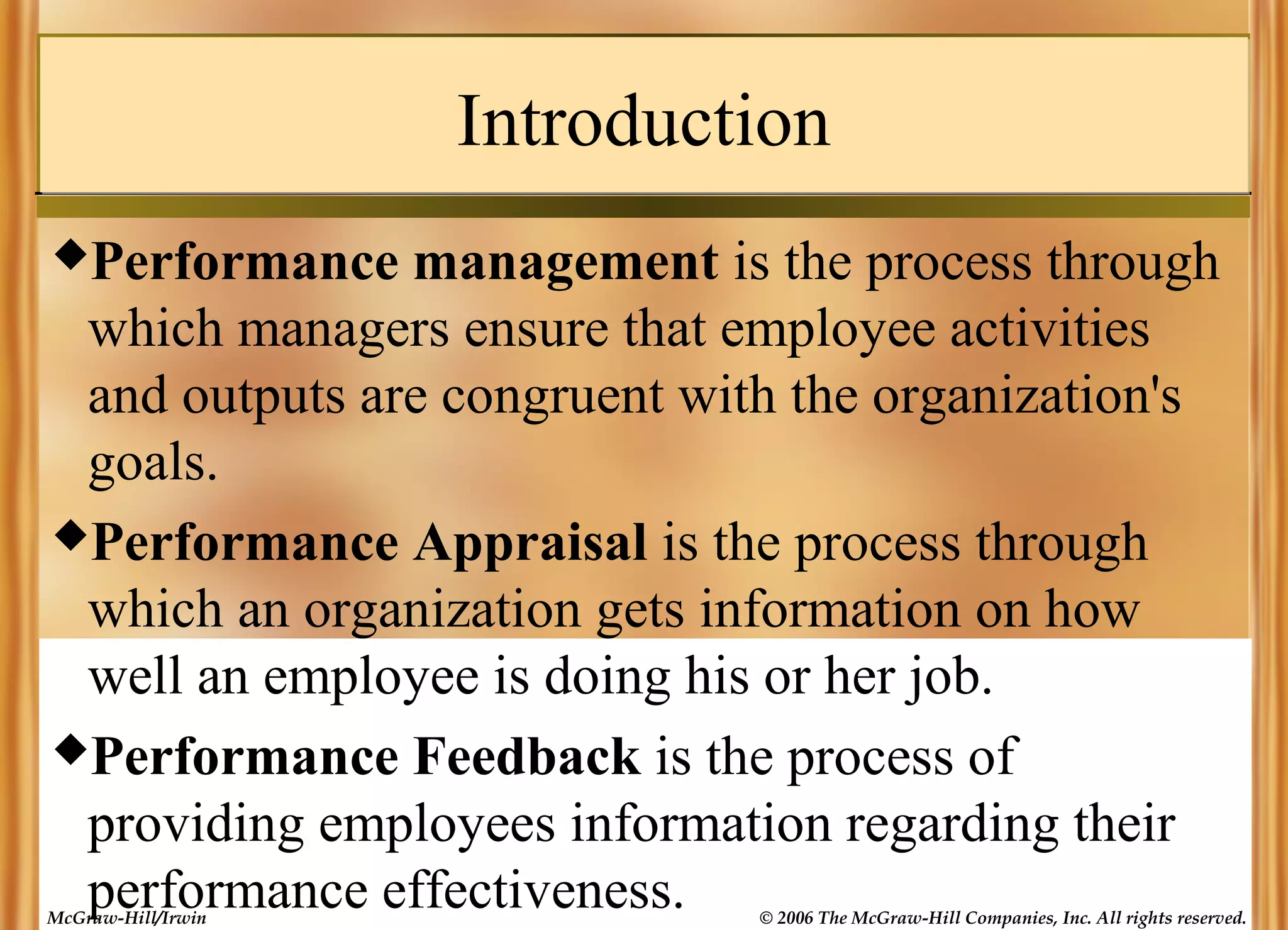
Performance

management is the process through
which managers ensure that employee activities
and outputs are congruent with the organization's
goals.
Performance Appraisal is the process through
which an organization gets information on how
well an employee is doing his or her job.
Performance Feedback is the process of
providing employees information regarding their
performance effectiveness.

McGraw-Hill/Irwin

© 2006 The McGraw-Hill Companies, Inc. All rights reserved.
PERFORMANCE APPRAISAL VS
PERFORMANCE MANAGEMENT
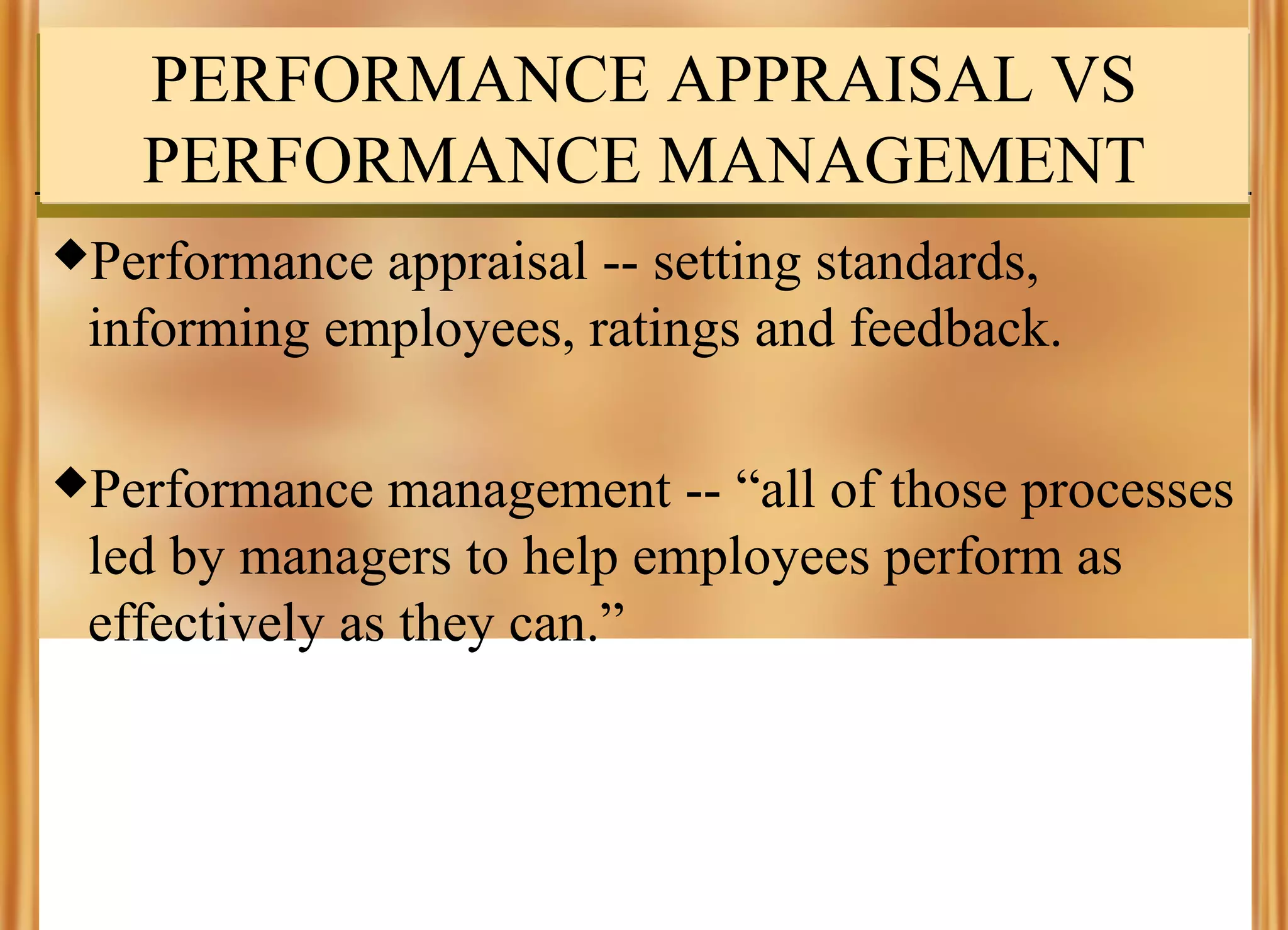
Performance

appraisal -- setting standards,
informing employees, ratings and feedback.

Performance

management -- “all of those processes
led by managers to help employees perform as
effectively as they can.”
GOALS OF PERFORMANCE
MANAGEMENT
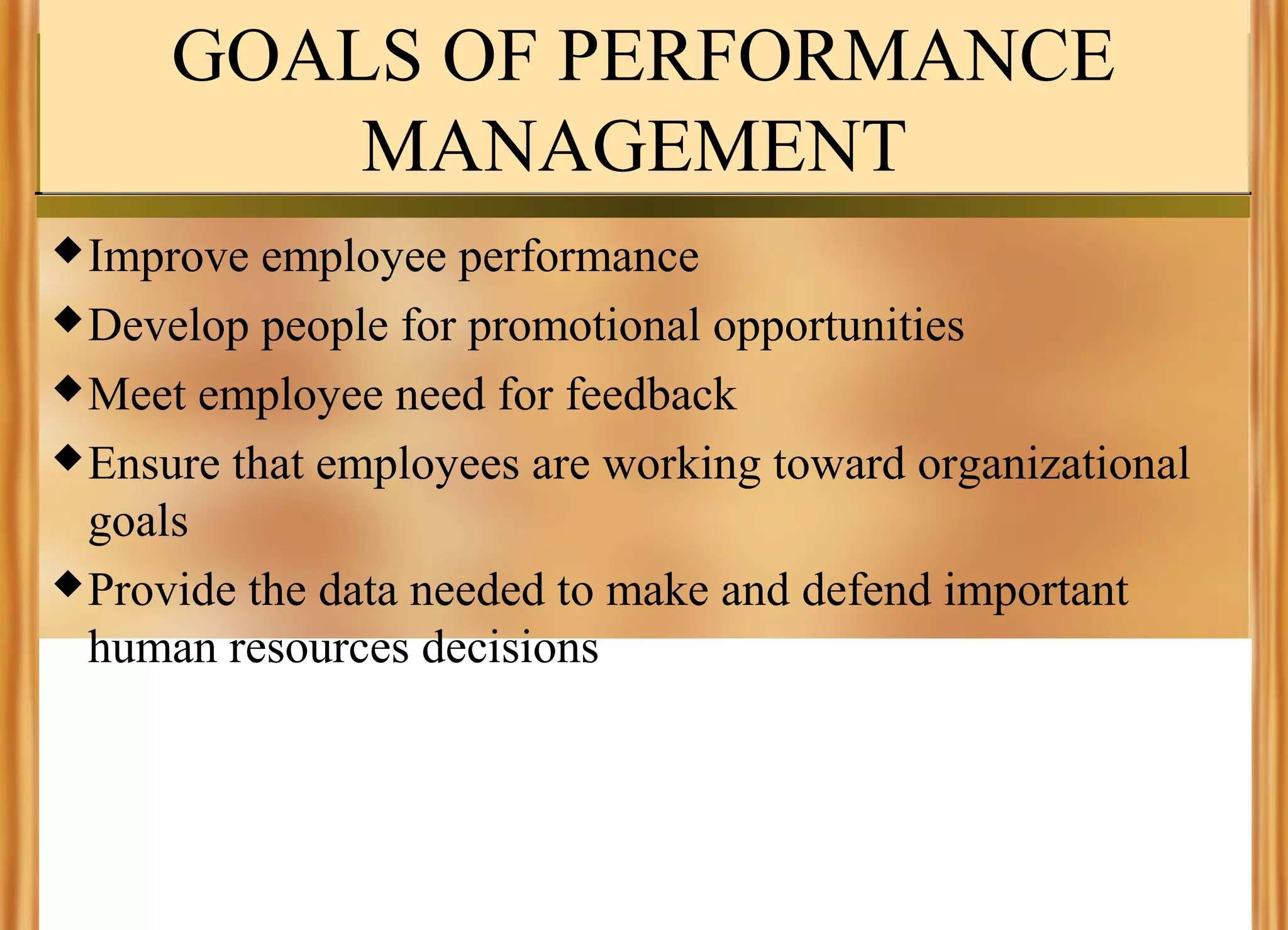
 Improve

employee performance
 Develop people for promotional opportunities
 Meet employee need for feedback
 Ensure that employees are working toward organizational
goals
 Provide the data needed to make and defend important
human resources decisions
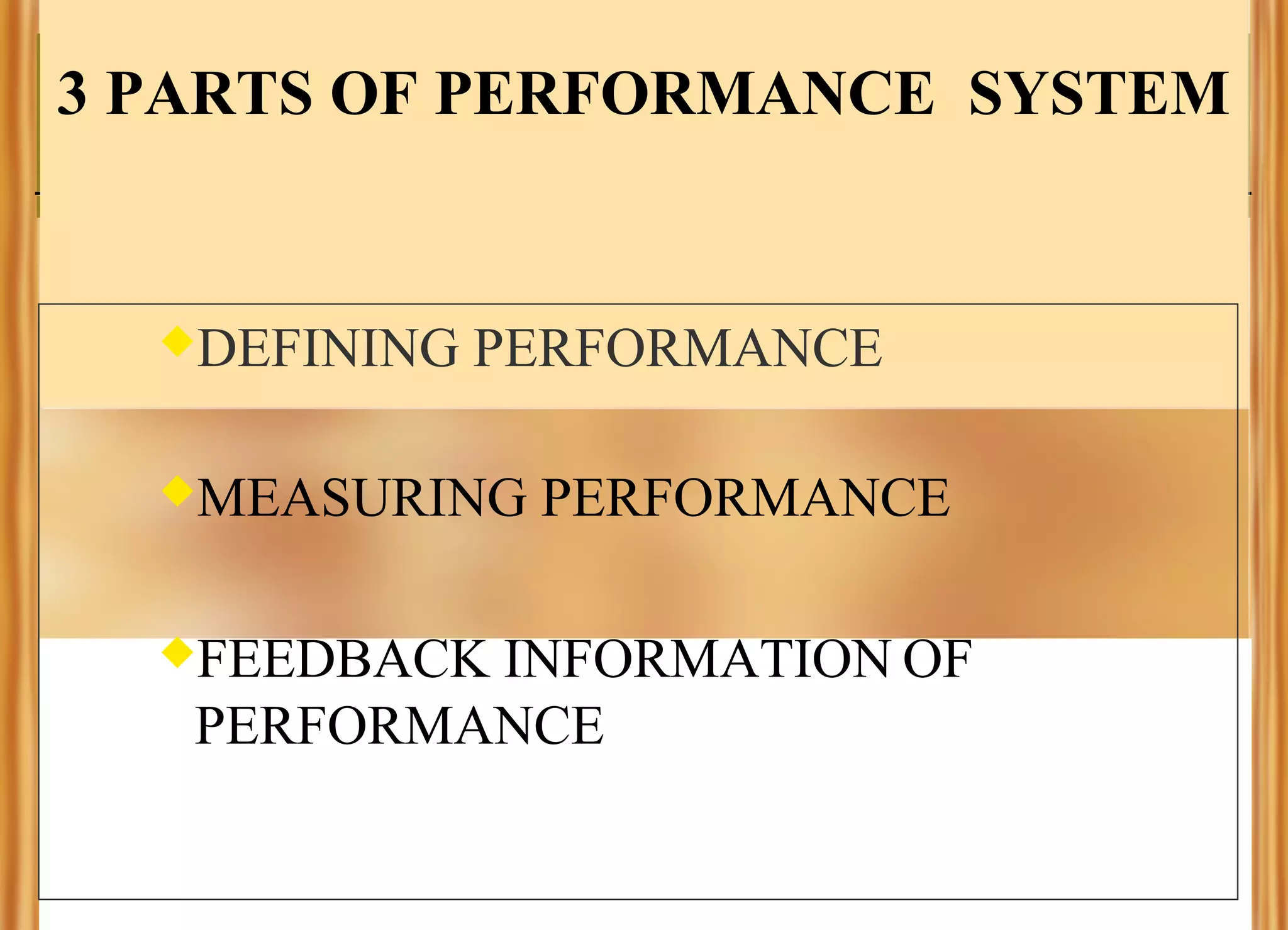
3 PARTS OF PERFORMANCE SYSTEM

DEFINING

PERFORMANCE

MEASURING

FEEDBACK

PERFORMANCE

INFORMATION OF
PERFORMANCE
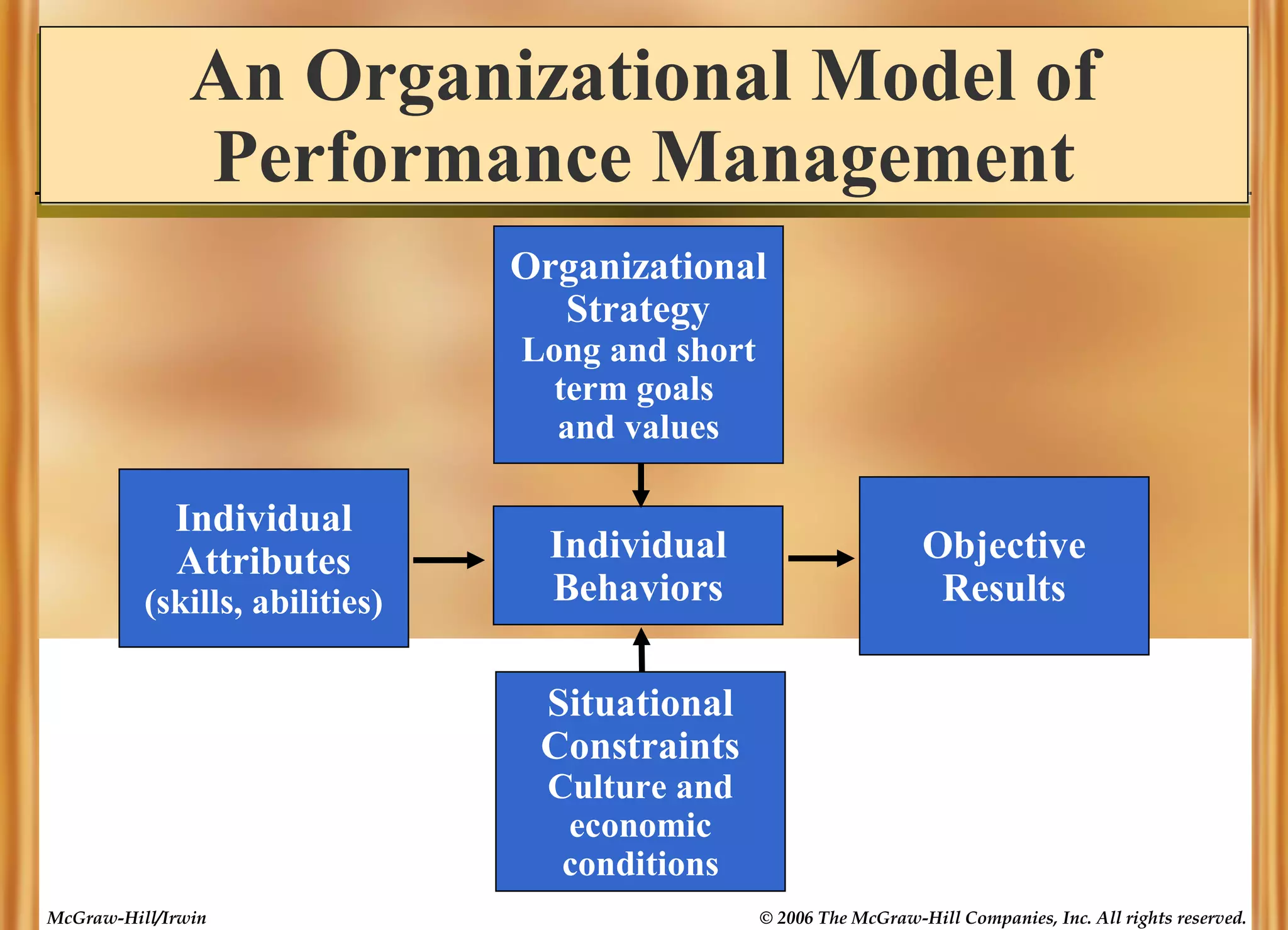
An Organizational Model of
Performance Management
Organizational
Strategy
Long and short
term goals
and values

Individual
Attributes

(skills, abilities)

Individual
Behaviors

Objective
Results

Situational
Constraints
Culture and
economic
conditions

McGraw-Hill/Irwin

© 2006 The McGraw-Hill Companies, Inc. All rights reserved.
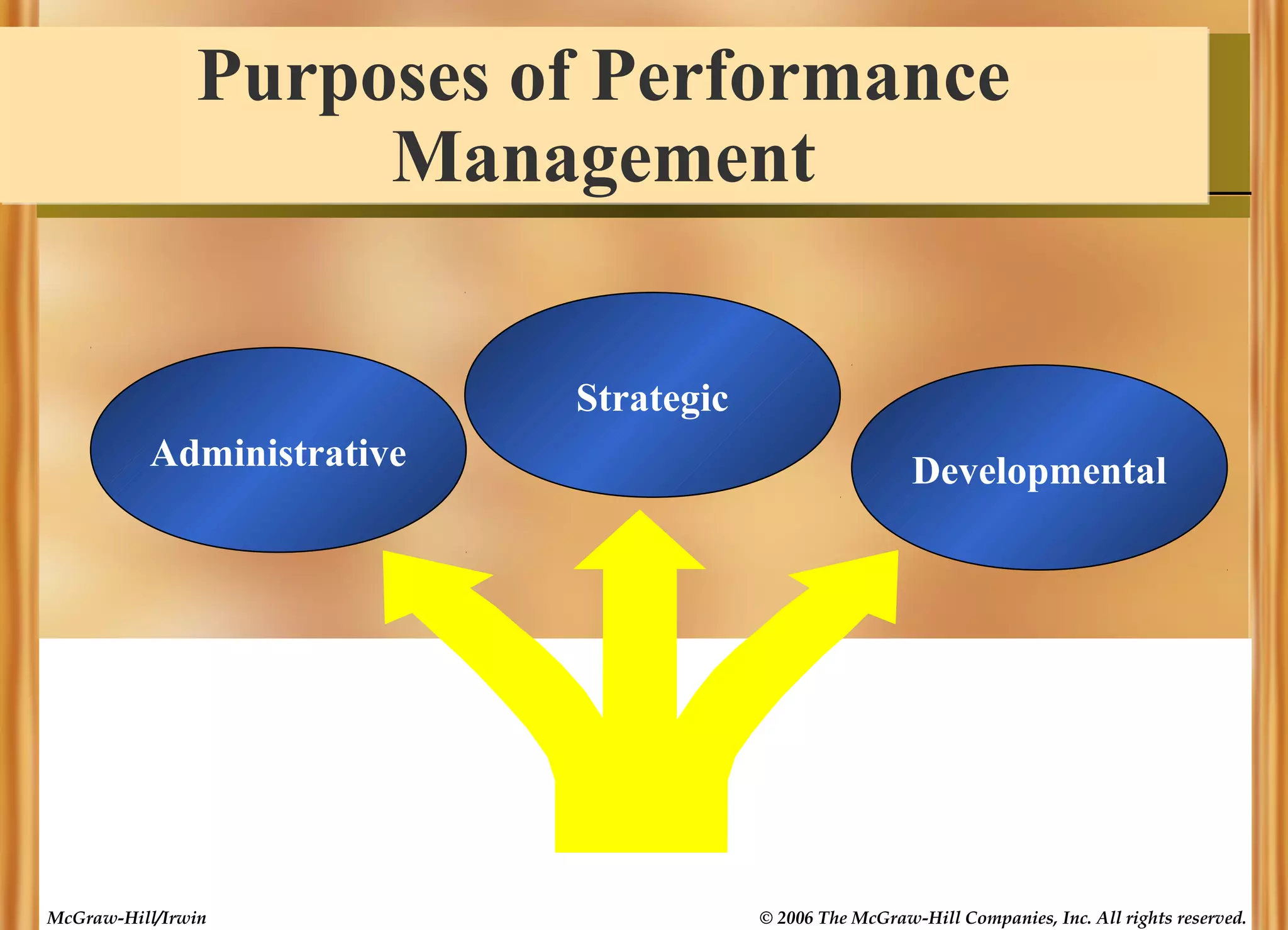
Purposes of Performance
Management
Strategic
Administrative

McGraw-Hill/Irwin

Developmental

© 2006 The McGraw-Hill Companies, Inc. All rights reserved.
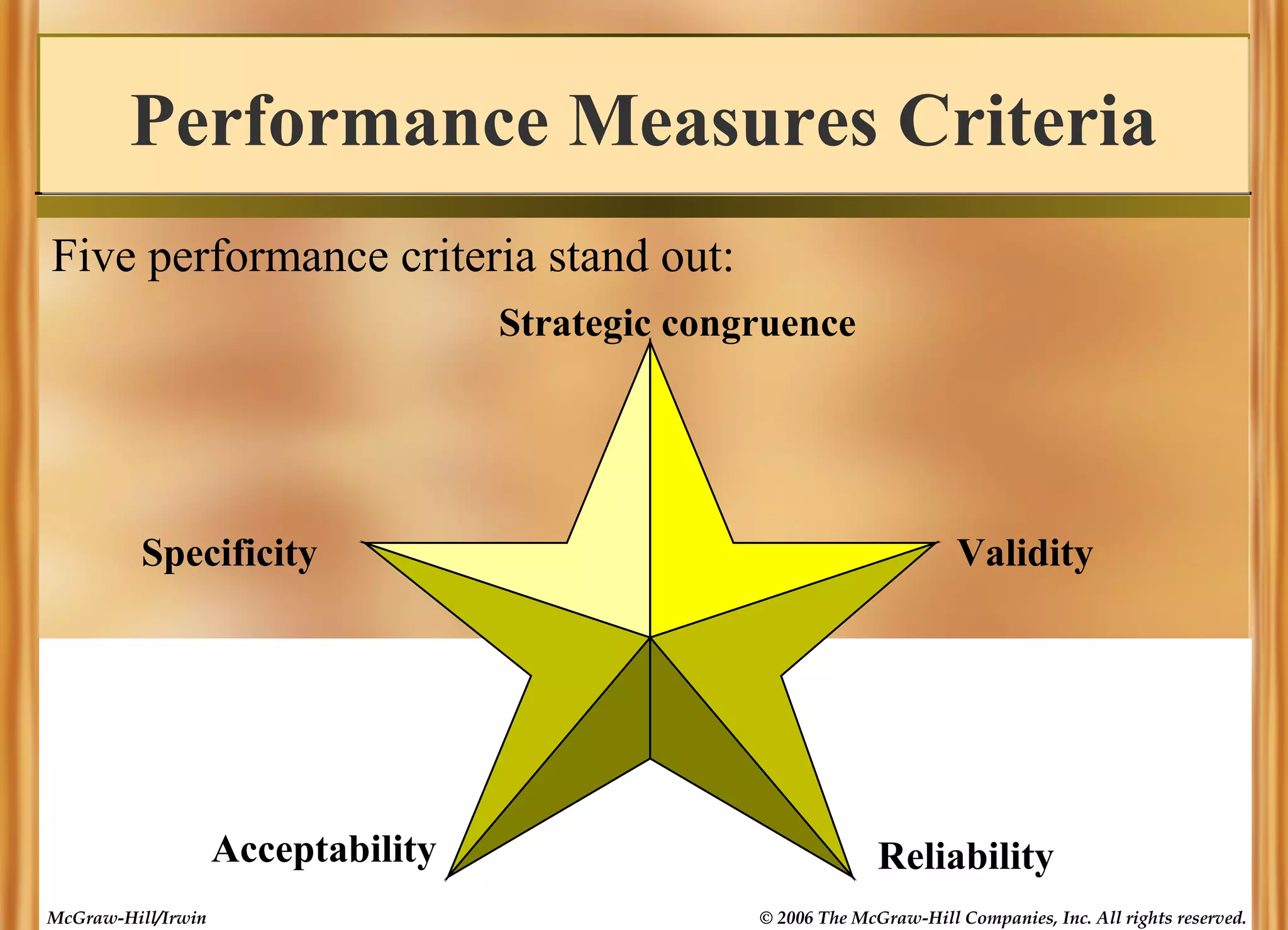
Performance Measures Criteria
Five performance criteria stand out:
Strategic congruence

Specificity

Acceptability
McGraw-Hill/Irwin

Validity

Reliability
© 2006 The McGraw-Hill Companies, Inc. All rights reserved.
Performance Measures Criteria
All approaches and techniques used for measuring and
managing performance must be evaluated against the
criteria of :
- Strategic Congruence
- Validity
-Reliability
- Acceptability
-Specificity
STRATEGIC CONGRUENCE
DEFINITION:
The extent to which the performance management
system elicits its job
performance that is congruent with the
organisation’s strategy, goals and culture.
VALIDITY
DEFINITION:
The extent to which the performance measure
assesses all the relevant – and only the relevant
aspects of performance.
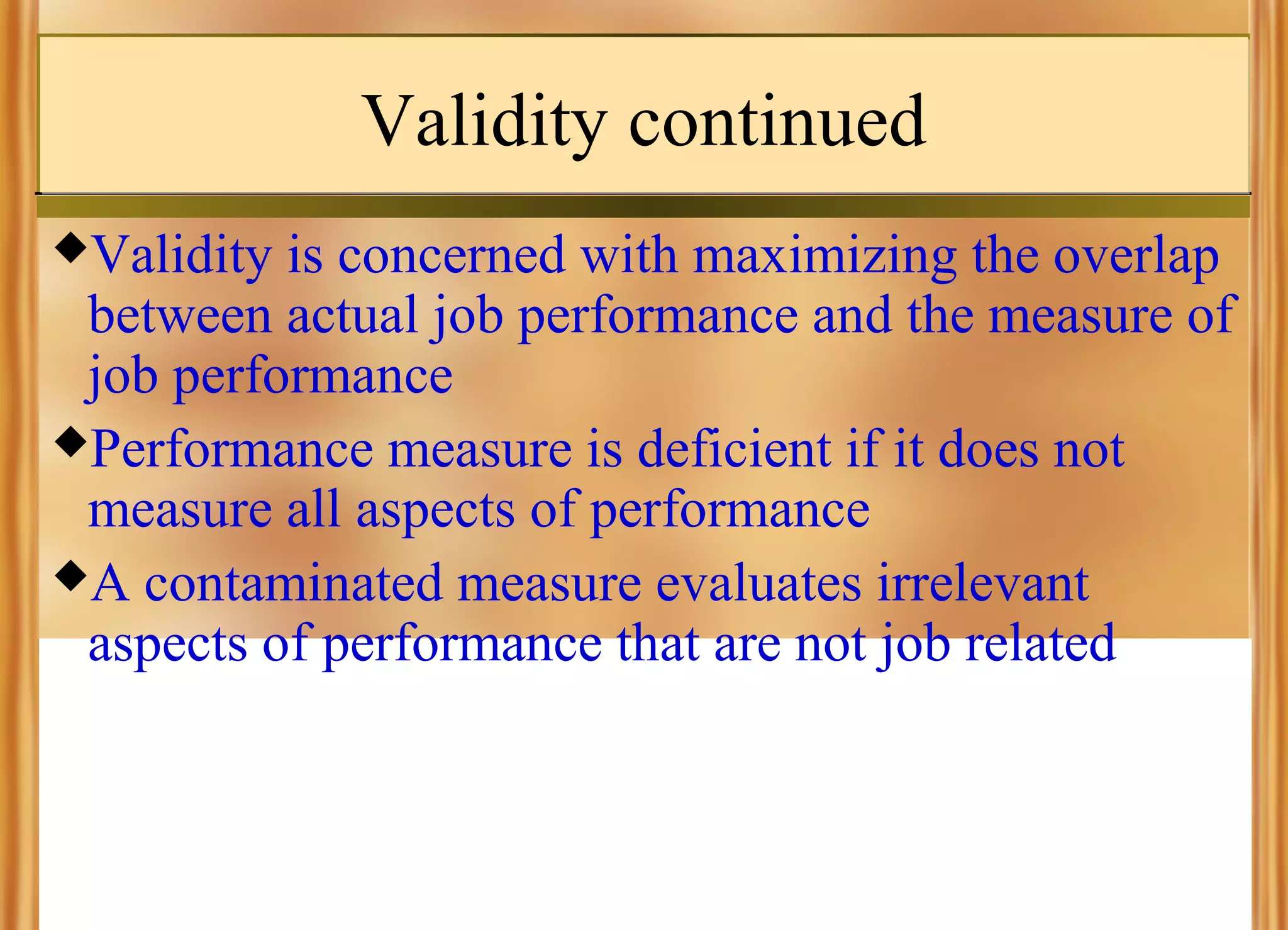
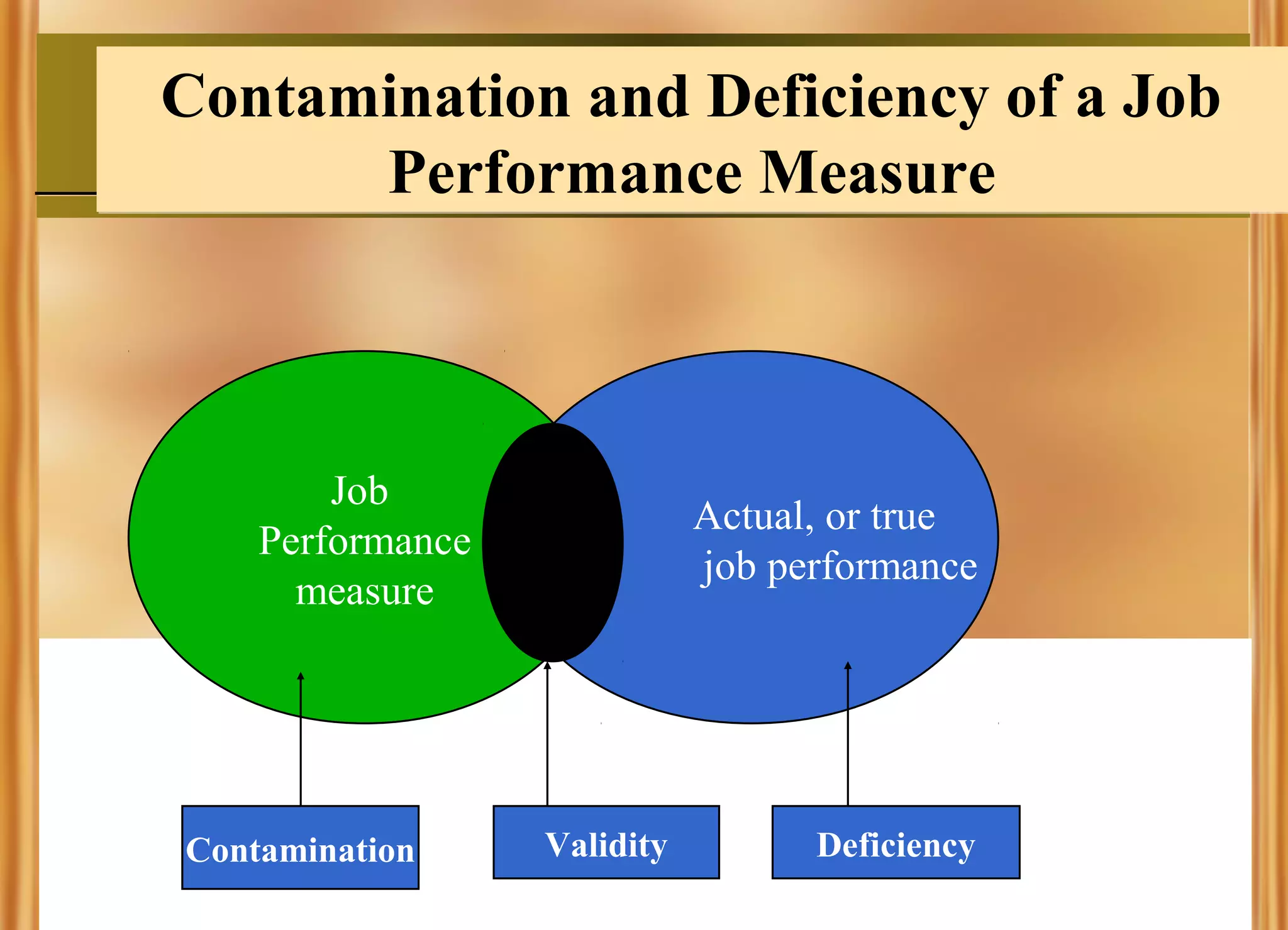
Validity continued
Validity

is concerned with maximizing the overlap
between actual job performance and the measure of
job performance
Performance measure is deficient if it does not
measure all aspects of performance
A contaminated measure evaluates irrelevant
aspects of performance that are not job related
Contamination and Deficiency of a Job
Performance Measure

Job
Performance
measure

Contamination

Actual, or true
job performance

Validity

Deficiency
RELIABILITY
DEFINITION:
The extent to which the performance is consistent;
the degree to which a performance measure is free
from random error
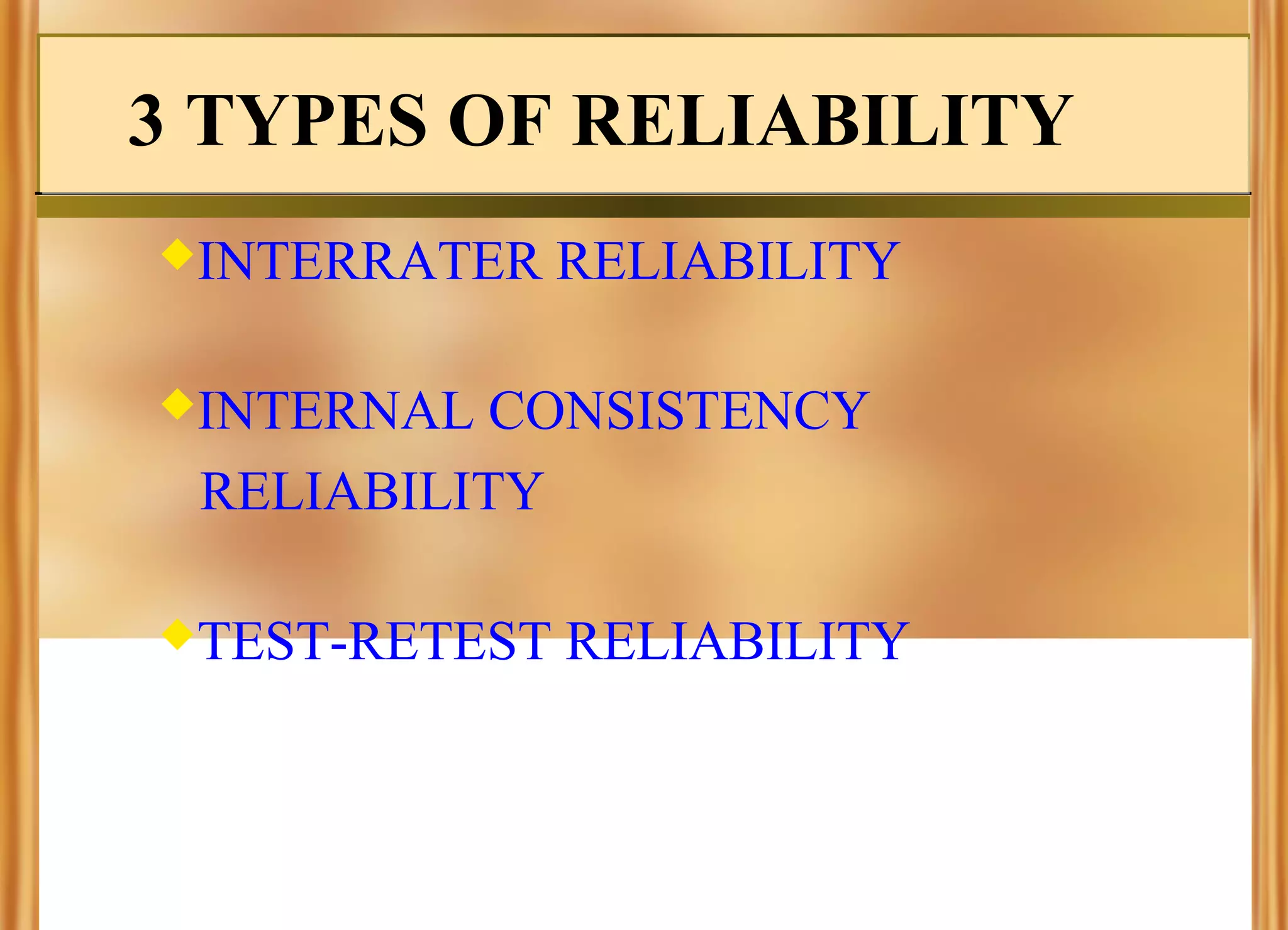
3 TYPES OF RELIABILITY
INTERRATER

RELIABILITY

INTERNAL

CONSISTENCY
RELIABILITY

TEST-RETEST

RELIABILITY
ACCEPTABILITY

DEFINITION:
The extent to which a performance measure
is deemed to be satisfactory or adequate by
those who use
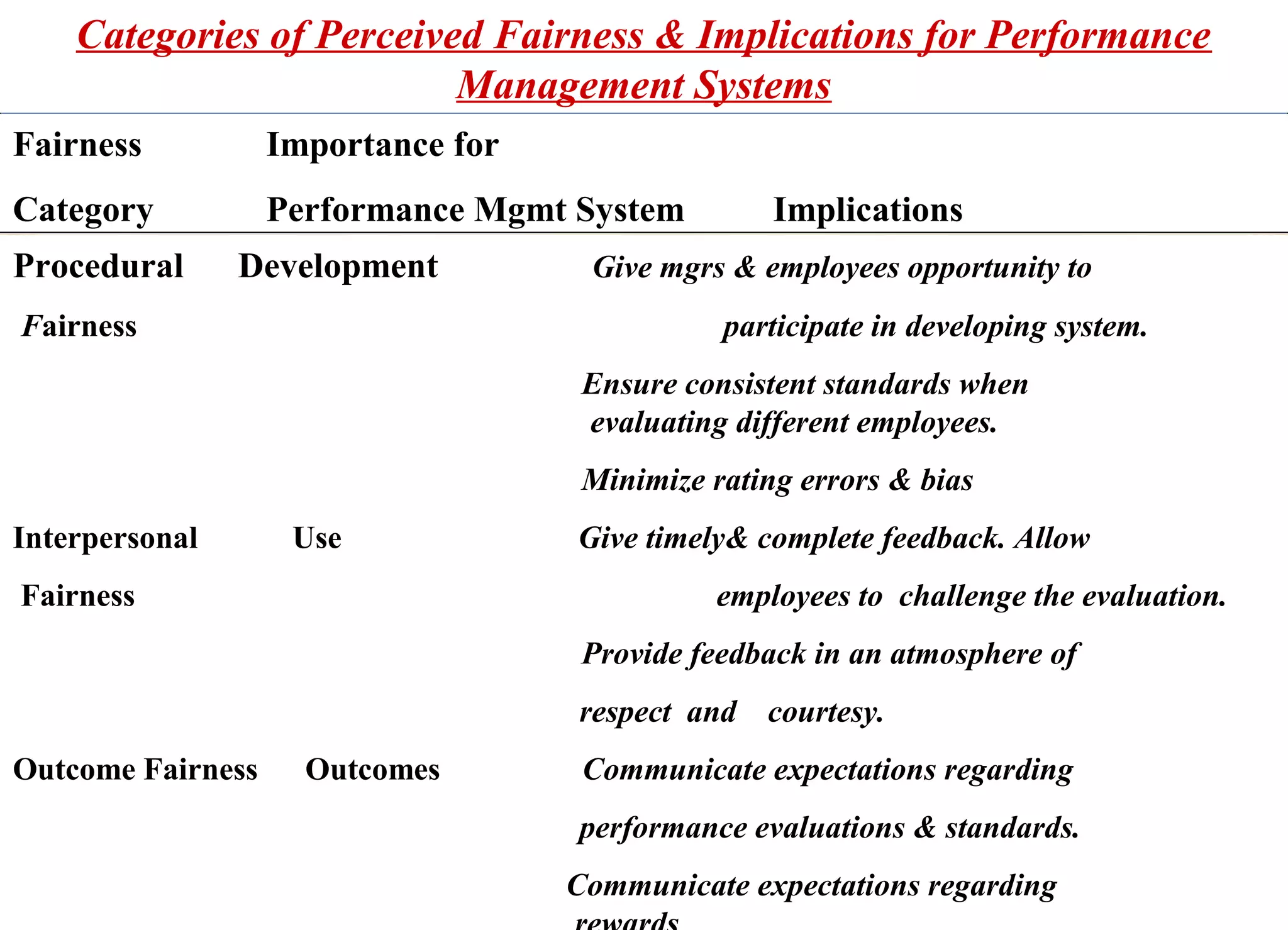
Categories of Perceived Fairness & Implications for Performance
Management Systems
Fairness

Importance for

Category

Performance Mgmt System

Procedural

Development

Fairness

Implications

Give mgrs & employees opportunity to
participate in developing system.
Ensure consistent standards when
evaluating different employees.
Minimize rating errors & bias

Interpersonal

Use

Fairness

Give timely& complete feedback. Allow
employees to challenge the evaluation.
Provide feedback in an atmosphere of
respect and courtesy.

Outcome Fairness

Outcomes

Communicate expectations regarding
performance evaluations & standards.
Communicate expectations regarding
SPECIFICITY
DEFINITION:
The extent to which the performance measure gives detailed
guidance to employees about what is expected of them and
how they can meet these expectations.
APPROACHES TO MEASURING
PERFORMANCE
What

is a performance measure? A
generic term encompassing the
quantitative basis by which objectives are
established and performance is assessed
and gauged.
These include performance objectives
and criteria, performance standards and
other means that evaluate the success in
achieving a specified goal.
Uses of Performance Measures
Aim

is to manage performance by focusing on
employee attributes, behaviors, or results.
Measure performance in a relative way, making
overall comparisons among individual’s
performance.
Approaches to Measuring
Performance
Comparative
Attribute
Behavioral
Results

Approach
Quality Approach
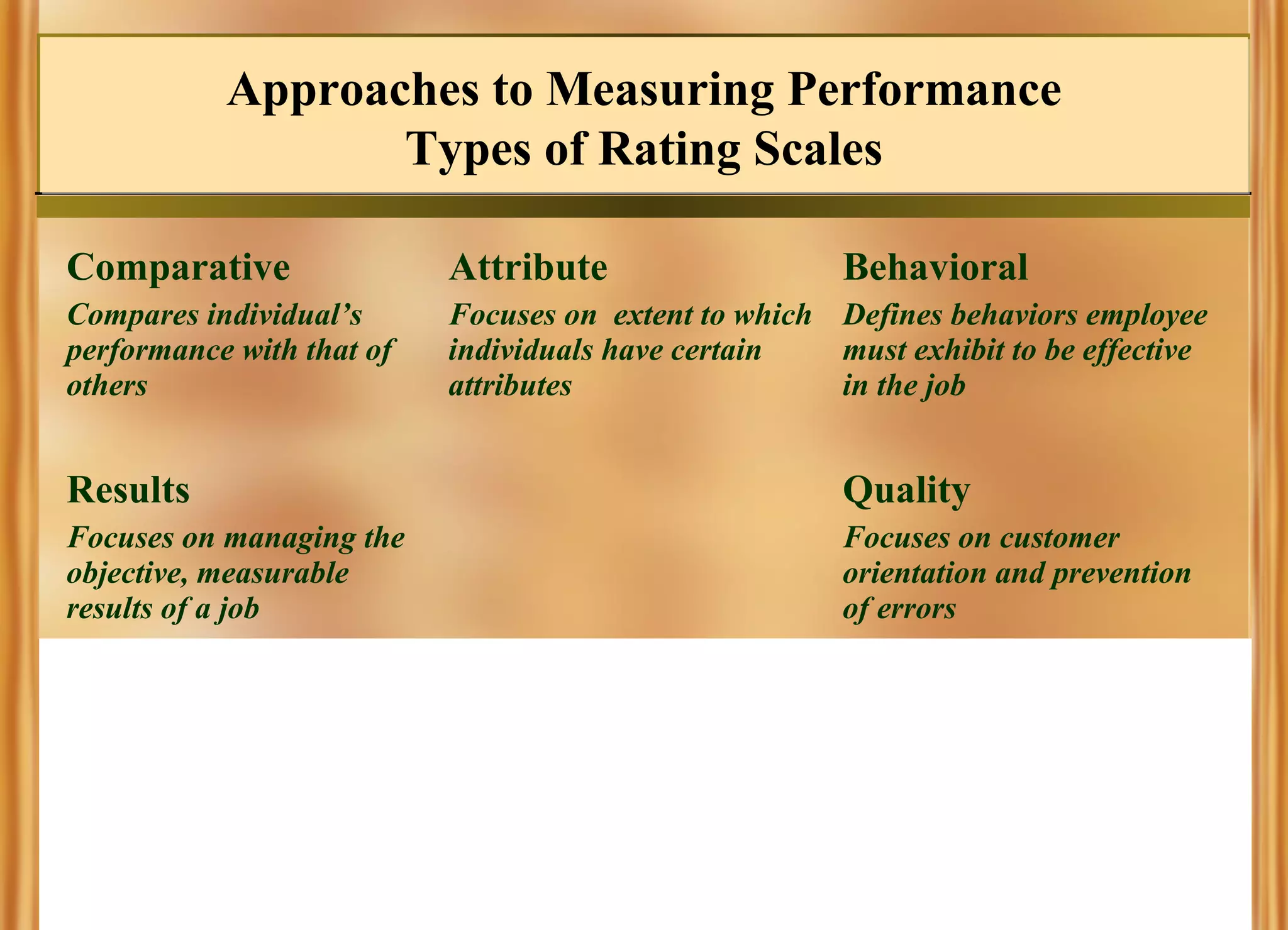
Approaches to Measuring Performance
Types of Rating Scales
Comparative

Attribute

Behavioral

Compares individual’s
performance with that of
others

Focuses on extent to which Defines behaviors employee
individuals have certain
must exhibit to be effective
attributes
in the job

Results

Quality

Focuses on managing the
objective, measurable
results of a job

Focuses on customer
orientation and prevention
of errors
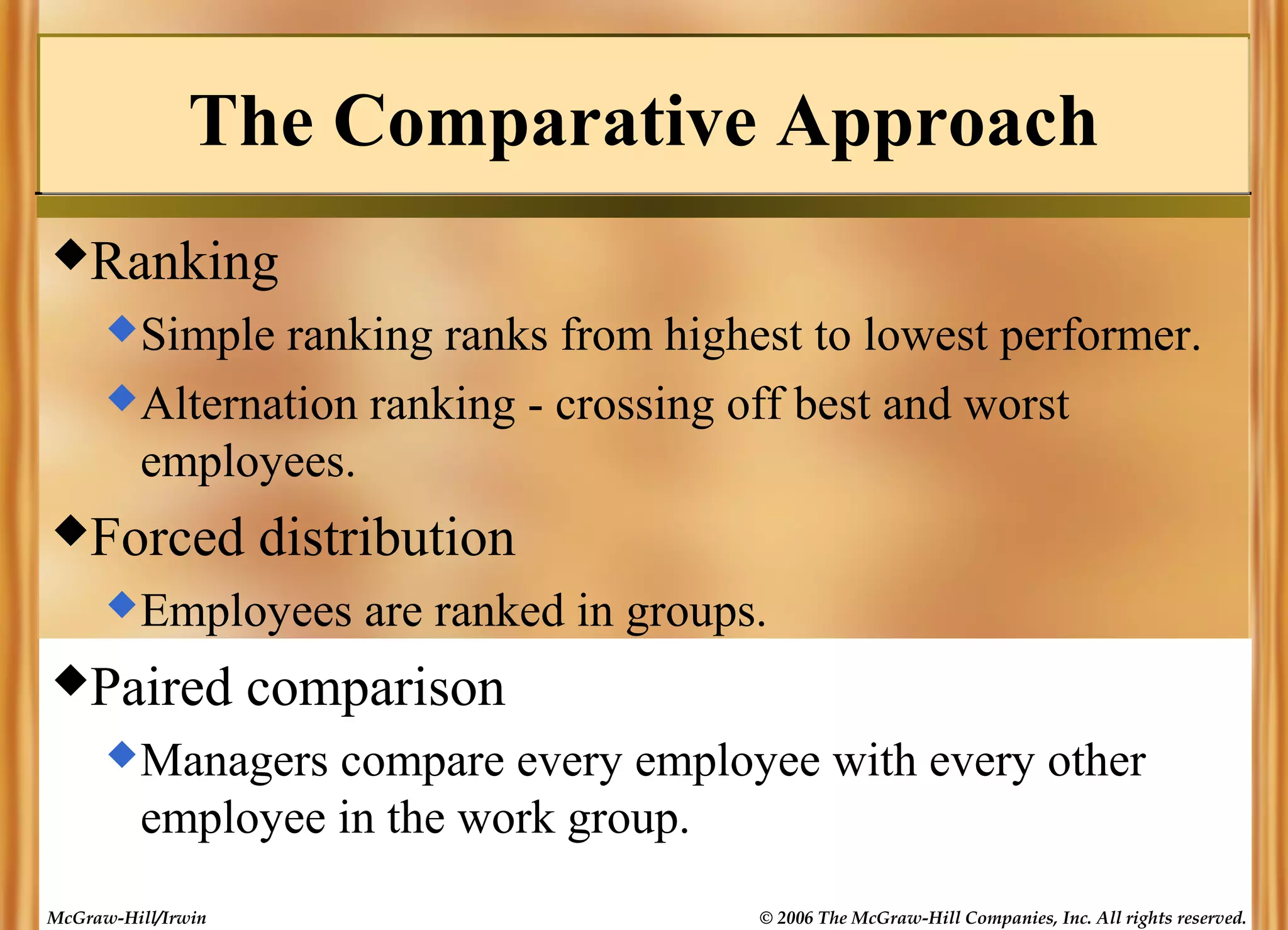
The Comparative Approach
Ranking
 Simple

ranking ranks from highest to lowest performer.
 Alternation ranking - crossing off best and worst
employees.
Forced

distribution

 Employees

Paired

are ranked in groups.

comparison

 Managers

compare every employee with every other
employee in the work group.

McGraw-Hill/Irwin

© 2006 The McGraw-Hill Companies, Inc. All rights reserved.
1. Ranking
Simple

Ranking - rank employees from best to

worse.
Alternation Ranking- subjective elimination of
worst employees based on best employee
Overall

process considered to be subjective.
2.Forced distribution
Also

requires a ranking format.ranking done in
groups.
Manger groups employees into predetermined
categories, employees are categorized based on
distribution rules, not on their performance.
Also considered to be subjective
3. Paired Comparison
Managers

compare employee with each other in
work group/units. Each employee is given a score
of 1 for each high activity.
Manager computes and compares the number of
times score is favorable. Sum of points is employee
performance score.
Evaluating the Comparative Approach to
Measuring Performance
 Can

be an effective tool in differentiating employee
performance, eliminates some rater errors (leniency,
distributional errors).
 Disadvantage is failure to link with strategic goals of the
organisation.
 Subjective, therefore validity and reliability is dependent on
rater.
 Feed back mechanisms excluded.
 Low acceptance by employees- normative rather than
absolute standards used.
The Attribute Approach
Graphic

rating scales

A

list of traits is evaluated by a fivepoint rating scale.
 Legally questionable.
Mixed-standard

scales

 Define

relevant performance dimensions
and then develop statements
representing good, average, and poor
performance along each dimension.

McGraw-Hill/Irwin

© 2006 The McGraw-Hill Companies, Inc. All rights reserved.
Advantages of the Attribute Approach
 Still

popular
 Easy to Develop
 Generalize
 Identifies and defines attributes relevant to
job performance
 Can be reliable & valid

Disadvantages of the Attribute Approach
•Little congruence between techniques
and company strategy
•Used widely because its easy to use
•Performance standards vaguereliability/validity low
•No feedback mechanisms
Behavioral Approach
Defines

behaviors an employee must exhibit
to be effective in the job

There

are 5 techniques used in this approach
Behavioral Approach
Critical

incidents approach - requires managers to keep
record of specific examples of effective and ineffective
performance.
Behaviorally anchored rating scales (BARS)
Behavioral observation scales (BOS)
Organizational behavior modification - a formal
system of behavioral feedback and reinforcement.
Assessment centers - multiple raters evaluate
employees’ performance on a number of exercises.
McGraw-Hill/Irwin

© 2006 The McGraw-Hill Companies, Inc. All rights reserved.
Critical Incidents
Log

is kept for recording observable behavior
demonstrated by an employee that is both effective
and ineffective.
Log is used to provide feedback to employees and
is used as an aid in goal/ objective setting
Behavioral Observation
Scales - (BOS)
Variation

of BARS , using critical incidents
BOS useful in differentiating good from poor
performers, objectivity, providing feedback,
training.
BOS is easy to use, but does require more
information
Behaviorally Anchored Rating Scales
(BARS)
Expansion

of the critical incidents approach and is
used to develop behavioral anchors that define
different levels of performance.
Can increase interrater reliability by providing
precise and complete definition of the
performance, however behavioral anchors can bias
information recall
Four actions in using BARS
1.
2.

3.

4.

Define key behaviors
Use a measurement system to assess
behaviors
Inform employee of behaviors to be
measured
Provide feedback and reinforcement to
employee
Organizational Behavior Modification
(OBM)
Managing

behavior through a system of feedback
and reinforcement
Uses the behaviorist approach which indicates that
future behavior is influenced by past behaviour that
has been positively reinforced
Assessment Centers
Normally

used in selection /promotion , but also
for measuring performance
Simulations are carried out, multiple raters
evaluate employee performance
Provide an objective measure of an employee’s job
performance
Allows for specific feedback & individual
developmental plans
Advantages of the Behavioral Approach
Can be effective
Provides for strategic congruence
Provides specific guidance & feedback for
employees about performance expected of them
Behaviors measured are valid
Acceptability usually high
Raters performance is usually high

Disadvantages of the Behavioral Approach
Weaknesses:
Behaviors need to be constantly monitored and
revised to ensure strategic congruence.
Approach assumes that there is only one way to do
the job and that behaviors are identifiable
Arguments
:
 Behavioral

systems are” person based outcomes ”
employees do not have complete control over these
outcomes- may be regarded as contaminated, rather
“systems factors” should be used to evaluate
performance. Outcomes can result in dysfunctional
behavior.
 Suggests that: performance feedback should given to
employees using both objective and subjective
feedback
 Employees should not be categorized for
performance ratings
 Relies on combination of attribute & results for
measurement of performance
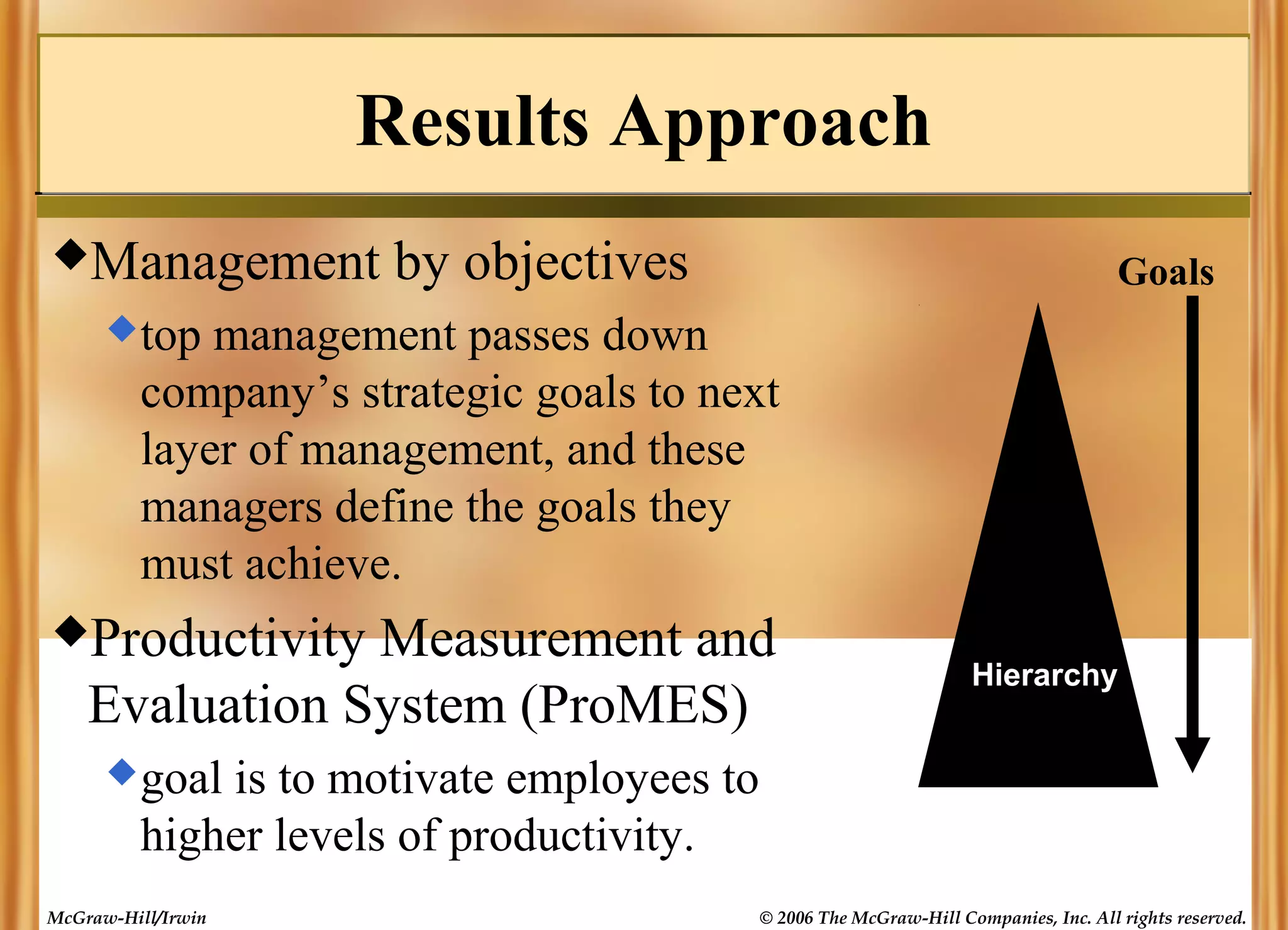
Results Approach
Management

by objectives

Goals

 top

management passes down
company’s strategic goals to next
layer of management, and these
managers define the goals they
must achieve.

Productivity

Measurement and
Evaluation System (ProMES)

Hierarchy

 goal

is to motivate employees to
higher levels of productivity.

McGraw-Hill/Irwin

© 2006 The McGraw-Hill Companies, Inc. All rights reserved.
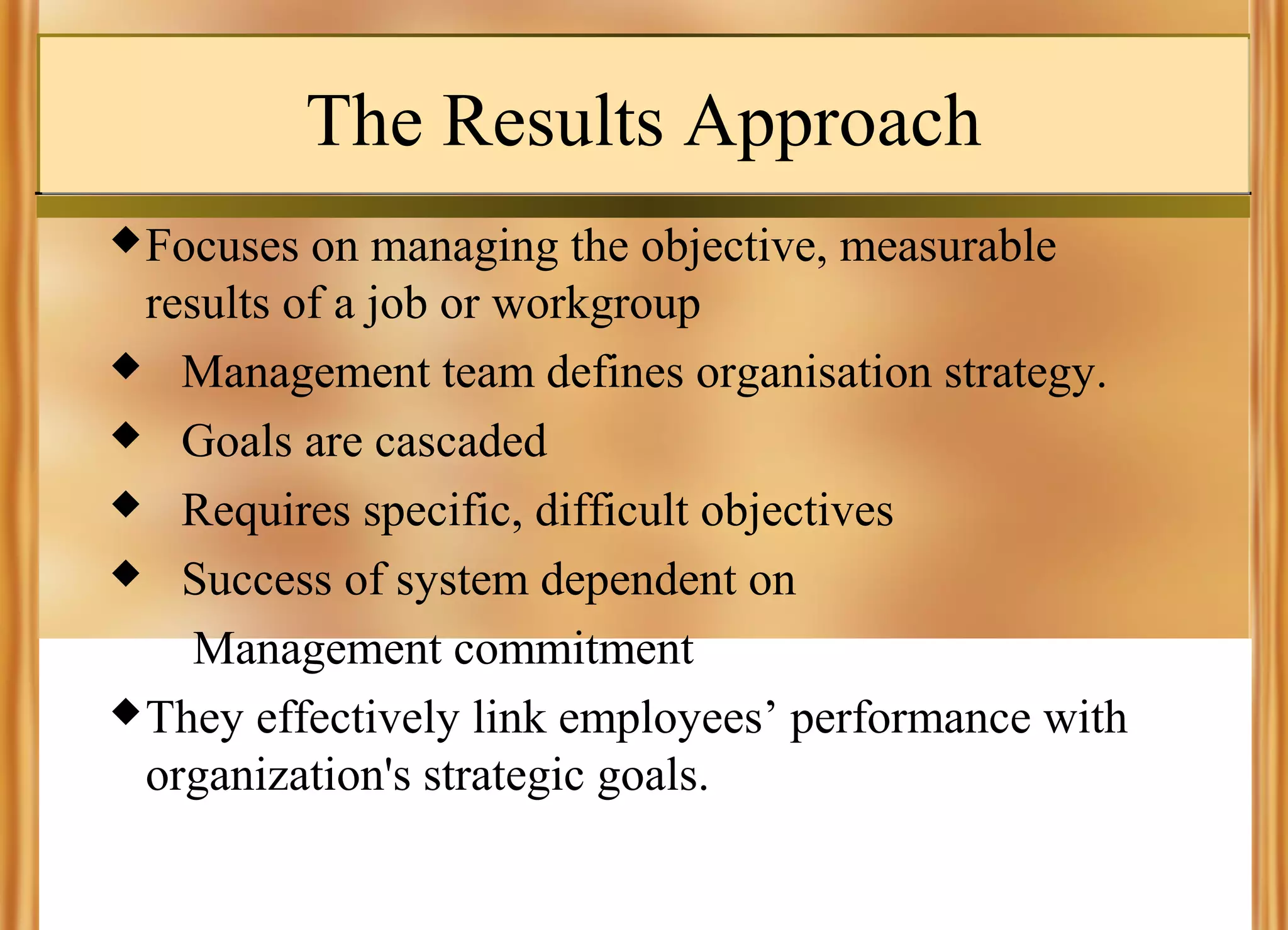
The Results Approach
 Focuses

on managing the objective, measurable
results of a job or workgroup
 Management team defines organisation strategy.
 Goals are cascaded
 Requires specific, difficult objectives
 Success of system dependent on
Management commitment
 They effectively link employees’ performance with
organization's strategic goals.
What is MBO?
A

goal directed and results oriented approach to
performance appraisal in which employees and
their managers/supervisors set goals together for
the upcoming evaluation period and for and
explicit time period
Common components of the MBO
System
They

require specific objective goals
Goals are set with managers’ and employees’
participation
Managers provide objective feedback
throughout the rating period to monitor progress
towards goals
What is an Objective
Objectives describe:
Conditions that will exist when the desired
outcome has been established
A time frame during which the outcome is to be
completed
Resources that the organisation is willing to
commit.
GOOD OBJECTIVES ARE
“SMART”
S
M
A
R
T

Specific
Measurable
Aligned with organizational/unit goals
Realistic and results-oriented
Timed
What is a Standard?
Standards are established criteria used by an
organisation to objectively measure the
performance of employees.
Standards refer to ongoing performance criterion
that must be met consistently.
Performance Standards
A well written performance standard
is:
1.Clearly Defined
2. Reliable
3.Valid
Clearly Defined Performance Standards
These

standards are congruent with the
organisation’s strategy, goals and objectives

They

must also satisfy the following criteria:
(SMART)
Specific
Measurable
Attainable
Realistic
Time Bound
Reliability
Refers

to the consistency of the
performance standards and
measures
Validity
Validity

refers to the extent to which the
performance standards measure all/only the
relevant aspects of performance.

A

performance standard is contaminated whenever
it measures irrelevant aspects of performance.

A

performance standard is deficient if it does not
measure all aspects of performance.
Performance Standards
Performance standards are used to minimise:
Prejudices
Rating Errors
Personal biases
Productivity Measurement
Systems(ProMES)
Aims

to motivate employees to higher levels of
production
Has measurement and feedback mechanisms.
It is effective, in increasing productivity
4 Steps in the ProMES Process
1.

2.
3.

4.

Employees identify the
products/activities/objectives to be
accomplished by organisation.
Staff defines indicators of the product
Staff establishes the contingencies between
the quantity of the indicator and level of
evaluation associated with the amount
Feedback system is developed
Advantages of the Results Approach
Minimises

subjectivity, objective and quantifiable
indicators of performance are used.
High acceptability
Links individual performance to organisation's
strategy & goals.
Disadvantages of the Results Approach
Weaknesses:
Measures can be contaminated and deficient
Employees tend to focus on measurable
aspects of performance- neglecting others
Feedback may not help employees improvefeedback needs to focus on actual behavior
that needs to be changed
Quality Approach
A performance management system designed with a
strong quality orientation can be expected to:
 Emphasize

an assessment of both person and system
factors in the measurement system.
 Emphasize that managers and employees work together
to solve performance problems.
 Involve both internal and external customers in setting
standards and measuring performance.
 Use multiple sources to evaluate person and system
factors.
McGraw-Hill/Irwin

© 2006 The McGraw-Hill Companies, Inc. All rights reserved.
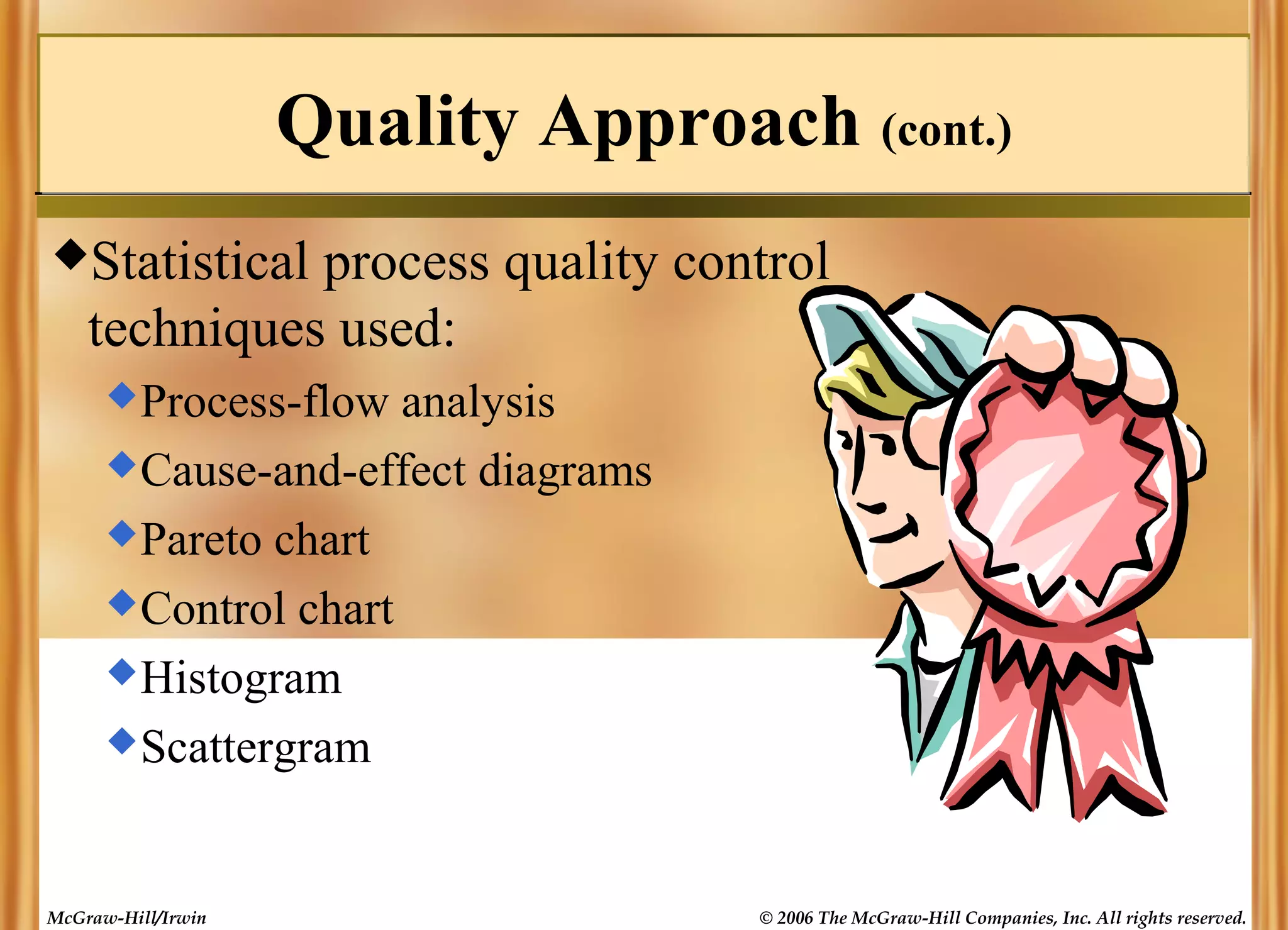
Quality Approach (cont.)
Statistical

process quality control
techniques used:
 Process-flow

analysis
 Cause-and-effect diagrams
 Pareto chart
 Control chart
 Histogram
 Scattergram

McGraw-Hill/Irwin

© 2006 The McGraw-Hill Companies, Inc. All rights reserved.
Recommendations for designing an
Effective Performance System
1.

2.

3.

Aim for Precision in defining and measuring
performance.
Link Performance dimensions to meeting
internal and external customer requirements.
Measure and correct for the impact of situational
constraints.
CURRENT ISSUES IN PERFORMANCE
MANAGEMENT
The

focus on ratings and rewards
Too much for one rater to appraise
The system is too top down
Team-based work systems
Total Quality Management
PERFORMANCE MANAGEMENT
INNOVATIONS
Increased

employee involvement
Less focus on ratings and rewards
Multi-rater systems (i.e., 360 degree feedback, peer
reviews)
IMPLEMENTATION ISSUES AND
STRATEGIES
Involvement

of users in development
Pilot programs
Implementation in one unit
Staggered implementation
OBSTACLES TO SUCCESSFUL
IMPLEMENTATION
Lack

of commitment from the top
Overselling the program
A program excessive in paperwork and
administrative requirements
Failing to train and retrain appraisers
Changing the system
Failing to monitor the program and deal with noncompliance
PERFORMANCE APPRAISAL

THE APPRAISAL PROCESS
PERFORMANCE APPRAISAL VS PERFORMANCE
MANAGEMENT
Performance

management -- “all of those processes
led by managers to help employees perform as
effectively as they can.”
Performance appraisal -- process involving setting
standards, informing employees, assigning ratings
and giving feedback.
Why Appraise?
Appraisal is designed as a means of
monitoring the progress and
achievement of the organisation ,to
encourage and support the continuing
development of the organisation in a
changing world
Objective of Performance Appraisal

Performance Appraisal is the systematic evaluation
of an individual’s job performance which seeks to
measure his/her performance in relation to the
achievement of an organization’s strategy.
Effective Characteristics for Managing
Performance
 Know

your organisation’s performance cycle
 Demonstrate effective communication skills
 Be able to explore causes of performance problems
 Ability to develop action plans and empower employee to
be solution-oriented
 Be objective and focus attention towards the problem
 Be able to provide feedback
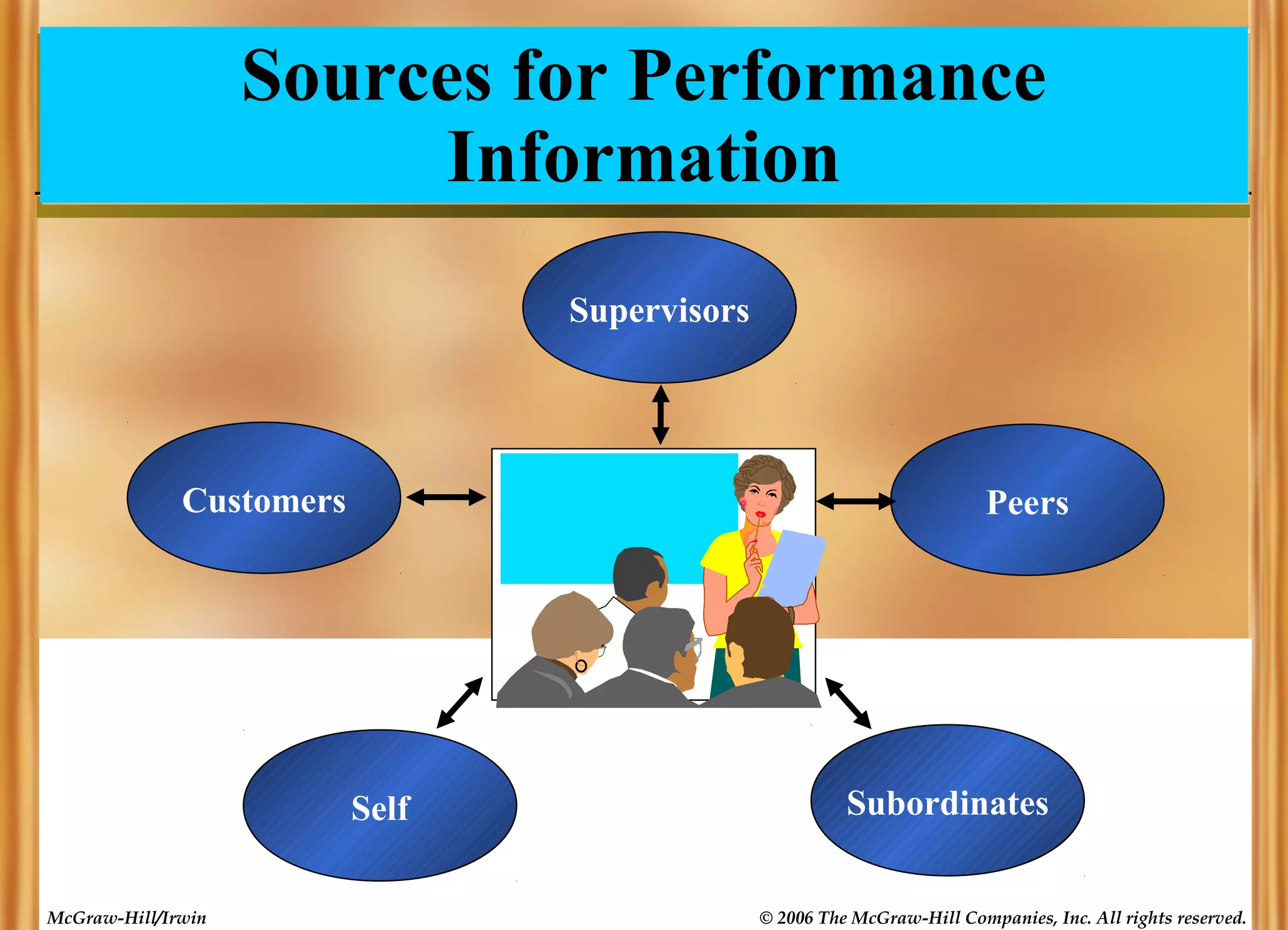
Sources for Performance
Information
Supervisors

Customers

Peers

Self
McGraw-Hill/Irwin

Subordinates
© 2006 The McGraw-Hill Companies, Inc. All rights reserved.
Rater Errors in Performance
Measurement
Similar

to me
Contrast
Distributional errors
Halo and horns
Recency
Stereotypes
Selective perception
Bias
McGraw-Hill/Irwin

© 2006 The McGraw-Hill Companies, Inc. All rights reserved.
Following Legal Guidelines
Conduct

a valid job analysis related to
performance.
Base system on specific behaviors or results.
Train raters to use system correctly.
Review performance ratings and allow for
employee appeal.
Provide guidance/support for poor performers.
Use multiple raters.
McGraw-Hill/Irwin

© 2006 The McGraw-Hill Companies, Inc. All rights reserved.
Reducing Errors and Appraisal
Politics
Two

Approaches to reducing rater error:

 Rater

error training
 Rater accuracy training
Appraisal

politics - a situation in which evaluators
purposefully distort ratings to achieve personal or
company goals.

McGraw-Hill/Irwin

© 2006 The McGraw-Hill Companies, Inc. All rights reserved.
Purposes of Performance Appraisals
 Monitor

progress &
achievements of
organizations
 Identify employees current
levels of performance
 Encourage & motivate
employees
 Reward employees
performance

 Identify

training &
development needs
 Link strategic goals with
employees’ activities
 Organizational
development
 Provide for succession
planning
Benefits To the Organization
Identification

of skills to enhance organization’s

performance
Employees are motivated
Proactive identification of training and
development needs
Provides a competitive advantage by managing
behavior and results of employees.
Benefits To The Manager
Builds the relationship with the
employee
 Enhance employee’s motivation
 Evaluate employee’s
effectiveness against strategic
goals
 Identify training &
developmental needs
 Builds a rational basis for
constructing rewards
 Provides documentation for legal
purposes.

Benefits To The Employee

 Fairness

of system measurement enhances/effects outcomes
 Recognition and rewards for contributions to the
organization
 Enables employee to improve performance
 Provides for feedback
 Enhances communication between employee and manager
 Acts as a motivator to improve performance
Challenges Associated With Performance Appraisals
 Managers

are uncomfortable providing feedback
 Culture of the organization/organizational politics
 Process can be subjective rather than objective if not
properly administered
 Rater Errors can cause bias in appraising actual
performance.
 Whether to focus on individual or team performance
 Legal Issues
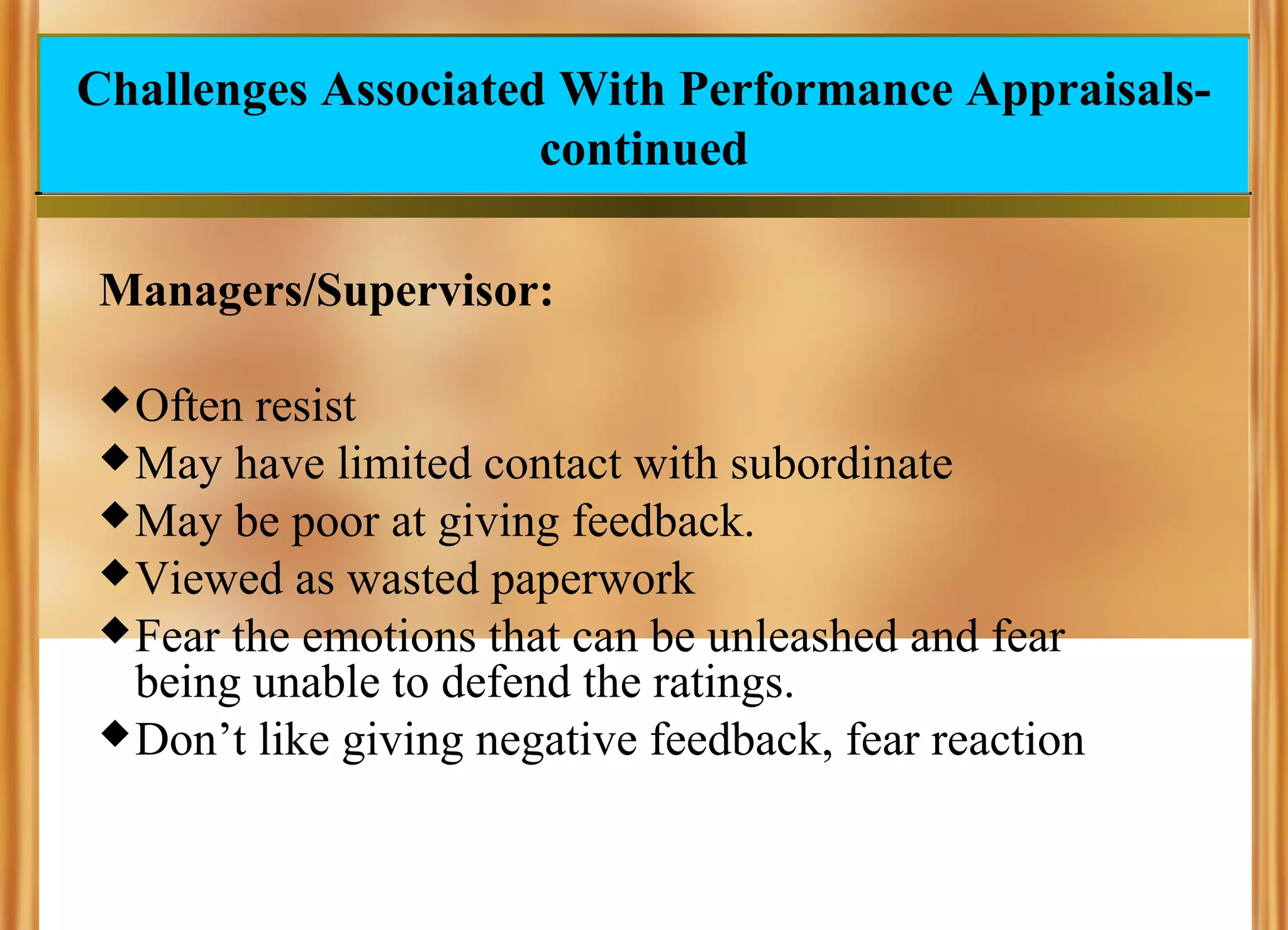
Challenges Associated With Performance Appraisalscontinued
Managers/Supervisor:
 Often

resist
 May have limited contact with subordinate
 May be poor at giving feedback.
 Viewed as wasted paperwork
 Fear the emotions that can be unleashed and fear
being unable to defend the ratings.
 Don’t like giving negative feedback, fear reaction
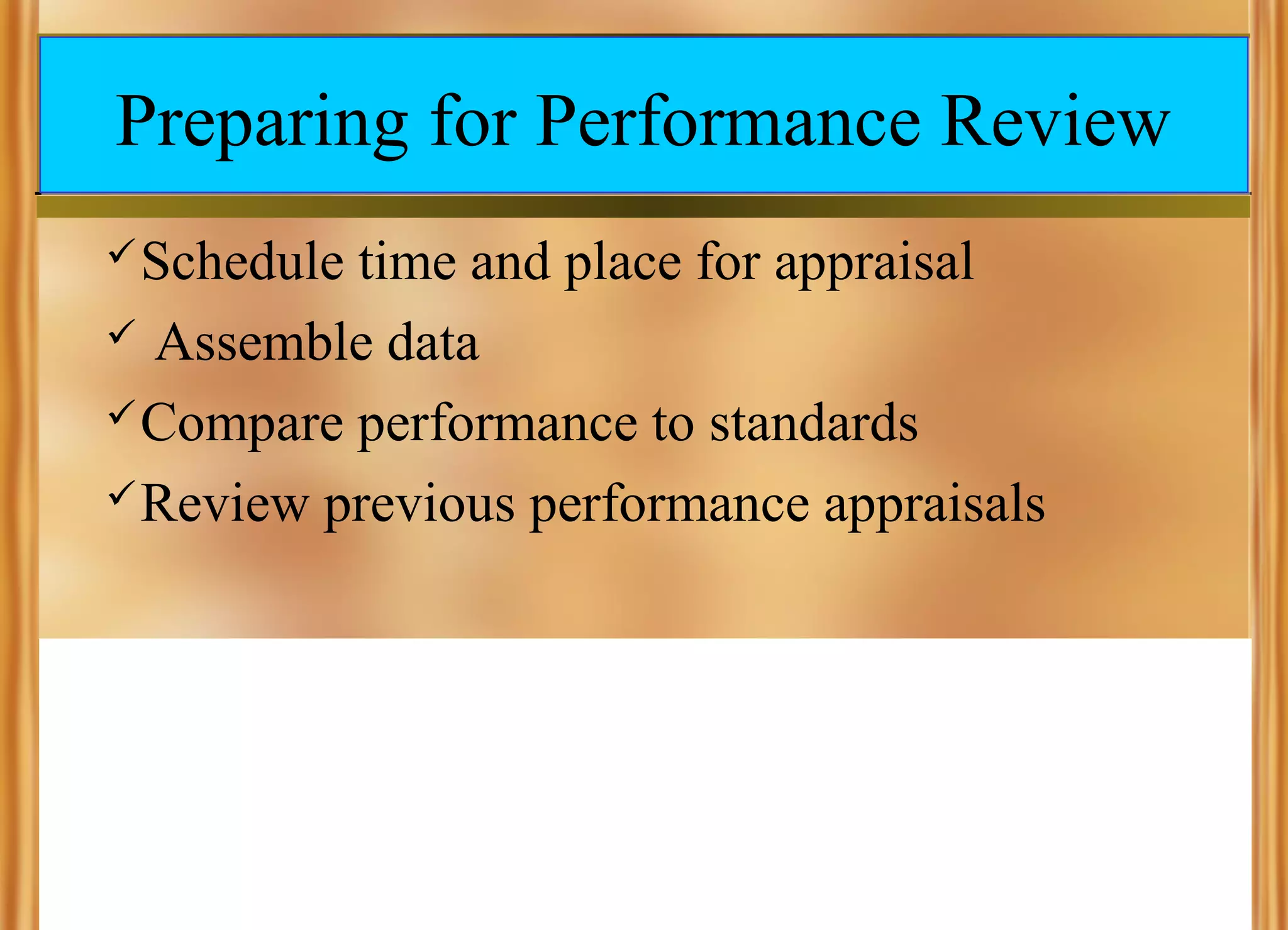
Preparing for Performance Review
 Schedule

time and place for appraisal
 Assemble data
 Compare performance to standards
 Review previous performance appraisals
Choosing a Performance Review Approach
Tell

& Sell
Tell & Listen
Problem Solving
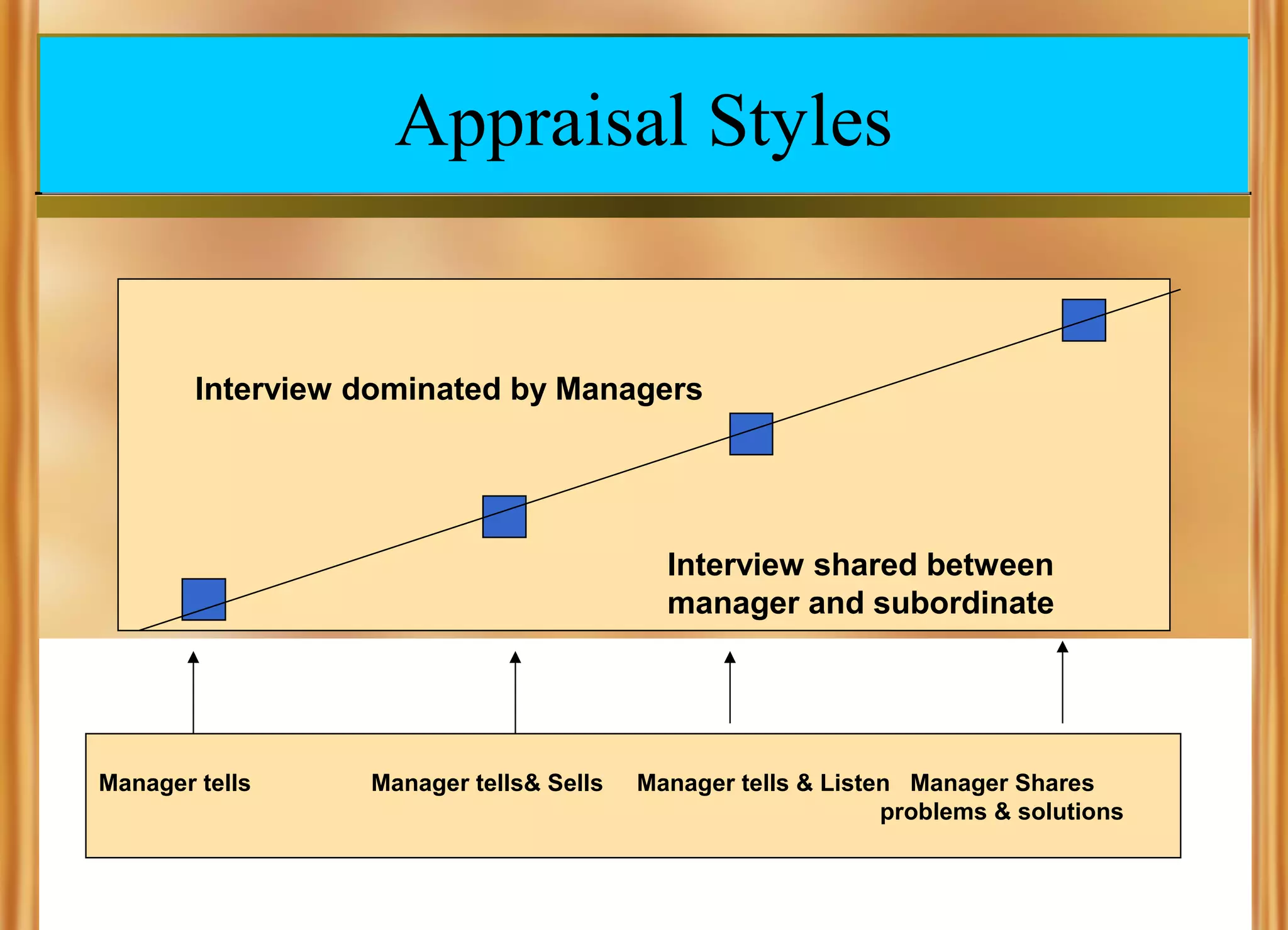
Appraisal Styles

Interview dominated by Managers

Interview shared between
manager and subordinate

Manager tells

Manager tells& Sells

Manager tells & Listen Manager Shares
problems & solutions
OVERCOMING BIASES
 Recognize

the ones you have.
 Share expectations with the appraisee.
 Keep a “log” of events during the year.
 Give regular feedback (no surprises!).
 Review your draft appraisal with someone.
 Remind yourself of your biases before every performance
appraisal conference.
The Appraiser’s Role
Be

Ready
Establish trust
Empower
Find Out
Listen
Negotiating
Agreeing
Conducting Appraisal
 Review

purpose of the interview
 Be direct and specific
 Start out with the positives
 Don’t get personal
 Encourage mutual communication
 Don’t “skirt” performance issues
 Pay attention to your non- verbals
Handling Defensive Employees
Recognise

that defensive behavior s normal
Never attack a person’s defensives
Postpone action
Recognise your own limitations
Appraisal of Teams
Types of teams:
 Work

or service Teams

 Project

Teams

 Network

Teams
Challenges of Team Performance
Management
 How

do we assess relative individual contribution?

 How

do we balance individual and team performance?

 How

do we identify individual and team measures of
performance?
3Types of Team Performance
1.

Individual performance

2.

Individual performance that
contributes to team performance

3.

Team performance
Factors to consider for effective
measurement of Teams
Key Success Factors- Competencies
1.
2.
3.

Communication
Decision Making
Collaboration

Key Accountabilities
1.
2.

Goals to be reached
Performance standards
Appraisal of Teams
Using Four dimensions for measurement of team
performance:
1. Effectiveness
2. Efficiency
3. Learning and Growth
4. Team Member Satisfaction
Performance Feedback

Characteristics of an Effective
Feedback Process
What is Coaching?
A directive process by a
manager/supervisor to train and orient an
employee to the realities of the workplace
and to help the employee remove barriers
to optimum work performance.
Crisp 1989
Benefits of Coaching
 Builds

your reputation as a people developer
 Increases productivity when employees know what
the goals are and how to achieve them
 Positive recognition and feedback increases
employee motivation and initiative
 Avoids surprises and defensiveness in performance
appraisals
 Increases creativity and innovation of unit as
employees feel safe to take risks
 Increases team cohesiveness due to clarified goals
and roles
Improving Performance Feedback
 Feedback

should be given every day, not once a year.
 Create the Right Context for Discussion.
 Ask employees to rate their performance before the session.
 Encourage the subordinate to participate in the session.
 Recognize effective performance through praise.
 Focus on solving problems.
 Focus feedback on behavior or results, not on the person.
 Minimize criticism.
 Agree to specific goals and set a date to review progress.
McGraw-Hill/Irwin

© 2006 The McGraw-Hill Companies, Inc. All rights reserved.
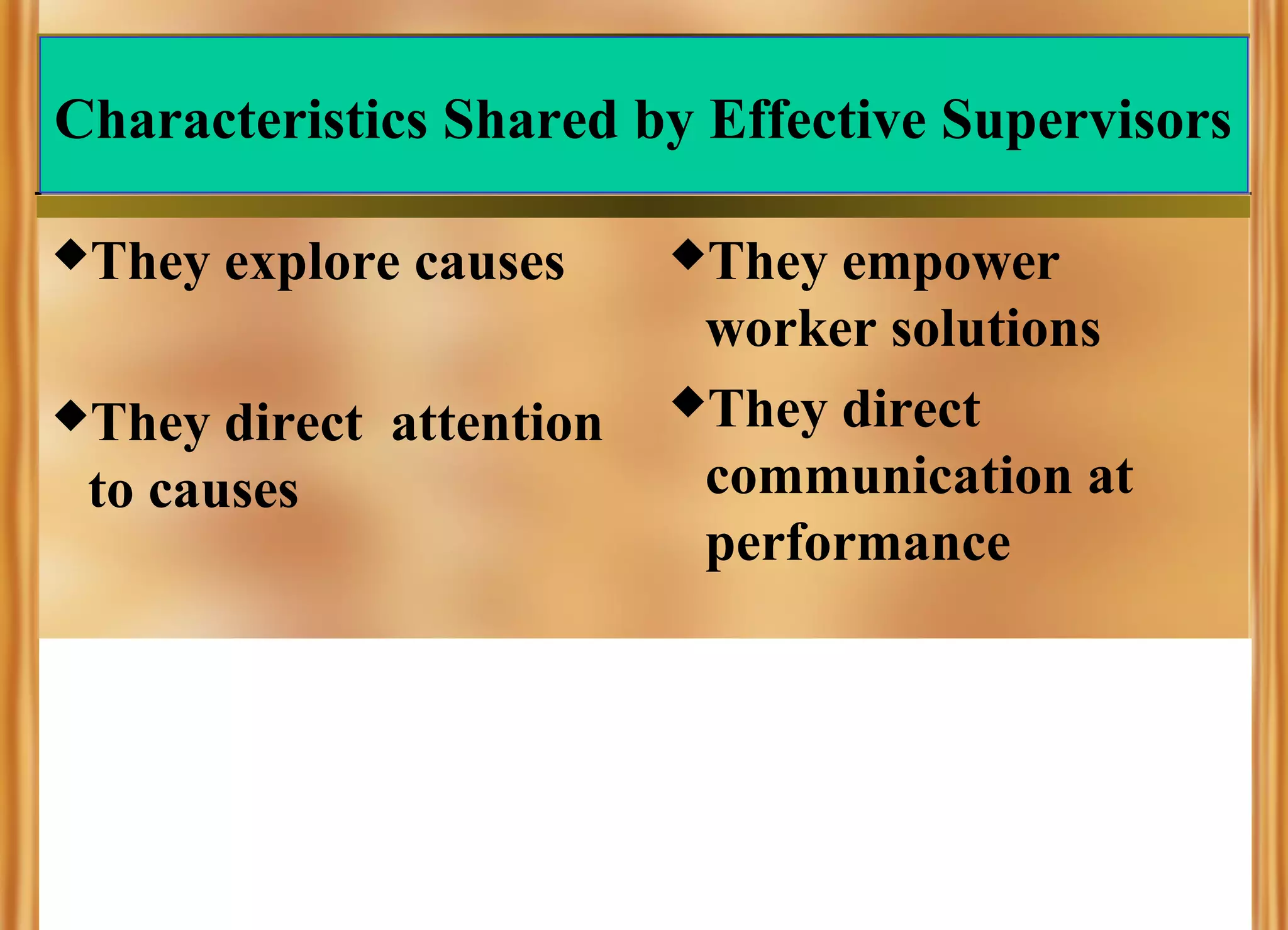
Characteristics Shared by Effective Supervisors
They

They

explore causes

direct attention
to causes

They

empower
worker solutions
They direct
communication at
performance
Managing Performance of Marginal
Performers
 Solid

performers

 High

ability and motivation; managers should provide
development opportunities

 Misdirected

effort

 Lack

of ability but high motivation; managers should focus on
training

 Underutilizers
 High

ability but lack motivation; managers should focus on
interpersonal abilities

 Deadwood
 Low

ability and motivation; managerial action, outplacement,
demotion, firing.

McGraw-Hill/Irwin

© 2006 The McGraw-Hill Companies, Inc. All rights reserved.
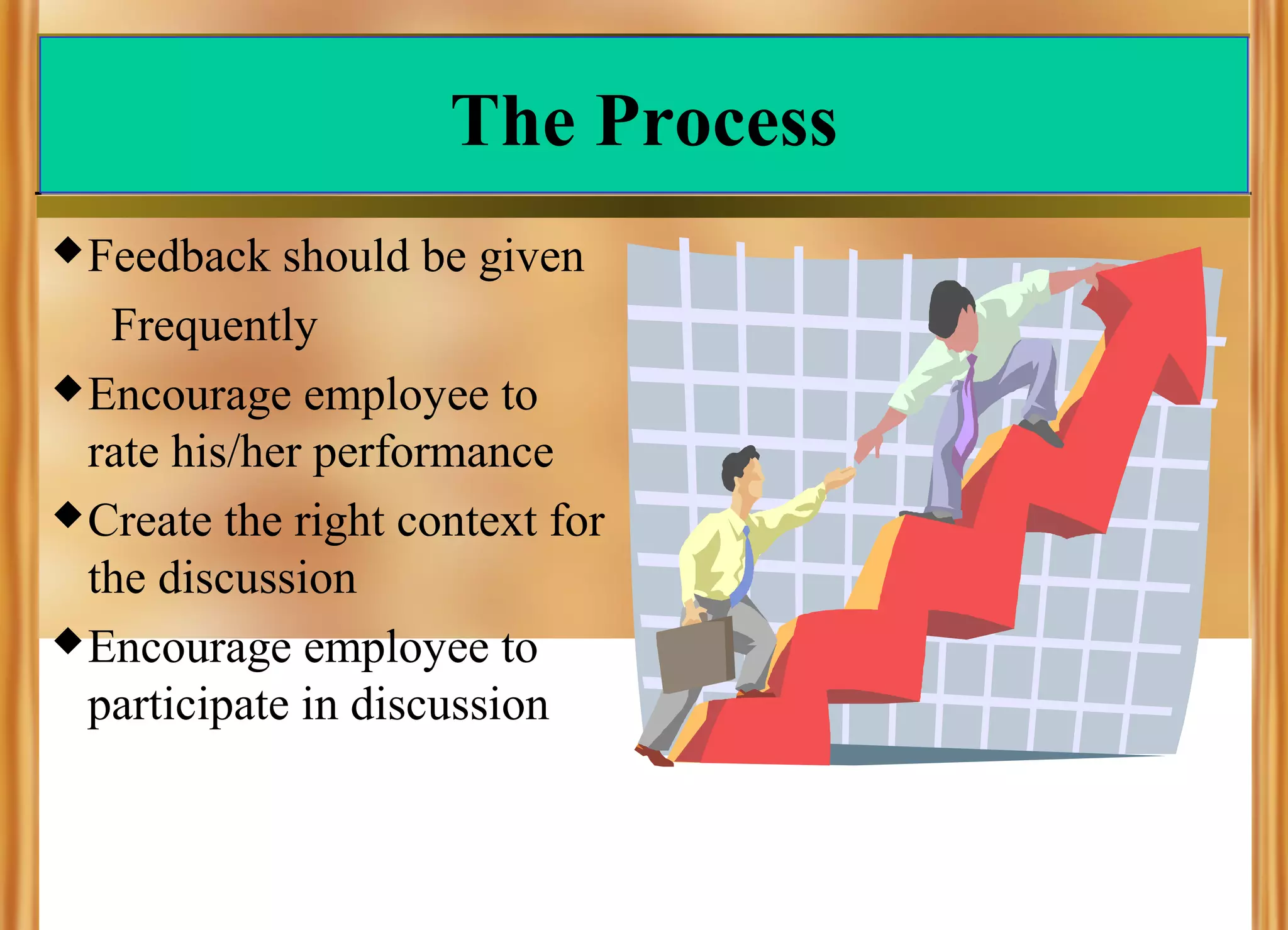
The Process
 Feedback

should be given
Frequently
 Encourage employee to
rate his/her performance
 Create the right context for
the discussion
 Encourage employee to
participate in discussion
Coaching For Improved Performance
Critical Discussion Steps







Set informal tone
Clarify discussion purpose
Discuss relationship between observations & objectives
Ask for and discuss solutions
Mutually agree on necessary actions
Express confidence in employee and set next review
date
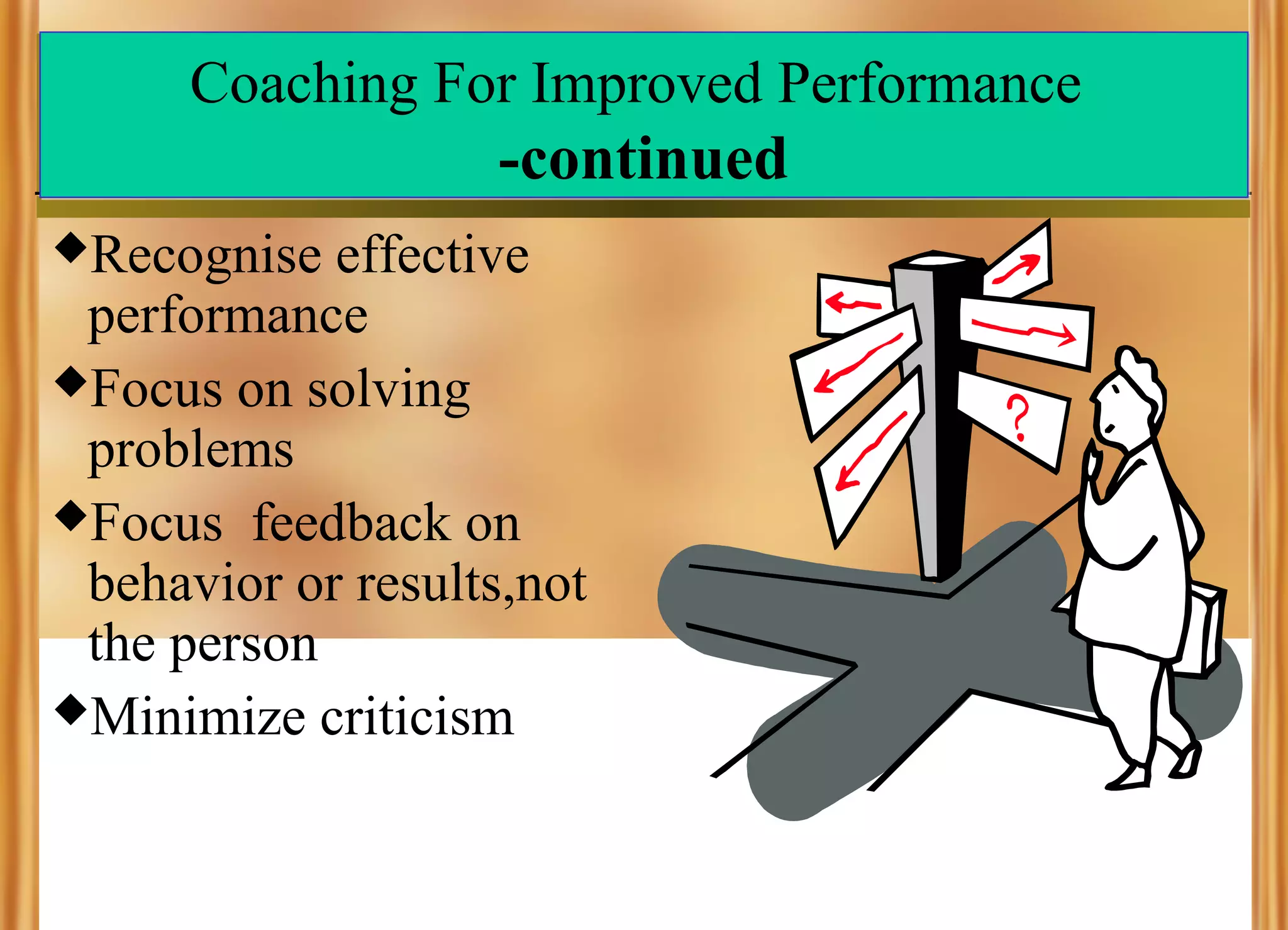
Coaching For Improved Performance

-continued
Recognise

effective
performance
Focus on solving
problems
Focus feedback on
behavior or results,not
the person
Minimize criticism
Coaching For Improved Performancecontinued
SETTING EXPECTATIONS
 Review organizational and unit goals and individual
performance expectations.
 Identify duties,objectives, and projects.
 Describe performance measures and standards.
 Identify performance factors.
 Develop a monitoring plan
 Agree to specific goals
 Monitor performance,
 Set progress review dates.

Performance Management :)

  • 1.
  • 2.
    Performance Management Identify the majordeterminants of individual performance. Discuss the three general purposes of performance management. Identify the five criteria for effective performance-management systems. Discuss the four approaches to performance management, the specific techniques used in each approach, and the way these approaches compare with the criteria for effective performancemanagement systems.
  • 3.
    Performance Management Choose the mosteffective approach to performance measurement for a given situation. Discuss the advantages and disadvantages of the different sources of performance information. Choose the most effective source(s) for performance information for any situation. Distinguish types of rating errors and explain how to minimize each in a performance evaluation.
  • 4.
    Performance Management Understand the performanceappraisal process Conduct an effective performance feedback session. Identify the characteristics of a performance measurement system that follows legal guidelines.
  • 5.
    Introduction Performance management is theprocess through which managers ensure that employee activities and outputs are congruent with the organization's goals. Performance Appraisal is the process through which an organization gets information on how well an employee is doing his or her job. Performance Feedback is the process of providing employees information regarding their performance effectiveness. McGraw-Hill/Irwin © 2006 The McGraw-Hill Companies, Inc. All rights reserved.
  • 6.
    PERFORMANCE APPRAISAL VS PERFORMANCEMANAGEMENT Performance appraisal -- setting standards, informing employees, ratings and feedback. Performance management -- “all of those processes led by managers to help employees perform as effectively as they can.”
  • 7.
    GOALS OF PERFORMANCE MANAGEMENT Improve employee performance  Develop people for promotional opportunities  Meet employee need for feedback  Ensure that employees are working toward organizational goals  Provide the data needed to make and defend important human resources decisions
  • 8.
    3 PARTS OFPERFORMANCE SYSTEM DEFINING PERFORMANCE MEASURING FEEDBACK PERFORMANCE INFORMATION OF PERFORMANCE
  • 9.
    An Organizational Modelof Performance Management Organizational Strategy Long and short term goals and values Individual Attributes (skills, abilities) Individual Behaviors Objective Results Situational Constraints Culture and economic conditions McGraw-Hill/Irwin © 2006 The McGraw-Hill Companies, Inc. All rights reserved.
  • 10.
  • 11.
    Performance Measures Criteria Fiveperformance criteria stand out: Strategic congruence Specificity Acceptability McGraw-Hill/Irwin Validity Reliability © 2006 The McGraw-Hill Companies, Inc. All rights reserved.
  • 12.
    Performance Measures Criteria Allapproaches and techniques used for measuring and managing performance must be evaluated against the criteria of : - Strategic Congruence - Validity -Reliability - Acceptability -Specificity
  • 13.
    STRATEGIC CONGRUENCE DEFINITION: The extentto which the performance management system elicits its job performance that is congruent with the organisation’s strategy, goals and culture.
  • 14.
    VALIDITY DEFINITION: The extent towhich the performance measure assesses all the relevant – and only the relevant aspects of performance.
  • 15.
    Validity continued Validity is concernedwith maximizing the overlap between actual job performance and the measure of job performance Performance measure is deficient if it does not measure all aspects of performance A contaminated measure evaluates irrelevant aspects of performance that are not job related
  • 16.
    Contamination and Deficiencyof a Job Performance Measure Job Performance measure Contamination Actual, or true job performance Validity Deficiency
  • 17.
    RELIABILITY DEFINITION: The extent towhich the performance is consistent; the degree to which a performance measure is free from random error
  • 18.
    3 TYPES OFRELIABILITY INTERRATER RELIABILITY INTERNAL CONSISTENCY RELIABILITY TEST-RETEST RELIABILITY
  • 19.
    ACCEPTABILITY DEFINITION: The extent towhich a performance measure is deemed to be satisfactory or adequate by those who use
  • 20.
    Categories of PerceivedFairness & Implications for Performance Management Systems Fairness Importance for Category Performance Mgmt System Procedural Development Fairness Implications Give mgrs & employees opportunity to participate in developing system. Ensure consistent standards when evaluating different employees. Minimize rating errors & bias Interpersonal Use Fairness Give timely& complete feedback. Allow employees to challenge the evaluation. Provide feedback in an atmosphere of respect and courtesy. Outcome Fairness Outcomes Communicate expectations regarding performance evaluations & standards. Communicate expectations regarding
  • 21.
    SPECIFICITY DEFINITION: The extent towhich the performance measure gives detailed guidance to employees about what is expected of them and how they can meet these expectations.
  • 22.
    APPROACHES TO MEASURING PERFORMANCE What isa performance measure? A generic term encompassing the quantitative basis by which objectives are established and performance is assessed and gauged. These include performance objectives and criteria, performance standards and other means that evaluate the success in achieving a specified goal.
  • 23.
    Uses of PerformanceMeasures Aim is to manage performance by focusing on employee attributes, behaviors, or results. Measure performance in a relative way, making overall comparisons among individual’s performance.
  • 24.
  • 25.
    Approaches to MeasuringPerformance Types of Rating Scales Comparative Attribute Behavioral Compares individual’s performance with that of others Focuses on extent to which Defines behaviors employee individuals have certain must exhibit to be effective attributes in the job Results Quality Focuses on managing the objective, measurable results of a job Focuses on customer orientation and prevention of errors
  • 26.
    The Comparative Approach Ranking Simple ranking ranks from highest to lowest performer.  Alternation ranking - crossing off best and worst employees. Forced distribution  Employees Paired are ranked in groups. comparison  Managers compare every employee with every other employee in the work group. McGraw-Hill/Irwin © 2006 The McGraw-Hill Companies, Inc. All rights reserved.
  • 27.
    1. Ranking Simple Ranking -rank employees from best to worse. Alternation Ranking- subjective elimination of worst employees based on best employee Overall process considered to be subjective.
  • 28.
    2.Forced distribution Also requires aranking format.ranking done in groups. Manger groups employees into predetermined categories, employees are categorized based on distribution rules, not on their performance. Also considered to be subjective
  • 29.
    3. Paired Comparison Managers compareemployee with each other in work group/units. Each employee is given a score of 1 for each high activity. Manager computes and compares the number of times score is favorable. Sum of points is employee performance score.
  • 30.
    Evaluating the ComparativeApproach to Measuring Performance  Can be an effective tool in differentiating employee performance, eliminates some rater errors (leniency, distributional errors).  Disadvantage is failure to link with strategic goals of the organisation.  Subjective, therefore validity and reliability is dependent on rater.  Feed back mechanisms excluded.  Low acceptance by employees- normative rather than absolute standards used.
  • 31.
    The Attribute Approach Graphic ratingscales A list of traits is evaluated by a fivepoint rating scale.  Legally questionable. Mixed-standard scales  Define relevant performance dimensions and then develop statements representing good, average, and poor performance along each dimension. McGraw-Hill/Irwin © 2006 The McGraw-Hill Companies, Inc. All rights reserved.
  • 32.
    Advantages of theAttribute Approach  Still popular  Easy to Develop  Generalize  Identifies and defines attributes relevant to job performance  Can be reliable & valid 
  • 33.
    Disadvantages of theAttribute Approach •Little congruence between techniques and company strategy •Used widely because its easy to use •Performance standards vaguereliability/validity low •No feedback mechanisms
  • 34.
    Behavioral Approach Defines behaviors anemployee must exhibit to be effective in the job There are 5 techniques used in this approach
  • 35.
    Behavioral Approach Critical incidents approach- requires managers to keep record of specific examples of effective and ineffective performance. Behaviorally anchored rating scales (BARS) Behavioral observation scales (BOS) Organizational behavior modification - a formal system of behavioral feedback and reinforcement. Assessment centers - multiple raters evaluate employees’ performance on a number of exercises. McGraw-Hill/Irwin © 2006 The McGraw-Hill Companies, Inc. All rights reserved.
  • 36.
    Critical Incidents Log is keptfor recording observable behavior demonstrated by an employee that is both effective and ineffective. Log is used to provide feedback to employees and is used as an aid in goal/ objective setting
  • 37.
    Behavioral Observation Scales -(BOS) Variation of BARS , using critical incidents BOS useful in differentiating good from poor performers, objectivity, providing feedback, training. BOS is easy to use, but does require more information
  • 38.
    Behaviorally Anchored RatingScales (BARS) Expansion of the critical incidents approach and is used to develop behavioral anchors that define different levels of performance. Can increase interrater reliability by providing precise and complete definition of the performance, however behavioral anchors can bias information recall
  • 39.
    Four actions inusing BARS 1. 2. 3. 4. Define key behaviors Use a measurement system to assess behaviors Inform employee of behaviors to be measured Provide feedback and reinforcement to employee
  • 40.
    Organizational Behavior Modification (OBM) Managing behaviorthrough a system of feedback and reinforcement Uses the behaviorist approach which indicates that future behavior is influenced by past behaviour that has been positively reinforced
  • 41.
    Assessment Centers Normally used inselection /promotion , but also for measuring performance Simulations are carried out, multiple raters evaluate employee performance Provide an objective measure of an employee’s job performance Allows for specific feedback & individual developmental plans
  • 42.
    Advantages of theBehavioral Approach Can be effective Provides for strategic congruence Provides specific guidance & feedback for employees about performance expected of them Behaviors measured are valid Acceptability usually high Raters performance is usually high 
  • 43.
    Disadvantages of theBehavioral Approach Weaknesses: Behaviors need to be constantly monitored and revised to ensure strategic congruence. Approach assumes that there is only one way to do the job and that behaviors are identifiable
  • 44.
    Arguments :  Behavioral systems are”person based outcomes ” employees do not have complete control over these outcomes- may be regarded as contaminated, rather “systems factors” should be used to evaluate performance. Outcomes can result in dysfunctional behavior.  Suggests that: performance feedback should given to employees using both objective and subjective feedback  Employees should not be categorized for performance ratings  Relies on combination of attribute & results for measurement of performance
  • 45.
    Results Approach Management by objectives Goals top management passes down company’s strategic goals to next layer of management, and these managers define the goals they must achieve. Productivity Measurement and Evaluation System (ProMES) Hierarchy  goal is to motivate employees to higher levels of productivity. McGraw-Hill/Irwin © 2006 The McGraw-Hill Companies, Inc. All rights reserved.
  • 46.
    The Results Approach Focuses on managing the objective, measurable results of a job or workgroup  Management team defines organisation strategy.  Goals are cascaded  Requires specific, difficult objectives  Success of system dependent on Management commitment  They effectively link employees’ performance with organization's strategic goals.
  • 47.
    What is MBO? A goaldirected and results oriented approach to performance appraisal in which employees and their managers/supervisors set goals together for the upcoming evaluation period and for and explicit time period
  • 48.
    Common components ofthe MBO System They require specific objective goals Goals are set with managers’ and employees’ participation Managers provide objective feedback throughout the rating period to monitor progress towards goals
  • 49.
    What is anObjective Objectives describe: Conditions that will exist when the desired outcome has been established A time frame during which the outcome is to be completed Resources that the organisation is willing to commit.
  • 50.
    GOOD OBJECTIVES ARE “SMART” S M A R T Specific Measurable Alignedwith organizational/unit goals Realistic and results-oriented Timed
  • 51.
    What is aStandard? Standards are established criteria used by an organisation to objectively measure the performance of employees. Standards refer to ongoing performance criterion that must be met consistently.
  • 52.
    Performance Standards A wellwritten performance standard is: 1.Clearly Defined 2. Reliable 3.Valid
  • 53.
    Clearly Defined PerformanceStandards These standards are congruent with the organisation’s strategy, goals and objectives They must also satisfy the following criteria: (SMART) Specific Measurable Attainable Realistic Time Bound
  • 54.
    Reliability Refers to the consistencyof the performance standards and measures
  • 55.
    Validity Validity refers to theextent to which the performance standards measure all/only the relevant aspects of performance. A performance standard is contaminated whenever it measures irrelevant aspects of performance. A performance standard is deficient if it does not measure all aspects of performance.
  • 56.
    Performance Standards Performance standardsare used to minimise: Prejudices Rating Errors Personal biases
  • 57.
    Productivity Measurement Systems(ProMES) Aims to motivateemployees to higher levels of production Has measurement and feedback mechanisms. It is effective, in increasing productivity
  • 58.
    4 Steps inthe ProMES Process 1. 2. 3. 4. Employees identify the products/activities/objectives to be accomplished by organisation. Staff defines indicators of the product Staff establishes the contingencies between the quantity of the indicator and level of evaluation associated with the amount Feedback system is developed
  • 59.
    Advantages of theResults Approach Minimises subjectivity, objective and quantifiable indicators of performance are used. High acceptability Links individual performance to organisation's strategy & goals.
  • 60.
    Disadvantages of theResults Approach Weaknesses: Measures can be contaminated and deficient Employees tend to focus on measurable aspects of performance- neglecting others Feedback may not help employees improvefeedback needs to focus on actual behavior that needs to be changed
  • 61.
    Quality Approach A performancemanagement system designed with a strong quality orientation can be expected to:  Emphasize an assessment of both person and system factors in the measurement system.  Emphasize that managers and employees work together to solve performance problems.  Involve both internal and external customers in setting standards and measuring performance.  Use multiple sources to evaluate person and system factors. McGraw-Hill/Irwin © 2006 The McGraw-Hill Companies, Inc. All rights reserved.
  • 62.
    Quality Approach (cont.) Statistical processquality control techniques used:  Process-flow analysis  Cause-and-effect diagrams  Pareto chart  Control chart  Histogram  Scattergram McGraw-Hill/Irwin © 2006 The McGraw-Hill Companies, Inc. All rights reserved.
  • 63.
    Recommendations for designingan Effective Performance System 1. 2. 3. Aim for Precision in defining and measuring performance. Link Performance dimensions to meeting internal and external customer requirements. Measure and correct for the impact of situational constraints.
  • 64.
    CURRENT ISSUES INPERFORMANCE MANAGEMENT The focus on ratings and rewards Too much for one rater to appraise The system is too top down Team-based work systems Total Quality Management
  • 65.
    PERFORMANCE MANAGEMENT INNOVATIONS Increased employee involvement Lessfocus on ratings and rewards Multi-rater systems (i.e., 360 degree feedback, peer reviews)
  • 66.
    IMPLEMENTATION ISSUES AND STRATEGIES Involvement ofusers in development Pilot programs Implementation in one unit Staggered implementation
  • 67.
    OBSTACLES TO SUCCESSFUL IMPLEMENTATION Lack ofcommitment from the top Overselling the program A program excessive in paperwork and administrative requirements Failing to train and retrain appraisers Changing the system Failing to monitor the program and deal with noncompliance
  • 68.
  • 69.
    PERFORMANCE APPRAISAL VSPERFORMANCE MANAGEMENT Performance management -- “all of those processes led by managers to help employees perform as effectively as they can.” Performance appraisal -- process involving setting standards, informing employees, assigning ratings and giving feedback.
  • 70.
    Why Appraise? Appraisal isdesigned as a means of monitoring the progress and achievement of the organisation ,to encourage and support the continuing development of the organisation in a changing world
  • 71.
    Objective of PerformanceAppraisal Performance Appraisal is the systematic evaluation of an individual’s job performance which seeks to measure his/her performance in relation to the achievement of an organization’s strategy.
  • 72.
    Effective Characteristics forManaging Performance  Know your organisation’s performance cycle  Demonstrate effective communication skills  Be able to explore causes of performance problems  Ability to develop action plans and empower employee to be solution-oriented  Be objective and focus attention towards the problem  Be able to provide feedback
  • 73.
  • 74.
    Rater Errors inPerformance Measurement Similar to me Contrast Distributional errors Halo and horns Recency Stereotypes Selective perception Bias McGraw-Hill/Irwin © 2006 The McGraw-Hill Companies, Inc. All rights reserved.
  • 75.
    Following Legal Guidelines Conduct avalid job analysis related to performance. Base system on specific behaviors or results. Train raters to use system correctly. Review performance ratings and allow for employee appeal. Provide guidance/support for poor performers. Use multiple raters. McGraw-Hill/Irwin © 2006 The McGraw-Hill Companies, Inc. All rights reserved.
  • 76.
    Reducing Errors andAppraisal Politics Two Approaches to reducing rater error:  Rater error training  Rater accuracy training Appraisal politics - a situation in which evaluators purposefully distort ratings to achieve personal or company goals. McGraw-Hill/Irwin © 2006 The McGraw-Hill Companies, Inc. All rights reserved.
  • 77.
    Purposes of PerformanceAppraisals  Monitor progress & achievements of organizations  Identify employees current levels of performance  Encourage & motivate employees  Reward employees performance  Identify training & development needs  Link strategic goals with employees’ activities  Organizational development  Provide for succession planning
  • 78.
    Benefits To theOrganization Identification of skills to enhance organization’s performance Employees are motivated Proactive identification of training and development needs Provides a competitive advantage by managing behavior and results of employees.
  • 79.
    Benefits To TheManager Builds the relationship with the employee  Enhance employee’s motivation  Evaluate employee’s effectiveness against strategic goals  Identify training & developmental needs  Builds a rational basis for constructing rewards  Provides documentation for legal purposes. 
  • 80.
    Benefits To TheEmployee  Fairness of system measurement enhances/effects outcomes  Recognition and rewards for contributions to the organization  Enables employee to improve performance  Provides for feedback  Enhances communication between employee and manager  Acts as a motivator to improve performance
  • 81.
    Challenges Associated WithPerformance Appraisals  Managers are uncomfortable providing feedback  Culture of the organization/organizational politics  Process can be subjective rather than objective if not properly administered  Rater Errors can cause bias in appraising actual performance.  Whether to focus on individual or team performance  Legal Issues
  • 82.
    Challenges Associated WithPerformance Appraisalscontinued Managers/Supervisor:  Often resist  May have limited contact with subordinate  May be poor at giving feedback.  Viewed as wasted paperwork  Fear the emotions that can be unleashed and fear being unable to defend the ratings.  Don’t like giving negative feedback, fear reaction
  • 83.
    Preparing for PerformanceReview  Schedule time and place for appraisal  Assemble data  Compare performance to standards  Review previous performance appraisals
  • 84.
    Choosing a PerformanceReview Approach Tell & Sell Tell & Listen Problem Solving
  • 85.
    Appraisal Styles Interview dominatedby Managers Interview shared between manager and subordinate Manager tells Manager tells& Sells Manager tells & Listen Manager Shares problems & solutions
  • 86.
    OVERCOMING BIASES  Recognize theones you have.  Share expectations with the appraisee.  Keep a “log” of events during the year.  Give regular feedback (no surprises!).  Review your draft appraisal with someone.  Remind yourself of your biases before every performance appraisal conference.
  • 87.
    The Appraiser’s Role Be Ready Establishtrust Empower Find Out Listen Negotiating Agreeing
  • 88.
    Conducting Appraisal  Review purposeof the interview  Be direct and specific  Start out with the positives  Don’t get personal  Encourage mutual communication  Don’t “skirt” performance issues  Pay attention to your non- verbals
  • 89.
    Handling Defensive Employees Recognise thatdefensive behavior s normal Never attack a person’s defensives Postpone action Recognise your own limitations
  • 90.
    Appraisal of Teams Typesof teams:  Work or service Teams  Project Teams  Network Teams
  • 91.
    Challenges of TeamPerformance Management  How do we assess relative individual contribution?  How do we balance individual and team performance?  How do we identify individual and team measures of performance?
  • 92.
    3Types of TeamPerformance 1. Individual performance 2. Individual performance that contributes to team performance 3. Team performance
  • 93.
    Factors to considerfor effective measurement of Teams Key Success Factors- Competencies 1. 2. 3. Communication Decision Making Collaboration Key Accountabilities 1. 2. Goals to be reached Performance standards
  • 94.
    Appraisal of Teams UsingFour dimensions for measurement of team performance: 1. Effectiveness 2. Efficiency 3. Learning and Growth 4. Team Member Satisfaction
  • 95.
    Performance Feedback Characteristics ofan Effective Feedback Process
  • 96.
    What is Coaching? Adirective process by a manager/supervisor to train and orient an employee to the realities of the workplace and to help the employee remove barriers to optimum work performance. Crisp 1989
  • 97.
    Benefits of Coaching Builds your reputation as a people developer  Increases productivity when employees know what the goals are and how to achieve them  Positive recognition and feedback increases employee motivation and initiative  Avoids surprises and defensiveness in performance appraisals  Increases creativity and innovation of unit as employees feel safe to take risks  Increases team cohesiveness due to clarified goals and roles
  • 98.
    Improving Performance Feedback Feedback should be given every day, not once a year.  Create the Right Context for Discussion.  Ask employees to rate their performance before the session.  Encourage the subordinate to participate in the session.  Recognize effective performance through praise.  Focus on solving problems.  Focus feedback on behavior or results, not on the person.  Minimize criticism.  Agree to specific goals and set a date to review progress. McGraw-Hill/Irwin © 2006 The McGraw-Hill Companies, Inc. All rights reserved.
  • 99.
    Characteristics Shared byEffective Supervisors They They explore causes direct attention to causes They empower worker solutions They direct communication at performance
  • 100.
    Managing Performance ofMarginal Performers  Solid performers  High ability and motivation; managers should provide development opportunities  Misdirected effort  Lack of ability but high motivation; managers should focus on training  Underutilizers  High ability but lack motivation; managers should focus on interpersonal abilities  Deadwood  Low ability and motivation; managerial action, outplacement, demotion, firing. McGraw-Hill/Irwin © 2006 The McGraw-Hill Companies, Inc. All rights reserved.
  • 101.
    The Process  Feedback shouldbe given Frequently  Encourage employee to rate his/her performance  Create the right context for the discussion  Encourage employee to participate in discussion
  • 102.
    Coaching For ImprovedPerformance Critical Discussion Steps       Set informal tone Clarify discussion purpose Discuss relationship between observations & objectives Ask for and discuss solutions Mutually agree on necessary actions Express confidence in employee and set next review date
  • 103.
    Coaching For ImprovedPerformance -continued Recognise effective performance Focus on solving problems Focus feedback on behavior or results,not the person Minimize criticism
  • 104.
    Coaching For ImprovedPerformancecontinued SETTING EXPECTATIONS  Review organizational and unit goals and individual performance expectations.  Identify duties,objectives, and projects.  Describe performance measures and standards.  Identify performance factors.  Develop a monitoring plan  Agree to specific goals  Monitor performance,  Set progress review dates.

Editor's Notes