Enlarging the Margins in Perceptron
              Decision Trees
                     Kristin P. Bennett, Donghui Wu
                        Department of Mathematical Sciences

                           Rensselaer Polytechnic Institute

                     bennek@rpi.edu, wud2@rpi.edu

         Nello Cristianini                                John Shawe-Taylor
    Dept of Engineering Mathematics                       Dept of Computer Science

          University of Bristol                     Royal Holloway, University of London

nello.cristianini@bristol.ac.uk                         jst@dcs.rhbnc.ac.uk


                                        0-0
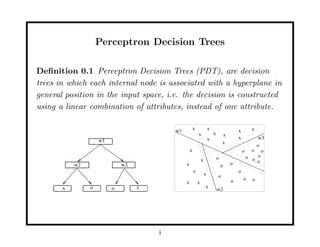
Perceptron Decision Trees

Definition 0.1 Perceptron Decision Trees (PDT), are decision
trees in which each internal node is associated with a hyperplane in
general position in the input space, i.e. the decision is constructed
using a linear combination of attributes, instead of one attribute.

                                          w1           x               x                       x         x
                                                           x               x           x
                                                                       x                       x             w3
                    w1                                                             x
                                                                                                             o
                                                   x                                               o     o       o
                                                                               o                       o o o
                                                               x                                           o
           w2                w3                x                                   o       o
                                                       x                                       o
                                                                   x           o
                                                                                           o       o     o
                                               x           x
       x        o        o        x                                x
                                                                               w2


                                      1
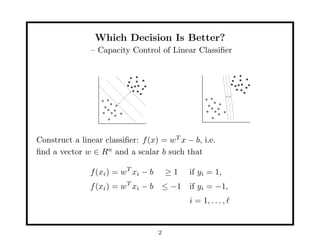
Which Decision Is Better?
               – Capacity Control of Linear Classifier


Construct a linear classifier: f (x) = wT x − b, i.e.
find a vector w ∈ Rn and a scalar b such that

               f (xi ) = wT xi − b       ≥1   if yi = 1,
               f (xi ) = wT xi − b ≤ −1 if yi = −1,
                                              i = 1, . . . ,


                                     2
Large Margin PDTs Generalize Better

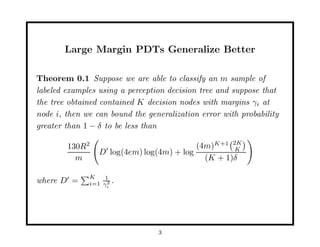
Theorem 0.1 Suppose we are able to classify an m sample of
labeled examples using a perception decision tree and suppose that
the tree obtained contained K decision nodes with margins γi at
node i, then we can bound the generalization error with probability
greater than 1 − δ to be less than

        130R2                             (4m)K+1 2K
                                                   K
                 D log(4em) log(4m) + log
          m                                 (K + 1)δ

              K    1
where D =     i=1 γi .
                    2


                                 3
The Baseline Algorithms for Comparison
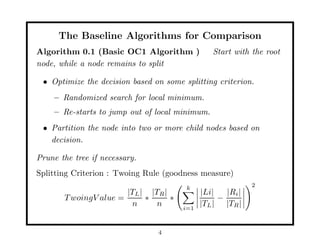
Algorithm 0.1 (Basic OC1 Algorithm )            Start with the root
node, while a node remains to split

 • Optimize the decision based on some splitting criterion.
    – Randomized search for local minimum.
    – Re-starts to jump out of local minimum.
 • Partition the node into two or more child nodes based on
   decision.

Prune the tree if necessary.
Splitting Criterion : Twoing Rule (goodness measure)
                                        k                   2
                       |TL | |TR |           |Li|   |Ri |
       T woingV alue =      ∗      ∗              −
                        n      n       i=1
                                             |TL | |TR |


                                4
Twoing Rule

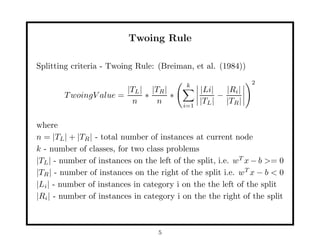
Splitting criteria - Twoing Rule: (Breiman, et al. (1984))

                                           k                   2
                          |TL | |TR |           |Li|   |Ri |
        T woingV alue =        ∗      ∗              −
                            n     n       i=1
                                                |TL | |TR |

where
n = |TL | + |TR | - total number of instances at current node
k - number of classes, for two class problems
|TL | - number of instances on the left of the split, i.e. wT x − b >= 0
|TR | - number of instances on the right of the split i.e. wT x − b < 0
|Li | - number of instances in category i on the the left of the split
|Ri | - number of instances in category i on the the right of the split


                                   5
Enlarging the Margins of PDT

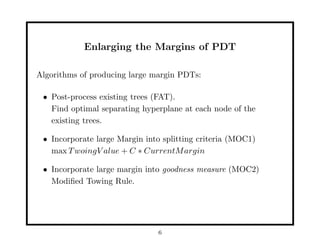
Algorithms of producing large margin PDTs:

 • Post-process existing trees (FAT).
   Find optimal separating hyperplane at each node of the
   existing trees.

 • Incorporate large Margin into splitting criteria (MOC1)
   max T woingV alue + C ∗ CurrentM argin

 • Incorporate large margin into goodness measure (MOC2)
   Modified Towing Rule.


                               6
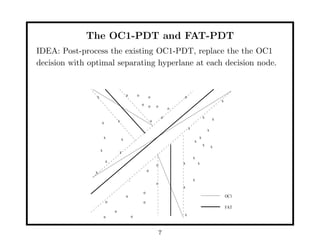
The OC1-PDT and FAT-PDT
IDEA: Post-process the existing OC1-PDT, replace the the OC1
decision with optimal separating hyperlane at each decision node.


                x                       o           o       o                   o
                                                                                                            x
                                                        o   o       o       o
                                                                        o                       x       x
                    x           x                               o
                                                                                    x               x
                        x           x                                                       x
                                                                                        x
                                                                                                x       x
                    x           x
                                                                                        x
                        x                                                       x           x
                                                                    o
                x                                           o

                                            ;                                           x
                                                                    o
                                                                                x
                                                        o
                                        o                                                                       OC1
                        o                               o
                                                                                                                FAT
                            o
                                                o                               x
                        o


                                                                        7
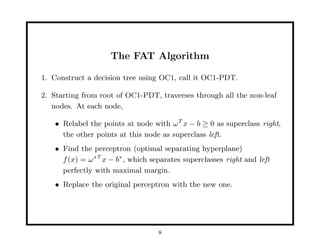
The FAT Algorithm

1. Construct a decision tree using OC1, call it OC1-PDT.

2. Starting from root of OC1-PDT, traverses through all the non-leaf
   nodes. At each node,

    • Relabel the points at node with ω T x − b ≥ 0 as superclass right,
      the other points at this node as superclass left.
    • Find the perceptron (optimal separating hyperplane)
      f (x) = ω ∗ T x − b∗ , which separates superclasses right and left
      perfectly with maximal margin.
    • Replace the original perceptron with the new one.


                                    8
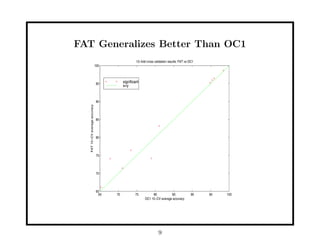
FAT Generalizes Better Than OC1
                                                     10−fold cross validation results: FAT vs OC1
                               100


                                95          significant
                                            x=y


                                90
  FAT 10−CV average accuracy


                                85


                                80


                                75


                                70


                                65
                                  65   70           75          80          85                90    95   100
                                                           OC1 10−CV average accuracy


                                                                      9
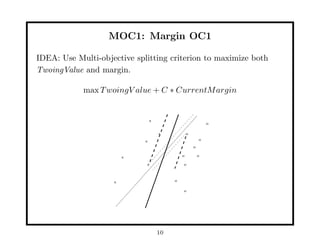
MOC1: Margin OC1

IDEA: Use Multi-objective splitting criterion to maximize both
TwoingValue and margin.

            max T woingV alue + C ∗ CurrentM argin


                                 x
                                                              o

                                     x            o

                             x                            o

                                                      o

                        x                     o           o

                             x                o


                    x                     o

                                              o


                                     10
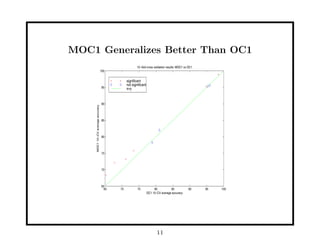
MOC1 Generalizes Better Than OC1
                                                       10−fold cross validation results: MOC1 vs OC1
                                  100


                                               significant
                                               not significant
                                   95          x=y


                                   90
    MOC1 10−CV average accuracy


                                   85


                                   80


                                   75


                                   70


                                   65
                                     65   70           75             80          85            90     95   100
                                                                 OC1 10−CV average accuracy


                                                                        11
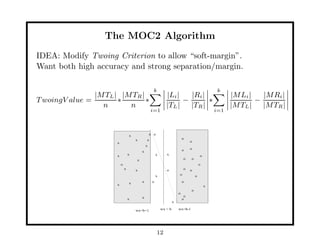
The MOC2 Algorithm
IDEA: Modify Twoing Criterion to allow “soft-margin”.
Want both high accuracy and strong separation/margin.

                                                     k                                            k
                |M TL | |M TR |                                |Li |   |Ri |                            |M Li |   |M Ri |
T woingV alue =        ∗        ∗                                    −       ∗                                  −
                  n       n                                    |TL |   |TR |                            |M TL |   |M TR |
                                                   i=1                                            i=1


                                   x               x o
                                       x       x                             o
                       x                                                          o
                                               x
                                                                             o    o
                                           x
                       x           x                    x      x                          o
                                       x                                     o    o
                           o                                                              o
                               x       x                       o             o    o
                                                        x                o            o

                                   x       x        o                        o
                       x                                                                      x
                                                                                  o
                                                                         o
                                           x                                  o
                                   x                                         o
                                                                     x

                                       wx=b+1               wx = b       wx=b-1


                                                         12
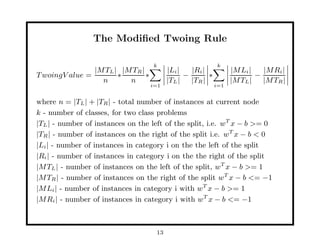
The Modified Twoing Rule

                                    k                       k
                |M TL | |M TR |           |Li |   |Ri |           |M Li |   |M Ri |
T woingV alue =        ∗        ∗               −       ∗                 −
                  n       n               |TL |   |TR |           |M TL |   |M TR |
                                    i=1                     i=1


where n = |TL | + |TR | - total number of instances at current node
k - number of classes, for two class problems
|TL | - number of instances on the left of the split, i.e. wT x − b >= 0
|TR | - number of instances on the right of the split i.e. wT x − b < 0
|Li | - number of instances in category i on the the left of the split
|Ri | - number of instances in category i on the the right of the split
|M TL | - number of instances on the left of the split, wT x − b >= 1
|M TR | - number of instances on the right of the split wT x − b <= −1
|M Li | - number of instances in category i with wT x − b >= 1
|M Ri | - number of instances in category i with wT x − b <= −1


                                     13
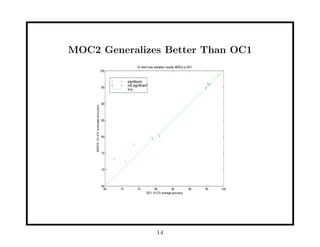
MOC2 Generalizes Better Than OC1
                                                      10−fold cross validation results: MOC2 vs OC1
                                  100


                                               significant
                                   95
                                               not significant
                                               x=y


                                   90
    MOC2 10−CV average accuracy


                                   85


                                   80


                                   75


                                   70


                                   65
                                     65   70          75          80          85               90     95   100
                                                             OC1 10−CV average accuracy


                                                                      14
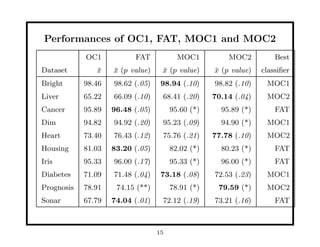
Performances of OC1, FAT, MOC1 and MOC2
            OC1           FAT            MOC1          MOC2          Best
Dataset        x
               ¯    x (p value)
                    ¯              x (p value)
                                   ¯               x (p value)
                                                   ¯             classifier
Bright      98.46   98.62 (.05)    98.94 (.10)     98.82 (.10)    MOC1
Liver       65.22   66.09 (.10)    68.41 (.20)     70.14 (.04)    MOC2
Cancer      95.89   96.48 (.05)        95.60 (*)     95.89 (*)       FAT
Dim         94.82   94.92 (.20)    95.23 (.09)       94.90 (*)    MOC1
Heart       73.40   76.43 (.12)    75.76 (.21)     77.78 (.10)    MOC2
Housing     81.03   83.20 (.05)        82.02 (*)     80.23 (*)       FAT
Iris        95.33   96.00 (.17)        95.33 (*)     96.00 (*)       FAT
Diabetes    71.09   71.48 (.04)    73.18 (.08)     72.53 (.23)    MOC1
Prognosis   78.91    74.15 (**)        78.91 (*)    79.59 (*)     MOC2
Sonar       67.79   74.04 (.01)    72.12 (.19)     73.21 (.16)       FAT


                                  15
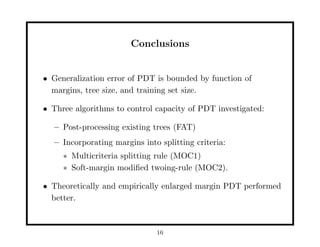
Conclusions


• Generalization error of PDT is bounded by function of
  margins, tree size, and training set size.

• Three algorithms to control capacity of PDT investigated:

  – Post-processing existing trees (FAT)
  – Incorporating margins into splitting criteria:
     ∗ Multicriteria splitting rule (MOC1)
     ∗ Soft-margin modified twoing-rule (MOC2).

• Theoretically and empirically enlarged margin PDT performed
  better.


                              16

Perceptron Arboles De Decision

  • 1.
    Enlarging the Marginsin Perceptron Decision Trees Kristin P. Bennett, Donghui Wu Department of Mathematical Sciences Rensselaer Polytechnic Institute bennek@rpi.edu, wud2@rpi.edu Nello Cristianini John Shawe-Taylor Dept of Engineering Mathematics Dept of Computer Science University of Bristol Royal Holloway, University of London nello.cristianini@bristol.ac.uk jst@dcs.rhbnc.ac.uk 0-0
  • 2.
    Perceptron Decision Trees Definition0.1 Perceptron Decision Trees (PDT), are decision trees in which each internal node is associated with a hyperplane in general position in the input space, i.e. the decision is constructed using a linear combination of attributes, instead of one attribute. w1 x x x x x x x x x w3 w1 x o x o o o o o o o x o w2 w3 x o o x o x o o o o x x x o o x x w2 1
  • 3.
    Which Decision IsBetter? – Capacity Control of Linear Classifier Construct a linear classifier: f (x) = wT x − b, i.e. find a vector w ∈ Rn and a scalar b such that f (xi ) = wT xi − b ≥1 if yi = 1, f (xi ) = wT xi − b ≤ −1 if yi = −1, i = 1, . . . , 2
  • 4.
    Large Margin PDTsGeneralize Better Theorem 0.1 Suppose we are able to classify an m sample of labeled examples using a perception decision tree and suppose that the tree obtained contained K decision nodes with margins γi at node i, then we can bound the generalization error with probability greater than 1 − δ to be less than 130R2 (4m)K+1 2K K D log(4em) log(4m) + log m (K + 1)δ K 1 where D = i=1 γi . 2 3
  • 5.
    The Baseline Algorithmsfor Comparison Algorithm 0.1 (Basic OC1 Algorithm ) Start with the root node, while a node remains to split • Optimize the decision based on some splitting criterion. – Randomized search for local minimum. – Re-starts to jump out of local minimum. • Partition the node into two or more child nodes based on decision. Prune the tree if necessary. Splitting Criterion : Twoing Rule (goodness measure) k 2 |TL | |TR | |Li| |Ri | T woingV alue = ∗ ∗ − n n i=1 |TL | |TR | 4
  • 6.
    Twoing Rule Splitting criteria- Twoing Rule: (Breiman, et al. (1984)) k 2 |TL | |TR | |Li| |Ri | T woingV alue = ∗ ∗ − n n i=1 |TL | |TR | where n = |TL | + |TR | - total number of instances at current node k - number of classes, for two class problems |TL | - number of instances on the left of the split, i.e. wT x − b >= 0 |TR | - number of instances on the right of the split i.e. wT x − b < 0 |Li | - number of instances in category i on the the left of the split |Ri | - number of instances in category i on the the right of the split 5
  • 7.
    Enlarging the Marginsof PDT Algorithms of producing large margin PDTs: • Post-process existing trees (FAT). Find optimal separating hyperplane at each node of the existing trees. • Incorporate large Margin into splitting criteria (MOC1) max T woingV alue + C ∗ CurrentM argin • Incorporate large margin into goodness measure (MOC2) Modified Towing Rule. 6
  • 8.
    The OC1-PDT andFAT-PDT IDEA: Post-process the existing OC1-PDT, replace the the OC1 decision with optimal separating hyperlane at each decision node. x o o o o x o o o o o x x x x o x x x x x x x x x x x x x x o x o ; x o x o o OC1 o o FAT o o x o 7
  • 9.
    The FAT Algorithm 1.Construct a decision tree using OC1, call it OC1-PDT. 2. Starting from root of OC1-PDT, traverses through all the non-leaf nodes. At each node, • Relabel the points at node with ω T x − b ≥ 0 as superclass right, the other points at this node as superclass left. • Find the perceptron (optimal separating hyperplane) f (x) = ω ∗ T x − b∗ , which separates superclasses right and left perfectly with maximal margin. • Replace the original perceptron with the new one. 8
  • 10.
    FAT Generalizes BetterThan OC1 10−fold cross validation results: FAT vs OC1 100 95 significant x=y 90 FAT 10−CV average accuracy 85 80 75 70 65 65 70 75 80 85 90 95 100 OC1 10−CV average accuracy 9
  • 11.
    MOC1: Margin OC1 IDEA:Use Multi-objective splitting criterion to maximize both TwoingValue and margin. max T woingV alue + C ∗ CurrentM argin x o x o x o o x o o x o x o o 10
  • 12.
    MOC1 Generalizes BetterThan OC1 10−fold cross validation results: MOC1 vs OC1 100 significant not significant 95 x=y 90 MOC1 10−CV average accuracy 85 80 75 70 65 65 70 75 80 85 90 95 100 OC1 10−CV average accuracy 11
  • 13.
    The MOC2 Algorithm IDEA:Modify Twoing Criterion to allow “soft-margin”. Want both high accuracy and strong separation/margin. k k |M TL | |M TR | |Li | |Ri | |M Li | |M Ri | T woingV alue = ∗ ∗ − ∗ − n n |TL | |TR | |M TL | |M TR | i=1 i=1 x x o x x o x o x o o x x x x x o x o o o o x x o o o x o o x x o o x x o o x o x o x wx=b+1 wx = b wx=b-1 12
  • 14.
    The Modified TwoingRule k k |M TL | |M TR | |Li | |Ri | |M Li | |M Ri | T woingV alue = ∗ ∗ − ∗ − n n |TL | |TR | |M TL | |M TR | i=1 i=1 where n = |TL | + |TR | - total number of instances at current node k - number of classes, for two class problems |TL | - number of instances on the left of the split, i.e. wT x − b >= 0 |TR | - number of instances on the right of the split i.e. wT x − b < 0 |Li | - number of instances in category i on the the left of the split |Ri | - number of instances in category i on the the right of the split |M TL | - number of instances on the left of the split, wT x − b >= 1 |M TR | - number of instances on the right of the split wT x − b <= −1 |M Li | - number of instances in category i with wT x − b >= 1 |M Ri | - number of instances in category i with wT x − b <= −1 13
  • 15.
    MOC2 Generalizes BetterThan OC1 10−fold cross validation results: MOC2 vs OC1 100 significant 95 not significant x=y 90 MOC2 10−CV average accuracy 85 80 75 70 65 65 70 75 80 85 90 95 100 OC1 10−CV average accuracy 14
  • 16.
    Performances of OC1,FAT, MOC1 and MOC2 OC1 FAT MOC1 MOC2 Best Dataset x ¯ x (p value) ¯ x (p value) ¯ x (p value) ¯ classifier Bright 98.46 98.62 (.05) 98.94 (.10) 98.82 (.10) MOC1 Liver 65.22 66.09 (.10) 68.41 (.20) 70.14 (.04) MOC2 Cancer 95.89 96.48 (.05) 95.60 (*) 95.89 (*) FAT Dim 94.82 94.92 (.20) 95.23 (.09) 94.90 (*) MOC1 Heart 73.40 76.43 (.12) 75.76 (.21) 77.78 (.10) MOC2 Housing 81.03 83.20 (.05) 82.02 (*) 80.23 (*) FAT Iris 95.33 96.00 (.17) 95.33 (*) 96.00 (*) FAT Diabetes 71.09 71.48 (.04) 73.18 (.08) 72.53 (.23) MOC1 Prognosis 78.91 74.15 (**) 78.91 (*) 79.59 (*) MOC2 Sonar 67.79 74.04 (.01) 72.12 (.19) 73.21 (.16) FAT 15
  • 17.
    Conclusions • Generalization errorof PDT is bounded by function of margins, tree size, and training set size. • Three algorithms to control capacity of PDT investigated: – Post-processing existing trees (FAT) – Incorporating margins into splitting criteria: ∗ Multicriteria splitting rule (MOC1) ∗ Soft-margin modified twoing-rule (MOC2). • Theoretically and empirically enlarged margin PDT performed better. 16