PROTEINS: Structure, Function, and Bioinformatics 67:418–434 (2007)


Protein–Protein Recognition and Interaction Hot Spots in
an Antigen–Antibody Complex: Free Energy Decomposition
Identifies ‘‘Efficient Amino Acids’’
Virginie Lafont,1,2 Michael Schaefer,3 Roland H. Stote,4 Daniele Altschuh,2 and Annick Dejaegere1*
                                                                    `
1
                                                                         ´ ´                       ´
 Structural Biology and Genomics Department, UMR 7104, Institut de Genetique et de Biologie Moleculaire et Cellulaire, CNRS/
INSERM/ULP, F-67404 Illkirch Cedex, France
2
 UMR7175-LC1 CNRS/ULP, ESBS, Parc d’Innovation, 67412 Illkirch Cedex, France
3
                                                              ´
 Laboratoire de Chimie Biophysique, Institut le Bel, Universite Louis Pasteur, 67000 Strasbourg, France
4
                                    ´                                                       ´
 Laboratoire de Biophysicochime Moleculaire, Institut de Chimie, LC3-UMR7177, Universite Louis Pasteur,
67070 Strasbourg Cedex, France

   ABSTRACT         The molecular mechanics Poisson–            tions is difficult.1 There are several examples of natural
Boltzmann surface area (MM/PBSA) method was                     molecules that bind at protein interfaces2 and a growing
applied to the study of the protein–protein complex             number of synthetic compounds that are aimed at per-
between a camelid single chain variable domain                  turbing protein–protein interactions (for a recent review,
(cAb-Lys3) and hen egg white lysozyme (HEL), and                see Ref. 3). Progress in developing synthetic compounds
between cAb-Lys3 and turkey egg white lysozyme                  will benefit greatly from improved understanding of the
(TEL). The electrostatic energy was estimated by                energetics and dynamics of protein–protein recognition.
solving the linear Poisson–Boltzmann equation. A                Our current understanding of protein–protein interac-
free energy decomposition scheme was developed to               tions is based on structural analysis of protein–protein
determine binding energy hot spots of each complex.             complexes mostly determined by crystallography, on vari-
The calculations identified amino acids of the anti-            ous biophysical characterizations of protein–protein com-
body that make important contributions to the inter-            plexes that give insight into the kinetics and thermody-
action with lysozyme. They further showed the influ-            namics of protein–protein association,4 and on biochemi-
ence of small structural variations on the energetics           cal analyses that help identify amino acids important for
of binding and they showed that the antibody amino              recognition.
acids that make up the hot spots are organized in                  An important concept that has emerged in the last
such a way as to mimic the lysozyme substrate.                  years is the notion of interaction energy ‘‘hot spots,’’ which
Through further analysis of the results, we define              is the idea that a handful of amino acids at the binding
the concept of ‘‘efficient amino acids,’’ which can pro-        interface make a dominant contribution to the binding af-
vide an assessment of the binding potential of a par-           finity.5,6 Mutation studies, mostly alanine scanning stud-
ticular hot spot interaction. This information, in              ies, have indeed shown7 that only a few mutations [native
turn, can be useful in the rational design of small             ? Ala] affect the free energy of binding by more than
molecules that mimic the antibody. The implications             2 kcal/mol. This has led to a distinction between the func-
of using free energy decomposition to identify                  tional epitope (i.e. ‘‘hot spot residues) and the structural
regions of a protein–protein complex that could be              epitope (all residues that participate in the interface).8
targeted by small molecules inhibitors are discussed.
Proteins 2007;67:418–434. V 2007 Wiley-Liss, Inc.
                              C


                                                                  The Supplementary Material referred to in this article can be found
Key words: MM/PBSA; molecular dynamics; macro-                  at http://www.interscience.wiley.com/jpages/0887-3585/suppmat/
           molecular electrostatics; protein engi-                Grant sponsor: French Ministry of Defense, Centre National de la
           neering; drug design; antibodies;                                                                        ´
                                                                Recherche Scientifique, Institut National de la Sante et de la Recher-
                                                                     ´                      ´
                                                                che Medicale, and Universite Louis Pasteur, Strasbourg, France.
           camelids
                                                                  Virginie Lafont’s current address is Department of Biology, Johns
                                                                Hopkins University, 3400 North Charles Street, Baltimore, MD
                   INTRODUCTION                                 21218-2685.
                                                                  Michael Schafer’s current address is Novartis Pharma AG, Kly-
   For a wide range of biological processes, including anti-    beckstrasse 141, 4057 Basel, Switzerland.
body–antigen interactions, hormone–receptor interac-              *Correspondence to: Annick Dejaegere. Structural Biology and
tions, signal transduction, and regulation, the formation                                                       ´ ´
                                                                Genomics Department, UMR 7104, Institut de Genetique et de Biolo-
                                                                        ´
                                                                gie Moleculaire et Cellulaire, CNRS/INSERM/ULP, BP 10142,
of stable protein–protein complexes is of fundamental im-       F-67404 Illkirch Cedex, France. E-mail: annick@igbmc.u-strasbg.fr
portance. Interfering with or modulating the formation of         Received 20 May 2006; Revised 6 September 2006; Accepted 15 Sep-
these complexes therefore offers attractive opportunities       tember 2006
for therapeutic intervention. However, the development of         Published online 26 January 2007 in Wiley InterScience (www.
small molecules that modulate protein–protein interac-          interscience.wiley.com). DOI: 10.1002/prot.21259

V 2007 WILEY-LISS, INC.
C
INTERACTION HOT SPOTS IN ANTIGEN–ANTIBODY COMPLEX                                         419

However, much remains to be understood of the role of           are minimally sized, stable, and highly soluble, and there-
residues surrounding the hot spots in creating a favorable      fore offer a number of benefits in medical and biotechno-
binding environment, on the balance between electro-            logical applications (for a recent review, see Ref. 25). High
static, van der Waals, and hydrophobic interactions in the      affinity VHH can be obtained after immunization of lla-
formation of complexes, in entropic contributions to bind-      mas and dromedaries with specific antigens.23,26 Alterna-
ing, and in the role of molecular flexibility on the binding    tively, phage antibody libraries can be used.27,28 VHHs
process.                                                        that inhibit several enzymes22,23,26,28–31 have been identi-
   Computational and theoretical methods permit the sys-        fied, as well as VHH that target antigens specific of
tematic analysis of individual amino acid contributions to      human tumors32,33 or specific of infectious agents.34
the formation of protein complexes.9–13 They provide a          VHHs against a mouse anti-DNA monoclonal antibody
wealth of information that are complementary to experi-         that are competitive binders of the original DNA antigen
ments and allow the determination of the structural and         have also been recently identified and are shown to be
energetic consequences of mutations, as well as a better        useful for molecular mimicry studies.35 VHHs against pro-
understanding of the physical mechanism and origin of           teins of interest in human disease have potential diagnos-
the intermolecular interactions that drive binding. Free        tic33 or therapeutic32 applications. Camelidae VHHs are
energy simulations methods14–16 have been successfully          not only able to recognize a wide range of target proteins,
used to predict the effect of point mutations on binding af-    their high stability and small size makes them amenable
finity in macromolecular complexes (for a recent review,        to structural studies, and an increasing number of VHH–
see Ref. 17). Computational cost, however, puts practical       antigen structures are available (for recent examples see
limitations on the number of point mutations that can be        Refs. 36–38). The structural information from these com-
analyzed by free energy simulations for a given complex.        plexes is potentially useful for the development of small
Systematic analysis of the contribution of all amino acids      molecule mimicks of the VHH.39 For this to be realized,
to the stability of macromolecular complexes have mostly        however, it is important to identify the important interac-
relied on different empirical free energy functions11,12 as     tions in the VHH–antigen complex. From an experimental
well as on all-atom molecular mechanics methods using           analysis alone, this is not necessarily evident. In this pa-
implicit representation of the solvent (so called MM/PBSA       per, we show, for the VHH cAb-Lys3–lysozyme complex,
or MM/GBSA methods18). The MM/PBSA method has                   that an interaction energy hot spot exploited in the anti-
been used to systematically analyze the contribution of all     body–lysozyme complex is also used by the N-acetyl gluco-
amino acids to the formation of several macromolecular          samine (NAG) ring of saccharide substrates in subsite C
complexes. For computational efficiency, these analyses         of the lysozyme binding pocket. We support the results of
were performed on a single structure of the complex.10,19       the free energy decomposition approach by the mutational
The generalized Born model for electrostatics has also          analysis of four VHH positions. We further introduce the
recently been applied to the free energy decomposition in       concept of amino acid efficiency and show the potential of
protein–protein complexes.13,20,21 The generalized Born         free energy decomposition in extracting useful informa-
model is faster, but introduces additional approximations       tion for drug design.
in the electrostatics treatment with respect to numerical
solutions of the Poisson–Boltzmann equations. In the                          MATERIALS AND METHODS
present work, we develop a computationally tractable, yet
reliable, free energy decomposition protocol that can be           We developed a protocol based on the MM/PBSA
used to identify amino-acids that have a dominant role in       method,13,18,40 in which conformations extracted from mo-
binding. In the MM/PBSA approach presented here, we             lecular dynamics simulations are processed by a combina-
use solutions to the Poisson–Boltzmann equation to              tion of methods using a simplified description for the sol-
obtain the electrostatic contribution to binding. This is in    vent to give an estimate of binding free energy. Individual
contrast to other recent applications of the methodol-          contributions of each amino acid to the complex formation
ogy13,20,21 where the Generalized Born model was                are estimated and important amino acid ‘‘hot spots’’ are
employed. In addition, multiple conformations from mo-          identified.
lecular dynamics trajectories are used in the analysis.
                                                                Structures
   The protocol is used to analyze molecular recognition in
the complex between a camel single chain antibody vari-           The coordinates of the camel single-domain VH anti-
able domain (cAb-Lys3) and its antigen lysozyme.22,23 The       body–lysozyme complexes were obtained from the Protein
recombinant protein cAb-Lys3 is a single variable domain.       Data Bank.41 Two structure files containing hen egg white
Single domain antigen binding fragments can be gener-           lysozyme as the antigen were obtained: 1MEL (solved at
ated from the variable domain of Camelidae heavy chain              ˚                                       ˚
                                                                2.5 A resolution)22 and 1JTT (solved at 2.1 A resolution).42
antibodies. Indeed, the Camelidae possess, in addition to       A third structure file containing the coordinates for the
classical IgG molecules, a large fraction of naturally          complex of the same antibody with turkey egg white lyso-
occurring heavy chain antibodies that are devoid of light       zyme as the antigen was also obtained from the Protein
chains.24 These single domains preserve the ability to                                            ˚
                                                                Data Bank: 1JTP (solved at 1.9 A resolution).42 For the
bind specifically and with high affinity to their antigens.     structures 1MEL and 1JTP, there are two complexes per
These small antibodies, also called VHH or nanobodyTM           asymmetric unit, antibody chain A with lysozyme chain L

                                                          PROTEINS: Structure, Function, and Bioinformatics   DOI 10.1002/prot
420                                                     LAFONT ET AL.

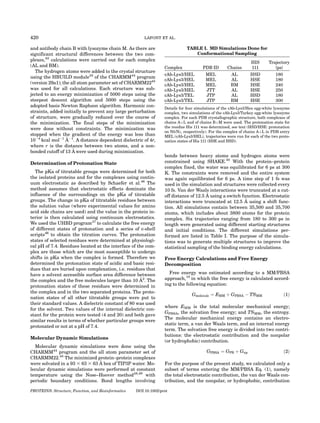
and antibody chain B with lysozyme chain M. As there are                      TABLE I. MD Simulations Done for
significant structural differences between the two com-                          Conformational Sampling
plexes,42 calculations were carried out for each complex
                                                                                                                 HIS      Trajectory
(AL and BM).                                                      Complex             PDB ID        Chains       111         {ps}
  The hydrogen atoms were added to the crystal structure
                                                                  cAb-Lys3/HEL          MEL           AL        HSD           180
using the HBUILD module43 of the CHARMM44 program
                                                                  cAb-Lys3/HEL          MEL           AL        HSE           180
(version 29a1); the all atom parameter set of CHARMM2245          cAb-Lys3/HEL          MEL           BM        HSE           240
was used for all calculations. Each structure was sub-            cAb-Lys3/HEL          JTT           AL        HSE           250
jected to an energy minimization of 5000 steps using the          cAb-Lys3/TEL          JTP           AL        HSD           180
steepest descent algorithm and 5000 steps using the               cAb-Lys3/TEL          JTP           BM        HSE           300
adopted basis Newton Raphson algorithm. Harmonic con-             Details for four simulations of the cAb-Lys3/Hen egg-white lysozyme
straints, added initially to prevent any large perturbation       complex, two simulations of the cAb-Lys3/Turkey egg-white lysozyme
of structure, were gradually reduced over the course of           complex. For each PDB crystallographic structure, both complexes of
the minimization. The final steps of the minimization             chains AþL and of chains BþM were used. The protonation state for
were done without constraints. The minimization was               the residue His 111 was determined, see text (HSD/HSE: protonation
                                                                  on Nd/Ne, respectively). For the complex of chains AþL in PDB entry
stopped when the gradient of the energy was less than             MEL (cAb-Lys3/HEL), trajectories were run for each of the two proto-
                  ˚
10À4 kcal molÀ1 AÀ1. A distance dependent dielectric of 4r,       nation states of His 111 (HSE and HSD).
where r is the distance between two atoms, and a non-
                     ˚
bonded cutoff of 13 A were used during minimization.
                                                                  bonds between heavy atoms and hydrogen atoms were
Determination of Protonation State                                constrained using SHAKE.50 With the protein–protein
                                                                  complex fixed, the water was equilibrated for 6 ps at 300
  The pKa of titratable groups were determined for both           K. The constraints were removed and the entire system
the isolated proteins and for the complexes using contin-         was again equilibrated for 6 ps. A time step of 1 fs was
uum electrostatic as described by Schaefer et al.46 The           used in the simulation and structures were collected every
method assumes that electrostatic effects dominate the            10 fs. Van der Waals interactions were truncated at a cut-
influence of the surroundings on the pKa of titratable                                 ˚
                                                                  off distance of 12.5 A using a switch function. Electrostatic
groups. The change in pKa of titratable residues between                                                  ˚
                                                                  interactions were truncated at 12.5 A using a shift func-
the solution value (where experimental values for amino           tion. All simulations contain between 35,500 and 35,700
acid side chains are used) and the value in the protein in-       atoms, which includes about 3800 atoms for the protein
terior is then calculated using continuum electrostatics.         complex. Six trajectories ranging from 180 to 300 ps in
We used the UHBD program47 to calculate the free energy           length were generated using different starting structures
of different states of protonation and a series of c-shell        and initial conditions. The different simulations per-
scripts46 to obtain the titration curves. The protonation         formed are listed in Table I. The purpose of the simula-
states of selected residues were determined at physiologi-        tions was to generate multiple structures to improve the
cal pH of 7.4. Residues located at the interface of the com-      statistical sampling of the binding energy calculations.
plex are those which are the most susceptible to undergo
shifts in pKa when the complex is formed. Therefore we            Free Energy Calculations and Free Energy
determined the protonation state of acidic and basic resi-        Decomposition
dues that are buried upon complexation, i.e. residues that
have a solvent accessible surface area difference between           Free energy was estimated according to a MM/PBSA
                                                     ˚
the complex and the free molecules larger than 10 A2. The         approach,18 in which the free energy is calculated accord-
protonation states of these residues were determined in           ing to the following equation:
the complex and in the two separated proteins. The proto-
                                                                                Gmolecule ¼ EMM þ GPBSA À TSMM                      ð1Þ
nation states of all other titratable groups were put to
their standard values. A dielectric constant of 80 was used
                                                                  where EMM is the total molecular mechanical energy;
for the solvent. Two values of the internal dielectric con-
                                                                  GPBSA, the solvation free energy; and TSMM, the entropy.
stant for the protein were tested (4 and 20) and both gave
                                                                  The molecular mechanical energy contains an electro-
similar results in terms of whether particular groups were
                                                                  static term, a van der Waals term, and an internal energy
protonated or not at a pH of 7.4.
                                                                  term. The solvation free energy is divided into two contri-
                                                                  butions: the electrostatic contribution and the nonpolar
Molecular Dynamic Simulations
                                                                  (or hydrophobic) contribution.
  Molecular dynamic simulations were done using the
CHARMM44 program and the all atom parameter set of                                      GPBSA ¼ GPB þ Gnp                           ð2Þ
CHARMM22.45 The minimized protein–protein complexes
                                ˚
were solvated in a 93 3 63 3 63 A box of TIP3P water. Mo-         For the purpose of the present study, we calculated only a
lecular dynamic simulations were performed at constant            subset of terms entering the MM/PBSA Eq. (1), namely
temperature using the Nose–Hoover method48,49 with                the total electrostatic contribution, the van der Waals con-
periodic boundary conditions. Bond lengths involving              tribution, and the nonpolar, or hydrophobic, contribution

PROTEINS: Structure, Function, and Bioinformatics   DOI 10.1002/prot
INTERACTION HOT SPOTS IN ANTIGEN–ANTIBODY COMPLEX                                              421

to the free energy. As we neglect conformational change         tions. For example, there is always a destabilizing contri-
upon complexation (see later), there are no changes to the      bution due to the loss of favorable interactions between
internal energy terms. The binding free energy was then         charged and polar residues and the solvent molecules
estimated according to the following equation:                  (desolvation). In addition, there is a change in the num-
                                                                ber, and the environment, of pair-wise interactions result-
          DG ¼ DEelec þ DEvdw þ DGelec þ DGnp
                                  solv     solv          ð3Þ    ing from complex formation, which counterbalances the
                                                                unfavorable desolvation term.
where DEelec and DEvdw are the electrostatic and van der           We used the UHBD program47 to solve the linearized
Waals contributions to the energy of the complex forma-         Poisson–Boltzmann equation using a finite-difference
tion, respectively; DGelec and DGnp are the electrostatic
                       solv        solv
                                                                method (FDPB). A shell script, which includes interfaces
and nonpolar contributions related to solvation, respec-        to UHBD, was used to compute the electrostatic binding
tively.                                                         free energy of binding of the two molecules. The boundary
   Equation 3 neglects conformational entropy contribu-         between the solute and solvent regions with different
tions to the thermodynamics of binding. We did not esti-        dielectric constants is determined by the molecular sur-
mate this term because our main goal was to apply this          face. van der Waals radii and charges of atoms are
method to identify residues that play a dominant role in        obtained from parameters of the force field CHARMM22.
stabilizing the bound complex rather than obtaining a           A dielectric constant of 80 was used for the solvent and 1
quantitative account of the binding thermodynamics.             for the protein (the value of 1 for the protein dielectric con-
Although methods have been proposed to analyze individ-         stant is used when conformational averaging is per-
ual contributions to conformational entropies,51,52 their       formed; for the single calculation on the X-ray structure of
generalization in the present context would entail a signif-    the cAbLys3-HEL, a value of 4 was used for the protein
icant and unnecessary computational cost. Another sim-          dielectric constant10). The final mesh grid on which
plification introduced concerns the neglect of conforma-        charges are located and on which the electrostatic poten-
                                                                                                              ˚
                                                                tial is calculated has a grid spacing of 0.35 A.
tion changes between the bound and unbound proteins. In
the absence of an experimental structure for the unbound           The electrostatic contribution was decomposed by resi-
antibody, the structures of the unbound proteins were           dues. This decomposition is possible because the linear
taken from that of the complex. There are experimental          Poisson–Boltzmann equation is used, which permits a
indications that the antibody–antigen association is domi-      superposition of the electrostatic potential at point i by
nated by enthalpy and occurs without large structural           the sum of potentials created by each individual charge.
rearrangements.53,54 These simplifications preclude cal-                   X1
culations of absolute values of the binding free energy;        DGelec ¼           qi /complex
                                                                                       i
however, they are expected to be satisfactory in the con-                  i2C
                                                                               2
                                                                                8                                         9
text of identifying interaction energy ‘‘hot spots’’ in the                     >X 1                   X1
                                                                                >
                                                                                >           antibody             lysozyme >
                                                                                                                          >
                                                                                                                          >
protein–protein complex, which is the goal of the present                      À>
                                                                                :       qi /i        þ       qi /i        >
                                                                                                                          ;     ð4Þ
                                                                                      2                    2
study. Similar simplifications have been adopted by other                         i2A                  i2L

authors.10,19,55,56 Each contribution to the binding free
energy entering Eq. (3) was decomposed as a sum of indi-
                                                                This equation shows that the total electrostatic energy of
vidual contributions per residue, as described later.
                                                                a complex C (antibody þ lysozyme) is calculated by sum-
van der Waals contributions                                     ming over all charges, the product of the charge qi and the
                                                                potential /i at the position of the charge. The potential /i
   The van der Waals energy was calculated by the 6-12          is obtained by solving the linear Poisson–Boltzmann (PB)
Lennard-Jones potential of the CHARMM22 force field.            equation using the program UHBD. The contribution of
The individual contributions to the van der Waals interac-      one residue j to the electrostatic free energy of complex
tion energy of each residue of the antibody was estimated       formation is estimated by summing over all charges qi
as one half the interaction with the set of lysozyme resi-      using the potentials /i created at the position i by the
                       ˚
dues located in a 12.5 A cutoff distance, and vice versa for    atomic charges of residue j:
lysozyme. The division by two ensures that the sum of                                     8                           9
individual contributions gives the total van der Waals                      X1            >X 1
                                                                                      j2C >           j2A
                                                                                                          X1      j2L >
                                                                                                                      >
                                                                       elec
                                                                    DGj ¼                 >
                                                                                  qi /i À >       qi /i þ     qi /i > >  ð5Þ
interaction energy of the complex.                                              2         :     2           2         ;
                                                                              i2C                i2A          i2L

Electrostatic contributions
   The total electrostatic energy of a macromolecular sys-      where j belongs either to A (antibody) or to L (lysozyme).
tem can be partitioned into contributions from interac-           Such decompositions were first used to interpret contin-
tions between pairs of atomic partial charges of the macro-     uum electrostatic calculations for solvation of phosphor-
molecule and from the interactions of individual partial        anes in water,57 and a decomposition scheme similar to
charges with the solvent.                                       equation (4) was first applied to proteins by Hendsch and
   In a process such as protein association, there is always    Tidor.10 However, in earlier free energy decomposition
interplay between favorable and unfavorable contribu-           work based on the Poisson–Boltzmann method, only a sin-

                                                          PROTEINS: Structure, Function, and Bioinformatics         DOI 10.1002/prot
422                                                     LAFONT ET AL.

gle conformation of the protein–protein complex was usu-          trostatic Coulomb term. We therefore computed the Cou-
ally used,10,19,58 which is not the case here.                    lomb interaction energy in vacuo between the protein
                                                                  cAb-Lys3 and lysozyme for all conformations saved from
Nonpolar contributions                                            the MD trajectory (coordinates were collected every 0.1 ps
                                                                  from the MD). The Coulomb electrostatic interaction
  The nonpolar contributions to the free energy of binding
                                                                  energy in vacuo was calculated using the CHARMM pro-
are taken to be proportional to the loss in solvent accessi-
                                                                  gram. A dielectric constant of 1 and a nonbonded cutoff of
ble surface area.                                                       ˚
                                                                  12.5 A was used, with a shift truncation function for elec-
                                                              trostatics. The conformations were clustered in ten groups
 DGnp ¼ g SAScomplex À SASantibody þ SASlysozyme    ð6Þ
                          unbound       unbound                   that had similar values of the electrostatic interaction
                                                                  energy, and that were distributed evenly between the low-
                                                                  est and highest values recorded for the electrostatic inter-
The radii of protein atoms are obtained from the parame-          actions over the course of the trajectory. One conformation
ters of the force field CHARMM22. We used CHARMM for              was extracted from each cluster (with vacuum interaction
calculating the accessible surface with a probe radius of         energy closest to the cluster average value). Each
     ˚
1.4 A. We determined the accessible surface of each               extracted conformation was then postprocessed using the
residue in the free molecules and in the complex and then         MM/PBSA procedure. The total free energy and its indi-
we calculated the accessible surface area difference              vidual components were then obtained for each trajectory
between the free molecule and the complex for each                as a weighted average over the conformations extracted,
                                ˚
residue. A value of 5 cal molÀ1 AÀ2 was used13,20,21 for the      with higher weight given to conformations extracted from
constant g.                                                       more populated clusters (i.e. the weight of a conformation
                                                                  is proportional to the ratio of the number of conformations
Selection of Structures for the Free
                                                                  with that energy to the total number of conformations
Energy Decomposition
                                                                  extracted from the MD trajectory). This procedure reduces
   Past free energy decomposition analysis based on the           the computational cost of performing MM/PBSA calcula-
MM/PBSA or MM/GBSA methods have been performed                    tions while allowing an estimate of the effect of conforma-
using either a single experimental structure9,10 or an en-        tional variation on the decomposition analysis. While the
semble of conformations extracted from molecular                  energy used for selecting the conformations was the vac-
dynamic simulations.13,56 It is known that the different          uum electrostatic term, which differs from the solvent
energy terms used in the MM/PBSA method fluctuate sig-            term computed by continuum electrostatics, the two terms
nificantly with small changes in structure linked to ther-        show a significant statistical correlation, so that confor-
mal fluctuations.59 It is therefore necessary to use an en-       mations that show large variation in vacuum energy also
semble of structures rather than one experimental struc-          show significant variation in solution energy (data not
ture in free energy decompositions based on the MM/               shown,60), hence the interest of the simplified protocol.
PBSA scheme. Obtaining converged values of binding free              A standard deviation of each amino acid contribution is
energies for quantitative assessment of binding thermody-         also calculated. The statistical weight of the conformation
namics entails significant computational effort.13 The            is taken into account in computing the standard devia-
intention of the present work was to reliably identify            tion.61 When results from different simulations using dif-
those amino acids that play a dominant role in binding,           ferent starting structures are averaged, the total number
and to obtain a semi-quantitative estimate of their contri-       of conformations in all trajectories is used to normalize
butions to the binding thermodynamics. We, therefore,             the weight of each individual conformation in the average.
developed a protocol that uses only a limited number of
conformations extracted from molecular dynamics trajec-
                                                                  Amino Acid Efficiency
tories for the free energy decomposition, but that allows
sufficient sampling to reduce artifacts linked to the use of         We define the amino acid efficiency as the free energy
a single conformation. For the system studied, several            contribution of each amino acid divided by its number of
crystal structures were available (cf. Structures Section).       nonhydrogen atoms (i.e. 4 for Gly, 5 for Ala, 14 for Trp
These structures were used as starting points for short           etc.). This definition is similar in spirit to the definition of
molecular dynamics trajectories. Thus, significant confor-        ligand efficiency62 which is defined as the binding affinity
mational differences would be taken into account by using         per heavy atom. When extending the notion to amino
the different initial structures and the MD simulations           acids within a macromolecule, we also considered that
would give small thermal fluctuations around the crystal          some amino acids may be partially or even fully buried in
structure. Ten conformations were extracted from the MD           unbound proteins. We therefore tested an alternative defi-
trajectories for analysis. The structures were not                nition of the number of atoms as the solvent accessible
extracted at regular time intervals, but selected using a         atoms rather than all heavy atoms. The effective number
protocol that was designed to cover a large, representative       of solvent accessible atoms was computed in the following
range of individual MM/PBSA energy terms. The compo-              way: for each of the 20 amino acid, AA, a tripeptide Gly-
nent of the binding free energy that shows the largest            AA-Gly was constructed in extended conformation and
fluctuations with small changes in structures is the elec-        the solvent accessible surface of the amino acid in the tri-

PROTEINS: Structure, Function, and Bioinformatics   DOI 10.1002/prot
INTERACTION HOT SPOTS IN ANTIGEN–ANTIBODY COMPLEX                                     423

peptide was computed. The radii of amino acids atoms            cules were injected at different concentrations on a control
were obtained from the CHARMM force field and                   surface and on a surface containing low levels of immobi-
CHARMM program was used for calculating the accessi-            lized lysozyme. The injection and postinjection phases
                                       ˚
ble surface with a probe radius of 1.4 A. The solvent acces-    lasted between 3 and 5 min. The surfaces were regener-
sible surface of each amino acid of the unbound protein         ated with 50 mM HCl. Data were fitted globally with the
was computed using the same procedure. Then an effec-           BIAevaluation 3.1 software (Biacore AB), using the Lang-
tive number of atoms (Neffect) for each amino acid within       muir binding model.
the protein was computed as
                                                                              RESULTS
                                      Sprot
             Neffect ¼    Nheavy Á               þ1      ð7Þ    Free Energy Decomposition for the Antibody
                                     Speptide
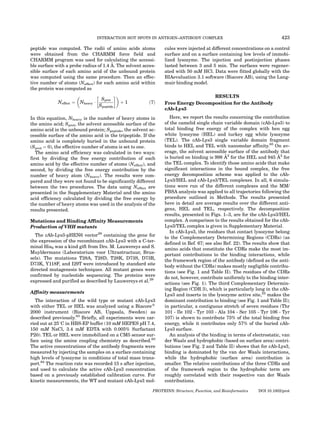
                                                                cAb-Lys3

In this equation, Nheavy is the number of heavy atoms in           Here, we report the results concerning the contribution
the amino acid; Sprot, the solvent accessible surface of the    of the camelid single chain variable domain (cAb-Lys3) to
amino acid in the unbound protein; Speptide, the solvent ac-    total binding free energy of the complex with hen egg
cessible surface of the amino acid in the tripeptide. If the    white lysozyme (HEL) and turkey egg white lysozyme
amino acid is completely buried in the unbound protein          (TEL). The cAb-Lys3 single variable domain fragment
(Sprot ¼ 0), the effective number of atoms is set to one.       binds to HEL and TEL with nanomolar affinity.65 On av-
   The amino acid efficiency was calculated in two ways:        erage, the solvent accessible surface of the antibody that
                                                                                             ˚                         ˚
                                                                is buried on binding is 998 A2 for the HEL and 945 A2 for
first by dividing the free energy contribution of each
amino acid by the effective number of atoms (Neffect), and      the TEL complex. To identify those amino acids that make
second, by dividing the free energy contribution by the         significant interactions in the bound complex, the free
number of heavy atom (Nheavy). The results were com-            energy decomposition scheme was applied to the cAb-
pared and they were not found to be significantly different     Lys3/HEL and cAb-Lys3/TEL complexes. In all, 6 simula-
between the two procedures. The data using Neffect are          tions were run of the different complexes and the MM/
presented in the Supplementary Material and the amino           PBSA analysis was applied to all trajectories following the
acid efficiency calculated by dividing the free energy by       procedure outlined in Methods. The results presented
the number of heavy atoms was used in the analysis of the       here in detail are average results over the different anti-
results presented.                                              gens, HEL and TEL, respectively. The decomposition
                                                                results, presented in Figs. 1–3, are for the cAb-Lys3/HEL
Mutations and Binding Affinity Measurements                     complex. A comparison to the results obtained for the cAb-
Production of VHH mutants                                       Lys3/TEL complex is given in Supplementary Material.
                                                                   In cAb-Lys3, the residues that contact lysozyme belong
  The cAb-Lys3-pHEN6 vector29 containing the gene for           to the Complementary Determining Regions (CDRs) (as
the expression of the recombinant cAb-Lys3 with a C-ter-        defined in Ref. 67; see also Ref. 22). The results show that
minal His6 was a kind gift from Drs. M. Lauwereys and S.        amino acids that constitute the CDRs make the most im-
Muyldermans (Laboratorium voor Ultrastructuur, Brus-            portant contributions to the binding interactions, while
sels). The mutations T28A, T28D, T28K, D73S, D73R,              the framework region of the antibody (defined as the anti-
D73K, Y118F, and I29T were introduced by standard site          body without the CDRs) makes mostly negligible contribu-
directed mutagenesis techniques. All mutant genes were          tions (see Fig. 1 and Table II). The residues of the CDRs
confirmed by nucleotide sequencing. The proteins were
                                                                do not, however, contribute uniformly to the binding inter-
expressed and purified as described by Lauwereys et al.29       actions (see Fig. 1). The third Complementary Determin-
                                                                ing Region (CDR 3), which is particularly long in the cAb-
Affinity measurements
                                                                Lys3 and inserts in the lysozyme active site,22 makes the
  The interaction of the wild type or mutant cAb-Lys3           dominant contribution to binding (see Fig. 1 and Table II);
with either TEL or HEL was analyzed using a Biacore1            in particular, a contiguous stretch of seven residues (Thr
2000 instrument (Biacore AB, Uppsala, Sweden) as                101 - Ile 102 - Tyr 103 - Ala 104 - Ser 105 - Tyr 106 - Tyr
described previously.63 Briefly, all experiments were car-      107) is shown to contribute 75% of the total binding free
ried out at 258C in HBS-EP buffer (10 mM HEPES pH 7.4,          energy, while it contributes only 57% of the buried cAb-
150 mM NaCl, 3.4 mM EDTA with 0.005% Surfactant                 Lys3 surface.
P20). TEL or HEL were immobilized on a CM5 sensor sur-             An analysis of the binding in terms of electrostatic, van
face using the amine coupling chemistry as described.63         der Waals and hydrophobic (based on surface area) contri-
The active concentrations of the antibody fragments were        butions (see Fig. 2 and Table II) shows that for cAb-Lys3,
measured by injecting the samples on a surface containing       binding is dominated by the van der Waals interactions,
high levels of lysozyme in conditions of total mass trans-      while the hydrophobic (surface area) contribution is
port.64 The reaction rate was recorded 15 s after injection,    smaller. The relative contributions of the three CDRs and
and used to calculate the active cAb-Lys3 concentration         of the framework region to the hydrophobic term are
based on a previously established calibration curve. For        roughly correlated with their respective van der Waals
kinetic measurements, the WT and mutant cAb-Lys3 mol-           contributions.

                                                          PROTEINS: Structure, Function, and Bioinformatics   DOI 10.1002/prot
424                                                                  LAFONT ET AL.


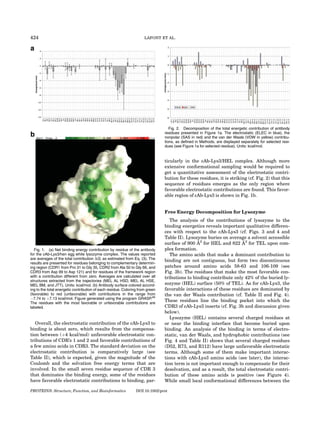
                                                                                  Fig. 2. Decomposition of the total energetic contribution of antibody
                                                                               residues presented in Figure 1a. The electrostatic (ELEC in blue), the
                                                                               nonpolar (SAS in red) and the van der Waals (VDW in yellow) contribu-
                                                                               tions, as defined in Methods, are displayed separately for selected resi-
                                                                               dues (see Figure 1a for selected residue). Units: kcal/mol.


                                                                               ticularly in the cAb-Lys3/HEL complex. Although more
                                                                               extensive conformational sampling would be required to
                                                                               get a quantitative assessment of the electrostatic contri-
                                                                               bution for these residues, it is striking (cf. Fig. 2) that this
                                                                               sequence of residues emerges as the only region where
                                                                               favorable electrostatic contributions are found. This favor-
                                                                               able region of cAb-Lys3 is shown in Fig. 1b.


                                                                               Free Energy Decomposition for Lysozyme
                                                                                  The analysis of the contributions of lysozyme to the
                                                                               binding energetics reveals important qualitative differen-
                                                                               ces with respect to the cAb-Lys3 (cf. Figs. 3 and 4 and
                                                                               Table II). Lysozyme buries on average a solvent accessible
                                                                                               ˚                    ˚
                                                                               surface of 900 A2 for HEL and 822 A2 for TEL upon com-
   Fig. 1. (a) Net binding energy contribution by residue of the antibody      plex formation.
for the cAb-Lys3/hen egg white lysozyme complex. The values reported              The amino acids that make a dominant contribution to
are averages of the total contribution DG, as estimated from Eq. (3). The
                                                                               binding are not contiguous, but form two discontinuous
results are presented for residues belonging to complementary determin-
ing region (CDR1 from Pro 31 to Gly 35, CDR2 from Ala 50 to Gly 66, and        patches around amino acids 58-63 and 106-109 (see
CDR3 from Asp 99 to Asp 121) and for residues of the framework region          Fig. 3b). The residues that make the most favorable con-
with a contribution different from zero. Averages are calculated over all      tributions to binding contribute only 42% of the buried ly-
structures extracted from the trajectories (MEL AL HSD, MEL AL HSE,
MEL BM, and JTT). Units: kcal/mol. (b) Antibody surface colored accord-        sozyme (HEL) surface (50% of TEL). As for cAb-Lys3, the
ing to the total energetic contribution of each residue. Coloring from green   favorable interactions of these residues are dominated by
(favorable) to red (unfavorable) with contributions in the range from          the van der Waals contribution (cf. Table II and Fig. 4).
À7.74 to þ7.13 kcal/mol. Figure generated using the program GRASP.66
The residues with the most favorable or unfavorable contributions are
                                                                               These residues line the binding pocket into which the
labeled.                                                                       CDR3 of cAb-Lys3 inserts (cf. Fig. 3b and discussion given
                                                                               below).
                                                                                  Lysozyme (HEL) contains several charged residues at
   Overall, the electrostatic contribution of the cAb-Lys3 to                  or near the binding interface that become buried upon
binding is about zero, which results from the compensa-                        binding. An analysis of the binding in terms of electro-
tion between (þ4 kcal/mol) unfavorable electrostatic con-                      static, van der Waals, and hydrophobic contributions (see
tributions of CDR’s 1 and 2 and favorable contributions of                     Fig. 4 and Table II) shows that several charged residues
a few amino acids in CDR3. The standard deviation on the                       (D52, R73, and R112) have large unfavorable electrostatic
electrostatic contribution is comparatively large (see                         terms. Although some of them make important interac-
Table II), which is expected, given the magnitude of the                       tions with cAb-Lys3 amino acids (see later), the interac-
Coulomb and the solvation free energy terms that are                           tion term is not important enough to compensate for their
involved. In the small seven residue sequence of CDR 3                         desolvation, and as a result, the total electrostatic contri-
that dominates the binding energy, some of the residues                        bution of these amino acids is positive (see Figure 4).
have favorable electrostatic contributions to binding, par-                    While small local conformational differences between the

PROTEINS: Structure, Function, and Bioinformatics               DOI 10.1002/prot
INTERACTION HOT SPOTS IN ANTIGEN–ANTIBODY COMPLEX                                                425

                                                                                 relative contribution of lysozyme to the total binding free
                                                                                 energy is only about 15% (cf. Table II, À7 kcal/mol from a
                                                                                 total of À52 kcal/mol for HEL, and À6 kcal/mol out of a
                                                                                 total of À38 kcal/mol for TEL). The observation that the
                                                                                 difference in total contribution to binding between the two
                                                                                 partners is directly linked to the difference in electrostatic
                                                                                 interaction also results from the fact that, by definition
                                                                                 (see Methods), the van der Waals interactions are shared
                                                                                 equally between the two proteins, and that the difference
                                                                                 in buried surface area between two proteins in a complex
                                                                                 is very small.68 Electrostatic desolvation, on the other
                                                                                 hand, is strongly dependent on the individual structure
                                                                                 and charge distribution of each partner, and large differ-
                                                                                 ences can be observed for two proteins in a complex as
                                                                                 demonstrated here. Although the absolute values of the
                                                                                 antibody and lysozyme contributions to binding differ
                                                                                 between the HEL and TEL complexes (see Table II), the
                                                                                 relative magnitudes of the individual contributions are
                                                                                 very similar.


                                                                                 Comparison of the Different Structures
                                                                                    We studied three experimental structures of the cAb-
                                                                                 Lys3 in complex with HEL, and two of the complex with
                                                                                 TEL. The three HEL complex structures differ signifi-
                                                                                 cantly by a rigid body rotation of one protein with respect
                                                                                 to the other42 and both the sequence and the internal
                                                                                 structure of the lysozyme monomer are different in the
                                                                                 TEL and in the HEL complex structures. The RMS differ-
                                                                                 ences between the different protein–protein complexes (in
                                                                                 both the crystal structures and structures obtained from
                                                                                 the MD trajectory) are given in Table 1 of Supplementary
                                                                                 Material.
                                                                                    With these differences, it is possible to test the robust-
                                                                                 ness of the free energy decomposition scheme with respect
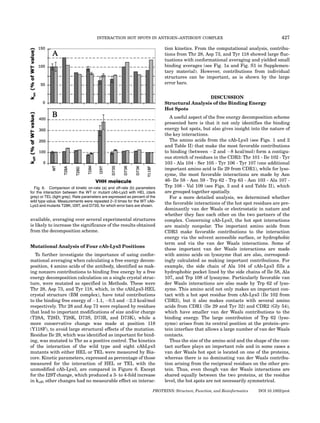
   Fig. 3. (a) Net binding energy contribution by residue of the HEL lyso-       to changes in sequence and in conformation space. The
zyme for the cAb-Lys3/hen egg white lysozyme complex. The values
reported are averages of the total contribution DG [cf. Eq. (3)]. The results
                                                                                 short MD simulations that were run for each structure
are presented for residues with a contribution different from zero. The          were used to generate ensembles of conformations and
averages were calculated over all structures extracted from the trajecto-        thus to reduce statistical error. We are then able to obtain
ries of the different initial structures (MEL AL HSD, MEL AL HSE, MEL            a more general understanding of the recognition process
BM, and JTT). Units: kcal/mol. (b) Projection of the total energetic contri-
bution of each residue onto the lysozyme surface. The residues are col-          in that our results are less dependent on the specific
ored from green (favorable contributions) to red (unfavorable contribu-          three-dimensional structure.
tions). The values range from À7.74 to þ7.13 kcal/mol. The picture was              A comparison of the results for the two lysozymes (see
prepared using the program GRASP66. The residues with the most favor-
able or unfavorable contributions are noted. [Color figure can be viewed
                                                                                 Fig. 5) shows that the interaction energy hot spots are the
in the online issue, which is available at www.interscience.wiley.com.]          same in the two complexes; similar results are obtained
                                                                                 for the antibody (see Fig. 1 of Supplementary Material).
                                                                                 However, some charged amino acids of the interface, such
                                                                                 as Asp 48 and Arg 73 (HEL) or Lys 73 (TEL), show signifi-
complexed and uncomplexed lysozyme may modulate the                              cantly different binding energy contributions for the five
magnitude of this term, the desolvation effect explains, in                      structures of the complex (three structures for HEL and
large part, why the electrostatic contribution is large and                      two structures for TEL). These differences can be
positive for lysozyme (about þ36 Æ 6 kcal/mol, average of                        explained either structurally or based on the lysozyme
HEL and TEL; see Table II).                                                      sequences. For example, Asp 48 of lysozyme can form
  This is an important difference with the cAb-Lys3,                             favorable interactions with Tyr 106 of cAb-Lys3, but it is
where such large positive contributions were not                                 situated in a loop and shows larger structural fluctuations
observed. As a result, although unfavorable electrostatic                        than other amino acids. Hence its contribution varies
interactions are compensated by the favorable nonpolar                           considerably between the different structures. Likewise,
ones, the contribution of lysozyme to the binding ener-                          Arg 73 (HEL) or Lys 73 (TEL) are in a region of the pro-
getics is small when compared with that of cAb-Lys3. The                         tein–protein interface that shows significant structural

                                                                           PROTEINS: Structure, Function, and Bioinformatics   DOI 10.1002/prot
426                                                              LAFONT ET AL.

   TABLE II. Individual Contributions to the Binding Energy for the cAb-Lys3/HEL Complex (top part) and the
                                     cAb-Lys3/TEL Complex (lower part)

                                                            ELEC                   SAS                       VDW                        TOTAL
CHICKEN
  CDR1 {P31-G35}                                          1.3 Æ 1.2            À0.1 Æ 0.04                À2.9 Æ 0.9                  À1.8 Æ 2.2
  CDR2 {A50-G66}                                          2.6 Æ 2.6            À0.7 Æ 0.1                 À6.4 Æ 1.2                  À4.6 Æ 3.9
  CDR3 {D99-D121}                                        À3.8 Æ 5.5            À3.4 Æ 0.2                À26.9 Æ 2.0                 À34.0 Æ 7.7
  HOT SPOT {T101-Y107}                                   À6.4 Æ 4.6            À2.8 Æ 0.2                À23.6 Æ 1.9                 À32.8 Æ 6.7
  FRAME {all without CDRs}                                0.3 Æ 5.3            À0.7 Æ 0.3                 À4.0 Æ 1.9                  À4.4 Æ 7.4
  cAb-Lys3 {all antibody}                                 0.4 Æ 4.5            À5.0 Æ 0.2                À40.2 Æ 3.6                 À44.8 Æ 8.3
  Lysozyme: N46, I58, N59, W62,                          À1.8 Æ 2.1            À1.9 Æ 0.1                À20.6 Æ 1.1                 À24.3 Æ 3.3
    W63, N103, A107, W108, V109
  Lysozyme: D48, D52, R61, R73, R112                      29.5 Æ 6.3           À1.5 Æ 0.1                 À9.6 Æ 1.7                  18.4 Æ 8.1
  HEL {all lysozyme}                                      37.4 Æ 7.0           À4.5 Æ 0.3                À40.2 Æ 3.6                  À7.2 Æ 10.9
Total                                                     37.8 Æ 8.6           À9.5 Æ 0.5                À80.4 Æ 7.2                 À52.0 Æ 16.2
TURKEY
  CDR1 {P31-G35}                                           2.6 Æ 0.8           À0.2 Æ 0.03                À2.1 Æ 0.5                   0.3 Æ 1.3
  CDR2 {A50-G66}                                           3.7 Æ 1.2           À0.7 Æ 0.04                À5.0 Æ 0.4                  À2.1 Æ 1.7
  CDR3 {D99-D121}                                          1.8 Æ 3.9           À3.4 Æ 0.2                À26.9 Æ 1.7                 À28.5 Æ 5.8
  HOT SPOT {T101-Y107}                                     1.1 Æ 2.9           À2.8 Æ 0.1                À23.8 Æ 1.7                 À25.5 Æ 4.7
  FRAME {all without CDR’s}                                0.4 Æ 0.6           À0.4 Æ 0.1                 À2.0 Æ 0.3                  À2.0 Æ 1.0
  cAb-Lys3 {all antibody}                                  8.5 Æ 4.7           À4.7 Æ 0.2                À36.0 Æ 2.0                 À32.3 Æ 6.8
  Lysozyme: N46, I58, N59, W62, W63,                      0.02 Æ 1.9           À2.1 Æ 0.1                À20.0 Æ 1.2                À22.08 Æ 3.2
     N103, A107, W108, V109
  Lysozyme: D48, D52, R61, R73, R112                      30.1 Æ 3.3           À1.3 Æ 0.1                 À8.8 Æ 0.7                  20.0 Æ 4.1
  TEL {all lysozyme}                                      34.3 Æ 3.3           À4.2 Æ 0.2                À36.0 Æ 2.0                  À5.8 Æ 5.5
Total                                                     42.8 Æ 7.4           À8.9 Æ 0.3                À72.1 Æ 3.9                 À38.1 Æ 11.6
All contributions are averages over the structures extracted from several molecular dynamics trajectories, as described in the Methods section.
The contributions for CDRs (Complementary Determining Regions) 1 to 3, for the hot spot residues (T101 to Y107 for cAb-Lys3), for the frame-
work (residues not in the CDR regions of cAb-Lys3, FRAME), for the entire antibody (cAb-Lys3), for lysozyme (HEL or TEL), for the hydrophobic
patches in lysozyme, and for charged residues in lysozyme are obtained by summing over the specified residues. All energies are in kcal/mol.


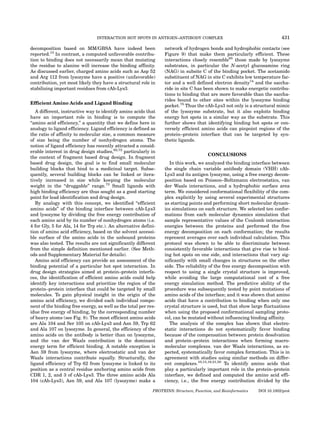
                                                                              Fig. 5. Comparison of results obtained for the two complexes cAb-
   Fig. 4. Decomposition of the total energetic contribution of lysozyme   Lys3/hen egg white lysozyme (red) and the cAb-Lys3/turkey egg white
residues presented in Figure 3a. The electrostatic (ELEC in blue), the     lysozyme (green). The contributions plotted are averages of total contri-
nonpolar (SAS in red) and the van der Waals (VDW in yellow) contribu-      butions of lysozyme residues. The two lysozymes differ by only seven
tions are displayed separately for selected residues (see Fig. 3a for      residues. The sequence used in this plot is the one for the chicken egg-
selected residue). Units: kcal/mol. [Color figure can be viewed in the     white lysozyme. Amongst the residues shown in the graph, the following
online issue, which is available at www.interscience.wiley.com.]           sequence differences in the turkey egg-white lysozyme are found: Q41H,
                                                                           R73K, V99A, and D101G. The averages were calculated over all trajecto-
                                                                           ries generated for each complex. The standard deviation for each residue
                                                                           is shown. [Color figure can be viewed in the online issue, which is avail-
                                                                           able at www.interscience.wiley.com.]
variations. These results underline the need to exercise
caution when interpreting the results from a free energy
decomposition for a single crystallographic structure. The                 For example, in the cAb-Lys3/HEL complex, the confor-
conformational sampling applied in this study yields a                     mational sampling clearly helps discriminating the true
mean value with a standard deviation for each contribu-                    hot spot residues from amino acids that have favorable
tion; the standard deviation is a useful first indication of               but highly fluctuating contributions (see Fig. 1 of Supple-
the dependence of the results on small structural changes.                 mentary Material). These results suggest that, whenever

PROTEINS: Structure, Function, and Bioinformatics           DOI 10.1002/prot
INTERACTION HOT SPOTS IN ANTIGEN–ANTIBODY COMPLEX                                               427

                                                                              tion kinetics. From the computational analysis, contribu-
                                                                              tions from Thr 28, Asp 73, and Tyr 118 showed large fluc-
                                                                              tuations with conformational averaging and yielded small
                                                                              binding averages (see Fig. 1a and Fig. S1 in Supplemen-
                                                                              tary material). However, contributions from individual
                                                                              structures can be important, as is shown by the large
                                                                              error bars.


                                                                                                DISCUSSION
                                                                              Structural Analysis of the Binding Energy
                                                                              Hot Spots
                                                                                 A useful aspect of the free energy decomposition scheme
                                                                              presented here is that it not only identifies the binding
                                                                              energy hot spots, but also gives insight into the nature of
                                                                              the key interactions.
                                                                                 The amino acids from the cAb-Lys3 (see Figs. 1 and 2
                                                                              and Table II) that make the most favorable contributions
                                                                              to binding (between À2 and À8 kcal/mol) form a contigu-
                                                                              ous stretch of residues in the CDR3: Thr 101 - Ile 102 - Tyr
                                                                              103 - Ala 104 - Ser 105 - Tyr 106 - Tyr 107 (one additional
                                                                              important amino acid is Ile 29 from CDR1), while for lyso-
                                                                              zyme, the most favorable interactions are made by Asn
                                                                              46- Ile 58 - Asn 59 - Trp 62 - Trp 63 - Asn 103 - Ala 107 -
  Fig. 6. Comparison of kinetic on-rate (a) and off-rate (b) parameters       Trp 108 - Val 109 (see Figs. 3 and 4 and Table II), which
for the interaction between the WT or mutant cAb-Lys3 with HEL (dark          are grouped together spatially.
grey) or TEL (light grey). Rate parameters are expressed as percent of the       For a more detailed analysis, we determined whether
wild type value. Measurements were repeated 2–3 times for the WT cAb-
Lys3 and mutants T28K, I29T, and D73S, for which error bars are shown.
                                                                              the favorable interactions of the hot spot residues are pre-
                                                                              dominantly van der Waals or electrostatic in nature and
                                                                              whether they face each other on the two partners of the
available, averaging over several experimental structures                     complex. Concerning cAb-Lys3, the hot spot interactions
is likely to increase the significance of the results obtained                are mainly nonpolar. The important amino acids from
from the decomposition scheme.                                                CDR3 make favorable contributions to the interaction
                                                                              energy via the solvent accessible surface, or hydrophobic
                                                                              term and via the van der Waals interactions. Some of
Mutational Analysis of Four cAb-Lys3 Positions
                                                                              these important van der Waals interactions are made
  To further investigate the importance of using confor-                      with amino acids on lysozyme that are also, correspond-
mational averaging when calculating a free energy decom-                      ingly calculated as making important contributions. For
position, 4 amino acids of the antibody, identified as mak-                   example, the side chain of Ala 104 of cAb-Lys3 fills a
ing nonzero contributions to binding free energy by a free                    hydrophobic pocket lined by the side chains of Ile 58, Ala
energy decomposition calculation on a single crystal struc-                   107, and Trp 108 of lysozyme. Particularly favorable van
ture, were mutated as specified in Methods. These were                        der Waals interactions are also made by Trp 62 of lyso-
Thr 28, Asp 73, and Tyr 118, which, in the cAbLys3-HEL                        zyme. This amino acid not only makes an important con-
crystal structure (BM complex), have total contributions                      tact with a hot spot residue from cAb-Lys3 (Ile 102 from
to the binding free energy of À1.1, À0.5 and À2.3 kcal/mol                    CDR3), but it also makes contacts with several amino
respectively. Thr 28 and Asp 73 were replaced by residues                     acids from CDR1 (Ile 29 and Tyr 32) and CDR2 (Gly 54),
that lead to important modifications of size and/or charge                    which have smaller van der Waals contributions to the
(T28A, T28D, T28K, D73S, D73R, and D73K), while a                             binding energy. The large contribution of Trp 62 (lyso-
more conservative change was made at position 118                             zyme) arises from its central position at the protein–pro-
(Y118F), to avoid large structural effects of the mutation.                   tein interface that allows a large number of van der Waals
Residue Ile 29, which was identified as important for bind-                   contacts.
ing, was mutated to Thr as a positive control. The kinetics                      Thus the size of the amino acid and the shape of the con-
of the interaction of the wild type and eight cAbLys3                         tact surface plays an important role and in some cases a
mutants with either HEL or TEL were measured by Bia-                          van der Waals hot spot is located on one of the proteins,
core. Kinetic parameters, expressed as percentage of those                    whereas there is no dominating van der Waals contribu-
measured for the interaction of HEL or TEL with the                           tion arising from the reciprocal residues on the other pro-
unmodified cAb-Lys3, are compared in Figure 6. Except                         tein. Thus, even though van der Waals interactions are
for the I29T change, which produced a 3- to 4-fold increase                   shared equally between the two proteins, at the residue
in koff, other changes had no measurable effect on interac-                   level, the hot spots are not necessarily symmetrical.

                                                                        PROTEINS: Structure, Function, and Bioinformatics   DOI 10.1002/prot
428                                                                     LAFONT ET AL.

                                                                                     In contrast to the unfavorable electrostatic contribu-
                                                                                  tions calculated for Arg 112 and Asp 52 of lysozyme, a
                                                                                  small favorable contribution is found for Trp 63 of lyso-
                                                                                  zyme, which interacts with Tyr 103 main chain from cAb-
                                                                                  Lys3. Thus, even though the electrostatic interaction from
                                                                                  the main chain of Tyr 103 of cAb-Lys3 is smaller than the
                                                                                  interaction made by its side chain (cf. Fig. 7), the main
                                                                                  chain H-bond yields a favorable binding energy contribu-
                                                                                  tion both on cAb-Lys3 and on lysozyme. Two additional
                                                                                  amino acids of lysozyme make favorable (although smaller
                                                                                  than those found in cAb-Lys3) electrostatic contributions:
                                                                                  Asn 59 (HEL: À1.7 kcal/mol) and Ala 107 (HEL: À0.6 kcal/
                                                                                  mol), see Figure 4. An analysis of the structures shows
   Fig. 7. Decomposition of the electrostatic contributions into side chain       that Asn 59 and Ala 107 are engaged in hydrogen bonds
and main chain components for the antibody in the cAb-Lys3/hen egg
white lysozyme complex. The values represented are averages of the
                                                                                  with Ala 104 of cAb-Lys3 (cf. Figure 9), and this buried
electrostatic contribution of backbone (yellow) and side chain (blue) of          network of H-bonds is particularly favorable.
antibody residues. (see Fig. 1a for selected residues). The average was
calculated over all the trajectories done with the different initial structures
(MEL AL HSD, MEL AL HSE, MEL BM, and JTT). Units: kcal/mol.                       Comparison of Experimental and
[Color figure can be viewed in the online issue, which is available at www.       Computational Data
interscience.wiley.com.]
                                                                                     The conclusions of the calculations were challenged
                                                                                  with both existing and new mutational studies of cAb-
   Even though van der Waals interactions have an impor-                          Lys3. While the existing studies mainly focus on residues
tant contribution to hot spots, some important electro-                           identified here as ‘‘hot spot,’’ we chose to focus on four
static interactions can also be identified. The electrostatic                     positions with a calculated small contribution to binding
contribution is favorable for cAb-Lys3 residues Tyr 103 -                         energy.
Ala 104 - Ser 105 - Tyr 106, which are involved in a hydro-                          Existing experimental studies include replacements of
gen bond network with several residues from lysozyme.                             residues Thr 101 (by L,S,P) and Ser 105 (by N,H,Q,A,
The most favorable electrostatic interactions are made by                         G,P,M) from CDR3 of cAb-Lys3 for a quantitative struc-
the two tyrosine residues; they can be further decomposed                         ture-activity study,53 and replacements of residues from
into side chain and main chain contributions. As can be                           CDR1 and CDR2 to revert to the germ line sequence.54
seen from Figure 7, the dominant contributions are made                           The replacements at positions 101 and 105 had varied
by the side chain for Tyr 103 (the main chain also makes a                        effects, the largest losses in binding affinity being 120-fold
favorable, but less important, contribution) and by the                           for the T100P change, and 100-fold for the S105Q
main chain for Tyr 106. Examination of the structures                             change.53 In particular, the mutation S105A resulted in a
indicates that the Tyr 103 side chain hydroxyl group                              10-fold loss in experimental binding affinity (i.e. a change
makes an H-bond with Arg 112 from lysozyme, while the                             of 1.4 kcal/mol in binding affinity), which is in reasonable
Tyr 106 main chain NH makes an H-bond with the car-                               agreement with the computed binding free energy contri-
boxyl group of Asp 52 from lysozyme. The favorable contri-                        bution of À4.8 Æ 2.3 kcal/mol for the serine as a whole (i.e.
bution of these H-bonds is directly linked to the strong                          including main chain contributions that are not lost upon
electrostatic potential created by the charged amino acids                        mutation to Ala). Multiple mutations were introduced in
on lysozyme. Remarkably, the free energy decomposition                            CDR1 and CDR2 so that the influence of individual
for lysozyme (see Figs. 3 and 4) yields unfavorable electro-                      changes is not known.54 Thermodynamic data however
static contributions to the binding free energy for Arg 112                       show a role of residues from CDR1 and CDR2 for
and Asp 52. This is due to the large desolvation penalty                          enthalpic stabilization of the bound complex during matu-
upon binding for the charged side chains of these residues.                       ration,54 which is in agreement with the results of the
The fact that electrostatic interactions are not always                           present calculations that show that CDR1 and CDR2
favorable to binding has been noted in other free energy                          make favorable van der Waals interactions with lysozyme
decomposition studies.13,19,21,58 In this particular exam-                        and thus play a role in stabilizing the complex.
ple, it can be seen that Arg 112 and Asp 52, although not                            To investigate whether positions with small, but non-
favorable themselves, create a favorable environment for                          zero, computed contributions can nevertheless influence
Tyr 103 and Tyr 106 on the cAb-Lys3, and thus have an                             binding, we targeted residues Thr 28, Asp 73, and Tyr
important role in the formation of the complex. The other                         118. The residue Ile 29, which is identified as important in
charged amino acid on lysozyme that has a large unfavor-                          CDR1, was taken as a positive control. None of the muta-
able desolvation contribution is Arg 73. Arg 73 is not                            tions at positions 28, 73, and 118 had a measurable effect
involved in hydrogen bonds with amino acids on cAb-                               on binding kinetics (see Figure 6), while the mutation at
Lys3, and its binding energy contribution shows larger                            position I29 (I29T) increased koff 3- to 4-fold, thus result-
fluctuations than those of Arg 112 and Asp 52 (see                                ing in a loss of binding affinity. These experimental
Fig. 3a).                                                                         results support the validity of our computational ap-

PROTEINS: Structure, Function, and Bioinformatics                 DOI 10.1002/prot
INTERACTION HOT SPOTS IN ANTIGEN–ANTIBODY COMPLEX                                                      429

proach. In particular, the mutations data support our             face area (hydrophobic solvation) terms as a sum over
simplified conformational averaging scheme, and show              individual amino acid contributions (as described in Mate-
that the three amino acids tested, which showed large             rial and Methods). The decomposition is performed in
fluctuations in the computed contribution, do not influ-          such a way that the sum of all individual contributions
ence binding, while their contribution was non negligible         corresponds to the total free energy (cf. Eq. 1). Decompos-
if only one experimental X-ray structure is used.                 ing into individual amino acid contributions implies that
                                                                  pairwise interactions (such as van der Waals and electro-
                                                                  static) are divided equally between the interacting amino
Experimental vs. Computational Hot Spots
                                                                  acids i.e. if for example the van der Waals interaction
   The comparison of the experimental data to the compu-          energy between amino acids A and B amounts to À4 kcal/
tational results raises some important issues. Amino acids        mol, a contribution of À2 kcal/mol will be attributed to A
that are found to play an important role in binding are of-       and À2 kcal/mol to B, and likewise for electrostatic inter-
ten referred to in the computational literature as ‘‘binding      actions. It must be noted that in the continuum descrip-
energy hot spots,’’ irrespective of whether the quantity          tion of the solvent that is used here, desolvation (whether
calculated is the change in binding free energy upon              electrostatic or hydrophobic) is a self-energy term and is
mutating the residue to alanine, or a related but different       thus naturally decomposed in individual contribu-
quantity. In this paper, we used the term hot spot for            tions.57,71
amino acids that make significant individual contribu-               The earlier-mentioned differences between computa-
tions (À1.5 kcal/mol) to the total binding free energy, as       tional free energy decomposition and experimental ala-
described in Material and Methods. It is therefore useful         nine scanning data should be kept in mind when compar-
to clarify the relationship between ‘‘hot spots’’ as dis-         ing computational and experimental hot spot residues.
cussed in the present computations and ‘‘hot spots’’
obtained by alanine scanning experiments.
   Experimentally, binding energy hot spots are often
defined as residues that, when mutated to alanine, give
rise to a significant drop in the binding affinity (typically,
changes in binding free energy larger than 1.5 kcal/mol).7
As discussed in Ref. 69, mutations to alanine can affect
the binding affinity by both changing the structure and/or
free energy of the unbound partners as well as those of
the bound complex. This combination of effects compli-
cates the interpretation of alanine scanning experiments,
and consequently their exploitation in, for example,
designing small molecule inhibitors that mimic important
interactions. An advantage of computational approaches
is that the energetic contributions can be separated in a
manner that is not attainable experimentally. For exam-
ple, as done in the present study, it is possible to analyze
the energetic contribution of an amino acid without
resorting to explicit mutation to alanine.
   This is an important aspect of the present calculations,
which is to identify binding energy hot spots and, thus,
free energy decomposition is used rather than explicit
mutation to alanine. Individual amino acid contributions
to binding presented in Figs. 1, 2, 3, 4, 7 are therefore not
the same quantity as the change in free energy upon
mutating the residue to alanine. If a direct comparison to
Ala-scanning experiments was desired, it would be possi-
ble to calculate free energy changes upon mutating a resi-
due to alanine by constructing the mutant and reevaluat-
ing the free energy of binding.11,70 A full estimate of the
free energy change should also consider the structural
consequences of mutating a specific amino acid to alanine,
                                                                     Fig. 8. Bar graph of the amino acid efficiency. Each free energy contri-
both in the complex and in the unbound partners.                  bution (Electrostatic (ELE), nonpolar solvation (SAS), van der Waals
   Another difference with experimental alanine scanning          energy (VDW), and total DG (TOT)) of amino acids is divided by the num-
data is that single amino acid free energy contributions to       ber of nonhydrogen atoms. The results are presented for the residues
binding, as computed here, include contributions to the           having the most efficient amino-acids in the interaction for the antibody
                                                                  (top graph) and for the lysozyme (bottom graph). See Methods for details.
binding energy from main chain atoms. They are obtained           [Color figure can be viewed in the online issue, which is available at
by writing the total electrostatic, van der Waals and sur-        www.interscience.wiley.com.]

                                                            PROTEINS: Structure, Function, and Bioinformatics             DOI 10.1002/prot
430                                                             LAFONT ET AL.


                    Fig. 9. Structural comparison of the lysozyme–cAb-Lys 3 complex and lysozyme-N-acetyl glucosamine
                  (NAG) ring complex. The similarity between the hydrogen bond network formed between A107 and N59 of ly-
                  sozyme and A104 of cAb-Lys3 (upper picture) and the network formed between A107 and N59 of lysozyme
                  and NAG is shown. This network involves efficient amino acids of the lysozyme-cAb-Lys3 complex, and shows
                  the energetic mimicry of the substrate (see text for details). [Color figure can be viewed in the online issue,
                  which is available at www.interscience.wiley.com.]


The two approaches nevertheless give convergent infor-                      nine will be detrimental to the binding affinity (unless the
mation i.e. when the free energy decomposition identifies                   contribution is made by main chain atoms). Significant
a residue as making a large favorable contribution to                       correlations between experimental free energy changes
binding, one can expect that mutating this residue to ala-                  upon mutating a residue to alanine and free energy

PROTEINS: Structure, Function, and Bioinformatics          DOI 10.1002/prot
INTERACTION HOT SPOTS IN ANTIGEN–ANTIBODY COMPLEX                                         431

decomposition based on MM/GBSA have indeed been                   network of hydrogen bonds and hydrophobic contacts (see
reported.13 In contrast, a computed unfavorable contribu-         Figure 9) that make them particularly efficient. These
tion to binding does not necessarily mean that mutating           interactions closely resemble65 those made by lysozyme
the residue to alanine will increase the binding affinity.        substrates, in particular the N-acetyl glucosamine ring
As discussed earlier, charged amino acids such as Asp 52          (NAG) in subsite C of the binding pocket. The acetamido
and Arg 112 from lysozyme have a positive (unfavorable)           substituent of NAG in site C exhibits low temperature fac-
contribution, yet most likely they have a structural role in      tor and a well defined electron density74 and the saccha-
stabilizing important residues from cAb-Lys3.                     ride in site C has been shown to make energetic contribu-
                                                                  tions to binding that are more favorable than the saccha-
                                                                  rides bound to other sites within the lysozyme binding
Efficient Amino Acids and Ligand Binding
                                                                  pocket.75 Thus the cAb-Lys3 not only is a structural mimic
   A different, instructive way to identify amino acids that      of the lysozyme substrate, but it also exploits binding
have an important role in binding is to compute the               energy hot spots in a similar way as the substrate. This
‘‘amino acid efficiency,’’ a quantity that we define here in      further shows that identifying binding hot spots or con-
analogy to ligand efficiency. Ligand efficiency is defined as     versely efficient amino acids can pinpoint regions of the
the ratio of affinity to molecular size, a common measure         protein–protein interface that can be targeted by syn-
of size being the number of nonhydrogen atoms. The                thetic ligands.
notion of ligand efficiency has recently attracted a consid-
erable interest in drug design studies,62,72 particularly in
                                                                                        CONCLUSIONS
the context of fragment based drug design. In fragment
based drug design, the goal is to find small molecular               In this work, we analyzed the binding interface between
building blocks that bind to a medicinal target. Subse-           the single chain variable antibody domain (VHH) cAb-
quently, several building blocks can be linked or itera-          Lys3 and its antigen lysozyme, using a free energy decom-
tively increased in size while keeping the molecular              position based on Poisson–Boltzmann electrostatics, van
weight in the ‘‘druggable’’ range.73 Small ligands with           der Waals interactions, and a hydrophobic surface area
high binding efficiency are thus sought as a good starting        term. We considered conformational flexibility of the com-
point for lead identification and drug design.                    plex explicitly by using several experimental structures
   By analogy with this concept, we identified ‘‘efficient        as starting points and performing short molecular dynam-
amino acids’’ of the binding interface between cAb-Lys3           ics simulations on each structure. We selected ten confor-
and lysozyme by dividing the free energy contribution of          mations from each molecular dynamics simulation that
each amino acid by its number of nonhydrogen atoms (i.e.          sample representative values of the Coulomb interaction
4 for Gly, 5 for Ala, 14 for Trp etc.). An alternative defini-    energies between the proteins and performed the free
tion of amino acid efficiency, based on the solvent accessi-      energy decomposition on each conformation; the results
ble surface of the amino acids in the unbound proteins            represent averages over each individual calculation. This
was also tested. The results are not significantly different      protocol was shown to be able to discriminate between
from the simple definition mentioned earlier. (See Meth-          consistently favorable interactions that give rise to bind-
ods and Supplementary Material for details).                      ing hot spots on one side, and interactions that vary sig-
   Amino acid efficiency can provide an assessment of the         nificantly with small changes in structures on the other
binding potential of a particular hot spot interaction. In        side. The reliability of the free energy decomposition with
drug design strategies aimed at protein–protein interfa-          respect to using a single crystal structure is improved,
ces, the identification of efficient amino acids could help       while avoiding the large computational cost of a free
identify key interactions and prioritize the region of the        energy simulation method. The predictive ability of the
protein–protein interface that could be targeted by small         procedure was subsequently tested by point mutations of
molecules. To gain physical insight in the origin of the          amino acids of the interface; and it was shown that amino
amino acid efficiency, we divided each individual compo-          acids that have a contribution to binding when only one
nent of the binding free energy, as well as the total per res-    crystal structure is used, but that show large fluctuations
idue free energy of binding, by the corresponding number          when using the proposed conformational sampling proto-
of heavy atoms (see Fig. 8). The most efficient amino acids       col, can be mutated without influencing binding affinity.
are Ala 104 and Ser 105 on cAb-Lys3 and Asn 59, Trp 62               The analysis of the complex has shown that electro-
and Ala 107 on lysozyme. In general, the efficiency of the        static interactions do not systematically favor binding
amino acids on the antibody is better than on lysozyme,           because of the compensation between protein desolvation
and the van der Waals contribution is the dominant                and protein–protein interactions when forming macro-
energy term for efficient binding. A notable exception is         molecular complexes. van der Waals interactions, as ex-
Asn 59 from lysozyme, where electrostatic and van der             pected, systematically favor complex formation. This is in
Waals interactions contribute equally. Structurally, the          agreement with studies using similar methods on differ-
ligand efficiency of Trp 62 from lysozyme is linked to its        ent complexes.10,13,19,21,58 To identify amino acids that
position as a central residue anchoring amino acids from          play a particularly important role in the protein–protein
CDR 1, 2, and 3 of cAb-Lys3. The three amino acids Ala            interface, we defined and computed the amino acid effi-
104 (cAb-Lys3), Asn 59, and Ala 107 (lysozyme) make a             ciency, i.e., the free energy contribution divided by the

                                                            PROTEINS: Structure, Function, and Bioinformatics   DOI 10.1002/prot
432                                                           LAFONT ET AL.

number of heavy atoms in the amino acid. The analogous                  3. Fletcher S, Hamilton AD. Protein surface recognition and proteo-
concept of ligand efficiency is commonly used in drug                      mimetics: mimics of protein surface structure and function. Curr
                                                                           Opin Chem Biol 2005;9:632–638.
design, but to our knowledge, it has not been applied to                4. Janin J. Principles of protein-protein recognition from structure
protein–protein interactions. The efficient amino acids                    to thermodynamics. Biochimie 1995;77:497–505.
correspond to binding energy hot spots, and they originate              5. Wells JA. Systematic mutational analyses of protein–protein
                                                                           interfaces. Methods Enzymol 1991;202:390–411.
mainly from efficient van der Waals packing of key resi-                6. Clackson T, Wells JA. A hot spot of binding energy in a hormone–
dues on the interface. Electrostatic interactions make an                  receptor interface. Science 1995;267:383–386.
important contribution to a binding energy hot spot of                  7. Bogan AA, Thorn KS. Anatomy of hot spots in protein interfaces.
                                                                           J Mol Biol 1998;280:1–9.
three neutral amino acids on the interface that form a net-             8. Cunningham BC, Wells JA. Comparison of a structural and a
work of hydrogen bonds, Asn 59 and Ala 107 of lysozyme,                    functional epitope. J Mol Biol 1993;234:554–563.
and Ala 104 of cAb-Lys3. The formation of networks of                   9. Honig B, Nicholls A. Classical electrostatics in biology and chem-
hydrogen bonds that stabilize protein–protein interac-                     istry. Science 1995;268:1144–1149.
                                                                       10. Hendsch ZS, Tidor B. Electrostatic interactions in the GCN4 leu-
tions has been noticed previously.19 It shows that contin-                 cine zipper: substantial contributions arise from intramolecular
uum electrostatics using point charges from a classical                    interactions enhanced on binding. Protein Sci 1999;8:1381–
force field, despite its simplified description of the hydro-              1392.
gen bond,76,77 can identify favorable electrostatic interac-           11. Kortemme T, Baker D. A simple physical model for binding
                                                                           energy hot spots in protein–protein complexes. Proc Natl Acad Sci
tions in a context where, on average, protein–protein                      USA 2002;99:14116–14121.
hydrogen bonds are not contributing or even unfavorable                12. Guerois R, Nielsen JE, Serrano L. Predicting changes in the sta-
to binding.                                                                bility of proteins and protein complexes: a study of more than
                                                                           1000 mutations. J Mol Biol 2002;320:369–387.
   Interestingly, the amino acids from cAb-Lys3 identified             13. Gohlke H, Kiel C, Case DA. Insights into protein-protein binding
as efficient are structural mimics of the lysozyme saccha-                 by binding free energy calculation and free energy decomposition
ride substrate, and they interact with amino acids of lyso-                for the Ras-Raf and Ras-RalGDS complexes. J Mol Biol 2003;330:
zyme that are also identified as efficient. Our analysis                   891–913.
                                                                       14. Wong C, McCammon JA. Dynamics and design of enzymes and
thus establishes that the antibody not only is a structural                inhibitors. J Am Chem Soc 1986;108:3830–3832.
mimic of the substrate,65 but that it exploits key interac-            15. Kollman P. Free energy calculations: application to chemical and
tions that are consistent with those of a small molecule                   biochemical phenomena. Chem Rev 1993;93:2395–2417.
                                                                       16. Simonson T, Archontis G, Karplus M. Free energy simulations
substrate. This indicates that the free energy decomposi-                  come of age: protein-ligand recognition. Acc Chem Res 2002;35:
tion method presented in this work can be used to guide                    430–437.
antibody engineering, and that it can also serve as a tool             17. Rodinger T, Pomes R. Enhancing the accuracy, the efficiency and
                                                                           the scope of free energy simulations. Curr Opin Struct Biol
for designing small molecule inhibitors of protein–protein                 2005;15:164–170.
interactions with potential therapeutic impact.                        18. Kollman PA, Massova I, Reyes C, Kuhn B, Huo S, Chong L, Lee M,
                                                                           Lee T, Duan Y, Wang W, Donini O, Cieplak P, Srinivasan J, Case DA.
                                                                           Calculating structures and free energies of complex molecules: com-
                 NOTE ADDED IN PROOF                                       bining molecular mechanics and continuum models. Acc Chem Res
                                                                           2000;33:889–897.
   In a recent study (Thanos, CD, DeLano WL, Wells, JA.                19. Sheinerman FB, Honig B. On the role of electrostatic interactions in
Hot spot mimicry of a cytokine receptor by a small mole-                   the design of protein-protein interfaces. J Mol Biol 2002;318:161–177.
cule Proc Natl Acad Sci USA 2006;103:15422–15427) the                  20. Gohlke H, Case DA. Converging free energy estimates: MM-
                                                                           PB(GB)SA studies on the protein-protein complex Ras-Raf.
ligand efficiency of a protein-small molecule and protein-
                                                                           J Comput Chem 2004;25:238–250.
protein complex were compared. However, the ligand effi-               21. Zoete V, Meuwly M, Karplus M. Study of the insulin dimerization:
ciency was defined as the total binding free energy divided                binding free energy calculations and per-residue free energy
by the number of contact atoms, which differs from the                     decomposition. Proteins 2005;61:79–93.
                                                                       22. Desmyter A, Transue TR, Ghahroudi MA, Thi MH, Poortmans F,
definition of amino acid efficiency as described here.                     Hamers R, Muyldermans S, Wyns L. Crystal structure of a camel
                                                                           single-domain VH antibody fragment in complex with lysozyme.
                                                                           Nat Struct Biol 1996;3:803–811.
                  ACKNOWLEDGMENTS                                      23. Arbabi Ghahroudi M, Desmyter A, Wyns L, Hamers R, Muylder-
                                    ´
  We thank IDRIS (Institut du Developpement et des                         mans S. Selection and identification of single domain antibody
                                                                           fragments from camel heavy-chain antibodies. FEBS Lett
Ressources en Informatique Scientifique) and CINES                         1997;414:521–526.
(Centre Informatique National de l’Enseignement Super-´                24. Hamers-Casterman C, Atarhouch T, Muyldermans S, Robinson G,
ieur) for generous allowance of computer time, Drs Serge                   Hamers C, Songa EB, Bendahman N, Hamers R. Naturally occur-
                                                                           ring antibodies devoid of light chains. Nature 1993;363:446–448.
Muyldermans and M. Lauwereys for the kind gift of the                  25. De Genst E, Saerens D, Muyldermans S, Conrath K. Antibody
cAbLys3-pHEN6 vector and Julien Gras and Elyette                           repertoire development in camelids. Dev Comp Immunol 2006;
Martin for programming assistance.                                         30:187–198.
                                                                       26. Conrath KE, Lauwereys M, Galleni M, Matagne A, Frere JM,
                                                                           Kinne J, Wyns L, Muyldermans S. b-Lactamase inhibitors
                        REFERENCES                                         derived from single-domain antibody fragments elicited in the
                                                                           camelidae. Antimicrob Agents Chemother 2001;45:2807–2812.
 1. Arkin MR, Wells JA. Small-molecule inhibitors of protein-protein   27. Tanha J, Xu P, Chen Z, Ni F, Kaplan H, Narang SA, MacKenzie
    interactions: progressing towards the dream. Nat Rev Drug Dis-         CR. Optimal design features of camelized human single-domain
    cov 2004;3:301–317.                                                    antibody libraries. J Biol Chem 2001;276:24774–24780.
 2. Pommier Y, Cherfils J. Interfacial inhibition of macromolecular    28. Jobling SA, Jarman C, Teh MM, Holmberg N, Blake C, Verhoeyen
    interactions: nature’s paradigm for drug discovery. Trends Phar-       ME. Immunomodulation of enzyme function in plants by single-
    macol Sci 2005;26:138–145.                                             domain antibody fragments. Nat Biotechnol 2003;21:77–80.

PROTEINS: Structure, Function, and Bioinformatics        DOI 10.1002/prot
INTERACTION HOT SPOTS IN ANTIGEN–ANTIBODY COMPLEX                                                         433

29. Lauwereys M, Arbabi Ghahroudi M, Desmyter A, Kinne J, Holzer           47. Davis ME, Madura JD, Luty BA, McCammon JA. Electrostatics
    W, De Genst E, Wyns L, Muyldermans S. Potent enzyme inhibi-                and diffusion of molecules in solution: simulations with the Uni-
    tors derived from dromedary heavy-chain antibodies. EMBO J                 versity of Houston Brownian Dynamics program. Comput Phys
    1998;17:3512–3520.                                                         Commun 1991;62:187–197.
30. Decanniere K, Desmyter A, Lauwereys M, Ghahroudi MA,                   48. Nose S. A unified formulation of the constant temperature mole-
    Muyldermans S, Wyns L. A single-domain antibody fragment in                cular dynamics methods. J Chem Phys 1984;81:511.
    complex with RNase A: non-canonical loop structures and nano-          49. Hoover WG. Canonical dynamics: equilibrium phase-space distri-
    molar affinity using two CDR loops. Structure Fold Des                     butions. Phys Rev A 1985;31:1695.
    1999;7:361–370.                                                        50. Ryckaert J-P, Ciccotti G, Berendsen HJC. Numerical integration
31. Desmyter A, Spinelli S, Payan F, Lauwereys M, Wyns L, Muylder-             of the cartesian equations of motion of a system with constraints.
    mans S, Cambillau C. Three camelid VHH domains in complex                  Molecular Dynamics of n-Alkanes. J Comp Phys 1977;23:327–
    with porcine pancreatic a-amylase. Inhibition and versatility of           341.
    binding topology. J Biol Chem 2002;277:23645–23650.                    51. Fischer S, Smith JC, Verma CS. Dissecting the vibrational en-
32. Cortez-Retamozo V, Backmann N, Senter PD, Wernery U, De                    tropy change on protein/ligand binding: burial of a water molecule
    Baetselier P, Muyldermans S, Revets H. Efficient cancer therapy            in BPTI. J Phys Chem B 2001;105:8050–8055.
    with a nanobody-based conjugate. Cancer Res 2004;64:2853–              52. Fischer S, Verma CS. Binding of buried structural water
    2857.                                                                      increases the flexibility of proteins. Proc Natl Acad Sci USA 1999;
33. Saerens D, Kinne J, Bosmans E, Wernery U, Muyldermans S,                   96:9613–9615.
    Conrath K. Single domain antibodies derived from dromedary             53. De Genst E, Areskoug D, Decanniere K, Muyldermans S,
    lymph node and peripheral blood lymphocytes sensing conforma-              Andersson K. Kinetic and affinity predictions of a protein–protein
    tional variants of prostate-specific antigen. J Biol Chem 2004;279:        interaction using multivariate experimental design. J Biol Chem
    51965–51972.                                                               2002;277:29897–29907.
34. Stijlemans B, Conrath K, Cortez-Retamozo V, Van Xong H, Wyns L,        54. De Genst E, Handelberg F, Van Meirhaeghe A, Vynck S, Loris R,
    Senter P, Revets H, De Baetselier P, Muyldermans S, Magez S. Effi-         Wyns L, Muyldermans S. Chemical basis for the affinity matura-
    cient targeting of conserved cryptic epitopes of infectious agents         tion of a camel single domain antibody. J Biol Chem 2004;279:
    by single domain antibodies. African trypanosomes as paradigm.             53593–53601.
    J Biol Chem 2004;279:1256–1261.                                        55. Gouda H, Kuntz ID, Case DA, Kollman PA. Free energy calcula-
35. Zarebski LM, Urrutia M, Goldbaum FA. Llama single domain                   tions for theophylline binding to an RNA aptamer: MM-PBSA
    antibodies as a tool for molecular mimicry. J Mol Biol                     and comparison of thermodynamic integration methods. Biopoly-
    2005;349:814–824.                                                          mers 2003;68:16–34.
36. Loris R, Marianovsky I, Lah J, Laeremans T, Engelberg-Kulka H,         56. Massova I, Kollman PA. Computational alanine scanning to
    Glaser G, Muyldermans S, Wyns L. Crystal structure of the                  probe protein-protein interactions: a novel approach to evalu-
    intrinsically flexible addiction antidote MazE. J Biol Chem 2003;          ate binding free energies. J Am Chem Soc 1999;121:8133–
    278:28252–28257.                                                           8143.
37. De Genst E, Silence K, Ghahroudi MA, Decanniere K, Loris R,            57. Dejaegere A, Liang X, Karplus M. Phosphate ester hydrolysis:
    Kinne J, Wyns L, Muyldermans S. Strong in vivo maturation com-             calculation of gas-phase reaction paths and solvation effects.
    pensates for structurally restricted H3 loops in antibody reper-           J Chem Soc Faraday Trans 1994;90:1763.
    toires. J Biol Chem 2005;280:14114–14121.                              58. Green DF, Tidor B. Design of improved protein inhibitors of HIV-1
38. De Genst E, Silence K, Decanniere K, Conrath K, Loris R, Kinne J,          cell entry: optimization of electrostatic interactions at the binding
    Muyldermans S, Wyns L. Molecular basis for the preferential cleft          interface. Proteins 2005;60:644–657.
    recognition by dromedary heavy-chain antibodies Proc Natl Acad         59. Tsui V, Case DA. Calculations of the absolute free energies of
    Sci 2006;103:4586–4591.                                                    binding between RNA and metal ions using molecular dynamics
39. Marquardt A, Muyldermans S, Przybylski M. A synthetic camel                simulations and continuum electrostatics. J Phys Chem B
    anti-lysozyme peptide antibody (Peptibody) with flexible loop              2001;105:11314–11325.
    structure identified by high-resolution affinity mass spectro-                                                                `
                                                                           60. Lafont V. Analyse de la reconnaissance antigene-anticorps par
    metry. Chemistry 2006;12:1915–1923.                                             ´              ´
                                                                               modelisation moleculaire et mesures biophysiques en vue du
40. Vorobjev YN, Almagro JC, Hermans J. Discrimination between                   ´                     ´              ´
                                                                               developpement de methodes d’ingenierie rationnelle des pro-
    native and intentionally misfolded conformations of proteins:               ´
                                                                               teines. Strasbourg: Louis Pasteur; 2004.
    ES/IS, a new method for calculating conformational free energy         61. Spiegel MR. In:Schaum , editor. Probability and statistics. New
    that uses both dynamics simulations with an explicit solvent               York: McGraw Hill; 1975.
    and an implicit solvent continuum model. Proteins 1998;32:             62. Hopkins AL, Groom CR, Alex A. Ligand efficiency: a useful metric
    399–413.                                                                   for lead selection. Drug Discov Today 2004;9:430, 431.
41. Berman HM, Westbrook J, Feng Z, Gilliland G, Bhat TN, Weissig          63. Dejaegere A, Choulier L, Lafont V, De Genst E, Altschuh D. Varia-
    H, Shindyalov IN, Bourne PE. The Protein Data Bank. Nucleic                tions in antigen-antibody association kinetics as a function of pH
    Acids Res 2000;28:235–242.                                                 and salt concentration: a QSAR and molecular modeling study.
42. Decanniere K, Transue TR, Desmyter A, Maes D, Muyldermans S,               Biochemistry 2005;44:14409–14418.
    Wyns L. Degenerate interfaces in antigen-antibody complexes.           64. Karlsson R, Fagerstam L, Nilshans H, Persson B. Analysis
    J Mol Biol 2001;313:473–478.                                               of active antibody concentration. Separation of affinity and
43. Brunger AT, Karplus M. Polar hydrogen positions in proteins: em-           concentration parameters. J Immunol Methods 1993;166:75–
    pirical energy placement and neutron diffraction comparison.               84.
    Proteins 1988;4:148–156.                                               65. Transue TR, De Genst E, Ghahroudi MA, Wyns L, Muyldermans
44. Brooks BR, Bruccoleri RE, Olafson BD, States DJ, Swaminathan S,            S. Camel single-domain antibody inhibits enzyme by mimicking
    Karplus M. CHARMM: a program for macromolecular energy, mini-              carbohydrate substrate. Proteins 1998;32:515–522.
    mization, and dynamics calculations. J Comput Chem 1983;4:187–         66. Nicholls A, Sharp KA, Honig B. Protein folding and association:
    217.                                                                       insights from the interfacial and thermodynamic properties of
45. MacKerell AD, Bashford D, Bellott M, Dunbrack RL, Evanseck JD,             hydrocarbons. Proteins 1991;11:281–296.
    Field MJ, Fischer S, Gao J, Guo H, Ha S, Joseph-McCarthy D,            67. Kabat EA, Wu TT, Perry H, Gottesman K, Foeller C. Sequences of
    Kuchnir L, Kuczera K, Lau FTK, Mattos C, Michnick S, Ngo T,                proteins of immunological interest, 5th ed. 1991 NIH Publication
    Nguyen DT, Prodhom B, Reiher WE, Roux B, Schlenkrich M,                    No. 91–3242.
    Smith JC, Stote R, Straub J, Watanabe M, Wiorkiewicz-Kuczera J,        68. Janin J, Wodak SJ. Protein modules and protein–protein interac-
    Yin D, Karplus M. All-atom empirical potential for molecular mod-          tion. Introduction. Adv Protein Chem 2002;61:1–8.
    eling and dynamics studies of proteins. J Phys Chem B                  69. DeLano WL. Unraveling hot spots in binding interfaces: progress
    1998;102:3586–3616.                                                        and challenges. Curr Opin Struct Biol 2002;12:14–20.
46. Schaefer M, Vlijmen HWv, Karplus M. Electrostatic contributions        70. Huo S, Massova I, Kollman PA. Computational alanine scanning
    to molecular free energies in solution. Adv Protein Chem 1998;51:          of the 1:1 human growth hormone-receptor complex. J Comput
    1–57.                                                                      Chem 2002;23:15–27.

                                                                     PROTEINS: Structure, Function, and Bioinformatics           DOI 10.1002/prot
434                                                           LAFONT ET AL.

71. Bashford D, Karplus M. pKa’s of ionizable groups in proteins:       75. Chipman DM, Sharon N. Mechanism of lysozyme action. Science
    atomic detail from a continuum electrostatic model. Biochemistry        1969;167:454–469.
    1990;29:10219–10225.                                                76. Kortemme T, Morozov AV, Baker D. An orientation-dependent
72. Andrews PR, Craik DJ, Martin JL. Functional group contributions         hydrogen bonding potential improves prediction of specificity and
    to drug–receptor interactions. J Med Chem 1984;27:1648–1657.            structure for proteins and protein–protein complexes. J Mol Biol
73. Lipinski CA. Drug-like properties and the causes of poor solubil-       2003;326:1239–1259.
    ity and poor permeability. J Pharmacol Toxicol Methods 2000;44:     77. Morozov AV, Kortemme T, Tsemekhman K, Baker D. Close
    235–249.                                                                agreement between the orientation dependence of hydrogen
74. Strynadka NC, James MN. Lysozyme revisited: crystallographic            bonds observed in protein structures and quantum mechani-
    evidence for distortion of an N-acetylmuramic acid residue bound        cal calculations. Proc Natl Acad Sci USA 2004;101:6946–
    in site D. J Mol Biol 1991;220:401–424.                                 6951.


PROTEINS: Structure, Function, and Bioinformatics         DOI 10.1002/prot

Lafont proteins 2007

  • 1.
    PROTEINS: Structure, Function,and Bioinformatics 67:418–434 (2007) Protein–Protein Recognition and Interaction Hot Spots in an Antigen–Antibody Complex: Free Energy Decomposition Identifies ‘‘Efficient Amino Acids’’ Virginie Lafont,1,2 Michael Schaefer,3 Roland H. Stote,4 Daniele Altschuh,2 and Annick Dejaegere1* ` 1 ´ ´ ´ Structural Biology and Genomics Department, UMR 7104, Institut de Genetique et de Biologie Moleculaire et Cellulaire, CNRS/ INSERM/ULP, F-67404 Illkirch Cedex, France 2 UMR7175-LC1 CNRS/ULP, ESBS, Parc d’Innovation, 67412 Illkirch Cedex, France 3 ´ Laboratoire de Chimie Biophysique, Institut le Bel, Universite Louis Pasteur, 67000 Strasbourg, France 4 ´ ´ Laboratoire de Biophysicochime Moleculaire, Institut de Chimie, LC3-UMR7177, Universite Louis Pasteur, 67070 Strasbourg Cedex, France ABSTRACT The molecular mechanics Poisson– tions is difficult.1 There are several examples of natural Boltzmann surface area (MM/PBSA) method was molecules that bind at protein interfaces2 and a growing applied to the study of the protein–protein complex number of synthetic compounds that are aimed at per- between a camelid single chain variable domain turbing protein–protein interactions (for a recent review, (cAb-Lys3) and hen egg white lysozyme (HEL), and see Ref. 3). Progress in developing synthetic compounds between cAb-Lys3 and turkey egg white lysozyme will benefit greatly from improved understanding of the (TEL). The electrostatic energy was estimated by energetics and dynamics of protein–protein recognition. solving the linear Poisson–Boltzmann equation. A Our current understanding of protein–protein interac- free energy decomposition scheme was developed to tions is based on structural analysis of protein–protein determine binding energy hot spots of each complex. complexes mostly determined by crystallography, on vari- The calculations identified amino acids of the anti- ous biophysical characterizations of protein–protein com- body that make important contributions to the inter- plexes that give insight into the kinetics and thermody- action with lysozyme. They further showed the influ- namics of protein–protein association,4 and on biochemi- ence of small structural variations on the energetics cal analyses that help identify amino acids important for of binding and they showed that the antibody amino recognition. acids that make up the hot spots are organized in An important concept that has emerged in the last such a way as to mimic the lysozyme substrate. years is the notion of interaction energy ‘‘hot spots,’’ which Through further analysis of the results, we define is the idea that a handful of amino acids at the binding the concept of ‘‘efficient amino acids,’’ which can pro- interface make a dominant contribution to the binding af- vide an assessment of the binding potential of a par- finity.5,6 Mutation studies, mostly alanine scanning stud- ticular hot spot interaction. This information, in ies, have indeed shown7 that only a few mutations [native turn, can be useful in the rational design of small ? Ala] affect the free energy of binding by more than molecules that mimic the antibody. The implications 2 kcal/mol. This has led to a distinction between the func- of using free energy decomposition to identify tional epitope (i.e. ‘‘hot spot residues) and the structural regions of a protein–protein complex that could be epitope (all residues that participate in the interface).8 targeted by small molecules inhibitors are discussed. Proteins 2007;67:418–434. V 2007 Wiley-Liss, Inc. C The Supplementary Material referred to in this article can be found Key words: MM/PBSA; molecular dynamics; macro- at http://www.interscience.wiley.com/jpages/0887-3585/suppmat/ molecular electrostatics; protein engi- Grant sponsor: French Ministry of Defense, Centre National de la neering; drug design; antibodies; ´ Recherche Scientifique, Institut National de la Sante et de la Recher- ´ ´ che Medicale, and Universite Louis Pasteur, Strasbourg, France. camelids Virginie Lafont’s current address is Department of Biology, Johns Hopkins University, 3400 North Charles Street, Baltimore, MD INTRODUCTION 21218-2685. Michael Schafer’s current address is Novartis Pharma AG, Kly- For a wide range of biological processes, including anti- beckstrasse 141, 4057 Basel, Switzerland. body–antigen interactions, hormone–receptor interac- *Correspondence to: Annick Dejaegere. Structural Biology and tions, signal transduction, and regulation, the formation ´ ´ Genomics Department, UMR 7104, Institut de Genetique et de Biolo- ´ gie Moleculaire et Cellulaire, CNRS/INSERM/ULP, BP 10142, of stable protein–protein complexes is of fundamental im- F-67404 Illkirch Cedex, France. E-mail: annick@igbmc.u-strasbg.fr portance. Interfering with or modulating the formation of Received 20 May 2006; Revised 6 September 2006; Accepted 15 Sep- these complexes therefore offers attractive opportunities tember 2006 for therapeutic intervention. However, the development of Published online 26 January 2007 in Wiley InterScience (www. small molecules that modulate protein–protein interac- interscience.wiley.com). DOI: 10.1002/prot.21259 V 2007 WILEY-LISS, INC. C
  • 2.
    INTERACTION HOT SPOTSIN ANTIGEN–ANTIBODY COMPLEX 419 However, much remains to be understood of the role of are minimally sized, stable, and highly soluble, and there- residues surrounding the hot spots in creating a favorable fore offer a number of benefits in medical and biotechno- binding environment, on the balance between electro- logical applications (for a recent review, see Ref. 25). High static, van der Waals, and hydrophobic interactions in the affinity VHH can be obtained after immunization of lla- formation of complexes, in entropic contributions to bind- mas and dromedaries with specific antigens.23,26 Alterna- ing, and in the role of molecular flexibility on the binding tively, phage antibody libraries can be used.27,28 VHHs process. that inhibit several enzymes22,23,26,28–31 have been identi- Computational and theoretical methods permit the sys- fied, as well as VHH that target antigens specific of tematic analysis of individual amino acid contributions to human tumors32,33 or specific of infectious agents.34 the formation of protein complexes.9–13 They provide a VHHs against a mouse anti-DNA monoclonal antibody wealth of information that are complementary to experi- that are competitive binders of the original DNA antigen ments and allow the determination of the structural and have also been recently identified and are shown to be energetic consequences of mutations, as well as a better useful for molecular mimicry studies.35 VHHs against pro- understanding of the physical mechanism and origin of teins of interest in human disease have potential diagnos- the intermolecular interactions that drive binding. Free tic33 or therapeutic32 applications. Camelidae VHHs are energy simulations methods14–16 have been successfully not only able to recognize a wide range of target proteins, used to predict the effect of point mutations on binding af- their high stability and small size makes them amenable finity in macromolecular complexes (for a recent review, to structural studies, and an increasing number of VHH– see Ref. 17). Computational cost, however, puts practical antigen structures are available (for recent examples see limitations on the number of point mutations that can be Refs. 36–38). The structural information from these com- analyzed by free energy simulations for a given complex. plexes is potentially useful for the development of small Systematic analysis of the contribution of all amino acids molecule mimicks of the VHH.39 For this to be realized, to the stability of macromolecular complexes have mostly however, it is important to identify the important interac- relied on different empirical free energy functions11,12 as tions in the VHH–antigen complex. From an experimental well as on all-atom molecular mechanics methods using analysis alone, this is not necessarily evident. In this pa- implicit representation of the solvent (so called MM/PBSA per, we show, for the VHH cAb-Lys3–lysozyme complex, or MM/GBSA methods18). The MM/PBSA method has that an interaction energy hot spot exploited in the anti- been used to systematically analyze the contribution of all body–lysozyme complex is also used by the N-acetyl gluco- amino acids to the formation of several macromolecular samine (NAG) ring of saccharide substrates in subsite C complexes. For computational efficiency, these analyses of the lysozyme binding pocket. We support the results of were performed on a single structure of the complex.10,19 the free energy decomposition approach by the mutational The generalized Born model for electrostatics has also analysis of four VHH positions. We further introduce the recently been applied to the free energy decomposition in concept of amino acid efficiency and show the potential of protein–protein complexes.13,20,21 The generalized Born free energy decomposition in extracting useful informa- model is faster, but introduces additional approximations tion for drug design. in the electrostatics treatment with respect to numerical solutions of the Poisson–Boltzmann equations. In the MATERIALS AND METHODS present work, we develop a computationally tractable, yet reliable, free energy decomposition protocol that can be We developed a protocol based on the MM/PBSA used to identify amino-acids that have a dominant role in method,13,18,40 in which conformations extracted from mo- binding. In the MM/PBSA approach presented here, we lecular dynamics simulations are processed by a combina- use solutions to the Poisson–Boltzmann equation to tion of methods using a simplified description for the sol- obtain the electrostatic contribution to binding. This is in vent to give an estimate of binding free energy. Individual contrast to other recent applications of the methodol- contributions of each amino acid to the complex formation ogy13,20,21 where the Generalized Born model was are estimated and important amino acid ‘‘hot spots’’ are employed. In addition, multiple conformations from mo- identified. lecular dynamics trajectories are used in the analysis. Structures The protocol is used to analyze molecular recognition in the complex between a camel single chain antibody vari- The coordinates of the camel single-domain VH anti- able domain (cAb-Lys3) and its antigen lysozyme.22,23 The body–lysozyme complexes were obtained from the Protein recombinant protein cAb-Lys3 is a single variable domain. Data Bank.41 Two structure files containing hen egg white Single domain antigen binding fragments can be gener- lysozyme as the antigen were obtained: 1MEL (solved at ated from the variable domain of Camelidae heavy chain ˚ ˚ 2.5 A resolution)22 and 1JTT (solved at 2.1 A resolution).42 antibodies. Indeed, the Camelidae possess, in addition to A third structure file containing the coordinates for the classical IgG molecules, a large fraction of naturally complex of the same antibody with turkey egg white lyso- occurring heavy chain antibodies that are devoid of light zyme as the antigen was also obtained from the Protein chains.24 These single domains preserve the ability to ˚ Data Bank: 1JTP (solved at 1.9 A resolution).42 For the bind specifically and with high affinity to their antigens. structures 1MEL and 1JTP, there are two complexes per These small antibodies, also called VHH or nanobodyTM asymmetric unit, antibody chain A with lysozyme chain L PROTEINS: Structure, Function, and Bioinformatics DOI 10.1002/prot
  • 3.
    420 LAFONT ET AL. and antibody chain B with lysozyme chain M. As there are TABLE I. MD Simulations Done for significant structural differences between the two com- Conformational Sampling plexes,42 calculations were carried out for each complex HIS Trajectory (AL and BM). Complex PDB ID Chains 111 {ps} The hydrogen atoms were added to the crystal structure cAb-Lys3/HEL MEL AL HSD 180 using the HBUILD module43 of the CHARMM44 program cAb-Lys3/HEL MEL AL HSE 180 (version 29a1); the all atom parameter set of CHARMM2245 cAb-Lys3/HEL MEL BM HSE 240 was used for all calculations. Each structure was sub- cAb-Lys3/HEL JTT AL HSE 250 jected to an energy minimization of 5000 steps using the cAb-Lys3/TEL JTP AL HSD 180 steepest descent algorithm and 5000 steps using the cAb-Lys3/TEL JTP BM HSE 300 adopted basis Newton Raphson algorithm. Harmonic con- Details for four simulations of the cAb-Lys3/Hen egg-white lysozyme straints, added initially to prevent any large perturbation complex, two simulations of the cAb-Lys3/Turkey egg-white lysozyme of structure, were gradually reduced over the course of complex. For each PDB crystallographic structure, both complexes of the minimization. The final steps of the minimization chains AþL and of chains BþM were used. The protonation state for were done without constraints. The minimization was the residue His 111 was determined, see text (HSD/HSE: protonation on Nd/Ne, respectively). For the complex of chains AþL in PDB entry stopped when the gradient of the energy was less than MEL (cAb-Lys3/HEL), trajectories were run for each of the two proto- ˚ 10À4 kcal molÀ1 AÀ1. A distance dependent dielectric of 4r, nation states of His 111 (HSE and HSD). where r is the distance between two atoms, and a non- ˚ bonded cutoff of 13 A were used during minimization. bonds between heavy atoms and hydrogen atoms were Determination of Protonation State constrained using SHAKE.50 With the protein–protein complex fixed, the water was equilibrated for 6 ps at 300 The pKa of titratable groups were determined for both K. The constraints were removed and the entire system the isolated proteins and for the complexes using contin- was again equilibrated for 6 ps. A time step of 1 fs was uum electrostatic as described by Schaefer et al.46 The used in the simulation and structures were collected every method assumes that electrostatic effects dominate the 10 fs. Van der Waals interactions were truncated at a cut- influence of the surroundings on the pKa of titratable ˚ off distance of 12.5 A using a switch function. Electrostatic groups. The change in pKa of titratable residues between ˚ interactions were truncated at 12.5 A using a shift func- the solution value (where experimental values for amino tion. All simulations contain between 35,500 and 35,700 acid side chains are used) and the value in the protein in- atoms, which includes about 3800 atoms for the protein terior is then calculated using continuum electrostatics. complex. Six trajectories ranging from 180 to 300 ps in We used the UHBD program47 to calculate the free energy length were generated using different starting structures of different states of protonation and a series of c-shell and initial conditions. The different simulations per- scripts46 to obtain the titration curves. The protonation formed are listed in Table I. The purpose of the simula- states of selected residues were determined at physiologi- tions was to generate multiple structures to improve the cal pH of 7.4. Residues located at the interface of the com- statistical sampling of the binding energy calculations. plex are those which are the most susceptible to undergo shifts in pKa when the complex is formed. Therefore we Free Energy Calculations and Free Energy determined the protonation state of acidic and basic resi- Decomposition dues that are buried upon complexation, i.e. residues that have a solvent accessible surface area difference between Free energy was estimated according to a MM/PBSA ˚ the complex and the free molecules larger than 10 A2. The approach,18 in which the free energy is calculated accord- protonation states of these residues were determined in ing to the following equation: the complex and in the two separated proteins. The proto- Gmolecule ¼ EMM þ GPBSA À TSMM ð1Þ nation states of all other titratable groups were put to their standard values. A dielectric constant of 80 was used where EMM is the total molecular mechanical energy; for the solvent. Two values of the internal dielectric con- GPBSA, the solvation free energy; and TSMM, the entropy. stant for the protein were tested (4 and 20) and both gave The molecular mechanical energy contains an electro- similar results in terms of whether particular groups were static term, a van der Waals term, and an internal energy protonated or not at a pH of 7.4. term. The solvation free energy is divided into two contri- butions: the electrostatic contribution and the nonpolar Molecular Dynamic Simulations (or hydrophobic) contribution. Molecular dynamic simulations were done using the CHARMM44 program and the all atom parameter set of GPBSA ¼ GPB þ Gnp ð2Þ CHARMM22.45 The minimized protein–protein complexes ˚ were solvated in a 93 3 63 3 63 A box of TIP3P water. Mo- For the purpose of the present study, we calculated only a lecular dynamic simulations were performed at constant subset of terms entering the MM/PBSA Eq. (1), namely temperature using the Nose–Hoover method48,49 with the total electrostatic contribution, the van der Waals con- periodic boundary conditions. Bond lengths involving tribution, and the nonpolar, or hydrophobic, contribution PROTEINS: Structure, Function, and Bioinformatics DOI 10.1002/prot
  • 4.
    INTERACTION HOT SPOTSIN ANTIGEN–ANTIBODY COMPLEX 421 to the free energy. As we neglect conformational change tions. For example, there is always a destabilizing contri- upon complexation (see later), there are no changes to the bution due to the loss of favorable interactions between internal energy terms. The binding free energy was then charged and polar residues and the solvent molecules estimated according to the following equation: (desolvation). In addition, there is a change in the num- ber, and the environment, of pair-wise interactions result- DG ¼ DEelec þ DEvdw þ DGelec þ DGnp solv solv ð3Þ ing from complex formation, which counterbalances the unfavorable desolvation term. where DEelec and DEvdw are the electrostatic and van der We used the UHBD program47 to solve the linearized Waals contributions to the energy of the complex forma- Poisson–Boltzmann equation using a finite-difference tion, respectively; DGelec and DGnp are the electrostatic solv solv method (FDPB). A shell script, which includes interfaces and nonpolar contributions related to solvation, respec- to UHBD, was used to compute the electrostatic binding tively. free energy of binding of the two molecules. The boundary Equation 3 neglects conformational entropy contribu- between the solute and solvent regions with different tions to the thermodynamics of binding. We did not esti- dielectric constants is determined by the molecular sur- mate this term because our main goal was to apply this face. van der Waals radii and charges of atoms are method to identify residues that play a dominant role in obtained from parameters of the force field CHARMM22. stabilizing the bound complex rather than obtaining a A dielectric constant of 80 was used for the solvent and 1 quantitative account of the binding thermodynamics. for the protein (the value of 1 for the protein dielectric con- Although methods have been proposed to analyze individ- stant is used when conformational averaging is per- ual contributions to conformational entropies,51,52 their formed; for the single calculation on the X-ray structure of generalization in the present context would entail a signif- the cAbLys3-HEL, a value of 4 was used for the protein icant and unnecessary computational cost. Another sim- dielectric constant10). The final mesh grid on which plification introduced concerns the neglect of conforma- charges are located and on which the electrostatic poten- ˚ tial is calculated has a grid spacing of 0.35 A. tion changes between the bound and unbound proteins. In the absence of an experimental structure for the unbound The electrostatic contribution was decomposed by resi- antibody, the structures of the unbound proteins were dues. This decomposition is possible because the linear taken from that of the complex. There are experimental Poisson–Boltzmann equation is used, which permits a indications that the antibody–antigen association is domi- superposition of the electrostatic potential at point i by nated by enthalpy and occurs without large structural the sum of potentials created by each individual charge. rearrangements.53,54 These simplifications preclude cal- X1 culations of absolute values of the binding free energy; DGelec ¼ qi /complex i however, they are expected to be satisfactory in the con- i2C 2 8 9 text of identifying interaction energy ‘‘hot spots’’ in the >X 1 X1 > > antibody lysozyme > > > protein–protein complex, which is the goal of the present À> : qi /i þ qi /i > ; ð4Þ 2 2 study. Similar simplifications have been adopted by other i2A i2L authors.10,19,55,56 Each contribution to the binding free energy entering Eq. (3) was decomposed as a sum of indi- This equation shows that the total electrostatic energy of vidual contributions per residue, as described later. a complex C (antibody þ lysozyme) is calculated by sum- van der Waals contributions ming over all charges, the product of the charge qi and the potential /i at the position of the charge. The potential /i The van der Waals energy was calculated by the 6-12 is obtained by solving the linear Poisson–Boltzmann (PB) Lennard-Jones potential of the CHARMM22 force field. equation using the program UHBD. The contribution of The individual contributions to the van der Waals interac- one residue j to the electrostatic free energy of complex tion energy of each residue of the antibody was estimated formation is estimated by summing over all charges qi as one half the interaction with the set of lysozyme resi- using the potentials /i created at the position i by the ˚ dues located in a 12.5 A cutoff distance, and vice versa for atomic charges of residue j: lysozyme. The division by two ensures that the sum of 8 9 individual contributions gives the total van der Waals X1 >X 1 j2C > j2A X1 j2L > > elec DGj ¼ > qi /i À > qi /i þ qi /i > > ð5Þ interaction energy of the complex. 2 : 2 2 ; i2C i2A i2L Electrostatic contributions The total electrostatic energy of a macromolecular sys- where j belongs either to A (antibody) or to L (lysozyme). tem can be partitioned into contributions from interac- Such decompositions were first used to interpret contin- tions between pairs of atomic partial charges of the macro- uum electrostatic calculations for solvation of phosphor- molecule and from the interactions of individual partial anes in water,57 and a decomposition scheme similar to charges with the solvent. equation (4) was first applied to proteins by Hendsch and In a process such as protein association, there is always Tidor.10 However, in earlier free energy decomposition interplay between favorable and unfavorable contribu- work based on the Poisson–Boltzmann method, only a sin- PROTEINS: Structure, Function, and Bioinformatics DOI 10.1002/prot
  • 5.
    422 LAFONT ET AL. gle conformation of the protein–protein complex was usu- trostatic Coulomb term. We therefore computed the Cou- ally used,10,19,58 which is not the case here. lomb interaction energy in vacuo between the protein cAb-Lys3 and lysozyme for all conformations saved from Nonpolar contributions the MD trajectory (coordinates were collected every 0.1 ps from the MD). The Coulomb electrostatic interaction The nonpolar contributions to the free energy of binding energy in vacuo was calculated using the CHARMM pro- are taken to be proportional to the loss in solvent accessi- gram. A dielectric constant of 1 and a nonbonded cutoff of ble surface area. ˚ 12.5 A was used, with a shift truncation function for elec- trostatics. The conformations were clustered in ten groups DGnp ¼ g SAScomplex À SASantibody þ SASlysozyme ð6Þ unbound unbound that had similar values of the electrostatic interaction energy, and that were distributed evenly between the low- est and highest values recorded for the electrostatic inter- The radii of protein atoms are obtained from the parame- actions over the course of the trajectory. One conformation ters of the force field CHARMM22. We used CHARMM for was extracted from each cluster (with vacuum interaction calculating the accessible surface with a probe radius of energy closest to the cluster average value). Each ˚ 1.4 A. We determined the accessible surface of each extracted conformation was then postprocessed using the residue in the free molecules and in the complex and then MM/PBSA procedure. The total free energy and its indi- we calculated the accessible surface area difference vidual components were then obtained for each trajectory between the free molecule and the complex for each as a weighted average over the conformations extracted, ˚ residue. A value of 5 cal molÀ1 AÀ2 was used13,20,21 for the with higher weight given to conformations extracted from constant g. more populated clusters (i.e. the weight of a conformation is proportional to the ratio of the number of conformations Selection of Structures for the Free with that energy to the total number of conformations Energy Decomposition extracted from the MD trajectory). This procedure reduces Past free energy decomposition analysis based on the the computational cost of performing MM/PBSA calcula- MM/PBSA or MM/GBSA methods have been performed tions while allowing an estimate of the effect of conforma- using either a single experimental structure9,10 or an en- tional variation on the decomposition analysis. While the semble of conformations extracted from molecular energy used for selecting the conformations was the vac- dynamic simulations.13,56 It is known that the different uum electrostatic term, which differs from the solvent energy terms used in the MM/PBSA method fluctuate sig- term computed by continuum electrostatics, the two terms nificantly with small changes in structure linked to ther- show a significant statistical correlation, so that confor- mal fluctuations.59 It is therefore necessary to use an en- mations that show large variation in vacuum energy also semble of structures rather than one experimental struc- show significant variation in solution energy (data not ture in free energy decompositions based on the MM/ shown,60), hence the interest of the simplified protocol. PBSA scheme. Obtaining converged values of binding free A standard deviation of each amino acid contribution is energies for quantitative assessment of binding thermody- also calculated. The statistical weight of the conformation namics entails significant computational effort.13 The is taken into account in computing the standard devia- intention of the present work was to reliably identify tion.61 When results from different simulations using dif- those amino acids that play a dominant role in binding, ferent starting structures are averaged, the total number and to obtain a semi-quantitative estimate of their contri- of conformations in all trajectories is used to normalize butions to the binding thermodynamics. We, therefore, the weight of each individual conformation in the average. developed a protocol that uses only a limited number of conformations extracted from molecular dynamics trajec- Amino Acid Efficiency tories for the free energy decomposition, but that allows sufficient sampling to reduce artifacts linked to the use of We define the amino acid efficiency as the free energy a single conformation. For the system studied, several contribution of each amino acid divided by its number of crystal structures were available (cf. Structures Section). nonhydrogen atoms (i.e. 4 for Gly, 5 for Ala, 14 for Trp These structures were used as starting points for short etc.). This definition is similar in spirit to the definition of molecular dynamics trajectories. Thus, significant confor- ligand efficiency62 which is defined as the binding affinity mational differences would be taken into account by using per heavy atom. When extending the notion to amino the different initial structures and the MD simulations acids within a macromolecule, we also considered that would give small thermal fluctuations around the crystal some amino acids may be partially or even fully buried in structure. Ten conformations were extracted from the MD unbound proteins. We therefore tested an alternative defi- trajectories for analysis. The structures were not nition of the number of atoms as the solvent accessible extracted at regular time intervals, but selected using a atoms rather than all heavy atoms. The effective number protocol that was designed to cover a large, representative of solvent accessible atoms was computed in the following range of individual MM/PBSA energy terms. The compo- way: for each of the 20 amino acid, AA, a tripeptide Gly- nent of the binding free energy that shows the largest AA-Gly was constructed in extended conformation and fluctuations with small changes in structures is the elec- the solvent accessible surface of the amino acid in the tri- PROTEINS: Structure, Function, and Bioinformatics DOI 10.1002/prot
  • 6.
    INTERACTION HOT SPOTSIN ANTIGEN–ANTIBODY COMPLEX 423 peptide was computed. The radii of amino acids atoms cules were injected at different concentrations on a control were obtained from the CHARMM force field and surface and on a surface containing low levels of immobi- CHARMM program was used for calculating the accessi- lized lysozyme. The injection and postinjection phases ˚ ble surface with a probe radius of 1.4 A. The solvent acces- lasted between 3 and 5 min. The surfaces were regener- sible surface of each amino acid of the unbound protein ated with 50 mM HCl. Data were fitted globally with the was computed using the same procedure. Then an effec- BIAevaluation 3.1 software (Biacore AB), using the Lang- tive number of atoms (Neffect) for each amino acid within muir binding model. the protein was computed as RESULTS Sprot Neffect ¼ Nheavy Á þ1 ð7Þ Free Energy Decomposition for the Antibody Speptide cAb-Lys3 In this equation, Nheavy is the number of heavy atoms in Here, we report the results concerning the contribution the amino acid; Sprot, the solvent accessible surface of the of the camelid single chain variable domain (cAb-Lys3) to amino acid in the unbound protein; Speptide, the solvent ac- total binding free energy of the complex with hen egg cessible surface of the amino acid in the tripeptide. If the white lysozyme (HEL) and turkey egg white lysozyme amino acid is completely buried in the unbound protein (TEL). The cAb-Lys3 single variable domain fragment (Sprot ¼ 0), the effective number of atoms is set to one. binds to HEL and TEL with nanomolar affinity.65 On av- The amino acid efficiency was calculated in two ways: erage, the solvent accessible surface of the antibody that ˚ ˚ is buried on binding is 998 A2 for the HEL and 945 A2 for first by dividing the free energy contribution of each amino acid by the effective number of atoms (Neffect), and the TEL complex. To identify those amino acids that make second, by dividing the free energy contribution by the significant interactions in the bound complex, the free number of heavy atom (Nheavy). The results were com- energy decomposition scheme was applied to the cAb- pared and they were not found to be significantly different Lys3/HEL and cAb-Lys3/TEL complexes. In all, 6 simula- between the two procedures. The data using Neffect are tions were run of the different complexes and the MM/ presented in the Supplementary Material and the amino PBSA analysis was applied to all trajectories following the acid efficiency calculated by dividing the free energy by procedure outlined in Methods. The results presented the number of heavy atoms was used in the analysis of the here in detail are average results over the different anti- results presented. gens, HEL and TEL, respectively. The decomposition results, presented in Figs. 1–3, are for the cAb-Lys3/HEL Mutations and Binding Affinity Measurements complex. A comparison to the results obtained for the cAb- Production of VHH mutants Lys3/TEL complex is given in Supplementary Material. In cAb-Lys3, the residues that contact lysozyme belong The cAb-Lys3-pHEN6 vector29 containing the gene for to the Complementary Determining Regions (CDRs) (as the expression of the recombinant cAb-Lys3 with a C-ter- defined in Ref. 67; see also Ref. 22). The results show that minal His6 was a kind gift from Drs. M. Lauwereys and S. amino acids that constitute the CDRs make the most im- Muyldermans (Laboratorium voor Ultrastructuur, Brus- portant contributions to the binding interactions, while sels). The mutations T28A, T28D, T28K, D73S, D73R, the framework region of the antibody (defined as the anti- D73K, Y118F, and I29T were introduced by standard site body without the CDRs) makes mostly negligible contribu- directed mutagenesis techniques. All mutant genes were tions (see Fig. 1 and Table II). The residues of the CDRs confirmed by nucleotide sequencing. The proteins were do not, however, contribute uniformly to the binding inter- expressed and purified as described by Lauwereys et al.29 actions (see Fig. 1). The third Complementary Determin- ing Region (CDR 3), which is particularly long in the cAb- Affinity measurements Lys3 and inserts in the lysozyme active site,22 makes the The interaction of the wild type or mutant cAb-Lys3 dominant contribution to binding (see Fig. 1 and Table II); with either TEL or HEL was analyzed using a Biacore1 in particular, a contiguous stretch of seven residues (Thr 2000 instrument (Biacore AB, Uppsala, Sweden) as 101 - Ile 102 - Tyr 103 - Ala 104 - Ser 105 - Tyr 106 - Tyr described previously.63 Briefly, all experiments were car- 107) is shown to contribute 75% of the total binding free ried out at 258C in HBS-EP buffer (10 mM HEPES pH 7.4, energy, while it contributes only 57% of the buried cAb- 150 mM NaCl, 3.4 mM EDTA with 0.005% Surfactant Lys3 surface. P20). TEL or HEL were immobilized on a CM5 sensor sur- An analysis of the binding in terms of electrostatic, van face using the amine coupling chemistry as described.63 der Waals and hydrophobic (based on surface area) contri- The active concentrations of the antibody fragments were butions (see Fig. 2 and Table II) shows that for cAb-Lys3, measured by injecting the samples on a surface containing binding is dominated by the van der Waals interactions, high levels of lysozyme in conditions of total mass trans- while the hydrophobic (surface area) contribution is port.64 The reaction rate was recorded 15 s after injection, smaller. The relative contributions of the three CDRs and and used to calculate the active cAb-Lys3 concentration of the framework region to the hydrophobic term are based on a previously established calibration curve. For roughly correlated with their respective van der Waals kinetic measurements, the WT and mutant cAb-Lys3 mol- contributions. PROTEINS: Structure, Function, and Bioinformatics DOI 10.1002/prot
  • 7.
    424 LAFONT ET AL. Fig. 2. Decomposition of the total energetic contribution of antibody residues presented in Figure 1a. The electrostatic (ELEC in blue), the nonpolar (SAS in red) and the van der Waals (VDW in yellow) contribu- tions, as defined in Methods, are displayed separately for selected resi- dues (see Figure 1a for selected residue). Units: kcal/mol. ticularly in the cAb-Lys3/HEL complex. Although more extensive conformational sampling would be required to get a quantitative assessment of the electrostatic contri- bution for these residues, it is striking (cf. Fig. 2) that this sequence of residues emerges as the only region where favorable electrostatic contributions are found. This favor- able region of cAb-Lys3 is shown in Fig. 1b. Free Energy Decomposition for Lysozyme The analysis of the contributions of lysozyme to the binding energetics reveals important qualitative differen- ces with respect to the cAb-Lys3 (cf. Figs. 3 and 4 and Table II). Lysozyme buries on average a solvent accessible ˚ ˚ surface of 900 A2 for HEL and 822 A2 for TEL upon com- Fig. 1. (a) Net binding energy contribution by residue of the antibody plex formation. for the cAb-Lys3/hen egg white lysozyme complex. The values reported The amino acids that make a dominant contribution to are averages of the total contribution DG, as estimated from Eq. (3). The binding are not contiguous, but form two discontinuous results are presented for residues belonging to complementary determin- ing region (CDR1 from Pro 31 to Gly 35, CDR2 from Ala 50 to Gly 66, and patches around amino acids 58-63 and 106-109 (see CDR3 from Asp 99 to Asp 121) and for residues of the framework region Fig. 3b). The residues that make the most favorable con- with a contribution different from zero. Averages are calculated over all tributions to binding contribute only 42% of the buried ly- structures extracted from the trajectories (MEL AL HSD, MEL AL HSE, MEL BM, and JTT). Units: kcal/mol. (b) Antibody surface colored accord- sozyme (HEL) surface (50% of TEL). As for cAb-Lys3, the ing to the total energetic contribution of each residue. Coloring from green favorable interactions of these residues are dominated by (favorable) to red (unfavorable) with contributions in the range from the van der Waals contribution (cf. Table II and Fig. 4). À7.74 to þ7.13 kcal/mol. Figure generated using the program GRASP.66 The residues with the most favorable or unfavorable contributions are These residues line the binding pocket into which the labeled. CDR3 of cAb-Lys3 inserts (cf. Fig. 3b and discussion given below). Lysozyme (HEL) contains several charged residues at Overall, the electrostatic contribution of the cAb-Lys3 to or near the binding interface that become buried upon binding is about zero, which results from the compensa- binding. An analysis of the binding in terms of electro- tion between (þ4 kcal/mol) unfavorable electrostatic con- static, van der Waals, and hydrophobic contributions (see tributions of CDR’s 1 and 2 and favorable contributions of Fig. 4 and Table II) shows that several charged residues a few amino acids in CDR3. The standard deviation on the (D52, R73, and R112) have large unfavorable electrostatic electrostatic contribution is comparatively large (see terms. Although some of them make important interac- Table II), which is expected, given the magnitude of the tions with cAb-Lys3 amino acids (see later), the interac- Coulomb and the solvation free energy terms that are tion term is not important enough to compensate for their involved. In the small seven residue sequence of CDR 3 desolvation, and as a result, the total electrostatic contri- that dominates the binding energy, some of the residues bution of these amino acids is positive (see Figure 4). have favorable electrostatic contributions to binding, par- While small local conformational differences between the PROTEINS: Structure, Function, and Bioinformatics DOI 10.1002/prot
  • 8.
    INTERACTION HOT SPOTSIN ANTIGEN–ANTIBODY COMPLEX 425 relative contribution of lysozyme to the total binding free energy is only about 15% (cf. Table II, À7 kcal/mol from a total of À52 kcal/mol for HEL, and À6 kcal/mol out of a total of À38 kcal/mol for TEL). The observation that the difference in total contribution to binding between the two partners is directly linked to the difference in electrostatic interaction also results from the fact that, by definition (see Methods), the van der Waals interactions are shared equally between the two proteins, and that the difference in buried surface area between two proteins in a complex is very small.68 Electrostatic desolvation, on the other hand, is strongly dependent on the individual structure and charge distribution of each partner, and large differ- ences can be observed for two proteins in a complex as demonstrated here. Although the absolute values of the antibody and lysozyme contributions to binding differ between the HEL and TEL complexes (see Table II), the relative magnitudes of the individual contributions are very similar. Comparison of the Different Structures We studied three experimental structures of the cAb- Lys3 in complex with HEL, and two of the complex with TEL. The three HEL complex structures differ signifi- cantly by a rigid body rotation of one protein with respect to the other42 and both the sequence and the internal structure of the lysozyme monomer are different in the TEL and in the HEL complex structures. The RMS differ- ences between the different protein–protein complexes (in both the crystal structures and structures obtained from the MD trajectory) are given in Table 1 of Supplementary Material. With these differences, it is possible to test the robust- ness of the free energy decomposition scheme with respect Fig. 3. (a) Net binding energy contribution by residue of the HEL lyso- to changes in sequence and in conformation space. The zyme for the cAb-Lys3/hen egg white lysozyme complex. The values reported are averages of the total contribution DG [cf. Eq. (3)]. The results short MD simulations that were run for each structure are presented for residues with a contribution different from zero. The were used to generate ensembles of conformations and averages were calculated over all structures extracted from the trajecto- thus to reduce statistical error. We are then able to obtain ries of the different initial structures (MEL AL HSD, MEL AL HSE, MEL a more general understanding of the recognition process BM, and JTT). Units: kcal/mol. (b) Projection of the total energetic contri- bution of each residue onto the lysozyme surface. The residues are col- in that our results are less dependent on the specific ored from green (favorable contributions) to red (unfavorable contribu- three-dimensional structure. tions). The values range from À7.74 to þ7.13 kcal/mol. The picture was A comparison of the results for the two lysozymes (see prepared using the program GRASP66. The residues with the most favor- able or unfavorable contributions are noted. [Color figure can be viewed Fig. 5) shows that the interaction energy hot spots are the in the online issue, which is available at www.interscience.wiley.com.] same in the two complexes; similar results are obtained for the antibody (see Fig. 1 of Supplementary Material). However, some charged amino acids of the interface, such as Asp 48 and Arg 73 (HEL) or Lys 73 (TEL), show signifi- complexed and uncomplexed lysozyme may modulate the cantly different binding energy contributions for the five magnitude of this term, the desolvation effect explains, in structures of the complex (three structures for HEL and large part, why the electrostatic contribution is large and two structures for TEL). These differences can be positive for lysozyme (about þ36 Æ 6 kcal/mol, average of explained either structurally or based on the lysozyme HEL and TEL; see Table II). sequences. For example, Asp 48 of lysozyme can form This is an important difference with the cAb-Lys3, favorable interactions with Tyr 106 of cAb-Lys3, but it is where such large positive contributions were not situated in a loop and shows larger structural fluctuations observed. As a result, although unfavorable electrostatic than other amino acids. Hence its contribution varies interactions are compensated by the favorable nonpolar considerably between the different structures. Likewise, ones, the contribution of lysozyme to the binding ener- Arg 73 (HEL) or Lys 73 (TEL) are in a region of the pro- getics is small when compared with that of cAb-Lys3. The tein–protein interface that shows significant structural PROTEINS: Structure, Function, and Bioinformatics DOI 10.1002/prot
  • 9.
    426 LAFONT ET AL. TABLE II. Individual Contributions to the Binding Energy for the cAb-Lys3/HEL Complex (top part) and the cAb-Lys3/TEL Complex (lower part) ELEC SAS VDW TOTAL CHICKEN CDR1 {P31-G35} 1.3 Æ 1.2 À0.1 Æ 0.04 À2.9 Æ 0.9 À1.8 Æ 2.2 CDR2 {A50-G66} 2.6 Æ 2.6 À0.7 Æ 0.1 À6.4 Æ 1.2 À4.6 Æ 3.9 CDR3 {D99-D121} À3.8 Æ 5.5 À3.4 Æ 0.2 À26.9 Æ 2.0 À34.0 Æ 7.7 HOT SPOT {T101-Y107} À6.4 Æ 4.6 À2.8 Æ 0.2 À23.6 Æ 1.9 À32.8 Æ 6.7 FRAME {all without CDRs} 0.3 Æ 5.3 À0.7 Æ 0.3 À4.0 Æ 1.9 À4.4 Æ 7.4 cAb-Lys3 {all antibody} 0.4 Æ 4.5 À5.0 Æ 0.2 À40.2 Æ 3.6 À44.8 Æ 8.3 Lysozyme: N46, I58, N59, W62, À1.8 Æ 2.1 À1.9 Æ 0.1 À20.6 Æ 1.1 À24.3 Æ 3.3 W63, N103, A107, W108, V109 Lysozyme: D48, D52, R61, R73, R112 29.5 Æ 6.3 À1.5 Æ 0.1 À9.6 Æ 1.7 18.4 Æ 8.1 HEL {all lysozyme} 37.4 Æ 7.0 À4.5 Æ 0.3 À40.2 Æ 3.6 À7.2 Æ 10.9 Total 37.8 Æ 8.6 À9.5 Æ 0.5 À80.4 Æ 7.2 À52.0 Æ 16.2 TURKEY CDR1 {P31-G35} 2.6 Æ 0.8 À0.2 Æ 0.03 À2.1 Æ 0.5 0.3 Æ 1.3 CDR2 {A50-G66} 3.7 Æ 1.2 À0.7 Æ 0.04 À5.0 Æ 0.4 À2.1 Æ 1.7 CDR3 {D99-D121} 1.8 Æ 3.9 À3.4 Æ 0.2 À26.9 Æ 1.7 À28.5 Æ 5.8 HOT SPOT {T101-Y107} 1.1 Æ 2.9 À2.8 Æ 0.1 À23.8 Æ 1.7 À25.5 Æ 4.7 FRAME {all without CDR’s} 0.4 Æ 0.6 À0.4 Æ 0.1 À2.0 Æ 0.3 À2.0 Æ 1.0 cAb-Lys3 {all antibody} 8.5 Æ 4.7 À4.7 Æ 0.2 À36.0 Æ 2.0 À32.3 Æ 6.8 Lysozyme: N46, I58, N59, W62, W63, 0.02 Æ 1.9 À2.1 Æ 0.1 À20.0 Æ 1.2 À22.08 Æ 3.2 N103, A107, W108, V109 Lysozyme: D48, D52, R61, R73, R112 30.1 Æ 3.3 À1.3 Æ 0.1 À8.8 Æ 0.7 20.0 Æ 4.1 TEL {all lysozyme} 34.3 Æ 3.3 À4.2 Æ 0.2 À36.0 Æ 2.0 À5.8 Æ 5.5 Total 42.8 Æ 7.4 À8.9 Æ 0.3 À72.1 Æ 3.9 À38.1 Æ 11.6 All contributions are averages over the structures extracted from several molecular dynamics trajectories, as described in the Methods section. The contributions for CDRs (Complementary Determining Regions) 1 to 3, for the hot spot residues (T101 to Y107 for cAb-Lys3), for the frame- work (residues not in the CDR regions of cAb-Lys3, FRAME), for the entire antibody (cAb-Lys3), for lysozyme (HEL or TEL), for the hydrophobic patches in lysozyme, and for charged residues in lysozyme are obtained by summing over the specified residues. All energies are in kcal/mol. Fig. 5. Comparison of results obtained for the two complexes cAb- Fig. 4. Decomposition of the total energetic contribution of lysozyme Lys3/hen egg white lysozyme (red) and the cAb-Lys3/turkey egg white residues presented in Figure 3a. The electrostatic (ELEC in blue), the lysozyme (green). The contributions plotted are averages of total contri- nonpolar (SAS in red) and the van der Waals (VDW in yellow) contribu- butions of lysozyme residues. The two lysozymes differ by only seven tions are displayed separately for selected residues (see Fig. 3a for residues. The sequence used in this plot is the one for the chicken egg- selected residue). Units: kcal/mol. [Color figure can be viewed in the white lysozyme. Amongst the residues shown in the graph, the following online issue, which is available at www.interscience.wiley.com.] sequence differences in the turkey egg-white lysozyme are found: Q41H, R73K, V99A, and D101G. The averages were calculated over all trajecto- ries generated for each complex. The standard deviation for each residue is shown. [Color figure can be viewed in the online issue, which is avail- able at www.interscience.wiley.com.] variations. These results underline the need to exercise caution when interpreting the results from a free energy decomposition for a single crystallographic structure. The For example, in the cAb-Lys3/HEL complex, the confor- conformational sampling applied in this study yields a mational sampling clearly helps discriminating the true mean value with a standard deviation for each contribu- hot spot residues from amino acids that have favorable tion; the standard deviation is a useful first indication of but highly fluctuating contributions (see Fig. 1 of Supple- the dependence of the results on small structural changes. mentary Material). These results suggest that, whenever PROTEINS: Structure, Function, and Bioinformatics DOI 10.1002/prot
  • 10.
    INTERACTION HOT SPOTSIN ANTIGEN–ANTIBODY COMPLEX 427 tion kinetics. From the computational analysis, contribu- tions from Thr 28, Asp 73, and Tyr 118 showed large fluc- tuations with conformational averaging and yielded small binding averages (see Fig. 1a and Fig. S1 in Supplemen- tary material). However, contributions from individual structures can be important, as is shown by the large error bars. DISCUSSION Structural Analysis of the Binding Energy Hot Spots A useful aspect of the free energy decomposition scheme presented here is that it not only identifies the binding energy hot spots, but also gives insight into the nature of the key interactions. The amino acids from the cAb-Lys3 (see Figs. 1 and 2 and Table II) that make the most favorable contributions to binding (between À2 and À8 kcal/mol) form a contigu- ous stretch of residues in the CDR3: Thr 101 - Ile 102 - Tyr 103 - Ala 104 - Ser 105 - Tyr 106 - Tyr 107 (one additional important amino acid is Ile 29 from CDR1), while for lyso- zyme, the most favorable interactions are made by Asn 46- Ile 58 - Asn 59 - Trp 62 - Trp 63 - Asn 103 - Ala 107 - Fig. 6. Comparison of kinetic on-rate (a) and off-rate (b) parameters Trp 108 - Val 109 (see Figs. 3 and 4 and Table II), which for the interaction between the WT or mutant cAb-Lys3 with HEL (dark are grouped together spatially. grey) or TEL (light grey). Rate parameters are expressed as percent of the For a more detailed analysis, we determined whether wild type value. Measurements were repeated 2–3 times for the WT cAb- Lys3 and mutants T28K, I29T, and D73S, for which error bars are shown. the favorable interactions of the hot spot residues are pre- dominantly van der Waals or electrostatic in nature and whether they face each other on the two partners of the available, averaging over several experimental structures complex. Concerning cAb-Lys3, the hot spot interactions is likely to increase the significance of the results obtained are mainly nonpolar. The important amino acids from from the decomposition scheme. CDR3 make favorable contributions to the interaction energy via the solvent accessible surface, or hydrophobic term and via the van der Waals interactions. Some of Mutational Analysis of Four cAb-Lys3 Positions these important van der Waals interactions are made To further investigate the importance of using confor- with amino acids on lysozyme that are also, correspond- mational averaging when calculating a free energy decom- ingly calculated as making important contributions. For position, 4 amino acids of the antibody, identified as mak- example, the side chain of Ala 104 of cAb-Lys3 fills a ing nonzero contributions to binding free energy by a free hydrophobic pocket lined by the side chains of Ile 58, Ala energy decomposition calculation on a single crystal struc- 107, and Trp 108 of lysozyme. Particularly favorable van ture, were mutated as specified in Methods. These were der Waals interactions are also made by Trp 62 of lyso- Thr 28, Asp 73, and Tyr 118, which, in the cAbLys3-HEL zyme. This amino acid not only makes an important con- crystal structure (BM complex), have total contributions tact with a hot spot residue from cAb-Lys3 (Ile 102 from to the binding free energy of À1.1, À0.5 and À2.3 kcal/mol CDR3), but it also makes contacts with several amino respectively. Thr 28 and Asp 73 were replaced by residues acids from CDR1 (Ile 29 and Tyr 32) and CDR2 (Gly 54), that lead to important modifications of size and/or charge which have smaller van der Waals contributions to the (T28A, T28D, T28K, D73S, D73R, and D73K), while a binding energy. The large contribution of Trp 62 (lyso- more conservative change was made at position 118 zyme) arises from its central position at the protein–pro- (Y118F), to avoid large structural effects of the mutation. tein interface that allows a large number of van der Waals Residue Ile 29, which was identified as important for bind- contacts. ing, was mutated to Thr as a positive control. The kinetics Thus the size of the amino acid and the shape of the con- of the interaction of the wild type and eight cAbLys3 tact surface plays an important role and in some cases a mutants with either HEL or TEL were measured by Bia- van der Waals hot spot is located on one of the proteins, core. Kinetic parameters, expressed as percentage of those whereas there is no dominating van der Waals contribu- measured for the interaction of HEL or TEL with the tion arising from the reciprocal residues on the other pro- unmodified cAb-Lys3, are compared in Figure 6. Except tein. Thus, even though van der Waals interactions are for the I29T change, which produced a 3- to 4-fold increase shared equally between the two proteins, at the residue in koff, other changes had no measurable effect on interac- level, the hot spots are not necessarily symmetrical. PROTEINS: Structure, Function, and Bioinformatics DOI 10.1002/prot
  • 11.
    428 LAFONT ET AL. In contrast to the unfavorable electrostatic contribu- tions calculated for Arg 112 and Asp 52 of lysozyme, a small favorable contribution is found for Trp 63 of lyso- zyme, which interacts with Tyr 103 main chain from cAb- Lys3. Thus, even though the electrostatic interaction from the main chain of Tyr 103 of cAb-Lys3 is smaller than the interaction made by its side chain (cf. Fig. 7), the main chain H-bond yields a favorable binding energy contribu- tion both on cAb-Lys3 and on lysozyme. Two additional amino acids of lysozyme make favorable (although smaller than those found in cAb-Lys3) electrostatic contributions: Asn 59 (HEL: À1.7 kcal/mol) and Ala 107 (HEL: À0.6 kcal/ mol), see Figure 4. An analysis of the structures shows Fig. 7. Decomposition of the electrostatic contributions into side chain that Asn 59 and Ala 107 are engaged in hydrogen bonds and main chain components for the antibody in the cAb-Lys3/hen egg white lysozyme complex. The values represented are averages of the with Ala 104 of cAb-Lys3 (cf. Figure 9), and this buried electrostatic contribution of backbone (yellow) and side chain (blue) of network of H-bonds is particularly favorable. antibody residues. (see Fig. 1a for selected residues). The average was calculated over all the trajectories done with the different initial structures (MEL AL HSD, MEL AL HSE, MEL BM, and JTT). Units: kcal/mol. Comparison of Experimental and [Color figure can be viewed in the online issue, which is available at www. Computational Data interscience.wiley.com.] The conclusions of the calculations were challenged with both existing and new mutational studies of cAb- Even though van der Waals interactions have an impor- Lys3. While the existing studies mainly focus on residues tant contribution to hot spots, some important electro- identified here as ‘‘hot spot,’’ we chose to focus on four static interactions can also be identified. The electrostatic positions with a calculated small contribution to binding contribution is favorable for cAb-Lys3 residues Tyr 103 - energy. Ala 104 - Ser 105 - Tyr 106, which are involved in a hydro- Existing experimental studies include replacements of gen bond network with several residues from lysozyme. residues Thr 101 (by L,S,P) and Ser 105 (by N,H,Q,A, The most favorable electrostatic interactions are made by G,P,M) from CDR3 of cAb-Lys3 for a quantitative struc- the two tyrosine residues; they can be further decomposed ture-activity study,53 and replacements of residues from into side chain and main chain contributions. As can be CDR1 and CDR2 to revert to the germ line sequence.54 seen from Figure 7, the dominant contributions are made The replacements at positions 101 and 105 had varied by the side chain for Tyr 103 (the main chain also makes a effects, the largest losses in binding affinity being 120-fold favorable, but less important, contribution) and by the for the T100P change, and 100-fold for the S105Q main chain for Tyr 106. Examination of the structures change.53 In particular, the mutation S105A resulted in a indicates that the Tyr 103 side chain hydroxyl group 10-fold loss in experimental binding affinity (i.e. a change makes an H-bond with Arg 112 from lysozyme, while the of 1.4 kcal/mol in binding affinity), which is in reasonable Tyr 106 main chain NH makes an H-bond with the car- agreement with the computed binding free energy contri- boxyl group of Asp 52 from lysozyme. The favorable contri- bution of À4.8 Æ 2.3 kcal/mol for the serine as a whole (i.e. bution of these H-bonds is directly linked to the strong including main chain contributions that are not lost upon electrostatic potential created by the charged amino acids mutation to Ala). Multiple mutations were introduced in on lysozyme. Remarkably, the free energy decomposition CDR1 and CDR2 so that the influence of individual for lysozyme (see Figs. 3 and 4) yields unfavorable electro- changes is not known.54 Thermodynamic data however static contributions to the binding free energy for Arg 112 show a role of residues from CDR1 and CDR2 for and Asp 52. This is due to the large desolvation penalty enthalpic stabilization of the bound complex during matu- upon binding for the charged side chains of these residues. ration,54 which is in agreement with the results of the The fact that electrostatic interactions are not always present calculations that show that CDR1 and CDR2 favorable to binding has been noted in other free energy make favorable van der Waals interactions with lysozyme decomposition studies.13,19,21,58 In this particular exam- and thus play a role in stabilizing the complex. ple, it can be seen that Arg 112 and Asp 52, although not To investigate whether positions with small, but non- favorable themselves, create a favorable environment for zero, computed contributions can nevertheless influence Tyr 103 and Tyr 106 on the cAb-Lys3, and thus have an binding, we targeted residues Thr 28, Asp 73, and Tyr important role in the formation of the complex. The other 118. The residue Ile 29, which is identified as important in charged amino acid on lysozyme that has a large unfavor- CDR1, was taken as a positive control. None of the muta- able desolvation contribution is Arg 73. Arg 73 is not tions at positions 28, 73, and 118 had a measurable effect involved in hydrogen bonds with amino acids on cAb- on binding kinetics (see Figure 6), while the mutation at Lys3, and its binding energy contribution shows larger position I29 (I29T) increased koff 3- to 4-fold, thus result- fluctuations than those of Arg 112 and Asp 52 (see ing in a loss of binding affinity. These experimental Fig. 3a). results support the validity of our computational ap- PROTEINS: Structure, Function, and Bioinformatics DOI 10.1002/prot
  • 12.
    INTERACTION HOT SPOTSIN ANTIGEN–ANTIBODY COMPLEX 429 proach. In particular, the mutations data support our face area (hydrophobic solvation) terms as a sum over simplified conformational averaging scheme, and show individual amino acid contributions (as described in Mate- that the three amino acids tested, which showed large rial and Methods). The decomposition is performed in fluctuations in the computed contribution, do not influ- such a way that the sum of all individual contributions ence binding, while their contribution was non negligible corresponds to the total free energy (cf. Eq. 1). Decompos- if only one experimental X-ray structure is used. ing into individual amino acid contributions implies that pairwise interactions (such as van der Waals and electro- static) are divided equally between the interacting amino Experimental vs. Computational Hot Spots acids i.e. if for example the van der Waals interaction The comparison of the experimental data to the compu- energy between amino acids A and B amounts to À4 kcal/ tational results raises some important issues. Amino acids mol, a contribution of À2 kcal/mol will be attributed to A that are found to play an important role in binding are of- and À2 kcal/mol to B, and likewise for electrostatic inter- ten referred to in the computational literature as ‘‘binding actions. It must be noted that in the continuum descrip- energy hot spots,’’ irrespective of whether the quantity tion of the solvent that is used here, desolvation (whether calculated is the change in binding free energy upon electrostatic or hydrophobic) is a self-energy term and is mutating the residue to alanine, or a related but different thus naturally decomposed in individual contribu- quantity. In this paper, we used the term hot spot for tions.57,71 amino acids that make significant individual contribu- The earlier-mentioned differences between computa- tions (À1.5 kcal/mol) to the total binding free energy, as tional free energy decomposition and experimental ala- described in Material and Methods. It is therefore useful nine scanning data should be kept in mind when compar- to clarify the relationship between ‘‘hot spots’’ as dis- ing computational and experimental hot spot residues. cussed in the present computations and ‘‘hot spots’’ obtained by alanine scanning experiments. Experimentally, binding energy hot spots are often defined as residues that, when mutated to alanine, give rise to a significant drop in the binding affinity (typically, changes in binding free energy larger than 1.5 kcal/mol).7 As discussed in Ref. 69, mutations to alanine can affect the binding affinity by both changing the structure and/or free energy of the unbound partners as well as those of the bound complex. This combination of effects compli- cates the interpretation of alanine scanning experiments, and consequently their exploitation in, for example, designing small molecule inhibitors that mimic important interactions. An advantage of computational approaches is that the energetic contributions can be separated in a manner that is not attainable experimentally. For exam- ple, as done in the present study, it is possible to analyze the energetic contribution of an amino acid without resorting to explicit mutation to alanine. This is an important aspect of the present calculations, which is to identify binding energy hot spots and, thus, free energy decomposition is used rather than explicit mutation to alanine. Individual amino acid contributions to binding presented in Figs. 1, 2, 3, 4, 7 are therefore not the same quantity as the change in free energy upon mutating the residue to alanine. If a direct comparison to Ala-scanning experiments was desired, it would be possi- ble to calculate free energy changes upon mutating a resi- due to alanine by constructing the mutant and reevaluat- ing the free energy of binding.11,70 A full estimate of the free energy change should also consider the structural consequences of mutating a specific amino acid to alanine, Fig. 8. Bar graph of the amino acid efficiency. Each free energy contri- both in the complex and in the unbound partners. bution (Electrostatic (ELE), nonpolar solvation (SAS), van der Waals Another difference with experimental alanine scanning energy (VDW), and total DG (TOT)) of amino acids is divided by the num- data is that single amino acid free energy contributions to ber of nonhydrogen atoms. The results are presented for the residues binding, as computed here, include contributions to the having the most efficient amino-acids in the interaction for the antibody (top graph) and for the lysozyme (bottom graph). See Methods for details. binding energy from main chain atoms. They are obtained [Color figure can be viewed in the online issue, which is available at by writing the total electrostatic, van der Waals and sur- www.interscience.wiley.com.] PROTEINS: Structure, Function, and Bioinformatics DOI 10.1002/prot
  • 13.
    430 LAFONT ET AL. Fig. 9. Structural comparison of the lysozyme–cAb-Lys 3 complex and lysozyme-N-acetyl glucosamine (NAG) ring complex. The similarity between the hydrogen bond network formed between A107 and N59 of ly- sozyme and A104 of cAb-Lys3 (upper picture) and the network formed between A107 and N59 of lysozyme and NAG is shown. This network involves efficient amino acids of the lysozyme-cAb-Lys3 complex, and shows the energetic mimicry of the substrate (see text for details). [Color figure can be viewed in the online issue, which is available at www.interscience.wiley.com.] The two approaches nevertheless give convergent infor- nine will be detrimental to the binding affinity (unless the mation i.e. when the free energy decomposition identifies contribution is made by main chain atoms). Significant a residue as making a large favorable contribution to correlations between experimental free energy changes binding, one can expect that mutating this residue to ala- upon mutating a residue to alanine and free energy PROTEINS: Structure, Function, and Bioinformatics DOI 10.1002/prot
  • 14.
    INTERACTION HOT SPOTSIN ANTIGEN–ANTIBODY COMPLEX 431 decomposition based on MM/GBSA have indeed been network of hydrogen bonds and hydrophobic contacts (see reported.13 In contrast, a computed unfavorable contribu- Figure 9) that make them particularly efficient. These tion to binding does not necessarily mean that mutating interactions closely resemble65 those made by lysozyme the residue to alanine will increase the binding affinity. substrates, in particular the N-acetyl glucosamine ring As discussed earlier, charged amino acids such as Asp 52 (NAG) in subsite C of the binding pocket. The acetamido and Arg 112 from lysozyme have a positive (unfavorable) substituent of NAG in site C exhibits low temperature fac- contribution, yet most likely they have a structural role in tor and a well defined electron density74 and the saccha- stabilizing important residues from cAb-Lys3. ride in site C has been shown to make energetic contribu- tions to binding that are more favorable than the saccha- rides bound to other sites within the lysozyme binding Efficient Amino Acids and Ligand Binding pocket.75 Thus the cAb-Lys3 not only is a structural mimic A different, instructive way to identify amino acids that of the lysozyme substrate, but it also exploits binding have an important role in binding is to compute the energy hot spots in a similar way as the substrate. This ‘‘amino acid efficiency,’’ a quantity that we define here in further shows that identifying binding hot spots or con- analogy to ligand efficiency. Ligand efficiency is defined as versely efficient amino acids can pinpoint regions of the the ratio of affinity to molecular size, a common measure protein–protein interface that can be targeted by syn- of size being the number of nonhydrogen atoms. The thetic ligands. notion of ligand efficiency has recently attracted a consid- erable interest in drug design studies,62,72 particularly in CONCLUSIONS the context of fragment based drug design. In fragment based drug design, the goal is to find small molecular In this work, we analyzed the binding interface between building blocks that bind to a medicinal target. Subse- the single chain variable antibody domain (VHH) cAb- quently, several building blocks can be linked or itera- Lys3 and its antigen lysozyme, using a free energy decom- tively increased in size while keeping the molecular position based on Poisson–Boltzmann electrostatics, van weight in the ‘‘druggable’’ range.73 Small ligands with der Waals interactions, and a hydrophobic surface area high binding efficiency are thus sought as a good starting term. We considered conformational flexibility of the com- point for lead identification and drug design. plex explicitly by using several experimental structures By analogy with this concept, we identified ‘‘efficient as starting points and performing short molecular dynam- amino acids’’ of the binding interface between cAb-Lys3 ics simulations on each structure. We selected ten confor- and lysozyme by dividing the free energy contribution of mations from each molecular dynamics simulation that each amino acid by its number of nonhydrogen atoms (i.e. sample representative values of the Coulomb interaction 4 for Gly, 5 for Ala, 14 for Trp etc.). An alternative defini- energies between the proteins and performed the free tion of amino acid efficiency, based on the solvent accessi- energy decomposition on each conformation; the results ble surface of the amino acids in the unbound proteins represent averages over each individual calculation. This was also tested. The results are not significantly different protocol was shown to be able to discriminate between from the simple definition mentioned earlier. (See Meth- consistently favorable interactions that give rise to bind- ods and Supplementary Material for details). ing hot spots on one side, and interactions that vary sig- Amino acid efficiency can provide an assessment of the nificantly with small changes in structures on the other binding potential of a particular hot spot interaction. In side. The reliability of the free energy decomposition with drug design strategies aimed at protein–protein interfa- respect to using a single crystal structure is improved, ces, the identification of efficient amino acids could help while avoiding the large computational cost of a free identify key interactions and prioritize the region of the energy simulation method. The predictive ability of the protein–protein interface that could be targeted by small procedure was subsequently tested by point mutations of molecules. To gain physical insight in the origin of the amino acids of the interface; and it was shown that amino amino acid efficiency, we divided each individual compo- acids that have a contribution to binding when only one nent of the binding free energy, as well as the total per res- crystal structure is used, but that show large fluctuations idue free energy of binding, by the corresponding number when using the proposed conformational sampling proto- of heavy atoms (see Fig. 8). The most efficient amino acids col, can be mutated without influencing binding affinity. are Ala 104 and Ser 105 on cAb-Lys3 and Asn 59, Trp 62 The analysis of the complex has shown that electro- and Ala 107 on lysozyme. In general, the efficiency of the static interactions do not systematically favor binding amino acids on the antibody is better than on lysozyme, because of the compensation between protein desolvation and the van der Waals contribution is the dominant and protein–protein interactions when forming macro- energy term for efficient binding. A notable exception is molecular complexes. van der Waals interactions, as ex- Asn 59 from lysozyme, where electrostatic and van der pected, systematically favor complex formation. This is in Waals interactions contribute equally. Structurally, the agreement with studies using similar methods on differ- ligand efficiency of Trp 62 from lysozyme is linked to its ent complexes.10,13,19,21,58 To identify amino acids that position as a central residue anchoring amino acids from play a particularly important role in the protein–protein CDR 1, 2, and 3 of cAb-Lys3. The three amino acids Ala interface, we defined and computed the amino acid effi- 104 (cAb-Lys3), Asn 59, and Ala 107 (lysozyme) make a ciency, i.e., the free energy contribution divided by the PROTEINS: Structure, Function, and Bioinformatics DOI 10.1002/prot
  • 15.
    432 LAFONT ET AL. number of heavy atoms in the amino acid. The analogous 3. Fletcher S, Hamilton AD. Protein surface recognition and proteo- concept of ligand efficiency is commonly used in drug mimetics: mimics of protein surface structure and function. Curr Opin Chem Biol 2005;9:632–638. design, but to our knowledge, it has not been applied to 4. Janin J. Principles of protein-protein recognition from structure protein–protein interactions. The efficient amino acids to thermodynamics. Biochimie 1995;77:497–505. correspond to binding energy hot spots, and they originate 5. Wells JA. Systematic mutational analyses of protein–protein interfaces. Methods Enzymol 1991;202:390–411. mainly from efficient van der Waals packing of key resi- 6. Clackson T, Wells JA. A hot spot of binding energy in a hormone– dues on the interface. Electrostatic interactions make an receptor interface. Science 1995;267:383–386. important contribution to a binding energy hot spot of 7. Bogan AA, Thorn KS. Anatomy of hot spots in protein interfaces. J Mol Biol 1998;280:1–9. three neutral amino acids on the interface that form a net- 8. Cunningham BC, Wells JA. Comparison of a structural and a work of hydrogen bonds, Asn 59 and Ala 107 of lysozyme, functional epitope. J Mol Biol 1993;234:554–563. and Ala 104 of cAb-Lys3. The formation of networks of 9. Honig B, Nicholls A. Classical electrostatics in biology and chem- hydrogen bonds that stabilize protein–protein interac- istry. Science 1995;268:1144–1149. 10. Hendsch ZS, Tidor B. Electrostatic interactions in the GCN4 leu- tions has been noticed previously.19 It shows that contin- cine zipper: substantial contributions arise from intramolecular uum electrostatics using point charges from a classical interactions enhanced on binding. Protein Sci 1999;8:1381– force field, despite its simplified description of the hydro- 1392. gen bond,76,77 can identify favorable electrostatic interac- 11. Kortemme T, Baker D. A simple physical model for binding energy hot spots in protein–protein complexes. Proc Natl Acad Sci tions in a context where, on average, protein–protein USA 2002;99:14116–14121. hydrogen bonds are not contributing or even unfavorable 12. Guerois R, Nielsen JE, Serrano L. Predicting changes in the sta- to binding. bility of proteins and protein complexes: a study of more than 1000 mutations. J Mol Biol 2002;320:369–387. Interestingly, the amino acids from cAb-Lys3 identified 13. Gohlke H, Kiel C, Case DA. Insights into protein-protein binding as efficient are structural mimics of the lysozyme saccha- by binding free energy calculation and free energy decomposition ride substrate, and they interact with amino acids of lyso- for the Ras-Raf and Ras-RalGDS complexes. J Mol Biol 2003;330: zyme that are also identified as efficient. Our analysis 891–913. 14. Wong C, McCammon JA. Dynamics and design of enzymes and thus establishes that the antibody not only is a structural inhibitors. J Am Chem Soc 1986;108:3830–3832. mimic of the substrate,65 but that it exploits key interac- 15. Kollman P. Free energy calculations: application to chemical and tions that are consistent with those of a small molecule biochemical phenomena. Chem Rev 1993;93:2395–2417. 16. Simonson T, Archontis G, Karplus M. Free energy simulations substrate. This indicates that the free energy decomposi- come of age: protein-ligand recognition. Acc Chem Res 2002;35: tion method presented in this work can be used to guide 430–437. antibody engineering, and that it can also serve as a tool 17. Rodinger T, Pomes R. Enhancing the accuracy, the efficiency and the scope of free energy simulations. Curr Opin Struct Biol for designing small molecule inhibitors of protein–protein 2005;15:164–170. interactions with potential therapeutic impact. 18. Kollman PA, Massova I, Reyes C, Kuhn B, Huo S, Chong L, Lee M, Lee T, Duan Y, Wang W, Donini O, Cieplak P, Srinivasan J, Case DA. Calculating structures and free energies of complex molecules: com- NOTE ADDED IN PROOF bining molecular mechanics and continuum models. Acc Chem Res 2000;33:889–897. In a recent study (Thanos, CD, DeLano WL, Wells, JA. 19. Sheinerman FB, Honig B. On the role of electrostatic interactions in Hot spot mimicry of a cytokine receptor by a small mole- the design of protein-protein interfaces. J Mol Biol 2002;318:161–177. cule Proc Natl Acad Sci USA 2006;103:15422–15427) the 20. Gohlke H, Case DA. Converging free energy estimates: MM- PB(GB)SA studies on the protein-protein complex Ras-Raf. ligand efficiency of a protein-small molecule and protein- J Comput Chem 2004;25:238–250. protein complex were compared. However, the ligand effi- 21. Zoete V, Meuwly M, Karplus M. Study of the insulin dimerization: ciency was defined as the total binding free energy divided binding free energy calculations and per-residue free energy by the number of contact atoms, which differs from the decomposition. Proteins 2005;61:79–93. 22. Desmyter A, Transue TR, Ghahroudi MA, Thi MH, Poortmans F, definition of amino acid efficiency as described here. Hamers R, Muyldermans S, Wyns L. Crystal structure of a camel single-domain VH antibody fragment in complex with lysozyme. Nat Struct Biol 1996;3:803–811. ACKNOWLEDGMENTS 23. Arbabi Ghahroudi M, Desmyter A, Wyns L, Hamers R, Muylder- ´ We thank IDRIS (Institut du Developpement et des mans S. Selection and identification of single domain antibody fragments from camel heavy-chain antibodies. FEBS Lett Ressources en Informatique Scientifique) and CINES 1997;414:521–526. (Centre Informatique National de l’Enseignement Super-´ 24. Hamers-Casterman C, Atarhouch T, Muyldermans S, Robinson G, ieur) for generous allowance of computer time, Drs Serge Hamers C, Songa EB, Bendahman N, Hamers R. Naturally occur- ring antibodies devoid of light chains. Nature 1993;363:446–448. Muyldermans and M. Lauwereys for the kind gift of the 25. De Genst E, Saerens D, Muyldermans S, Conrath K. Antibody cAbLys3-pHEN6 vector and Julien Gras and Elyette repertoire development in camelids. Dev Comp Immunol 2006; Martin for programming assistance. 30:187–198. 26. Conrath KE, Lauwereys M, Galleni M, Matagne A, Frere JM, Kinne J, Wyns L, Muyldermans S. b-Lactamase inhibitors REFERENCES derived from single-domain antibody fragments elicited in the camelidae. Antimicrob Agents Chemother 2001;45:2807–2812. 1. Arkin MR, Wells JA. Small-molecule inhibitors of protein-protein 27. Tanha J, Xu P, Chen Z, Ni F, Kaplan H, Narang SA, MacKenzie interactions: progressing towards the dream. Nat Rev Drug Dis- CR. Optimal design features of camelized human single-domain cov 2004;3:301–317. antibody libraries. J Biol Chem 2001;276:24774–24780. 2. Pommier Y, Cherfils J. Interfacial inhibition of macromolecular 28. Jobling SA, Jarman C, Teh MM, Holmberg N, Blake C, Verhoeyen interactions: nature’s paradigm for drug discovery. Trends Phar- ME. Immunomodulation of enzyme function in plants by single- macol Sci 2005;26:138–145. domain antibody fragments. Nat Biotechnol 2003;21:77–80. PROTEINS: Structure, Function, and Bioinformatics DOI 10.1002/prot
  • 16.
    INTERACTION HOT SPOTSIN ANTIGEN–ANTIBODY COMPLEX 433 29. Lauwereys M, Arbabi Ghahroudi M, Desmyter A, Kinne J, Holzer 47. Davis ME, Madura JD, Luty BA, McCammon JA. Electrostatics W, De Genst E, Wyns L, Muyldermans S. Potent enzyme inhibi- and diffusion of molecules in solution: simulations with the Uni- tors derived from dromedary heavy-chain antibodies. EMBO J versity of Houston Brownian Dynamics program. Comput Phys 1998;17:3512–3520. Commun 1991;62:187–197. 30. Decanniere K, Desmyter A, Lauwereys M, Ghahroudi MA, 48. Nose S. A unified formulation of the constant temperature mole- Muyldermans S, Wyns L. A single-domain antibody fragment in cular dynamics methods. J Chem Phys 1984;81:511. complex with RNase A: non-canonical loop structures and nano- 49. Hoover WG. Canonical dynamics: equilibrium phase-space distri- molar affinity using two CDR loops. Structure Fold Des butions. Phys Rev A 1985;31:1695. 1999;7:361–370. 50. Ryckaert J-P, Ciccotti G, Berendsen HJC. Numerical integration 31. Desmyter A, Spinelli S, Payan F, Lauwereys M, Wyns L, Muylder- of the cartesian equations of motion of a system with constraints. mans S, Cambillau C. Three camelid VHH domains in complex Molecular Dynamics of n-Alkanes. J Comp Phys 1977;23:327– with porcine pancreatic a-amylase. Inhibition and versatility of 341. binding topology. J Biol Chem 2002;277:23645–23650. 51. Fischer S, Smith JC, Verma CS. Dissecting the vibrational en- 32. Cortez-Retamozo V, Backmann N, Senter PD, Wernery U, De tropy change on protein/ligand binding: burial of a water molecule Baetselier P, Muyldermans S, Revets H. Efficient cancer therapy in BPTI. J Phys Chem B 2001;105:8050–8055. with a nanobody-based conjugate. Cancer Res 2004;64:2853– 52. Fischer S, Verma CS. Binding of buried structural water 2857. increases the flexibility of proteins. Proc Natl Acad Sci USA 1999; 33. Saerens D, Kinne J, Bosmans E, Wernery U, Muyldermans S, 96:9613–9615. Conrath K. Single domain antibodies derived from dromedary 53. De Genst E, Areskoug D, Decanniere K, Muyldermans S, lymph node and peripheral blood lymphocytes sensing conforma- Andersson K. Kinetic and affinity predictions of a protein–protein tional variants of prostate-specific antigen. J Biol Chem 2004;279: interaction using multivariate experimental design. J Biol Chem 51965–51972. 2002;277:29897–29907. 34. Stijlemans B, Conrath K, Cortez-Retamozo V, Van Xong H, Wyns L, 54. De Genst E, Handelberg F, Van Meirhaeghe A, Vynck S, Loris R, Senter P, Revets H, De Baetselier P, Muyldermans S, Magez S. Effi- Wyns L, Muyldermans S. Chemical basis for the affinity matura- cient targeting of conserved cryptic epitopes of infectious agents tion of a camel single domain antibody. J Biol Chem 2004;279: by single domain antibodies. African trypanosomes as paradigm. 53593–53601. J Biol Chem 2004;279:1256–1261. 55. Gouda H, Kuntz ID, Case DA, Kollman PA. Free energy calcula- 35. Zarebski LM, Urrutia M, Goldbaum FA. Llama single domain tions for theophylline binding to an RNA aptamer: MM-PBSA antibodies as a tool for molecular mimicry. J Mol Biol and comparison of thermodynamic integration methods. Biopoly- 2005;349:814–824. mers 2003;68:16–34. 36. Loris R, Marianovsky I, Lah J, Laeremans T, Engelberg-Kulka H, 56. Massova I, Kollman PA. Computational alanine scanning to Glaser G, Muyldermans S, Wyns L. Crystal structure of the probe protein-protein interactions: a novel approach to evalu- intrinsically flexible addiction antidote MazE. J Biol Chem 2003; ate binding free energies. J Am Chem Soc 1999;121:8133– 278:28252–28257. 8143. 37. De Genst E, Silence K, Ghahroudi MA, Decanniere K, Loris R, 57. Dejaegere A, Liang X, Karplus M. Phosphate ester hydrolysis: Kinne J, Wyns L, Muyldermans S. Strong in vivo maturation com- calculation of gas-phase reaction paths and solvation effects. pensates for structurally restricted H3 loops in antibody reper- J Chem Soc Faraday Trans 1994;90:1763. toires. J Biol Chem 2005;280:14114–14121. 58. Green DF, Tidor B. Design of improved protein inhibitors of HIV-1 38. De Genst E, Silence K, Decanniere K, Conrath K, Loris R, Kinne J, cell entry: optimization of electrostatic interactions at the binding Muyldermans S, Wyns L. Molecular basis for the preferential cleft interface. Proteins 2005;60:644–657. recognition by dromedary heavy-chain antibodies Proc Natl Acad 59. Tsui V, Case DA. Calculations of the absolute free energies of Sci 2006;103:4586–4591. binding between RNA and metal ions using molecular dynamics 39. Marquardt A, Muyldermans S, Przybylski M. A synthetic camel simulations and continuum electrostatics. J Phys Chem B anti-lysozyme peptide antibody (Peptibody) with flexible loop 2001;105:11314–11325. structure identified by high-resolution affinity mass spectro- ` 60. Lafont V. Analyse de la reconnaissance antigene-anticorps par metry. Chemistry 2006;12:1915–1923. ´ ´ modelisation moleculaire et mesures biophysiques en vue du 40. Vorobjev YN, Almagro JC, Hermans J. Discrimination between ´ ´ ´ developpement de methodes d’ingenierie rationnelle des pro- native and intentionally misfolded conformations of proteins: ´ teines. Strasbourg: Louis Pasteur; 2004. ES/IS, a new method for calculating conformational free energy 61. Spiegel MR. In:Schaum , editor. Probability and statistics. New that uses both dynamics simulations with an explicit solvent York: McGraw Hill; 1975. and an implicit solvent continuum model. Proteins 1998;32: 62. Hopkins AL, Groom CR, Alex A. Ligand efficiency: a useful metric 399–413. for lead selection. Drug Discov Today 2004;9:430, 431. 41. Berman HM, Westbrook J, Feng Z, Gilliland G, Bhat TN, Weissig 63. Dejaegere A, Choulier L, Lafont V, De Genst E, Altschuh D. Varia- H, Shindyalov IN, Bourne PE. The Protein Data Bank. Nucleic tions in antigen-antibody association kinetics as a function of pH Acids Res 2000;28:235–242. and salt concentration: a QSAR and molecular modeling study. 42. Decanniere K, Transue TR, Desmyter A, Maes D, Muyldermans S, Biochemistry 2005;44:14409–14418. Wyns L. Degenerate interfaces in antigen-antibody complexes. 64. Karlsson R, Fagerstam L, Nilshans H, Persson B. Analysis J Mol Biol 2001;313:473–478. of active antibody concentration. Separation of affinity and 43. Brunger AT, Karplus M. Polar hydrogen positions in proteins: em- concentration parameters. J Immunol Methods 1993;166:75– pirical energy placement and neutron diffraction comparison. 84. Proteins 1988;4:148–156. 65. Transue TR, De Genst E, Ghahroudi MA, Wyns L, Muyldermans 44. Brooks BR, Bruccoleri RE, Olafson BD, States DJ, Swaminathan S, S. Camel single-domain antibody inhibits enzyme by mimicking Karplus M. CHARMM: a program for macromolecular energy, mini- carbohydrate substrate. Proteins 1998;32:515–522. mization, and dynamics calculations. J Comput Chem 1983;4:187– 66. Nicholls A, Sharp KA, Honig B. Protein folding and association: 217. insights from the interfacial and thermodynamic properties of 45. MacKerell AD, Bashford D, Bellott M, Dunbrack RL, Evanseck JD, hydrocarbons. Proteins 1991;11:281–296. Field MJ, Fischer S, Gao J, Guo H, Ha S, Joseph-McCarthy D, 67. Kabat EA, Wu TT, Perry H, Gottesman K, Foeller C. Sequences of Kuchnir L, Kuczera K, Lau FTK, Mattos C, Michnick S, Ngo T, proteins of immunological interest, 5th ed. 1991 NIH Publication Nguyen DT, Prodhom B, Reiher WE, Roux B, Schlenkrich M, No. 91–3242. Smith JC, Stote R, Straub J, Watanabe M, Wiorkiewicz-Kuczera J, 68. Janin J, Wodak SJ. Protein modules and protein–protein interac- Yin D, Karplus M. All-atom empirical potential for molecular mod- tion. Introduction. Adv Protein Chem 2002;61:1–8. eling and dynamics studies of proteins. J Phys Chem B 69. DeLano WL. Unraveling hot spots in binding interfaces: progress 1998;102:3586–3616. and challenges. Curr Opin Struct Biol 2002;12:14–20. 46. Schaefer M, Vlijmen HWv, Karplus M. Electrostatic contributions 70. Huo S, Massova I, Kollman PA. Computational alanine scanning to molecular free energies in solution. Adv Protein Chem 1998;51: of the 1:1 human growth hormone-receptor complex. J Comput 1–57. Chem 2002;23:15–27. PROTEINS: Structure, Function, and Bioinformatics DOI 10.1002/prot
  • 17.
    434 LAFONT ET AL. 71. Bashford D, Karplus M. pKa’s of ionizable groups in proteins: 75. Chipman DM, Sharon N. Mechanism of lysozyme action. Science atomic detail from a continuum electrostatic model. Biochemistry 1969;167:454–469. 1990;29:10219–10225. 76. Kortemme T, Morozov AV, Baker D. An orientation-dependent 72. Andrews PR, Craik DJ, Martin JL. Functional group contributions hydrogen bonding potential improves prediction of specificity and to drug–receptor interactions. J Med Chem 1984;27:1648–1657. structure for proteins and protein–protein complexes. J Mol Biol 73. Lipinski CA. Drug-like properties and the causes of poor solubil- 2003;326:1239–1259. ity and poor permeability. J Pharmacol Toxicol Methods 2000;44: 77. Morozov AV, Kortemme T, Tsemekhman K, Baker D. Close 235–249. agreement between the orientation dependence of hydrogen 74. Strynadka NC, James MN. Lysozyme revisited: crystallographic bonds observed in protein structures and quantum mechani- evidence for distortion of an N-acetylmuramic acid residue bound cal calculations. Proc Natl Acad Sci USA 2004;101:6946– in site D. J Mol Biol 1991;220:401–424. 6951. PROTEINS: Structure, Function, and Bioinformatics DOI 10.1002/prot