FORM+
MEANING
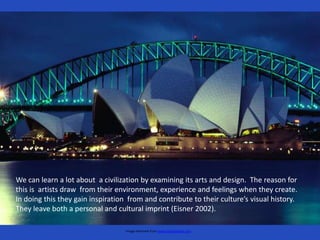
We can learn a lot about a civilization by examining its arts and design. The reason for
this is artists draw from their environment, experience and feelings when they create.
In doing this they gain inspiration from and contribute to their culture’s visual history.
They leave both a personal and cultural imprint (Eisner 2002).
Image retrieved from www.lonelyplanet.com
“There is not a human production that exists outside of what I
call the ‘big image’. The big image is our story, our poetry, our
romanticism. Our poetry is our mutation, our life.”
(Philippe Starck 2007) TED talk: Design and Destiny
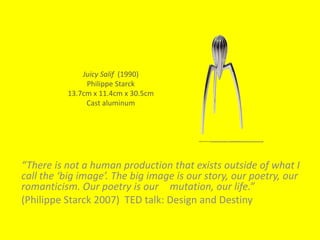
Juicy Salif (1990)
Philippe Starck
13.7cm x 11.4cm x 30.5cm
Cast aluminum
Imageretrieved from http://mikarchitect.wordpress.com/2010/06/28/discourse-about-philip-starck-and-his-juicy-salif/
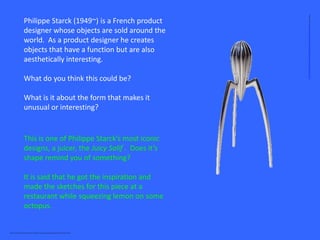
This is one of Philippe Starck’s most iconic
designs, a juicer, the Juicy Salif . Does it’s
shape remind you of something?
It is said that he got the inspiration and
made the sketches for this piece at a
restaurant while squeezing lemon on some
octopus.
Philippe Starck (1949~) is a French product
designer whose objects are sold around the
world. As a product designer he creates
objects that have a function but are also
aesthetically interesting.
What do you think this could be?
What is it about the form that makes it
unusual or interesting?
Imageretrievedfromhttp://mikarchitect.wordpress.com/2010/06/28/discourse-about-philip-starck-and-his-juicy-salif/
Octopus imageretrieved from http://www.norbertwu.com/nwp/subjects/cephalopods/detail.np/detail-19.html
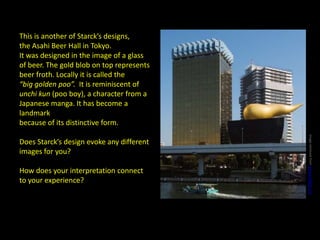
This is another of Starck’s designs,
the Asahi Beer Hall in Tokyo.
It was designed in the image of a glass
of beer. The gold blob on top represents
beer froth. Locally it is called the
“big golden poo”. It is reminiscent of
unchi kun (poo boy), a character from a
Japanese manga. It has become a
landmark
because of its distinctive form.
Does Starck’s design evoke any different
images for you?
How does your interpretation connect
to your experience?
Imageretrievedfromwww.archdaily.com
Image retrieved from www.cocktailsandcuriosities.com
Image retrieved from www.japan-guide.com
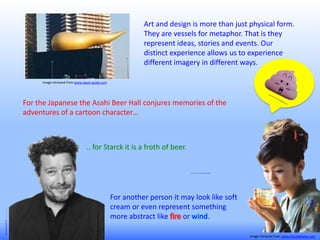
Art and design is more than just physical form.
They are vessels for metaphor. That is they
represent ideas, stories and events. Our
distinct experience allows us to experience
different imagery in different ways.
For another person it may look like soft
cream or even represent something
more abstract like fire or wind.
Image retrieved from www.visualphotos.com
For the Japanese the Asahi Beer Hall conjures memories of the
adventures of a cartoon character…
Imageretrievedfrommikarchitect.wordpress.com
.. for Starck it is a froth of beer.
As we examine the possible and
intended layers of meaning that
are represented in different art
forms we are able to reflect on our
own experience and ideas
This process helps us broaden our minds and gain insight into how
different people think and feel. Some would say that this process can
help us understand human nature and the human psyche. Others
would even go as far as to say looking at and thinking about the arts
sharpens our understanding of our place in the universe.
Image retrieved from http://edtseng.com/2012/11/message-1651-the-thinker
Image retrieved from hdw.eweb4.com
Image retrieved from www.candcsigns.com
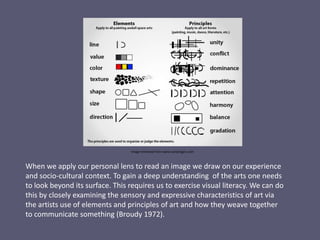
When we apply our personal lens to read an image we draw on our experience
and socio-cultural context. To gain a deep understanding of the arts one needs
to look beyond its surface. This requires us to exercise visual literacy. We can do
this by closely examining the sensory and expressive characteristics of art via
the artists use of elements and principles of art and how they weave together
to communicate something (Broudy 1972).
Philippe Starck for Fluocaril ( 1989)
toothbrush and holder
Mass: size and appearance of weight of an object.
Space:
• positive space is the form created by the material.
• negative space is the empty space that sits between
and around the form.
When creating form artists and designers that create three dimensional objects
are generally concerned with mass and space. How has Starck used the elements
and principles of art to create a sense of mass and space?
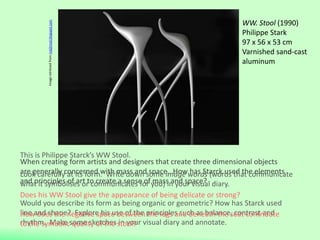
WW. Stool (1990)
Philippe Stark
97 x 56 x 53 cm
Varnished sand-cast
aluminum
This is Philippe Starck’s WW Stool.
Look carefully at its form. Write down some image words (words that communicate
what it symbolises or communicates for you) in your visual diary.
Would you describe its form as being organic or geometric? How has Starck used
line and shape? Explore his use of the principles such as balance, contrast and
rhythm. Make some sketches in your visual diary and annotate.
Imageretrievedfrommid2mod.blogspot.com
Does his WW Stool give the appearance of being delicate or strong?
How does the negative space between the legs and beneath the seat contribute
to the symbolic quality of the stool?
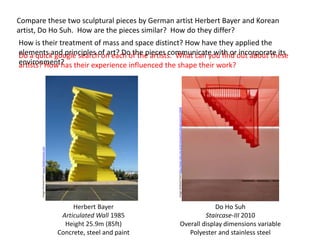
Herbert Bayer
Articulated Wall 1985
Height 25.9m (85ft)
Concrete, steel and paint
Compare these two sculptural pieces by German artist Herbert Bayer and Korean
artist, Do Ho Suh. How are the pieces similar? How do they differ?
Do a quick google search on each of the artists. What can you find out about these
artists? How has their experience influenced the shape their work?
Do Ho Suh
Staircase-III 2010
Overall display dimensions variable
Polyester and stainless steel
How is their treatment of mass and space distinct? How have they applied the
elements and principles of art? Do the pieces communicate with or incorporate its
environment?
Imageretrievedfromwww.thedenvereye.com
Imageretrievedfromhttp://www.tate.org.uk/art/artworks/suh-staircase-iii-t13344
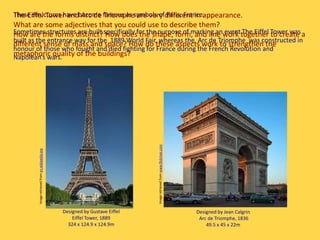
Designed by Jean Calgrin
Arc de Triomphe, 1836
49.5 x 45 x 22m
These structures have become famous as symbols of Paris, France.
Sometimes structures are built specifically for the purpose of marking an event.The Eiffel Tower was
built as the entrance way for the 1889 World Fair, whereas the Arc de Triomphe was constructed in
honour of those who fought and died fighting for France during the French Revolution and
Napolean’s wars.
Designed by Gustave Eiffel
Eiffel Tower, 1889
324 x 124.9 x 124.9m
The Eiffel Tower and Arc de Triomphe are very different in appearance.
What are some adjectives that you could use to describe them?
How are the forms distinct? How does the shape, form, and line work together to create a
different sense of mass and space? How do these aspects work to strengthen the
metaphoric quality of the buildings?
Imageretrievedfromen.wikipedia.org
Imageretrievedfromwww.flickriver.com
Image retrieved from www.destination360.com
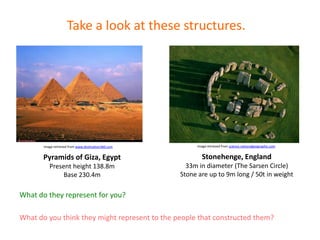
Take a look at these structures.
What do you think they might represent to the people that constructed them?
Image retrieved from science.nationalgeographic.com
Pyramids of Giza, Egypt
Present height 138.8m
Base 230.4m
Stonehenge, England
33m in diameter (The Sarsen Circle)
Stone are up to 9m long / 50t in weight
What do they represent for you?
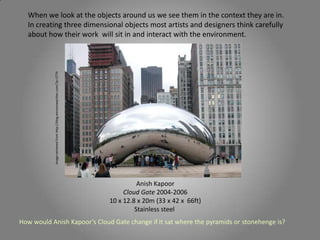
When we look at the objects around us we see them in the context they are in.
In creating three dimensional objects most artists and designers think carefully
about how their work will sit in and interact with the environment.
Anish Kapoor
Cloud Gate 2004-2006
10 x 12.8 x 20m (33 x 42 x 66ft)
Stainless steel
Imageretrievedfromhttp://blog.winstonwachter.com/?p=2774
How would Anish Kapoor’s Cloud Gate change if it sat where the pyramids or stonehenge is?
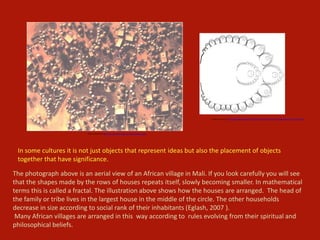
The photograph above is an aerial view of an African village in Mali. If you look carefully you will see
that the shapes made by the rows of houses repeats itself, slowly becoming smaller. In mathematical
terms this is called a fractal. The illustration above shows how the houses are arranged. The head of
the family or tribe lives in the largest house in the middle of the circle. The other households
decrease in size according to social rank of their inhabitants (Eglash, 2007 ).
Many African villages are arranged in this way according to rules evolving from their spiritual and
philosophical beliefs.
In some cultures it is not just objects that represent ideas but also the placement of objects
together that have significance.
Image retrieved from http://csdt.rpi.edu/african/African_Fractals/labbazanga.jpg
Image retrieved from http://www.miqel.com/images_1/fractal_math_patterns/fractal_technology/african_fractal_ba-Ila_vill.gif
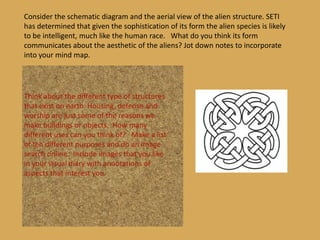
Consider the schematic diagram and the aerial view of the alien structure. SETI
has determined that given the sophistication of its form the alien species is likely
to be intelligent, much like the human race. What do you think its form
communicates about the aesthetic of the aliens? Jot down notes to incorporate
into your mind map.
Think about the different type of structures
that exist on earth. Housing, defense and
worship are just some of the reasons we
make buildings or objects. How many
different uses can you think of? Make a list
of ten different purposes and do an image
search online. Include images that you like
in your visual diary with annotations of
aspects that interest you.
Now…
Think about what the purpose of the alien structure might be. Choose
one. For example it might be a space ship storage unit or perhaps it is an
amusement park.
What is a key word that can act as an image word for your structure? In
the case of the space ship storage unit it might be safety or sanctuary,
whereas for an amusement park it might be fun or speed. Do a search
online for artists and designers that have explored the same theme. Be
sure to include any research in your visual diary and make annotations
documenting what it is about their work that conveys these ideas.
Reflect on your research and consider how an alien architect or designer
might use the elements and principles of art and design to convey the
structure’s purpose.
MIND MAP
You should now have a lot of information that you can use for inspiration when
constructing your model. Open to a new double page in your visual diary. Printout
a copy of the schematic image and stick it in the center of your page. Write your
image word and the purpose of the building underneath the image. The center of
your mind map will represent the Big Idea underpinning your model’s design.
Next arrange and add the information you have gathered through discussions with
your peers and independent research so that they link with the center of the mind
map.
As you design the layout of your mind map take care to make it look visually
interesting. Think about how you can use the elements, colour, line, tone, shape,
texture and space to create a composition that is informative and dynamic.
References
• Eisner, E. W. (2002). The Arts and the Creation of Mind. New Haven, CT:
Yale University Press
• Starck, P. (2007). Design and destiny. TEDtalk retrieved on May 3, 2013
from http://www.youtube.com/watch?v=Z4PwHD7XKj0
• Broudy, H. S. (1972). Enlightened Cherishing: An Essay on Aesthetic
Education. Champaign-Urbana, IL: University of Illinois Press

Form and meaning

  • 1.
  • 2.
    We can learna lot about a civilization by examining its arts and design. The reason for this is artists draw from their environment, experience and feelings when they create. In doing this they gain inspiration from and contribute to their culture’s visual history. They leave both a personal and cultural imprint (Eisner 2002). Image retrieved from www.lonelyplanet.com
  • 3.
    “There is nota human production that exists outside of what I call the ‘big image’. The big image is our story, our poetry, our romanticism. Our poetry is our mutation, our life.” (Philippe Starck 2007) TED talk: Design and Destiny Juicy Salif (1990) Philippe Starck 13.7cm x 11.4cm x 30.5cm Cast aluminum Imageretrieved from http://mikarchitect.wordpress.com/2010/06/28/discourse-about-philip-starck-and-his-juicy-salif/
  • 4.
    This is oneof Philippe Starck’s most iconic designs, a juicer, the Juicy Salif . Does it’s shape remind you of something? It is said that he got the inspiration and made the sketches for this piece at a restaurant while squeezing lemon on some octopus. Philippe Starck (1949~) is a French product designer whose objects are sold around the world. As a product designer he creates objects that have a function but are also aesthetically interesting. What do you think this could be? What is it about the form that makes it unusual or interesting? Imageretrievedfromhttp://mikarchitect.wordpress.com/2010/06/28/discourse-about-philip-starck-and-his-juicy-salif/ Octopus imageretrieved from http://www.norbertwu.com/nwp/subjects/cephalopods/detail.np/detail-19.html
  • 5.
    This is anotherof Starck’s designs, the Asahi Beer Hall in Tokyo. It was designed in the image of a glass of beer. The gold blob on top represents beer froth. Locally it is called the “big golden poo”. It is reminiscent of unchi kun (poo boy), a character from a Japanese manga. It has become a landmark because of its distinctive form. Does Starck’s design evoke any different images for you? How does your interpretation connect to your experience? Imageretrievedfromwww.archdaily.com
  • 6.
    Image retrieved fromwww.cocktailsandcuriosities.com Image retrieved from www.japan-guide.com Art and design is more than just physical form. They are vessels for metaphor. That is they represent ideas, stories and events. Our distinct experience allows us to experience different imagery in different ways. For another person it may look like soft cream or even represent something more abstract like fire or wind. Image retrieved from www.visualphotos.com For the Japanese the Asahi Beer Hall conjures memories of the adventures of a cartoon character… Imageretrievedfrommikarchitect.wordpress.com .. for Starck it is a froth of beer.
  • 7.
    As we examinethe possible and intended layers of meaning that are represented in different art forms we are able to reflect on our own experience and ideas This process helps us broaden our minds and gain insight into how different people think and feel. Some would say that this process can help us understand human nature and the human psyche. Others would even go as far as to say looking at and thinking about the arts sharpens our understanding of our place in the universe. Image retrieved from http://edtseng.com/2012/11/message-1651-the-thinker Image retrieved from hdw.eweb4.com
  • 8.
    Image retrieved fromwww.candcsigns.com When we apply our personal lens to read an image we draw on our experience and socio-cultural context. To gain a deep understanding of the arts one needs to look beyond its surface. This requires us to exercise visual literacy. We can do this by closely examining the sensory and expressive characteristics of art via the artists use of elements and principles of art and how they weave together to communicate something (Broudy 1972). Philippe Starck for Fluocaril ( 1989) toothbrush and holder
  • 9.
    Mass: size andappearance of weight of an object. Space: • positive space is the form created by the material. • negative space is the empty space that sits between and around the form.
  • 10.
    When creating formartists and designers that create three dimensional objects are generally concerned with mass and space. How has Starck used the elements and principles of art to create a sense of mass and space? WW. Stool (1990) Philippe Stark 97 x 56 x 53 cm Varnished sand-cast aluminum This is Philippe Starck’s WW Stool. Look carefully at its form. Write down some image words (words that communicate what it symbolises or communicates for you) in your visual diary. Would you describe its form as being organic or geometric? How has Starck used line and shape? Explore his use of the principles such as balance, contrast and rhythm. Make some sketches in your visual diary and annotate. Imageretrievedfrommid2mod.blogspot.com Does his WW Stool give the appearance of being delicate or strong? How does the negative space between the legs and beneath the seat contribute to the symbolic quality of the stool?
  • 11.
    Herbert Bayer Articulated Wall1985 Height 25.9m (85ft) Concrete, steel and paint Compare these two sculptural pieces by German artist Herbert Bayer and Korean artist, Do Ho Suh. How are the pieces similar? How do they differ? Do a quick google search on each of the artists. What can you find out about these artists? How has their experience influenced the shape their work? Do Ho Suh Staircase-III 2010 Overall display dimensions variable Polyester and stainless steel How is their treatment of mass and space distinct? How have they applied the elements and principles of art? Do the pieces communicate with or incorporate its environment? Imageretrievedfromwww.thedenvereye.com Imageretrievedfromhttp://www.tate.org.uk/art/artworks/suh-staircase-iii-t13344
  • 12.
    Designed by JeanCalgrin Arc de Triomphe, 1836 49.5 x 45 x 22m These structures have become famous as symbols of Paris, France. Sometimes structures are built specifically for the purpose of marking an event.The Eiffel Tower was built as the entrance way for the 1889 World Fair, whereas the Arc de Triomphe was constructed in honour of those who fought and died fighting for France during the French Revolution and Napolean’s wars. Designed by Gustave Eiffel Eiffel Tower, 1889 324 x 124.9 x 124.9m The Eiffel Tower and Arc de Triomphe are very different in appearance. What are some adjectives that you could use to describe them? How are the forms distinct? How does the shape, form, and line work together to create a different sense of mass and space? How do these aspects work to strengthen the metaphoric quality of the buildings? Imageretrievedfromen.wikipedia.org Imageretrievedfromwww.flickriver.com
  • 13.
    Image retrieved fromwww.destination360.com Take a look at these structures. What do you think they might represent to the people that constructed them? Image retrieved from science.nationalgeographic.com Pyramids of Giza, Egypt Present height 138.8m Base 230.4m Stonehenge, England 33m in diameter (The Sarsen Circle) Stone are up to 9m long / 50t in weight What do they represent for you?
  • 14.
    When we lookat the objects around us we see them in the context they are in. In creating three dimensional objects most artists and designers think carefully about how their work will sit in and interact with the environment. Anish Kapoor Cloud Gate 2004-2006 10 x 12.8 x 20m (33 x 42 x 66ft) Stainless steel Imageretrievedfromhttp://blog.winstonwachter.com/?p=2774 How would Anish Kapoor’s Cloud Gate change if it sat where the pyramids or stonehenge is?
  • 15.
    The photograph aboveis an aerial view of an African village in Mali. If you look carefully you will see that the shapes made by the rows of houses repeats itself, slowly becoming smaller. In mathematical terms this is called a fractal. The illustration above shows how the houses are arranged. The head of the family or tribe lives in the largest house in the middle of the circle. The other households decrease in size according to social rank of their inhabitants (Eglash, 2007 ). Many African villages are arranged in this way according to rules evolving from their spiritual and philosophical beliefs. In some cultures it is not just objects that represent ideas but also the placement of objects together that have significance. Image retrieved from http://csdt.rpi.edu/african/African_Fractals/labbazanga.jpg Image retrieved from http://www.miqel.com/images_1/fractal_math_patterns/fractal_technology/african_fractal_ba-Ila_vill.gif
  • 16.
    Consider the schematicdiagram and the aerial view of the alien structure. SETI has determined that given the sophistication of its form the alien species is likely to be intelligent, much like the human race. What do you think its form communicates about the aesthetic of the aliens? Jot down notes to incorporate into your mind map. Think about the different type of structures that exist on earth. Housing, defense and worship are just some of the reasons we make buildings or objects. How many different uses can you think of? Make a list of ten different purposes and do an image search online. Include images that you like in your visual diary with annotations of aspects that interest you.
  • 17.
    Now… Think about whatthe purpose of the alien structure might be. Choose one. For example it might be a space ship storage unit or perhaps it is an amusement park. What is a key word that can act as an image word for your structure? In the case of the space ship storage unit it might be safety or sanctuary, whereas for an amusement park it might be fun or speed. Do a search online for artists and designers that have explored the same theme. Be sure to include any research in your visual diary and make annotations documenting what it is about their work that conveys these ideas. Reflect on your research and consider how an alien architect or designer might use the elements and principles of art and design to convey the structure’s purpose.
  • 18.
    MIND MAP You shouldnow have a lot of information that you can use for inspiration when constructing your model. Open to a new double page in your visual diary. Printout a copy of the schematic image and stick it in the center of your page. Write your image word and the purpose of the building underneath the image. The center of your mind map will represent the Big Idea underpinning your model’s design. Next arrange and add the information you have gathered through discussions with your peers and independent research so that they link with the center of the mind map. As you design the layout of your mind map take care to make it look visually interesting. Think about how you can use the elements, colour, line, tone, shape, texture and space to create a composition that is informative and dynamic.
  • 19.
    References • Eisner, E.W. (2002). The Arts and the Creation of Mind. New Haven, CT: Yale University Press • Starck, P. (2007). Design and destiny. TEDtalk retrieved on May 3, 2013 from http://www.youtube.com/watch?v=Z4PwHD7XKj0 • Broudy, H. S. (1972). Enlightened Cherishing: An Essay on Aesthetic Education. Champaign-Urbana, IL: University of Illinois Press