

KINETIC
STRUCTURES
Anoushka Shome
Pawandeep Singh
Shubham Baldota
KINETIC STRUCUTRES
Kinetic structures are defined as buildings and/or building components with variable
mobility, location and/or geometry.
The performance ways of a kinetic structural solution can be FOLDING, SLIDING,
EXPANDING, AND TRANSFORMING in both size and shape.
3 TYPES
Embedded kinetic structures
Deployable kinetic structures
Dynamic kinetic structures
EMBEDDED KINETIC STRUCTURES
SHUBHAM BALDOTA
1DT16AT035
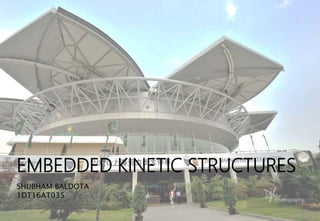
EMBEDDED KINETIC STRUCTURES
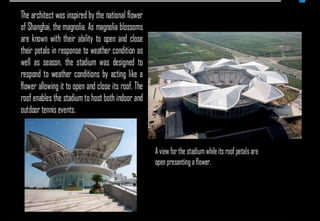
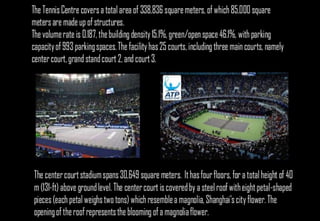
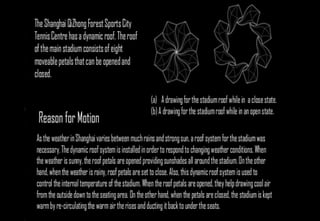
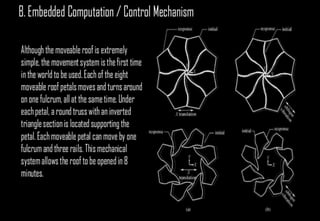
Embedded Kinetic Structures are systems that exist within a larger architectural whole in
a fixed location. The primary function is to control the larger architectural system or
building, in response to changing factors.
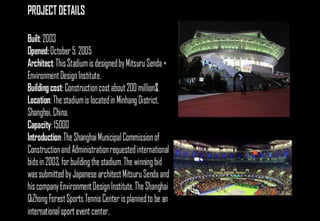
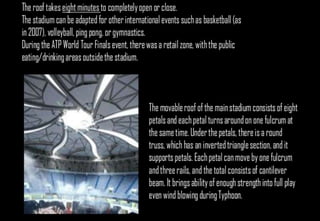
Example: Quihong Stadium ,China
3 TYPES
Embedded kinetic structures
Deployable kinetic structures
Dynamic kinetic structures
DEPLOYABLE KINETIC STRUCTURES
ANOUSHKA SHOME
1DT16AT005
DEPLOYABLE STRUCTURES
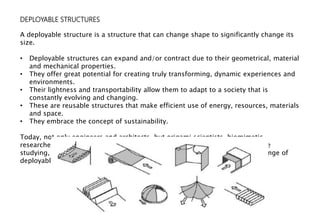
A deployable structure is a structure that can change shape to significantly change its
size.
• Deployable structures can expand and/or contract due to their geometrical, material
and mechanical properties.
• They offer great potential for creating truly transforming, dynamic experiences and
environments.
• Their lightness and transportability allow them to adapt to a society that is
constantly evolving and changing.
• These are reusable structures that make efficient use of energy, resources, materials
and space.
• They embrace the concept of sustainability.
Today, not only engineers and architects, but origami scientists, biomimetic
researchers, astrophysicists, mathematicians, biologists, artists and others are
studying, designing and developing applications for an extraordinarily vast range of
deployable structures.
As this is still an emerging field, there is no single agreed definition of a deployable
structure. These structures are sometimes referred to as foldable, reconfigurable,
unfurl able, auxetic, extendible or expandable structures; however, they are perhaps
best understood from these descriptions:
Deployable structures are structures capable of large configuration changes in an
autonomous way.
TIBERT, 2002, P1
Such structures may pass from a ‘folded’ to an ‘erect’ state; and in many cases the
component parts are connected throughout topologically but alter their geometry
through the process of deployment. In the process of deployment the initial mobility
is transformed into a final rigidity. But that is by no means the only possible scheme
for structural deployment.
CALLADINE, 2001, P64
By the application of a force at one or more points, it [a deployable structure]
transforms in a fluid and controlled manner. Despite such ease of transformation,
these structures are stable, strong and durable.
HOBERMAN, 2004, P72
Interdisciplinary Nature Of Deployable Structures
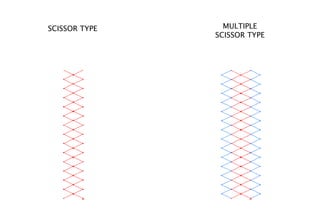
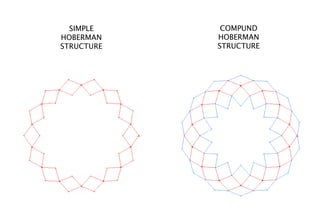
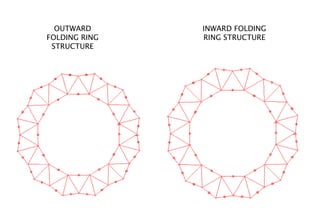
TYPES OF DEPLOYABLE STRUCTURES
Based on their folding and deployment
SCISSOR TYPE
HOBERMAN STRUCTURE
OUTWARD/INWARD FOLDING
SCISSOR TYPE MULTIPLE
SCISSOR TYPE
SIMPLE
HOBERMAN
STRUCTURE
COMPUND
HOBERMAN
STRUCTURE
OUTWARD
FOLDING RING
STRUCTURE
INWARD FOLDING
RING STRUCTURE
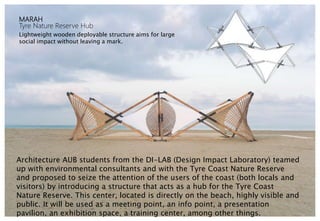
MARAH
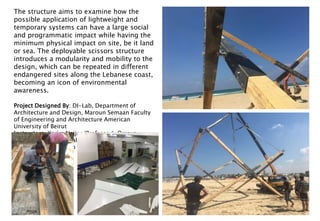
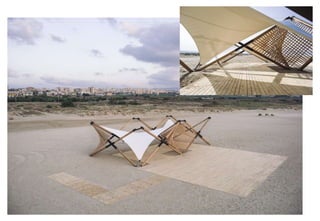
Tyre Nature Reserve Hub
Lightweight wooden deployable structure aims for large
social impact without leaving a mark.
Architecture AUB students from the DI-LAB (Design Impact Laboratory) teamed
up with environmental consultants and with the Tyre Coast Nature Reserve
and proposed to seize the attention of the users of the coast (both locals and
visitors) by introducing a structure that acts as a hub for the Tyre Coast
Nature Reserve. This center, located is directly on the beach, highly visible and
public. It will be used as a meeting point, an info point, a presentation
pavilion, an exhibition space, a training center, among other things.
The structure aims to examine how the
possible application of lightweight and
temporary systems can have a large social
and programmatic impact while having the
minimum physical impact on site, be it land
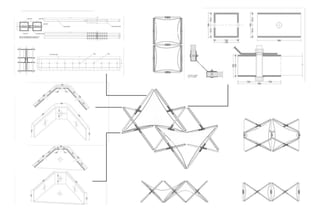
or sea. The deployable scissors structure
introduces a modularity and mobility to the
design, which can be repeated in different
endangered sites along the Lebanese coast,
becoming an icon of environmental
awareness.
Project Designed By: DI-Lab, Department of
Architecture and Design, Maroun Semaan Faculty
of Engineering and Architecture American
University of Beirut
Instructors: Karim Najjar (Professor), Omaya
Malaeb, Ahmad Nouraldeen, Mohamad Nazar
Photography: Lorenzo Tugnoli
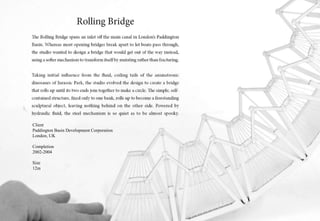
Client
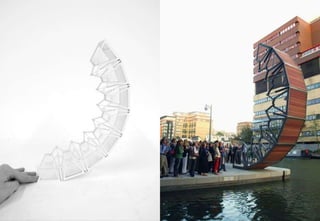
Paddington Basin Development Corporation
London, UK
Completion
2002-2004
Size
12m
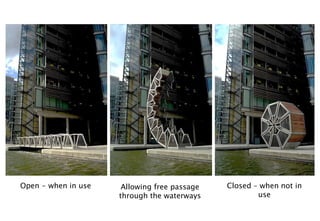
Open - when in use Closed – when not in
use
Allowing free passage
through the waterways
USES OF DEPLOYABLE STRUCTURES
Due to their lightweight nature and degree of flexibility, deployable structures are
widely used as temporary structures. They can be installed easily as well as dismantles
and transported to different locations. This makes them the most favorable for
emergency shelters when there is a need of mass-produced modular structures that
can be transported to the site of destruction and setup for fast service.
One of the most basic deployable kinetic structure is a camping tent (even an
umbrella). Apart from architecture, this mechanism is widely used in robotics and the
aeronautics industry. For Space-based constructions it is used for making spacecraft
equipment and mechanisms.
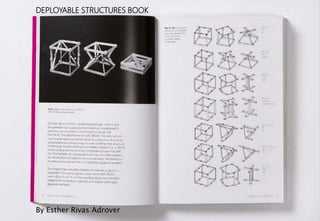
DEPLOYABLE STRUCTURES BOOK
By Esther Rivas Adrover
3 TYPES
Embedded kinetic structures
Deployable kinetic structures
Dynamic kinetic structures
DYNAMIC KINETIC STRUCTURES
PAWANDEEP SINGH
1DT16AT027
DYNAMIC KINETIC STRUCTURES
“Dynamic kinetic structures exist within a larger architectural whole but act
independently with respect of the larger context”
Dynamic systems are the most used among the three. They include small architectural
elements as well as large ones, such as doors, windows, movable partitions, furniture
and ceilings. As they act independently, it is quite common to have dynamic kinetic
system as well. They are becoming increasingly automated and intelligent as a result
of the technological innovation nowadays.
Dynamic kinetic systems are sub-categorised into :-
• MOBILE SYSTEMS - are those that could be physically moved within an architectural
space to different locations.
• TRANSFORMABLE SYSTEMS - are those capable of changing shape to take on a
different spatial configuration and can be used for space-saving or utilitarian
needs.
• INCREMENTAL KINETIC SYSTEMS -are those that can be added to or subtracted from
a building like LEGO pieces.
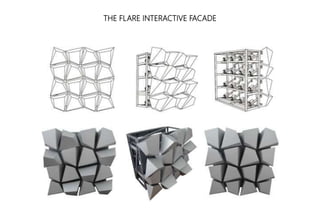
THE FLARE INTERACTIVE FACADE
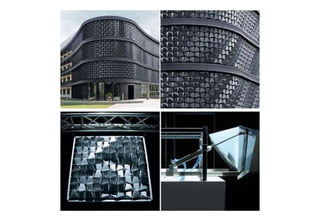
Flare - is a modular system to create a dynamic hull for facades or any building or
wall surface. Acting like a living skin, it allows a building to express, communicate
and interact with its environment. The system consists of a number of tilt-able metal
flake bodies supplemented by individually controllable pneumatic cylinders. Due to
the developed pattern, an infinite array of flakes can be mounted on any building or
wall surface in a modular system of multiplied FLARE units.
One Flare module - consisting of 16 aluminum cast units, which can be inclined
silently with a Festo Pneumatic system - is about 1x1m. By reflecting ambient or
direct sunlight the individual flakes of the system act like pixels formed by natural
light.
Kinetic structures | B.arch

Kinetic structures | B.arch

  • 1.
  • 2.
    KINETIC STRUCUTRES Kinetic structuresare defined as buildings and/or building components with variable mobility, location and/or geometry. The performance ways of a kinetic structural solution can be FOLDING, SLIDING, EXPANDING, AND TRANSFORMING in both size and shape.
  • 3.
    3 TYPES Embedded kineticstructures Deployable kinetic structures Dynamic kinetic structures
  • 4.
  • 5.
    EMBEDDED KINETIC STRUCTURES EmbeddedKinetic Structures are systems that exist within a larger architectural whole in a fixed location. The primary function is to control the larger architectural system or building, in response to changing factors. Example: Quihong Stadium ,China
  • 13.
    3 TYPES Embedded kineticstructures Deployable kinetic structures Dynamic kinetic structures
  • 14.
  • 15.
    DEPLOYABLE STRUCTURES A deployablestructure is a structure that can change shape to significantly change its size. • Deployable structures can expand and/or contract due to their geometrical, material and mechanical properties. • They offer great potential for creating truly transforming, dynamic experiences and environments. • Their lightness and transportability allow them to adapt to a society that is constantly evolving and changing. • These are reusable structures that make efficient use of energy, resources, materials and space. • They embrace the concept of sustainability. Today, not only engineers and architects, but origami scientists, biomimetic researchers, astrophysicists, mathematicians, biologists, artists and others are studying, designing and developing applications for an extraordinarily vast range of deployable structures.
  • 16.
    As this isstill an emerging field, there is no single agreed definition of a deployable structure. These structures are sometimes referred to as foldable, reconfigurable, unfurl able, auxetic, extendible or expandable structures; however, they are perhaps best understood from these descriptions: Deployable structures are structures capable of large configuration changes in an autonomous way. TIBERT, 2002, P1 Such structures may pass from a ‘folded’ to an ‘erect’ state; and in many cases the component parts are connected throughout topologically but alter their geometry through the process of deployment. In the process of deployment the initial mobility is transformed into a final rigidity. But that is by no means the only possible scheme for structural deployment. CALLADINE, 2001, P64 By the application of a force at one or more points, it [a deployable structure] transforms in a fluid and controlled manner. Despite such ease of transformation, these structures are stable, strong and durable. HOBERMAN, 2004, P72
  • 17.
    Interdisciplinary Nature OfDeployable Structures
  • 18.
    TYPES OF DEPLOYABLESTRUCTURES Based on their folding and deployment SCISSOR TYPE HOBERMAN STRUCTURE OUTWARD/INWARD FOLDING
  • 19.
  • 20.
  • 21.
  • 22.
    MARAH Tyre Nature ReserveHub Lightweight wooden deployable structure aims for large social impact without leaving a mark. Architecture AUB students from the DI-LAB (Design Impact Laboratory) teamed up with environmental consultants and with the Tyre Coast Nature Reserve and proposed to seize the attention of the users of the coast (both locals and visitors) by introducing a structure that acts as a hub for the Tyre Coast Nature Reserve. This center, located is directly on the beach, highly visible and public. It will be used as a meeting point, an info point, a presentation pavilion, an exhibition space, a training center, among other things.
  • 23.
    The structure aimsto examine how the possible application of lightweight and temporary systems can have a large social and programmatic impact while having the minimum physical impact on site, be it land or sea. The deployable scissors structure introduces a modularity and mobility to the design, which can be repeated in different endangered sites along the Lebanese coast, becoming an icon of environmental awareness. Project Designed By: DI-Lab, Department of Architecture and Design, Maroun Semaan Faculty of Engineering and Architecture American University of Beirut Instructors: Karim Najjar (Professor), Omaya Malaeb, Ahmad Nouraldeen, Mohamad Nazar Photography: Lorenzo Tugnoli
  • 26.
    Client Paddington Basin DevelopmentCorporation London, UK Completion 2002-2004 Size 12m
  • 28.
    Open - whenin use Closed – when not in use Allowing free passage through the waterways
  • 31.
    USES OF DEPLOYABLESTRUCTURES Due to their lightweight nature and degree of flexibility, deployable structures are widely used as temporary structures. They can be installed easily as well as dismantles and transported to different locations. This makes them the most favorable for emergency shelters when there is a need of mass-produced modular structures that can be transported to the site of destruction and setup for fast service. One of the most basic deployable kinetic structure is a camping tent (even an umbrella). Apart from architecture, this mechanism is widely used in robotics and the aeronautics industry. For Space-based constructions it is used for making spacecraft equipment and mechanisms.
  • 32.
    DEPLOYABLE STRUCTURES BOOK ByEsther Rivas Adrover
  • 33.
    3 TYPES Embedded kineticstructures Deployable kinetic structures Dynamic kinetic structures
  • 34.
  • 35.
    DYNAMIC KINETIC STRUCTURES “Dynamickinetic structures exist within a larger architectural whole but act independently with respect of the larger context” Dynamic systems are the most used among the three. They include small architectural elements as well as large ones, such as doors, windows, movable partitions, furniture and ceilings. As they act independently, it is quite common to have dynamic kinetic system as well. They are becoming increasingly automated and intelligent as a result of the technological innovation nowadays. Dynamic kinetic systems are sub-categorised into :- • MOBILE SYSTEMS - are those that could be physically moved within an architectural space to different locations. • TRANSFORMABLE SYSTEMS - are those capable of changing shape to take on a different spatial configuration and can be used for space-saving or utilitarian needs. • INCREMENTAL KINETIC SYSTEMS -are those that can be added to or subtracted from a building like LEGO pieces.
  • 36.
  • 37.
    Flare - isa modular system to create a dynamic hull for facades or any building or wall surface. Acting like a living skin, it allows a building to express, communicate and interact with its environment. The system consists of a number of tilt-able metal flake bodies supplemented by individually controllable pneumatic cylinders. Due to the developed pattern, an infinite array of flakes can be mounted on any building or wall surface in a modular system of multiplied FLARE units. One Flare module - consisting of 16 aluminum cast units, which can be inclined silently with a Festo Pneumatic system - is about 1x1m. By reflecting ambient or direct sunlight the individual flakes of the system act like pixels formed by natural light.