This document discusses the importance of designing cities and spaces with human needs in mind. It argues that many public spaces in cities, like plazas and streets, are designed without considering human scale or how people will use and interact in those spaces. As a result, people create their own informal spaces that better meet their needs. However, some cities are now trying to address this issue by redesigning streets and public spaces to prioritize pedestrians over vehicles and include seating, greenery, and other amenities that encourage human use and interaction. The document examines how "human space" is about more than just the physical dimensions and can include social and community aspects as well.
![Most cities lack the human space I have described, but planners and even developers have
began to tackle the issue. “(social) space is a (social) product.”1 In all best intensions Henri
Lefebvre is correct, remove the social aspect of space and we begin to see why many people are
starting to give space the attention it needs. Space is a product. An asset to be sold to the
highest bidder, a desirable location to draw business and increase property prices. Although most
western cities have raised the status of space for profit seeking purposes, this does allow
architects to place humans at the summit of the pyramid. Parks, places, and even streets can,
and have begun to change. New York City authorities are continually adapting the way the cities
streets work for the people that occupy it. Restricting access to vehicles, creating public space,
introducing nature into city dwellers lives. New Yorks Transport Commissioner has been
experimenting with the cities streets to make them more human. Whilst much of her success is
measured in the increase of profitability for retailers and in turn the city, the changes are being
made with a heavy influence on people.
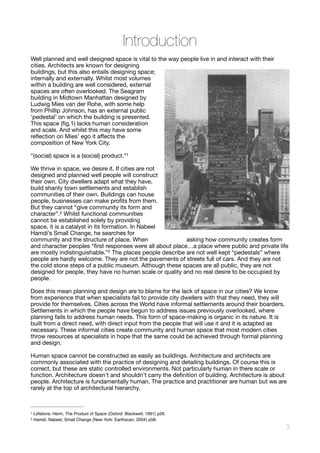
Times Square has gained 2.5 acres of3
public space for the 350,000 that pass
through it everyday3 by closing the area to
vehicular movements. The space has been
re-designed for humans not just to pass
through, but to stop, look and have a sense
of place when they reach the square. The
new zoning was piloted through the use of
temporary materials and furniture (fig.2) but
will be going through huge changes due to
its success. Whilst this success was
measured by a predisposition for profits
(the doubling of retail rents3) it has, and will
have huge benefits to the populous and the
sense of place to the area.
Janette Sadik-Khan: New York’s streets? Not so mean any more,TEDTALKS, 2013 [online] Available at: http://www.ted.com/talks/3
janette_sadik_khan_new_york_s_streets_not_so_mean_any_more
!4
Fig.2](https://image.slidesharecdn.com/342cee97-7ffc-4c40-9295-e53d1bce5d27-151101145007-lva1-app6891/85/Human-Space-for-Human-Cities-4-320.jpg)
![Human Space
We often think of space and its associated issues as a volume contained within four walls. We
label these ‘spaces’ and place objects related to the space within them. Plans contain bedrooms,
kitchens, receptions, offices. And because land now has such high prices within cities, our
labelled spaces are becoming smaller and some disappear all together. Its very common for
people in cities to be sharing a home with people they don’t know, with just a bedroom, kitchen
and bathroom. These conditions are innately un-human.
We then take these undersized “shoebox homes” and stack them into a larger set of four walls.4
We associate this archetype with 60s style design, and we know that these have tended not to
work. But with a housing crisis, its hard for architects to persuade developers or even
governments to change housing type.
Housing isn’t the only spatial issue that cities face. As anyone that lives in a city knows, there are
many social issues trying to be tackled in varying ways. Issues are trying to be solved with a new
school, a community centre, a youth centre, police station, etc.
As Cedric Price observes, “Building may not be the best solution to a spatial problem.” Social5
work, education and police work can only achieve a certain amount of success within a
community. But if the community is fundamentally broken, then much of the areas resources will
be wasted on attempting social change. On the other hand many poverty stricken areas of cities
are given no funding. Both scenarios can be assisted by Nabeel Hamdi’s research into social
change. “Places that happen, and happen to work; places that are made and don’t work”2. This
phrase appears at the beginning of Hamdi’s chapter: In Search of Community and the Structure of
Place.
Regardless of an organisation or governments decision to provide building, or open community
space, local needs are the most important factor. What human spaces allow for is the direct
interpretation of space by the community it serves. If a community needs a place for waiting,
trading, or a place for memories to be made. This is what it becomes. Human space follows the
dynamism of human life. Zygmunt Bauman identifies social space as “a complex interaction of
three interwoven, yet distinct processes- those of cognitive, aesthetic and moral spacings- and
their respective products.” The product of the space is community, it is the end product of this6
development. The initiation of the development is the idea of an architect or planner, they provide
the cognitive, aesthetic and moral ideas of the space. People then inhabit, and live within and
around this space. But this classification of space is rather abstract, it is much easier to design
physical space.
Can space within a modern city be treated as abstract? ‘Space’ as a set of metric dimensions, is
very valuable, especially in dense areas of a metropolis. Therefore it is usually rather hard to find,
and not something easily experimented with.
Philosophers and writers portray their ideas of space in abstract ways. Its an ideological view.
None of their views are incorrect. Its simply the difference between physical and abstract that
turns an idea into the product Bauman describes. Architects ideas are driven by profits.
Developers and authorities are looking for a Bilbao effect to increase surrounding rents. Human
space, can still be achieved this way.
Gentrification can be achieved in various ways. Developer led by moving communities and
inserting another is less popular, it happens quickly and removes a community of values and
established citizens. In this case people are not given the chance to prosper from said
gentrification. Gentrification schemes, such as Elephant & Castle and the development of the
Joyce, Julian. ‘Shoebox homes’ becomes the UK norm, 2011, BBC News [online] Available from: http://www.bbc.co.uk/news/4
uk-14916580
Price, Cedric. Architectural Association Works 2 (London, Architectural Association, 1984) p1075
Bauman, Zygmunt. Postmodern Ethics (Oxford: Blackwell, 1993) p1456
!5](https://image.slidesharecdn.com/342cee97-7ffc-4c40-9295-e53d1bce5d27-151101145007-lva1-app6891/85/Human-Space-for-Human-Cities-5-320.jpg)
![Heygate Estate are not popular, and have not proved financially profitable. The council “spent
more on emptying an estate that it made by selling it.”
7
Human spaces, that provide for its community can cause steady development within the area,
bringing better jobs, increased income and better living conditions. Rather than destroying a
community it can grow and flourish. Physical spatiality can also be a metaphor, it is the abstract
liveness of a space that will allow physicality and abstract to co-exist within a space.
The dominos affect of well thought human space, already described through the changes made in
Times Square is the advantage this concept of space has. It seems obvious that all building, all
space and all design should be made with human interaction and occupation in mind, but in a
society where profitability is paramount, the aspect key to its function is subjugated to lesser
significance. Connectivity, not just to humans, but all accounts of community is vital to human
space actually working. Need for the space, like a business, space needs occupation and use. It
needs to be connected to the city and its populous.
We live in a modern world, where humans are connected more than ever. Particularly through
social media, creating online communities. It is important spaces are connected in order for
community to be created, and to prosper. ‘Connected space’ as Matthew Barac and Lesley
McFadyen describe; “Space connects not only circumscribed disciplines with other discourses,
but also things and places with activities and ideas.”
8
Product, place, time, change, community, etc, all vital in the production and success of space. It
is the connection between people and environment that I believe is a key aspect to modern takes
on ‘Space’. Our cities lack it, humans crave it. The spaces and buildings Frank Lloyd Wright
designed had obviously important connections to the environment around them. He advised we
“Study nature, love nature, stay close to nature. It will never fail you.” Although space is not only
created externally, I have tried to focus on spaces that exist beyond the one confined between
four walls because of the importance I feel nature has on real human spaces.
Nature is not fixed, it is dynamic and unpredictable. Yet it is constant and relatable. We know how
nature works and how it works with us. It is not only vital to the existence of humans, but also (I
believe) vital to the enjoyment of space. The authors of Spatial Agency observe that a space’s
“production continues over time and is not fixed to a single moment of completion.” The human9
space described, compliments the cycle of nature. This relationship with nature removes space
from the static objects of an architects drawing and into the abstract theoretical production of a
successful physical “place that happens, and happens to work”2 for the people and the
community it supports.
London Evening Standard, London council LOSES money in sale of well-loved housing estate, 2014 [online] Available from: http://7
www.standardevening.co.uk/stories/london-council-loses-money-in-sale-of-well-loved-housing-estate
Barac, Matthew & McFadyen, Lesley, Home Cultures (Volume Four Issue Two, The Journal of Architecture, Design and Domestic8
Space, 2007) p3
Awan, Nishat & Schneider, Tatjana & Till, Jeremy, Spatial Agency (London: Routledge, 2011) p299
!6](https://image.slidesharecdn.com/342cee97-7ffc-4c40-9295-e53d1bce5d27-151101145007-lva1-app6891/85/Human-Space-for-Human-Cities-6-320.jpg)
![Tackling the Issue
Whilst most cities do lack the kind of spaces described, the problem is being addressed and
human spaces are being created for city dwellers. New York City have used there success in
Times Square across the city. Creating public places for communities across the boroughs. Whilst
some of these local authority led projects are relatively small scale, experiments with existing
spaces there is also one much larger project that has seen incredible success in achieving a
innately human space for the City of New York.
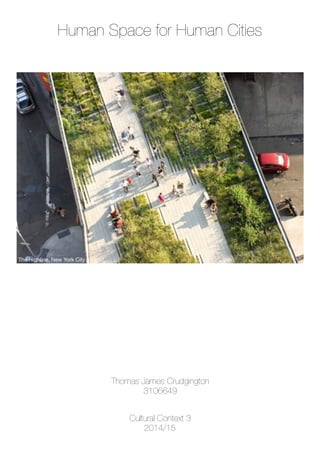
The High Line Park is a new raised public park running 1.5 miles along the western side of
Manhattan island. The park is the product of citizen led campaign to save and turn a disused rail
line into a park. The High Line Park used to be a freight line that run down 10th Avenue. The street
become known as ‘Death Avenue’ because so many people were run over by the trains. This is10
the reason the railway was then raised above the street.
The removal of the rail line at street level gave a
safe, open space for people to inhabit. That is
until New York became renowned for its
congested streets full of cars, again making the
space less accessible to people. I believe this is
part of its success and popularity. Central park
is a beautiful public space, and works very well.
But it does have a certain detachment from the
city. The High Line park (fig.3) runs between the
skyscrapers, through peoples communities and
connects them through activity and ideology, in
some ways like the ‘connected space’8 Barac
and McFayden describe.
Because the evolution of the city has led to the
saturation of vehicles on street level, when city
dweller turned High Line campaigner Robert Hammond left the de-humanised street and
ascended to the track level he “saw a mile and a half of wild flowers running through
Manhattan” and decided that this space should be used by the people of New York.
11
Due to the nature of modern planning, they had to convince authorities that the park would be
economically viable. It has hit their original estimates, and surpassed them. The park is estimated
to create $20 billion of tax revenue for the city over 20 years. This shows how space has not just
social but economical power. The linear park is having greater gentrification capability than
imagined.
The park works because of its unmitigated focus on human interaction with nature and the city as
a whole. High Line designers Diller and Scofidio fall into a similar belief as Cedric Price’s view that
“Building may not be the best solution to a spatial problem.”5 They avoided making an
architectural statement with the project, and instead they were “really pulling-back from
architecture.”
12
“It is the people and how they use it that makes it so special.”11
The High Line park has now fully opened and is attracting millions of visitors from around the
world. Its a space, and place that people want to be. The park has had a profound affect on the
city, not just economically, but it has humanised a part of the city that longed for this kind of
Pilkington, Ed, High Line park on disused railway in New York opens second section, The Guardian, 2011 [online] Available from:10
http://www.theguardian.com/world/2011/jun/08/high-line-park-new-york
Hammond, Robert. Building a park in the sky, TEDTALKS, 2011 [online] Available from: https://www.ted.com/talks/11
robert_hammond_building_a_park_in_the_sky?language=en
dezeen magazine, The High Line is a “pulling-back from architecture” say Diller and Scofido, 2014 [online] Available from: http://12
www.dezeen.com/2014/11/03/elizabeth-diller-ricardo-scofidio-interview-high-line-new-york/
!7
Fig.3](https://image.slidesharecdn.com/342cee97-7ffc-4c40-9295-e53d1bce5d27-151101145007-lva1-app6891/85/Human-Space-for-Human-Cities-7-320.jpg)
![space. It has changed the way the communities connected by the park interact with nature, and
even the way people interact with one another. Robert Hammond expressed the change that he
had seen the park drive when he “realised just after it opened there were people holding hands on
the High Line…New Yorkers don't hold hands…thats the power public space can have to
transform how people experience their city and interact with each other.”11
The High Line’s success has led to cities around the world launching proposals of their own,
reclaiming abandoned infrastructure, attempting to implement gentrification and the increase of
tax revenue. A green ‘promenade’ in London has been proposed to aid the development of
Vauxhall and the Nine Elms area. The Goods Line railway in Sydney, a garden bridge in
Washington DC and even a ‘low line’ scheme for disused tunnels in New York’s lower east side
have been pushed for development.
Scofidio (one of the High Line’s designers) isn’t convinced that other projects will be able to match
New Yorks newest parks success. Scoffed feels that the other proposals are too focused on
making an “architectural statement”.12 “Its really about growing out of what was there in a very
quiet way.”12 His practice is not solely focused on architecture. Diller, Scofidio + Renfro participate
in many art installations and exhibitions. It may be there focus on space in unconventional ways,
removed from the world of architecture that has allowed them to create the focused human space
on this site.
Another proposal, just approved in London is a garden bridge, also designed by a practice with
projects outside of the architectural world. Thomas Heatherwick, with the support of celebrity
Joanna Lumley and the Mayor of London has proposed the construction of a garden bridge
spanning the Thames. (fig.4)
The majority of London’s river crossings
are congested with vehicles. Not a very
pleasant way for people to cross the river.
The original Roman London bridge,
similar to Venice’s Rialto Bridge, have
shops, and act as an extension of the city
spanning the river. Continuing the human
activities on either side of the water. A
‘connecting space’. The garden bridge is
intended to improve pedestrian links
across the river. Designer of the bridge
Thomas Heatherwick’s “idea is simple; to
connect north and south London with a
garden.”
13
In a somewhat similar way to the High
Line Park, the garden bridge is wholly
focused on human interaction. Interaction with the city, the river and each other. The Thames is
faced by embankments on either side to protect the city from the tidal water. This eliminates the
natural connection between flora, fauna, and water. The bridge would bring this connection to the
centre of one of the worlds densest cities.
Its unpredictable whether the bridge will be successful, but with such a focus on providing human
space it seems likely it could follow in the footsteps of the High Line.
dezeen magazine, Thomas Heatherwick reveals garden bridge designed for River Thames, 2013 [online] Available from: http://13
www.dezeen.com/2013/06/13/thomas-heatherwick-reveals-garden-bridge-across-the-thames/
!8
Fig.4](https://image.slidesharecdn.com/342cee97-7ffc-4c40-9295-e53d1bce5d27-151101145007-lva1-app6891/85/Human-Space-for-Human-Cities-8-320.jpg)
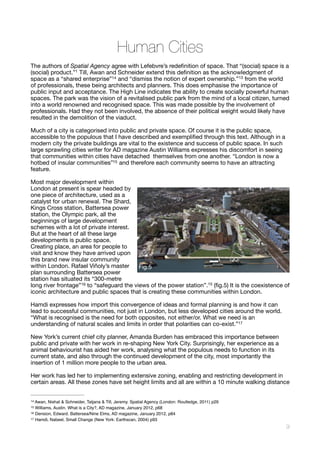
![of New Yorks Metro system. Making all new development “predictable”18 and helping its
acceptance within communities. But what Burden understands is that “open spaces in cities are
opportunities. Opportunities for commercial investment, but also opportunities for the common
good of the city.”
18
New York City has more developments, focused on its communities and populous than most
cities at this point in time. The majority of these developments, are relatively small scale. Closer to
a human scale than the larger developments we see within London, and are more focused on
people than business. I believe this is in part due to the understanding that planners and
professionals involved in aforementioned developments have of the importance that humanisation
has to the success of their plans.
I have discussed the idea of treating space as physical and abstract in the handling of its design.
It may be possible the detachment some architects and planners have of their work is the fault in
its inability to work as a human space. Stepping back from the plans of these spaces could be
leading to their misinterpretation, and involvement of external factors that are dehumanising them.
Factors such as the maintenance of spaces, and there ability to create revenues.
These factors have been achieved in the High Line project. It is economically successful and it is a
place people want to be. Burden believes the key to a spaces success is not entirely through
design expertise or social observations. She believes that “You don't tap into your design
expertise, you tap into your humanity.”18
The key to creating fundamentally human space could simply be humanity, and the professionals
ability to recognise space that would appeal to their innate human nature, understanding scales
and limits so that community, development and profit can co-exist in a modern city.
Amanda Burden: How public spaces make cities work, TEDTALKS, 2014 [online] Available from: http://www.ted.com/talks/18
amanda_burden_how_public_spaces_make_cities_work?language=en#t-1054913
!10](https://image.slidesharecdn.com/342cee97-7ffc-4c40-9295-e53d1bce5d27-151101145007-lva1-app6891/85/Human-Space-for-Human-Cities-10-320.jpg)
![Conclusion
Over 70 years ago urban theorist and historian Lewis Mumford posed the question, ‘What is a
city?’ his view was; “In its complete sense [it] is a geographical plexus, an economical
organisation, an institutional process, a theatre of social action, and an aesthetic symbol of
creative unity.” A city is of course many things, but it is the way that these are connected that19
aid its ability to operate and succeed. Public space is a perfect way to this. It is the barrier
between public and private, it increases a cities permeability and allows people to inhabit it.
It may appear that a city is a humans ability to conquer and cultivate a land, but it is in fact the
partnering of these that is so important. Human and nature. There is a reason that most cities are
situated near water. Nature is a commodity and an object to be appreciated. Cities would not
exist without nature, and they would not exist without people. Not just in presence but in
cultivation, investment and planning. Alan Weisman complains that humans “vainly or
disingenuously pretend” that we have dominion over nature.
20
The wrongful belief that humans have warrant over nature is possibly the reason that many cities
lack the human spaces that I have addressed. The abstracted view that professionals have taken
when designing spaces, especially in relation to architectural statements has detached humans
from nature.
Till believes that Lefebvre’s “(social) space is a (social) product.”1 banishes “any notion that space
could be treated as abstract matter” I don’t completely agree that space cannot be treated as21
abstract. We perceive space as physical because it is usually confined within four walls. Had
Diller, Scofidio + Renfro not treated their design of the High Line Park with some abstractness
then it may not have been as successful as it is. The “dynamics of power/empowerment,
interaction/isolation and control/freedom” are the political factors that are argued remove all22
abstract notions from space by the authors of Spatial Agency. Yet all these aspects are what
connects space to human emotion and ability. It is the successful implementation of an abstract
ideology within public space that allows a vital connection between humans and the space they
are inhabiting. Without the more successful abstract ideas of professionals within spatial design
social space could not be created, nor could it be a product of an individuals doing.
Cities are experiments, in the dynamic setting of a modern urban environment there is no doctrine
for professionals to follow in the planning and composing of cities. There are few cities (excluding
New Towns such as Masdar) that are entirely pre-planned and ‘perfected’. A social experiment at
a city scale makes it necessary for public space to cater for a populous.
Human space should be physical and abstract, it should connect necessary elements of a
community and should tap into a persons humanity. It should be thoughtful and be “pulled back
from architecture”.12
“Architecture is the thoughtful making of spaces”
-Louis Kahn
Mumford, Lewis. ‘What is a City?’, Architectural Record, LXXXII, November 1937, p9419
Weisman, Alan. The World Without Us (Virgin Books: London, 2008) p9820
Till, Jeremy. Architecture Depends (First MIT Press, Massachusetts, 2013) p12621
Awan, Nishat & Schneider, Tatjana & Till, Jeremy. Spatial Agency (London: Routledge, 2011) p3022
!11](https://image.slidesharecdn.com/342cee97-7ffc-4c40-9295-e53d1bce5d27-151101145007-lva1-app6891/85/Human-Space-for-Human-Cities-11-320.jpg)


