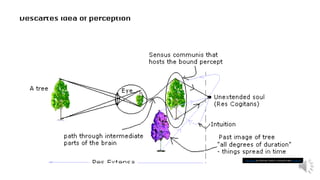
Perception Dr Vijay Bhatia
Definitions
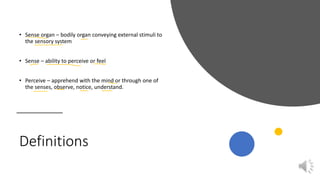
• Sense organ – bodily organ conveying external stimuli to
the sensory system
• Sense – ability to perceive or feel
• Perceive – apprehend with the mind or through one of
the senses, observe, notice, understand.
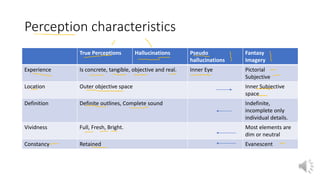
Perception characteristics
True Perceptions Hallucinations Pseudo
hallucinations
Fantasy
Imagery
Experience Is concrete, tangible, objective and real. Inner Eye Pictorial
Subjective
Location Outer objective space Inner Subjective
space
Definition Definite outlines, Complete sound Indefinite,
incomplete only
individual details.
Vividness Full, Fresh, Bright. Most elements are
dim or neutral
Constancy Retained Evanescent
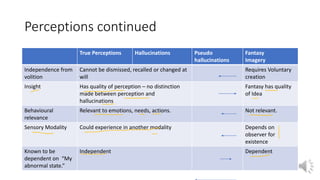
Perceptions continued
True Perceptions Hallucinations Pseudo
hallucinations
Fantasy
Imagery
Independence from
volition
Cannot be dismissed, recalled or changed at
will
Requires Voluntary
creation
Insight Has quality of perception – no distinction
made between perception and
hallucinations
Fantasy has quality
of Idea
Behavioural
relevance
Relevant to emotions, needs, actions. Not relevant.
Sensory Modality Could experience in another modality Depends on
observer for
existence
Known to be
dependent on “My
abnormal state.”
Independent Dependent
This Photo by Unknown Author is licensed under CC BY-SA
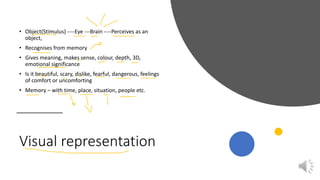
Visual representation
• Object(Stimulus) ----Eye ---Brain ----Perceives as an
object,
• Recognises from memory
• Gives meaning, makes sense, colour, depth, 3D,
emotional significance
• Is it beautiful, scary, dislike, fearful, dangerous, feelings
of comfort or uncomforting
• Memory – with time, place, situation, people etc.
The End
• Thanks for watching
• Please press like button
• Please subscribe to channel and view other videos on
perception, hallucinations.

Perception and perceptual disorders

  • 1.
  • 2.
    Definitions • Sense organ– bodily organ conveying external stimuli to the sensory system • Sense – ability to perceive or feel • Perceive – apprehend with the mind or through one of the senses, observe, notice, understand.
  • 3.
    Perception characteristics True PerceptionsHallucinations Pseudo hallucinations Fantasy Imagery Experience Is concrete, tangible, objective and real. Inner Eye Pictorial Subjective Location Outer objective space Inner Subjective space Definition Definite outlines, Complete sound Indefinite, incomplete only individual details. Vividness Full, Fresh, Bright. Most elements are dim or neutral Constancy Retained Evanescent
  • 4.
    Perceptions continued True PerceptionsHallucinations Pseudo hallucinations Fantasy Imagery Independence from volition Cannot be dismissed, recalled or changed at will Requires Voluntary creation Insight Has quality of perception – no distinction made between perception and hallucinations Fantasy has quality of Idea Behavioural relevance Relevant to emotions, needs, actions. Not relevant. Sensory Modality Could experience in another modality Depends on observer for existence Known to be dependent on “My abnormal state.” Independent Dependent
  • 5.
    This Photo byUnknown Author is licensed under CC BY-SA
  • 6.
    Visual representation • Object(Stimulus)----Eye ---Brain ----Perceives as an object, • Recognises from memory • Gives meaning, makes sense, colour, depth, 3D, emotional significance • Is it beautiful, scary, dislike, fearful, dangerous, feelings of comfort or uncomforting • Memory – with time, place, situation, people etc.
  • 7.
    The End • Thanksfor watching • Please press like button • Please subscribe to channel and view other videos on perception, hallucinations.