SENSORY DECEPTIONS
DR VIJAY BHATIA
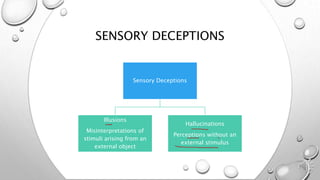
SENSORY DECEPTIONS
Sensory Deceptions
Illusions
Misinterpretations of
stimuli arising from an
external object
Hallucinations
Perceptions without an
external stimulus
ILLUSION
This Photo by
Unknown
Author is
licensed under
CC BY-SA
Do you see a
rabbit.
What do you
see?
Do you see a duck.
ILLUSION
S
Stimuli from a perceived object is combined with a mental image
to produce false perception.
For example – Do you see a duck or Rabbit.
The person walking along a dark road may interpret innocuous
shadows as threatening attackers.
Illusions can occur in delirium.
Auditory illusions may occur when a person hear words in a
conversation that resemble their own name and they believe they
are being talked bout.
FANTASTI
C
ILLUSION
S
Illusions in which person see
extraordinary modifications to their
environment.
E.g. A patient who insisted that during
an interview he saw the psychiatrist’s
head change in to that of a rabbit.
TYPES OF ILLUSIONS
Three types of Illusions
Complete Illusions
Misreading words
Missing misprints
Affect Illusions arise in mood states.
e.g. see the deceased person.
In delirium – innocent gestures as
threatening.
In severe depression – with delusions of
guilt – may believe they are wicked.
Pareidolia
Excessive fantasy
Vivid imagery
Pictures in Fire or clouds.
VISUAL
HALLUCINATIO
NS
These may be elementary in the form of lashes of light.
Partly organised in the form of patterns
Or completely organised in the form of vision of people, objects or
animals.
Figures of living things and inanimate objects mat appear against the
normally perceived environment or scenic hallucinations can occur in
which whole scenes are hallucinated rather like a cinema film.
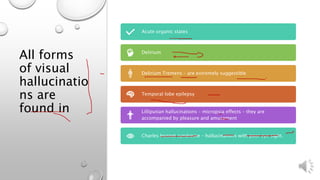
All forms
of visual
hallucinatio
ns are
found in
Acute organic states
Delirium
Delirium Tremens – are extremely suggestible
Temporal lobe epilepsy
Lilliputian hallucinations – micropsia effects – they are
accompanied by pleasure and amusement
Charles bonnet syndrome – hallucinations with poor eye sight.
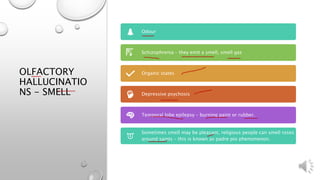
OLFACTORY
HALLUCINATIO
NS - SMELL
Odour
Schizophrenia – they emit a smell, smell gas
Organic states
Depressive psychosis
Temporal lobe epilepsy – burning paint or rubber.
Sometimes smell may be pleasant, religious people can smell roses
around saints – this is known as padre pio phenomenon.
TASTE
(GUSTATORY
HALLUCINATIO
NS)
Perception of - Taste without any stimulus.
In schizophrenia
In Organic states
Depressed patients often describe a loss of taste or state
that all foods taste the same.
Taste illusion – when taste is perceived as different from
the real taste.
TACTILE
HALLUCINATIO
NS
Perception of touch when no stimulus is present.
For example - Small animals crawling over the body – Formication. In organic states
and cocaine bug.
Some patients experience the feeling of cold winds blowing on their face.
Sensations of heat
Electric shocks
Sexual sensations
Patients are convinced that these are produced by the outside agencies when they
cannot see anyone.
TACTILE
HALLUCINATIO
NS
Tactile Hallucinations
Superficial Kinaesthetic Visceral
Skin Muscles and
Joints
Sinking in bed
A cold wind blowing across
the face
Limbs being
twisted,
pulled or
moved.
Flying in air
Haptic – Feeling a hand
brushing against the skin,
poking sensations
Alcohol
intoxication
Hygric – Feeling fluid such as
water running from the head
in to stomach
Benzo
withdrawal
Par aesthetic
Pins and needles
PAIN AND
TWISTING
SENSATION
S
Twisting and tearing
sensations
Organs are being torn out
Flesh ripped away from the
body
DELUSIONA
L
ZOOPATHY
This may take the form of a
delusional belief that there is an
animal crawling about in the body.
There is also a hallucinatory
component since the patient feel it
and describe in detail.
THE
SENSE OF
PRESENC
E
The sense that someone is present when they are alone
Often the feeling is that someone is behind them
Can happen with lack of sleep, hunger and religious
enthusiasm.
Can happen in healthy people as well as in organic states,
schizophrenia,
hysteria or borderline personality disorder.
THANK
YOU FOR
WATCHIN
G
Please subscribe the channelSubscribe
Please see other related videos on perception, distortions
and deceptions in perceptions and Hallucinations.
See
Please press the like button and share.Press

Sensory deceptions in mental disorders

  • 1.
  • 2.
    SENSORY DECEPTIONS Sensory Deceptions Illusions Misinterpretationsof stimuli arising from an external object Hallucinations Perceptions without an external stimulus
  • 3.
    ILLUSION This Photo by Unknown Authoris licensed under CC BY-SA Do you see a rabbit. What do you see? Do you see a duck.
  • 4.
    ILLUSION S Stimuli from aperceived object is combined with a mental image to produce false perception. For example – Do you see a duck or Rabbit. The person walking along a dark road may interpret innocuous shadows as threatening attackers. Illusions can occur in delirium. Auditory illusions may occur when a person hear words in a conversation that resemble their own name and they believe they are being talked bout.
  • 5.
    FANTASTI C ILLUSION S Illusions in whichperson see extraordinary modifications to their environment. E.g. A patient who insisted that during an interview he saw the psychiatrist’s head change in to that of a rabbit.
  • 6.
    TYPES OF ILLUSIONS Threetypes of Illusions Complete Illusions Misreading words Missing misprints Affect Illusions arise in mood states. e.g. see the deceased person. In delirium – innocent gestures as threatening. In severe depression – with delusions of guilt – may believe they are wicked. Pareidolia Excessive fantasy Vivid imagery Pictures in Fire or clouds.
  • 7.
    VISUAL HALLUCINATIO NS These may beelementary in the form of lashes of light. Partly organised in the form of patterns Or completely organised in the form of vision of people, objects or animals. Figures of living things and inanimate objects mat appear against the normally perceived environment or scenic hallucinations can occur in which whole scenes are hallucinated rather like a cinema film.
  • 8.
    All forms of visual hallucinatio nsare found in Acute organic states Delirium Delirium Tremens – are extremely suggestible Temporal lobe epilepsy Lilliputian hallucinations – micropsia effects – they are accompanied by pleasure and amusement Charles bonnet syndrome – hallucinations with poor eye sight.
  • 9.
    OLFACTORY HALLUCINATIO NS - SMELL Odour Schizophrenia– they emit a smell, smell gas Organic states Depressive psychosis Temporal lobe epilepsy – burning paint or rubber. Sometimes smell may be pleasant, religious people can smell roses around saints – this is known as padre pio phenomenon.
  • 10.
    TASTE (GUSTATORY HALLUCINATIO NS) Perception of -Taste without any stimulus. In schizophrenia In Organic states Depressed patients often describe a loss of taste or state that all foods taste the same. Taste illusion – when taste is perceived as different from the real taste.
  • 11.
    TACTILE HALLUCINATIO NS Perception of touchwhen no stimulus is present. For example - Small animals crawling over the body – Formication. In organic states and cocaine bug. Some patients experience the feeling of cold winds blowing on their face. Sensations of heat Electric shocks Sexual sensations Patients are convinced that these are produced by the outside agencies when they cannot see anyone.
  • 12.
    TACTILE HALLUCINATIO NS Tactile Hallucinations Superficial KinaestheticVisceral Skin Muscles and Joints Sinking in bed A cold wind blowing across the face Limbs being twisted, pulled or moved. Flying in air Haptic – Feeling a hand brushing against the skin, poking sensations Alcohol intoxication Hygric – Feeling fluid such as water running from the head in to stomach Benzo withdrawal Par aesthetic Pins and needles
  • 13.
    PAIN AND TWISTING SENSATION S Twisting andtearing sensations Organs are being torn out Flesh ripped away from the body
  • 14.
    DELUSIONA L ZOOPATHY This may takethe form of a delusional belief that there is an animal crawling about in the body. There is also a hallucinatory component since the patient feel it and describe in detail.
  • 15.
    THE SENSE OF PRESENC E The sensethat someone is present when they are alone Often the feeling is that someone is behind them Can happen with lack of sleep, hunger and religious enthusiasm. Can happen in healthy people as well as in organic states, schizophrenia, hysteria or borderline personality disorder.
  • 16.
    THANK YOU FOR WATCHIN G Please subscribethe channelSubscribe Please see other related videos on perception, distortions and deceptions in perceptions and Hallucinations. See Please press the like button and share.Press