What is Mental
Disorder
Dr Vijay Bhatia
Psychiatrist
What is mental
Disorder?
Mental disorder is
the disorder of
the mind.
Definition
• It is usually defined as the faculty of an entity’s thoughts and
consciousness.
• It holds the power of imagination and appreciation, and is
responsible for processing feelings and emotions, resulting in
attitudes and actions.
• Attitudes - relating to others.
• Impulses – control, gratification.
What is mind?
The mind is the set of cognitive faculties including
Consciousness
Imagination
Perception
Thinking
Judgement
Language
Memory
What is normal mind?
Mind is the collective functions of the Brain.
It Includes:
• Consciousness – Orientation/attention/concentration – fully aware of the
environment in place, person, time etc. Environmental adaptability.
• Perceptions – How we perceive and interpret people, events, self and others.
Real view of the self, others and the World. Analysing accurately all sensory
stimuli (internal and external).
• Cognitions – Actualisation, acquiring and recall of knowledge. Attention,
concentration, Judgement, Planning, language. etc
• Thinking – How strongly we believe what we perceive. Can be ideas or
assumptions. About self, future and the World. Own thoughts and not alien
thoughts. Self esteem.
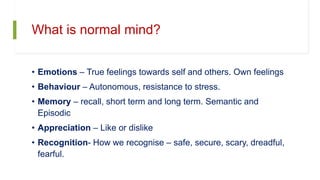
What is normal mind?
• Emotions – True feelings towards self and others. Own feelings
• Behaviour – Autonomous, resistance to stress.
• Memory – recall, short term and long term. Semantic and
Episodic
• Appreciation – Like or dislike
• Recognition- How we recognise – safe, secure, scary, dreadful,
fearful.
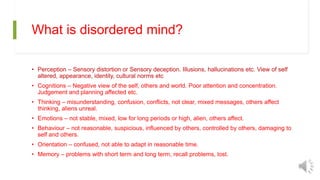
What is disordered mind?
• Perception – Sensory distortion or Sensory deception. Illusions, hallucinations etc. View of self
altered, appearance, identity, cultural norms etc
• Cognitions – Negative view of the self, others and world. Poor attention and concentration.
Judgement and planning affected etc.
• Thinking – misunderstanding, confusion, conflicts, not clear, mixed messages, others affect
thinking, aliens unreal.
• Emotions – not stable, mixed, low for long periods or high, alien, others affect.
• Behaviour – not reasonable, suspicious, influenced by others, controlled by others, damaging to
self and others.
• Orientation – confused, not able to adapt in reasonable time.
• Memory – problems with short term and long term, recall problems, lost.

What is mental disorder

  • 1.
    What is Mental Disorder DrVijay Bhatia Psychiatrist
  • 2.
    What is mental Disorder? Mentaldisorder is the disorder of the mind.
  • 3.
    Definition • It isusually defined as the faculty of an entity’s thoughts and consciousness. • It holds the power of imagination and appreciation, and is responsible for processing feelings and emotions, resulting in attitudes and actions. • Attitudes - relating to others. • Impulses – control, gratification.
  • 4.
    What is mind? Themind is the set of cognitive faculties including Consciousness Imagination Perception Thinking Judgement Language Memory
  • 5.
    What is normalmind? Mind is the collective functions of the Brain. It Includes: • Consciousness – Orientation/attention/concentration – fully aware of the environment in place, person, time etc. Environmental adaptability. • Perceptions – How we perceive and interpret people, events, self and others. Real view of the self, others and the World. Analysing accurately all sensory stimuli (internal and external). • Cognitions – Actualisation, acquiring and recall of knowledge. Attention, concentration, Judgement, Planning, language. etc • Thinking – How strongly we believe what we perceive. Can be ideas or assumptions. About self, future and the World. Own thoughts and not alien thoughts. Self esteem.
  • 6.
    What is normalmind? • Emotions – True feelings towards self and others. Own feelings • Behaviour – Autonomous, resistance to stress. • Memory – recall, short term and long term. Semantic and Episodic • Appreciation – Like or dislike • Recognition- How we recognise – safe, secure, scary, dreadful, fearful.
  • 7.
    What is disorderedmind? • Perception – Sensory distortion or Sensory deception. Illusions, hallucinations etc. View of self altered, appearance, identity, cultural norms etc • Cognitions – Negative view of the self, others and world. Poor attention and concentration. Judgement and planning affected etc. • Thinking – misunderstanding, confusion, conflicts, not clear, mixed messages, others affect thinking, aliens unreal. • Emotions – not stable, mixed, low for long periods or high, alien, others affect. • Behaviour – not reasonable, suspicious, influenced by others, controlled by others, damaging to self and others. • Orientation – confused, not able to adapt in reasonable time. • Memory – problems with short term and long term, recall problems, lost.