1865 – custodian care hospital a subculture of Sindh
1. Sensation and sense organs
2. Perception
Dr. Muhammad Raza Memon
MBBS, DPM, Dip-CBT, MD Psych
Senior Registrar of Psychiatry
Liaquat University of Medical & Health Sciences,
Jamshoro
UNDERSTAND HUMAN BEHAVIOR THROUGH
THE PRINCIPLES OF PSYCHOLOGY
Sensation: Our Gateway to the
World
 Our Sense Organs act as gateways, capturing stimuli
from the environment.
 Five sense organs are specialized structures
responsible for transuding external stimuli into electrical
signals the brain can interpret.
Eyes: convert light into electrical signals for vision.
Ears: convert sound waves into electrical signals for
hearing.
Nose: detects chemicals in the air for smell.
Tongue: detects chemicals in food for taste.
Skin: detects pressure, temperature, pain, and touch.
From Pixels to Meaning: The Visual
Journey
Our eyes receive light waves:
Photoreceptor cells in the retina (rods and cones)
convert light into electrical signals.
 Rods: Sensitive to low light, enable black and white
vision.
 Cones: Sensitive to bright light and color vision.
The brain takes over:
 Visual cortex interprets the signals, creating our
perception of sight.
 This includes depth perception, object
recognition, and motion detection.
The Symphony of Sounds: Hearing
more than just Noise
Sound waves enter the ear:
 Travel through the ear canal and vibrate the eardrum.
 These vibrations are transmitted to tiny hair cells in
the cochlea, generating electrical signals.
The brain conducts the orchestra:
 Auditory cortex interprets the signals, allowing us to
hear and understand sounds.
 This includes recognizing pitch, rhythm, and even the
speaker's voice.
The Touchy Subject: Feeling beyond
Skin Deep
Touch receptors all over:
 Located in skin, muscles, and joints, detecting
pressure, temperature, and texture.
More than just physical:
 Touch conveys emotions, comfort, and social
connection.
 It plays a crucial role in early development and
social bonding.
The Lens of Perception
 Perception: The process of organizing and interpreting
sensory information to create meaningful experiences.
 More than just sensation: Perception involves
selection, attention, and interpretation of sensory
information, influenced by past experiences,
expectations, and emotions.
 Examples:
 Seeing a friend in a crowded room – your brain filters out
other stimuli to focus on their specific features.
 Feeling the warmth of the sun – your brain interprets the
skin sensation as pleasant warmth.
 Tasting a dish – your brain integrates taste, smell, and
texture to create a unique flavor experience.
Five Major Functions of the Perceptual
System
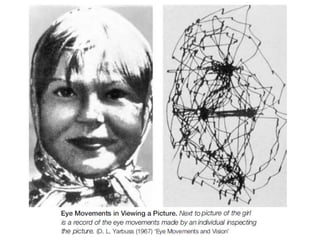
1. Attention: Determining which part of the sensory
environment to pay attention to
2. Localization: Localizing where objects are
3. Recognition: Identifying what objects are
4. Abstraction: Extracting the critical information
from objects
5. Constancy: Maintaining the appearance of
objects constant. (even though their retinal images
are changing)
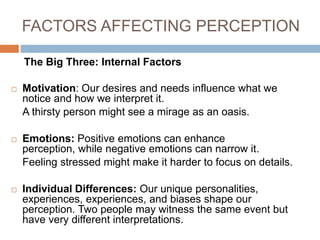
FACTORS AFFECTING PERCEPTION
The Big Three: Internal Factors
 Motivation: Our desires and needs influence what we
notice and how we interpret it.
A thirsty person might see a mirage as an oasis.
 Emotions: Positive emotions can enhance
perception, while negative emotions can narrow it.
Feeling stressed might make it harder to focus on details.
 Individual Differences: Our unique personalities,
experiences, experiences, and biases shape our
perception. Two people may witness the same event but
have very different interpretations.
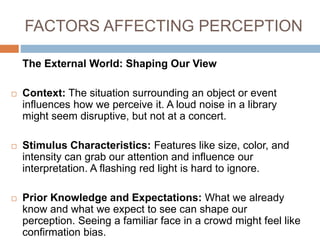
FACTORS AFFECTING PERCEPTION
The External World: Shaping Our View
 Context: The situation surrounding an object or event
influences how we perceive it. A loud noise in a library
might seem disruptive, but not at a concert.
 Stimulus Characteristics: Features like size, color, and
intensity can grab our attention and influence our
interpretation. A flashing red light is hard to ignore.
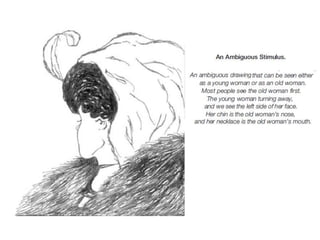
 Prior Knowledge and Expectations: What we already
know and what we expect to see can shape our
perception. Seeing a familiar face in a crowd might feel like
confirmation bias.
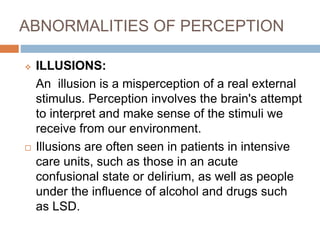
ABNORMALITIES OF PERCEPTION
 ILLUSIONS:
An illusion is a misperception of a real external
stimulus. Perception involves the brain's attempt
to interpret and make sense of the stimuli we
receive from our environment.
 Illusions are often seen in patients in intensive
care units, such as those in an acute
confusional state or delirium, as well as people
under the influence of alcohol and drugs such
as LSD.
ABNORMALITIES OF PERCEPTION
 HALLUCINATIONS:
Hallucinations are perceptions without any
external stimulus. They can involve any of the
five senses, but the most common are auditory
and visual.
 They are most commonly seen in patients with
serious mental illnesses, such as schizophrenia.
The most common cause of visual
hallucinations is delirium tremens.
EXTRASENSORY PERCEPTION (ESP)
 The occurrence of experiences or behaviours in the
absence of an adequate stimulus.
 Considered to be paranormal or beyond our normal
sensory abilities and are studied in parapsychology.
ESP includes the phenomena of:
 Clairvoyance: The ability to perceive events or gain
information in ways that appear unaffected by distance
or normal physical barriers.
 Telepathy: Extrasensory perception of another
person’s thoughts or in other words the ability to read
someone’s mind.
EXTRASENSORY PERCEPTION (ESP)
 Precognition: The ability to perceive or accurately predict
future events. Thus prophecies and prophetic dreams
about the future are included in precognitions.
 Telekinesis: This phenomenon studied by
parapsychologists is basically the ability to move objects
at a distance by mental power or other non-physical
means
To date there is little scientific evidence to prove the
existence of extrasensory perceptions
For Contact:
email: muhammad.raza@lumhs.edu.pk

Sensation & Perception PPT 2024 .pptx

  • 1.
    1865 – custodiancare hospital a subculture of Sindh
  • 2.
    1. Sensation andsense organs 2. Perception Dr. Muhammad Raza Memon MBBS, DPM, Dip-CBT, MD Psych Senior Registrar of Psychiatry Liaquat University of Medical & Health Sciences, Jamshoro UNDERSTAND HUMAN BEHAVIOR THROUGH THE PRINCIPLES OF PSYCHOLOGY
  • 3.
    Sensation: Our Gatewayto the World  Our Sense Organs act as gateways, capturing stimuli from the environment.  Five sense organs are specialized structures responsible for transuding external stimuli into electrical signals the brain can interpret. Eyes: convert light into electrical signals for vision. Ears: convert sound waves into electrical signals for hearing. Nose: detects chemicals in the air for smell. Tongue: detects chemicals in food for taste. Skin: detects pressure, temperature, pain, and touch.
  • 4.
    From Pixels toMeaning: The Visual Journey Our eyes receive light waves: Photoreceptor cells in the retina (rods and cones) convert light into electrical signals.  Rods: Sensitive to low light, enable black and white vision.  Cones: Sensitive to bright light and color vision. The brain takes over:  Visual cortex interprets the signals, creating our perception of sight.  This includes depth perception, object recognition, and motion detection.
  • 5.
    The Symphony ofSounds: Hearing more than just Noise Sound waves enter the ear:  Travel through the ear canal and vibrate the eardrum.  These vibrations are transmitted to tiny hair cells in the cochlea, generating electrical signals. The brain conducts the orchestra:  Auditory cortex interprets the signals, allowing us to hear and understand sounds.  This includes recognizing pitch, rhythm, and even the speaker's voice.
  • 6.
    The Touchy Subject:Feeling beyond Skin Deep Touch receptors all over:  Located in skin, muscles, and joints, detecting pressure, temperature, and texture. More than just physical:  Touch conveys emotions, comfort, and social connection.  It plays a crucial role in early development and social bonding.
  • 8.
    The Lens ofPerception  Perception: The process of organizing and interpreting sensory information to create meaningful experiences.  More than just sensation: Perception involves selection, attention, and interpretation of sensory information, influenced by past experiences, expectations, and emotions.  Examples:  Seeing a friend in a crowded room – your brain filters out other stimuli to focus on their specific features.  Feeling the warmth of the sun – your brain interprets the skin sensation as pleasant warmth.  Tasting a dish – your brain integrates taste, smell, and texture to create a unique flavor experience.
  • 9.
    Five Major Functionsof the Perceptual System 1. Attention: Determining which part of the sensory environment to pay attention to 2. Localization: Localizing where objects are 3. Recognition: Identifying what objects are 4. Abstraction: Extracting the critical information from objects 5. Constancy: Maintaining the appearance of objects constant. (even though their retinal images are changing)
  • 12.
    FACTORS AFFECTING PERCEPTION TheBig Three: Internal Factors  Motivation: Our desires and needs influence what we notice and how we interpret it. A thirsty person might see a mirage as an oasis.  Emotions: Positive emotions can enhance perception, while negative emotions can narrow it. Feeling stressed might make it harder to focus on details.  Individual Differences: Our unique personalities, experiences, experiences, and biases shape our perception. Two people may witness the same event but have very different interpretations.
  • 13.
    FACTORS AFFECTING PERCEPTION TheExternal World: Shaping Our View  Context: The situation surrounding an object or event influences how we perceive it. A loud noise in a library might seem disruptive, but not at a concert.  Stimulus Characteristics: Features like size, color, and intensity can grab our attention and influence our interpretation. A flashing red light is hard to ignore.  Prior Knowledge and Expectations: What we already know and what we expect to see can shape our perception. Seeing a familiar face in a crowd might feel like confirmation bias.
  • 15.
    ABNORMALITIES OF PERCEPTION ILLUSIONS: An illusion is a misperception of a real external stimulus. Perception involves the brain's attempt to interpret and make sense of the stimuli we receive from our environment.  Illusions are often seen in patients in intensive care units, such as those in an acute confusional state or delirium, as well as people under the influence of alcohol and drugs such as LSD.
  • 17.
    ABNORMALITIES OF PERCEPTION HALLUCINATIONS: Hallucinations are perceptions without any external stimulus. They can involve any of the five senses, but the most common are auditory and visual.  They are most commonly seen in patients with serious mental illnesses, such as schizophrenia. The most common cause of visual hallucinations is delirium tremens.
  • 18.
    EXTRASENSORY PERCEPTION (ESP) The occurrence of experiences or behaviours in the absence of an adequate stimulus.  Considered to be paranormal or beyond our normal sensory abilities and are studied in parapsychology. ESP includes the phenomena of:  Clairvoyance: The ability to perceive events or gain information in ways that appear unaffected by distance or normal physical barriers.  Telepathy: Extrasensory perception of another person’s thoughts or in other words the ability to read someone’s mind.
  • 19.
    EXTRASENSORY PERCEPTION (ESP) Precognition: The ability to perceive or accurately predict future events. Thus prophecies and prophetic dreams about the future are included in precognitions.  Telekinesis: This phenomenon studied by parapsychologists is basically the ability to move objects at a distance by mental power or other non-physical means To date there is little scientific evidence to prove the existence of extrasensory perceptions
  • 20.

Editor's Notes

  • #10 Attention: This is the ability to focus on specific parts of our sensory environment, blocking out distractions. For example, if you're looking for a friend in a crowded room, you'll focus your attention on faces, scanning until you find your friend's. Localization: This is our ability to determine where objects are in space relative to ourselves and other objects. This ability helps us to avoid bumping into things and to reach for objects we need. Recognition: This is our ability to identify objects and categorize them. For example, you can recognize a coffee cup as a coffee cup, even if you've never seen that particular cup before. Abstraction: This is our ability to extract the important features of objects from the sensory data we receive. For example, you can recognize a chair as a chair, even if it's upside down or in the dark. Constancy: This is our ability to perceive objects as having stable properties, even when the sensory information we receive about them is changing. For example, you can still recognize a person as the same person, even if they turn their head or walk away from you.