Making transitions  from academic literacy to  professional literacy:  the nexus of the practical and the theoretical.
PEPE INC 2008 Jan Millwater ( Dr.)  President, PEPE INC . Journal Editor. Faculty of Education Queensland University of Technology KELVIN GROVE  Q  4059 Brisbane ( temperature 29 degrees C) Australia.
Transitions Learning  and Employability   I wish to acknowledge the work contributed by the QUT team- Professor Peter Taylor-ED,  Dr Robyn Nash- Health,  Deidre Seeto - MD,  Melinda Service- Health,  Christy Collis &, Shaaron Boughen - Creative Industries.
Key words   Transitions tertiary literacy  graduate attributes graduate capabilities employability skills transferable skills  lifelong learning.  professional literacy
Methodology literature search into government and university reports on university/employers needs with regard to employability interviews with staff (especially course leaders and coordinators)  students in focus groups an analysis of reports from final year students in capstone units (Internships and the Education Faculty  Stepping Out Conference) case studies of exemplary teaching and learning events and strategies our own stories/experiences.
Conceptual framework Department of Education Science and Training, 2006 ;  Business Industry and Higher Education Collaboration Council, 2007; Watts, 2006;  Yorke & Knight, 2006;  Washer, 2007;  Association of Graduate Careers Advisory Services, 2005.
Transitions Learning students’ sense of themselves, as individuals and as learners  the sense-of-self that students are challenged to re-construct in order to achieve transition Commitment to change
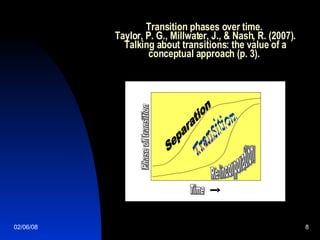
Transition phases over time.  Taylor, P. G., Millwater, J., & Nash, R. (2007). Talking about transitions: the value of a conceptual approach (p. 3).
Employabilty  assumes the ability to effectively apply knowledge and a range of skills which workers need to enter and continue to use effectively within work environments.  is contained within graduate attributes of the individual  should not be confused with simply getting employment
Graduate Attributes the qualities, skills and understandings a university community agrees its students would desirably develop during their time at the institutions (Bowden, Hart, King, Trigwell, & Watts, 2000)  shape the contribution they are able to make to their profession and as well as a citizen…
Graduate capabilities  equivalent to employability skills and are generic across the university generic to a whole range of life and work contexts
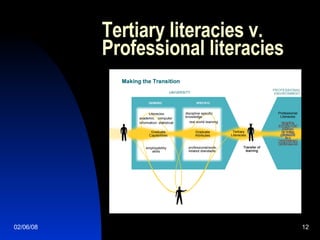
Tertiary literacies v. Professional literacies
Professional Literacy As work-ready preservice professionals make the transition out of university they look forward to being further professionally developed within a new environment by their employers PL cannot be attained until a job is  attained – extension of levels of attributes Context variables shape new learning
Articulation of GA into PL. In using a Learning Continuum concept an appreciation of the particular principles listed below generate the deep learning ability which forms integrated knowledge and understanding and attitudes Acquisition Application Personalisation Actualisation
Institution embeddednesss In particular, the four recommendations of the project, with reference to course curriculum  design ,are these: All courses draw on a shared QUT-wide understanding of and language for transitions All courses systematically scaffold students’ understanding, confidence, and self-management of their transitions into new professional environments thorugh enlightened and engaging teaching and learning processes All courses systematically scaffold the development of students’ employability All three above be embedded in the core curriculum and must be monitored and evaluated through a university wide assessment scheme..
Thank you  Please email me on  j.millwater@qut.edu.au  For paper (incl. references.)

pepe421

  • 1.
    Making transitions from academic literacy to professional literacy: the nexus of the practical and the theoretical.
  • 2.
    PEPE INC 2008Jan Millwater ( Dr.) President, PEPE INC . Journal Editor. Faculty of Education Queensland University of Technology KELVIN GROVE  Q  4059 Brisbane ( temperature 29 degrees C) Australia.
  • 3.
    Transitions Learning and Employability I wish to acknowledge the work contributed by the QUT team- Professor Peter Taylor-ED, Dr Robyn Nash- Health, Deidre Seeto - MD, Melinda Service- Health, Christy Collis &, Shaaron Boughen - Creative Industries.
  • 4.
    Key words Transitions tertiary literacy graduate attributes graduate capabilities employability skills transferable skills lifelong learning. professional literacy
  • 5.
    Methodology literature searchinto government and university reports on university/employers needs with regard to employability interviews with staff (especially course leaders and coordinators) students in focus groups an analysis of reports from final year students in capstone units (Internships and the Education Faculty Stepping Out Conference) case studies of exemplary teaching and learning events and strategies our own stories/experiences.
  • 6.
    Conceptual framework Departmentof Education Science and Training, 2006 ; Business Industry and Higher Education Collaboration Council, 2007; Watts, 2006; Yorke & Knight, 2006; Washer, 2007; Association of Graduate Careers Advisory Services, 2005.
  • 7.
    Transitions Learning students’sense of themselves, as individuals and as learners the sense-of-self that students are challenged to re-construct in order to achieve transition Commitment to change
  • 8.
    Transition phases overtime. Taylor, P. G., Millwater, J., & Nash, R. (2007). Talking about transitions: the value of a conceptual approach (p. 3).
  • 9.
    Employabilty assumesthe ability to effectively apply knowledge and a range of skills which workers need to enter and continue to use effectively within work environments. is contained within graduate attributes of the individual should not be confused with simply getting employment
  • 10.
    Graduate Attributes thequalities, skills and understandings a university community agrees its students would desirably develop during their time at the institutions (Bowden, Hart, King, Trigwell, & Watts, 2000) shape the contribution they are able to make to their profession and as well as a citizen…
  • 11.
    Graduate capabilities equivalent to employability skills and are generic across the university generic to a whole range of life and work contexts
  • 12.
    Tertiary literacies v.Professional literacies
  • 13.
    Professional Literacy Aswork-ready preservice professionals make the transition out of university they look forward to being further professionally developed within a new environment by their employers PL cannot be attained until a job is attained – extension of levels of attributes Context variables shape new learning
  • 14.
    Articulation of GAinto PL. In using a Learning Continuum concept an appreciation of the particular principles listed below generate the deep learning ability which forms integrated knowledge and understanding and attitudes Acquisition Application Personalisation Actualisation
  • 15.
    Institution embeddednesss Inparticular, the four recommendations of the project, with reference to course curriculum design ,are these: All courses draw on a shared QUT-wide understanding of and language for transitions All courses systematically scaffold students’ understanding, confidence, and self-management of their transitions into new professional environments thorugh enlightened and engaging teaching and learning processes All courses systematically scaffold the development of students’ employability All three above be embedded in the core curriculum and must be monitored and evaluated through a university wide assessment scheme..
  • 16.
    Thank you Please email me on j.millwater@qut.edu.au For paper (incl. references.)