Developing the professional curriculum: looking
both ways with practice knowledge and theory
Dr. Richard Pountney
1
Social Realism Symposium
2nd July 2015
Outline
1. Review the curricular and pedagogic development of
professional courses and the importance of the
professional context
2. Identify issues associated with the role, effects and
implications of work-related learning in education
3. Examine the formation of specialist knowledge and
expertise and a reflection on the ‘know-how’ and
‘know-what’ in professional contexts
4. Reflect on the need for knowledge building in
professional /vocational fields and how to investigate
it
2
The sociology of professional
knowledge
• ‘The construction of the inner was a guarantee of
the construction of the outer. In this we find the
origin of the professions’ (Bernstein, 2000: 85)
• Professional knowledge is both ‘theoretical’
(general and unvarying) and practical (purposive
and contextual)
• About doing things but doing things in complex
ways that cannot rely on experience alone (Young
and Muller, 2014)
• Professional practice is always in a context, with a
purpose and relates to specific occupations
3
Regions, singulars and fields of practice
• Singulars: which represent knowledge relations (or
structures) oriented to inwardness – the rules,
methods and boundaries that define a discipline (e.g.
Sociology or physiology)
• Regions: which combine disciplines, selecting, pacing
and sequencing knowledge in relation to specific
purposes (e.g. Knowledge of muscles in physiotherapy)
• Fields of Practice: the specialised practical contexts in
which professionals practice – exercise knowledgeable
and reasoned judgements as professionals, by drawing
on, often tacitly, their acquired stock of specialised
professional knowledge
4
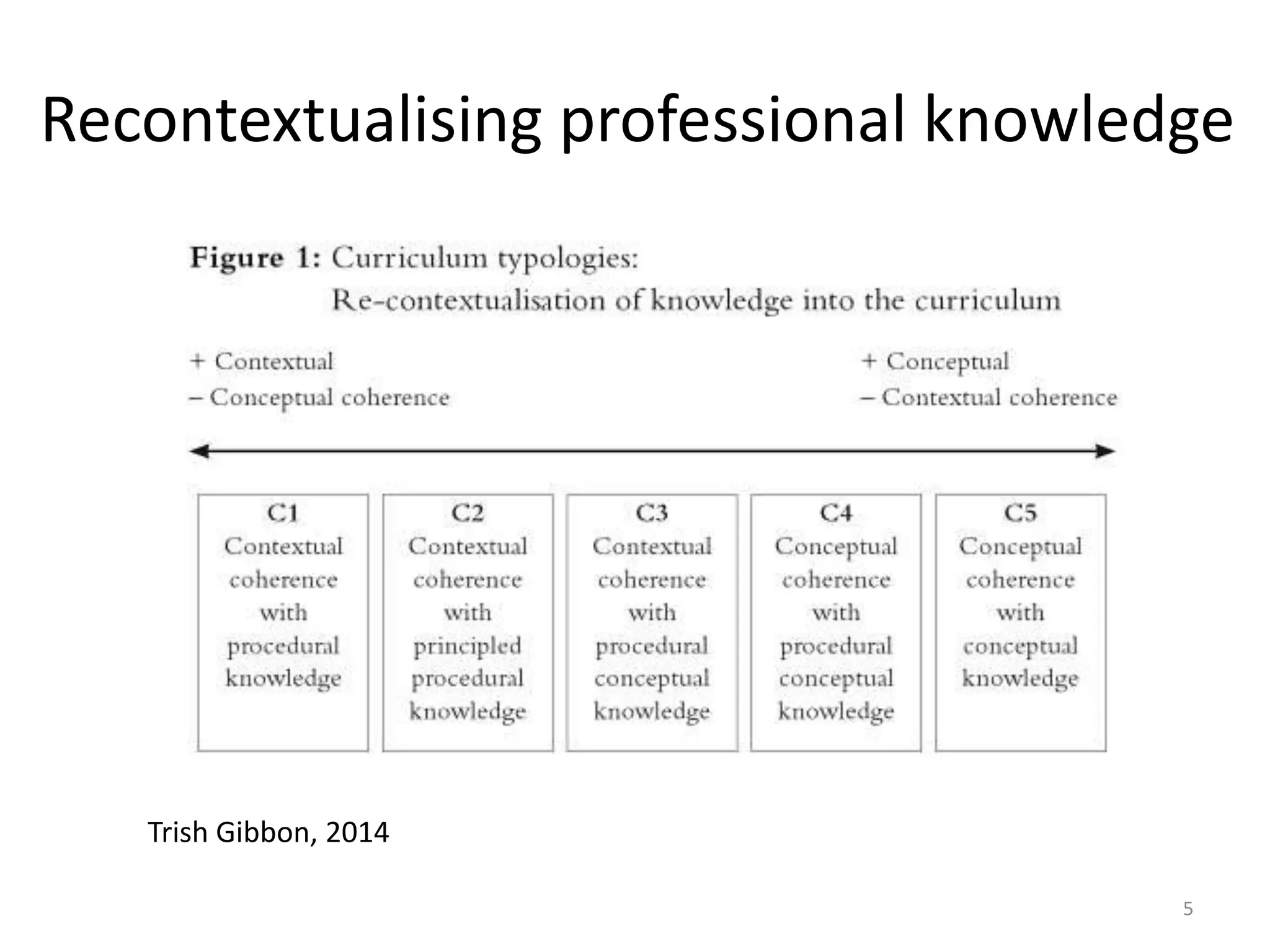
Recontextualising professional knowledge
5
Trish Gibbon, 2014
Reproduction of (professional)
knowledge in the curriculum
Higher education providers [should] have in place
effective processes to approve and periodically
review the validity and relevance of programmes
(QAA, 2011)
Why is it assumed that when we are ‘given’ a course
to teach that we know how to write a course
outline? Where is it that we ‘learn’ how to do this
important piece of pedagogy? What underpins
this process? (Millen, 1997: 11)
6
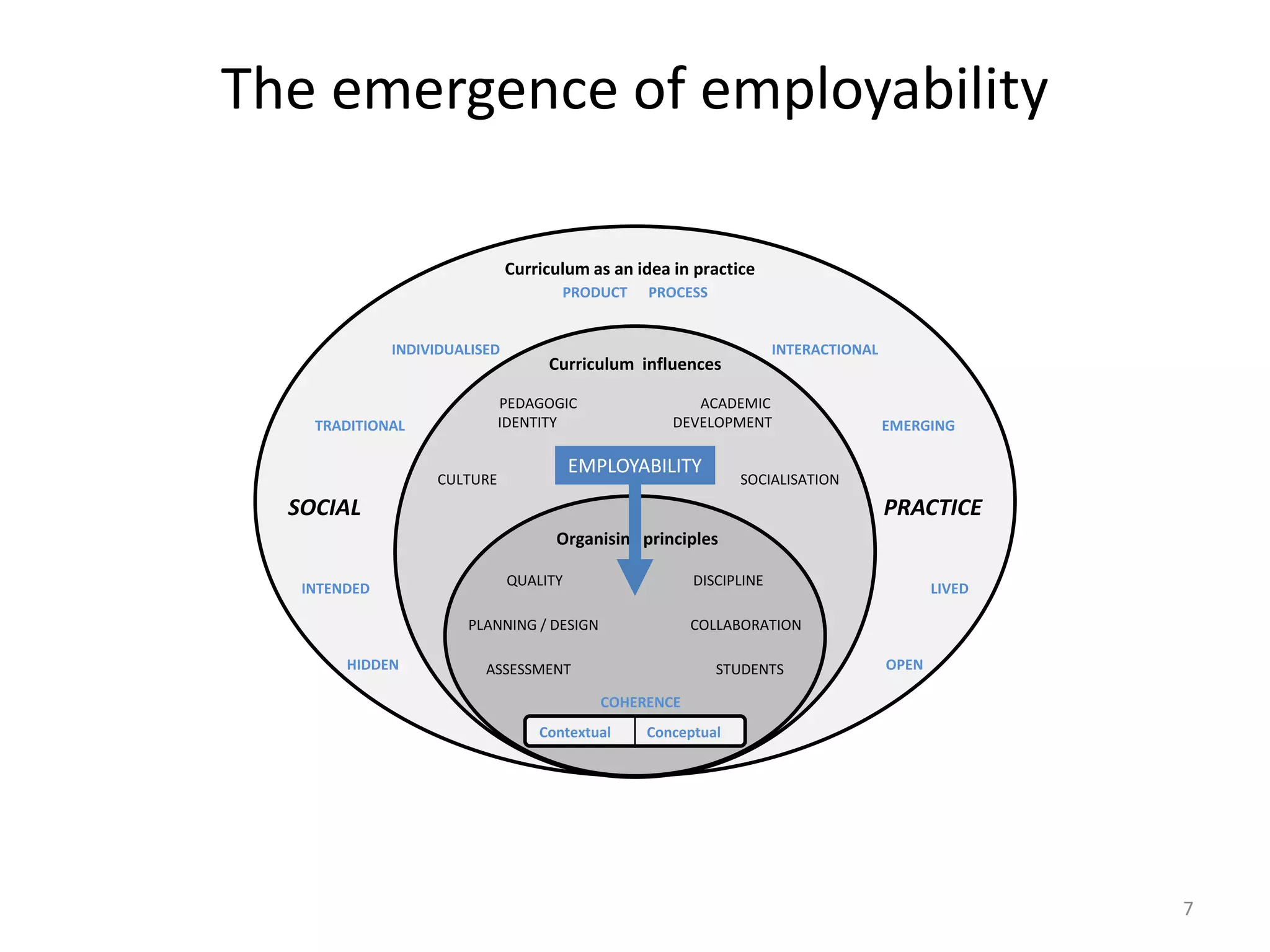
PRODUCT PROCESS
INDIVIDUALISED INTERACTIONAL
TRADITIONAL EMERGING
SOCIAL PRACTICE
INTENDED LIVED
HIDDEN OPEN
Curriculum as an idea in practice
Curriculum influences
Organising principles
PEDAGOGIC ACADEMIC
IDENTITY DEVELOPMENT
CULTURE SOCIALISATION
QUALITY DISCIPLINE
PLANNING / DESIGN COLLABORATION
ASSESSMENT STUDENTS
EMPLOYABILITY
The emergence of employability
Contextual Conceptual
COHERENCE
7
Employability and its effects in the
curriculum
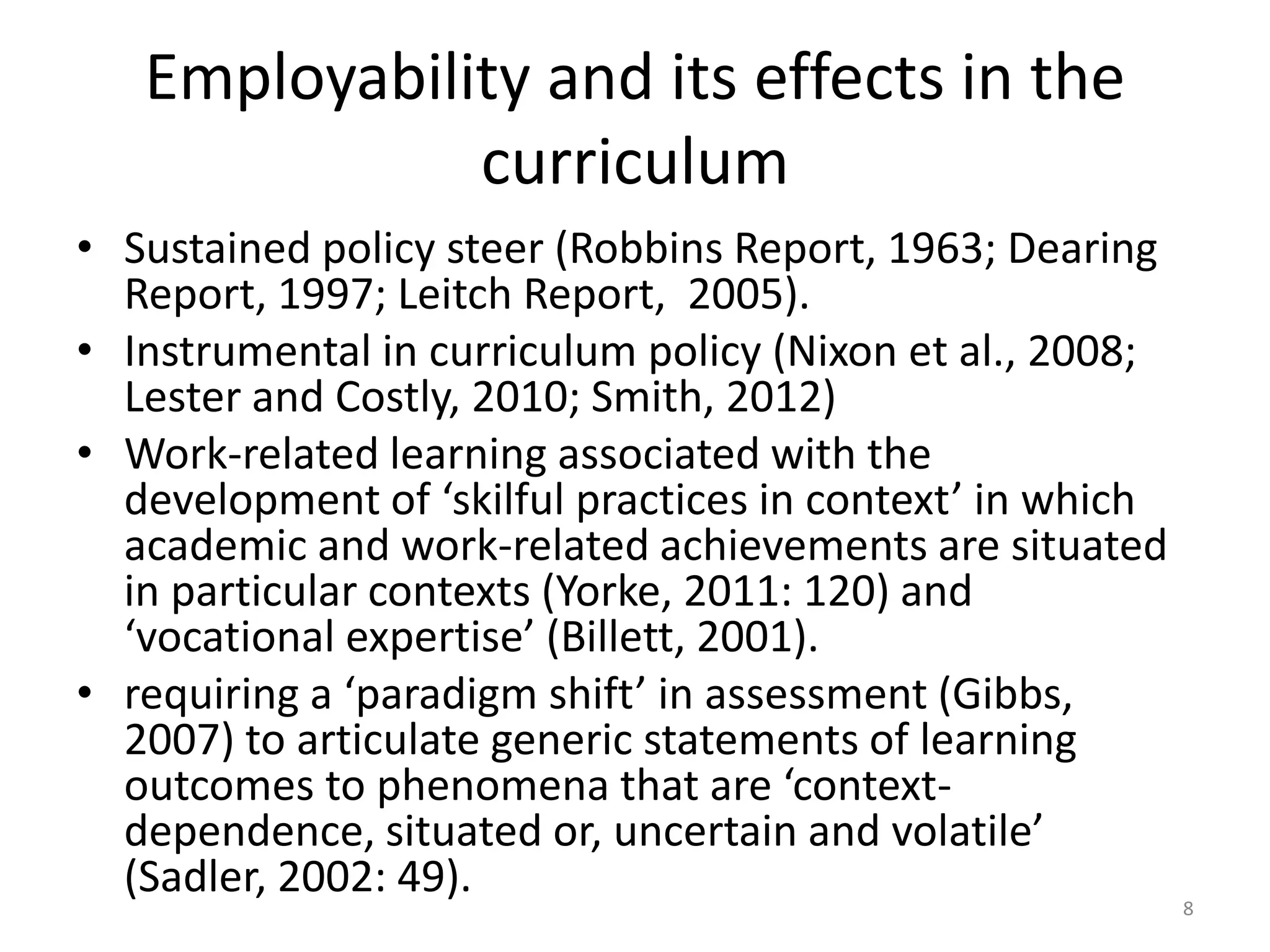
• Sustained policy steer (Robbins Report, 1963; Dearing
Report, 1997; Leitch Report, 2005).
• Instrumental in curriculum policy (Nixon et al., 2008;
Lester and Costly, 2010; Smith, 2012)
• Work-related learning associated with the
development of ‘skilful practices in context’ in which
academic and work-related achievements are situated
in particular contexts (Yorke, 2011: 120) and
‘vocational expertise’ (Billett, 2001).
• requiring a ‘paradigm shift’ in assessment (Gibbs,
2007) to articulate generic statements of learning
outcomes to phenomena that are ‘context-
dependence, situated or, uncertain and volatile’
(Sadler, 2002: 49).
8
Employability knowledge in the
curriculum
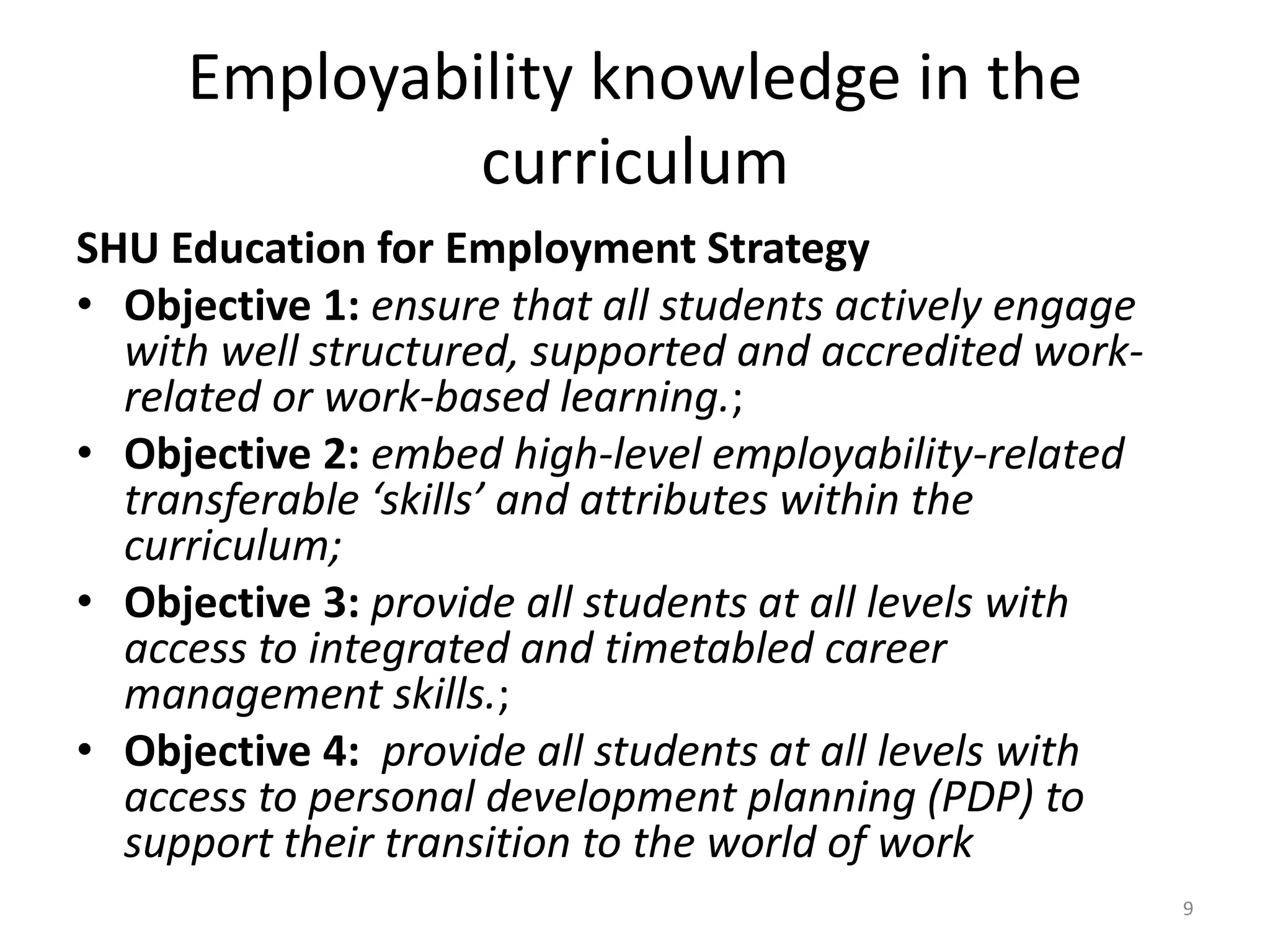
SHU Education for Employment Strategy
• Objective 1: ensure that all students actively engage
with well structured, supported and accredited work-
related or work-based learning.;
• Objective 2: embed high-level employability-related
transferable ‘skills’ and attributes within the
curriculum;
• Objective 3: provide all students at all levels with
access to integrated and timetabled career
management skills.;
• Objective 4: provide all students at all levels with
access to personal development planning (PDP) to
support their transition to the world of work
9
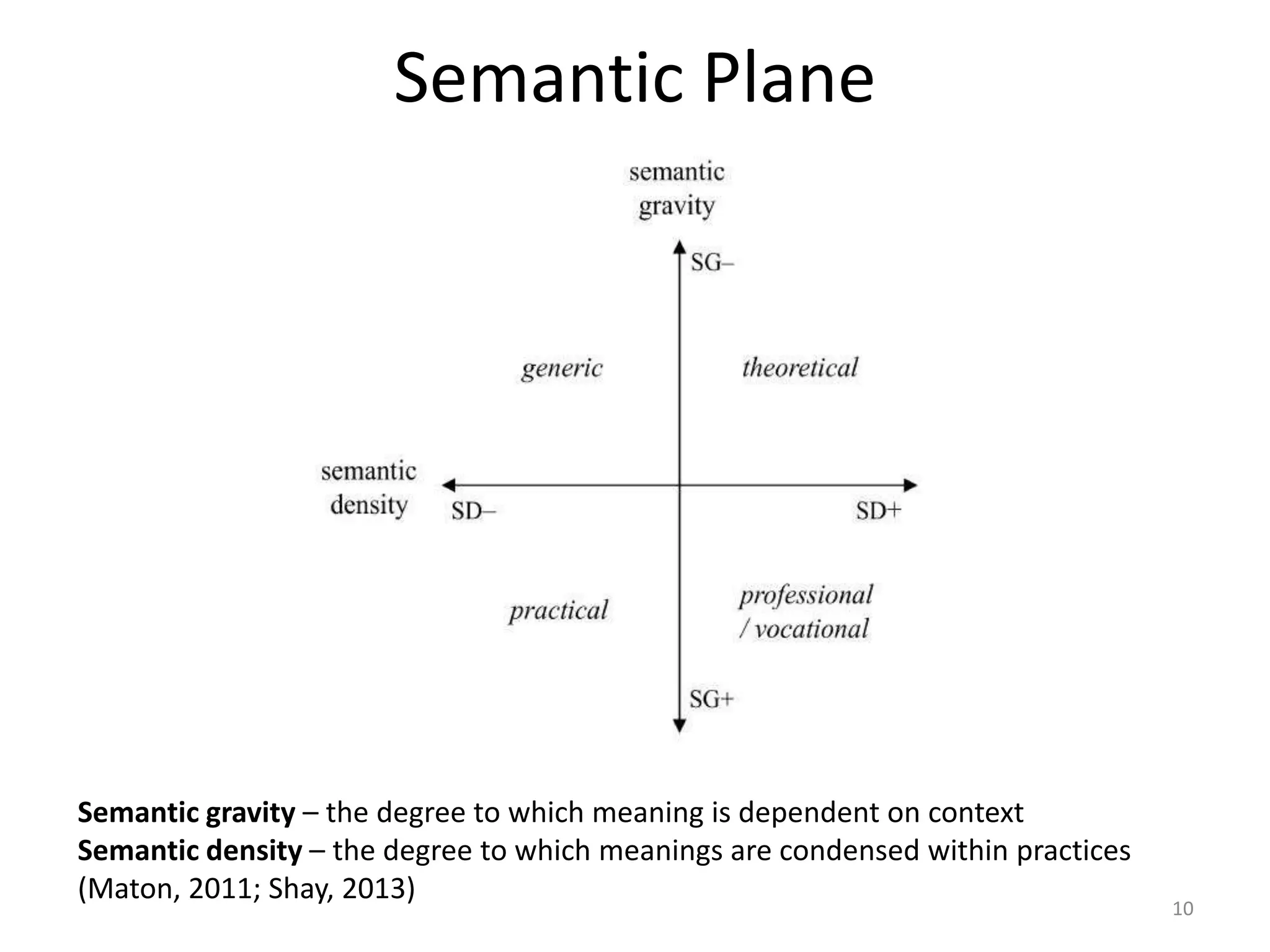
Semantic Plane
Semantic gravity – the degree to which meaning is dependent on context
Semantic density – the degree to which meanings are condensed within practices
(Maton, 2011; Shay, 2013)
10
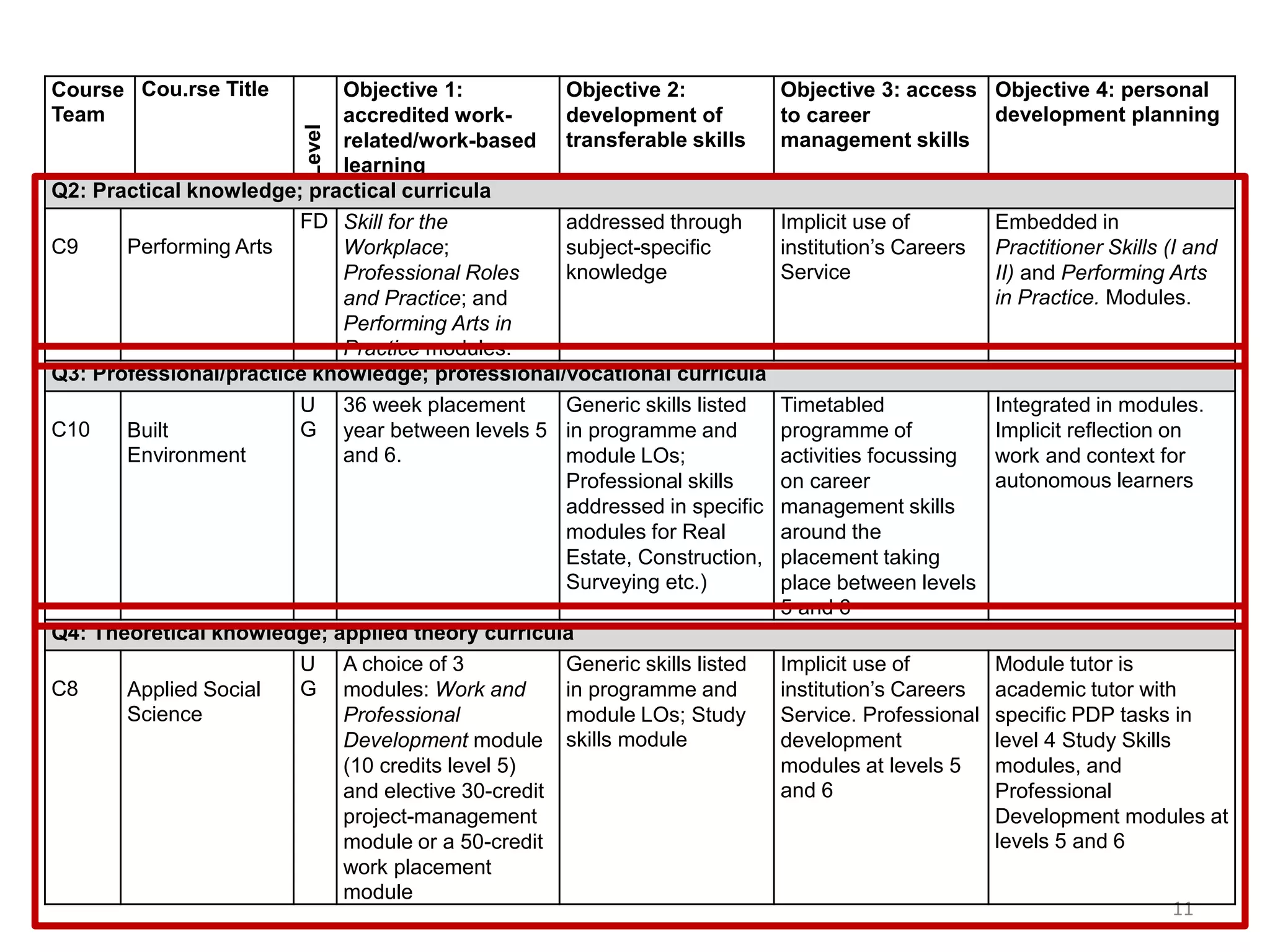
11
Course
Team
Cou.rse Title
Level
Objective 1:
accredited work-
related/work-based
learning
Objective 2:
development of
transferable skills
Objective 3: access
to career
management skills
Objective 4: personal
development planning
Q2: Practical knowledge; practical curricula
C9 Performing Arts
FD Skill for the
Workplace;
Professional Roles
and Practice; and
Performing Arts in
Practice modules.
addressed through
subject-specific
knowledge
Implicit use of
institution’s Careers
Service
Embedded in
Practitioner Skills (I and
II) and Performing Arts
in Practice. Modules.
Q3: Professional/practice knowledge; professional/vocational curricula
C10 Built
Environment
U
G
36 week placement
year between levels 5
and 6.
Generic skills listed
in programme and
module LOs;
Professional skills
addressed in specific
modules for Real
Estate, Construction,
Surveying etc.)
Timetabled
programme of
activities focussing
on career
management skills
around the
placement taking
place between levels
5 and 6
Integrated in modules.
Implicit reflection on
work and context for
autonomous learners
Q4: Theoretical knowledge; applied theory curricula
C8 Applied Social
Science
U
G
A choice of 3
modules: Work and
Professional
Development module
(10 credits level 5)
and elective 30-credit
project-management
module or a 50-credit
work placement
module
Generic skills listed
in programme and
module LOs; Study
skills module
Implicit use of
institution’s Careers
Service. Professional
development
modules at levels 5
and 6
Module tutor is
academic tutor with
specific PDP tasks in
level 4 Study Skills
modules, and
Professional
Development modules at
levels 5 and 6
12[1] The professional Practice and Placement module was mandatory for Housing students and elective for the other awards in CPT2
Module Course Assessment
Tasks
Learning Outcomes Assessment Criteria
Preparing for the
world of Work
(10 credits)
Elective
Criminology
Level 5
Reflection
(2000 words)
Identify employability skills and
practices
Ability to recognise relevant skills
and practices necessary to enhance
employability
Explain the transferability of skills
across a range of different work
environments
Ability to consider different ways that
key skills and practices can be
utilised across a range of settings
Reflect upon their own learning
processes within a work related
setting
An evaluation of their learning and
reflective practice
Professional
Practice and
Placement
(20 credits)
Mandatory / elective
Geography,
Environment
Planning and
Housing
Level 5
Performance
Appraisal
(25%, 1000
words);
Reflective
Report (75%,
3000 words)
Identify complex problems in real-
life situations, and select and
apply appropriate techniques and
behaviours to solve these
problems.
Appropriateness of approaches,
practice, techniques and behaviour
employed in various workplace
situations
Identify objectives and personal
responsibilities when working with
others, and collaborate effectively
in teams.
Self management skills applied in a
professional teamwork context.
Reflect on and analyse the values
and ethics relating to professional
practice in the relevant sector.
Knowledge and understanding of
'values and ethics' and analysis of
their role and impact in professional
practice.
Reflect on and evaluate their own
performance, and plan actions
relating to their own continuing
professional development needs.
Evidence of reflective practice skills,
(including reflection, analysis, insight,
planning)
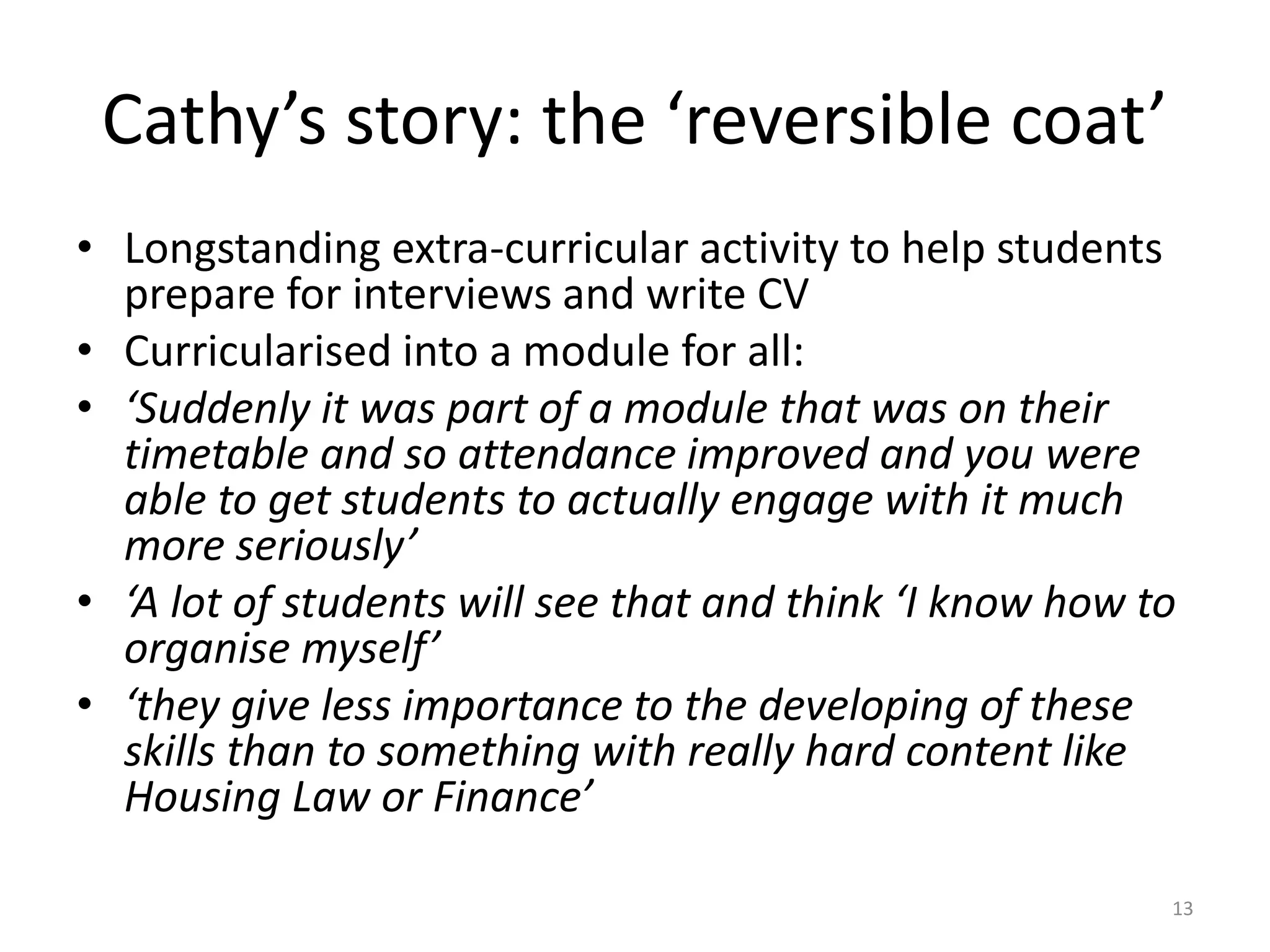
Cathy’s story: the ‘reversible coat’
• Longstanding extra-curricular activity to help students
prepare for interviews and write CV
• Curricularised into a module for all:
• ‘Suddenly it was part of a module that was on their
timetable and so attendance improved and you were
able to get students to actually engage with it much
more seriously’
• ‘A lot of students will see that and think ‘I know how to
organise myself’
• ‘they give less importance to the developing of these
skills than to something with really hard content like
Housing Law or Finance’
13
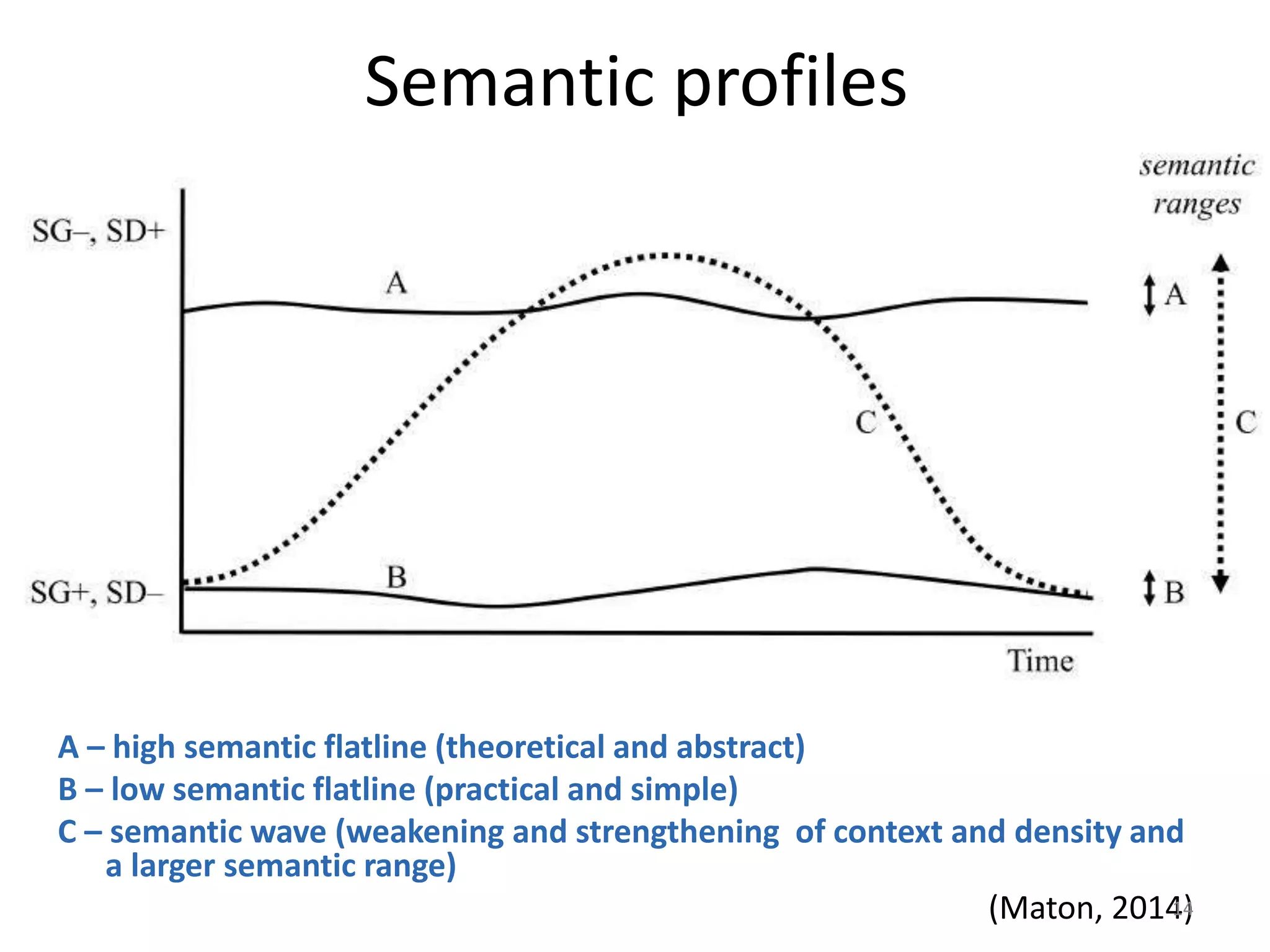
Semantic profiles
A – high semantic flatline (theoretical and abstract)
B – low semantic flatline (practical and simple)
C – semantic wave (weakening and strengthening of context and density and
a larger semantic range)
(Maton, 2014)14
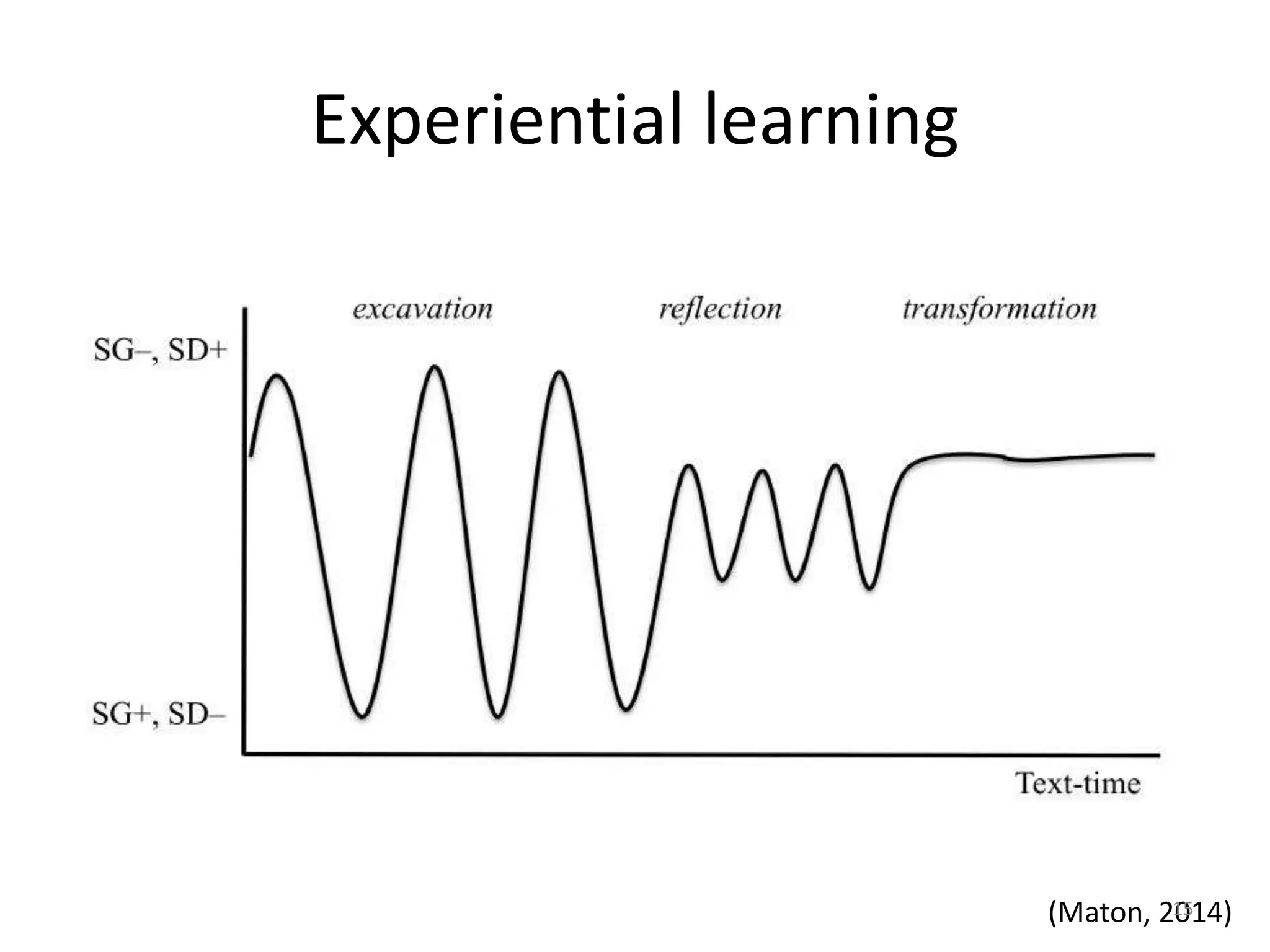
Experiential learning
(Maton, 2014)15
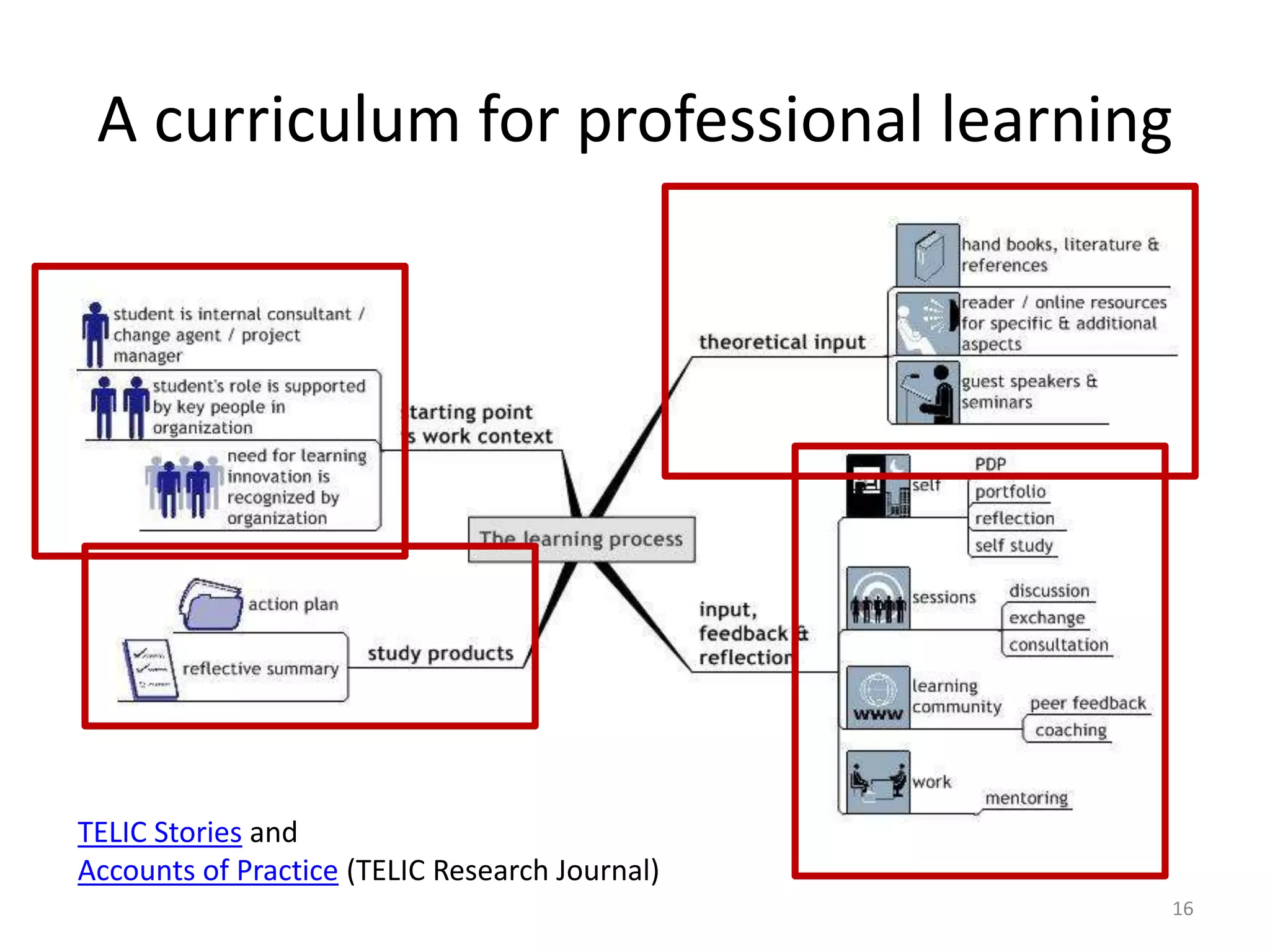
A curriculum for professional learning
16
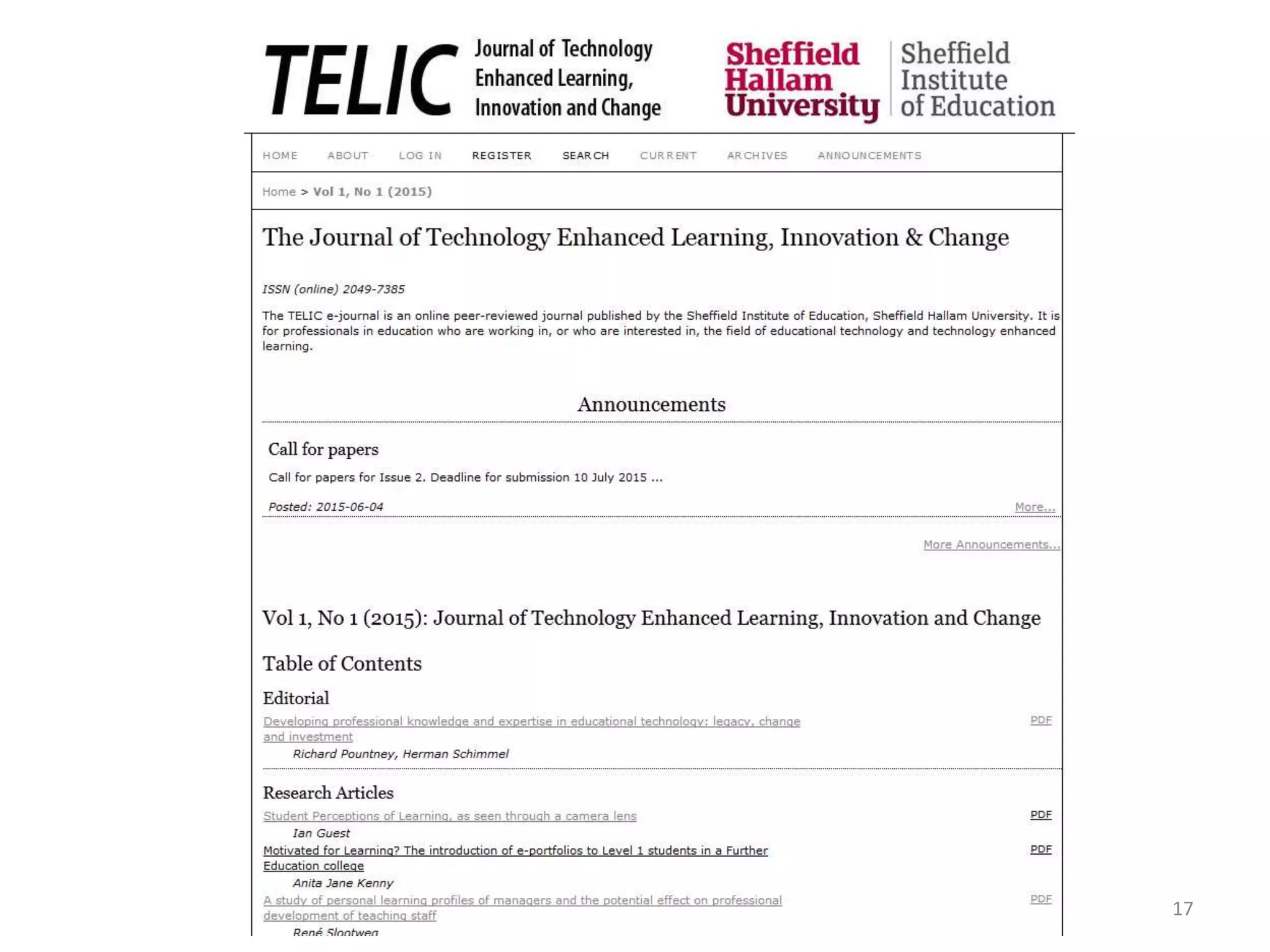
TELIC Stories and
Accounts of Practice (TELIC Research Journal)
17
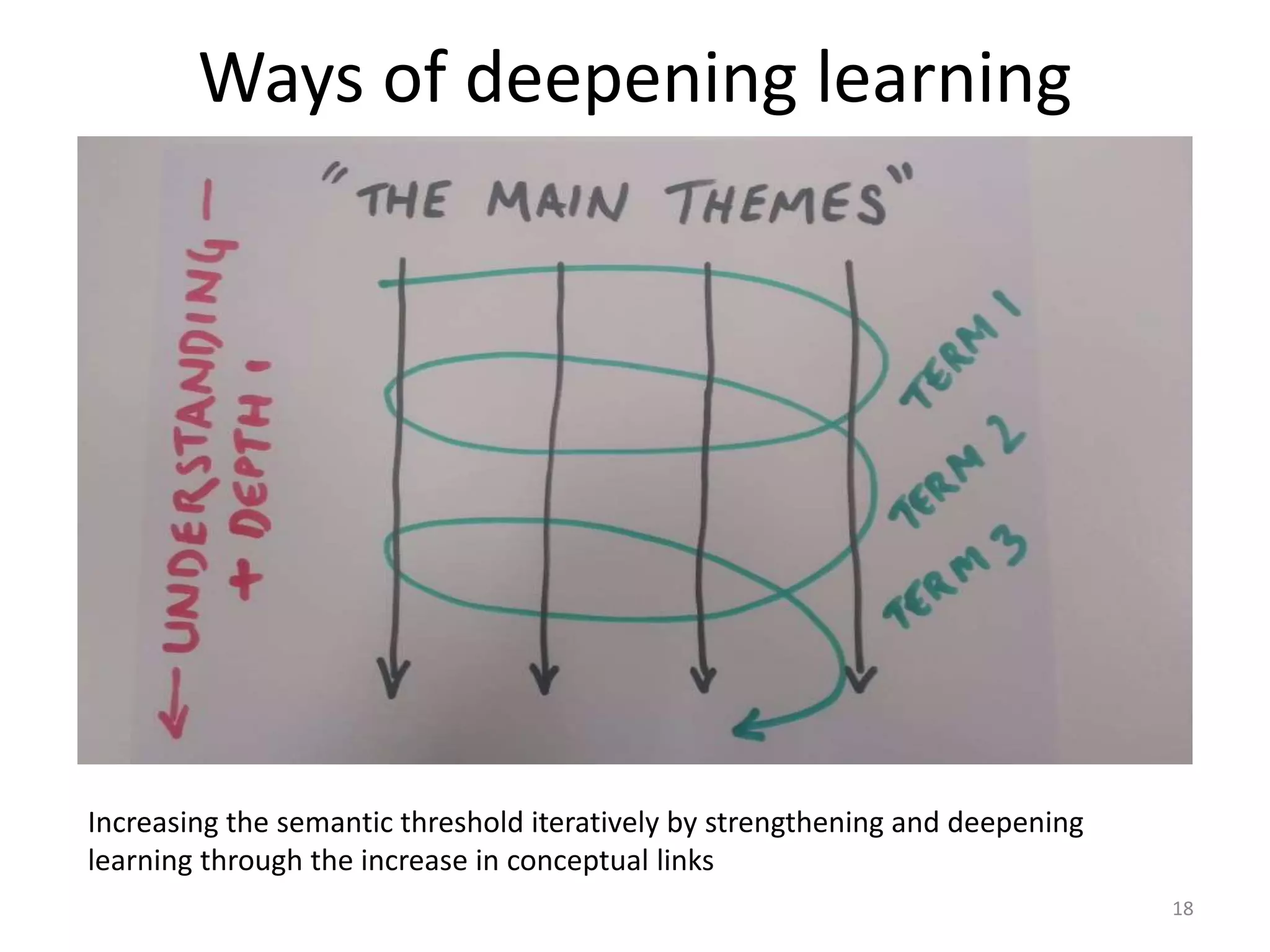
Ways of deepening learning
Increasing the semantic threshold iteratively by strengthening and deepening
learning through the increase in conceptual links
18
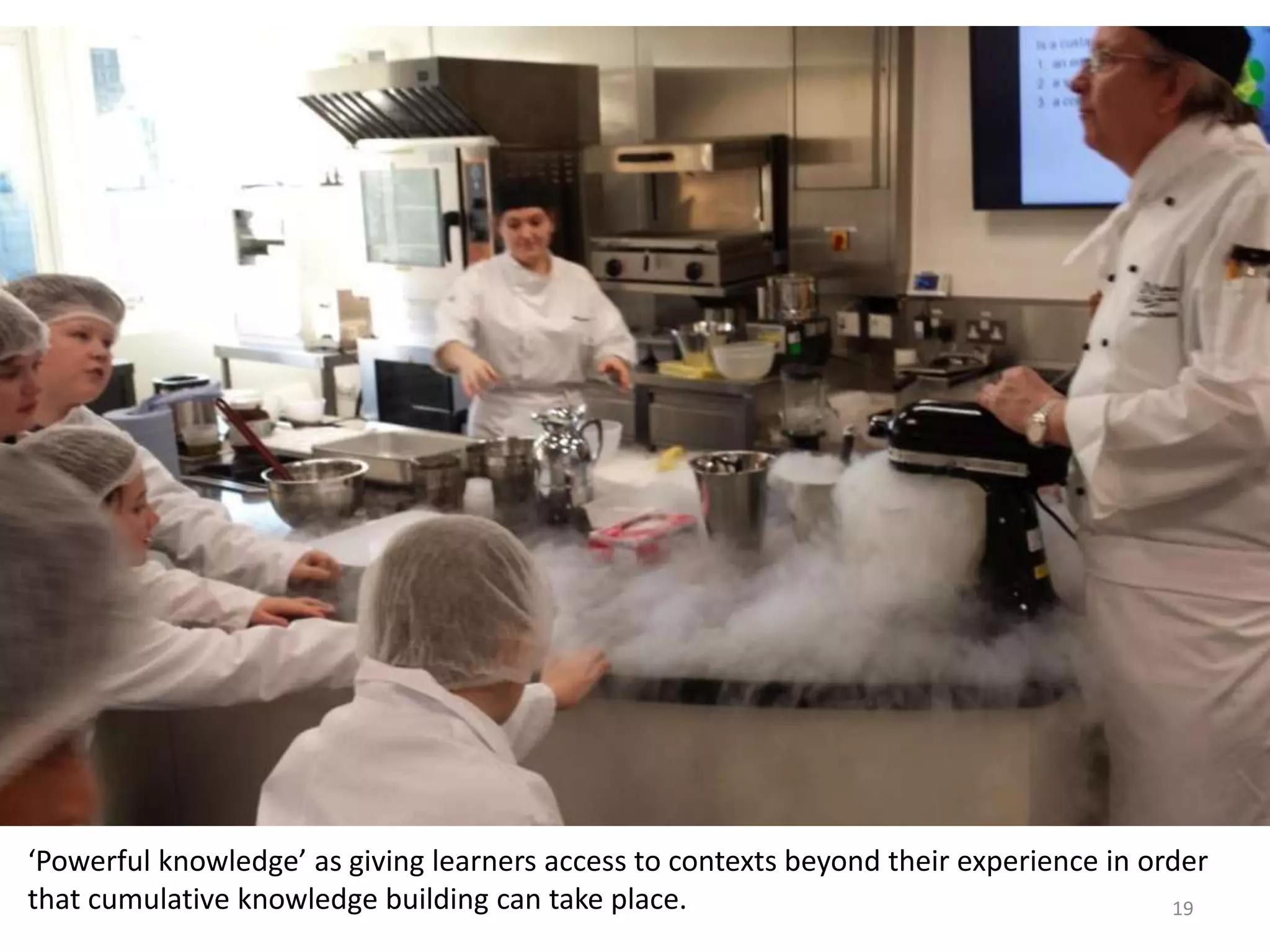
‘Powerful knowledge’ as giving learners access to contexts beyond their experience in order
that cumulative knowledge building can take place. 19
Conclusion
• If we pay attention to the semantic structure
of knowledge we can help students cope with
difficult concepts
• This acknowledges that powerful knowledge
enables learners to go beyond their contexts
• It enables learners to develop knowledge
literacy (the specialised language of the
profession and the subject) in order that they
can be more effective learners.
20

Developing the professional curriculum: looking both ways with practice knowledge and theory

  • 1.
    Developing the professionalcurriculum: looking both ways with practice knowledge and theory Dr. Richard Pountney 1 Social Realism Symposium 2nd July 2015
  • 2.
    Outline 1. Review thecurricular and pedagogic development of professional courses and the importance of the professional context 2. Identify issues associated with the role, effects and implications of work-related learning in education 3. Examine the formation of specialist knowledge and expertise and a reflection on the ‘know-how’ and ‘know-what’ in professional contexts 4. Reflect on the need for knowledge building in professional /vocational fields and how to investigate it 2
  • 3.
    The sociology ofprofessional knowledge • ‘The construction of the inner was a guarantee of the construction of the outer. In this we find the origin of the professions’ (Bernstein, 2000: 85) • Professional knowledge is both ‘theoretical’ (general and unvarying) and practical (purposive and contextual) • About doing things but doing things in complex ways that cannot rely on experience alone (Young and Muller, 2014) • Professional practice is always in a context, with a purpose and relates to specific occupations 3
  • 4.
    Regions, singulars andfields of practice • Singulars: which represent knowledge relations (or structures) oriented to inwardness – the rules, methods and boundaries that define a discipline (e.g. Sociology or physiology) • Regions: which combine disciplines, selecting, pacing and sequencing knowledge in relation to specific purposes (e.g. Knowledge of muscles in physiotherapy) • Fields of Practice: the specialised practical contexts in which professionals practice – exercise knowledgeable and reasoned judgements as professionals, by drawing on, often tacitly, their acquired stock of specialised professional knowledge 4
  • 5.
  • 6.
    Reproduction of (professional) knowledgein the curriculum Higher education providers [should] have in place effective processes to approve and periodically review the validity and relevance of programmes (QAA, 2011) Why is it assumed that when we are ‘given’ a course to teach that we know how to write a course outline? Where is it that we ‘learn’ how to do this important piece of pedagogy? What underpins this process? (Millen, 1997: 11) 6
  • 7.
    PRODUCT PROCESS INDIVIDUALISED INTERACTIONAL TRADITIONALEMERGING SOCIAL PRACTICE INTENDED LIVED HIDDEN OPEN Curriculum as an idea in practice Curriculum influences Organising principles PEDAGOGIC ACADEMIC IDENTITY DEVELOPMENT CULTURE SOCIALISATION QUALITY DISCIPLINE PLANNING / DESIGN COLLABORATION ASSESSMENT STUDENTS EMPLOYABILITY The emergence of employability Contextual Conceptual COHERENCE 7
  • 8.
    Employability and itseffects in the curriculum • Sustained policy steer (Robbins Report, 1963; Dearing Report, 1997; Leitch Report, 2005). • Instrumental in curriculum policy (Nixon et al., 2008; Lester and Costly, 2010; Smith, 2012) • Work-related learning associated with the development of ‘skilful practices in context’ in which academic and work-related achievements are situated in particular contexts (Yorke, 2011: 120) and ‘vocational expertise’ (Billett, 2001). • requiring a ‘paradigm shift’ in assessment (Gibbs, 2007) to articulate generic statements of learning outcomes to phenomena that are ‘context- dependence, situated or, uncertain and volatile’ (Sadler, 2002: 49). 8
  • 9.
    Employability knowledge inthe curriculum SHU Education for Employment Strategy • Objective 1: ensure that all students actively engage with well structured, supported and accredited work- related or work-based learning.; • Objective 2: embed high-level employability-related transferable ‘skills’ and attributes within the curriculum; • Objective 3: provide all students at all levels with access to integrated and timetabled career management skills.; • Objective 4: provide all students at all levels with access to personal development planning (PDP) to support their transition to the world of work 9
  • 10.
    Semantic Plane Semantic gravity– the degree to which meaning is dependent on context Semantic density – the degree to which meanings are condensed within practices (Maton, 2011; Shay, 2013) 10
  • 11.
    11 Course Team Cou.rse Title Level Objective 1: accreditedwork- related/work-based learning Objective 2: development of transferable skills Objective 3: access to career management skills Objective 4: personal development planning Q2: Practical knowledge; practical curricula C9 Performing Arts FD Skill for the Workplace; Professional Roles and Practice; and Performing Arts in Practice modules. addressed through subject-specific knowledge Implicit use of institution’s Careers Service Embedded in Practitioner Skills (I and II) and Performing Arts in Practice. Modules. Q3: Professional/practice knowledge; professional/vocational curricula C10 Built Environment U G 36 week placement year between levels 5 and 6. Generic skills listed in programme and module LOs; Professional skills addressed in specific modules for Real Estate, Construction, Surveying etc.) Timetabled programme of activities focussing on career management skills around the placement taking place between levels 5 and 6 Integrated in modules. Implicit reflection on work and context for autonomous learners Q4: Theoretical knowledge; applied theory curricula C8 Applied Social Science U G A choice of 3 modules: Work and Professional Development module (10 credits level 5) and elective 30-credit project-management module or a 50-credit work placement module Generic skills listed in programme and module LOs; Study skills module Implicit use of institution’s Careers Service. Professional development modules at levels 5 and 6 Module tutor is academic tutor with specific PDP tasks in level 4 Study Skills modules, and Professional Development modules at levels 5 and 6
  • 12.
    12[1] The professionalPractice and Placement module was mandatory for Housing students and elective for the other awards in CPT2 Module Course Assessment Tasks Learning Outcomes Assessment Criteria Preparing for the world of Work (10 credits) Elective Criminology Level 5 Reflection (2000 words) Identify employability skills and practices Ability to recognise relevant skills and practices necessary to enhance employability Explain the transferability of skills across a range of different work environments Ability to consider different ways that key skills and practices can be utilised across a range of settings Reflect upon their own learning processes within a work related setting An evaluation of their learning and reflective practice Professional Practice and Placement (20 credits) Mandatory / elective Geography, Environment Planning and Housing Level 5 Performance Appraisal (25%, 1000 words); Reflective Report (75%, 3000 words) Identify complex problems in real- life situations, and select and apply appropriate techniques and behaviours to solve these problems. Appropriateness of approaches, practice, techniques and behaviour employed in various workplace situations Identify objectives and personal responsibilities when working with others, and collaborate effectively in teams. Self management skills applied in a professional teamwork context. Reflect on and analyse the values and ethics relating to professional practice in the relevant sector. Knowledge and understanding of 'values and ethics' and analysis of their role and impact in professional practice. Reflect on and evaluate their own performance, and plan actions relating to their own continuing professional development needs. Evidence of reflective practice skills, (including reflection, analysis, insight, planning)
  • 13.
    Cathy’s story: the‘reversible coat’ • Longstanding extra-curricular activity to help students prepare for interviews and write CV • Curricularised into a module for all: • ‘Suddenly it was part of a module that was on their timetable and so attendance improved and you were able to get students to actually engage with it much more seriously’ • ‘A lot of students will see that and think ‘I know how to organise myself’ • ‘they give less importance to the developing of these skills than to something with really hard content like Housing Law or Finance’ 13
  • 14.
    Semantic profiles A –high semantic flatline (theoretical and abstract) B – low semantic flatline (practical and simple) C – semantic wave (weakening and strengthening of context and density and a larger semantic range) (Maton, 2014)14
  • 15.
  • 16.
    A curriculum forprofessional learning 16 TELIC Stories and Accounts of Practice (TELIC Research Journal)
  • 17.
  • 18.
    Ways of deepeninglearning Increasing the semantic threshold iteratively by strengthening and deepening learning through the increase in conceptual links 18
  • 19.
    ‘Powerful knowledge’ asgiving learners access to contexts beyond their experience in order that cumulative knowledge building can take place. 19
  • 20.
    Conclusion • If wepay attention to the semantic structure of knowledge we can help students cope with difficult concepts • This acknowledges that powerful knowledge enables learners to go beyond their contexts • It enables learners to develop knowledge literacy (the specialised language of the profession and the subject) in order that they can be more effective learners. 20

Editor's Notes

  • #7 Practice as the meeting of two logics: the logic of the field and the logic of actors’ dispoitions.