ETIOLOGY AND
EVALUATION OF
ERECTILE DYSFUNCTION
Dept of Urology
Govt Royapettah Hospital and Kilpauk Medical College
Chennai
1
Moderators:
Professors:
 Prof. Dr. G. Sivasankar, M.S., M.Ch.,
 Prof. Dr. A. Senthilvel, M.S., M.Ch.,
Asst Professors:
 Dr. J. Sivabalan, M.S., M.Ch.,
 Dr. R. Bhargavi, M.S., M.Ch.,
 Dr. S. Raju, M.S., M.Ch.,
 Dr. K. Muthurathinam, M.S., M.Ch.,
 Dr. D. Tamilselvan, M.S., M.Ch.,
 Dr. K. Senthilkumar, M.S., M.Ch.
Dept of Urology, GRH and KMC,
Chennai. 2
ERECTILE DYSFUNCTION
 ED defined as the consistent or
recurrent inability to attain and/or
maintain penile erection sufficient for
sexual performance
3
Dept of Urology, GRH and KMC,
Chennai.
HISTORY
 Hippocrates -male impotence among the rich;
excessive horseback riding.
 Aristotle -three branches of nerves carry spirit
and energy to penis & erection is produced by
influx of air .
 Leonardo da Vinci - large amount of blood in
erect penis of hanged men , doubt on the
concept.
 In 1585, Ambroise Paré - penile anatomy and
vascular event of erection .
4
Dept of Urology, GRH and KMC,
Chennai.
EPIDEMIOLOGY
 Mean probability of some degree of ED -52%
 Incidence - 25.9 cases per 1000 man-years.
 Annual incidence rates increased with each decade
(per 1000 man-years):
• 12.4 %cases in 40 to 49 years,
• 29.8 %cases in 50 to 59 years, and
• 46.4% cases in 60 to 69 years.
Massachusetts Male Aging Study (MMAS ) -men between ages of
40- 70 yrs , first surveyed 1987 - 1989 and resurveyed 1995 - 1997 .
5
Dept of Urology, GRH and KMC,
Chennai.
RISK FACTORS
 Heart disease
 Hypertension
 Diabetes
 Chronic renal failure
 Hepatic failure
 Multiple Sclerosis
 Severe depression
 Other (vascular disease, low HDL, high
cholesterol)
Benet et al. Urol Clinic North Am. 1995; 151:54-61
6
Dept of Urology, GRH and KMC,
Chennai.
FUNCTIONAL CLASSIFICATION OF ED
7
Dept of Urology, GRH and KMC,
Chennai.
PSYCHOGENIC
 Persistent inability to achieve or maintain
erection satisfactory for sexual performance due
predominantly or exclusively to psychological or
interpersonal factors.
 Anxiety
 Self-reported depressive symptoms
 Low degrees of self-esteem
 Negative outlook on life
 Self-reported emotional stress
8
Dept of Urology, GRH and KMC,
Chennai.
NEUROGENIC
 10% to 19% of ED is neurogenic , prevalence is
much high if iatrogenic & mixed ED included.
 Parkinson's disease
 Stroke
 Encephalitis
 Temporal lobe epilepsy
 Tumors
 Dementia
 Alzheimer's disease
 Shy-Drager syndrome
 Spinal cord Trauma.
9
Dept of Urology, GRH and KMC,
Chennai.
 Iatrogenic impotence :
• Radical prostatectomy 43% to 100%
• Perineal prostatectomy for BPH 29%
• APR - 15% to 100%
 Nerve-sparing radical prostatectomy
reduced the incidence from 100% to 30%-
50%
 In Pelvic fracture, ED result of cavernous
nerve injury or vascular insufficiency or
both .
10
Dept of Urology, GRH and KMC,
Chennai.
ENDOCRINOLOGIC
 Men receiving long-term androgen ablation
therapy for prostate cancer reported poor libido
and ED .
 Hyperprolactinemia- pituitary adenoma or drugs,
results in both reproductive and sexual
dysfunction.
 hyperthyroidism- decreased libido
hypothyroidism- Hyperprolactinemia, decreased
testosterone
11
Dept of Urology, GRH and KMC,
Chennai.
ARTERIOGENIC
 Due to Atherosclerotic or traumatic
arterial occlusive disease
 Risk factors HT, hyperlipidemia, cigarette
smoking, DM, blunt perineal or pelvic
trauma, and pelvic irradiation.
12
Dept of Urology, GRH and KMC,
Chennai.
13
Dept of Urology, GRH and KMC,
Chennai.
CAVERNOUS (VENOGENIC)
 Tunical changes-
Degenerative changes (Peyronie's disease, old
age, and DM) or traumatic injury to T.A (penile #
)
 Fibroelastic structural alterations,
 Insufficient trabecular smooth muscle relaxation
 Venous shunts. (priapism)
14
Dept of Urology, GRH and KMC,
Chennai.
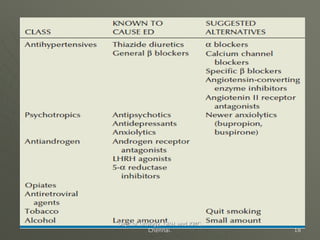
DRUG INDUCED
 Anti HT- thiazide diuretics, non sel β blockers,
clonidine, methyl dopa.
 Psychotropic - all anti dep except trazodone &
bupropion.
 Antiandrogen - bicalutamide, LHRH agonist ,
estrogen, ketoconazole, cyproterone.
 MISC -digoxin, cimitidine, tobacco & alcohol -ED.
15
Dept of Urology, GRH and KMC,
Chennai.
ANTIHYPERTENSION
16
Dept of Urology, GRH and KMC,
Chennai.
PSYCHOTROPIC
 Antipsychotic- β-adrenergic blockade
anticholinergic properties
antidopaminergic actions-(40-60%
 Antidepressants
TCA- β-adrenergic,anticholinergic
causes orgasmic dysfuntion
SSRI-orgasmic dysfuntion(50%)
17
Dept of Urology, GRH and KMC,
Chennai.
18
Dept of Urology, GRH and KMC,
Chennai.
Diabetes mellitus
cause ED
 Altered psychologic well being
 Decreased androgen secretion,
 altered peripheral nerve activity,
 endothelial cell function,
 smooth muscle contractility
19
Dept of Urology, GRH and KMC,
Chennai.
CAD in ED
 In men having symptomatic
coronary artery disease ( CAD ), ED
precedes 55 – 65% CAD by 3 – 4
years
20
Dept of Urology, GRH and KMC,
Chennai.
Princeton II consensus
21
Dept of Urology, GRH and KMC,
Chennai.
Hypertension cause ED
 Independent risk factor
 IHD
 Arterial biochemical and structural
changes
22
Dept of Urology, GRH and KMC,
Chennai.
PRIMARY ED
 Lifelong inability to initiate /maintain
erections, or both.
 Begins with first sexual attempt .
 Most cases due to psychologic factors,
 Physical cause - maldevelopment of penis
or blood and nerve supply .
23
Dept of Urology, GRH and KMC,
Chennai.
EVALUATION
24
Dept of Urology, GRH and KMC,
Chennai.
SEXUAL QUESTIONNAIRES
 International Index of Erectile Function (IIEF) ,
 Brief Male Sexual Function Inventory (BMSFI)
 Dysfunction Inventory for Treatment Satisfaction
(EDITS) ,
 Male Sexual Function Scale.
Major drawback is reliance on self-assessment.
25
Dept of Urology, GRH and KMC,
Chennai.
SAQ’S
 Formerly, questionnaires used to differentiate
psychogenic from nonpsychogenic ED.
 SAQs greatest use in clinical trials.
 Do not differentiate various causes of ED.
 A good history, physical examination, and
proper lab studies still form the cornerstone
26
Dept of Urology, GRH and KMC,
Chennai.
MEDICAL HISTORY
 Evaluate role of underlying comorbidities.
 Assess potential role of medication.
 Past H/O: Prostatectomy, APR, Pelvic trauma.
 Differentiate potential organic and psychogenic
causes .
27
Dept of Urology, GRH and KMC,
Chennai.
Characteristic
Organic Psychogenic
Onset Gradual Acute
Circumstances Global Situational
Course Constant Varying
Noncoital erection Poor Rigid
Psychosexual problem Secondary Long history
Partner problem Secondary At onset
Anxiety and fear Secondary Primary
28
Dept of Urology, GRH and KMC,
Chennai.
physical examination
 Height , weight BMI , BP
 Secondary sexual characteristics to rule out
hypogonadism
 Thyroid evaluation
 Cardiovascular system
• LL pulses
 Abdominal
• Waist cricumference
 Neurological system
• Penile Sensation, bulbocarvernosus reflex, LL neurology
 Genital-urinary system
• Penile deformity, phimosis, Peyronie's plaques
• Testicular size, consistency and mass
• DRE: anal tone, prostate
29
Dept of Urology, GRH and KMC,
Chennai.
LAB TESTS
 Fasting Glucose, RFT, lipids & testosterone.
 HORMONAL STUDY Optional :
.
( Prolactin, LH, FSH, Thyroid function.)
 PSA measured >50 yrs age ,to R/O ca prostate, if
hormonal replacement planned.
30
Dept of Urology, GRH and KMC,
Chennai.
EVALUATION OF COMPLEX PATIENT
 Indications for specialized evaluation
• Failure of initial treatment
• Peyronie's disease
• Primary ED
• H/O pelvic/perineal trauma
• Vascular or neurosurgical intervention
• Complicated endocrinopathy
• Complicated psychiatric disorder
• Complex relationship problems
• Medicolegal concerns .
31
Dept of Urology, GRH and KMC,
Chennai.
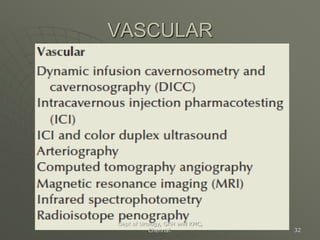
VASCULAR
32
Dept of Urology, GRH and KMC,
Chennai.
VASCULAR
 Most commonly performed diagnostic procedure.
 Intracavernous inj of vasodilator –
genital / Audiovisual sexual stimulation, and
assessment of erection by an observer.
 It bypass neurologic & hormonal influences
evaluate vascular status of penis directly .
COMBINED INTRACAVERNOUS INJECTION
AND STIMULATION (CIS)
33
Dept of Urology, GRH and KMC,
Chennai.
 Trimix -0.3ml(papaverine ,phentolamine,
alprostadil)
 27 to 29 gauge is inserted at the lateral base of
the penis directly into the corpus cavernosum
 manual compression is applied to the injection
site for 5 minutes to prevent local hematoma
formation.
 The assessment is done periodically afterwards to
rate rigidity
34
Dept of Urology, GRH and KMC,
Chennai.
35
Dept of Urology, GRH and KMC,
Chennai.
intracavernous injection test
 A positive test is a rigid erectile response
(unable to bend the penis) that appears within
10 min after the intracavernous injection and
lasts for 30 min
 This response indicates a functional and rule
out veno-occlusive dysfunction, although co-
exist with arterial insufficiency
 Positive test shows that a patient will respond
to the intracavernous injection program
36
Dept of Urology, GRH and KMC,
Chennai.
CIS
 False-neg in 20% with borderline arterial inflow.
 False-positive occur most commonly because of
pt anxiety, needle phobia, or inadequate dosage.
 Pt should not leave until penis becomes flaccid
spontaneously or by injection of phenylephrine.
• 500 μg/mL, given 1 mL every 3 to 5 minutes
until detumescence.
37
Dept of Urology, GRH and KMC,
Chennai.
Duplex ultrasound
38
Dept of Urology, GRH and KMC,
Chennai.
Step 2
 Per injection flaccid state:
 PSV-10cm/sec
 Cavernosal artery diameter-0.3-
10mm
39
Dept of Urology, GRH and KMC,
Chennai.
Step 3 post injection
 After 10min , usually multiple
measurement is done
 PSV- >25-35 cm/sec
 Cavernosal arterial diameter ->7mm
40
Dept of Urology, GRH and KMC,
Chennai.
Step 4 Diastolic measurement
 EDV - < 5cm/min
RI = PSV - EDV/PSV.
 During tumescence until full rigidity, diastolic flow
is antegrade RI remains <1.
 RI >0.9 associated with normal results during
DICC in 90% .
 RI < 0.75 associated with venous leakage in
95%.
41
Dept of Urology, GRH and KMC,
Chennai.
Dynamic Infusion Cavernosometry &
Cavernosography
 4 phases
 combined intracavernous injection and
stimulation
• Pharmacologic cavernosometry (infusing the penis
with heparinized saline whilst monitoring
the intracavernosmal pressure)
• Cavernosal artery systolic occlusion pressure
(CASOP) is found
• Pharmacologic cavernosography -infusing contrast
into the corporeal tissue and obtaining radiographic
images of the penis and perineum to see if there is
venous leakage
42
Dept of Urology, GRH and KMC,
Chennai.
 Normal:
• A gradient between
the CASOP and the
brachial artery
pressures of
<35mmHg
• an equal pressure
between the right
and the left
cavernous arteries
 Venous leakage:
- Inability to attain systolic
pressure
- Large gradient between
CASOP & brachial
systolic pressure
- Rapid drop of
intracavernosal pressure
upon stopping of
infusion
43
Dept of Urology, GRH and KMC,
Chennai.
CAVERNOSAL ARTERY FLOW
BRACHIAL SYSTOLIC AND
DIASTOLIC BP
(CASOP)-108 mmHg
INTRACAVERNOSAL
HEPARINIZED SALINE FLOW
44
Dept of Urology, GRH and KMC,
Chennai.
Cavernosography
 Indication:
1. evaluate venous problems in men with
ED
2. Investigation of priapism (high flow)
3. Assessment of penile fractures/injury
to assess cavernosal damage
4. Assessment of Peyronie’s disease
(rarely used)
 Contraindication:
• Hx of contrast allergy 45
Dept of Urology, GRH and KMC,
Chennai.
Carvernosography
 Two 19–22 G butterfly needles inserted into
the corpora
 60-100ml Omnipaque or urograffin infused
slowly to obtain penile pressure 90mmHg
 If penis not erection , contrast leakage
 Fluoroscopy: AP , Rt, Lt oblique view
 Normal: no contrast visualized outside the 2
corpora cavernosa
 Abnormal: Contrast leakage or significant
curvature
46
Dept of Urology, GRH and KMC,
Chennai.
 Advantage: more sensitive and
accurate compare to doppler USG for
venous leakage
 Disadvantage:
• Invasive
• Can be painful
• Risk of infection
• Contrast related fibrosis within corpora
• Risk of priapism
47
Dept of Urology, GRH and KMC,
Chennai.
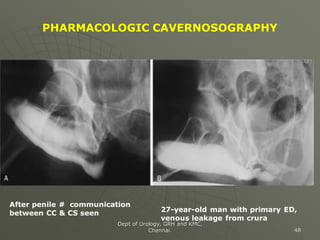
PHARMACOLOGIC CAVERNOSOGRAPHY
After penile # communication
between CC & CS seen 27-year-old man with primary ED,
venous leakage from crura
48
Dept of Urology, GRH and KMC,
Chennai.
NEUROLOGIC
 Specialized test for neurologic ED unnecessary.
 Nerve conduction velocity studies
 Biothesiometry,
 Bulbocavernosus EMG,
 Corpus cavernosus EMG
All lack sensitivity & reliability.
 Penile thermal sensory testing - promising tool
for diagnosis of neurogenic ED .
49
Dept of Urology, GRH and KMC,
Chennai.
Biothesiometer
 The Digital
Biothesiometer
designed to
measure the
threshold of
appreciation of
vibration in human
subjects simply
and accurately
50
Dept of Urology, GRH and KMC,
Chennai.
PSYCHOPHYSIOLOGIC
 Nocturnal penile tumescence (NPT) monitoring
 Stamp test :Ring of postage stamps placed
around the base of penis ,at night break.
 Snap gauges:3 individual, differently colored
bands secured at base of penis , break under
progressive radial forces.
 Sleep laboratory nocturnal penile tumescence
and rigidity (NPTR);
 RigiScan
.
51
Dept of Urology, GRH and KMC,
Chennai.
NPTR
INDICATIONS
• Suspected sleep disorder
• Obscure cause of ED
• No response to therapy
• Planned surgical treatment
• Legally sensitive case
• Measurement of drug effects in placebo-controlled trials
• Suspected psychogenic cause
 Advantages - Freedom from psychologic influences,
Ability to detect sleep-related abnormalities.
 Disadvantages of NPT evaluation –
Age dependent and costly,
Ideally done with RigiScan in a sleep center.
52
Dept of Urology, GRH and KMC,
Chennai.
NPTR …
 Devices measure
No of episodes, Tumescence , Maximal penile
rigidity, and Duration of N.E.
 Electroencephalography, electro-oculography, and EMG,
with nasal air flow, and O2 saturation to document REM
sleep and hypoxia
 Pt is awakened during maximal tumescence, erection is
photographed and axial rigidity measured at tip of penis.
 Buckling resistance of 500 g is considered minimum for
vaginal penetration;
1.5 kg is considered complete rigidity.
53
Dept of Urology, GRH and KMC,
Chennai.
RIGISCAN
 First automated, portable NPTR recording.
 Combines monitoring of radial rigidity, tumescence, no &
duration of erectile events with portable system -used at
home.
 Collect data 3 separate nights for maximum of 10 hrs/night
 Consist of two loops: one is placed at base of penis & other
at coronal sulcus. By constricting the loops, device records
penile tumescence & radial rigidity at penile base and tip.
 .
54
Dept of Urology, GRH and KMC,
Chennai.
RIGISCAN RESULT ANALYSIS…
 Radial rigidity > 70% - non buckling
erection,
 Rigidity of < 40% represents a flaccid
penis.
 Normal NPTR : 4-5 erectile episodes / night
 Mean duration > 30 mts
 ↑ in circumference of > 3 cm at base and > 2 cm at tip
 Maximal rigidity above 70% at both base & tip.
55
Dept of Urology, GRH and KMC,
Chennai.
nocturnal penile tumescence
testing
56
Dept of Urology, GRH and KMC,
Chennai.
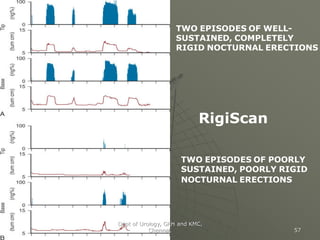
TWO EPISODES OF WELL-
SUSTAINED, COMPLETELY
RIGID NOCTURNAL ERECTIONS
TWO EPISODES OF POORLY
SUSTAINED, POORLY RIGID
NOCTURNAL ERECTIONS
RigiScan
57
Dept of Urology, GRH and KMC,
Chennai.
“…Mankind can survive
earthquakes, and experience the
horrors of illness, yet of all the
tortures of the soul, the most
tormenting tragedy of all time is,
the tragedy of the bedroom.”
— Leo Tolstoy
THANK YOU
58
Dept of Urology, GRH and KMC,
Chennai.

Penis: erectile dysfunction( ed)- evaluation

  • 1.
    ETIOLOGY AND EVALUATION OF ERECTILEDYSFUNCTION Dept of Urology Govt Royapettah Hospital and Kilpauk Medical College Chennai 1
  • 2.
    Moderators: Professors:  Prof. Dr.G. Sivasankar, M.S., M.Ch.,  Prof. Dr. A. Senthilvel, M.S., M.Ch., Asst Professors:  Dr. J. Sivabalan, M.S., M.Ch.,  Dr. R. Bhargavi, M.S., M.Ch.,  Dr. S. Raju, M.S., M.Ch.,  Dr. K. Muthurathinam, M.S., M.Ch.,  Dr. D. Tamilselvan, M.S., M.Ch.,  Dr. K. Senthilkumar, M.S., M.Ch. Dept of Urology, GRH and KMC, Chennai. 2
  • 3.
    ERECTILE DYSFUNCTION  EDdefined as the consistent or recurrent inability to attain and/or maintain penile erection sufficient for sexual performance 3 Dept of Urology, GRH and KMC, Chennai.
  • 4.
    HISTORY  Hippocrates -maleimpotence among the rich; excessive horseback riding.  Aristotle -three branches of nerves carry spirit and energy to penis & erection is produced by influx of air .  Leonardo da Vinci - large amount of blood in erect penis of hanged men , doubt on the concept.  In 1585, Ambroise Paré - penile anatomy and vascular event of erection . 4 Dept of Urology, GRH and KMC, Chennai.
  • 5.
    EPIDEMIOLOGY  Mean probabilityof some degree of ED -52%  Incidence - 25.9 cases per 1000 man-years.  Annual incidence rates increased with each decade (per 1000 man-years): • 12.4 %cases in 40 to 49 years, • 29.8 %cases in 50 to 59 years, and • 46.4% cases in 60 to 69 years. Massachusetts Male Aging Study (MMAS ) -men between ages of 40- 70 yrs , first surveyed 1987 - 1989 and resurveyed 1995 - 1997 . 5 Dept of Urology, GRH and KMC, Chennai.
  • 6.
    RISK FACTORS  Heartdisease  Hypertension  Diabetes  Chronic renal failure  Hepatic failure  Multiple Sclerosis  Severe depression  Other (vascular disease, low HDL, high cholesterol) Benet et al. Urol Clinic North Am. 1995; 151:54-61 6 Dept of Urology, GRH and KMC, Chennai.
  • 7.
    FUNCTIONAL CLASSIFICATION OFED 7 Dept of Urology, GRH and KMC, Chennai.
  • 8.
    PSYCHOGENIC  Persistent inabilityto achieve or maintain erection satisfactory for sexual performance due predominantly or exclusively to psychological or interpersonal factors.  Anxiety  Self-reported depressive symptoms  Low degrees of self-esteem  Negative outlook on life  Self-reported emotional stress 8 Dept of Urology, GRH and KMC, Chennai.
  • 9.
    NEUROGENIC  10% to19% of ED is neurogenic , prevalence is much high if iatrogenic & mixed ED included.  Parkinson's disease  Stroke  Encephalitis  Temporal lobe epilepsy  Tumors  Dementia  Alzheimer's disease  Shy-Drager syndrome  Spinal cord Trauma. 9 Dept of Urology, GRH and KMC, Chennai.
  • 10.
     Iatrogenic impotence: • Radical prostatectomy 43% to 100% • Perineal prostatectomy for BPH 29% • APR - 15% to 100%  Nerve-sparing radical prostatectomy reduced the incidence from 100% to 30%- 50%  In Pelvic fracture, ED result of cavernous nerve injury or vascular insufficiency or both . 10 Dept of Urology, GRH and KMC, Chennai.
  • 11.
    ENDOCRINOLOGIC  Men receivinglong-term androgen ablation therapy for prostate cancer reported poor libido and ED .  Hyperprolactinemia- pituitary adenoma or drugs, results in both reproductive and sexual dysfunction.  hyperthyroidism- decreased libido hypothyroidism- Hyperprolactinemia, decreased testosterone 11 Dept of Urology, GRH and KMC, Chennai.
  • 12.
    ARTERIOGENIC  Due toAtherosclerotic or traumatic arterial occlusive disease  Risk factors HT, hyperlipidemia, cigarette smoking, DM, blunt perineal or pelvic trauma, and pelvic irradiation. 12 Dept of Urology, GRH and KMC, Chennai.
  • 13.
    13 Dept of Urology,GRH and KMC, Chennai.
  • 14.
    CAVERNOUS (VENOGENIC)  Tunicalchanges- Degenerative changes (Peyronie's disease, old age, and DM) or traumatic injury to T.A (penile # )  Fibroelastic structural alterations,  Insufficient trabecular smooth muscle relaxation  Venous shunts. (priapism) 14 Dept of Urology, GRH and KMC, Chennai.
  • 15.
    DRUG INDUCED  AntiHT- thiazide diuretics, non sel β blockers, clonidine, methyl dopa.  Psychotropic - all anti dep except trazodone & bupropion.  Antiandrogen - bicalutamide, LHRH agonist , estrogen, ketoconazole, cyproterone.  MISC -digoxin, cimitidine, tobacco & alcohol -ED. 15 Dept of Urology, GRH and KMC, Chennai.
  • 16.
  • 17.
    PSYCHOTROPIC  Antipsychotic- β-adrenergicblockade anticholinergic properties antidopaminergic actions-(40-60%  Antidepressants TCA- β-adrenergic,anticholinergic causes orgasmic dysfuntion SSRI-orgasmic dysfuntion(50%) 17 Dept of Urology, GRH and KMC, Chennai.
  • 18.
    18 Dept of Urology,GRH and KMC, Chennai.
  • 19.
    Diabetes mellitus cause ED Altered psychologic well being  Decreased androgen secretion,  altered peripheral nerve activity,  endothelial cell function,  smooth muscle contractility 19 Dept of Urology, GRH and KMC, Chennai.
  • 20.
    CAD in ED In men having symptomatic coronary artery disease ( CAD ), ED precedes 55 – 65% CAD by 3 – 4 years 20 Dept of Urology, GRH and KMC, Chennai.
  • 21.
    Princeton II consensus 21 Deptof Urology, GRH and KMC, Chennai.
  • 22.
    Hypertension cause ED Independent risk factor  IHD  Arterial biochemical and structural changes 22 Dept of Urology, GRH and KMC, Chennai.
  • 23.
    PRIMARY ED  Lifelonginability to initiate /maintain erections, or both.  Begins with first sexual attempt .  Most cases due to psychologic factors,  Physical cause - maldevelopment of penis or blood and nerve supply . 23 Dept of Urology, GRH and KMC, Chennai.
  • 24.
    EVALUATION 24 Dept of Urology,GRH and KMC, Chennai.
  • 25.
    SEXUAL QUESTIONNAIRES  InternationalIndex of Erectile Function (IIEF) ,  Brief Male Sexual Function Inventory (BMSFI)  Dysfunction Inventory for Treatment Satisfaction (EDITS) ,  Male Sexual Function Scale. Major drawback is reliance on self-assessment. 25 Dept of Urology, GRH and KMC, Chennai.
  • 26.
    SAQ’S  Formerly, questionnairesused to differentiate psychogenic from nonpsychogenic ED.  SAQs greatest use in clinical trials.  Do not differentiate various causes of ED.  A good history, physical examination, and proper lab studies still form the cornerstone 26 Dept of Urology, GRH and KMC, Chennai.
  • 27.
    MEDICAL HISTORY  Evaluaterole of underlying comorbidities.  Assess potential role of medication.  Past H/O: Prostatectomy, APR, Pelvic trauma.  Differentiate potential organic and psychogenic causes . 27 Dept of Urology, GRH and KMC, Chennai.
  • 28.
    Characteristic Organic Psychogenic Onset GradualAcute Circumstances Global Situational Course Constant Varying Noncoital erection Poor Rigid Psychosexual problem Secondary Long history Partner problem Secondary At onset Anxiety and fear Secondary Primary 28 Dept of Urology, GRH and KMC, Chennai.
  • 29.
    physical examination  Height, weight BMI , BP  Secondary sexual characteristics to rule out hypogonadism  Thyroid evaluation  Cardiovascular system • LL pulses  Abdominal • Waist cricumference  Neurological system • Penile Sensation, bulbocarvernosus reflex, LL neurology  Genital-urinary system • Penile deformity, phimosis, Peyronie's plaques • Testicular size, consistency and mass • DRE: anal tone, prostate 29 Dept of Urology, GRH and KMC, Chennai.
  • 30.
    LAB TESTS  FastingGlucose, RFT, lipids & testosterone.  HORMONAL STUDY Optional : . ( Prolactin, LH, FSH, Thyroid function.)  PSA measured >50 yrs age ,to R/O ca prostate, if hormonal replacement planned. 30 Dept of Urology, GRH and KMC, Chennai.
  • 31.
    EVALUATION OF COMPLEXPATIENT  Indications for specialized evaluation • Failure of initial treatment • Peyronie's disease • Primary ED • H/O pelvic/perineal trauma • Vascular or neurosurgical intervention • Complicated endocrinopathy • Complicated psychiatric disorder • Complex relationship problems • Medicolegal concerns . 31 Dept of Urology, GRH and KMC, Chennai.
  • 32.
    VASCULAR 32 Dept of Urology,GRH and KMC, Chennai.
  • 33.
    VASCULAR  Most commonlyperformed diagnostic procedure.  Intracavernous inj of vasodilator – genital / Audiovisual sexual stimulation, and assessment of erection by an observer.  It bypass neurologic & hormonal influences evaluate vascular status of penis directly . COMBINED INTRACAVERNOUS INJECTION AND STIMULATION (CIS) 33 Dept of Urology, GRH and KMC, Chennai.
  • 34.
     Trimix -0.3ml(papaverine,phentolamine, alprostadil)  27 to 29 gauge is inserted at the lateral base of the penis directly into the corpus cavernosum  manual compression is applied to the injection site for 5 minutes to prevent local hematoma formation.  The assessment is done periodically afterwards to rate rigidity 34 Dept of Urology, GRH and KMC, Chennai.
  • 35.
    35 Dept of Urology,GRH and KMC, Chennai.
  • 36.
    intracavernous injection test A positive test is a rigid erectile response (unable to bend the penis) that appears within 10 min after the intracavernous injection and lasts for 30 min  This response indicates a functional and rule out veno-occlusive dysfunction, although co- exist with arterial insufficiency  Positive test shows that a patient will respond to the intracavernous injection program 36 Dept of Urology, GRH and KMC, Chennai.
  • 37.
    CIS  False-neg in20% with borderline arterial inflow.  False-positive occur most commonly because of pt anxiety, needle phobia, or inadequate dosage.  Pt should not leave until penis becomes flaccid spontaneously or by injection of phenylephrine. • 500 μg/mL, given 1 mL every 3 to 5 minutes until detumescence. 37 Dept of Urology, GRH and KMC, Chennai.
  • 38.
    Duplex ultrasound 38 Dept ofUrology, GRH and KMC, Chennai.
  • 39.
    Step 2  Perinjection flaccid state:  PSV-10cm/sec  Cavernosal artery diameter-0.3- 10mm 39 Dept of Urology, GRH and KMC, Chennai.
  • 40.
    Step 3 postinjection  After 10min , usually multiple measurement is done  PSV- >25-35 cm/sec  Cavernosal arterial diameter ->7mm 40 Dept of Urology, GRH and KMC, Chennai.
  • 41.
    Step 4 Diastolicmeasurement  EDV - < 5cm/min RI = PSV - EDV/PSV.  During tumescence until full rigidity, diastolic flow is antegrade RI remains <1.  RI >0.9 associated with normal results during DICC in 90% .  RI < 0.75 associated with venous leakage in 95%. 41 Dept of Urology, GRH and KMC, Chennai.
  • 42.
    Dynamic Infusion Cavernosometry& Cavernosography  4 phases  combined intracavernous injection and stimulation • Pharmacologic cavernosometry (infusing the penis with heparinized saline whilst monitoring the intracavernosmal pressure) • Cavernosal artery systolic occlusion pressure (CASOP) is found • Pharmacologic cavernosography -infusing contrast into the corporeal tissue and obtaining radiographic images of the penis and perineum to see if there is venous leakage 42 Dept of Urology, GRH and KMC, Chennai.
  • 43.
     Normal: • Agradient between the CASOP and the brachial artery pressures of <35mmHg • an equal pressure between the right and the left cavernous arteries  Venous leakage: - Inability to attain systolic pressure - Large gradient between CASOP & brachial systolic pressure - Rapid drop of intracavernosal pressure upon stopping of infusion 43 Dept of Urology, GRH and KMC, Chennai.
  • 44.
    CAVERNOSAL ARTERY FLOW BRACHIALSYSTOLIC AND DIASTOLIC BP (CASOP)-108 mmHg INTRACAVERNOSAL HEPARINIZED SALINE FLOW 44 Dept of Urology, GRH and KMC, Chennai.
  • 45.
    Cavernosography  Indication: 1. evaluatevenous problems in men with ED 2. Investigation of priapism (high flow) 3. Assessment of penile fractures/injury to assess cavernosal damage 4. Assessment of Peyronie’s disease (rarely used)  Contraindication: • Hx of contrast allergy 45 Dept of Urology, GRH and KMC, Chennai.
  • 46.
    Carvernosography  Two 19–22G butterfly needles inserted into the corpora  60-100ml Omnipaque or urograffin infused slowly to obtain penile pressure 90mmHg  If penis not erection , contrast leakage  Fluoroscopy: AP , Rt, Lt oblique view  Normal: no contrast visualized outside the 2 corpora cavernosa  Abnormal: Contrast leakage or significant curvature 46 Dept of Urology, GRH and KMC, Chennai.
  • 47.
     Advantage: moresensitive and accurate compare to doppler USG for venous leakage  Disadvantage: • Invasive • Can be painful • Risk of infection • Contrast related fibrosis within corpora • Risk of priapism 47 Dept of Urology, GRH and KMC, Chennai.
  • 48.
    PHARMACOLOGIC CAVERNOSOGRAPHY After penile# communication between CC & CS seen 27-year-old man with primary ED, venous leakage from crura 48 Dept of Urology, GRH and KMC, Chennai.
  • 49.
    NEUROLOGIC  Specialized testfor neurologic ED unnecessary.  Nerve conduction velocity studies  Biothesiometry,  Bulbocavernosus EMG,  Corpus cavernosus EMG All lack sensitivity & reliability.  Penile thermal sensory testing - promising tool for diagnosis of neurogenic ED . 49 Dept of Urology, GRH and KMC, Chennai.
  • 50.
    Biothesiometer  The Digital Biothesiometer designedto measure the threshold of appreciation of vibration in human subjects simply and accurately 50 Dept of Urology, GRH and KMC, Chennai.
  • 51.
    PSYCHOPHYSIOLOGIC  Nocturnal peniletumescence (NPT) monitoring  Stamp test :Ring of postage stamps placed around the base of penis ,at night break.  Snap gauges:3 individual, differently colored bands secured at base of penis , break under progressive radial forces.  Sleep laboratory nocturnal penile tumescence and rigidity (NPTR);  RigiScan . 51 Dept of Urology, GRH and KMC, Chennai.
  • 52.
    NPTR INDICATIONS • Suspected sleepdisorder • Obscure cause of ED • No response to therapy • Planned surgical treatment • Legally sensitive case • Measurement of drug effects in placebo-controlled trials • Suspected psychogenic cause  Advantages - Freedom from psychologic influences, Ability to detect sleep-related abnormalities.  Disadvantages of NPT evaluation – Age dependent and costly, Ideally done with RigiScan in a sleep center. 52 Dept of Urology, GRH and KMC, Chennai.
  • 53.
    NPTR …  Devicesmeasure No of episodes, Tumescence , Maximal penile rigidity, and Duration of N.E.  Electroencephalography, electro-oculography, and EMG, with nasal air flow, and O2 saturation to document REM sleep and hypoxia  Pt is awakened during maximal tumescence, erection is photographed and axial rigidity measured at tip of penis.  Buckling resistance of 500 g is considered minimum for vaginal penetration; 1.5 kg is considered complete rigidity. 53 Dept of Urology, GRH and KMC, Chennai.
  • 54.
    RIGISCAN  First automated,portable NPTR recording.  Combines monitoring of radial rigidity, tumescence, no & duration of erectile events with portable system -used at home.  Collect data 3 separate nights for maximum of 10 hrs/night  Consist of two loops: one is placed at base of penis & other at coronal sulcus. By constricting the loops, device records penile tumescence & radial rigidity at penile base and tip.  . 54 Dept of Urology, GRH and KMC, Chennai.
  • 55.
    RIGISCAN RESULT ANALYSIS… Radial rigidity > 70% - non buckling erection,  Rigidity of < 40% represents a flaccid penis.  Normal NPTR : 4-5 erectile episodes / night  Mean duration > 30 mts  ↑ in circumference of > 3 cm at base and > 2 cm at tip  Maximal rigidity above 70% at both base & tip. 55 Dept of Urology, GRH and KMC, Chennai.
  • 56.
    nocturnal penile tumescence testing 56 Deptof Urology, GRH and KMC, Chennai.
  • 57.
    TWO EPISODES OFWELL- SUSTAINED, COMPLETELY RIGID NOCTURNAL ERECTIONS TWO EPISODES OF POORLY SUSTAINED, POORLY RIGID NOCTURNAL ERECTIONS RigiScan 57 Dept of Urology, GRH and KMC, Chennai.
  • 58.
    “…Mankind can survive earthquakes,and experience the horrors of illness, yet of all the tortures of the soul, the most tormenting tragedy of all time is, the tragedy of the bedroom.” — Leo Tolstoy THANK YOU 58 Dept of Urology, GRH and KMC, Chennai.