A participatory methodology to assess
the factors influencing performances of
avian influenza surveillance network in
Northern Vietnam
Alexis Delabouglise1,2, Nicolas Antoine-Moussiaux1,3, Phan Dang Thang4, Nguyen Tien
Thanh5, Dao Cong Duan4, Pham Thi Thanh Hoa1, Dao Thi Hiep4, Vu Dinh Ton4, Nguyen Viet
Khong5, Aurélie Binot1, François Roger1, Marisa Peyre1
1 CIRAD, AGIRs, France
2 Laboratoire Espace, Santé et Territoires, Université Paris Ouest, France
3 Université de Liège, Belgique
4 Hanoi Agriculture University, Vietnam
5 National Institute of Veterinary Research, Hanoi, Vietnam
• Outlines
I. Background : need to evaluate AI surveillance
II. Methodology : participatory tools to approach
decision making
III. Results
IV. Conclusions
• Highly pathogenic avian influenza (HPAI) due to
H5N1 persisting in Vietnam since 2004
• Limited evaluations of surveillance programs
• Hypothesis : social and economic interactions
between local actors are key elements to
evaluate acceptability of surveillance systems
Background
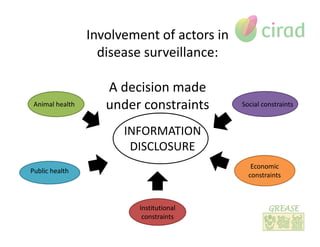
Involvement of actors in
disease surveillance:
A decision made
under constraints
INFORMATION
DISCLOSURE
Economic
constraints
Social constraintsAnimal health
Public health
Institutional
constraints
Methodology
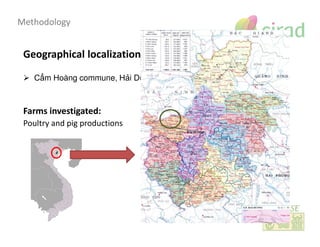
Geographical localization:
C m Hoàng commune, H i Dương province, Red river delta
Farms investigated:
Poultry and pig productions
Methodology
Decision making :
An answer to a series of
questions…
Methodology
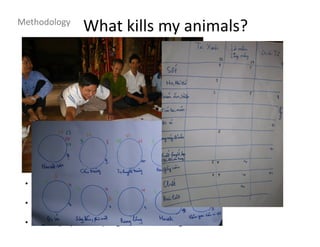
• Focus group producers
• Description of syndromes and terminology associated
• Use of proportional piling and matrix scoring
What kills my animals?Methodology
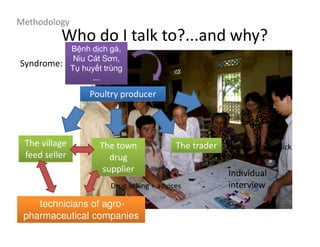
Who do I talk to?...and why?
B nh d ch gà,
Niu Cát Sơn,
T huy t trùng
….
The village
feed seller
Syndrome:
The town
drug
supplier
....
The trader
technicians of agro-
pharmaceutical companies
Poultry producer
Individual
interviewDrug selling + advices
Rapid selling of sick
animals
Methodology
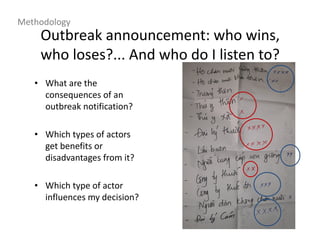
Outbreak announcement: who wins,
who loses?... And who do I listen to?
• What are the
consequences of an
outbreak notification?
• Which types of actors
get benefits or
disadvantages from it?
• Which type of actor
influences my decision?
Methodology
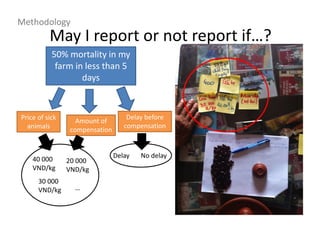
May I report or not report if…?
50% mortality in my
farm in less than 5
days
Price of sick
animals
Amount of
compensation
Delay before
compensation
40 000
VND/kg
30 000
VND/kg
20 000
VND/kg
Delay No delay
…
Methodology
50% mortality in my
farm in less than 5
days
Price of sick
animals
Amount of
compensation
Delay before
compensation
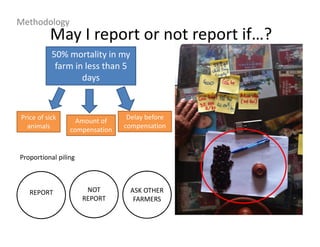
Proportional piling
REPORT NOT
REPORT
ASK OTHER
FARMERS
May I report or not report if…?
Methodology
Results
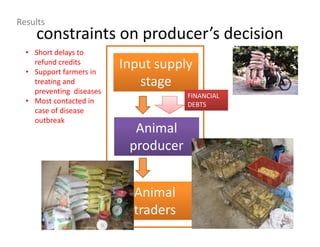
constraints on producer’s decision
Animal
producer
Input supply
stage
Animal
traders
Value chain
• Short delays to
refund credits
• Support farmers in
treating and
preventing diseases
• Most contacted in
case of disease
outbreak
FINANCIAL
DEBTS
Results
Results
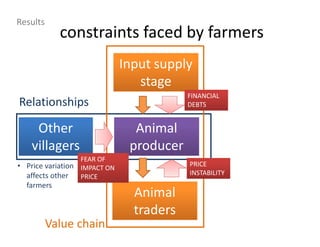
constraints faced by farmers
Animal
producer
Input supply
stage
Animal
traders
Value chain
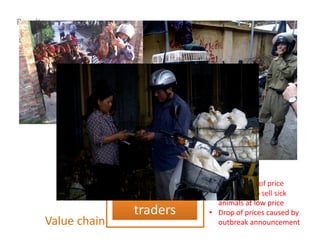
• Negotiation of price
• Possibility to sell sick
animals at low price
• Drop of prices caused by
outbreak announcement
FINANCIAL
DEBTS
PRICE
INSTABILITY
constraints faced by farmers
Animal
producer
Input supply
stage
Animal
traders
Value chain
Other
villagers
• Price variation
affects other
farmers
Relationships
FINANCIAL
DEBTS
PRICE
INSTABILITY
FEAR OF
IMPACT ON
PRICE
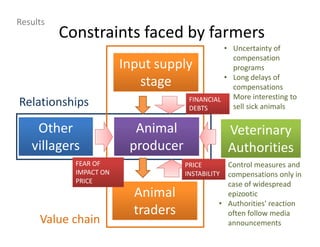
Results
Constraints faced by farmers
Animal
producer
Input supply
stage
Animal
traders
Value chain
Other
villagers
Veterinary
Authorities
• Uncertainty of
compensation
programs
• Long delays of
compensations
• More interesting to
sell sick animalsRelationships FINANCIAL
DEBTS
FEAR OF
IMPACT ON
PRICE
• Control measures and
compensations only in
case of widespread
epizootic
• Authorities' reaction
often follow media
announcements
PRICE
INSTABILITY
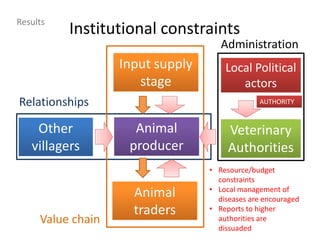
Results
Animal
producer
Input supply
stage
Animal
traders
Value chain
Other
villagers
Veterinary
Authorities
Relationships
• Resource/budget
constraints
• Local management of
diseases are encouraged
• Reports to higher
authorities are
dissuaded
Local Political
actors
AUTHORITY
Institutional constraints
Results
Administration
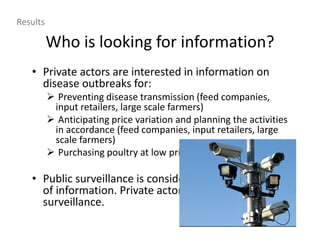
Who is looking for information?
• Private actors are interested in information on
disease outbreaks for:
Preventing disease transmission (feed companies,
input retailers, large scale farmers)
Anticipating price variation and planning the activities
in accordance (feed companies, input retailers, large
scale farmers)
Purchasing poultry at low price (poultry traders)
• Public surveillance is considered a useless source
of information. Private actors rely on informal
surveillance.
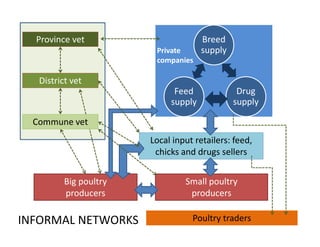
Results
Breed
supply
Drug
supply
Feed
supply
Local input retailers: feed,
chicks and drugs sellers
Small poultry
producers
Big poultry
producers
Poultry traders
District vet
Province vet
Commune vet
INFORMAL NETWORKS
Private
companies
Conclusions
1. Innovative approach
• Actors of surveillance = decision makers facing socio-economic constraints
• Interest of combining economic evaluation tools and participatory approach
2. Key elements to enhance the compliance to
surveillance and control programs :
• Producers and actors of input supply chain mainly aim at mitigating impact of
epizootics on their income and on market prices
• Existence of a private surveillance centered on feed companies
• Poor sanitary controls on the poultry value chain have an impact on disease
surveillance
• Institutional impediments = need for better control and higher support from
the central administration : encourage local actors to notify diseases
Acknowledgements
• CIRAD, AGIRs, France: Pham Thi Thanh Hoa, Marisa
Peyre, Aurélie Binot, François Roger
• Hanoi University of Agriculture, Vietnam: Phan Dang
Thang, Dao Cong Duan, Dao Thi Hiep, Vu Dinh Ton
• National Institute of Veterinary Research, Hanoi,
Vietnam: Nguyen Tien Thanh, Nguyen Viet Khong
• Université de Liège, Belgique: Nicolas Antoine Moussiaux
Thank you for your attention

A participatory methodology to assess the factors influencing performances of avian influenza surveillance network in Northern Vietnam

  • 1.
    A participatory methodologyto assess the factors influencing performances of avian influenza surveillance network in Northern Vietnam Alexis Delabouglise1,2, Nicolas Antoine-Moussiaux1,3, Phan Dang Thang4, Nguyen Tien Thanh5, Dao Cong Duan4, Pham Thi Thanh Hoa1, Dao Thi Hiep4, Vu Dinh Ton4, Nguyen Viet Khong5, Aurélie Binot1, François Roger1, Marisa Peyre1 1 CIRAD, AGIRs, France 2 Laboratoire Espace, Santé et Territoires, Université Paris Ouest, France 3 Université de Liège, Belgique 4 Hanoi Agriculture University, Vietnam 5 National Institute of Veterinary Research, Hanoi, Vietnam
  • 2.
    • Outlines I. Background: need to evaluate AI surveillance II. Methodology : participatory tools to approach decision making III. Results IV. Conclusions
  • 3.
    • Highly pathogenicavian influenza (HPAI) due to H5N1 persisting in Vietnam since 2004 • Limited evaluations of surveillance programs • Hypothesis : social and economic interactions between local actors are key elements to evaluate acceptability of surveillance systems Background
  • 4.
    Involvement of actorsin disease surveillance: A decision made under constraints INFORMATION DISCLOSURE Economic constraints Social constraintsAnimal health Public health Institutional constraints
  • 5.
  • 6.
    Geographical localization: C mHoàng commune, H i Dương province, Red river delta Farms investigated: Poultry and pig productions Methodology
  • 7.
    Decision making : Ananswer to a series of questions… Methodology
  • 8.
    • Focus groupproducers • Description of syndromes and terminology associated • Use of proportional piling and matrix scoring What kills my animals?Methodology
  • 9.
    Who do Italk to?...and why? B nh d ch gà, Niu Cát Sơn, T huy t trùng …. The village feed seller Syndrome: The town drug supplier .... The trader technicians of agro- pharmaceutical companies Poultry producer Individual interviewDrug selling + advices Rapid selling of sick animals Methodology
  • 10.
    Outbreak announcement: whowins, who loses?... And who do I listen to? • What are the consequences of an outbreak notification? • Which types of actors get benefits or disadvantages from it? • Which type of actor influences my decision? Methodology
  • 11.
    May I reportor not report if…? 50% mortality in my farm in less than 5 days Price of sick animals Amount of compensation Delay before compensation 40 000 VND/kg 30 000 VND/kg 20 000 VND/kg Delay No delay … Methodology
  • 12.
    50% mortality inmy farm in less than 5 days Price of sick animals Amount of compensation Delay before compensation Proportional piling REPORT NOT REPORT ASK OTHER FARMERS May I report or not report if…? Methodology
  • 13.
  • 14.
    constraints on producer’sdecision Animal producer Input supply stage Animal traders Value chain • Short delays to refund credits • Support farmers in treating and preventing diseases • Most contacted in case of disease outbreak FINANCIAL DEBTS Results
  • 15.
    Results constraints faced byfarmers Animal producer Input supply stage Animal traders Value chain • Negotiation of price • Possibility to sell sick animals at low price • Drop of prices caused by outbreak announcement FINANCIAL DEBTS PRICE INSTABILITY
  • 16.
    constraints faced byfarmers Animal producer Input supply stage Animal traders Value chain Other villagers • Price variation affects other farmers Relationships FINANCIAL DEBTS PRICE INSTABILITY FEAR OF IMPACT ON PRICE Results
  • 17.
    Constraints faced byfarmers Animal producer Input supply stage Animal traders Value chain Other villagers Veterinary Authorities • Uncertainty of compensation programs • Long delays of compensations • More interesting to sell sick animalsRelationships FINANCIAL DEBTS FEAR OF IMPACT ON PRICE • Control measures and compensations only in case of widespread epizootic • Authorities' reaction often follow media announcements PRICE INSTABILITY Results
  • 18.
    Animal producer Input supply stage Animal traders Value chain Other villagers Veterinary Authorities Relationships •Resource/budget constraints • Local management of diseases are encouraged • Reports to higher authorities are dissuaded Local Political actors AUTHORITY Institutional constraints Results Administration
  • 19.
    Who is lookingfor information? • Private actors are interested in information on disease outbreaks for: Preventing disease transmission (feed companies, input retailers, large scale farmers) Anticipating price variation and planning the activities in accordance (feed companies, input retailers, large scale farmers) Purchasing poultry at low price (poultry traders) • Public surveillance is considered a useless source of information. Private actors rely on informal surveillance. Results
  • 20.
    Breed supply Drug supply Feed supply Local input retailers:feed, chicks and drugs sellers Small poultry producers Big poultry producers Poultry traders District vet Province vet Commune vet INFORMAL NETWORKS Private companies
  • 21.
    Conclusions 1. Innovative approach •Actors of surveillance = decision makers facing socio-economic constraints • Interest of combining economic evaluation tools and participatory approach 2. Key elements to enhance the compliance to surveillance and control programs : • Producers and actors of input supply chain mainly aim at mitigating impact of epizootics on their income and on market prices • Existence of a private surveillance centered on feed companies • Poor sanitary controls on the poultry value chain have an impact on disease surveillance • Institutional impediments = need for better control and higher support from the central administration : encourage local actors to notify diseases
  • 22.
    Acknowledgements • CIRAD, AGIRs,France: Pham Thi Thanh Hoa, Marisa Peyre, Aurélie Binot, François Roger • Hanoi University of Agriculture, Vietnam: Phan Dang Thang, Dao Cong Duan, Dao Thi Hiep, Vu Dinh Ton • National Institute of Veterinary Research, Hanoi, Vietnam: Nguyen Tien Thanh, Nguyen Viet Khong • Université de Liège, Belgique: Nicolas Antoine Moussiaux
  • 23.
    Thank you foryour attention