Experiential account:
experience as a private
practitioner
Dr. Ashwin Mohan
M.D. Psychiatry (PGI)
Chandigarh
Presented at the national CME "OST: Policy and Practice" on 18th-19th April 2015 at AIIMS, New Delhi
The Facts
 Completed MD in 2000
 Practice since 2001
 OPD set up mainly; Attachment to Multi specialty
hospitals for admission
Presented at the national CME "OST: Policy and Practice" on 18th-19th April 2015 at AIIMS, New Delhi
Senior Residency in DDTC, PGI for one year
Multiple relapses and admissions of patients
Problems in controlling withdrawal
Poor follow up and compliance to naltrexone
Extremely frustrating for the treatment provider, patient and the family
member and very limited options available
First exposure to OST in PGI Chandigarh under
guidance of Dr. D. Basu
Patient was heroin user for 18 years including IV use and
was admitted for third time in DDTC, PGI and was put
on OST even after discharge. He continues to be relapse
free till date
Presented at the national CME "OST: Policy and Practice" on 18th-19th April 2015 at AIIMS, New Delhi
The Beginning:
 First 4 years – only 3 patients on OST; good follow up
and no relapse
 Around 2005: scaling up started after multiple failures
using traditional treatment methods, both OPD and
inpatient.
 In this initial period: used for detoxification and short
term maintenance – few weeks to about three months
 Selectively in patients of IV use and multiple relapses
Presented at the national CME "OST: Policy and Practice" on 18th-19th April 2015 at AIIMS, New Delhi
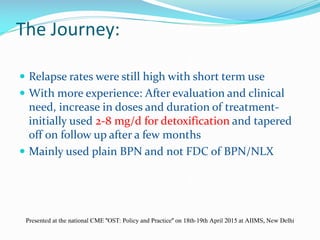
The Journey:
 Relapse rates were still high with short term use
 With more experience: After evaluation and clinical
need, increase in doses and duration of treatment-
initially used 2-8 mg/d for detoxification and tapered
off on follow up after a few months
 Mainly used plain BPN and not FDC of BPN/NLX
Presented at the national CME "OST: Policy and Practice" on 18th-19th April 2015 at AIIMS, New Delhi
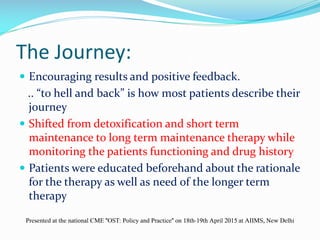
The Journey:
 Encouraging results and positive feedback.
.. “to hell and back” is how most patients describe their
journey
 Shifted from detoxification and short term
maintenance to long term maintenance therapy while
monitoring the patients functioning and drug history
 Patients were educated beforehand about the rationale
for the therapy as well as need of the longer term
therapy
Presented at the national CME "OST: Policy and Practice" on 18th-19th April 2015 at AIIMS, New Delhi
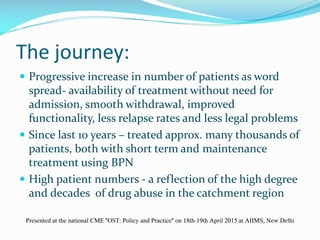
The journey:
 Progressive increase in number of patients as word
spread- availability of treatment without need for
admission, smooth withdrawal, improved
functionality, less relapse rates and less legal problems
 Since last 10 years – treated approx. many thousands of
patients, both with short term and maintenance
treatment using BPN
 High patient numbers - a reflection of the high degree
and decades of drug abuse in the catchment region
Presented at the national CME "OST: Policy and Practice" on 18th-19th April 2015 at AIIMS, New Delhi
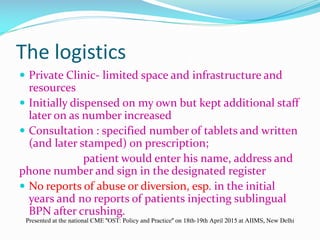
The logistics
 Private Clinic- limited space and infrastructure and
resources
 Initially dispensed on my own but kept additional staff
later on as number increased
 Consultation : specified number of tablets and written
(and later stamped) on prescription;
patient would enter his name, address and
phone number and sign in the designated register
 No reports of abuse or diversion, esp. in the initial
years and no reports of patients injecting sublingual
BPN after crushing.
Presented at the national CME "OST: Policy and Practice" on 18th-19th April 2015 at AIIMS, New Delhi
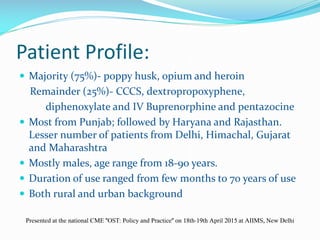
Patient Profile:
 Majority (75%)- poppy husk, opium and heroin
Remainder (25%)- CCCS, dextropropoxyphene,
diphenoxylate and IV Buprenorphine and pentazocine
 Most from Punjab; followed by Haryana and Rajasthan.
Lesser number of patients from Delhi, Himachal, Gujarat
and Maharashtra
 Mostly males, age range from 18-90 years.
 Duration of use ranged from few months to 70 years of use
 Both rural and urban background
Presented at the national CME "OST: Policy and Practice" on 18th-19th April 2015 at AIIMS, New Delhi
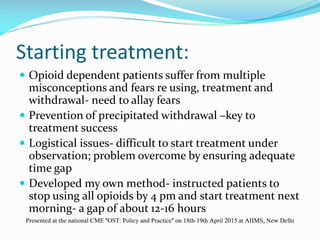
Starting treatment:
 Opioid dependent patients suffer from multiple
misconceptions and fears re using, treatment and
withdrawal- need to allay fears
 Prevention of precipitated withdrawal –key to
treatment success
 Logistical issues- difficult to start treatment under
observation; problem overcome by ensuring adequate
time gap
 Developed my own method- instructed patients to
stop using all opioids by 4 pm and start treatment next
morning- a gap of about 12-16 hours
Presented at the national CME "OST: Policy and Practice" on 18th-19th April 2015 at AIIMS, New Delhi
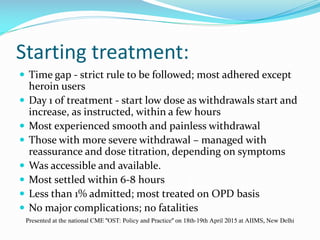
Starting treatment:
 Time gap - strict rule to be followed; most adhered except
heroin users
 Day 1 of treatment - start low dose as withdrawals start and
increase, as instructed, within a few hours
 Most experienced smooth and painless withdrawal
 Those with more severe withdrawal – managed with
reassurance and dose titration, depending on symptoms
 Was accessible and available.
 Most settled within 6-8 hours
 Less than 1% admitted; most treated on OPD basis
 No major complications; no fatalities
Presented at the national CME "OST: Policy and Practice" on 18th-19th April 2015 at AIIMS, New Delhi
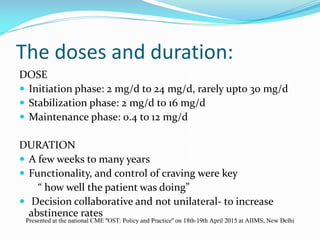
The doses and duration:
DOSE
 Initiation phase: 2 mg/d to 24 mg/d, rarely upto 30 mg/d
 Stabilization phase: 2 mg/d to 16 mg/d
 Maintenance phase: 0.4 to 12 mg/d
DURATION
 A few weeks to many years
 Functionality, and control of craving were key
“ how well the patient was doing”
 Decision collaborative and not unilateral- to increase
abstinence rates
Presented at the national CME "OST: Policy and Practice" on 18th-19th April 2015 at AIIMS, New Delhi
Termination or ……
 People often ask – “do you ever stop Buprenorphine”
The answer is YES.
Substance Dependence is a chronic, relapsing medical
illness. Maintenance treatments are used for a large
number of medical and psychiatric disorders- Do we
Question them so vehemently.
 Can categorize the patients in the following :
• The most important- majority follow up and reduce the
dose of medication under medical supervision and eventually
stop and many remain relapse free.
Able to manage without any sort of treatment later
Presented at the national CME "OST: Policy and Practice" on 18th-19th April 2015 at AIIMS, New Delhi
The other categories
 Those who use it to facilitate treatment for short term
withdrawal and then stop using Bpn
 Those using it for longer periods of time for months and then
gradually taper off on their own and don’t follow up
 Those who continue to use relatively higher doses and maintain
well on that so as to control craving
 Those tapering it off to as low as 0.4 mg and continue using it as
a form of psychological support in order not to get back to using.
 Those using Bpn intermittently and shift from using to
abstinence
 Those using bpn on an sos basis
 Those who start but don’t find complete benefit so they seesaw
between treatments
 Those who take higher doses and want to reduce but are unable
to do so despite multiple attempts as withdrawal is painful for
them – least common
Categories not mutually exclusive
Presented at the national CME "OST: Policy and Practice" on 18th-19th April 2015 at AIIMS, New Delhi
The crisis:
 March 2014, before General Elections - Tightened controls,
forces deployed, trans border and cross border vigilance
increased
 Politics to the fore with blame games, accusations and
counter accusations
 Sudden crackdown without adequate treatment
infrastructure in place - Gross underestimation of the
problem by authorities
 A massive tsunami of patients …thousands suddenly
deprived of their fix, supply lines cut
 Huge numbers registered in both govt. and private set ups
 LOGISTICAL NIGHTMARE
 Extraordinary problems with no clear solution
Presented at the national CME "OST: Policy and Practice" on 18th-19th April 2015 at AIIMS, New Delhi
The crisis:
 Unparalled environment of FEAR, PERSECUTION and
PROSECUTION prevailed
 Cases registered against patients; threats and coercion;
people forced to go for treatment
 Chemists raided….medication availability virtually
stopped in some districts
 Psychiatrists were overwhelmed, both govt. and
private sectors…most places were not equipped to deal
with the situation
Presented at the national CME "OST: Policy and Practice" on 18th-19th April 2015 at AIIMS, New Delhi
Psychiatry’s dilemma
 Harm reduction: deeply polarizing issue - No consensus,
Emotive issue, Sharp divisions. Fraternity itself plays
negative role in damning and demeaning Harm Reduction.
 Issues of Diversion and Abuse cropped up and selective
feeding by enforcement agencies fuelled this issue; blown
out of proportion relative to benefits of the medication
 Also provided a welcome distraction from the “real issue” at
hand- decades of facilitation and poor enforcement and
narco-money used for funding political ambitions
 Psychiatrists inspected, persecuted and prosecuted to no
end; Blamed for the whole situation as if they were the ones
responsible for its creation
Presented at the national CME "OST: Policy and Practice" on 18th-19th April 2015 at AIIMS, New Delhi
The crisis:
 Diversion occurred during this period : reason was
huge Demand – Supply gap between number of
patients and treatment services, and irrational
restriction of medication availability
 More a case of ‘para-prescribing and ‘unobserved
treatment’ and hoarding by panic stricken patients
 Vicious media campaign started against OST modality
and psychiatrists practicing it
Presented at the national CME "OST: Policy and Practice" on 18th-19th April 2015 at AIIMS, New Delhi
The crisis:
 Psychiatrists esp. private sector equated to drug
peddlers and blamed for diversion
 Govt. supply reduced further and even govt.
psychiatrists threatened..restricted to inpatient use
 Apart from BPN, even tramadol use was severely
restricted
 Convoluted, irrational and unscientific cobweb of
rules, policies and laws invoked to prosecute
psychiatrists
Presented at the national CME "OST: Policy and Practice" on 18th-19th April 2015 at AIIMS, New Delhi
The result:
“BUPRENORPHINE BECAME A GREAT MEDICATION
WITH A BAD PRESS”
 Psychiatrists stopped using BPN in many centres
 Those using it, reduced dispensing doses and duration
such that it was inadequate to control withdrawal/ craving
 No medication was available for treatment. In some
districts, even benzodiazepines were stopped
 There was an aversion towards treatment of opioid
dependence by doctors. Many did not want to treat them
Presented at the national CME "OST: Policy and Practice" on 18th-19th April 2015 at AIIMS, New Delhi
The result
 Illicit drugs still available- cost increased to 2-4 times.
 Treatment avenues and modalities reduced.
 No medications to address the crucial issue of craving
 No maintenance treatments, naltrexone a failure.
 The number of addicts registering at centres show a dramatic
fall. This statistic has been used to “show success” of the
campaign
 Many patients either relapsed or flocked to Haryana and
Rajasthan where treatment is still available
 Newer Epidemics- IV heroin use increased dramatically;
Tramadol and Tapentadol Dependence have emerged as the
newer drugs of abuse
Presented at the national CME "OST: Policy and Practice" on 18th-19th April 2015 at AIIMS, New Delhi
My opinion- the way forward
 OST is a wonderful treatment - one of the best tools
 Use can reduce the demand for illicit drugs significantly
 The principle of harm reduction needs better
understanding, publicity and coverage. This is where we
have failed miserably.
 All psychiatrists by way of their qualification need to be
allowed to use BPN and other treatments irrespective of
the setting in which they practice- Govt. Hospital,
Community health centres, Nursing homes or clinics. The
setting should not matter
 Checks and balances can be made - All psychiatrists
desirous of using OST can be registered, if required, rather
than persecuted.
Presented at the national CME "OST: Policy and Practice" on 18th-19th April 2015 at AIIMS, New Delhi
My opinion- the way forward
 Other treatment modalities like methadone should
also be widely available
 Urgent scaling up of services is the need of the hour
 There may also a case for opening up of low strength
poppy husk vends which can be taxed, with direct
supply from Govt. factories and fixed quotas
 Will take care of diversion to a large extent
Presented at the national CME "OST: Policy and Practice" on 18th-19th April 2015 at AIIMS, New Delhi
Conclusion
 Roller coaster ride with a current low as far as OST is
concerned
 Substance Dependence is treated with disdain and
repugnance; Need to change fraternity’s own approach
to dependence
 More patient friendly policies required
 All stakeholders need to be taken into confidence and
knee jerk reactions avoided
Though my experience can be described as
BITTER- SWEET, I continue to have faith in OST and
remain a firm advocate of the same
Presented at the national CME "OST: Policy and Practice" on 18th-19th April 2015 at AIIMS, New Delhi

Experiential account experience as a private practitioner

  • 1.
    Experiential account: experience asa private practitioner Dr. Ashwin Mohan M.D. Psychiatry (PGI) Chandigarh Presented at the national CME "OST: Policy and Practice" on 18th-19th April 2015 at AIIMS, New Delhi
  • 2.
    The Facts  CompletedMD in 2000  Practice since 2001  OPD set up mainly; Attachment to Multi specialty hospitals for admission Presented at the national CME "OST: Policy and Practice" on 18th-19th April 2015 at AIIMS, New Delhi
  • 3.
    Senior Residency inDDTC, PGI for one year Multiple relapses and admissions of patients Problems in controlling withdrawal Poor follow up and compliance to naltrexone Extremely frustrating for the treatment provider, patient and the family member and very limited options available First exposure to OST in PGI Chandigarh under guidance of Dr. D. Basu Patient was heroin user for 18 years including IV use and was admitted for third time in DDTC, PGI and was put on OST even after discharge. He continues to be relapse free till date Presented at the national CME "OST: Policy and Practice" on 18th-19th April 2015 at AIIMS, New Delhi
  • 4.
    The Beginning:  First4 years – only 3 patients on OST; good follow up and no relapse  Around 2005: scaling up started after multiple failures using traditional treatment methods, both OPD and inpatient.  In this initial period: used for detoxification and short term maintenance – few weeks to about three months  Selectively in patients of IV use and multiple relapses Presented at the national CME "OST: Policy and Practice" on 18th-19th April 2015 at AIIMS, New Delhi
  • 5.
    The Journey:  Relapserates were still high with short term use  With more experience: After evaluation and clinical need, increase in doses and duration of treatment- initially used 2-8 mg/d for detoxification and tapered off on follow up after a few months  Mainly used plain BPN and not FDC of BPN/NLX Presented at the national CME "OST: Policy and Practice" on 18th-19th April 2015 at AIIMS, New Delhi
  • 6.
    The Journey:  Encouragingresults and positive feedback. .. “to hell and back” is how most patients describe their journey  Shifted from detoxification and short term maintenance to long term maintenance therapy while monitoring the patients functioning and drug history  Patients were educated beforehand about the rationale for the therapy as well as need of the longer term therapy Presented at the national CME "OST: Policy and Practice" on 18th-19th April 2015 at AIIMS, New Delhi
  • 7.
    The journey:  Progressiveincrease in number of patients as word spread- availability of treatment without need for admission, smooth withdrawal, improved functionality, less relapse rates and less legal problems  Since last 10 years – treated approx. many thousands of patients, both with short term and maintenance treatment using BPN  High patient numbers - a reflection of the high degree and decades of drug abuse in the catchment region Presented at the national CME "OST: Policy and Practice" on 18th-19th April 2015 at AIIMS, New Delhi
  • 8.
    The logistics  PrivateClinic- limited space and infrastructure and resources  Initially dispensed on my own but kept additional staff later on as number increased  Consultation : specified number of tablets and written (and later stamped) on prescription; patient would enter his name, address and phone number and sign in the designated register  No reports of abuse or diversion, esp. in the initial years and no reports of patients injecting sublingual BPN after crushing. Presented at the national CME "OST: Policy and Practice" on 18th-19th April 2015 at AIIMS, New Delhi
  • 9.
    Patient Profile:  Majority(75%)- poppy husk, opium and heroin Remainder (25%)- CCCS, dextropropoxyphene, diphenoxylate and IV Buprenorphine and pentazocine  Most from Punjab; followed by Haryana and Rajasthan. Lesser number of patients from Delhi, Himachal, Gujarat and Maharashtra  Mostly males, age range from 18-90 years.  Duration of use ranged from few months to 70 years of use  Both rural and urban background Presented at the national CME "OST: Policy and Practice" on 18th-19th April 2015 at AIIMS, New Delhi
  • 10.
    Starting treatment:  Opioiddependent patients suffer from multiple misconceptions and fears re using, treatment and withdrawal- need to allay fears  Prevention of precipitated withdrawal –key to treatment success  Logistical issues- difficult to start treatment under observation; problem overcome by ensuring adequate time gap  Developed my own method- instructed patients to stop using all opioids by 4 pm and start treatment next morning- a gap of about 12-16 hours Presented at the national CME "OST: Policy and Practice" on 18th-19th April 2015 at AIIMS, New Delhi
  • 11.
    Starting treatment:  Timegap - strict rule to be followed; most adhered except heroin users  Day 1 of treatment - start low dose as withdrawals start and increase, as instructed, within a few hours  Most experienced smooth and painless withdrawal  Those with more severe withdrawal – managed with reassurance and dose titration, depending on symptoms  Was accessible and available.  Most settled within 6-8 hours  Less than 1% admitted; most treated on OPD basis  No major complications; no fatalities Presented at the national CME "OST: Policy and Practice" on 18th-19th April 2015 at AIIMS, New Delhi
  • 12.
    The doses andduration: DOSE  Initiation phase: 2 mg/d to 24 mg/d, rarely upto 30 mg/d  Stabilization phase: 2 mg/d to 16 mg/d  Maintenance phase: 0.4 to 12 mg/d DURATION  A few weeks to many years  Functionality, and control of craving were key “ how well the patient was doing”  Decision collaborative and not unilateral- to increase abstinence rates Presented at the national CME "OST: Policy and Practice" on 18th-19th April 2015 at AIIMS, New Delhi
  • 13.
    Termination or …… People often ask – “do you ever stop Buprenorphine” The answer is YES. Substance Dependence is a chronic, relapsing medical illness. Maintenance treatments are used for a large number of medical and psychiatric disorders- Do we Question them so vehemently.  Can categorize the patients in the following : • The most important- majority follow up and reduce the dose of medication under medical supervision and eventually stop and many remain relapse free. Able to manage without any sort of treatment later Presented at the national CME "OST: Policy and Practice" on 18th-19th April 2015 at AIIMS, New Delhi
  • 14.
    The other categories Those who use it to facilitate treatment for short term withdrawal and then stop using Bpn  Those using it for longer periods of time for months and then gradually taper off on their own and don’t follow up  Those who continue to use relatively higher doses and maintain well on that so as to control craving  Those tapering it off to as low as 0.4 mg and continue using it as a form of psychological support in order not to get back to using.  Those using Bpn intermittently and shift from using to abstinence  Those using bpn on an sos basis  Those who start but don’t find complete benefit so they seesaw between treatments  Those who take higher doses and want to reduce but are unable to do so despite multiple attempts as withdrawal is painful for them – least common Categories not mutually exclusive Presented at the national CME "OST: Policy and Practice" on 18th-19th April 2015 at AIIMS, New Delhi
  • 15.
    The crisis:  March2014, before General Elections - Tightened controls, forces deployed, trans border and cross border vigilance increased  Politics to the fore with blame games, accusations and counter accusations  Sudden crackdown without adequate treatment infrastructure in place - Gross underestimation of the problem by authorities  A massive tsunami of patients …thousands suddenly deprived of their fix, supply lines cut  Huge numbers registered in both govt. and private set ups  LOGISTICAL NIGHTMARE  Extraordinary problems with no clear solution Presented at the national CME "OST: Policy and Practice" on 18th-19th April 2015 at AIIMS, New Delhi
  • 16.
    The crisis:  Unparalledenvironment of FEAR, PERSECUTION and PROSECUTION prevailed  Cases registered against patients; threats and coercion; people forced to go for treatment  Chemists raided….medication availability virtually stopped in some districts  Psychiatrists were overwhelmed, both govt. and private sectors…most places were not equipped to deal with the situation Presented at the national CME "OST: Policy and Practice" on 18th-19th April 2015 at AIIMS, New Delhi
  • 17.
    Psychiatry’s dilemma  Harmreduction: deeply polarizing issue - No consensus, Emotive issue, Sharp divisions. Fraternity itself plays negative role in damning and demeaning Harm Reduction.  Issues of Diversion and Abuse cropped up and selective feeding by enforcement agencies fuelled this issue; blown out of proportion relative to benefits of the medication  Also provided a welcome distraction from the “real issue” at hand- decades of facilitation and poor enforcement and narco-money used for funding political ambitions  Psychiatrists inspected, persecuted and prosecuted to no end; Blamed for the whole situation as if they were the ones responsible for its creation Presented at the national CME "OST: Policy and Practice" on 18th-19th April 2015 at AIIMS, New Delhi
  • 18.
    The crisis:  Diversionoccurred during this period : reason was huge Demand – Supply gap between number of patients and treatment services, and irrational restriction of medication availability  More a case of ‘para-prescribing and ‘unobserved treatment’ and hoarding by panic stricken patients  Vicious media campaign started against OST modality and psychiatrists practicing it Presented at the national CME "OST: Policy and Practice" on 18th-19th April 2015 at AIIMS, New Delhi
  • 19.
    The crisis:  Psychiatristsesp. private sector equated to drug peddlers and blamed for diversion  Govt. supply reduced further and even govt. psychiatrists threatened..restricted to inpatient use  Apart from BPN, even tramadol use was severely restricted  Convoluted, irrational and unscientific cobweb of rules, policies and laws invoked to prosecute psychiatrists Presented at the national CME "OST: Policy and Practice" on 18th-19th April 2015 at AIIMS, New Delhi
  • 20.
    The result: “BUPRENORPHINE BECAMEA GREAT MEDICATION WITH A BAD PRESS”  Psychiatrists stopped using BPN in many centres  Those using it, reduced dispensing doses and duration such that it was inadequate to control withdrawal/ craving  No medication was available for treatment. In some districts, even benzodiazepines were stopped  There was an aversion towards treatment of opioid dependence by doctors. Many did not want to treat them Presented at the national CME "OST: Policy and Practice" on 18th-19th April 2015 at AIIMS, New Delhi
  • 21.
    The result  Illicitdrugs still available- cost increased to 2-4 times.  Treatment avenues and modalities reduced.  No medications to address the crucial issue of craving  No maintenance treatments, naltrexone a failure.  The number of addicts registering at centres show a dramatic fall. This statistic has been used to “show success” of the campaign  Many patients either relapsed or flocked to Haryana and Rajasthan where treatment is still available  Newer Epidemics- IV heroin use increased dramatically; Tramadol and Tapentadol Dependence have emerged as the newer drugs of abuse Presented at the national CME "OST: Policy and Practice" on 18th-19th April 2015 at AIIMS, New Delhi
  • 22.
    My opinion- theway forward  OST is a wonderful treatment - one of the best tools  Use can reduce the demand for illicit drugs significantly  The principle of harm reduction needs better understanding, publicity and coverage. This is where we have failed miserably.  All psychiatrists by way of their qualification need to be allowed to use BPN and other treatments irrespective of the setting in which they practice- Govt. Hospital, Community health centres, Nursing homes or clinics. The setting should not matter  Checks and balances can be made - All psychiatrists desirous of using OST can be registered, if required, rather than persecuted. Presented at the national CME "OST: Policy and Practice" on 18th-19th April 2015 at AIIMS, New Delhi
  • 23.
    My opinion- theway forward  Other treatment modalities like methadone should also be widely available  Urgent scaling up of services is the need of the hour  There may also a case for opening up of low strength poppy husk vends which can be taxed, with direct supply from Govt. factories and fixed quotas  Will take care of diversion to a large extent Presented at the national CME "OST: Policy and Practice" on 18th-19th April 2015 at AIIMS, New Delhi
  • 24.
    Conclusion  Roller coasterride with a current low as far as OST is concerned  Substance Dependence is treated with disdain and repugnance; Need to change fraternity’s own approach to dependence  More patient friendly policies required  All stakeholders need to be taken into confidence and knee jerk reactions avoided Though my experience can be described as BITTER- SWEET, I continue to have faith in OST and remain a firm advocate of the same Presented at the national CME "OST: Policy and Practice" on 18th-19th April 2015 at AIIMS, New Delhi