Animal Disease Control
Prepared by: Noemi Diloy- Encarnacion, DVM, MVetEpi
Session objectives:
At the end of this topic, the participants should be able to:
• Assess the importance of local diseases based on selected criteria;
• Distinguish prevention, control and eradication; and
• Describe the various strategies for animal disease control.
Disease control programs are essential for the reduction, elimination or eradication of animal and
poultry diseases and the prevention of the introduction or outbreak of foreign or domestic diseases.
Definitions
 Prevention- refers to measures designed to prevent disease occurrence.
 Disease control- reduction of the prevalence of a disease to a level where it is no longer
considered a major health and/or economic problem.
Goals are:
o Reduce mortality
o Reduce morbidity
 Disease elimination- this is the near eradication stage; it is the stage between disease control
and disease eradication status. The goal is to reduce the disease to a level that it has become a
minor health problem. WHO (1991) defines it as “reduction of prevalence to a level below one
case per million population.”
 Eradication- total elimination of a disease. Achieved by eliminating the reservoir or source of the
agent, severing the transmission chain or making the hosts immune to the disease. WHO
describes this stage as having “no further cases of a disease occurring anywhere, and continued
control measures are unnecessary.”
How do you know a good disease control officer?
1. He/she knows how to make a “priority” list.
2. He/she responds quickly
3. He/she can mobilize the right persons for the task: diagnose, control, and monitor disease problems.
4. He/she can control the disease with the least cost.
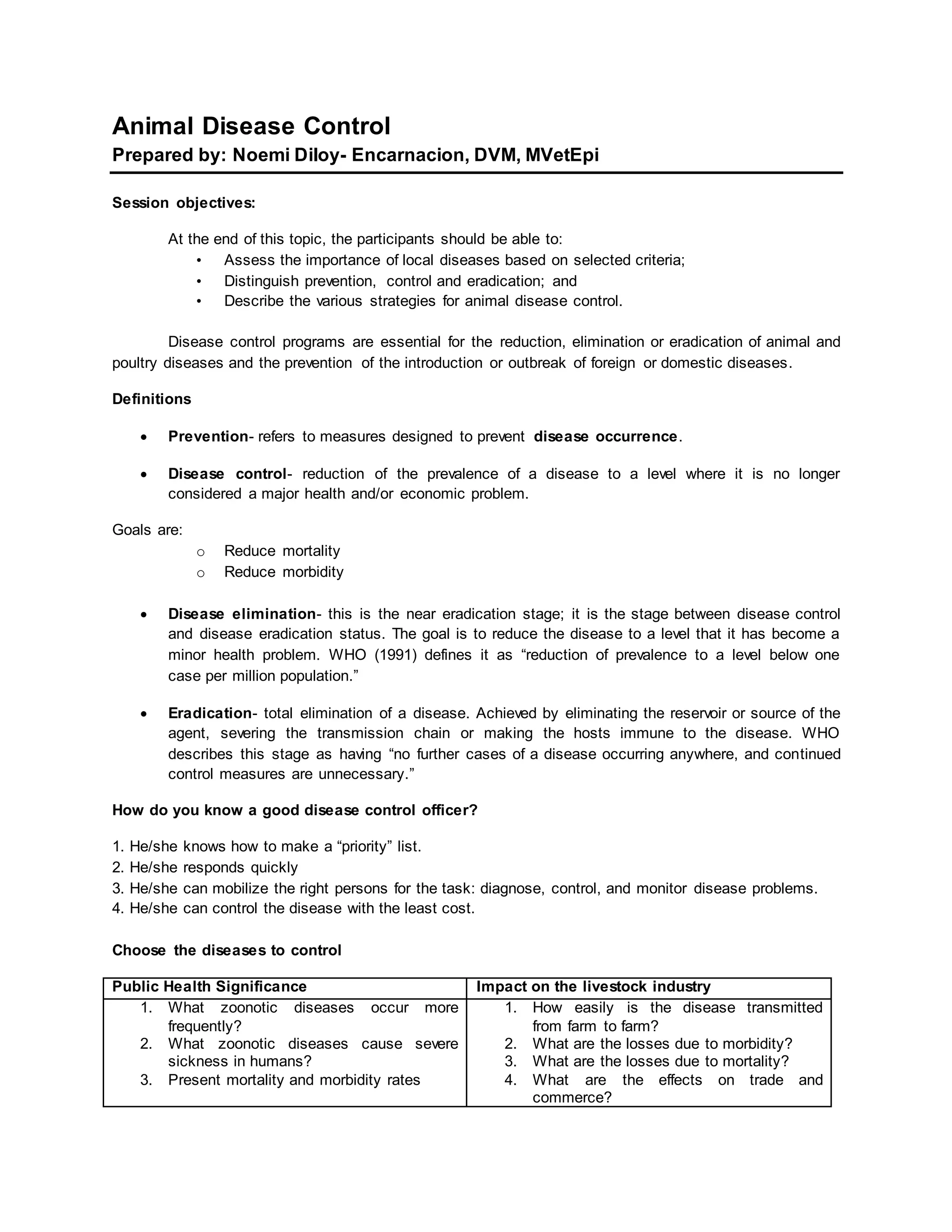
Choose the diseases to control
Public Health Significance Impact on the livestock industry
1. What zoonotic diseases occur more
frequently?
2. What zoonotic diseases cause severe
sickness in humans?
3. Present mortality and morbidity rates
1. How easily is the disease transmitted
from farm to farm?
2. What are the losses due to morbidity?
3. What are the losses due to mortality?
4. What are the effects on trade and
commerce?
Prioritization
Items are ranked in order based on their “perceived or measured importance or significance”.
Make the best use of limited human and financial resources
A. Simplex: Group perceptions are obtained by the use of questionnaires.
B. Nominal Group planning: Panel of experts is formed and individual judgments must be tapped and
combined to arrive at decisions which cannot be determined by one person.
C. Criteria Weighting Method: Mathematical process whereby participants establish a relevant set of
criteria and assign a priority ranking to issues based on how they measure against the criteria. The
calculated values do not necessarily dictate the final policy decision, but offer a means by which choices
can be ordered.
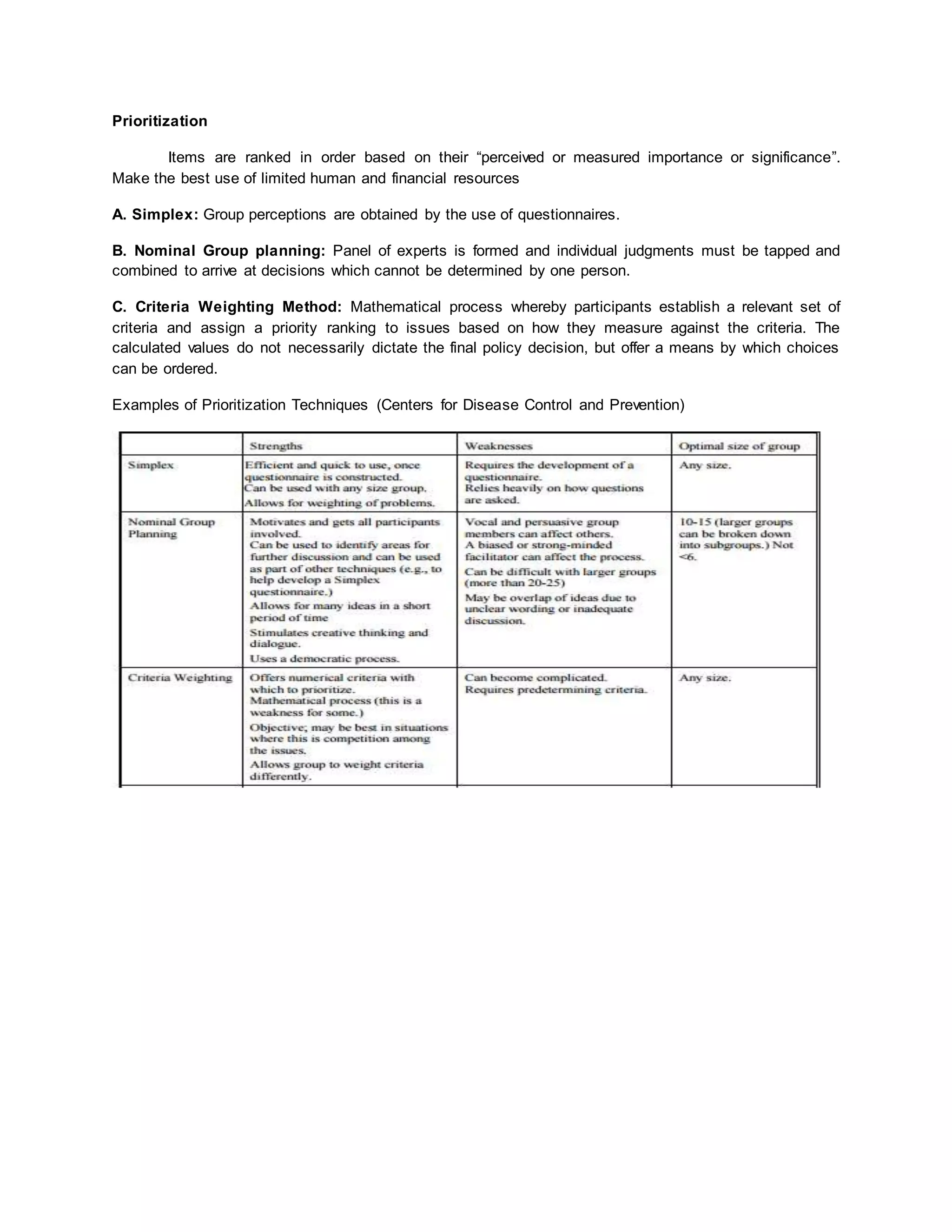
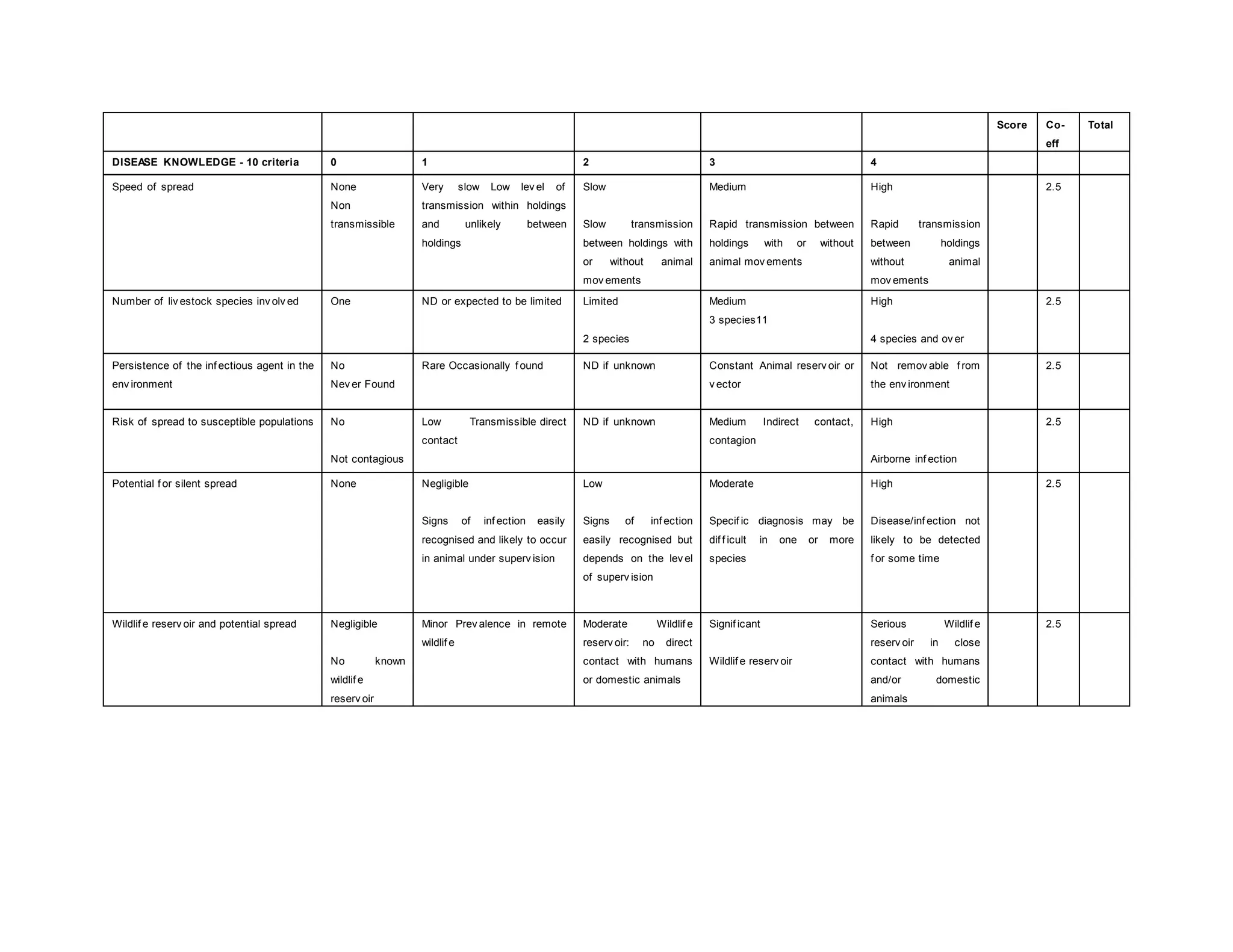
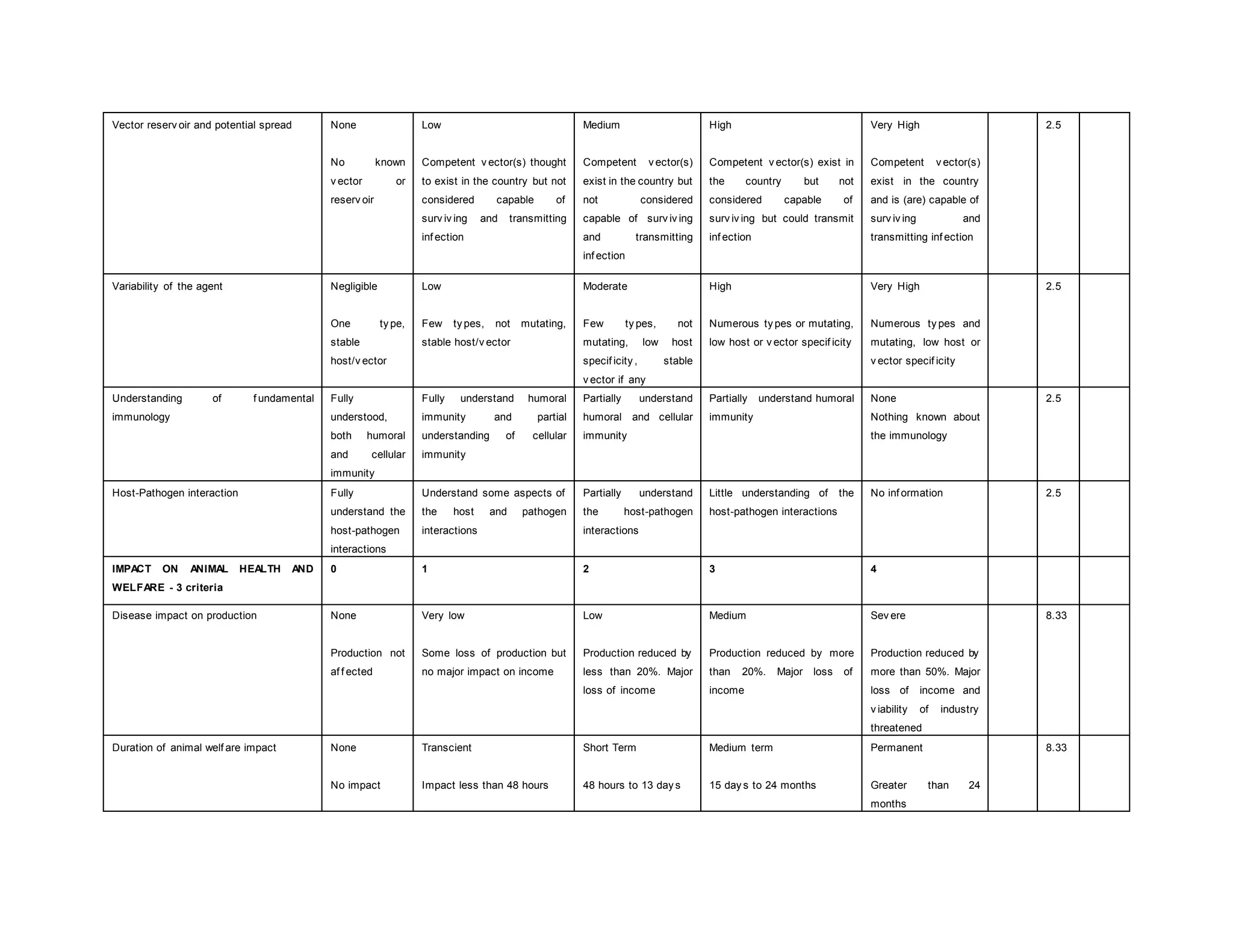
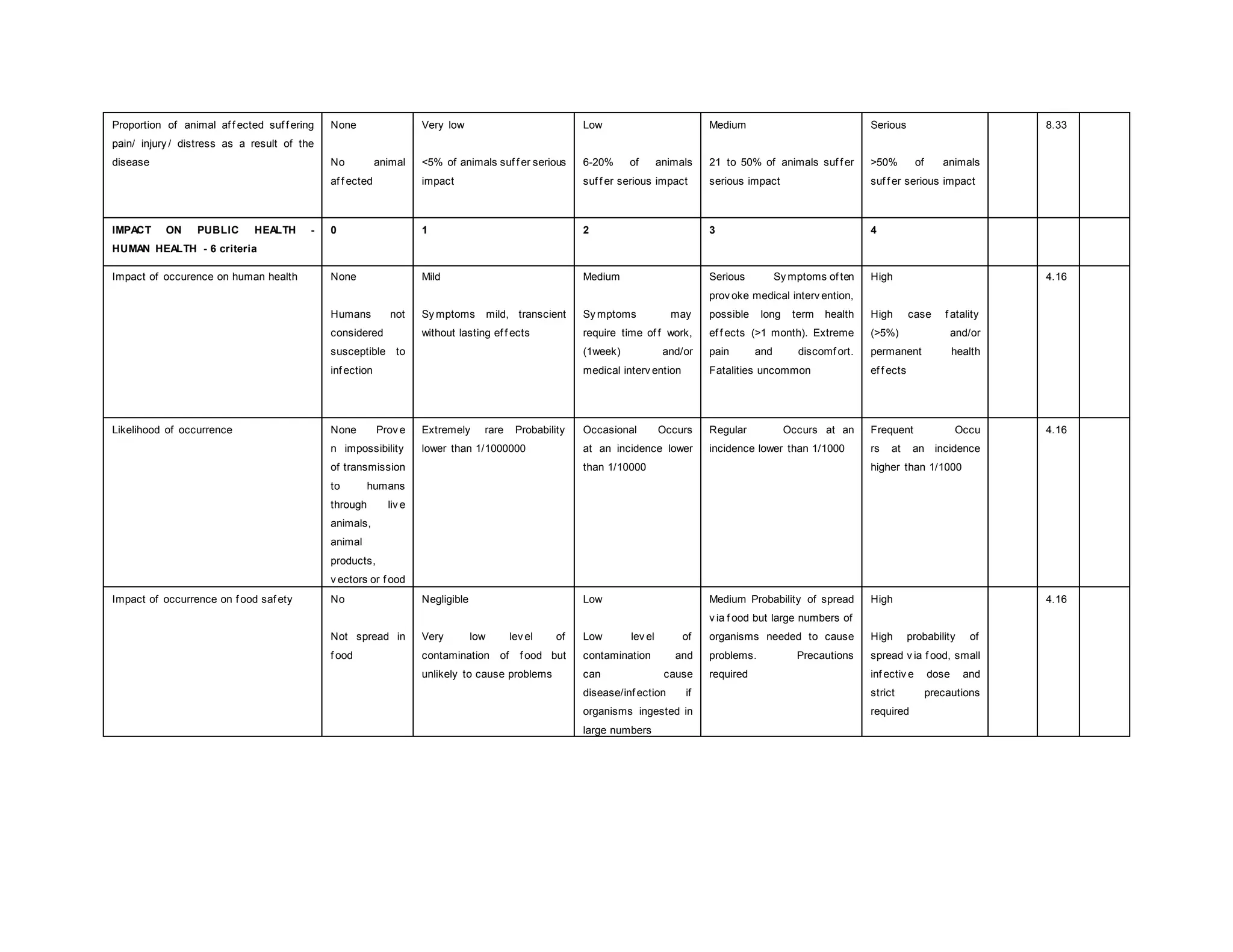
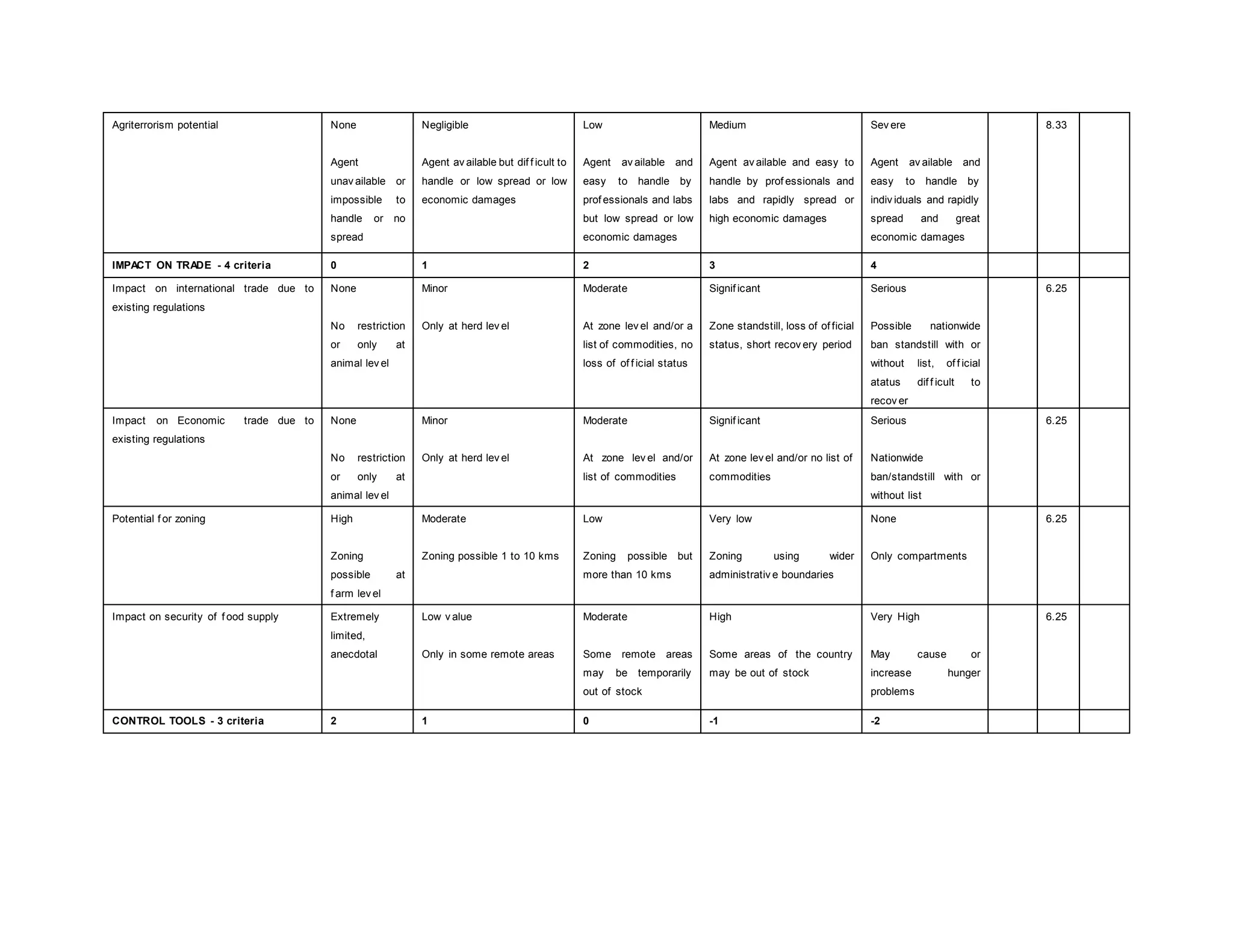
Examples of Prioritization Techniques (Centers for Disease Control and Prevention)
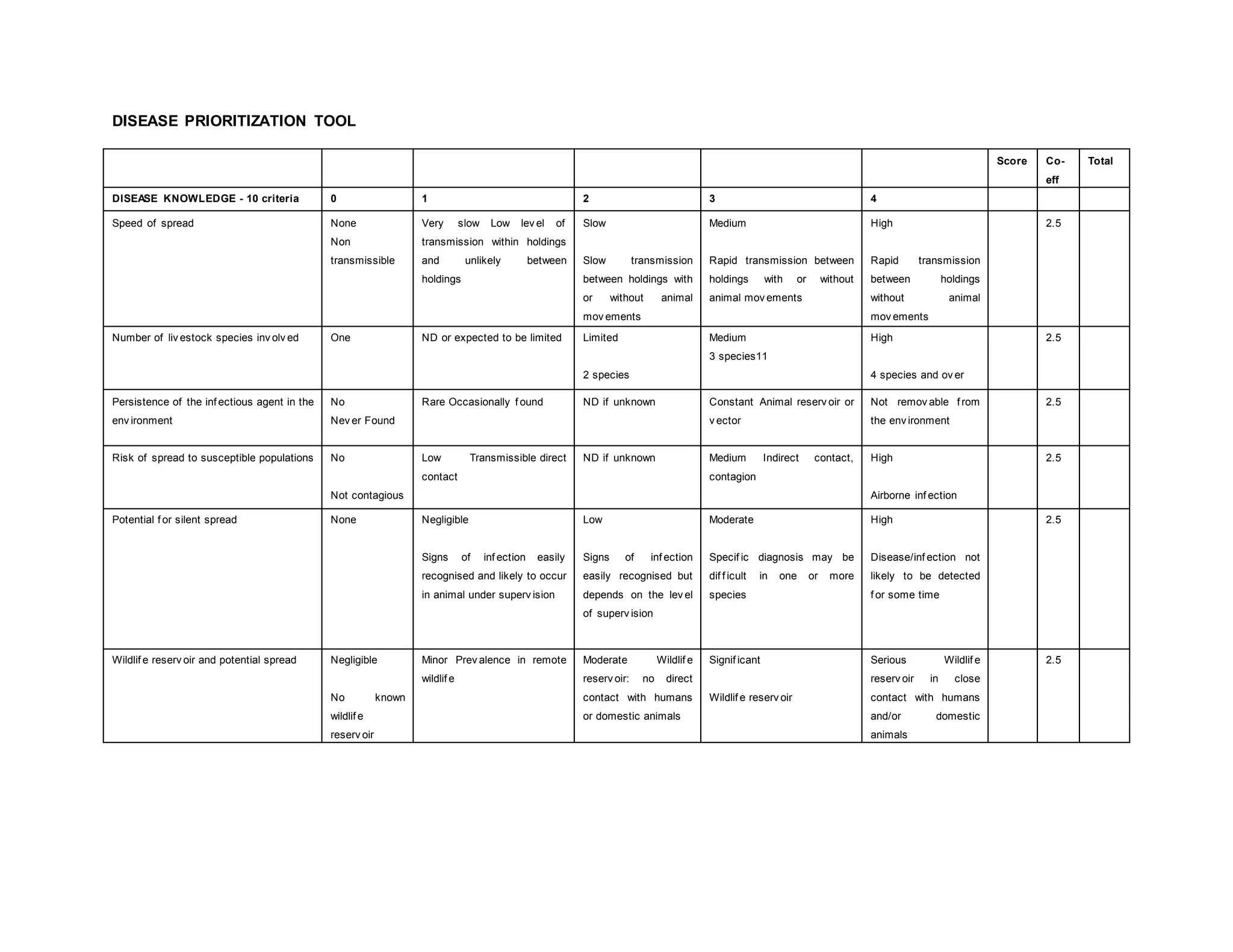
DISEASE PRIORITIZATION TOOL
Score Co-
eff
Total
DISEASE KNOWLEDGE - 10 criteria 0 1 2 3 4
Speed of spread None
Non
transmissible
Very slow Low lev el of
transmission within holdings
and unlikely between
holdings
Slow
Slow transmission
between holdings with
or without animal
mov ements
Medium
Rapid transmission between
holdings with or without
animal mov ements
High
Rapid transmission
between holdings
without animal
mov ements
2.5
Number of liv estock species inv olv ed One ND or expected to be limited Limited
2 species
Medium
3 species11
High
4 species and ov er
2.5
Persistence of the inf ectious agent in the
env ironment
No
Nev er Found
Rare Occasionally f ound ND if unknown Constant Animal reserv oir or
v ector
Not remov able f rom
the env ironment
2.5
Risk of spread to susceptible populations No
Not contagious
Low Transmissible direct
contact
ND if unknown Medium Indirect contact,
contagion
High
Airborne inf ection
2.5
Potential f or silent spread None Negligible
Signs of inf ection easily
recognised and likely to occur
in animal under superv ision
Low
Signs of inf ection
easily recognised but
depends on the lev el
of superv ision
Moderate
Specif ic diagnosis may be
dif f icult in one or more
species
High
Disease/inf ection not
likely to be detected
f or some time
2.5
Wildlif e reserv oir and potential spread Negligible
No known
wildlif e
reserv oir
Minor Prev alence in remote
wildlif e
Moderate Wildlif e
reserv oir: no direct
contact with humans
or domestic animals
Signif icant
Wildlif e reserv oir
Serious Wildlif e
reserv oir in close
contact with humans
and/or domestic
animals
2.5
Vector reserv oir and potential spread None
No known
v ector or
reserv oir
Low
Competent v ector(s) thought
to exist in the country but not
considered capable of
surv iv ing and transmitting
inf ection
Medium
Competent v ector(s)
exist in the country but
not considered
capable of surv iv ing
and transmitting
inf ection
High
Competent v ector(s) exist in
the country but not
considered capable of
surv iv ing but could transmit
inf ection
Very High
Competent v ector(s)
exist in the country
and is (are) capable of
surv iv ing and
transmitting inf ection
2.5
Variability of the agent Negligible
One ty pe,
stable
host/v ector
Low
Few ty pes, not mutating,
stable host/v ector
Moderate
Few ty pes, not
mutating, low host
specif icity , stable
v ector if any
High
Numerous ty pes or mutating,
low host or v ector specif icity
Very High
Numerous ty pes and
mutating, low host or
v ector specif icity
2.5
Understanding of f undamental
immunology
Fully
understood,
both humoral
and cellular
immunity
Fully understand humoral
immunity and partial
understanding of cellular
immunity
Partially understand
humoral and cellular
immunity
Partially understand humoral
immunity
None
Nothing known about
the immunology
2.5
Host-Pathogen interaction Fully
understand the
host-pathogen
interactions
Understand some aspects of
the host and pathogen
interactions
Partially understand
the host-pathogen
interactions
Little understanding of the
host-pathogen interactions
No inf ormation 2.5
IMPACT ON ANIMAL HEALTH AND
WELFARE - 3 criteria
0 1 2 3 4
Disease impact on production None
Production not
af f ected
Very low
Some loss of production but
no major impact on income
Low
Production reduced by
less than 20%. Major
loss of income
Medium
Production reduced by more
than 20%. Major loss of
income
Sev ere
Production reduced by
more than 50%. Major
loss of income and
v iability of industry
threatened
8.33
Duration of animal welf are impact None
No impact
Transcient
Impact less than 48 hours
Short Term
48 hours to 13 day s
Medium term
15 day s to 24 months
Permanent
Greater than 24
months
8.33
Proportion of animal af f ected suf f ering
pain/ injury / distress as a result of the
disease
None
No animal
af f ected
Very low
<5% of animals suf f er serious
impact
Low
6-20% of animals
suf f er serious impact
Medium
21 to 50% of animals suf f er
serious impact
Serious
>50% of animals
suf f er serious impact
8.33
IMPACT ON PUBLIC HEALTH -
HUMAN HEALTH - 6 criteria
0 1 2 3 4
Impact of occurence on human health None
Humans not
considered
susceptible to
inf ection
Mild
Sy mptoms mild, transcient
without lasting ef f ects
Medium
Sy mptoms may
require time of f work,
(1week) and/or
medical interv ention
Serious Sy mptoms of ten
prov oke medical interv ention,
possible long term health
ef f ects (>1 month). Extreme
pain and discomf ort.
Fatalities uncommon
High
High case f atality
(>5%) and/or
permanent health
ef f ects
4.16
Likelihood of occurrence None Prov e
n impossibility
of transmission
to humans
through liv e
animals,
animal
products,
v ectors or f ood
Extremely rare Probability
lower than 1/1000000
Occasional Occurs
at an incidence lower
than 1/10000
Regular Occurs at an
incidence lower than 1/1000
Frequent Occu
rs at an incidence
higher than 1/1000
4.16
Impact of occurrence on f ood saf ety No
Not spread in
f ood
Negligible
Very low lev el of
contamination of f ood but
unlikely to cause problems
Low
Low lev el of
contamination and
can cause
disease/inf ection if
organisms ingested in
large numbers
Medium Probability of spread
v ia f ood but large numbers of
organisms needed to cause
problems. Precautions
required
High
High probability of
spread v ia f ood, small
inf ectiv e dose and
strict precautions
required
4.16
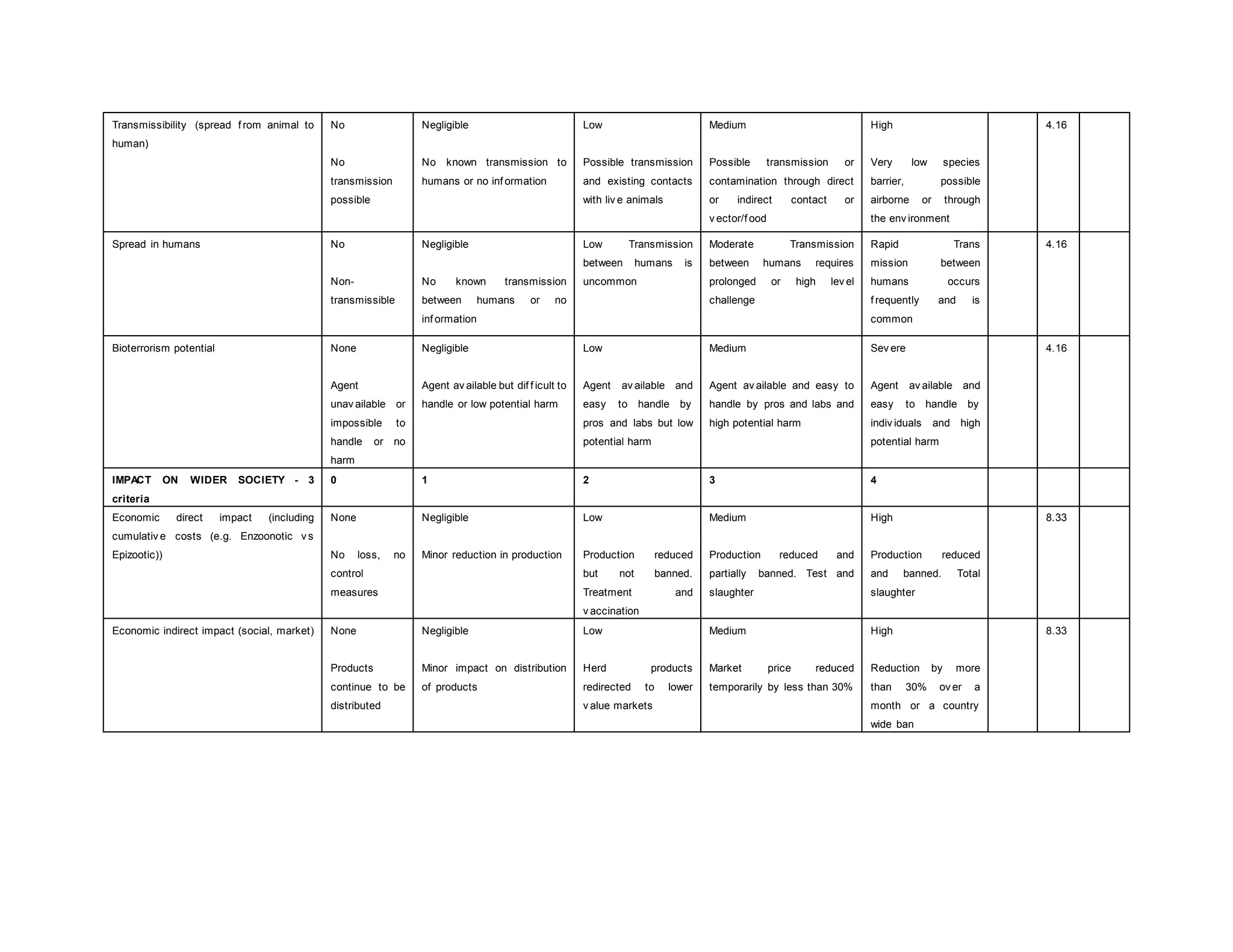
Transmissibility (spread f rom animal to
human)
No
No
transmission
possible
Negligible
No known transmission to
humans or no inf ormation
Low
Possible transmission
and existing contacts
with liv e animals
Medium
Possible transmission or
contamination through direct
or indirect contact or
v ector/f ood
High
Very low species
barrier, possible
airborne or through
the env ironment
4.16
Spread in humans No
Non-
transmissible
Negligible
No known transmission
between humans or no
inf ormation
Low Transmission
between humans is
uncommon
Moderate Transmission
between humans requires
prolonged or high lev el
challenge
Rapid Trans
mission between
humans occurs
f requently and is
common
4.16
Bioterrorism potential None
Agent
unav ailable or
impossible to
handle or no
harm
Negligible
Agent av ailable but dif f icult to
handle or low potential harm
Low
Agent av ailable and
easy to handle by
pros and labs but low
potential harm
Medium
Agent av ailable and easy to
handle by pros and labs and
high potential harm
Sev ere
Agent av ailable and
easy to handle by
indiv iduals and high
potential harm
4.16
IMPACT ON WIDER SOCIETY - 3
criteria
0 1 2 3 4
Economic direct impact (including
cumulativ e costs (e.g. Enzoonotic v s
Epizootic))
None
No loss, no
control
measures
Negligible
Minor reduction in production
Low
Production reduced
but not banned.
Treatment and
v accination
Medium
Production reduced and
partially banned. Test and
slaughter
High
Production reduced
and banned. Total
slaughter
8.33
Economic indirect impact (social, market) None
Products
continue to be
distributed
Negligible
Minor impact on distribution
of products
Low
Herd products
redirected to lower
v alue markets
Medium
Market price reduced
temporarily by less than 30%
High
Reduction by more
than 30% ov er a
month or a country
wide ban
8.33
Agriterrorism potential None
Agent
unav ailable or
impossible to
handle or no
spread
Negligible
Agent av ailable but dif f icult to
handle or low spread or low
economic damages
Low
Agent av ailable and
easy to handle by
prof essionals and labs
but low spread or low
economic damages
Medium
Agent av ailable and easy to
handle by prof essionals and
labs and rapidly spread or
high economic damages
Sev ere
Agent av ailable and
easy to handle by
indiv iduals and rapidly
spread and great
economic damages
8.33
IMPACT ON TRADE - 4 criteria 0 1 2 3 4
Impact on international trade due to
existing regulations
None
No restriction
or only at
animal lev el
Minor
Only at herd lev el
Moderate
At zone lev el and/or a
list of commodities, no
loss of of f icial status
Signif icant
Zone standstill, loss of of ficial
status, short recov ery period
Serious
Possible nationwide
ban standstill with or
without list, of f icial
atatus dif f icult to
recov er
6.25
Impact on Economic trade due to
existing regulations
None
No restriction
or only at
animal lev el
Minor
Only at herd lev el
Moderate
At zone lev el and/or
list of commodities
Signif icant
At zone lev el and/or no list of
commodities
Serious
Nationwide
ban/standstill with or
without list
6.25
Potential f or zoning High
Zoning
possible at
f arm lev el
Moderate
Zoning possible 1 to 10 kms
Low
Zoning possible but
more than 10 kms
Very low
Zoning using wider
administrativ e boundaries
None
Only compartments
6.25
Impact on security of f ood supply Extremely
limited,
anecdotal
Low v alue
Only in some remote areas
Moderate
Someremote areas
may be temporarily
out of stock
High
Some areas of the country
may be out of stock
Very High
May cause or
increase hunger
problems
6.25
CONTROL TOOLS - 3 criteria 2 1 0 -1 -2
Appropriate diagnostics Need: Yes
Av ailability : No
Market
Potential: Low
Need: Yes
Av ailability : No
Market Potential: Yes
Need: Yes
Av ailability : Yes (not
f ully ef f ectiv e)
Market Potential: Low
to Medium
Need: Yes
Av ailability : Yes (not f ully
ef f ectiv e)
Market Potential: Yes
Either Need: No
or Need: Yes
Av ailability : Yes (f ully
ef f ectiv e)
Market Potential: Yes
16.6
6
Appropriate v accines Need: Yes
Av ailability : No
Market
Potential: Low
Need: Yes
Av ailability : No
Market Potential: Yes
Need: Yes
Av ailability : Yes (not
f ully ef f ectiv e)
Market Potential: Low
to Medium
Need: Yes
Av ailability : Yes (not f ully
ef f ectiv e)
Market Potential: Yes
Either Need: No
or Need: Yes
Av ailability : Yes (f ully
ef f ectiv e)
Market Potential: Yes
16.6
6
Appropriate pharmaceuticals Need: Yes
Av ailability : No
Market
Potential: Low
Need: Yes
Av ailability : No
Market Potential: Yes
Need: Bacteria - Yes
Need: Virus -
Desirable
Av ailability : Bacteria -
Yes (not f ully
ef f ectiv e)
Av ailability : Virus - No
Market Potential: Low
to Medium
Need: Yes
Av ailability : Yes (not f ully
ef f ectiv e)
Market Potential: Yes
Either Need: No
or Need: Yes
Av ailability : Yes (f ully
ef f ectiv e)
Market Potential: Yes
16.6
6
TOTAL
Source:http://www.discontools.eu/
Estimate the monetary value
Cost of disease Cost of disease
control
Benefits of disease control
Costs due to mortality
costs due to morbidity
Costs associated with
treatment
Extra labor to nurse the sick
animals
Prohibition of sales of animal
products (ex. milk)
Increase in food conversion
index
Impact on trade
Diagnostic tests
Vaccines
Drugs
Travel costs
Staff costs
Vehicles
Equipment
Genetic loss due to
the slaughter policy
etc.
Benefit =
Losses due to the disease without control project
− Losses due to the disease with control project =
RATIONALE FOR ESTABLISHING A DISEASE CONTROL PROGRAM
Justification for the disease control program, summarizing the current knowledge about the
epidemiological situation within an area, providing detailed information on:
1. the disease situation
2. disease impacts (animal and public health, food safety, food security, biodiversity and
socioeconomic impact) and how these are distributed among stakeholders
3. identity, level of interest and involvement of stakeholders
CONTROL PROGRAM GOALS
Goals are the desired results or outcomes that a control program envisions, plans and commits to
achieve.
Examples:
a. Improve control of swine respiratory diseases in Bulacan.
b. Control and management of surra in the Philippines will contribute to increasing agricultural productivity
and incomes, improving livelihoods and ensuring food security.
Sample guide for setting goals in animal health [Table adopted from (World Organisation for Animal
Health, 2014)]
CONTROL PROGRAM OUTCOME, OUTPUTS, ACTIVITIES
Outcome is what had previously been termed “objective/s”. However the current approach is to have
only one outcome defined in one brief statement which describes the change that the project is expected
to generate in the target group. The outcome is the result of outputs which are the result of activities.
Outcome ___________
Output 1. ___________
Activity 1.1. __________
Activity 1.2. __________
Output 2. ___________
Activity 2.1. __________
Activity 2.2. __________
Output 3. ___________
Activity 3.1 __________
Etc.
Outcome and outputs should be formulated in very clear terms that are qualitatively and quantitatively
verifiable so that relevant indicators can be easily derived for monitoring and evaluation purposes.
Outputs are usually described as nouns and adjectives Activities are the actions that the project will carry
out in order to obtain the outputs. Note the activities are usually described as verbs and adverbs.
Examples:
Outcome: The strategy program envisions the Philippines to control and manage surra by 2025 such that
incidence would be nearly 0 by that date.
Expected Output: 1. Greater understanding on the epidemiology of surra
Corresponding Activities:
1. Training on surra surveillance
2. Conduct surveillance to establish true prevalence of surra.
RISKS AND ASSUMPTIONS
Risk assessment and management are essential in project planning not necessarily to avoid risks but to
plan for them and to mitigate their impact on the project.
 outline the key risks assessing their impact and probability
 describe how the risks will be monitored;
 explain whether there is a credible programme external to the project that addresses these risks (e.g.
to improve public sector standards and systems); and
 outline steps proposed within the project to address these risks and indicate if these steps have been
agreed with project partners.
VARIOUS STRATEGIES FOR ANIMAL DISEASE CONTROL
PREVENTION
1. On-Farm Biosecurity. The word is defined as measures adopted to keep diseases out of herds
where they do not currently exist.
a. Isolation of new animals brought to the farm
b. Restriction on movement of people, animals, and equipment
c. Use of safe feeds- Swill feeding can be dangerous
d. Hygiene. Effective combination of cleaning and disinfection
2. Border controls to prevent the entry of animals, animal products and other potentially disease-
causing products- at national, provincial, municipal or farm levels.
3. Regulation of importations- strict enough to prevent entry of exotic diseases but liberal enough to
encourage legal importations.
4. Strict observance of export and import protocols
a. Pre-export testing, quarantine and animal health certification
b. Post-arrival inspection, testing and quarantine
5. Inspection of persons and products arriving at airports and seaports
6. Proper disposal of food wastes from international aircraft and ship.
a. Incineration
b. Deep burial
7. Vaccination
8. Vector control
9. Public awareness and communication
CONTROL
Strategies to reduce the magnitude of existing disease
1. Reduce contact rate
a. case finding & isolation
b. contact tracing & quarantine
c. behavior change
d. “Resting” of farm or premises- length is not less than the survival time of the pathogen. FAO
recommends a minimum of 21 days.
e. Slaughter of susceptible animals
f. Closure of livestock markets and other congregations of susceptible species (e.g. livestock
auction markets, race meetings and livestock exhibit/shows)
g. Removal of animals from areas with high insect population
2. Reduce infectiousness: treatment, vaccination
3. Reduce susceptibility
a. Vaccination: Selective ( “ring vaccination”) or Total (“blanket” vaccination )
b. immune globulin
5. Identify and control reservoir/source
a. pest/vector control
a. Treatment or Destruction of breeding sites
b. Use of insecticidal sprays
b. environmental disinfection
c. Surveillance- regular inspection of animals
d. Biological - Read the success story on eradication of New World screwworm fly (Cochliomyia
hominovorax) in the Americas and North Africa using the sterile insect release method
(SIRM).
e. Ban swill feeding or cook swill
6. Reduce prevalence of infectious sources
a. identify and control infectious sources
a. Proper disposal of contaminated carcasses- deep burial or burning
7. Reduce duration of infectiousness: Treatment, Vaccination
8. Increase herd immunity
a. Vaccination
b. Genetic improvement
c. Improved husbandry
9. Public education- to inform people of the nature of the disease and of the restrictions in place.
10. Contact tracing- trace forward and trace back
11. Zoning- The designation of geographic areas in which specific disease control strategies is to be
carried out.
Vaccination Tips
1. Choose the safe and correct antigenic type.
2. Maintain vaccine quality- no contamination, potency, etc.
3. Follow the recommended vaccination coverage (preferably 70 %)
4. Mark vaccinated animals
5. Monitor proper storage temperatures for vaccines
6. Organize trained personnel into “clean” and “dirty” teams
7. Remember that gathering different herds together in one vaccination station maybe convenient but
dangerous.
8. Count your needles and bottles before and after vaccination.
ERADICATION
Strategies to eliminate selected organisms from a defined population.
Conditions for eradication
1. Social acceptability of the proposed eradication strategies;
2. Limited host range of the disease agent;
3. Limited transmission mechanisms;
4. Availability of reliable diagnostic tools that can even detect the pathogen in reservoirs
or carriers; and
5. Effective method for destruction of agents in reservoirs
Source: (Smith 2005)
Strategies for Eradication
1. Cleaning, disinfection and rest period
2. Animal treatments
3. Treatment of products and by-products
4. Culling
5. Test and isolation
6. Test and slaughter
7. Depopulation/repopulation
a. Advantages of stamping out
i. the most efficient method for the rapid elimination of disease
ii. It is often the most cost-effective.
iii. The disease eradication campaign is shorter
iv. Shorter waiting period before the country can be recognized as being free of the
disease and the export of livestock and animal products resumed.
b. Factors to consider before implementing the “slaughter” strategy
i. Community acceptance
ii. Availability of other strategies
iii. Immediate availability of resources
Writing an Animal Disease Control Plan
Prepared by: Noemi Diloy-Encarnacion, DVM, MVetEpi
I. Identify five diseases present in your locality that will satisfy the following criteria.
Public Health Significance Impact on the livestock industry
1. What zoonotic diseases occur more frequently?
2. What zoonotic diseases cause severe sickness in humans?
3. Present mortality and morbidity rates
1. How easily is the disease transmitted from farm to farm?
2. What are the losses due to morbidity?
3. What are the losses due to mortality?
4. What are the effects on trade and commerce?
II. Rank the diseases based on their measured importance using the prioritization tool. Write the summary of scores in the table below.
DISEASES DISEASE KNOWLEDGE IMPACT ON
ANIMAL
HEALTH
AND
WELFARE
IMPACT ON
PUBLIC HEALTH
AND HUMAN
HELATH
IMPACT
ON WIDER
SOCIETY
IMPACT
ON TRADE
CONTROL
TOOLS
TOTAL
SCORE
1 2 3 4 5 6 7 8 9 10 1 2 3 1 2 3 4 5 6 1 2 3 1 2 3 4 1 2 3
1
2
3
4
5
Score Co-
eff
Total
DISEASE KNOWLEDGE - 10 criteria 0 1 2 3 4
Speed of spread None
Non
transmissible
Very slow Low lev el of
transmission within holdings
and unlikely between
holdings
Slow
Slow transmission
between holdings with
or without animal
mov ements
Medium
Rapid transmission between
holdings with or without
animal mov ements
High
Rapid transmission
between holdings
without animal
mov ements
2.5
Number of liv estock species inv olv ed One ND or expected to be limited Limited
2 species
Medium
3 species11
High
4 species and ov er
2.5
Persistence of the inf ectious agent in the
env ironment
No
Nev er Found
Rare Occasionally f ound ND if unknown Constant Animal reserv oir or
v ector
Not remov able f rom
the env ironment
2.5
Risk of spread to susceptible populations No
Not contagious
Low Transmissible direct
contact
ND if unknown Medium Indirect contact,
contagion
High
Airborne inf ection
2.5
Potential f or silent spread None Negligible
Signs of inf ection easily
recognised and likely to occur
in animal under superv ision
Low
Signs of inf ection
easily recognised but
depends on the lev el
of superv ision
Moderate
Specif ic diagnosis may be
dif f icult in one or more
species
High
Disease/inf ection not
likely to be detected
f or some time
2.5
Wildlif e reserv oir and potential spread Negligible
No known
wildlif e
reserv oir
Minor Prev alence in remote
wildlif e
Moderate Wildlif e
reserv oir: no direct
contact with humans
or domestic animals
Signif icant
Wildlif e reserv oir
Serious Wildlif e
reserv oir in close
contact with humans
and/or domestic
animals
2.5
Vector reserv oir and potential spread None
No known
v ector or
reserv oir
Low
Competent v ector(s) thought
to exist in the country but not
considered capable of
surv iv ing and transmitting
inf ection
Medium
Competent v ector(s)
exist in the country but
not considered
capable of surv iv ing
and transmitting
inf ection
High
Competent v ector(s) exist in
the country but not
considered capable of
surv iv ing but could transmit
inf ection
Very High
Competent v ector(s)
exist in the country
and is (are) capable of
surv iv ing and
transmitting inf ection
2.5
Variability of the agent Negligible
One ty pe,
stable
host/v ector
Low
Few ty pes, not mutating,
stable host/v ector
Moderate
Few ty pes, not
mutating, low host
specif icity , stable
v ector if any
High
Numerous ty pes or mutating,
low host or v ector specif icity
Very High
Numerous ty pes and
mutating, low host or
v ector specif icity
2.5
Understanding of f undamental
immunology
Fully
understood,
both humoral
and cellular
immunity
Fully understand humoral
immunity and partial
understanding of cellular
immunity
Partially understand
humoral and cellular
immunity
Partially understand humoral
immunity
None
Nothing known about
the immunology
2.5
Host-Pathogen interaction Fully
understand the
host-pathogen
interactions
Understand some aspects of
the host and pathogen
interactions
Partially understand
the host-pathogen
interactions
Little understanding of the
host-pathogen interactions
No inf ormation 2.5
IMPACT ON ANIMAL HEALTH AND
WELFARE - 3 criteria
0 1 2 3 4
Disease impact on production None
Production not
af f ected
Very low
Some loss of production but
no major impact on income
Low
Production reduced by
less than 20%. Major
loss of income
Medium
Production reduced by more
than 20%. Major loss of
income
Sev ere
Production reduced by
more than 50%. Major
loss of income and
v iability of industry
threatened
8.33
Duration of animal welf are impact None
No impact
Transcient
Impact less than 48 hours
Short Term
48 hours to 13 day s
Medium term
15 day s to 24 months
Permanent
Greater than 24
months
8.33
Proportion of animal af f ected suf f ering
pain/ injury / distress as a result of the
disease
None
No animal
af f ected
Very low
<5% of animals suf f er serious
impact
Low
6-20% of animals
suf f er serious impact
Medium
21 to 50% of animals suf f er
serious impact
Serious
>50% of animals
suf f er serious impact
8.33
IMPACT ON PUBLIC HEALTH -
HUMAN HEALTH - 6 criteria
0 1 2 3 4
Impact of occurence on human health None
Humans not
considered
susceptible to
inf ection
Mild
Sy mptoms mild, transcient
without lasting ef f ects
Medium
Sy mptoms may
require time of f work,
(1week) and/or
medical interv ention
Serious Sy mptoms of ten
prov oke medical interv ention,
possible long term health
ef f ects (>1 month). Extreme
pain and discomf ort.
Fatalities uncommon
High
High case f atality
(>5%) and/or
permanent health
ef f ects
4.16
Likelihood of occurrence None Prov e
n impossibility
of transmission
to humans
through liv e
animals,
animal
products,
v ectors or f ood
Extremely rare Probability
lower than 1/1000000
Occasional Occurs
at an incidence lower
than 1/10000
Regular Occurs at an
incidence lower than 1/1000
Frequent Occu
rs at an incidence
higher than 1/1000
4.16
Impact of occurrence on f ood saf ety No
Not spread in
f ood
Negligible
Very low lev el of
contamination of f ood but
unlikely to cause problems
Low
Low lev el of
contamination and
can cause
disease/inf ection if
organisms ingested in
large numbers
Medium Probability of spread
v ia f ood but large numbers of
organisms needed to cause
problems. Precautions
required
High
High probability of
spread v ia f ood, small
inf ectiv e dose and
strict precautions
required
4.16
Transmissibility (spread f rom animal to
human)
No
No
transmission
possible
Negligible
No known transmission to
humans or no inf ormation
Low
Possible transmission
and existing contacts
with liv e animals
Medium
Possible transmission or
contamination through direct
or indirect contact or
v ector/f ood
High
Very low species
barrier, possible
airborne or through
the env ironment
4.16
Spread in humans No
Non-
transmissible
Negligible
No known transmission
between humans or no
inf ormation
Low Transmission
between humans is
uncommon
Moderate Transmission
between humans requires
prolonged or high lev el
challenge
Rapid Trans
mission between
humans occurs
f requently and is
common
4.16
Bioterrorism potential None
Agent
unav ailable or
impossible to
handle or no
harm
Negligible
Agent av ailable but dif f icult to
handle or low potential harm
Low
Agent av ailable and
easy to handle by
pros and labs but low
potential harm
Medium
Agent av ailable and easy to
handle by pros and labs and
high potential harm
Sev ere
Agent av ailable and
easy to handle by
indiv iduals and high
potential harm
4.16
IMPACT ON WIDER SOCIETY - 3
criteria
0 1 2 3 4
Economic direct impact (including
cumulativ e costs (e.g. Enzoonotic v s
Epizootic))
None
No loss, no
control
measures
Negligible
Minor reduction in production
Low
Production reduced
but not banned.
Treatment and
v accination
Medium
Production reduced and
partially banned. Test and
slaughter
High
Production reduced
and banned. Total
slaughter
8.33
Economic indirect impact (social, market) None
Products
continue to be
distributed
Negligible
Minor impact on distribution
of products
Low
Herd products
redirected to lower
v alue markets
Medium
Market price reduced
temporarily by less than 30%
High
Reduction by more
than 30% ov er a
month or a country
wide ban
8.33
Agriterrorism potential None
Agent
unav ailable or
impossible to
handle or no
spread
Negligible
Agent av ailable but dif f icult to
handle or low spread or low
economic damages
Low
Agent av ailable and
easy to handle by
prof essionals and labs
but low spread or low
economic damages
Medium
Agent av ailable and easy to
handle by prof essionals and
labs and rapidly spread or
high economic damages
Sev ere
Agent av ailable and
easy to handle by
indiv iduals and rapidly
spread and great
economic damages
8.33
IMPACT ON TRADE - 4 criteria 0 1 2 3 4
Impact on international trade due to
existing regulations
None
No restriction
or only at
animal lev el
Minor
Only at herd lev el
Moderate
At zone lev el and/or a
list of commodities, no
loss of of f icial status
Signif icant
Zone standstill, loss of of ficial
status, short recov ery period
Serious
Possible nationwide
ban standstill with or
without list, of f icial
atatus dif f icult to
recov er
6.25
Impact on Economic trade due to
existing regulations
None
No restriction
or only at
animal lev el
Minor
Only at herd lev el
Moderate
At zone lev el and/or
list of commodities
Signif icant
At zone lev el and/or no list of
commodities
Serious
Nationwide
ban/standstill with or
without list
6.25
Potential f or zoning High
Zoning
possible at
f arm lev el
Moderate
Zoning possible 1 to 10 kms
Low
Zoning possible but
more than 10 kms
Very low
Zoning using wider
administrativ e boundaries
None
Only compartments
6.25
Impact on security of f ood supply Extremely
limited,
anecdotal
Low v alue
Only in some remote areas
Moderate
Some remote areas
may be temporarily
out of stock
High
Some areas of the country
may be out of stock
Very High
May cause or
increase hunger
problems
6.25
CONTROL TOOLS - 3 criteria 2 1 0 -1 -2
Appropriate diagnostics Need: Yes
Av ailability : No
Market
Potential: Low
Need: Yes
Av ailability : No
Market Potential: Yes
Need: Yes
Av ailability : Yes (not
f ully ef f ectiv e)
Market Potential: Low
to Medium
Need: Yes
Av ailability : Yes (not f ully
ef f ectiv e)
Market Potential: Yes
Either Need: No
or Need: Yes
Av ailability : Yes (f ully
ef f ectiv e)
Market Potential: Yes
16.6
6
Appropriate v accines Need: Yes
Av ailability : No
Market
Potential: Low
Need: Yes
Av ailability : No
Market Potential: Yes
Need: Yes
Av ailability : Yes (not
f ully ef f ectiv e)
Market Potential: Low
to Medium
Need: Yes
Av ailability : Yes (not f ully
ef f ectiv e)
Market Potential: Yes
Either Need: No
or Need: Yes
Av ailability : Yes (f ully
ef f ectiv e)
Market Potential: Yes
16.6
6
Appropriate pharmaceuticals Need: Yes
Av ailability : No
Market
Potential: Low
Need: Yes
Av ailability : No
Market Potential: Yes
Need: Bacteria - Yes
Need: Virus -
Desirable
Av ailability : Bacteria -
Yes (not f ully
ef f ectiv e)
Av ailability : Virus - No
Market Potential: Low
to Medium
Need: Yes
Av ailability : Yes (not f ully
ef f ectiv e)
Market Potential: Yes
Either Need: No
or Need: Yes
Av ailability : Yes (f ully
ef f ectiv e)
Market Potential: Yes
16.6
6
TOTAL
TITLE: _______________________________________________________________________________________________________________
RATIONALE
RAT
CONTROL PROGRAM GOALS/
IMPACT
OUTCOME EXPECTED OUTPUT/ PRODUCT
BREAKDOWN STRUCTURE
CORRESPONDING ACTIVITIES/
WORK BREAKDOWN
STRUCTURE
Risk Matrix
Risk Impact Probability Mitigation
1.
2.
3.
4.
5.
OUTPUTS / ACTIVITIES YEAR 1 YEAR 2
1 2 3 4 5 6 7 8 9 10 11 12 1 2 3 4 5 6 7 8 9 10 11 12
Episeminarws

Episeminarws

  • 1.
    Animal Disease Control Preparedby: Noemi Diloy- Encarnacion, DVM, MVetEpi Session objectives: At the end of this topic, the participants should be able to: • Assess the importance of local diseases based on selected criteria; • Distinguish prevention, control and eradication; and • Describe the various strategies for animal disease control. Disease control programs are essential for the reduction, elimination or eradication of animal and poultry diseases and the prevention of the introduction or outbreak of foreign or domestic diseases. Definitions  Prevention- refers to measures designed to prevent disease occurrence.  Disease control- reduction of the prevalence of a disease to a level where it is no longer considered a major health and/or economic problem. Goals are: o Reduce mortality o Reduce morbidity  Disease elimination- this is the near eradication stage; it is the stage between disease control and disease eradication status. The goal is to reduce the disease to a level that it has become a minor health problem. WHO (1991) defines it as “reduction of prevalence to a level below one case per million population.”  Eradication- total elimination of a disease. Achieved by eliminating the reservoir or source of the agent, severing the transmission chain or making the hosts immune to the disease. WHO describes this stage as having “no further cases of a disease occurring anywhere, and continued control measures are unnecessary.” How do you know a good disease control officer? 1. He/she knows how to make a “priority” list. 2. He/she responds quickly 3. He/she can mobilize the right persons for the task: diagnose, control, and monitor disease problems. 4. He/she can control the disease with the least cost. Choose the diseases to control Public Health Significance Impact on the livestock industry 1. What zoonotic diseases occur more frequently? 2. What zoonotic diseases cause severe sickness in humans? 3. Present mortality and morbidity rates 1. How easily is the disease transmitted from farm to farm? 2. What are the losses due to morbidity? 3. What are the losses due to mortality? 4. What are the effects on trade and commerce?
  • 2.
    Prioritization Items are rankedin order based on their “perceived or measured importance or significance”. Make the best use of limited human and financial resources A. Simplex: Group perceptions are obtained by the use of questionnaires. B. Nominal Group planning: Panel of experts is formed and individual judgments must be tapped and combined to arrive at decisions which cannot be determined by one person. C. Criteria Weighting Method: Mathematical process whereby participants establish a relevant set of criteria and assign a priority ranking to issues based on how they measure against the criteria. The calculated values do not necessarily dictate the final policy decision, but offer a means by which choices can be ordered. Examples of Prioritization Techniques (Centers for Disease Control and Prevention)
  • 3.
    DISEASE PRIORITIZATION TOOL ScoreCo- eff Total DISEASE KNOWLEDGE - 10 criteria 0 1 2 3 4 Speed of spread None Non transmissible Very slow Low lev el of transmission within holdings and unlikely between holdings Slow Slow transmission between holdings with or without animal mov ements Medium Rapid transmission between holdings with or without animal mov ements High Rapid transmission between holdings without animal mov ements 2.5 Number of liv estock species inv olv ed One ND or expected to be limited Limited 2 species Medium 3 species11 High 4 species and ov er 2.5 Persistence of the inf ectious agent in the env ironment No Nev er Found Rare Occasionally f ound ND if unknown Constant Animal reserv oir or v ector Not remov able f rom the env ironment 2.5 Risk of spread to susceptible populations No Not contagious Low Transmissible direct contact ND if unknown Medium Indirect contact, contagion High Airborne inf ection 2.5 Potential f or silent spread None Negligible Signs of inf ection easily recognised and likely to occur in animal under superv ision Low Signs of inf ection easily recognised but depends on the lev el of superv ision Moderate Specif ic diagnosis may be dif f icult in one or more species High Disease/inf ection not likely to be detected f or some time 2.5 Wildlif e reserv oir and potential spread Negligible No known wildlif e reserv oir Minor Prev alence in remote wildlif e Moderate Wildlif e reserv oir: no direct contact with humans or domestic animals Signif icant Wildlif e reserv oir Serious Wildlif e reserv oir in close contact with humans and/or domestic animals 2.5
  • 4.
    Vector reserv oirand potential spread None No known v ector or reserv oir Low Competent v ector(s) thought to exist in the country but not considered capable of surv iv ing and transmitting inf ection Medium Competent v ector(s) exist in the country but not considered capable of surv iv ing and transmitting inf ection High Competent v ector(s) exist in the country but not considered capable of surv iv ing but could transmit inf ection Very High Competent v ector(s) exist in the country and is (are) capable of surv iv ing and transmitting inf ection 2.5 Variability of the agent Negligible One ty pe, stable host/v ector Low Few ty pes, not mutating, stable host/v ector Moderate Few ty pes, not mutating, low host specif icity , stable v ector if any High Numerous ty pes or mutating, low host or v ector specif icity Very High Numerous ty pes and mutating, low host or v ector specif icity 2.5 Understanding of f undamental immunology Fully understood, both humoral and cellular immunity Fully understand humoral immunity and partial understanding of cellular immunity Partially understand humoral and cellular immunity Partially understand humoral immunity None Nothing known about the immunology 2.5 Host-Pathogen interaction Fully understand the host-pathogen interactions Understand some aspects of the host and pathogen interactions Partially understand the host-pathogen interactions Little understanding of the host-pathogen interactions No inf ormation 2.5 IMPACT ON ANIMAL HEALTH AND WELFARE - 3 criteria 0 1 2 3 4 Disease impact on production None Production not af f ected Very low Some loss of production but no major impact on income Low Production reduced by less than 20%. Major loss of income Medium Production reduced by more than 20%. Major loss of income Sev ere Production reduced by more than 50%. Major loss of income and v iability of industry threatened 8.33 Duration of animal welf are impact None No impact Transcient Impact less than 48 hours Short Term 48 hours to 13 day s Medium term 15 day s to 24 months Permanent Greater than 24 months 8.33
  • 5.
    Proportion of animalaf f ected suf f ering pain/ injury / distress as a result of the disease None No animal af f ected Very low <5% of animals suf f er serious impact Low 6-20% of animals suf f er serious impact Medium 21 to 50% of animals suf f er serious impact Serious >50% of animals suf f er serious impact 8.33 IMPACT ON PUBLIC HEALTH - HUMAN HEALTH - 6 criteria 0 1 2 3 4 Impact of occurence on human health None Humans not considered susceptible to inf ection Mild Sy mptoms mild, transcient without lasting ef f ects Medium Sy mptoms may require time of f work, (1week) and/or medical interv ention Serious Sy mptoms of ten prov oke medical interv ention, possible long term health ef f ects (>1 month). Extreme pain and discomf ort. Fatalities uncommon High High case f atality (>5%) and/or permanent health ef f ects 4.16 Likelihood of occurrence None Prov e n impossibility of transmission to humans through liv e animals, animal products, v ectors or f ood Extremely rare Probability lower than 1/1000000 Occasional Occurs at an incidence lower than 1/10000 Regular Occurs at an incidence lower than 1/1000 Frequent Occu rs at an incidence higher than 1/1000 4.16 Impact of occurrence on f ood saf ety No Not spread in f ood Negligible Very low lev el of contamination of f ood but unlikely to cause problems Low Low lev el of contamination and can cause disease/inf ection if organisms ingested in large numbers Medium Probability of spread v ia f ood but large numbers of organisms needed to cause problems. Precautions required High High probability of spread v ia f ood, small inf ectiv e dose and strict precautions required 4.16
  • 6.
    Transmissibility (spread from animal to human) No No transmission possible Negligible No known transmission to humans or no inf ormation Low Possible transmission and existing contacts with liv e animals Medium Possible transmission or contamination through direct or indirect contact or v ector/f ood High Very low species barrier, possible airborne or through the env ironment 4.16 Spread in humans No Non- transmissible Negligible No known transmission between humans or no inf ormation Low Transmission between humans is uncommon Moderate Transmission between humans requires prolonged or high lev el challenge Rapid Trans mission between humans occurs f requently and is common 4.16 Bioterrorism potential None Agent unav ailable or impossible to handle or no harm Negligible Agent av ailable but dif f icult to handle or low potential harm Low Agent av ailable and easy to handle by pros and labs but low potential harm Medium Agent av ailable and easy to handle by pros and labs and high potential harm Sev ere Agent av ailable and easy to handle by indiv iduals and high potential harm 4.16 IMPACT ON WIDER SOCIETY - 3 criteria 0 1 2 3 4 Economic direct impact (including cumulativ e costs (e.g. Enzoonotic v s Epizootic)) None No loss, no control measures Negligible Minor reduction in production Low Production reduced but not banned. Treatment and v accination Medium Production reduced and partially banned. Test and slaughter High Production reduced and banned. Total slaughter 8.33 Economic indirect impact (social, market) None Products continue to be distributed Negligible Minor impact on distribution of products Low Herd products redirected to lower v alue markets Medium Market price reduced temporarily by less than 30% High Reduction by more than 30% ov er a month or a country wide ban 8.33
  • 7.
    Agriterrorism potential None Agent unavailable or impossible to handle or no spread Negligible Agent av ailable but dif f icult to handle or low spread or low economic damages Low Agent av ailable and easy to handle by prof essionals and labs but low spread or low economic damages Medium Agent av ailable and easy to handle by prof essionals and labs and rapidly spread or high economic damages Sev ere Agent av ailable and easy to handle by indiv iduals and rapidly spread and great economic damages 8.33 IMPACT ON TRADE - 4 criteria 0 1 2 3 4 Impact on international trade due to existing regulations None No restriction or only at animal lev el Minor Only at herd lev el Moderate At zone lev el and/or a list of commodities, no loss of of f icial status Signif icant Zone standstill, loss of of ficial status, short recov ery period Serious Possible nationwide ban standstill with or without list, of f icial atatus dif f icult to recov er 6.25 Impact on Economic trade due to existing regulations None No restriction or only at animal lev el Minor Only at herd lev el Moderate At zone lev el and/or list of commodities Signif icant At zone lev el and/or no list of commodities Serious Nationwide ban/standstill with or without list 6.25 Potential f or zoning High Zoning possible at f arm lev el Moderate Zoning possible 1 to 10 kms Low Zoning possible but more than 10 kms Very low Zoning using wider administrativ e boundaries None Only compartments 6.25 Impact on security of f ood supply Extremely limited, anecdotal Low v alue Only in some remote areas Moderate Someremote areas may be temporarily out of stock High Some areas of the country may be out of stock Very High May cause or increase hunger problems 6.25 CONTROL TOOLS - 3 criteria 2 1 0 -1 -2
  • 8.
    Appropriate diagnostics Need:Yes Av ailability : No Market Potential: Low Need: Yes Av ailability : No Market Potential: Yes Need: Yes Av ailability : Yes (not f ully ef f ectiv e) Market Potential: Low to Medium Need: Yes Av ailability : Yes (not f ully ef f ectiv e) Market Potential: Yes Either Need: No or Need: Yes Av ailability : Yes (f ully ef f ectiv e) Market Potential: Yes 16.6 6 Appropriate v accines Need: Yes Av ailability : No Market Potential: Low Need: Yes Av ailability : No Market Potential: Yes Need: Yes Av ailability : Yes (not f ully ef f ectiv e) Market Potential: Low to Medium Need: Yes Av ailability : Yes (not f ully ef f ectiv e) Market Potential: Yes Either Need: No or Need: Yes Av ailability : Yes (f ully ef f ectiv e) Market Potential: Yes 16.6 6 Appropriate pharmaceuticals Need: Yes Av ailability : No Market Potential: Low Need: Yes Av ailability : No Market Potential: Yes Need: Bacteria - Yes Need: Virus - Desirable Av ailability : Bacteria - Yes (not f ully ef f ectiv e) Av ailability : Virus - No Market Potential: Low to Medium Need: Yes Av ailability : Yes (not f ully ef f ectiv e) Market Potential: Yes Either Need: No or Need: Yes Av ailability : Yes (f ully ef f ectiv e) Market Potential: Yes 16.6 6 TOTAL Source:http://www.discontools.eu/
  • 9.
    Estimate the monetaryvalue Cost of disease Cost of disease control Benefits of disease control Costs due to mortality costs due to morbidity Costs associated with treatment Extra labor to nurse the sick animals Prohibition of sales of animal products (ex. milk) Increase in food conversion index Impact on trade Diagnostic tests Vaccines Drugs Travel costs Staff costs Vehicles Equipment Genetic loss due to the slaughter policy etc. Benefit = Losses due to the disease without control project − Losses due to the disease with control project = RATIONALE FOR ESTABLISHING A DISEASE CONTROL PROGRAM Justification for the disease control program, summarizing the current knowledge about the epidemiological situation within an area, providing detailed information on: 1. the disease situation 2. disease impacts (animal and public health, food safety, food security, biodiversity and socioeconomic impact) and how these are distributed among stakeholders 3. identity, level of interest and involvement of stakeholders CONTROL PROGRAM GOALS Goals are the desired results or outcomes that a control program envisions, plans and commits to achieve. Examples: a. Improve control of swine respiratory diseases in Bulacan. b. Control and management of surra in the Philippines will contribute to increasing agricultural productivity and incomes, improving livelihoods and ensuring food security.
  • 10.
    Sample guide forsetting goals in animal health [Table adopted from (World Organisation for Animal Health, 2014)] CONTROL PROGRAM OUTCOME, OUTPUTS, ACTIVITIES Outcome is what had previously been termed “objective/s”. However the current approach is to have only one outcome defined in one brief statement which describes the change that the project is expected to generate in the target group. The outcome is the result of outputs which are the result of activities. Outcome ___________ Output 1. ___________ Activity 1.1. __________ Activity 1.2. __________ Output 2. ___________ Activity 2.1. __________ Activity 2.2. __________
  • 11.
    Output 3. ___________ Activity3.1 __________ Etc. Outcome and outputs should be formulated in very clear terms that are qualitatively and quantitatively verifiable so that relevant indicators can be easily derived for monitoring and evaluation purposes. Outputs are usually described as nouns and adjectives Activities are the actions that the project will carry out in order to obtain the outputs. Note the activities are usually described as verbs and adverbs. Examples: Outcome: The strategy program envisions the Philippines to control and manage surra by 2025 such that incidence would be nearly 0 by that date. Expected Output: 1. Greater understanding on the epidemiology of surra Corresponding Activities: 1. Training on surra surveillance 2. Conduct surveillance to establish true prevalence of surra. RISKS AND ASSUMPTIONS Risk assessment and management are essential in project planning not necessarily to avoid risks but to plan for them and to mitigate their impact on the project.  outline the key risks assessing their impact and probability  describe how the risks will be monitored;  explain whether there is a credible programme external to the project that addresses these risks (e.g. to improve public sector standards and systems); and  outline steps proposed within the project to address these risks and indicate if these steps have been agreed with project partners. VARIOUS STRATEGIES FOR ANIMAL DISEASE CONTROL PREVENTION 1. On-Farm Biosecurity. The word is defined as measures adopted to keep diseases out of herds where they do not currently exist. a. Isolation of new animals brought to the farm b. Restriction on movement of people, animals, and equipment c. Use of safe feeds- Swill feeding can be dangerous d. Hygiene. Effective combination of cleaning and disinfection 2. Border controls to prevent the entry of animals, animal products and other potentially disease- causing products- at national, provincial, municipal or farm levels. 3. Regulation of importations- strict enough to prevent entry of exotic diseases but liberal enough to encourage legal importations. 4. Strict observance of export and import protocols a. Pre-export testing, quarantine and animal health certification
  • 12.
    b. Post-arrival inspection,testing and quarantine 5. Inspection of persons and products arriving at airports and seaports 6. Proper disposal of food wastes from international aircraft and ship. a. Incineration b. Deep burial 7. Vaccination 8. Vector control 9. Public awareness and communication CONTROL Strategies to reduce the magnitude of existing disease 1. Reduce contact rate a. case finding & isolation b. contact tracing & quarantine c. behavior change d. “Resting” of farm or premises- length is not less than the survival time of the pathogen. FAO recommends a minimum of 21 days. e. Slaughter of susceptible animals f. Closure of livestock markets and other congregations of susceptible species (e.g. livestock auction markets, race meetings and livestock exhibit/shows) g. Removal of animals from areas with high insect population 2. Reduce infectiousness: treatment, vaccination 3. Reduce susceptibility a. Vaccination: Selective ( “ring vaccination”) or Total (“blanket” vaccination ) b. immune globulin 5. Identify and control reservoir/source a. pest/vector control a. Treatment or Destruction of breeding sites b. Use of insecticidal sprays b. environmental disinfection c. Surveillance- regular inspection of animals d. Biological - Read the success story on eradication of New World screwworm fly (Cochliomyia hominovorax) in the Americas and North Africa using the sterile insect release method (SIRM). e. Ban swill feeding or cook swill 6. Reduce prevalence of infectious sources a. identify and control infectious sources a. Proper disposal of contaminated carcasses- deep burial or burning 7. Reduce duration of infectiousness: Treatment, Vaccination 8. Increase herd immunity a. Vaccination b. Genetic improvement c. Improved husbandry 9. Public education- to inform people of the nature of the disease and of the restrictions in place. 10. Contact tracing- trace forward and trace back 11. Zoning- The designation of geographic areas in which specific disease control strategies is to be carried out.
  • 13.
    Vaccination Tips 1. Choosethe safe and correct antigenic type. 2. Maintain vaccine quality- no contamination, potency, etc. 3. Follow the recommended vaccination coverage (preferably 70 %) 4. Mark vaccinated animals 5. Monitor proper storage temperatures for vaccines 6. Organize trained personnel into “clean” and “dirty” teams 7. Remember that gathering different herds together in one vaccination station maybe convenient but dangerous. 8. Count your needles and bottles before and after vaccination. ERADICATION Strategies to eliminate selected organisms from a defined population. Conditions for eradication 1. Social acceptability of the proposed eradication strategies; 2. Limited host range of the disease agent; 3. Limited transmission mechanisms; 4. Availability of reliable diagnostic tools that can even detect the pathogen in reservoirs or carriers; and 5. Effective method for destruction of agents in reservoirs Source: (Smith 2005) Strategies for Eradication 1. Cleaning, disinfection and rest period 2. Animal treatments 3. Treatment of products and by-products 4. Culling 5. Test and isolation 6. Test and slaughter 7. Depopulation/repopulation a. Advantages of stamping out i. the most efficient method for the rapid elimination of disease ii. It is often the most cost-effective. iii. The disease eradication campaign is shorter iv. Shorter waiting period before the country can be recognized as being free of the disease and the export of livestock and animal products resumed. b. Factors to consider before implementing the “slaughter” strategy i. Community acceptance ii. Availability of other strategies iii. Immediate availability of resources
  • 14.
    Writing an AnimalDisease Control Plan Prepared by: Noemi Diloy-Encarnacion, DVM, MVetEpi I. Identify five diseases present in your locality that will satisfy the following criteria. Public Health Significance Impact on the livestock industry 1. What zoonotic diseases occur more frequently? 2. What zoonotic diseases cause severe sickness in humans? 3. Present mortality and morbidity rates 1. How easily is the disease transmitted from farm to farm? 2. What are the losses due to morbidity? 3. What are the losses due to mortality? 4. What are the effects on trade and commerce? II. Rank the diseases based on their measured importance using the prioritization tool. Write the summary of scores in the table below. DISEASES DISEASE KNOWLEDGE IMPACT ON ANIMAL HEALTH AND WELFARE IMPACT ON PUBLIC HEALTH AND HUMAN HELATH IMPACT ON WIDER SOCIETY IMPACT ON TRADE CONTROL TOOLS TOTAL SCORE 1 2 3 4 5 6 7 8 9 10 1 2 3 1 2 3 4 5 6 1 2 3 1 2 3 4 1 2 3 1 2 3 4 5
  • 15.
    Score Co- eff Total DISEASE KNOWLEDGE- 10 criteria 0 1 2 3 4 Speed of spread None Non transmissible Very slow Low lev el of transmission within holdings and unlikely between holdings Slow Slow transmission between holdings with or without animal mov ements Medium Rapid transmission between holdings with or without animal mov ements High Rapid transmission between holdings without animal mov ements 2.5 Number of liv estock species inv olv ed One ND or expected to be limited Limited 2 species Medium 3 species11 High 4 species and ov er 2.5 Persistence of the inf ectious agent in the env ironment No Nev er Found Rare Occasionally f ound ND if unknown Constant Animal reserv oir or v ector Not remov able f rom the env ironment 2.5 Risk of spread to susceptible populations No Not contagious Low Transmissible direct contact ND if unknown Medium Indirect contact, contagion High Airborne inf ection 2.5 Potential f or silent spread None Negligible Signs of inf ection easily recognised and likely to occur in animal under superv ision Low Signs of inf ection easily recognised but depends on the lev el of superv ision Moderate Specif ic diagnosis may be dif f icult in one or more species High Disease/inf ection not likely to be detected f or some time 2.5 Wildlif e reserv oir and potential spread Negligible No known wildlif e reserv oir Minor Prev alence in remote wildlif e Moderate Wildlif e reserv oir: no direct contact with humans or domestic animals Signif icant Wildlif e reserv oir Serious Wildlif e reserv oir in close contact with humans and/or domestic animals 2.5
  • 16.
    Vector reserv oirand potential spread None No known v ector or reserv oir Low Competent v ector(s) thought to exist in the country but not considered capable of surv iv ing and transmitting inf ection Medium Competent v ector(s) exist in the country but not considered capable of surv iv ing and transmitting inf ection High Competent v ector(s) exist in the country but not considered capable of surv iv ing but could transmit inf ection Very High Competent v ector(s) exist in the country and is (are) capable of surv iv ing and transmitting inf ection 2.5 Variability of the agent Negligible One ty pe, stable host/v ector Low Few ty pes, not mutating, stable host/v ector Moderate Few ty pes, not mutating, low host specif icity , stable v ector if any High Numerous ty pes or mutating, low host or v ector specif icity Very High Numerous ty pes and mutating, low host or v ector specif icity 2.5 Understanding of f undamental immunology Fully understood, both humoral and cellular immunity Fully understand humoral immunity and partial understanding of cellular immunity Partially understand humoral and cellular immunity Partially understand humoral immunity None Nothing known about the immunology 2.5 Host-Pathogen interaction Fully understand the host-pathogen interactions Understand some aspects of the host and pathogen interactions Partially understand the host-pathogen interactions Little understanding of the host-pathogen interactions No inf ormation 2.5 IMPACT ON ANIMAL HEALTH AND WELFARE - 3 criteria 0 1 2 3 4 Disease impact on production None Production not af f ected Very low Some loss of production but no major impact on income Low Production reduced by less than 20%. Major loss of income Medium Production reduced by more than 20%. Major loss of income Sev ere Production reduced by more than 50%. Major loss of income and v iability of industry threatened 8.33 Duration of animal welf are impact None No impact Transcient Impact less than 48 hours Short Term 48 hours to 13 day s Medium term 15 day s to 24 months Permanent Greater than 24 months 8.33
  • 17.
    Proportion of animalaf f ected suf f ering pain/ injury / distress as a result of the disease None No animal af f ected Very low <5% of animals suf f er serious impact Low 6-20% of animals suf f er serious impact Medium 21 to 50% of animals suf f er serious impact Serious >50% of animals suf f er serious impact 8.33 IMPACT ON PUBLIC HEALTH - HUMAN HEALTH - 6 criteria 0 1 2 3 4 Impact of occurence on human health None Humans not considered susceptible to inf ection Mild Sy mptoms mild, transcient without lasting ef f ects Medium Sy mptoms may require time of f work, (1week) and/or medical interv ention Serious Sy mptoms of ten prov oke medical interv ention, possible long term health ef f ects (>1 month). Extreme pain and discomf ort. Fatalities uncommon High High case f atality (>5%) and/or permanent health ef f ects 4.16 Likelihood of occurrence None Prov e n impossibility of transmission to humans through liv e animals, animal products, v ectors or f ood Extremely rare Probability lower than 1/1000000 Occasional Occurs at an incidence lower than 1/10000 Regular Occurs at an incidence lower than 1/1000 Frequent Occu rs at an incidence higher than 1/1000 4.16 Impact of occurrence on f ood saf ety No Not spread in f ood Negligible Very low lev el of contamination of f ood but unlikely to cause problems Low Low lev el of contamination and can cause disease/inf ection if organisms ingested in large numbers Medium Probability of spread v ia f ood but large numbers of organisms needed to cause problems. Precautions required High High probability of spread v ia f ood, small inf ectiv e dose and strict precautions required 4.16
  • 18.
    Transmissibility (spread from animal to human) No No transmission possible Negligible No known transmission to humans or no inf ormation Low Possible transmission and existing contacts with liv e animals Medium Possible transmission or contamination through direct or indirect contact or v ector/f ood High Very low species barrier, possible airborne or through the env ironment 4.16 Spread in humans No Non- transmissible Negligible No known transmission between humans or no inf ormation Low Transmission between humans is uncommon Moderate Transmission between humans requires prolonged or high lev el challenge Rapid Trans mission between humans occurs f requently and is common 4.16 Bioterrorism potential None Agent unav ailable or impossible to handle or no harm Negligible Agent av ailable but dif f icult to handle or low potential harm Low Agent av ailable and easy to handle by pros and labs but low potential harm Medium Agent av ailable and easy to handle by pros and labs and high potential harm Sev ere Agent av ailable and easy to handle by indiv iduals and high potential harm 4.16 IMPACT ON WIDER SOCIETY - 3 criteria 0 1 2 3 4 Economic direct impact (including cumulativ e costs (e.g. Enzoonotic v s Epizootic)) None No loss, no control measures Negligible Minor reduction in production Low Production reduced but not banned. Treatment and v accination Medium Production reduced and partially banned. Test and slaughter High Production reduced and banned. Total slaughter 8.33 Economic indirect impact (social, market) None Products continue to be distributed Negligible Minor impact on distribution of products Low Herd products redirected to lower v alue markets Medium Market price reduced temporarily by less than 30% High Reduction by more than 30% ov er a month or a country wide ban 8.33
  • 19.
    Agriterrorism potential None Agent unavailable or impossible to handle or no spread Negligible Agent av ailable but dif f icult to handle or low spread or low economic damages Low Agent av ailable and easy to handle by prof essionals and labs but low spread or low economic damages Medium Agent av ailable and easy to handle by prof essionals and labs and rapidly spread or high economic damages Sev ere Agent av ailable and easy to handle by indiv iduals and rapidly spread and great economic damages 8.33 IMPACT ON TRADE - 4 criteria 0 1 2 3 4 Impact on international trade due to existing regulations None No restriction or only at animal lev el Minor Only at herd lev el Moderate At zone lev el and/or a list of commodities, no loss of of f icial status Signif icant Zone standstill, loss of of ficial status, short recov ery period Serious Possible nationwide ban standstill with or without list, of f icial atatus dif f icult to recov er 6.25 Impact on Economic trade due to existing regulations None No restriction or only at animal lev el Minor Only at herd lev el Moderate At zone lev el and/or list of commodities Signif icant At zone lev el and/or no list of commodities Serious Nationwide ban/standstill with or without list 6.25 Potential f or zoning High Zoning possible at f arm lev el Moderate Zoning possible 1 to 10 kms Low Zoning possible but more than 10 kms Very low Zoning using wider administrativ e boundaries None Only compartments 6.25 Impact on security of f ood supply Extremely limited, anecdotal Low v alue Only in some remote areas Moderate Some remote areas may be temporarily out of stock High Some areas of the country may be out of stock Very High May cause or increase hunger problems 6.25 CONTROL TOOLS - 3 criteria 2 1 0 -1 -2
  • 20.
    Appropriate diagnostics Need:Yes Av ailability : No Market Potential: Low Need: Yes Av ailability : No Market Potential: Yes Need: Yes Av ailability : Yes (not f ully ef f ectiv e) Market Potential: Low to Medium Need: Yes Av ailability : Yes (not f ully ef f ectiv e) Market Potential: Yes Either Need: No or Need: Yes Av ailability : Yes (f ully ef f ectiv e) Market Potential: Yes 16.6 6 Appropriate v accines Need: Yes Av ailability : No Market Potential: Low Need: Yes Av ailability : No Market Potential: Yes Need: Yes Av ailability : Yes (not f ully ef f ectiv e) Market Potential: Low to Medium Need: Yes Av ailability : Yes (not f ully ef f ectiv e) Market Potential: Yes Either Need: No or Need: Yes Av ailability : Yes (f ully ef f ectiv e) Market Potential: Yes 16.6 6 Appropriate pharmaceuticals Need: Yes Av ailability : No Market Potential: Low Need: Yes Av ailability : No Market Potential: Yes Need: Bacteria - Yes Need: Virus - Desirable Av ailability : Bacteria - Yes (not f ully ef f ectiv e) Av ailability : Virus - No Market Potential: Low to Medium Need: Yes Av ailability : Yes (not f ully ef f ectiv e) Market Potential: Yes Either Need: No or Need: Yes Av ailability : Yes (f ully ef f ectiv e) Market Potential: Yes 16.6 6 TOTAL
  • 21.
  • 22.
    CONTROL PROGRAM GOALS/ IMPACT OUTCOMEEXPECTED OUTPUT/ PRODUCT BREAKDOWN STRUCTURE CORRESPONDING ACTIVITIES/ WORK BREAKDOWN STRUCTURE
  • 23.
    Risk Matrix Risk ImpactProbability Mitigation 1. 2. 3. 4. 5.
  • 24.
    OUTPUTS / ACTIVITIESYEAR 1 YEAR 2 1 2 3 4 5 6 7 8 9 10 11 12 1 2 3 4 5 6 7 8 9 10 11 12