POST MARKETING
SURVEILLANCE METHODS
AMRUTHA JOSE
PHARMACY PRACTICE
NEHRU COLLEGE
INTRODUCTION
To market a drug,the manufacturer must provide
evidence of its efficacy and safety to the U.S.FOOD
AND Drug Administration(FDA)
In Premarketing testing,the numbers and type of
patient used to demonstrate a drugs efficacy and safety
are limited as compared with the numbers and type of
patient who will eventually be prescribed the drugs
after it is marketed.
Although post-marketing surveillance cannot
provide knowledge of the safety or efficacy of the
drug at the time of there introduction into the
market.
Post-marketing surveillance of drug therefore play
an important role to discover an undesirable effect
that might present at risk.
It provide additional information on the benefit and
risk of the drugs.
POST MARKETING SURVEILLANCE
Postmarketing surveillance
refers to any means of obtaining information about
a product after it has been approved for public use.
•This phase is so named because it is carried out after
the drug is released in the market for therapeutic use.
•It is mainly to detect uncommon but significant
adverse effects.
•Once the drug enters the market, it will be utilized
by many more patients having other co-morbidity
and co-existing diseases in addition to the disease for
which the drug is indicated and licensed.
No fixed duration/Patient population
Starts immediately after marketing
Report all ADRs
Help to detect
Rare ADRs
Drug interaction
Also new uses for drugs[sometimes called Phase
V]
HISTORY
In the 1960 at least two serious drugs reactions
were observed in many patient.thalidomide causes
limb deformities(phocomelia).
observed in Japan,was the optic nerve
damage(subacute myelooptic –neuropathy).
The PMA, senator Edward Kennedy (D-Mass.)
suggested that a better system was need for
monitoring the use and effects of prescription drug
after they are marketed.
As a result, the joint commissionon Prescription
Drugs Use was established in 1976,funded largely
by the drug industry, with the mandate to design a
post-marketing surveillance system to
detect,quantify,and describe the anticipated and
unanticipated effects of marketed drugs.
The delayed discovery of the practolol`s adverse
effects spurred effects to improve post-marketing
surveillance.
SOURCES OF PMS INFORMATION
The following may be considered as sources of
information, some source are proactive and some are
reactive.
Expert user groups(“ focus groups‟‟)
Customer surveys.
Customer complaints and warranty claims
Post CE-market clinical trials.
Literature reviews.
Device tracking/implant registries.
User reaction during training programmers.
The media.
WHY WE NEED PMS?
The primary objective of post-marketing
surveillance is to develop information about drug
effects under customary condition of drug use.
Rare adverse events may not be detected in pre-
licensure studies because in very large clinical
trials have limitation.
Access to more patient and given data
Given diversity of data sources, innovative
approaches to retrieval of key data may have great
potential vs. single unified system.
Better background rates,comparable “control’’
population.
Increase in “non-medical’’ data sources-
e.g.Pharmacy,supermarket,employer vaccination
ARE THERE BENEFITS TO PMS
SYSTEM
 Detection of manufacturing problems
improvement of medical device quality
verification of risk analysis
intelligence of long-term performance
chronic complications
performance trends
performance in different user populations
mechanisms the device may be misused
training required for users; use with other
devices.
customer satisfaction .
market performance and sustainability.
identification of incident reports (and field safety
corrective action reports)
VISION FOR PMS
All patient’s vaccination and health outcomes are
immediately and continuously accessible in
automated database allowing optimal detection and
analysis of potential problem in vaccine safety.
Not there yet –both major limitation and
opportunities in current health information system.
Both problems and solution to enhance vaccine
safety information and analysis are applicable to
safety initiatives for other medical products
PMS OPPORTUNITY
Access to additional health system data.
Access to global
data:regulatory,inspectional,healthsystem,international
surveillance and pharmacovigilence.
Better analytical tools and methods.
ABOUT PMS PROCEDURE
It should assign departments or position a
responsible for performing a particular function.
Manufacturer may find it helpful to a have
report at the end of year, as well as PMS tracking
schedule and log.
 This information could constitute feedback
received from user .
Information obtained from PMS system should
be communicated , at a minimum, annually
during a management review meeting-which is
top management's examination of the
organization's quality management system.
METHODS OF SURVEILLANCE
 Thus, four types of studies are generally used
to identify drugs effects:
1.Controlled clinical trials,
2.Spontaneous or voluntary recording
3.Cohort, studies and
4.Case control studies
1.Controlled clinical studies and trials:
Control refers to strict adherence to the
protocols.The purpose of which is to reduce the
variability of manyfactors and biases that might
influence the results.
Control features include the
double blind procedure.Where neither the patient nor
the investigator is aware of which treatment the
patients is receiving. But are not confined to this
others include the adequacy of the group used as
controls.
Limitations
• Reports directly to the health authority centers.
• This is mostoften the traditional system in many
countries.
•The intermediary model.
• This is a predominant in the USA where reports
are obtained via detail persons or letter & calls to the
manufacturer. Since all events are to be reported
this results in a large number of notifications.
2. Spontaneous or voluntary reporting
A communication from an individual (e.g: health
care professional, consumer) to a company or
regulatory authority .
This describes a suspected adverse event(S)
But the actual incidence of adverse drug reaction
cannot be determined through spontaneous
reporting.
By physician and other health provider & hospital
may to alert FDA and pharmaceutical firms to
possible adverse effects of drugs
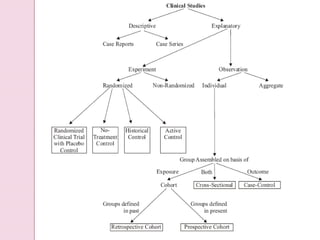
Descriptive studies
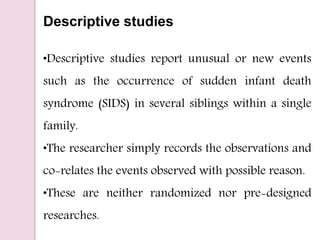
•Descriptive studies report unusual or new events
such as the occurrence of sudden infant death
syndrome (SIDS) in several siblings within a single
family.
•The researcher simply records the observations and
co-relates the events observed with possible reason.
•These are neither randomized nor pre-designed
researches.
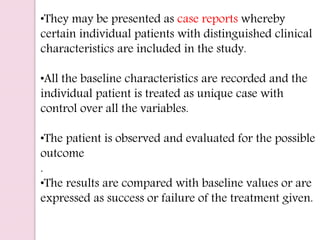
•They may be presented as case reports whereby
certain individual patients with distinguished clinical
characteristics are included in the study.
•All the baseline characteristics are recorded and the
individual patient is treated as unique case with
control over all the variables.
•The patient is observed and evaluated for the possible
outcome
.
•The results are compared with baseline values or are
expressed as success or failure of the treatment given.
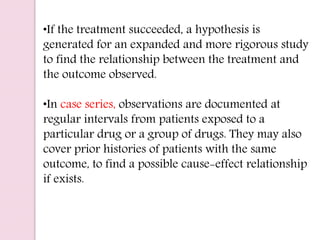
•If the treatment succeeded, a hypothesis is
generated for an expanded and more rigorous study
to find the relationship between the treatment and
the outcome observed.
•In case series, observations are documented at
regular intervals from patients exposed to a
particular drug or a group of drugs. They may also
cover prior histories of patients with the same
outcome, to find a possible cause-effect relationship
if exists.
•These are useful in predicting the incidence of an
adverse event of newly-marketed drug when
reports on such events are limited.
CASE REPORT
•Case report is a detailed report of the symptoms,
signs, diagnosis, treatment, and follow-up of an
individual patient.
•Case reports may contain a demographic profile
of the patient, but usually describe an unusual or
novel occurrence
CASE SERIES
•That tracks patients with a known exposure given
similar treatment or examines their medical records
for exposure and outcome.
•It can be retrospective or prospective and usually
involves a smaller number of patients than more
powerful case-control studies or randomized
controlled trials.
Descriptive Studies: Uses
•Hypothesis generating
•Suggesting associations
OBSERVATION STUDIES
•Where the assignment of subjects into a treated
group versus a control group is outside the control of
the investigator
•Errors that are likely to occur include the differences
in profile of the subjects since variables such as age,
family history of disease, cause and severity of disease
etc. may not be defined.
AGGREGATE OBSERVATION STUDIES
•Pandemic and epidemic studies on communicable
diseases and their treatments are generally carried
out as aggregate observation studies
•e.g. occurrence and effective treatment of malaria
and its relapse in particular geographical area.
INDIVIDUAL OBSERVATION STUDIES
•In individual observational study, the patients/
subjects are individually observed and they are
assembled in groups on the basis of outcome or
exposure or both.
•Depending upon the basis of the grouping, the
individual observational study is sub-classified as
1) Case-control
2) Cohort
3) Cross-sectional
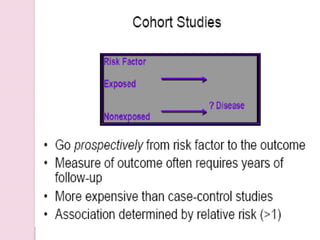
3.Cohort studies:
A cohort study is one into which patients are
entered according to their exposure status. That is,
between two groups of people one group is exposed
to the drug and other is unexposed comparison
group similar to them in all other important aspects.
The two groups are followed through time and
outcomes are observed and recorded. When the trail
is completed, rates are compared between the two
groups, and hypotheses may than be tested.
•It includes groups assembled on the basis of
exposure.
•Here the exposure is well-defined but the outcome
is variable.
•It allows study of one exposure with many more
outcomes.
•Cohort study can be retrospectivewherein the
groups are defined in past or it can be
prospectivewherein the groups are defined in
present.
Prospective
•A prospective study watches for outcomes, such as
the development of a disease, during the study period
and relates this to other factors such as suspected risk
or protection factor(s).
• The study usually involves taking a cohort of
subjects and watching them over a long period.
• The outcome of interest should be common;
otherwise, the number of outcomes observed will be
too small to be statistically meaningful
(indistinguishable from those that may have arisen by
chance).
•All efforts should be made to avoid sources of bias
such as the loss of individuals to follow up during the
study. studies.
.
Retrospective
•A retrospective study looks backwards and examines
exposures to suspected risk or protection factors in
relation to an outcome that is established at the start
of the study.
•Many valuable case-control studies, such as Lane
and Claypon's 1926 investigation of risk factors for
breast cancer, were retrospective investigations.
• Most sources of error due to confounding and bias
are more common in retrospective studies than in
prospective studies.
•For this reason, retrospective investigations are often
criticised.
•If the outcome of interest is uncommon, however,
the size of prospective investigation required to
estimate relative risk is often too large to be feasible.
•You should take special care to avoid sources
of bias and confounding in retrospective studies.
Cohort Study
•Begin with disease-free patients
•Classify patients as exposed/unexposed
•Record outcomes in both groups
•Compare outcomes using relative risk
Example of a Cohort Study
To see the effects of green tea on CAD mortality in a
population
•Provides incidence data
•Establishes time sequence for causality
•Eliminates recall bias
•Allows for accurate measurement of exposure
variables
Cohort Study: Strengths
•Can measure multiple outcomes
•Can adjust for confounding variables
•Can calculate relative risk
Cohort Study: Weaknesses
•Expensive
•Time consuming
•Cannot study rare outcomes
•Confounding variables
Cross-sectional Study
• Data collected at a single point in time
• Describes associations
• Prevalence
Prevalence vs. Incidence
•Prevalence
–The total number of cases at a point in time
–Includes both new and old cases
•Incidence
–The number of new cases over time
Example of a Cross-Sectional Study
Association between green tea consumption and
CAD in the Family Practice Clinic
• Cross –Sectional Strengths
–Quick
–Cheap
• Cross – Sectional Weaknesses
–Cannot establish cause-effect
4.Case-control study
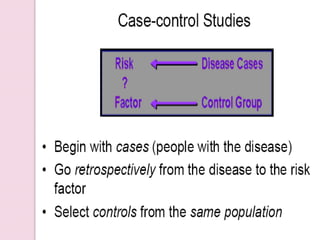
• Case-control study involves assembling of
subjects in groups on the basis of the outcome
found in those subjects.
• It compares the subjects with outcome in
question (the group behaves as a case group) with
the subjects without the outcome (the group acts
as a control) e.g. occurrence or nonoccurrence of
myocardial infarction (MI) in patients with
hypertension (HT).
•It generally follows the retrospective design and
evaluates how the exposure is related to the well-
defined outcome using control group. However,
grouping on the basis of outcome incorporates
subjects with variety of distinguished characteristics.
•It is quick and inexpensive.
Example of a Case-Control Study
Are those with CAD less likely to have consumed
green tea?
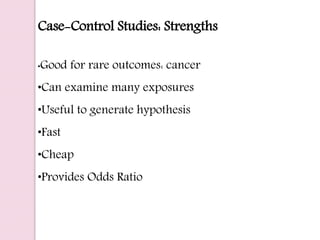
Case-Control Studies: Strengths
•Good for rare outcomes: cancer
•Can examine many exposures
•Useful to generate hypothesis
•Fast
•Cheap
•Provides Odds Ratio
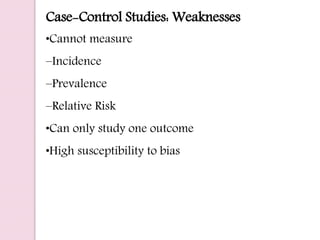
Case-Control Studies: Weaknesses
•Cannot measure
–Incidence
–Prevalence
–Relative Risk
•Can only study one outcome
•High susceptibility to bias
REFERENCE
1.Fundamentals of Clinical Trials, 3rd edition-
werence M Friedman, Curt D Furberg, David L
DeMets Pg. No.-42-55
2. Textbook on Clinical Research: A Guide for
Aspiring Professionals-Dr. Guru Prasad Mohanta
Pg. No.- 25-37
3.Clinical Pharmacy, 2nd edition –H.P.Tipnis,
Amrita Bajaj, Pg.No.-313-319
THANK YOU

post marketing –surveillance methods

  • 1.
    POST MARKETING SURVEILLANCE METHODS AMRUTHAJOSE PHARMACY PRACTICE NEHRU COLLEGE
  • 2.
    INTRODUCTION To market adrug,the manufacturer must provide evidence of its efficacy and safety to the U.S.FOOD AND Drug Administration(FDA) In Premarketing testing,the numbers and type of patient used to demonstrate a drugs efficacy and safety are limited as compared with the numbers and type of patient who will eventually be prescribed the drugs after it is marketed.
  • 3.
    Although post-marketing surveillancecannot provide knowledge of the safety or efficacy of the drug at the time of there introduction into the market. Post-marketing surveillance of drug therefore play an important role to discover an undesirable effect that might present at risk. It provide additional information on the benefit and risk of the drugs.
  • 4.
    POST MARKETING SURVEILLANCE Postmarketingsurveillance refers to any means of obtaining information about a product after it has been approved for public use. •This phase is so named because it is carried out after the drug is released in the market for therapeutic use. •It is mainly to detect uncommon but significant adverse effects.
  • 5.
    •Once the drugenters the market, it will be utilized by many more patients having other co-morbidity and co-existing diseases in addition to the disease for which the drug is indicated and licensed. No fixed duration/Patient population Starts immediately after marketing Report all ADRs Help to detect Rare ADRs Drug interaction Also new uses for drugs[sometimes called Phase V]
  • 6.
    HISTORY In the 1960at least two serious drugs reactions were observed in many patient.thalidomide causes limb deformities(phocomelia). observed in Japan,was the optic nerve damage(subacute myelooptic –neuropathy). The PMA, senator Edward Kennedy (D-Mass.) suggested that a better system was need for monitoring the use and effects of prescription drug after they are marketed.
  • 7.
    As a result,the joint commissionon Prescription Drugs Use was established in 1976,funded largely by the drug industry, with the mandate to design a post-marketing surveillance system to detect,quantify,and describe the anticipated and unanticipated effects of marketed drugs. The delayed discovery of the practolol`s adverse effects spurred effects to improve post-marketing surveillance.
  • 8.
    SOURCES OF PMSINFORMATION The following may be considered as sources of information, some source are proactive and some are reactive. Expert user groups(“ focus groups‟‟) Customer surveys. Customer complaints and warranty claims Post CE-market clinical trials. Literature reviews. Device tracking/implant registries. User reaction during training programmers. The media.
  • 9.
    WHY WE NEEDPMS? The primary objective of post-marketing surveillance is to develop information about drug effects under customary condition of drug use. Rare adverse events may not be detected in pre- licensure studies because in very large clinical trials have limitation. Access to more patient and given data Given diversity of data sources, innovative approaches to retrieval of key data may have great potential vs. single unified system.
  • 10.
    Better background rates,comparable“control’’ population. Increase in “non-medical’’ data sources- e.g.Pharmacy,supermarket,employer vaccination
  • 11.
    ARE THERE BENEFITSTO PMS SYSTEM  Detection of manufacturing problems improvement of medical device quality verification of risk analysis intelligence of long-term performance chronic complications performance trends performance in different user populations mechanisms the device may be misused
  • 12.
    training required forusers; use with other devices. customer satisfaction . market performance and sustainability. identification of incident reports (and field safety corrective action reports)
  • 13.
    VISION FOR PMS Allpatient’s vaccination and health outcomes are immediately and continuously accessible in automated database allowing optimal detection and analysis of potential problem in vaccine safety. Not there yet –both major limitation and opportunities in current health information system. Both problems and solution to enhance vaccine safety information and analysis are applicable to safety initiatives for other medical products
  • 14.
    PMS OPPORTUNITY Access toadditional health system data. Access to global data:regulatory,inspectional,healthsystem,international surveillance and pharmacovigilence. Better analytical tools and methods.
  • 15.
    ABOUT PMS PROCEDURE Itshould assign departments or position a responsible for performing a particular function. Manufacturer may find it helpful to a have report at the end of year, as well as PMS tracking schedule and log.  This information could constitute feedback received from user .
  • 16.
    Information obtained fromPMS system should be communicated , at a minimum, annually during a management review meeting-which is top management's examination of the organization's quality management system.
  • 17.
    METHODS OF SURVEILLANCE Thus, four types of studies are generally used to identify drugs effects: 1.Controlled clinical trials, 2.Spontaneous or voluntary recording 3.Cohort, studies and 4.Case control studies
  • 18.
    1.Controlled clinical studiesand trials: Control refers to strict adherence to the protocols.The purpose of which is to reduce the variability of manyfactors and biases that might influence the results. Control features include the double blind procedure.Where neither the patient nor the investigator is aware of which treatment the patients is receiving. But are not confined to this others include the adequacy of the group used as controls.
  • 19.
    Limitations • Reports directlyto the health authority centers. • This is mostoften the traditional system in many countries. •The intermediary model. • This is a predominant in the USA where reports are obtained via detail persons or letter & calls to the manufacturer. Since all events are to be reported this results in a large number of notifications.
  • 20.
    2. Spontaneous orvoluntary reporting A communication from an individual (e.g: health care professional, consumer) to a company or regulatory authority . This describes a suspected adverse event(S) But the actual incidence of adverse drug reaction cannot be determined through spontaneous reporting.
  • 21.
    By physician andother health provider & hospital may to alert FDA and pharmaceutical firms to possible adverse effects of drugs
  • 23.
    Descriptive studies •Descriptive studiesreport unusual or new events such as the occurrence of sudden infant death syndrome (SIDS) in several siblings within a single family. •The researcher simply records the observations and co-relates the events observed with possible reason. •These are neither randomized nor pre-designed researches.
  • 24.
    •They may bepresented as case reports whereby certain individual patients with distinguished clinical characteristics are included in the study. •All the baseline characteristics are recorded and the individual patient is treated as unique case with control over all the variables. •The patient is observed and evaluated for the possible outcome . •The results are compared with baseline values or are expressed as success or failure of the treatment given.
  • 25.
    •If the treatmentsucceeded, a hypothesis is generated for an expanded and more rigorous study to find the relationship between the treatment and the outcome observed. •In case series, observations are documented at regular intervals from patients exposed to a particular drug or a group of drugs. They may also cover prior histories of patients with the same outcome, to find a possible cause-effect relationship if exists.
  • 26.
    •These are usefulin predicting the incidence of an adverse event of newly-marketed drug when reports on such events are limited.
  • 27.
    CASE REPORT •Case reportis a detailed report of the symptoms, signs, diagnosis, treatment, and follow-up of an individual patient. •Case reports may contain a demographic profile of the patient, but usually describe an unusual or novel occurrence
  • 28.
    CASE SERIES •That trackspatients with a known exposure given similar treatment or examines their medical records for exposure and outcome. •It can be retrospective or prospective and usually involves a smaller number of patients than more powerful case-control studies or randomized controlled trials.
  • 29.
    Descriptive Studies: Uses •Hypothesisgenerating •Suggesting associations
  • 30.
    OBSERVATION STUDIES •Where theassignment of subjects into a treated group versus a control group is outside the control of the investigator •Errors that are likely to occur include the differences in profile of the subjects since variables such as age, family history of disease, cause and severity of disease etc. may not be defined.
  • 31.
    AGGREGATE OBSERVATION STUDIES •Pandemicand epidemic studies on communicable diseases and their treatments are generally carried out as aggregate observation studies •e.g. occurrence and effective treatment of malaria and its relapse in particular geographical area.
  • 32.
    INDIVIDUAL OBSERVATION STUDIES •Inindividual observational study, the patients/ subjects are individually observed and they are assembled in groups on the basis of outcome or exposure or both. •Depending upon the basis of the grouping, the individual observational study is sub-classified as 1) Case-control 2) Cohort 3) Cross-sectional
  • 33.
    3.Cohort studies: A cohortstudy is one into which patients are entered according to their exposure status. That is, between two groups of people one group is exposed to the drug and other is unexposed comparison group similar to them in all other important aspects. The two groups are followed through time and outcomes are observed and recorded. When the trail is completed, rates are compared between the two groups, and hypotheses may than be tested.
  • 34.
    •It includes groupsassembled on the basis of exposure. •Here the exposure is well-defined but the outcome is variable. •It allows study of one exposure with many more outcomes. •Cohort study can be retrospectivewherein the groups are defined in past or it can be prospectivewherein the groups are defined in present.
  • 35.
    Prospective •A prospective studywatches for outcomes, such as the development of a disease, during the study period and relates this to other factors such as suspected risk or protection factor(s). • The study usually involves taking a cohort of subjects and watching them over a long period. • The outcome of interest should be common; otherwise, the number of outcomes observed will be too small to be statistically meaningful (indistinguishable from those that may have arisen by chance). •All efforts should be made to avoid sources of bias such as the loss of individuals to follow up during the study. studies.
  • 36.
    . Retrospective •A retrospective studylooks backwards and examines exposures to suspected risk or protection factors in relation to an outcome that is established at the start of the study. •Many valuable case-control studies, such as Lane and Claypon's 1926 investigation of risk factors for breast cancer, were retrospective investigations. • Most sources of error due to confounding and bias are more common in retrospective studies than in prospective studies. •For this reason, retrospective investigations are often criticised.
  • 37.
    •If the outcomeof interest is uncommon, however, the size of prospective investigation required to estimate relative risk is often too large to be feasible. •You should take special care to avoid sources of bias and confounding in retrospective studies.
  • 38.
    Cohort Study •Begin withdisease-free patients •Classify patients as exposed/unexposed •Record outcomes in both groups •Compare outcomes using relative risk
  • 40.
    Example of aCohort Study To see the effects of green tea on CAD mortality in a population •Provides incidence data •Establishes time sequence for causality •Eliminates recall bias •Allows for accurate measurement of exposure variables Cohort Study: Strengths
  • 41.
    •Can measure multipleoutcomes •Can adjust for confounding variables •Can calculate relative risk Cohort Study: Weaknesses •Expensive •Time consuming •Cannot study rare outcomes •Confounding variables
  • 42.
    Cross-sectional Study • Datacollected at a single point in time • Describes associations • Prevalence Prevalence vs. Incidence •Prevalence –The total number of cases at a point in time –Includes both new and old cases •Incidence –The number of new cases over time
  • 43.
    Example of aCross-Sectional Study Association between green tea consumption and CAD in the Family Practice Clinic • Cross –Sectional Strengths –Quick –Cheap • Cross – Sectional Weaknesses –Cannot establish cause-effect
  • 44.
    4.Case-control study • Case-controlstudy involves assembling of subjects in groups on the basis of the outcome found in those subjects. • It compares the subjects with outcome in question (the group behaves as a case group) with the subjects without the outcome (the group acts as a control) e.g. occurrence or nonoccurrence of myocardial infarction (MI) in patients with hypertension (HT).
  • 45.
    •It generally followsthe retrospective design and evaluates how the exposure is related to the well- defined outcome using control group. However, grouping on the basis of outcome incorporates subjects with variety of distinguished characteristics. •It is quick and inexpensive.
  • 46.
    Example of aCase-Control Study Are those with CAD less likely to have consumed green tea?
  • 48.
    Case-Control Studies: Strengths •Goodfor rare outcomes: cancer •Can examine many exposures •Useful to generate hypothesis •Fast •Cheap •Provides Odds Ratio
  • 49.
    Case-Control Studies: Weaknesses •Cannotmeasure –Incidence –Prevalence –Relative Risk •Can only study one outcome •High susceptibility to bias
  • 50.
    REFERENCE 1.Fundamentals of ClinicalTrials, 3rd edition- werence M Friedman, Curt D Furberg, David L DeMets Pg. No.-42-55 2. Textbook on Clinical Research: A Guide for Aspiring Professionals-Dr. Guru Prasad Mohanta Pg. No.- 25-37 3.Clinical Pharmacy, 2nd edition –H.P.Tipnis, Amrita Bajaj, Pg.No.-313-319
  • 51.