ANATOMY OF FEMALE
PELVIC FLOOR
By Fabiha Fatima
BPT 3rd year
ANATOMY OF
THE PELVIC
FLOOR
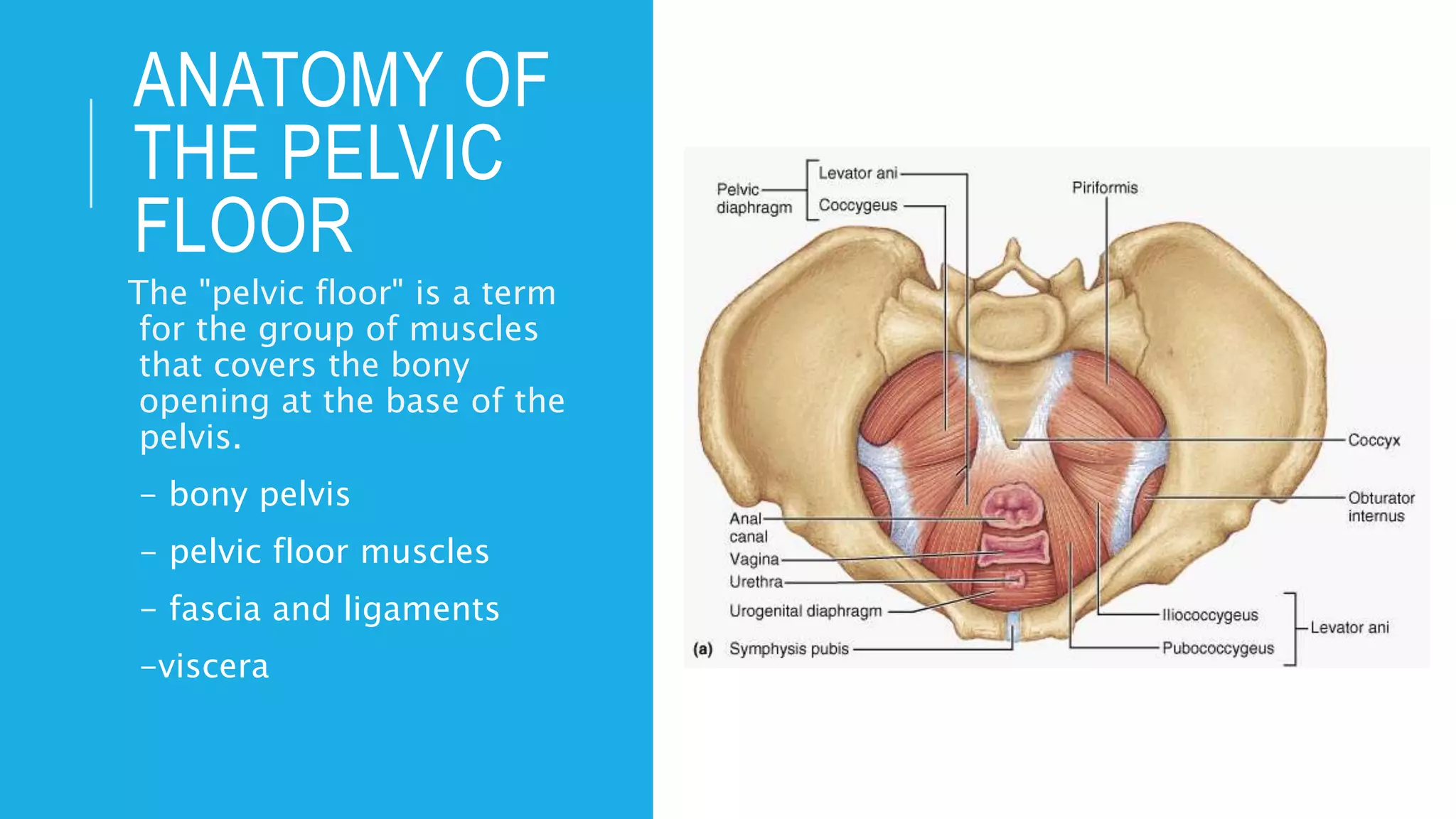
The "pelvic floor" is a term
for the group of muscles
that covers the bony
opening at the base of the
pelvis.
- bony pelvis
- pelvic floor muscles
- fascia and ligaments
-viscera
ANATOMY OF THE
PELVIC FLOOR
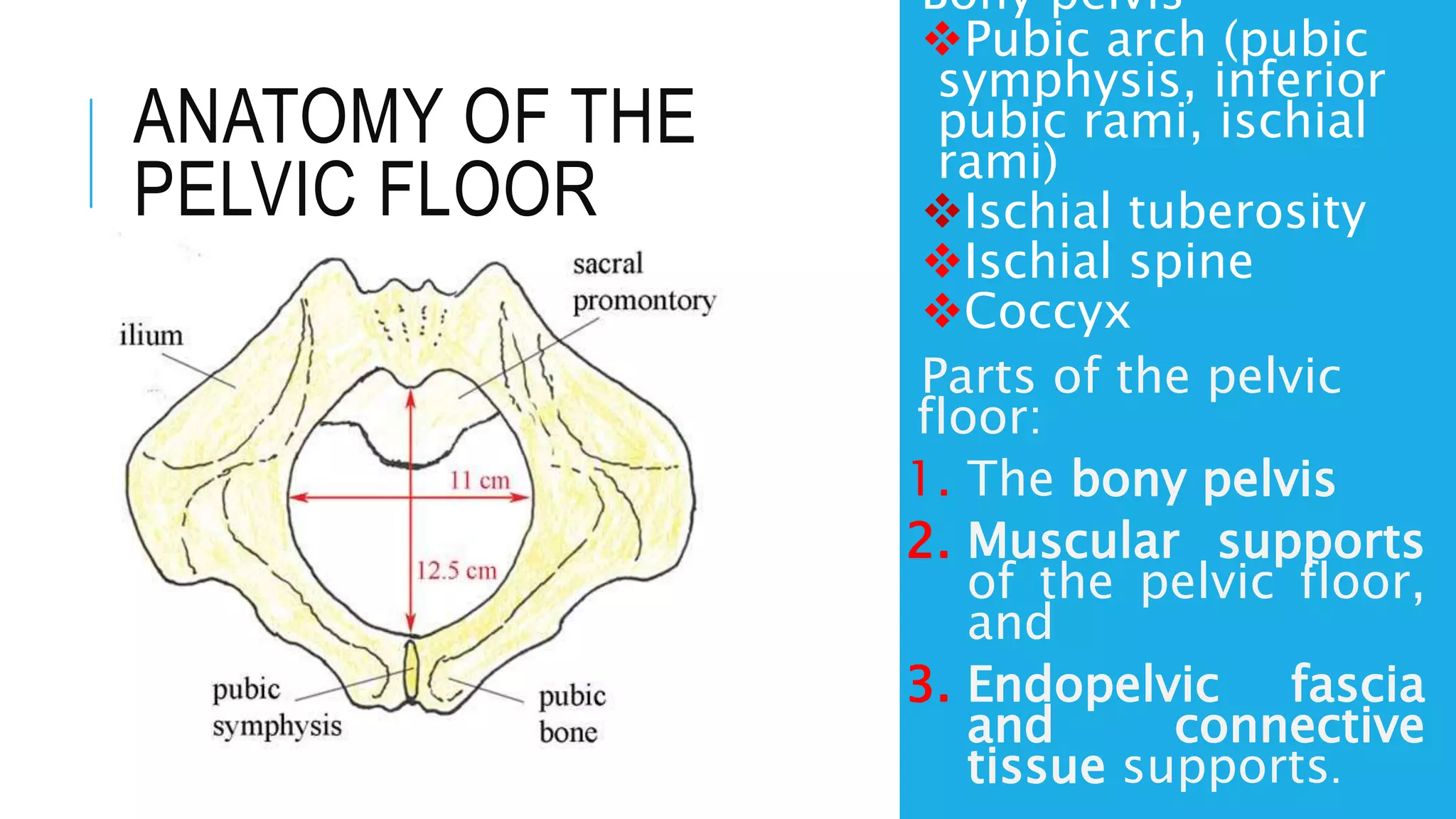
Bony pelvis
Pubic arch (pubic
symphysis, inferior
pubic rami, ischial
rami)
Ischial tuberosity
Ischial spine
Coccyx
Parts of the pelvic
floor:
1. The bony pelvis
2. Muscular supports
of the pelvic floor,
and
3. Endopelvic fascia
and connective
tissue supports.
THE BONY PELVIS
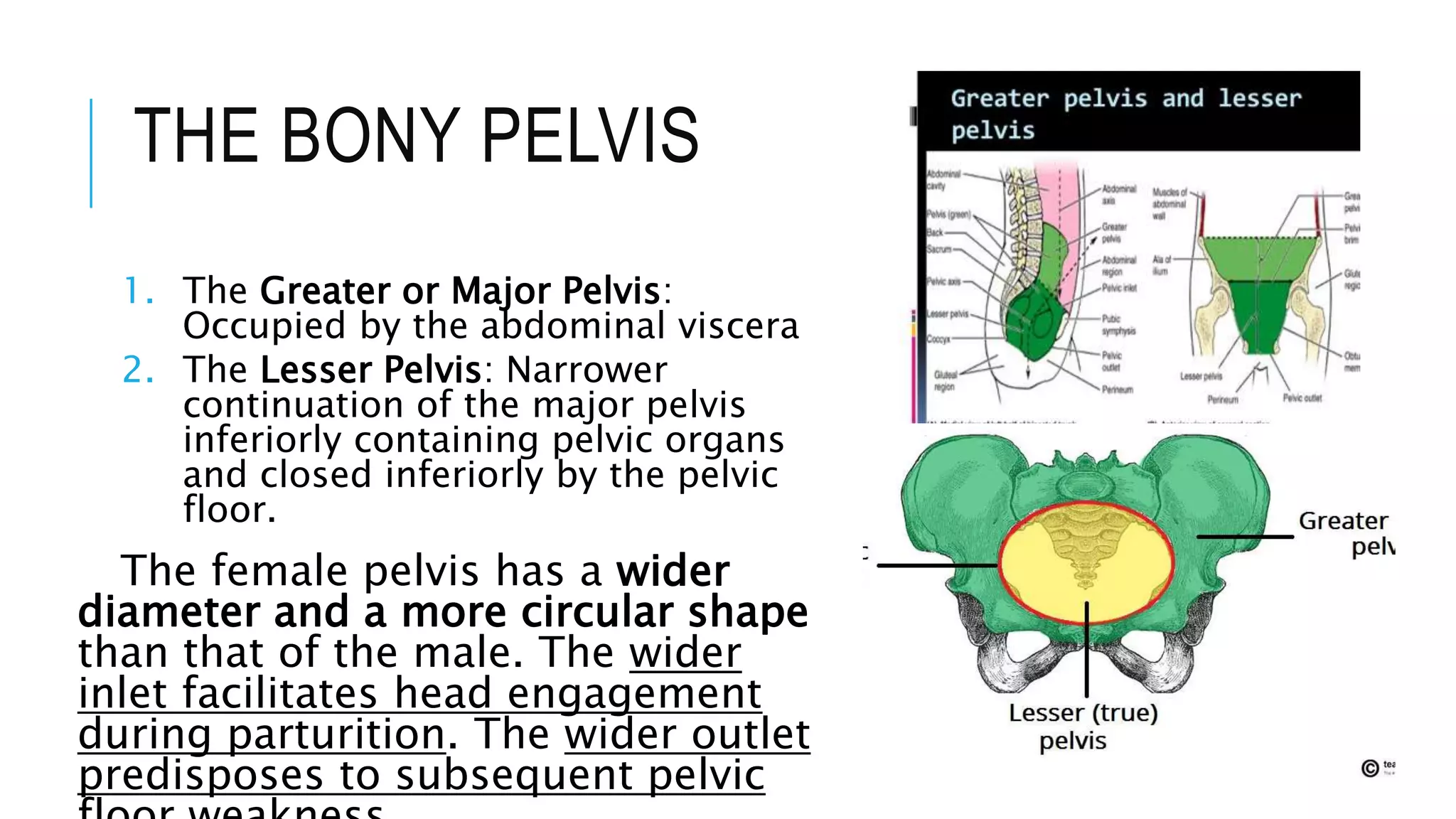
1. The Greater or Major Pelvis:
Occupied by the abdominal viscera
2. The Lesser Pelvis: Narrower
continuation of the major pelvis
inferiorly containing pelvic organs
and closed inferiorly by the pelvic
floor.
The female pelvis has a wider
diameter and a more circular shape
than that of the male. The wider
inlet facilitates head engagement
during parturition. The wider outlet
predisposes to subsequent pelvic
PELVIC LIGAMENTS
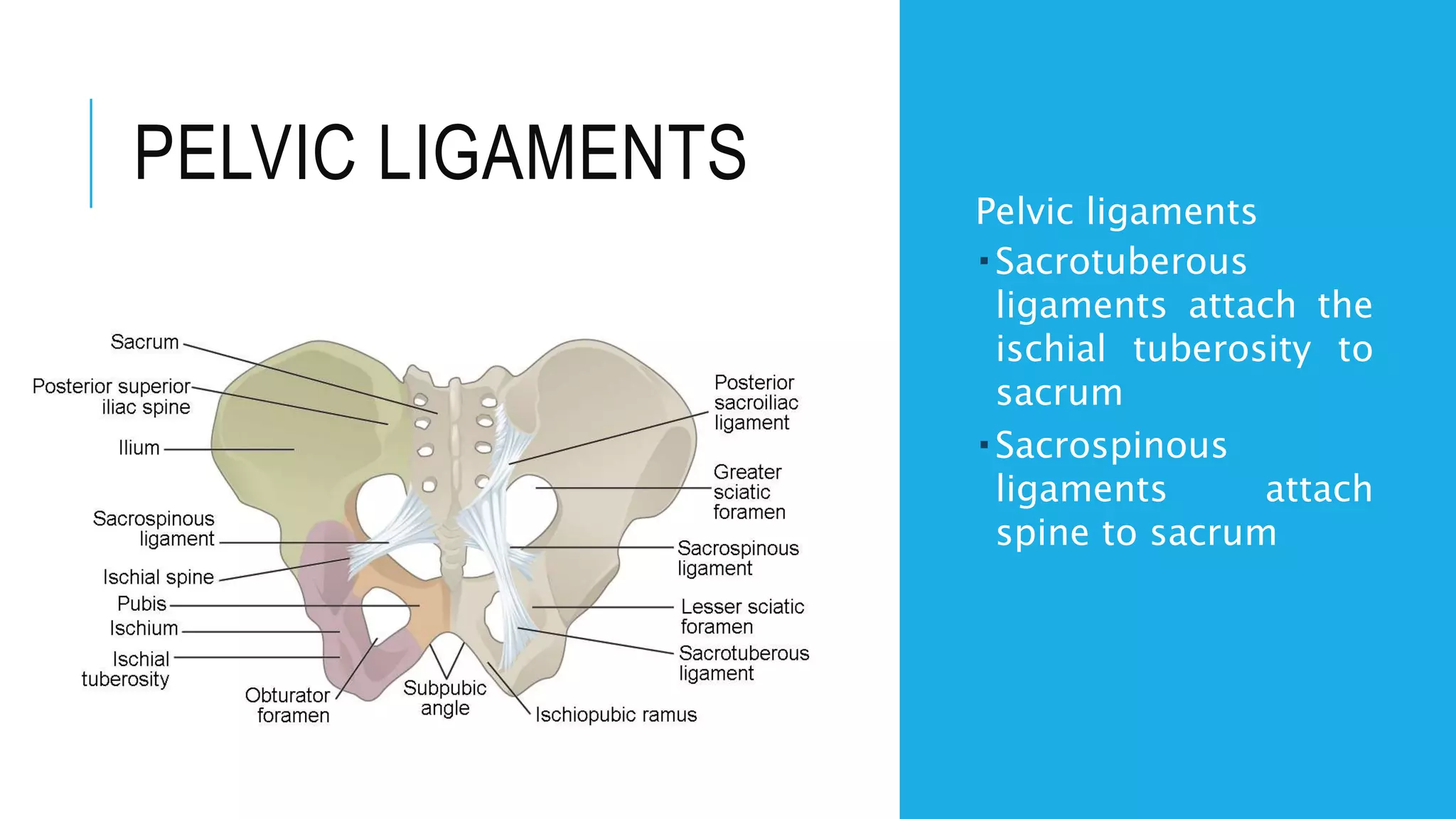
Pelvic ligaments
 Sacrotuberous
ligaments attach the
ischial tuberosity to
sacrum
 Sacrospinous
ligaments attach
spine to sacrum
PELVIC
FLOOR
MUSCLES
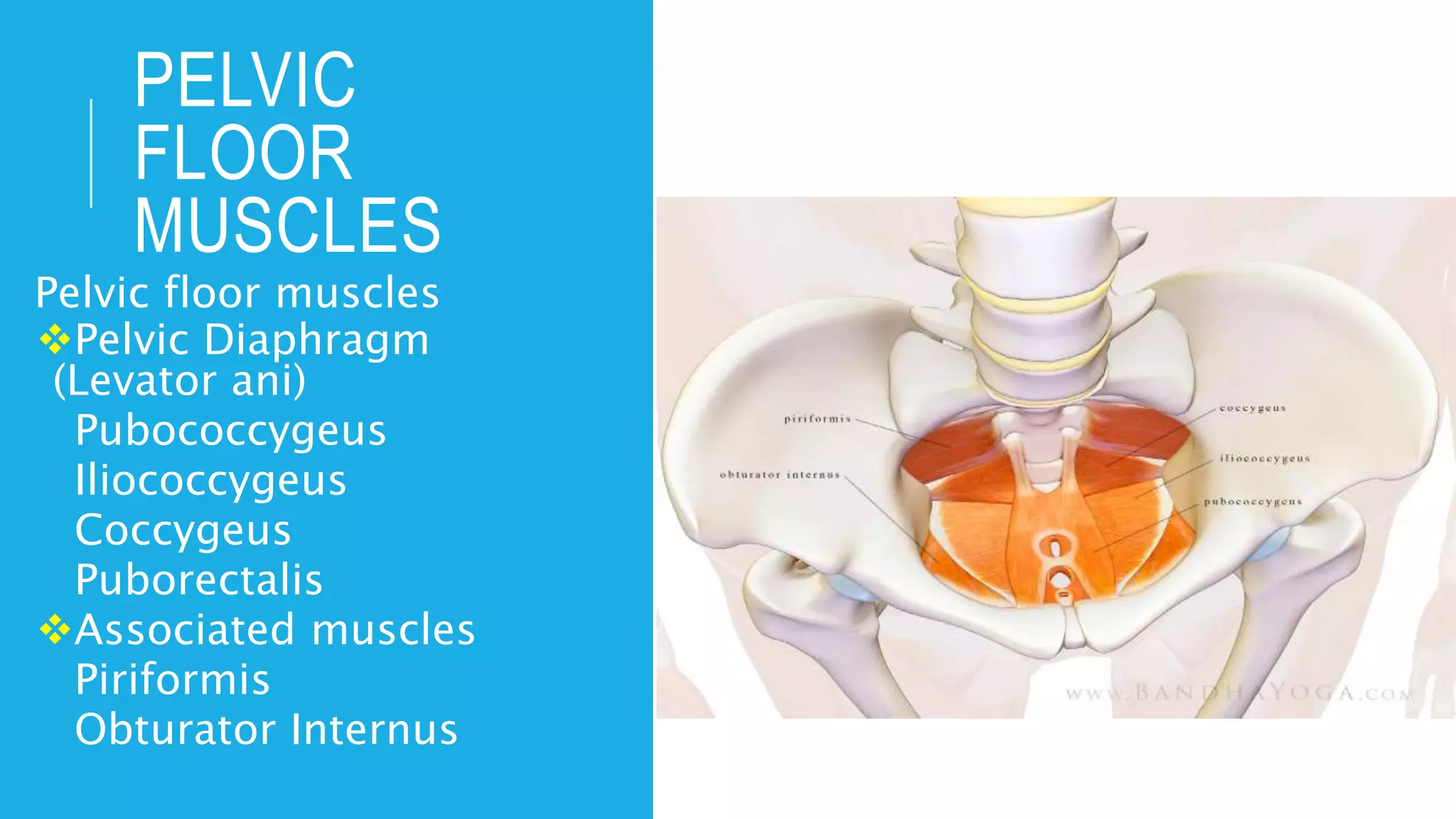
Pelvic floor muscles
Pelvic Diaphragm
(Levator ani)
Pubococcygeus
Iliococcygeus
Coccygeus
Puborectalis
Associated muscles
Piriformis
Obturator Internus
PELVIC
DIAPHRAG
M
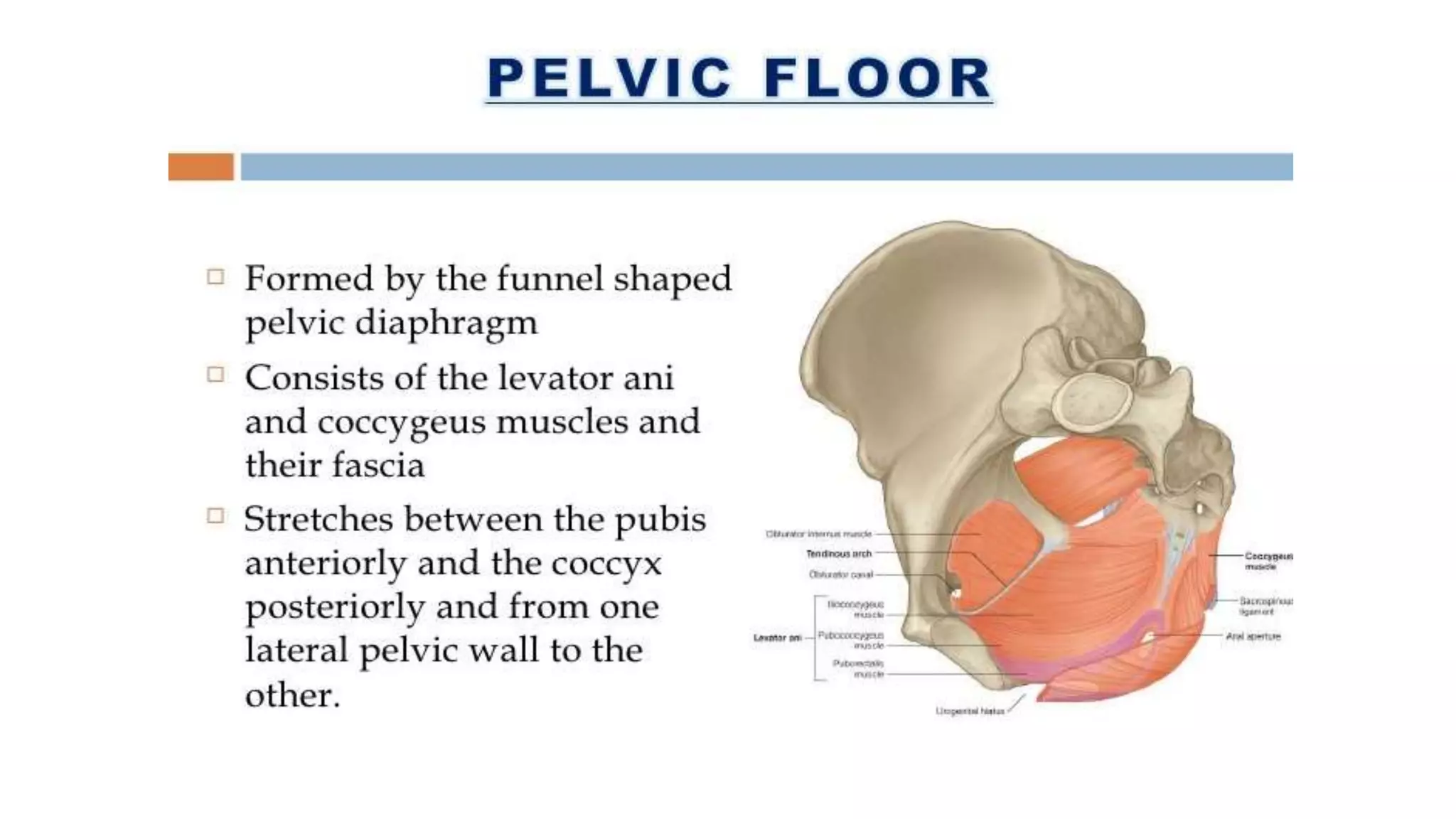
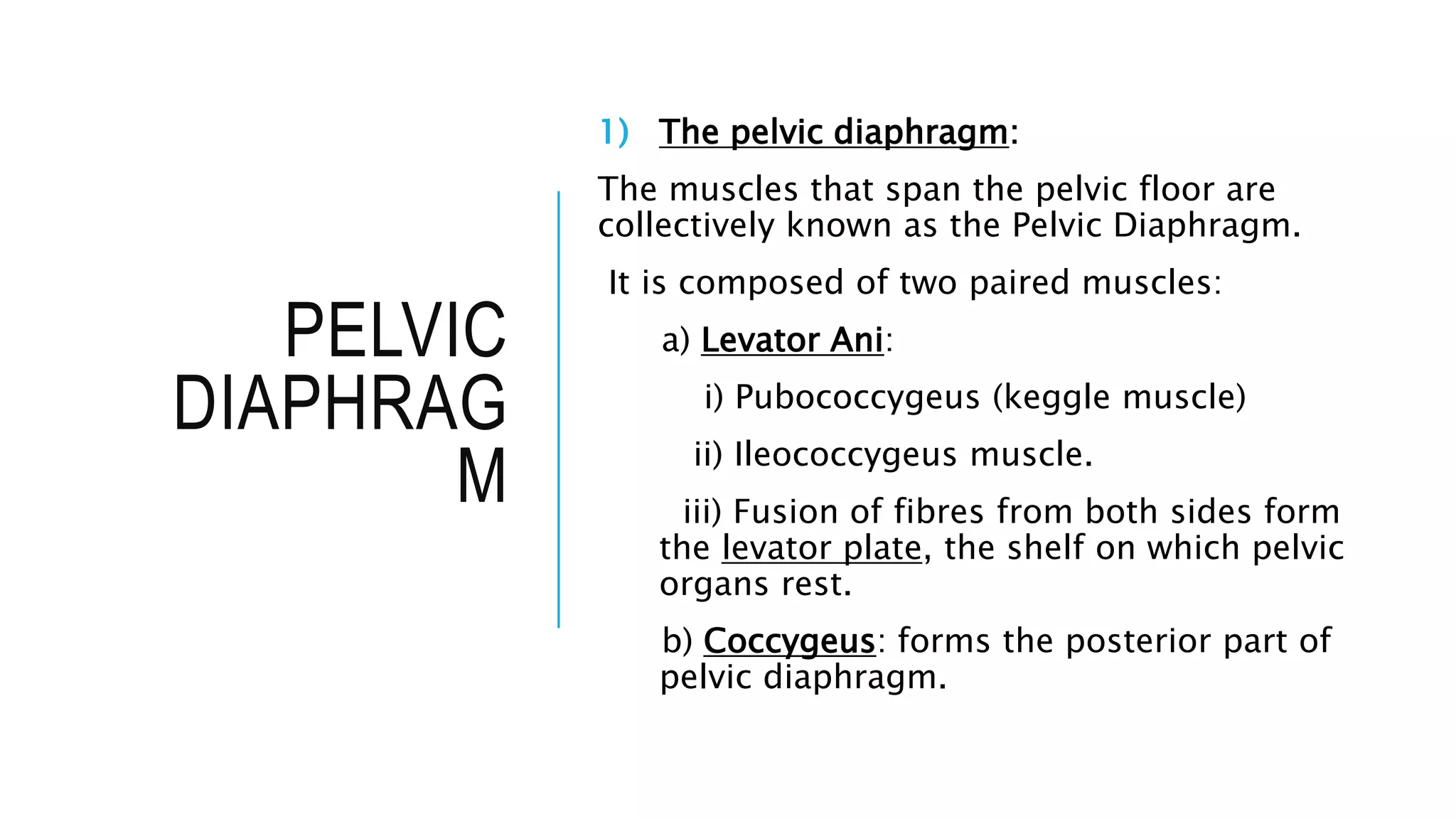
1) The pelvic diaphragm:
The muscles that span the pelvic floor are
collectively known as the Pelvic Diaphragm.
It is composed of two paired muscles:
a) Levator Ani:
i) Pubococcygeus (keggle muscle)
ii) Ileococcygeus muscle.
iii) Fusion of fibres from both sides form
the levator plate, the shelf on which pelvic
organs rest.
b) Coccygeus: forms the posterior part of
pelvic diaphragm.
LEVATOR ANI
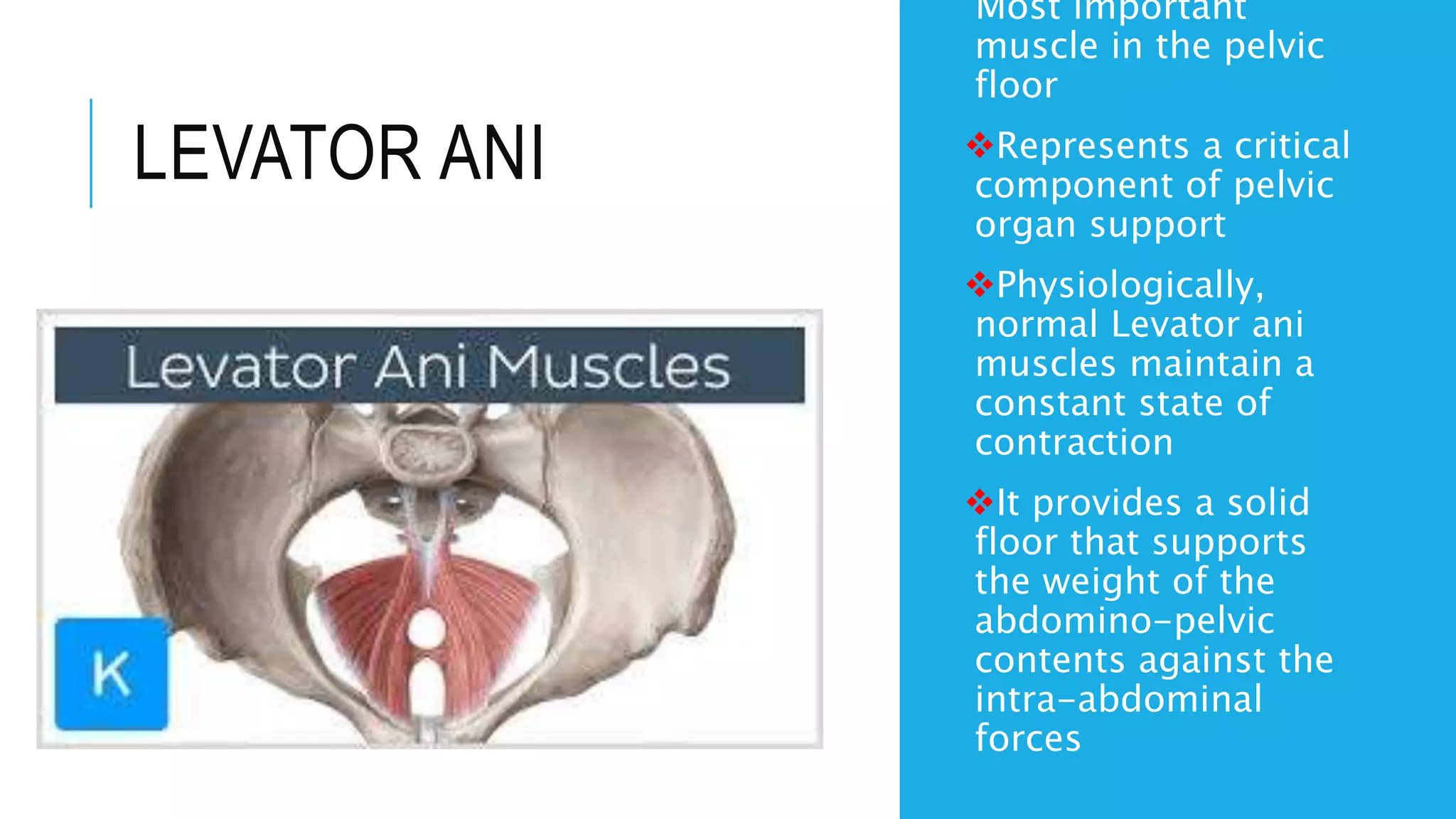
Most important
muscle in the pelvic
floor
Represents a critical
component of pelvic
organ support
Physiologically,
normal Levator ani
muscles maintain a
constant state of
contraction
It provides a solid
floor that supports
the weight of the
abdomino-pelvic
contents against the
intra-abdominal
forces
FUNCTIONS OF PELVIC
DIAGPHRAGM
These muscles:
1. Close the inferior outlet of the pelvis
2. Support the pelvic floor
3. Elevate the pelvic floor to help release feces
4. Resist increased intra-abdominal pressure
PD is pierced by the rectum and urethra and
vagina in females
Region inferior to the pelvic diaphragm is the
perineum
MUSCLES OF THE
PELVIC FLOOR
Superficial perineal
layer (innervated by the
pudendal nerve):
Bulbocavernosus,
Ischiocavernosus,
Superficial transverse
perineal, External anal
sphincter (EAS)
Deep urogenital
diaphragm
layer (innervated by
pudendal nerve):
Compressor urethera,
Uretrovaginal
sphincter, Deep
transverse perineal
THE UROGENITAL
DIAGPHRAGM
Muscles inferior to the pelvic floor
Stretches between two sides of the pubic arch
in the anterior half of the perineum
Contains
Deep transverse perineal muscle
External urethral sphincter muscle
Superficial transverse perineal muscle
Perineal membrane
Ischio cavernosus and bulbospongiosus
ENDOPELVIC FASCIA AND
CONNECTIVE TISSUE SUPPORTS
The bladder, urethra, the vagina and
uterus are attached to the pelvic walls by
a system of connective tissue that has
been called the endopelvic fascia.
The endopelvic fascia is continuous
with the visceral fascia, which provides a
capsule containing the organs and allows
displacements and changes in volume.
ENDOPELVI
C FASCIA
AND
CONNECTIV
E TISSUE
SUPPORTS
Anterior supports:
 The Pubo-urethral ligaments
 The Pubo-cervical fascia
Middle supports:
 The cardinal ligaments (also called Mackenrodt’s
ligament) extend from the lateral margins of the
cervix and upper vagina to the lateral pelvic
walls.
 The Utero Sacral ligaments are attached to the
cervix and upper vaginal fornices
posterolaterally. Posteriorly, they attach to the
pre-sacral fascia in front of the sacroiliac joint.
 The cardinal and uterosacral ligaments hold the
uterus and upper vagina in their proper place
over the levator plate.
Posterior Supports:
 Recto vaginal Septum/fascia
 Urogenital diaphragm
 Lateral Rectal ligaments
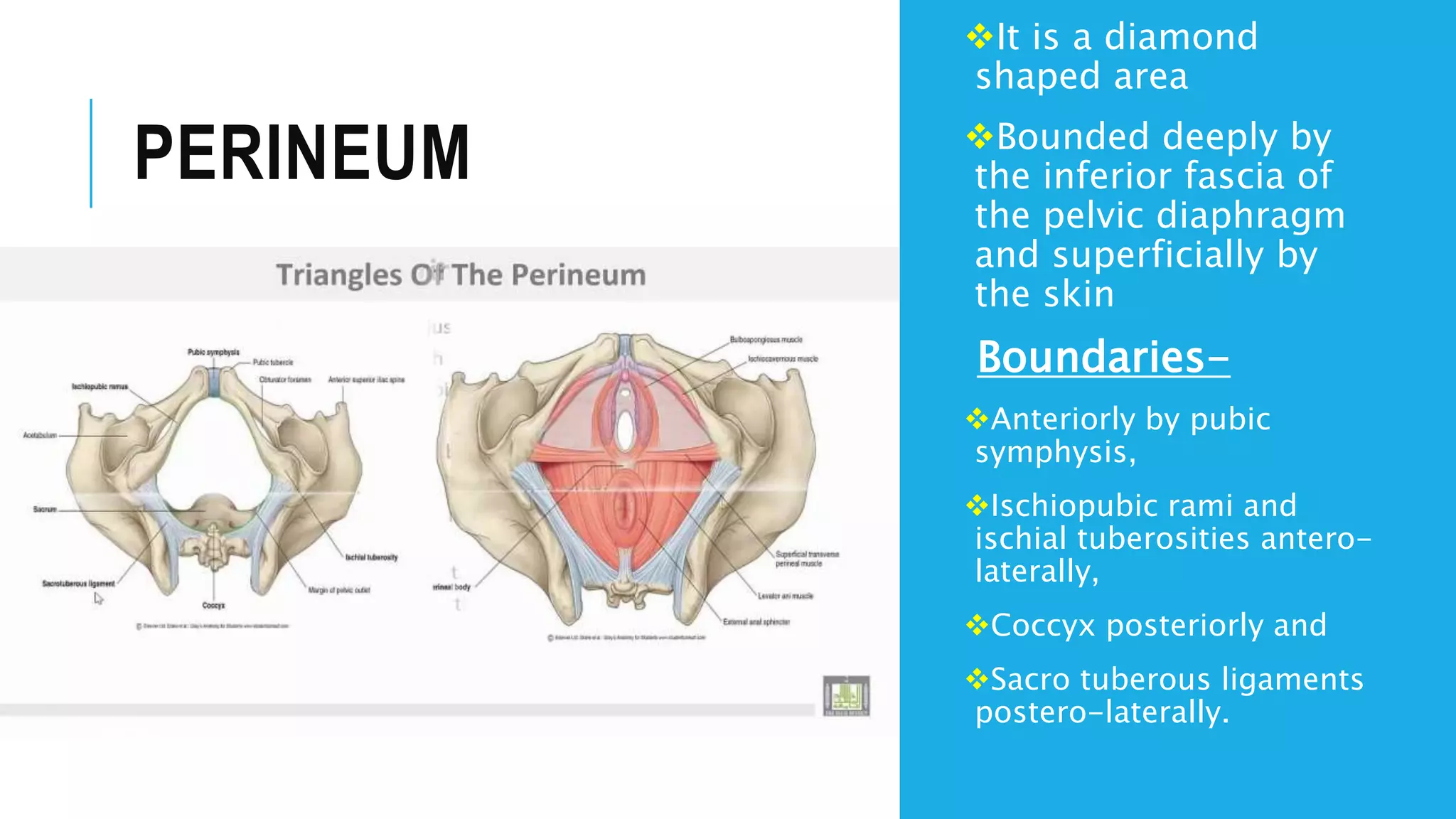
PERINEUM
It is a diamond
shaped area
Bounded deeply by
the inferior fascia of
the pelvic diaphragm
and superficially by
the skin
Boundaries-
Anteriorly by pubic
symphysis,
Ischiopubic rami and
ischial tuberosities antero-
laterally,
Coccyx posteriorly and
Sacro tuberous ligaments
postero-laterally.
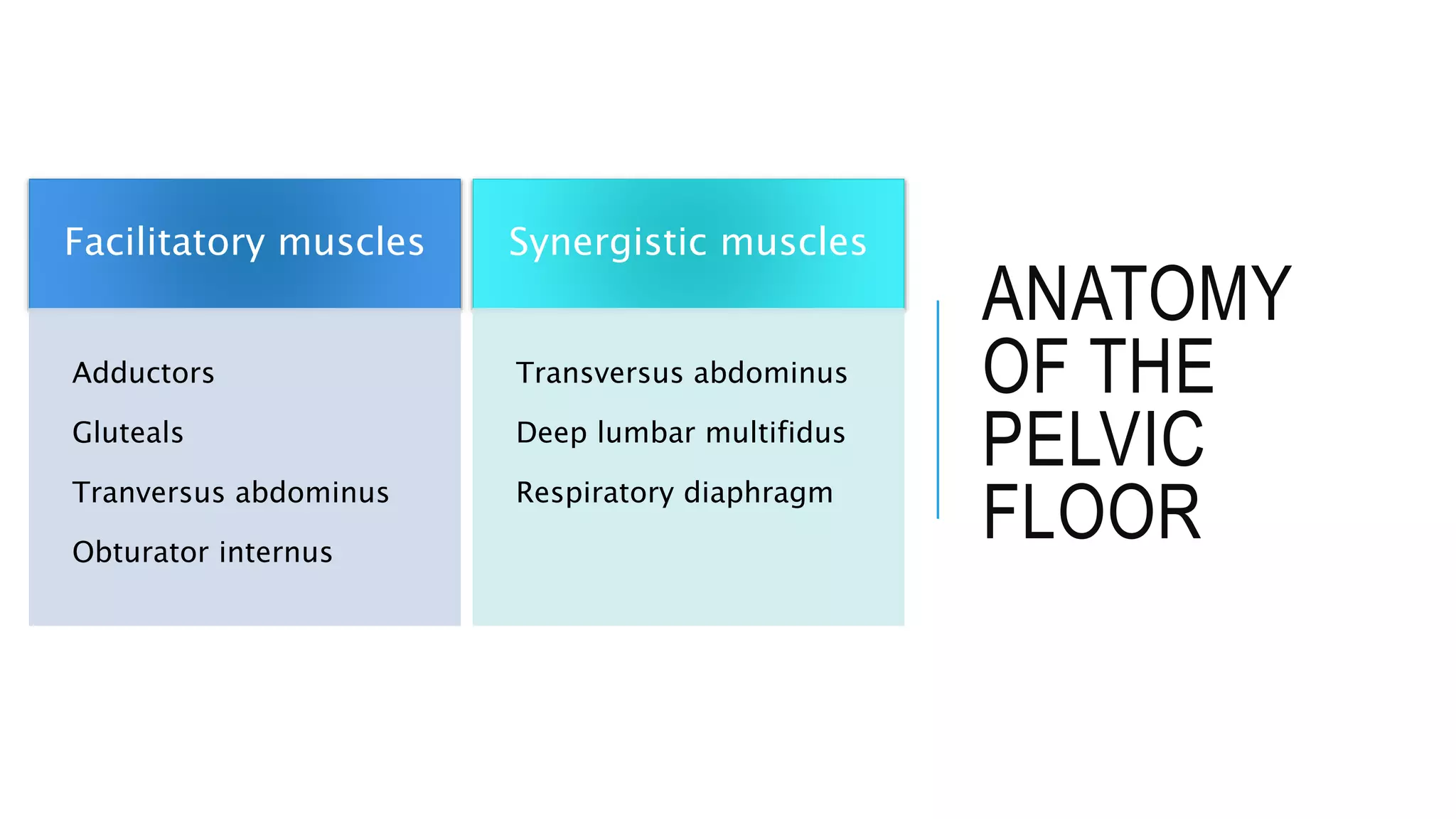
ANATOMY
OF THE
PELVIC
FLOOR
Facilitatory muscles
Adductors
Gluteals
Tranversus abdominus
Obturator internus
Synergistic muscles
Transversus abdominus
Deep lumbar multifidus
Respiratory diaphragm
PELVIC
FLOOR
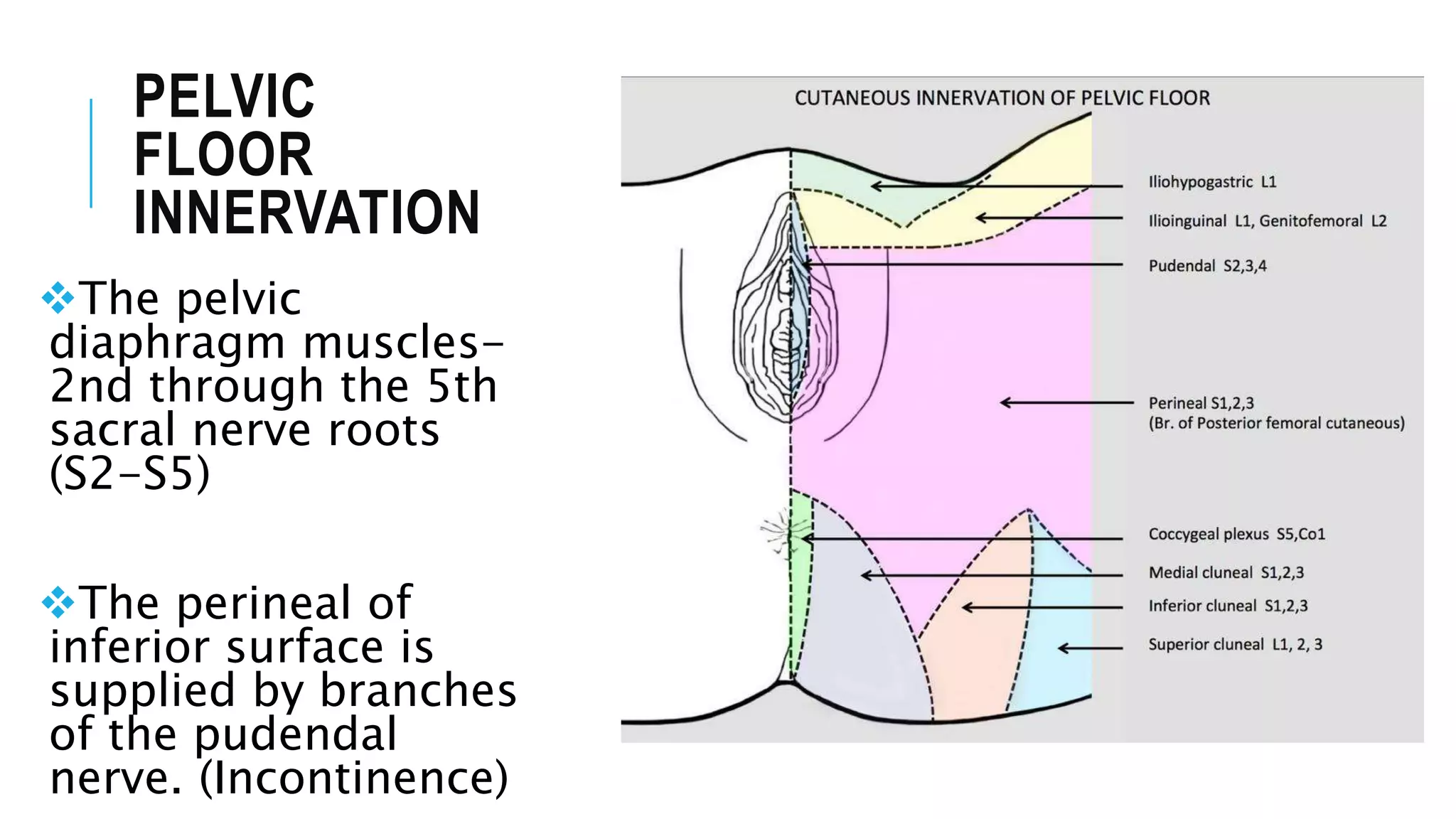
INNERVATION
The pelvic
diaphragm muscles-
2nd through the 5th
sacral nerve roots
(S2-S5)
The perineal of
inferior surface is
supplied by branches
of the pudendal
nerve. (Incontinence)
FUNCTION OF PELVIC
FLOOR MUSCLES
Pelvic diaphragm
Supports bladder, bowel and
uterus in a functional position
Assists the closure of the
bladder and bowel outlet.
It moves the sacrum/coccyx
on the pelvis.
Stabilizes pelvic ring together
with the diaphragm and
transversus abdominus to
provide trunk and pelvic
stability
Obturator internus
Laterally rotates the hip and
lifts the bladder, bowel and
uterus into a functional
position while assisting in
closure of the urethra and
anus
HOW
PELVIC
FLOOR IS
THE
HAMMOCK
OF THE
CORE ?
OVERALL
Because of the different orientations of their
fibers, the different attachment sites at bones
and ligaments, and their different layers, the
pelvic floor muscles are able to form a highly
adjustable, flexible and strong muscle group.
When properly functioning, the female pelvic
floor muscles adapt to even the stresses of
childbirth and are able to heal and return to
previous levels of function.
PELVIC
FLOOR
PHYSIOTHE
RAPY
An Emerging
Field
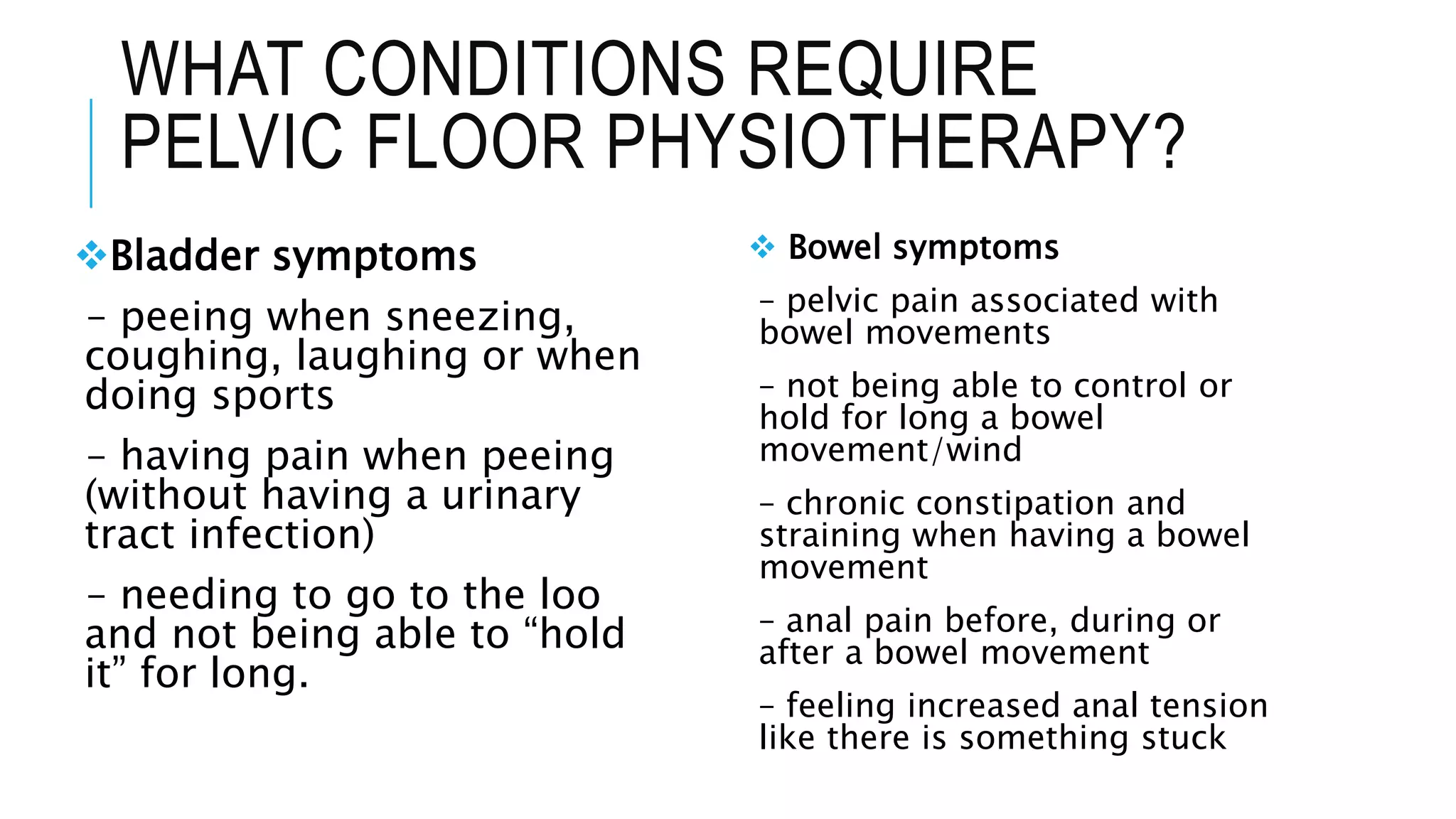
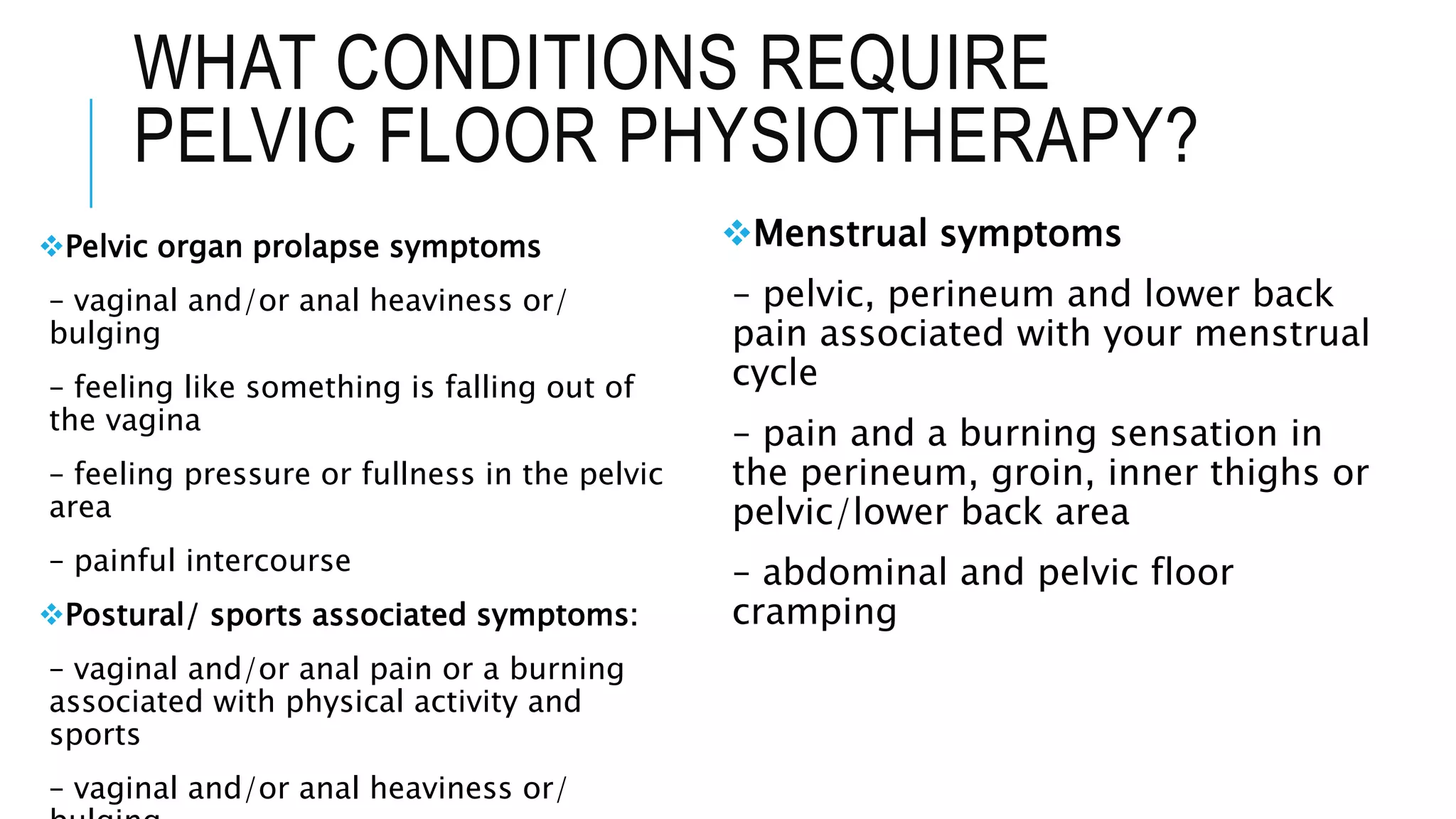
WHAT CONDITIONS REQUIRE
PELVIC FLOOR PHYSIOTHERAPY?
Bladder symptoms
– peeing when sneezing,
coughing, laughing or when
doing sports
– having pain when peeing
(without having a urinary
tract infection)
– needing to go to the loo
and not being able to “hold
it” for long.
 Bowel symptoms
– pelvic pain associated with
bowel movements
– not being able to control or
hold for long a bowel
movement/wind
– chronic constipation and
straining when having a bowel
movement
– anal pain before, during or
after a bowel movement
– feeling increased anal tension
like there is something stuck
WHAT CONDITIONS REQUIRE
PELVIC FLOOR PHYSIOTHERAPY?
Sexual and vaginal/anal symptoms
– vaginal and/or anal pain or a burning
sensation associated with sitting,
periods, sex, urination/ defecation or
wearing tight clothes.
– Vulvodynia – a sensation of vulval
burning and soreness in the absence of
any obvious skin condition or infection.
– Pelvic and perineum (anal, vaginal) pain
associated with intercourse
– Vulvovaginal athrophy caused by the
lack of estrogen in the tissues
Pregnancy and childbirth-related
symptoms
– pregnancy/ postpartum pelvic girdle, hip,
tailbone, perineum, symphysis pubic,
sacroiliac joint or upper/lower back pain
– After 6 weeks postpartum as part
as postnatal detailed physiotherapy
assessment of the back, abdominal and
pelvic area.
– Abdominal separation/rectus abdominis
diastasis/ tummy gap after pregnancy
– vaginal and/or anal heaviness or/
bulging
– feeling like something is falling out of
the vagina
– lower back/ tailbone pain when sitting
WHAT CONDITIONS REQUIRE
PELVIC FLOOR PHYSIOTHERAPY?
Menstrual symptoms
– pelvic, perineum and lower back
pain associated with your menstrual
cycle
– pain and a burning sensation in
the perineum, groin, inner thighs or
pelvic/lower back area
– abdominal and pelvic floor
cramping
Pelvic organ prolapse symptoms
– vaginal and/or anal heaviness or/
bulging
– feeling like something is falling out of
the vagina
– feeling pressure or fullness in the pelvic
area
– painful intercourse
Postural/ sports associated symptoms:
– vaginal and/or anal pain or a burning
associated with physical activity and
sports
– vaginal and/or anal heaviness or/
PELVIC FLOOR ASSESSMENT
1. Confidentiality and
respect
2. Explaining and
planning
3. Detailed history
including
Bladder and bowel
Menstrual History
Sexual history
Parity and Deliveries
4 . Examination – Palpation through anal
or vagina passage
1. Sensation
2. Injury or scarring
3. Muscle tone
4. Tenderness or pain
5. Neural sensitivity
6. Muscle tone
7. Function
8. Co-Ordination
9. Ability to contract and relax
10. Strength (MMT)
11. Endurance
For Further Reading please see
https://pdfs.semanticscholar.org/0e3d/2330f
9a0f2b8d3527a770b565ea061701c51.pdf
GOALS OF
PHYSIOTHE
RAPY
INTERVENT
IONS
IN PELVIC
FLOOR
PROBLEMS
Achieve optimal relaxation, function and
strength of the pelvic floor muscles.
– Improve the work of the abdominal
muscles, diaphragm and muscles in the
thighs and groin.
– Improve connective tissue (fascia, muscles,
ligaments, nerves etc.) mobility and function.
– Improve mobility of the pelvis, lumbar
spine and hips joints.
– Achieve good bowel, bladder and sexual
health.
– Restore correct breathing patterns.
– Learn about how the brain processes pain
and how simple lifestyle changes may have a
significant impact on quality of life.
GOALS OF
PHYSIOTHER
APY
INTERVENTIO
NS
IN PELVIC
FLOOR
PROBLEMS
PFM
strengthening
for endurance
and
coordination
Education regarding
behavioral strategies
to improve continence
Urge
suppressio
n
Timed
voiding
Toileting
strategies
Bladder
irritants
discussed
Flexibility and
strengthening of
associated
musculature
Postural and
functional retraining
for activities causing
dysfunction (sport,
sitting, intercourse)
Modalities as
needed:
biofeedback,
electrical
stimulation
PHYSIOTHE
RAPY
INTERVENTI
ONS
For Pain Relief
Exercises ( Core and Kegel)
Core Strengthening
Program
Abdominals
Postural Training
Pelvic Floor Muscles
Hips
Progression
Supine
Sitting
Standing
Activity while standing
Resistance With Weight
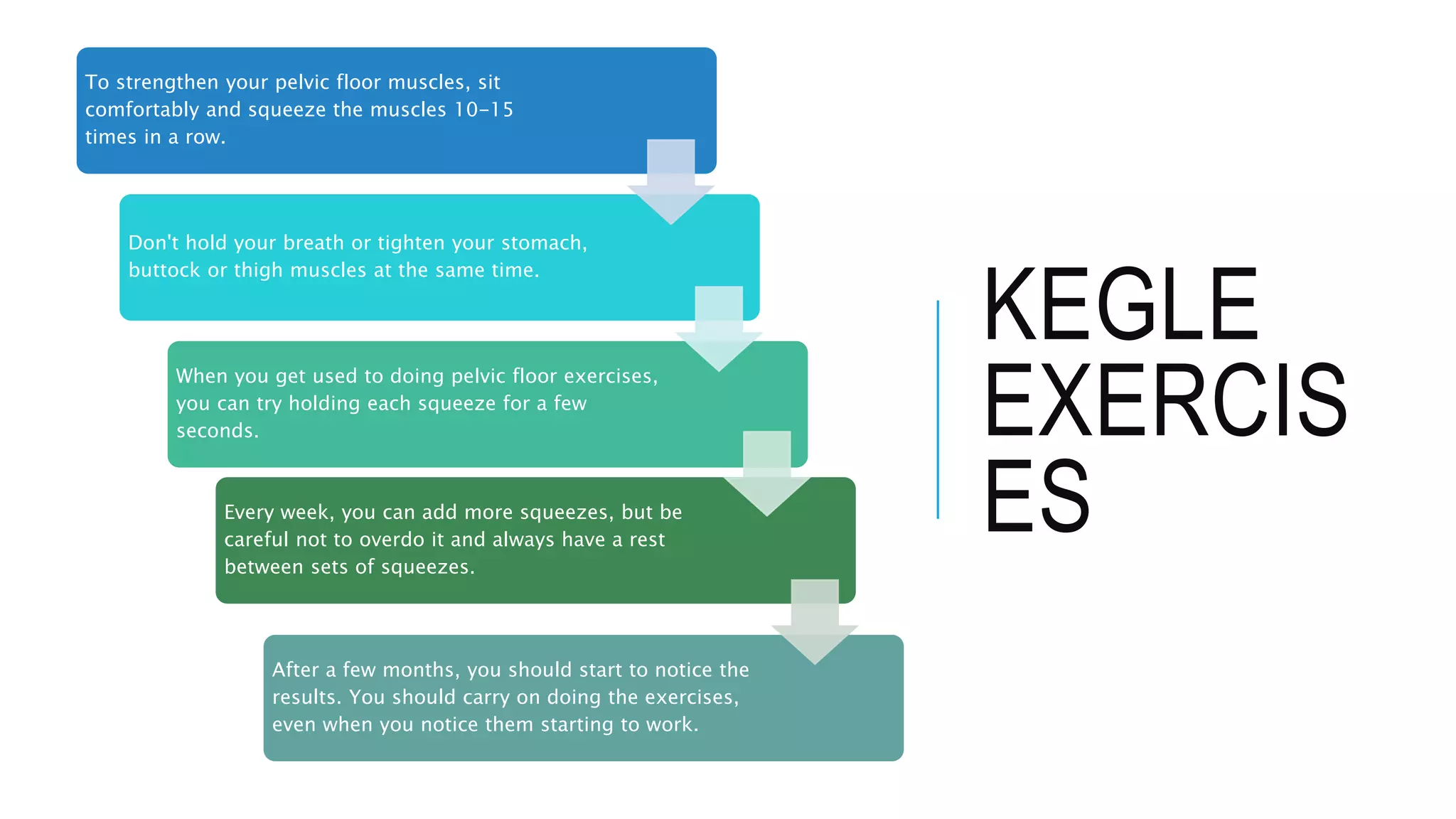
KEGLE
EXERCIS
ES
To strengthen your pelvic floor muscles, sit
comfortably and squeeze the muscles 10-15
times in a row.
Don't hold your breath or tighten your stomach,
buttock or thigh muscles at the same time.
When you get used to doing pelvic floor exercises,
you can try holding each squeeze for a few
seconds.
Every week, you can add more squeezes, but be
careful not to overdo it and always have a rest
between sets of squeezes.
After a few months, you should start to notice the
results. You should carry on doing the exercises,
even when you notice them starting to work.
POSITION FOR KEGEL
EXERCISE
DEVICES USED
IN PELVIC FLOOR
STRENGTHENING
THANK YOU

Pelvic Floor Anatomy and Physiotherapy management

  • 1.
    ANATOMY OF FEMALE PELVICFLOOR By Fabiha Fatima BPT 3rd year
  • 2.
    ANATOMY OF THE PELVIC FLOOR The"pelvic floor" is a term for the group of muscles that covers the bony opening at the base of the pelvis. - bony pelvis - pelvic floor muscles - fascia and ligaments -viscera
  • 3.
    ANATOMY OF THE PELVICFLOOR Bony pelvis Pubic arch (pubic symphysis, inferior pubic rami, ischial rami) Ischial tuberosity Ischial spine Coccyx Parts of the pelvic floor: 1. The bony pelvis 2. Muscular supports of the pelvic floor, and 3. Endopelvic fascia and connective tissue supports.
  • 4.
    THE BONY PELVIS 1.The Greater or Major Pelvis: Occupied by the abdominal viscera 2. The Lesser Pelvis: Narrower continuation of the major pelvis inferiorly containing pelvic organs and closed inferiorly by the pelvic floor. The female pelvis has a wider diameter and a more circular shape than that of the male. The wider inlet facilitates head engagement during parturition. The wider outlet predisposes to subsequent pelvic
  • 5.
    PELVIC LIGAMENTS Pelvic ligaments Sacrotuberous ligaments attach the ischial tuberosity to sacrum  Sacrospinous ligaments attach spine to sacrum
  • 6.
    PELVIC FLOOR MUSCLES Pelvic floor muscles PelvicDiaphragm (Levator ani) Pubococcygeus Iliococcygeus Coccygeus Puborectalis Associated muscles Piriformis Obturator Internus
  • 8.
    PELVIC DIAPHRAG M 1) The pelvicdiaphragm: The muscles that span the pelvic floor are collectively known as the Pelvic Diaphragm. It is composed of two paired muscles: a) Levator Ani: i) Pubococcygeus (keggle muscle) ii) Ileococcygeus muscle. iii) Fusion of fibres from both sides form the levator plate, the shelf on which pelvic organs rest. b) Coccygeus: forms the posterior part of pelvic diaphragm.
  • 10.
    LEVATOR ANI Most important musclein the pelvic floor Represents a critical component of pelvic organ support Physiologically, normal Levator ani muscles maintain a constant state of contraction It provides a solid floor that supports the weight of the abdomino-pelvic contents against the intra-abdominal forces
  • 11.
    FUNCTIONS OF PELVIC DIAGPHRAGM Thesemuscles: 1. Close the inferior outlet of the pelvis 2. Support the pelvic floor 3. Elevate the pelvic floor to help release feces 4. Resist increased intra-abdominal pressure PD is pierced by the rectum and urethra and vagina in females Region inferior to the pelvic diaphragm is the perineum
  • 12.
    MUSCLES OF THE PELVICFLOOR Superficial perineal layer (innervated by the pudendal nerve): Bulbocavernosus, Ischiocavernosus, Superficial transverse perineal, External anal sphincter (EAS) Deep urogenital diaphragm layer (innervated by pudendal nerve): Compressor urethera, Uretrovaginal sphincter, Deep transverse perineal
  • 13.
    THE UROGENITAL DIAGPHRAGM Muscles inferiorto the pelvic floor Stretches between two sides of the pubic arch in the anterior half of the perineum Contains Deep transverse perineal muscle External urethral sphincter muscle Superficial transverse perineal muscle Perineal membrane Ischio cavernosus and bulbospongiosus
  • 14.
    ENDOPELVIC FASCIA AND CONNECTIVETISSUE SUPPORTS The bladder, urethra, the vagina and uterus are attached to the pelvic walls by a system of connective tissue that has been called the endopelvic fascia. The endopelvic fascia is continuous with the visceral fascia, which provides a capsule containing the organs and allows displacements and changes in volume.
  • 15.
    ENDOPELVI C FASCIA AND CONNECTIV E TISSUE SUPPORTS Anteriorsupports:  The Pubo-urethral ligaments  The Pubo-cervical fascia Middle supports:  The cardinal ligaments (also called Mackenrodt’s ligament) extend from the lateral margins of the cervix and upper vagina to the lateral pelvic walls.  The Utero Sacral ligaments are attached to the cervix and upper vaginal fornices posterolaterally. Posteriorly, they attach to the pre-sacral fascia in front of the sacroiliac joint.  The cardinal and uterosacral ligaments hold the uterus and upper vagina in their proper place over the levator plate. Posterior Supports:  Recto vaginal Septum/fascia  Urogenital diaphragm  Lateral Rectal ligaments
  • 16.
    PERINEUM It is adiamond shaped area Bounded deeply by the inferior fascia of the pelvic diaphragm and superficially by the skin Boundaries- Anteriorly by pubic symphysis, Ischiopubic rami and ischial tuberosities antero- laterally, Coccyx posteriorly and Sacro tuberous ligaments postero-laterally.
  • 17.
    ANATOMY OF THE PELVIC FLOOR Facilitatory muscles Adductors Gluteals Tranversusabdominus Obturator internus Synergistic muscles Transversus abdominus Deep lumbar multifidus Respiratory diaphragm
  • 18.
    PELVIC FLOOR INNERVATION The pelvic diaphragm muscles- 2ndthrough the 5th sacral nerve roots (S2-S5) The perineal of inferior surface is supplied by branches of the pudendal nerve. (Incontinence)
  • 20.
    FUNCTION OF PELVIC FLOORMUSCLES Pelvic diaphragm Supports bladder, bowel and uterus in a functional position Assists the closure of the bladder and bowel outlet. It moves the sacrum/coccyx on the pelvis. Stabilizes pelvic ring together with the diaphragm and transversus abdominus to provide trunk and pelvic stability Obturator internus Laterally rotates the hip and lifts the bladder, bowel and uterus into a functional position while assisting in closure of the urethra and anus
  • 21.
  • 22.
    OVERALL Because of thedifferent orientations of their fibers, the different attachment sites at bones and ligaments, and their different layers, the pelvic floor muscles are able to form a highly adjustable, flexible and strong muscle group. When properly functioning, the female pelvic floor muscles adapt to even the stresses of childbirth and are able to heal and return to previous levels of function.
  • 23.
  • 24.
    WHAT CONDITIONS REQUIRE PELVICFLOOR PHYSIOTHERAPY? Bladder symptoms – peeing when sneezing, coughing, laughing or when doing sports – having pain when peeing (without having a urinary tract infection) – needing to go to the loo and not being able to “hold it” for long.  Bowel symptoms – pelvic pain associated with bowel movements – not being able to control or hold for long a bowel movement/wind – chronic constipation and straining when having a bowel movement – anal pain before, during or after a bowel movement – feeling increased anal tension like there is something stuck
  • 25.
    WHAT CONDITIONS REQUIRE PELVICFLOOR PHYSIOTHERAPY? Sexual and vaginal/anal symptoms – vaginal and/or anal pain or a burning sensation associated with sitting, periods, sex, urination/ defecation or wearing tight clothes. – Vulvodynia – a sensation of vulval burning and soreness in the absence of any obvious skin condition or infection. – Pelvic and perineum (anal, vaginal) pain associated with intercourse – Vulvovaginal athrophy caused by the lack of estrogen in the tissues Pregnancy and childbirth-related symptoms – pregnancy/ postpartum pelvic girdle, hip, tailbone, perineum, symphysis pubic, sacroiliac joint or upper/lower back pain – After 6 weeks postpartum as part as postnatal detailed physiotherapy assessment of the back, abdominal and pelvic area. – Abdominal separation/rectus abdominis diastasis/ tummy gap after pregnancy – vaginal and/or anal heaviness or/ bulging – feeling like something is falling out of the vagina – lower back/ tailbone pain when sitting
  • 26.
    WHAT CONDITIONS REQUIRE PELVICFLOOR PHYSIOTHERAPY? Menstrual symptoms – pelvic, perineum and lower back pain associated with your menstrual cycle – pain and a burning sensation in the perineum, groin, inner thighs or pelvic/lower back area – abdominal and pelvic floor cramping Pelvic organ prolapse symptoms – vaginal and/or anal heaviness or/ bulging – feeling like something is falling out of the vagina – feeling pressure or fullness in the pelvic area – painful intercourse Postural/ sports associated symptoms: – vaginal and/or anal pain or a burning associated with physical activity and sports – vaginal and/or anal heaviness or/
  • 27.
    PELVIC FLOOR ASSESSMENT 1.Confidentiality and respect 2. Explaining and planning 3. Detailed history including Bladder and bowel Menstrual History Sexual history Parity and Deliveries 4 . Examination – Palpation through anal or vagina passage 1. Sensation 2. Injury or scarring 3. Muscle tone 4. Tenderness or pain 5. Neural sensitivity 6. Muscle tone 7. Function 8. Co-Ordination 9. Ability to contract and relax 10. Strength (MMT) 11. Endurance For Further Reading please see https://pdfs.semanticscholar.org/0e3d/2330f 9a0f2b8d3527a770b565ea061701c51.pdf
  • 28.
    GOALS OF PHYSIOTHE RAPY INTERVENT IONS IN PELVIC FLOOR PROBLEMS Achieveoptimal relaxation, function and strength of the pelvic floor muscles. – Improve the work of the abdominal muscles, diaphragm and muscles in the thighs and groin. – Improve connective tissue (fascia, muscles, ligaments, nerves etc.) mobility and function. – Improve mobility of the pelvis, lumbar spine and hips joints. – Achieve good bowel, bladder and sexual health. – Restore correct breathing patterns. – Learn about how the brain processes pain and how simple lifestyle changes may have a significant impact on quality of life.
  • 29.
    GOALS OF PHYSIOTHER APY INTERVENTIO NS IN PELVIC FLOOR PROBLEMS PFM strengthening forendurance and coordination Education regarding behavioral strategies to improve continence Urge suppressio n Timed voiding Toileting strategies Bladder irritants discussed Flexibility and strengthening of associated musculature Postural and functional retraining for activities causing dysfunction (sport, sitting, intercourse) Modalities as needed: biofeedback, electrical stimulation
  • 30.
    PHYSIOTHE RAPY INTERVENTI ONS For Pain Relief Exercises( Core and Kegel) Core Strengthening Program Abdominals Postural Training Pelvic Floor Muscles Hips Progression Supine Sitting Standing Activity while standing Resistance With Weight
  • 31.
    KEGLE EXERCIS ES To strengthen yourpelvic floor muscles, sit comfortably and squeeze the muscles 10-15 times in a row. Don't hold your breath or tighten your stomach, buttock or thigh muscles at the same time. When you get used to doing pelvic floor exercises, you can try holding each squeeze for a few seconds. Every week, you can add more squeezes, but be careful not to overdo it and always have a rest between sets of squeezes. After a few months, you should start to notice the results. You should carry on doing the exercises, even when you notice them starting to work.
  • 32.
  • 33.
    DEVICES USED IN PELVICFLOOR STRENGTHENING
  • 34.