PHYSIOTHERAPY IN PCOS
By: Dr. Akshita (PT)
M.P
.T (Cardiopulmonary), B.P
.T (AJIPT, Delhi
University), D.C.P
.T
In charge, Department of Physiotherapy,
IPHI, New Delhi
Former PT Yashoda Super Specialty
Hospital & DCCW
Former Intern Sir Ganga Ram Hospital
Certified BLS & ACLS, AHA
INTRODUCTION:
• PCOS- Polycystic ovarian syndrome is a condition in which levels of women’s sex
hormones are imbalanced which further leads to the growth of a cyst in ovaries
medically termed ovarian cysts. It is also known as Stein Leventhal Syndrome. This
heterogeneous disorder is characterized by excessive androgen production by the
ovaries which interferes with the reproductive, endocrine & metabolic functions.
PREVALENCE:
• It is affecting 5-10% of women of reproductive age i.e. 15-45 years.
• It has been noted that the incidences are increasing fast with change in lifestyle &
stress.
• 20% of women suffer from infertility.
• It is said to be associated with Insulin Resistance creating the risk for diabetes,
hypertension & cardiovascular disorders
CAUSES:
SIGN AND SYMPTOMS:
Ovulatory dysfunction syndrome
• Amenorrhea or Oligomenorrhoea-
• Irregular uterine bleeding can occur-
26%
• Infertility is noted- 20%
2. Androgen excess
• Hirsutism Acne
• Alopecia or Baldness
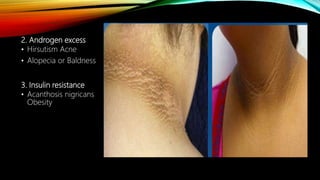
3. Insulin resistance
• Acanthosis nigricans
Obesity
PHYSIOTHERAPY MANAGEMENT
• Physiotherapy is proved to be a best therapeutic as well as supportive
management in PCOS patients, especially in reducing the risk of
infertility.
• Exercise helps in restoring quality of life and improving fertility through
inducing hormonal balancing, reducing inflammatory markers,
combating obesity, metabolic syndrome, and increasing immunity
BENEFITS OF EXERCISES FOR PCOS:
• Decreases the risk of infertility.
• Helps in reduction, even elimination, insulin resistivity which is common in
PCOS.
• Improves basal metabolic rate (BMR).
• Releases Endorphins (‘happy hormones’) which assists in normalizing stress
levels.
• Quash cravings- it is being said that a 10-minute walk can kill cravings for
chocolate.
• Aids fat loss and helps in maintenance of a healthy weight.
• Helps bowels and remove toxins.
EXERCISE TRAINING SESSION:
• Warm-up: At least 5–10 min.
• Aerobics exercises- Frequency: 5 days/week for 12–24 weeks- Low impact aerobics
classes, low impact dancing, jogging.
• Resistance exercise training- Frequency: 2–
3 days/week for 12–24 weeks- Gyming/
weight training: biceps and triceps curl,
abdominal curl ups, leg curls etc. Exercise
with theraband. Closed chain exercises:
with use of body weight, example:
pushups, squatting etc.
• Cardio-training: Walking, stationary cycle,
swimming, jogging, running, treadmill,
jumping robes.
CLOSED CHAIN EXERCISES
CARDIO-TRAINING
• Walking
• Stationary cycle
• Swimming
• Jogging
• Running
• Treadmill
• Jumping robes
MANAGEMENT OF COMPLICATIONS:
• Also, women with PCOS may experience low back pain, sacral pain,
and lower quadrant abdominal pain.
• Electrotherapy treatment can be given to reduce such issues: Hot
pack, Tens/IFT, Low back stretching.
Physiotherapy in pcos

Physiotherapy in pcos

  • 1.
    PHYSIOTHERAPY IN PCOS By:Dr. Akshita (PT) M.P .T (Cardiopulmonary), B.P .T (AJIPT, Delhi University), D.C.P .T In charge, Department of Physiotherapy, IPHI, New Delhi Former PT Yashoda Super Specialty Hospital & DCCW Former Intern Sir Ganga Ram Hospital Certified BLS & ACLS, AHA
  • 2.
    INTRODUCTION: • PCOS- Polycysticovarian syndrome is a condition in which levels of women’s sex hormones are imbalanced which further leads to the growth of a cyst in ovaries medically termed ovarian cysts. It is also known as Stein Leventhal Syndrome. This heterogeneous disorder is characterized by excessive androgen production by the ovaries which interferes with the reproductive, endocrine & metabolic functions.
  • 3.
    PREVALENCE: • It isaffecting 5-10% of women of reproductive age i.e. 15-45 years. • It has been noted that the incidences are increasing fast with change in lifestyle & stress. • 20% of women suffer from infertility. • It is said to be associated with Insulin Resistance creating the risk for diabetes, hypertension & cardiovascular disorders
  • 4.
  • 5.
  • 6.
    Ovulatory dysfunction syndrome •Amenorrhea or Oligomenorrhoea- • Irregular uterine bleeding can occur- 26% • Infertility is noted- 20%
  • 7.
    2. Androgen excess •Hirsutism Acne • Alopecia or Baldness 3. Insulin resistance • Acanthosis nigricans Obesity
  • 8.
    PHYSIOTHERAPY MANAGEMENT • Physiotherapyis proved to be a best therapeutic as well as supportive management in PCOS patients, especially in reducing the risk of infertility. • Exercise helps in restoring quality of life and improving fertility through inducing hormonal balancing, reducing inflammatory markers, combating obesity, metabolic syndrome, and increasing immunity
  • 9.
    BENEFITS OF EXERCISESFOR PCOS: • Decreases the risk of infertility. • Helps in reduction, even elimination, insulin resistivity which is common in PCOS. • Improves basal metabolic rate (BMR). • Releases Endorphins (‘happy hormones’) which assists in normalizing stress levels. • Quash cravings- it is being said that a 10-minute walk can kill cravings for chocolate. • Aids fat loss and helps in maintenance of a healthy weight. • Helps bowels and remove toxins.
  • 10.
    EXERCISE TRAINING SESSION: •Warm-up: At least 5–10 min. • Aerobics exercises- Frequency: 5 days/week for 12–24 weeks- Low impact aerobics classes, low impact dancing, jogging.
  • 11.
    • Resistance exercisetraining- Frequency: 2– 3 days/week for 12–24 weeks- Gyming/ weight training: biceps and triceps curl, abdominal curl ups, leg curls etc. Exercise with theraband. Closed chain exercises: with use of body weight, example: pushups, squatting etc. • Cardio-training: Walking, stationary cycle, swimming, jogging, running, treadmill, jumping robes.
  • 13.
  • 14.
    CARDIO-TRAINING • Walking • Stationarycycle • Swimming • Jogging • Running • Treadmill • Jumping robes
  • 15.
    MANAGEMENT OF COMPLICATIONS: •Also, women with PCOS may experience low back pain, sacral pain, and lower quadrant abdominal pain. • Electrotherapy treatment can be given to reduce such issues: Hot pack, Tens/IFT, Low back stretching.