
Patient with unstable pelvic injury in ED

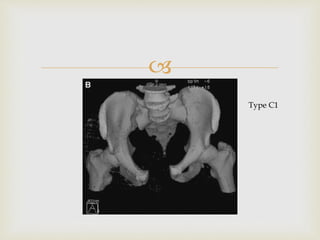
Type C1

 Pelvic injuries form about 3-4 % of all skeletal
injuries but it is likely to rise as more vehicles are put
on our roads ( 200%+ increase in last 5 years!)
 Low energy trauma in osteoporotic person
 High energy RTA
 Fall from height
 Earthquake/ war

 Emergent application in the E.D for unstable patient
with pelvic injury
 As adjunct to control bleeding in pelvic injury (?)
 As a definitive fixation in certain open injuries
 In combination with limited Internal fixation
 Children with pelvic injuries
 Pregnant women
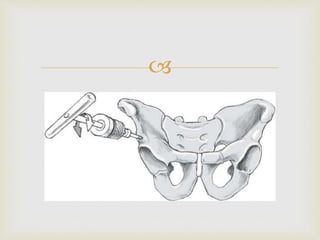
indications

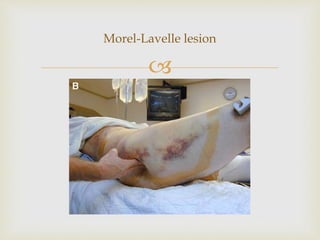
Morel-Lavelle lesion

Retroperitoneal bleed ? Urethral injury

Pelvic C- clamp

Contraindications:
 Poor general condition.
 Local soft-tissue damage.
 Local infection.

 The external fixator is the most commonly used
treatment for surgical stabilization of the pelvic ring
in emergency situations.
 Its advantages are ease of handling and its
availability in most hospitals

The inadequate biomechanical stability of some
configurations of external fixation is a concern.
Although adequate holding power was measured
for open-book type B injuries unstable in rotation,
the load limits for vertically unstable type C injuries is
poor


On account of the superior holding power of the
Schanz screws in the supraacetabular region compared
with their placement in the iliac crest and on account
of the superior soft-tissue coverage, the technically
more demanding placement of Schanz screws
in the supraacetabular area is preferred to their
placement in the iliac crest.

The good and excellent results of all treatments of
pelvic injuries are 79.8%, and of these 83.2% are with
internal fixation solely, while 78.5% are with external
fixation solely and hybrid fixation.
 The difference is less than 5%, and having in mind
that in many cases the external fixation was
irreplaceable, we would like to emphasize again that
this method still has its importance and certain place
today.
Pavlin Apostolov, Martin Burnev, Petar Milkov
Clinic of Orthopaedics and Traumatology
MBAL “Saint Anna” Hospital - Varna, Bulgaria

Advantages
 • Percutaneous screw insertion.
 • Minimal soft-tissue damage.
 • Reduced bleeding from pelvic bones and venous
plexuses thanks to the reduction.
 • Direct mechanical compression effect on the posterior
pelvic ring.
 • Immediate application in the emergency ward or the
intensive care unit.
 • Early mobilization with partial weight bearing for
type B injuries thanks to pain reduction
Axel Gänsslen, Tim Pohlemann, Christian Krettek
Operat Orthop Traumatol 2005;17:296–312

Disadvantages
 • If misdirected can penetrate into hip.
 • May be awkward for very obese patients,
particularly when sitting.
 • Has to be combined with internal fixation in type C
injuries.

Preoperative Work Up
 • Pelvic radiographs, if necessary oblique views or
computed tomography.
 • Identify type of injury & direction of instability
 • Antibiotics generally not necessary.

Anesthesia and Positioning
 • General anesthesia.
 • Standard supine position.
 • Free draping of the lower limb on the side of the injured
 pelvis.
 • Positioning of the patient in such away that the
following views are possible:
 – view of entire pelvis;
 – oblique views allowing a 40° rotation in the transverse
plane: inlet and outlet views;
 – oblique views allowing a 30° rotation in the sagittal
plane: ala and obturator views.

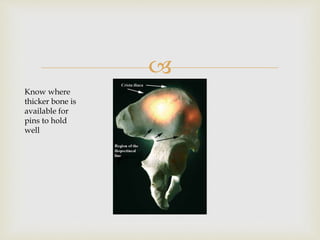
Know where
thicker bone is
available for
pins to hold
well
To obtain the maximal screw length, and
therefore an optimal screw purchase, a
drilling angle of approximately 20° must
be selected for the Schanz screw
In the frontal
plane there is a
triangular area
of cancellous
bone along
iliopectineal
line.

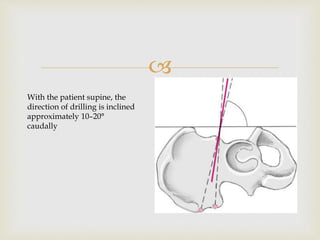
With the patient supine, the
direction of drilling is inclined
approximately 10–20°
caudally
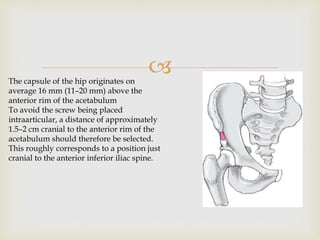
The capsule of the hip originates on
average 16 mm (11–20 mm) above the
anterior rim of the acetabulum
To avoid the screw being placed
intraarticular, a distance of approximately
1.5–2 cm cranial to the anterior rim of the
acetabulum should therefore be selected.
This roughly corresponds to a position just
cranial to the anterior inferior iliac spine.

Surface marking
3
2




The orientation of the ala of the iliac bone
is determined by palpation with
an instrument [30], a Kirschner wire [28] or
the finger. Only the cortical bone
is perforated by the drill bit, and the
Schanz screw is then introduced into
the drill hole and further advanced
between the two laminae of the iliac
bone without predrilling.

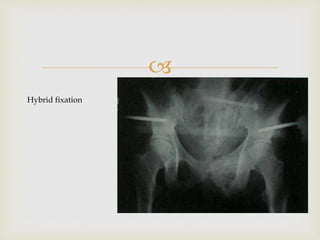
Hybrid fixation

Patient
comfortably
mobilized with
ExFix

Tamponade effect is doubtful

 Everyone treating pelvic injuries should know how
to do a good external fixation.
 Temporary emergent Tx in ED
 May be used as part of hybrid stabilization
 May be definitive in open injuries – (colostomy)
 Supra-pubic fixation preferable to iliac crest
(superior) fixation
summary


Pelvic ex fix

  • 2.
     Patient with unstablepelvic injury in ED
  • 3.
  • 4.
      Pelvic injuriesform about 3-4 % of all skeletal injuries but it is likely to rise as more vehicles are put on our roads ( 200%+ increase in last 5 years!)  Low energy trauma in osteoporotic person  High energy RTA  Fall from height  Earthquake/ war
  • 5.
      Emergent applicationin the E.D for unstable patient with pelvic injury  As adjunct to control bleeding in pelvic injury (?)  As a definitive fixation in certain open injuries  In combination with limited Internal fixation  Children with pelvic injuries  Pregnant women indications
  • 6.
  • 7.
  • 8.
  • 9.
     Contraindications:  Poor generalcondition.  Local soft-tissue damage.  Local infection.
  • 10.
      The externalfixator is the most commonly used treatment for surgical stabilization of the pelvic ring in emergency situations.  Its advantages are ease of handling and its availability in most hospitals
  • 11.
     The inadequate biomechanicalstability of some configurations of external fixation is a concern. Although adequate holding power was measured for open-book type B injuries unstable in rotation, the load limits for vertically unstable type C injuries is poor
  • 12.
  • 13.
     On account ofthe superior holding power of the Schanz screws in the supraacetabular region compared with their placement in the iliac crest and on account of the superior soft-tissue coverage, the technically more demanding placement of Schanz screws in the supraacetabular area is preferred to their placement in the iliac crest.
  • 14.
     The good andexcellent results of all treatments of pelvic injuries are 79.8%, and of these 83.2% are with internal fixation solely, while 78.5% are with external fixation solely and hybrid fixation.  The difference is less than 5%, and having in mind that in many cases the external fixation was irreplaceable, we would like to emphasize again that this method still has its importance and certain place today. Pavlin Apostolov, Martin Burnev, Petar Milkov Clinic of Orthopaedics and Traumatology MBAL “Saint Anna” Hospital - Varna, Bulgaria
  • 15.
     Advantages  • Percutaneousscrew insertion.  • Minimal soft-tissue damage.  • Reduced bleeding from pelvic bones and venous plexuses thanks to the reduction.  • Direct mechanical compression effect on the posterior pelvic ring.  • Immediate application in the emergency ward or the intensive care unit.  • Early mobilization with partial weight bearing for type B injuries thanks to pain reduction Axel Gänsslen, Tim Pohlemann, Christian Krettek Operat Orthop Traumatol 2005;17:296–312
  • 16.
     Disadvantages  • Ifmisdirected can penetrate into hip.  • May be awkward for very obese patients, particularly when sitting.  • Has to be combined with internal fixation in type C injuries.
  • 17.
     Preoperative Work Up • Pelvic radiographs, if necessary oblique views or computed tomography.  • Identify type of injury & direction of instability  • Antibiotics generally not necessary.
  • 18.
     Anesthesia and Positioning • General anesthesia.  • Standard supine position.  • Free draping of the lower limb on the side of the injured  pelvis.  • Positioning of the patient in such away that the following views are possible:  – view of entire pelvis;  – oblique views allowing a 40° rotation in the transverse plane: inlet and outlet views;  – oblique views allowing a 30° rotation in the sagittal plane: ala and obturator views.
  • 19.
     Know where thicker boneis available for pins to hold well
  • 20.
    To obtain themaximal screw length, and therefore an optimal screw purchase, a drilling angle of approximately 20° must be selected for the Schanz screw In the frontal plane there is a triangular area of cancellous bone along iliopectineal line.
  • 21.
     With the patientsupine, the direction of drilling is inclined approximately 10–20° caudally
  • 22.
    The capsule ofthe hip originates on average 16 mm (11–20 mm) above the anterior rim of the acetabulum To avoid the screw being placed intraarticular, a distance of approximately 1.5–2 cm cranial to the anterior rim of the acetabulum should therefore be selected. This roughly corresponds to a position just cranial to the anterior inferior iliac spine.
  • 23.
  • 24.
  • 25.
  • 26.
  • 27.
     The orientation ofthe ala of the iliac bone is determined by palpation with an instrument [30], a Kirschner wire [28] or the finger. Only the cortical bone is perforated by the drill bit, and the Schanz screw is then introduced into the drill hole and further advanced between the two laminae of the iliac bone without predrilling.
  • 28.
  • 29.
  • 30.
  • 31.
      Everyone treatingpelvic injuries should know how to do a good external fixation.  Temporary emergent Tx in ED  May be used as part of hybrid stabilization  May be definitive in open injuries – (colostomy)  Supra-pubic fixation preferable to iliac crest (superior) fixation summary
  • 32.