
POLYMETHYL
METHACRYLATE
(PMMA)
BY – RANA SAHA
B.PHARM. 4TH YEAR
INTRODUCTION
 PMMA, Polymethyl methacrylate (C5O2H8)n , polymer of methyl methacrylate, is a
transparent rigid thermoplastic (often used in sheet form as a lightweight or
shatter-resistant alternative to glass. ).
 It is also known as acrylic, acrylic glass, or plexiglass as well as by the trade names
Crylux, Plexiglas, Acrylite, Lucite, and Perspex.
 PMMA or poly (methyl 2‐methylpropenoate) is produced from monomer methyl
methacrylate
POLYMERIZATION OF PMMA
METHYL
METHACRYLATE
POLYMETHYL
METHACRYLATE
POLYMER
PROPERTIES OF PMMA
Transmittance
UV Stability
Surface Hardness
Chemical Resistance
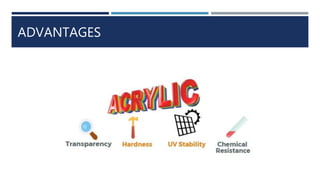
ADVANTAGES OF PMMA
Excellent clarity
UV resistant
Good abrasion resistant
Hardness and stiffness is good.
Low water absorption
Flamable, but has low smoke emission
Good track and arc resistant
ADVANTAGES
LIMITATIONS OF PMMA
Poor impact resistance
UVLimited chemical resistance, prone to attack
organic solvents Stability
Limited heat resistance (80°C)
Cracking under load possible
Poor wear and abrasion resistance
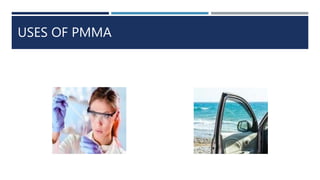
USES OF PMMA
Medical and Healthcare
Architecture and Construction
Lighting
Automotive and Transportation
Electronics
Furniture
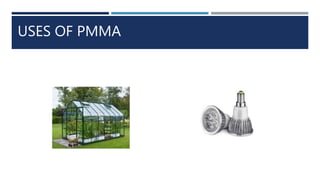
USES OF PMMA
USES OF PMMA
MEDICAL USES OF PMMA
In orthopaedics, as bone cement
Used to affix implant
Used to remodel lost bones
Used as sealing agents in dentistry
Used in dental prosthesis
RECYCLABILITY OF PMMA
 Polymethyl methacrylate is highly biocompatible, 100% recyclable
and non-biodegradable material. PMMA is considered as a group 7
plastic.
 There are several ways to recycle PMMA. Often these recycling
processes involve pyrolysis, in which the PMMA is extremely
heated in the absence of oxygen. Another procedure involves
depolymerization of PMMA using molten lead to obtain the
monomer MMA in a purity >98%.
THANK
YOU

Polymethyl methacrylate (pmma)

  • 1.
  • 2.
    INTRODUCTION  PMMA, Polymethylmethacrylate (C5O2H8)n , polymer of methyl methacrylate, is a transparent rigid thermoplastic (often used in sheet form as a lightweight or shatter-resistant alternative to glass. ).  It is also known as acrylic, acrylic glass, or plexiglass as well as by the trade names Crylux, Plexiglas, Acrylite, Lucite, and Perspex.  PMMA or poly (methyl 2‐methylpropenoate) is produced from monomer methyl methacrylate
  • 3.
  • 4.
    PROPERTIES OF PMMA Transmittance UVStability Surface Hardness Chemical Resistance
  • 5.
    ADVANTAGES OF PMMA Excellentclarity UV resistant Good abrasion resistant Hardness and stiffness is good. Low water absorption Flamable, but has low smoke emission Good track and arc resistant
  • 6.
  • 7.
    LIMITATIONS OF PMMA Poorimpact resistance UVLimited chemical resistance, prone to attack organic solvents Stability Limited heat resistance (80°C) Cracking under load possible Poor wear and abrasion resistance
  • 8.
    USES OF PMMA Medicaland Healthcare Architecture and Construction Lighting Automotive and Transportation Electronics Furniture
  • 9.
  • 10.
  • 11.
    MEDICAL USES OFPMMA In orthopaedics, as bone cement Used to affix implant Used to remodel lost bones Used as sealing agents in dentistry Used in dental prosthesis
  • 12.
    RECYCLABILITY OF PMMA Polymethyl methacrylate is highly biocompatible, 100% recyclable and non-biodegradable material. PMMA is considered as a group 7 plastic.  There are several ways to recycle PMMA. Often these recycling processes involve pyrolysis, in which the PMMA is extremely heated in the absence of oxygen. Another procedure involves depolymerization of PMMA using molten lead to obtain the monomer MMA in a purity >98%.
  • 13.