Peaky Blinders
A Case Study
Gemma Nunn and Jo Watkinson’s
Visits
The Programme
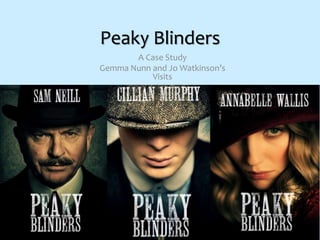
Peaky Blinders is a BBC 2 TV crime drama, starring
Cillian Murphy. It’s set in Birmingham, England in 1919,
just after the war, and is based around a gang who
sew razor blades into their caps, lead by Tommy
Shelby – a man who wants to move up in the world.
The series was created by Steven Knight, and
produced by Caryn Mandabach Productions and Tiger
Aspect Productions.
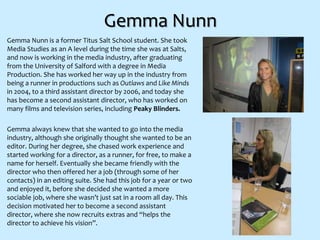
Gemma Nunn
Gemma Nunn is a former Titus Salt School student. She took
Media Studies as an A level during the time she was at Salts,
and now is working in the media industry, after graduating
from the University of Salford with a degree in Media
Production. She has worked her way up in the industry from
being a runner in productions such as Outlaws and Like Minds
in 2004, to a third assistant director by 2006, and today she
has become a second assistant director, who has worked on
many films and television series, including Peaky Blinders.
Gemma always knew that she wanted to go into the media
industry, although she originally thought she wanted to be an
editor. During her degree, she chased work experience and
started working for a director, as a runner, for free, to make a
name for herself. Eventually she became friendly with the
director who then offered her a job (through some of her
contacts) in an editing suite. She had this job for a year or two
and enjoyed it, before she decided she wanted a more
sociable job, where she wasn’t just sat in a room all day. This
decision motivated her to become a second assistant
director, where she now recruits extras and “helps the
director to achieve his vision”.
Gemma Nunn’s Visit
Gemma Nunn came back to visit Titus Salt School, to talk to our media studies class about her experiences in the media
industry. It was really interesting to hear about her time in the industry, and her stories of her experiences on Peaky
Blinders were particularly relevant to us because we’re going to be studying TV drama as part of our course.
We were able to ask her questions, which developed my interest in the media industry further because I got to hear
about what it’s really like. When asked, she summarised her current job (second assistant director) by saying “I manage
people on film sets, and I really enjoy it.” She also told us that the series she worked on that gave her a ‘break’ was the
Junior Eurovision, where she became friendly with the director. She told us that “you have to work hard to get
somewhere in the media industry, but it’s not just about what you know, it’s also about who you know.”
Her visit helped me to understand casting in particular, which will help me with my video production work later this
year, when I will be producing a short film. Gemma is in charge of casting extras, and recommended that I used an
audition process to find the best people for the roles in my short film. I think that I will follow her advice, as auditioning
is a good way to get a flavour for an actor or actress’s talent. She also talked to us about how important appearance of
actors and actresses can be, particularly when she is recruiting stunt doubles, but also extras. The actors and actresses
you choose must fit into the diegesis that you are trying to create, and it is far easier if they can fit into the physical
stereotype that you are trying to create too. For example, blondes are typically dumb, so if you’re wanting to cast a
dumb character, a blonde might be a good way of helping your audience to pick up on their character.
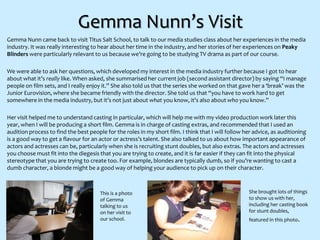
This is a photo
of Gemma
talking to us
on her visit to
our school.
She brought lots of things
to show us with her,
including her casting book
for stunt doubles,
featured in this photo.
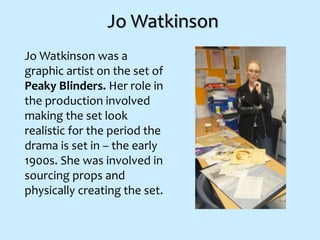
Jo Watkinson
Jo Watkinson was a
graphic artist on the set of
Peaky Blinders. Her role in
the production involved
making the set look
realistic for the period the
drama is set in – the early
1900s. She was involved in
sourcing props and
physically creating the set.
Jo Watkinson’s Visit
Jo Watkinson also paid a visit to Titus Salt School to talk to our media studies class about her
experiences on Peaky Blinders. She talked a lot about how the set was created, and the
importance of mise-en-scene.
Her visit helped me to understand this importance, both in still image photography and video
work. For an image of any kind to be successful, everything that’s ‘in the scene’ must be
relevant and create connotations when put together as a whole. Set design is very important
in creating the mise-en-scene, and Jo also helped me to realise this. She talked about how
much time and effort was put into the set design and creation of Peaky Blinders, essentially
so that nobody would notice it. As a period drama, the set needed to be designed to fit with
the period it was set in (the early 1900s), and if certain things stood out in the set, the illusion
wouldn’t be created.
For example, she told us that one of the doors used in one of the rooms was a brand new
door, but it was stripped and chipped before being painted several times and then smeared
with black and yellow offset, to make it look old fashioned and fitting of the era, when many
people smoked indoors.
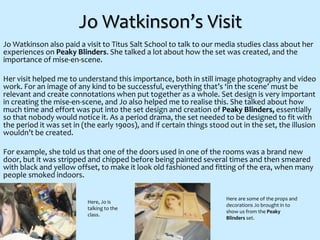
Here, Jo is
talking to the
class.
Here are some of the props and
decorations Jo brought in to
show us from the Peaky
Blinders set.

Peaky Blinders: A Case Study

  • 1.
    Peaky Blinders A CaseStudy Gemma Nunn and Jo Watkinson’s Visits
  • 2.
    The Programme Peaky Blindersis a BBC 2 TV crime drama, starring Cillian Murphy. It’s set in Birmingham, England in 1919, just after the war, and is based around a gang who sew razor blades into their caps, lead by Tommy Shelby – a man who wants to move up in the world. The series was created by Steven Knight, and produced by Caryn Mandabach Productions and Tiger Aspect Productions.
  • 3.
    Gemma Nunn Gemma Nunnis a former Titus Salt School student. She took Media Studies as an A level during the time she was at Salts, and now is working in the media industry, after graduating from the University of Salford with a degree in Media Production. She has worked her way up in the industry from being a runner in productions such as Outlaws and Like Minds in 2004, to a third assistant director by 2006, and today she has become a second assistant director, who has worked on many films and television series, including Peaky Blinders. Gemma always knew that she wanted to go into the media industry, although she originally thought she wanted to be an editor. During her degree, she chased work experience and started working for a director, as a runner, for free, to make a name for herself. Eventually she became friendly with the director who then offered her a job (through some of her contacts) in an editing suite. She had this job for a year or two and enjoyed it, before she decided she wanted a more sociable job, where she wasn’t just sat in a room all day. This decision motivated her to become a second assistant director, where she now recruits extras and “helps the director to achieve his vision”.
  • 4.
    Gemma Nunn’s Visit GemmaNunn came back to visit Titus Salt School, to talk to our media studies class about her experiences in the media industry. It was really interesting to hear about her time in the industry, and her stories of her experiences on Peaky Blinders were particularly relevant to us because we’re going to be studying TV drama as part of our course. We were able to ask her questions, which developed my interest in the media industry further because I got to hear about what it’s really like. When asked, she summarised her current job (second assistant director) by saying “I manage people on film sets, and I really enjoy it.” She also told us that the series she worked on that gave her a ‘break’ was the Junior Eurovision, where she became friendly with the director. She told us that “you have to work hard to get somewhere in the media industry, but it’s not just about what you know, it’s also about who you know.” Her visit helped me to understand casting in particular, which will help me with my video production work later this year, when I will be producing a short film. Gemma is in charge of casting extras, and recommended that I used an audition process to find the best people for the roles in my short film. I think that I will follow her advice, as auditioning is a good way to get a flavour for an actor or actress’s talent. She also talked to us about how important appearance of actors and actresses can be, particularly when she is recruiting stunt doubles, but also extras. The actors and actresses you choose must fit into the diegesis that you are trying to create, and it is far easier if they can fit into the physical stereotype that you are trying to create too. For example, blondes are typically dumb, so if you’re wanting to cast a dumb character, a blonde might be a good way of helping your audience to pick up on their character. This is a photo of Gemma talking to us on her visit to our school. She brought lots of things to show us with her, including her casting book for stunt doubles, featured in this photo.
  • 5.
    Jo Watkinson Jo Watkinsonwas a graphic artist on the set of Peaky Blinders. Her role in the production involved making the set look realistic for the period the drama is set in – the early 1900s. She was involved in sourcing props and physically creating the set.
  • 6.
    Jo Watkinson’s Visit JoWatkinson also paid a visit to Titus Salt School to talk to our media studies class about her experiences on Peaky Blinders. She talked a lot about how the set was created, and the importance of mise-en-scene. Her visit helped me to understand this importance, both in still image photography and video work. For an image of any kind to be successful, everything that’s ‘in the scene’ must be relevant and create connotations when put together as a whole. Set design is very important in creating the mise-en-scene, and Jo also helped me to realise this. She talked about how much time and effort was put into the set design and creation of Peaky Blinders, essentially so that nobody would notice it. As a period drama, the set needed to be designed to fit with the period it was set in (the early 1900s), and if certain things stood out in the set, the illusion wouldn’t be created. For example, she told us that one of the doors used in one of the rooms was a brand new door, but it was stripped and chipped before being painted several times and then smeared with black and yellow offset, to make it look old fashioned and fitting of the era, when many people smoked indoors. Here, Jo is talking to the class. Here are some of the props and decorations Jo brought in to show us from the Peaky Blinders set.