I asked this question to check that I have
reached a varied audience, and also to gage
who reads music magazines.
Male
Female
As I handed my questionnaire out at random, I
received a response from a variety of age
groups, making my survey unbiased and fair.
0
2
4
6
8
10
10 and
under
11 to
15
16 to
20
21 to
25
26 to
30
31 to
35
17 people answered yes to this question, and 23
people answered no. I expected the majority of
people to answer no as the music magazine is
dying out because there is less of a readership.
However, I was somewhat surprised that so many
people answered yes. This is encouraging for me
because it shows that there is still some people
who read music magazines, even if it is irregularly.
Male
Female
Only 23 people answered this question as only 23 people said that they
didn’t read music magazines. These are some of the responses I got:
 “They are too expensive. I would rather read a newspaper.”
 “I can access the media I am interested in online.”
 “I just don’t think to pick up a magazine when I go to the shop.”
 “I prefer to watch TV.”
 “I don’t know where I can buy music magazines. I don’t see many on the
shelves.”
 “I didn’t know music magazines existed.”
 “I don’t have time to read magazines. It’s a waste of money.”
 “I don’t care about where music comes from, I just wanna listen to it.”
 “I can watch live interviews on YouTube.”
 “I don’t know what music magazines are out there.”
 “Just not interested.”
 “I enjoy listening to music but I don’t feel compelled to buy a music
magazine.”
 “They are boring and not suited for me.”
 From this point on, 17 people have answered the
questions because they are only relevant to
people who answered yes.
 This shows that the majority of people who still
buy music magazines prefer to have a physical
printed copy, rather than reading it online or
through social media.
Print
Online
Social
Media
Here are some of the responses I got:
 “Nice to hold, easily accessible” (print)
 “It’s free” (online)
 “Prefer to have a physical copy that I can pick up
and put down whenever I like” (print)
 “It is most accessible to me” (social media)
 “Easy to buy, can go back to an old copy” (print)
 “I can look at it when I’m already on the
computer” (online)
 “Easy to browse through and find specific
articles” (social media)
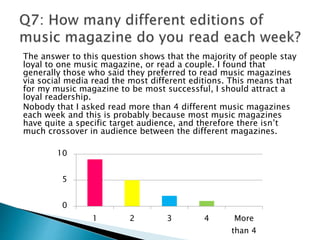
The answer to this question shows that the majority of people stay
loyal to one music magazine, or read a couple. I found that
generally those who said they preferred to read music magazines
via social media read the most different editions. This means that
for my music magazine to be most successful, I should attract a
loyal readership.
Nobody that I asked read more than 4 different music magazines
each week and this is probably because most music magazines
have quite a specific target audience, and therefore there isn’t
much crossover in audience between the different magazines.
0
5
10
1 2 3 4 More
than 4
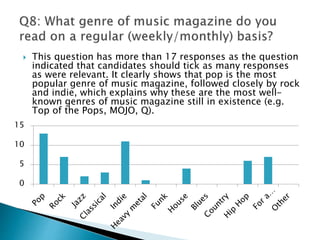
 This question has more than 17 responses as the question
indicated that candidates should tick as many responses
as were relevant. It clearly shows that pop is the most
popular genre of music magazine, followed closely by rock
and indie, which explains why these are the most well-
known genres of music magazine still in existence (e.g.
Top of the Pops, MOJO, Q).
0
5
10
15
Yes
No
As indicated in question 7, this feedback
shows that most people stay loyal to one
music magazine.
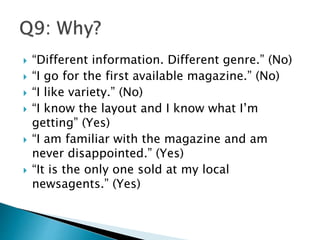
 “Different information. Different genre.” (No)
 “I go for the first available magazine.” (No)
 “I like variety.” (No)
 “I know the layout and I know what I’m
getting” (Yes)
 “I am familiar with the magazine and am
never disappointed.” (Yes)
 “It is the only one sold at my local
newsagents.” (Yes)
0
2
4
6
8
Images Interviews Articles Artists Other
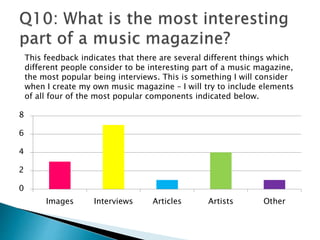
This feedback indicates that there are several different things which
different people consider to be interesting part of a music magazine,
the most popular being interviews. This is something I will consider
when I create my own music magazine – I will try to include elements
of all four of the most popular components indicated below.
 As everyone who is completing the questionnaire at this point has indicated that
they would buy a music magazine, I thought a fitting question would be to ask
them what the maximum they would pay for one is. This will help me to decide
how much to market my own for. Most people suggested that they would pay
somewhere in the reigon of £3-4 for a music magazine, so I should make the
price of my music magazine fit this range.
 Upon analysing my music magazine, I have noticed a minor mistake that means that people who would pay £4
could have ticked one of two boxes. However, it is too late to change it now so this is something that I will need
to take into consideration when deciding on the price of my own music magazine.
£1 - £2
£3 - £4
£4 - £5
Over £5

Music Magazine Questionnaire Feedback

  • 2.
    I asked thisquestion to check that I have reached a varied audience, and also to gage who reads music magazines. Male Female
  • 3.
    As I handedmy questionnaire out at random, I received a response from a variety of age groups, making my survey unbiased and fair. 0 2 4 6 8 10 10 and under 11 to 15 16 to 20 21 to 25 26 to 30 31 to 35
  • 4.
    17 people answeredyes to this question, and 23 people answered no. I expected the majority of people to answer no as the music magazine is dying out because there is less of a readership. However, I was somewhat surprised that so many people answered yes. This is encouraging for me because it shows that there is still some people who read music magazines, even if it is irregularly. Male Female
  • 5.
    Only 23 peopleanswered this question as only 23 people said that they didn’t read music magazines. These are some of the responses I got:  “They are too expensive. I would rather read a newspaper.”  “I can access the media I am interested in online.”  “I just don’t think to pick up a magazine when I go to the shop.”  “I prefer to watch TV.”  “I don’t know where I can buy music magazines. I don’t see many on the shelves.”  “I didn’t know music magazines existed.”  “I don’t have time to read magazines. It’s a waste of money.”  “I don’t care about where music comes from, I just wanna listen to it.”  “I can watch live interviews on YouTube.”  “I don’t know what music magazines are out there.”  “Just not interested.”  “I enjoy listening to music but I don’t feel compelled to buy a music magazine.”  “They are boring and not suited for me.”
  • 6.
     From thispoint on, 17 people have answered the questions because they are only relevant to people who answered yes.  This shows that the majority of people who still buy music magazines prefer to have a physical printed copy, rather than reading it online or through social media. Print Online Social Media
  • 7.
    Here are someof the responses I got:  “Nice to hold, easily accessible” (print)  “It’s free” (online)  “Prefer to have a physical copy that I can pick up and put down whenever I like” (print)  “It is most accessible to me” (social media)  “Easy to buy, can go back to an old copy” (print)  “I can look at it when I’m already on the computer” (online)  “Easy to browse through and find specific articles” (social media)
  • 8.
    The answer tothis question shows that the majority of people stay loyal to one music magazine, or read a couple. I found that generally those who said they preferred to read music magazines via social media read the most different editions. This means that for my music magazine to be most successful, I should attract a loyal readership. Nobody that I asked read more than 4 different music magazines each week and this is probably because most music magazines have quite a specific target audience, and therefore there isn’t much crossover in audience between the different magazines. 0 5 10 1 2 3 4 More than 4
  • 9.
     This questionhas more than 17 responses as the question indicated that candidates should tick as many responses as were relevant. It clearly shows that pop is the most popular genre of music magazine, followed closely by rock and indie, which explains why these are the most well- known genres of music magazine still in existence (e.g. Top of the Pops, MOJO, Q). 0 5 10 15
  • 10.
    Yes No As indicated inquestion 7, this feedback shows that most people stay loyal to one music magazine.
  • 11.
     “Different information.Different genre.” (No)  “I go for the first available magazine.” (No)  “I like variety.” (No)  “I know the layout and I know what I’m getting” (Yes)  “I am familiar with the magazine and am never disappointed.” (Yes)  “It is the only one sold at my local newsagents.” (Yes)
  • 12.
    0 2 4 6 8 Images Interviews ArticlesArtists Other This feedback indicates that there are several different things which different people consider to be interesting part of a music magazine, the most popular being interviews. This is something I will consider when I create my own music magazine – I will try to include elements of all four of the most popular components indicated below.
  • 13.
     As everyonewho is completing the questionnaire at this point has indicated that they would buy a music magazine, I thought a fitting question would be to ask them what the maximum they would pay for one is. This will help me to decide how much to market my own for. Most people suggested that they would pay somewhere in the reigon of £3-4 for a music magazine, so I should make the price of my music magazine fit this range.  Upon analysing my music magazine, I have noticed a minor mistake that means that people who would pay £4 could have ticked one of two boxes. However, it is too late to change it now so this is something that I will need to take into consideration when deciding on the price of my own music magazine. £1 - £2 £3 - £4 £4 - £5 Over £5