By Michelle Asafu-Adjaye

CONVENTIONS OF
DOCUMENTARIES
Conventions
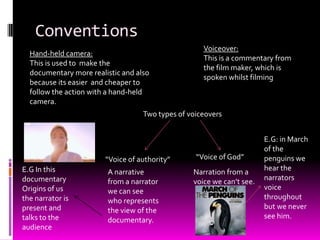
                                                    Voiceover:
  Hand-held camera:
                                                    This is a commentary from
  This is used to make the
                                                    the film maker, which is
  documentary more realistic and also
                                                    spoken whilst filming
  because its easier and cheaper to
  follow the action with a hand-held
  camera.
                                   Two types of voiceovers


                                                                       E.G: in March
                                                                       of the
                        “Voice of authority”      “Voice of God”       penguins we
E.G In this             A narrative              Narration from a      hear the
documentary             from a narrator          voice we can’t see.   narrators
Origins of us           we can see                                     voice
the narrator is         who represents                                 throughout
present and             the view of the                                but we never
talks to the            documentary.                                   see him.
audience
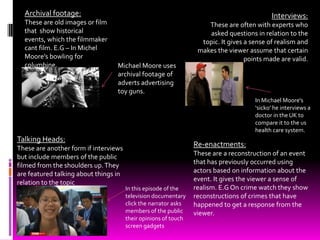
Archival footage:                                                                         Interviews:
  These are old images or film                                       These are often with experts who
  that show historical                                               asked questions in relation to the
  events, which the filmmaker                                      topic. It gives a sense of realism and
  cant film. E.G – In Michel                                      makes the viewer assume that certain
  Moore’s bowling for                                                              points made are valid.
  columbine.                      Michael Moore uses
                                  archival footage of
                                  adverts advertising
                                  toy guns.
                                                                                      In Michael Moore's
                                                                                      ‘sicko’ he interviews a
                                                                                      doctor in the UK to
                                                                                      compare it to the us
                                                                                      health care system.
Talking Heads:
These are another form if interviews
                                                                 Re-enactments:
but include members of the public                                These are a reconstruction of an event
filmed from the shoulders up. They                               that has previously occurred using
are featured talking about things in                             actors based on information about the
relation to the topic                                            event. It gives the viewer a sense of
                                       In this episode of the    realism. E.G On crime watch they show
                                       television documentary    reconstructions of crimes that have
                                       click the narrator asks   happened to get a response from the
                                       members of the public     viewer.
                                       their opinions of touch
                                       screen gadgets
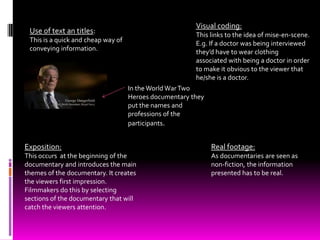
Visual coding:
 Use of text an titles:                                 This links to the idea of mise-en-scene.
 This is a quick and cheap way of                       E.g. If a doctor was being interviewed
 conveying information.                                 they’d have to wear clothing
                                                        associated with being a doctor in order
                                                        to make it obvious to the viewer that
                                                        he/she is a doctor.
                                    In the World War Two
                                    Heroes documentary they
                                    put the names and
                                    professions of the
                                    participants.


Exposition:                                                   Real footage:
This occurs at the beginning of the                           As documentaries are seen as
documentary and introduces the main                           non-fiction, the information
themes of the documentary. It creates                         presented has to be real.
the viewers first impression.
Filmmakers do this by selecting
sections of the documentary that will
catch the viewers attention.
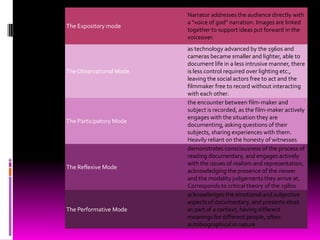
Narrator addresses the audience directly with
                         a “voice of god” narration. Images are linked
The Expository mode
                         together to support ideas put forward in the
                         voiceover.
                         as technology advanced by the 1960s and
                         cameras became smaller and lighter, able to
                         document life in a less intrusive manner, there
The Observational Mode   is less control required over lighting etc.,
                         leaving the social actors free to act and the
                         filmmaker free to record without interacting
                         with each other.
                         the encounter between film-maker and
                         subject is recorded, as the film-maker actively
                         engages with the situation they are
The Participatory Mode
                         documenting, asking questions of their
                         subjects, sharing experiences with them.
                         Heavily reliant on the honesty of witnesses
                         demonstrates consciousness of the process of
                         reading documentary, and engages actively
                         with the issues of realism and representation,
The Reflexive Mode
                         acknowledging the presence of the viewer
                         and the modality judgements they arrive at.
                         Corresponds to critical theory of the 1980s
                         acknowledges the emotional and subjective
                         aspects of documentary, and presents ideas
The Performative Mode    as part of a context, having different
                         meanings for different people, often
                         autobiographical in nature
Bibliography
http://natasha-a2-media.blogspot.com/2010/09/introduction-to-dpcumentary.html
http://www.slideshare.net/crosswaysfederation/codes-and-conventions-of-documentary
http://www.documentarysite.com/?p=40

Conventions of documentaries

  • 1.
  • 2.
    Conventions Voiceover: Hand-held camera: This is a commentary from This is used to make the the film maker, which is documentary more realistic and also spoken whilst filming because its easier and cheaper to follow the action with a hand-held camera. Two types of voiceovers E.G: in March of the “Voice of authority” “Voice of God” penguins we E.G In this A narrative Narration from a hear the documentary from a narrator voice we can’t see. narrators Origins of us we can see voice the narrator is who represents throughout present and the view of the but we never talks to the documentary. see him. audience
  • 3.
    Archival footage: Interviews: These are old images or film These are often with experts who that show historical asked questions in relation to the events, which the filmmaker topic. It gives a sense of realism and cant film. E.G – In Michel makes the viewer assume that certain Moore’s bowling for points made are valid. columbine. Michael Moore uses archival footage of adverts advertising toy guns. In Michael Moore's ‘sicko’ he interviews a doctor in the UK to compare it to the us health care system. Talking Heads: These are another form if interviews Re-enactments: but include members of the public These are a reconstruction of an event filmed from the shoulders up. They that has previously occurred using are featured talking about things in actors based on information about the relation to the topic event. It gives the viewer a sense of In this episode of the realism. E.G On crime watch they show television documentary reconstructions of crimes that have click the narrator asks happened to get a response from the members of the public viewer. their opinions of touch screen gadgets
  • 4.
    Visual coding: Useof text an titles: This links to the idea of mise-en-scene. This is a quick and cheap way of E.g. If a doctor was being interviewed conveying information. they’d have to wear clothing associated with being a doctor in order to make it obvious to the viewer that he/she is a doctor. In the World War Two Heroes documentary they put the names and professions of the participants. Exposition: Real footage: This occurs at the beginning of the As documentaries are seen as documentary and introduces the main non-fiction, the information themes of the documentary. It creates presented has to be real. the viewers first impression. Filmmakers do this by selecting sections of the documentary that will catch the viewers attention.
  • 5.
    Narrator addresses theaudience directly with a “voice of god” narration. Images are linked The Expository mode together to support ideas put forward in the voiceover. as technology advanced by the 1960s and cameras became smaller and lighter, able to document life in a less intrusive manner, there The Observational Mode is less control required over lighting etc., leaving the social actors free to act and the filmmaker free to record without interacting with each other. the encounter between film-maker and subject is recorded, as the film-maker actively engages with the situation they are The Participatory Mode documenting, asking questions of their subjects, sharing experiences with them. Heavily reliant on the honesty of witnesses demonstrates consciousness of the process of reading documentary, and engages actively with the issues of realism and representation, The Reflexive Mode acknowledging the presence of the viewer and the modality judgements they arrive at. Corresponds to critical theory of the 1980s acknowledges the emotional and subjective aspects of documentary, and presents ideas The Performative Mode as part of a context, having different meanings for different people, often autobiographical in nature
  • 6.