Tessa Perkins 
Stereotype Theory 
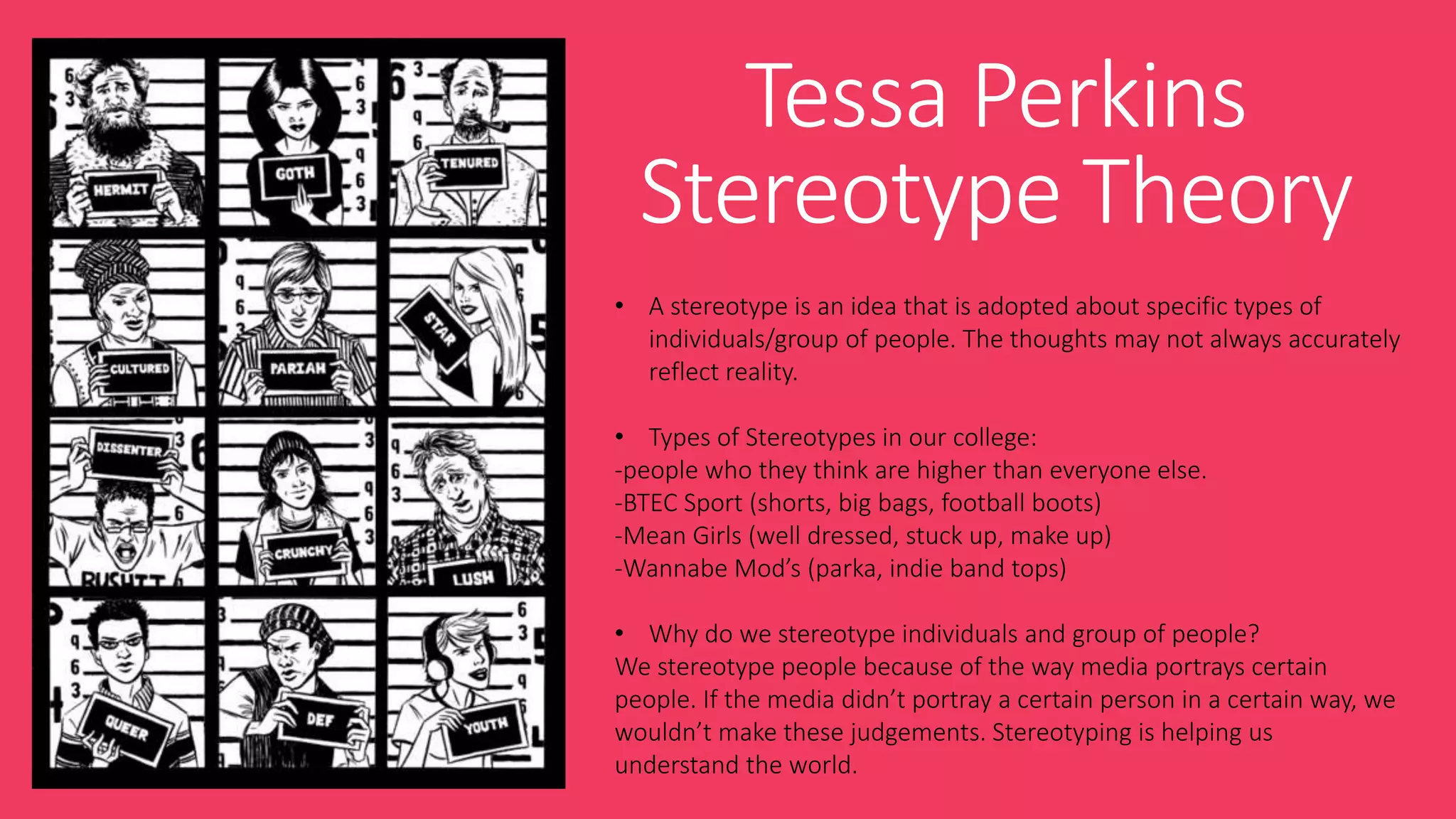
• A stereotype is an idea that is adopted about specific types of 
individuals/group of people. The thoughts may not always accurately 
reflect reality. 
• Types of Stereotypes in our college: 
-people who they think are higher than everyone else. 
-BTEC Sport (shorts, big bags, football boots) 
-Mean Girls (well dressed, stuck up, make up) 
-Wannabe Mod’s (parka, indie band tops) 
• Why do we stereotype individuals and group of people? 
We stereotype people because of the way media portrays certain 
people. If the media didn’t portray a certain person in a certain way, we 
wouldn’t make these judgements. Stereotyping is helping us 
understand the world.
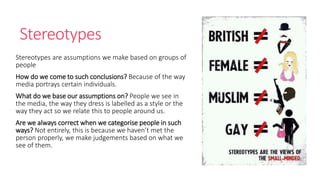
Stereotypes 
Stereotypes are assumptions we make based on groups of 
people 
How do we come to such conclusions? Because of the way 
media portrays certain individuals. 
What do we base our assumptions on? People we see in 
the media, the way they dress is labelled as a style or the 
way they act so we relate this to people around us. 
Are we always correct when we categorise people in such 
ways? Not entirely, this is because we haven’t met the 
person properly, we make judgements based on what we 
see of them.
Tessa Perkins 
Stereotyping is not a simple process and contains a number of assumptions that can 
be challenged. 
Perkins identifies 5 such assumptions: 
-Stereotypes are not always negative, e.g. The French are good cooks. 
-They are not always about minority groups or the less powerful, e.g. ‘Upper class 
twits’ 
-They can be held about one’s own group. 
-They are not rigid or unchanging. 
-They are not always false.
1. They are not always negative 
As I mentioned on the other slide, this is one of the assumptions Perkin’s talks about in 
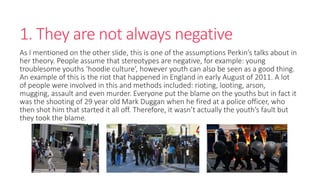
her theory. People assume that stereotypes are negative, for example: young 
troublesome youths ‘hoodie culture’, however youth can also be seen as a good thing. 
An example of this is the riot that happened in England in early August of 2011. A lot 
of people were involved in this and methods included: rioting, looting, arson, 
mugging, assault and even murder. Everyone put the blame on the youths but in fact it 
was the shooting of 29 year old Mark Duggan when he fired at a police officer, who 
then shot him that started it all off. Therefore, it wasn’t actually the youth’s fault but 
they took the blame.
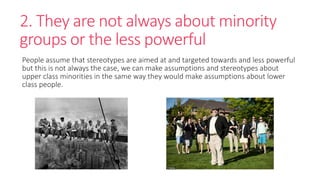
2. They are not always about minority 
groups or the less powerful 
People assume that stereotypes are aimed at and targeted towards and less powerful 
but this is not always the case, we can make assumptions and stereotypes about 
upper class minorities in the same way they would make assumptions about lower 
class people.
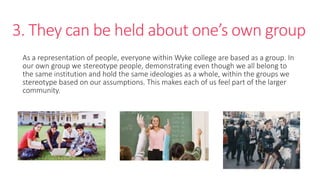
3. They can be held about one’s own group 
As a representation of people, everyone within Wyke college are based as a group. In 
our own group we stereotype people, demonstrating even though we all belong to 
the same institution and hold the same ideologies as a whole, within the groups we 
stereotype based on our assumptions. This makes each of us feel part of the larger 
community.
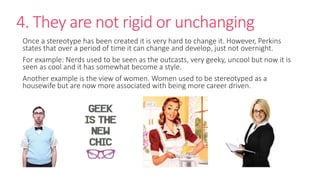
4. They are not rigid or unchanging 
Once a stereotype has been created it is very hard to change it. However, Perkins 
states that over a period of time it can change and develop, just not overnight. 
For example: Nerds used to be seen as the outcasts, very geeky, uncool but now it is 
seen as cool and it has somewhat become a style. 
Another example is the view of women. Women used to be stereotyped as a 
housewife but are now more associated with being more career driven.
5. They are not always false 
Stereotypes have to have some truth in them or where else would the representation 
come from? 
We witness and read many stories in the media that help us shape and understand 
these stereotypes. 
We may witness it first hand or second hand, however there must be some truth in a 
stereotype otherwise the ideology behind them would not have existed in the first 
place.
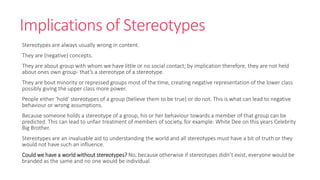
Implications of Stereotypes 
Stereotypes are always usually wrong in content. 
They are (negative) concepts. 
They are about group with whom we have little or no social contact; by implication therefore, they are not held 
about ones own group- that’s a stereotype of a stereotype. 
They are bout minority or repressed groups most of the time, creating negative representation of the lower class 
possibly giving the upper class more power. 
People either ‘hold’ stereotypes of a group (believe them to be true) or do not. This is what can lead to negative 
behaviour or wrong assumptions. 
Because someone holds a stereotype of a group, his or her behaviour towards a member of that group can be 
predicted. This can lead to unfair treatment of members of society, for example: White Dee on this years Celebrity 
Big Brother. 
Stereotypes are an invaluable aid to understanding the world and all stereotypes must have a bit of truth or they 
would not have such an influence. 
Could we have a world without stereotypes? No, because otherwise if stereotypes didn’t exist, everyone would be 
branded as the same and no one would be individual.
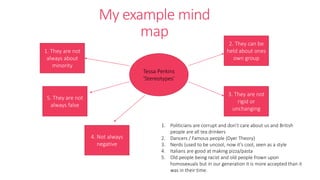
My example mind 
map 
Tessa Perkins 
‘Stereotypes’ 
1. They are not 
always about 
minority 
5. They are not 
always false 
2. They can be 
held about ones 
own group 
3. They are not 
rigid or 
unchanging 
4. Not always 
negative 
1. Politicians are corrupt and don’t care about us and British 
people are all tea drinkers 
2. Dancers / Famous people (Dyer Theory) 
3. Nerds (used to be uncool, now it’s cool, seen as a style 
4. Italians are good at making pizza/pasta 
5. Old people being racist and old people frown upon 
homosexuals but in our generation it is more accepted than it 
was in their time.
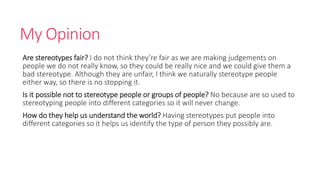
My Opinion 
Are stereotypes fair? I do not think they’re fair as we are making judgements on 
people we do not really know, so they could be really nice and we could give them a 
bad stereotype. Although they are unfair, I think we naturally stereotype people 
either way, so there is no stopping it. 
Is it possible not to stereotype people or groups of people? No because are so used to 
stereotyping people into different categories so it will never change. 
How do they help us understand the world? Having stereotypes put people into 
different categories so it helps us identify the type of person they possibly are.
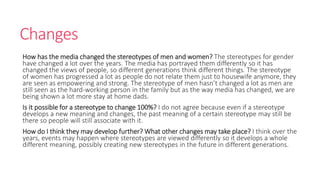
Changes 
How has the media changed the stereotypes of men and women? The stereotypes for gender 
have changed a lot over the years. The media has portrayed them differently so it has 
changed the views of people, so different generations think different things. The stereotype 
of women has progressed a lot as people do not relate them just to housewife anymore, they 
are seen as empowering and strong. The stereotype of men hasn’t changed a lot as men are 
still seen as the hard-working person in the family but as the way media has changed, we are 
being shown a lot more stay at home dads. 
Is it possible for a stereotype to change 100%? I do not agree because even if a stereotype 
develops a new meaning and changes, the past meaning of a certain stereotype may still be 
there so people will still associate with it. 
How do I think they may develop further? What other changes may take place? I think over the 
years, events may happen where stereotypes are viewed differently so it develops a whole 
different meaning, possibly creating new stereotypes in the future in different generations.

Tessa perkins stereotype theory

  • 1.
    Tessa Perkins StereotypeTheory • A stereotype is an idea that is adopted about specific types of individuals/group of people. The thoughts may not always accurately reflect reality. • Types of Stereotypes in our college: -people who they think are higher than everyone else. -BTEC Sport (shorts, big bags, football boots) -Mean Girls (well dressed, stuck up, make up) -Wannabe Mod’s (parka, indie band tops) • Why do we stereotype individuals and group of people? We stereotype people because of the way media portrays certain people. If the media didn’t portray a certain person in a certain way, we wouldn’t make these judgements. Stereotyping is helping us understand the world.
  • 2.
    Stereotypes Stereotypes areassumptions we make based on groups of people How do we come to such conclusions? Because of the way media portrays certain individuals. What do we base our assumptions on? People we see in the media, the way they dress is labelled as a style or the way they act so we relate this to people around us. Are we always correct when we categorise people in such ways? Not entirely, this is because we haven’t met the person properly, we make judgements based on what we see of them.
  • 3.
    Tessa Perkins Stereotypingis not a simple process and contains a number of assumptions that can be challenged. Perkins identifies 5 such assumptions: -Stereotypes are not always negative, e.g. The French are good cooks. -They are not always about minority groups or the less powerful, e.g. ‘Upper class twits’ -They can be held about one’s own group. -They are not rigid or unchanging. -They are not always false.
  • 4.
    1. They arenot always negative As I mentioned on the other slide, this is one of the assumptions Perkin’s talks about in her theory. People assume that stereotypes are negative, for example: young troublesome youths ‘hoodie culture’, however youth can also be seen as a good thing. An example of this is the riot that happened in England in early August of 2011. A lot of people were involved in this and methods included: rioting, looting, arson, mugging, assault and even murder. Everyone put the blame on the youths but in fact it was the shooting of 29 year old Mark Duggan when he fired at a police officer, who then shot him that started it all off. Therefore, it wasn’t actually the youth’s fault but they took the blame.
  • 5.
    2. They arenot always about minority groups or the less powerful People assume that stereotypes are aimed at and targeted towards and less powerful but this is not always the case, we can make assumptions and stereotypes about upper class minorities in the same way they would make assumptions about lower class people.
  • 6.
    3. They canbe held about one’s own group As a representation of people, everyone within Wyke college are based as a group. In our own group we stereotype people, demonstrating even though we all belong to the same institution and hold the same ideologies as a whole, within the groups we stereotype based on our assumptions. This makes each of us feel part of the larger community.
  • 7.
    4. They arenot rigid or unchanging Once a stereotype has been created it is very hard to change it. However, Perkins states that over a period of time it can change and develop, just not overnight. For example: Nerds used to be seen as the outcasts, very geeky, uncool but now it is seen as cool and it has somewhat become a style. Another example is the view of women. Women used to be stereotyped as a housewife but are now more associated with being more career driven.
  • 8.
    5. They arenot always false Stereotypes have to have some truth in them or where else would the representation come from? We witness and read many stories in the media that help us shape and understand these stereotypes. We may witness it first hand or second hand, however there must be some truth in a stereotype otherwise the ideology behind them would not have existed in the first place.
  • 9.
    Implications of Stereotypes Stereotypes are always usually wrong in content. They are (negative) concepts. They are about group with whom we have little or no social contact; by implication therefore, they are not held about ones own group- that’s a stereotype of a stereotype. They are bout minority or repressed groups most of the time, creating negative representation of the lower class possibly giving the upper class more power. People either ‘hold’ stereotypes of a group (believe them to be true) or do not. This is what can lead to negative behaviour or wrong assumptions. Because someone holds a stereotype of a group, his or her behaviour towards a member of that group can be predicted. This can lead to unfair treatment of members of society, for example: White Dee on this years Celebrity Big Brother. Stereotypes are an invaluable aid to understanding the world and all stereotypes must have a bit of truth or they would not have such an influence. Could we have a world without stereotypes? No, because otherwise if stereotypes didn’t exist, everyone would be branded as the same and no one would be individual.
  • 10.
    My example mind map Tessa Perkins ‘Stereotypes’ 1. They are not always about minority 5. They are not always false 2. They can be held about ones own group 3. They are not rigid or unchanging 4. Not always negative 1. Politicians are corrupt and don’t care about us and British people are all tea drinkers 2. Dancers / Famous people (Dyer Theory) 3. Nerds (used to be uncool, now it’s cool, seen as a style 4. Italians are good at making pizza/pasta 5. Old people being racist and old people frown upon homosexuals but in our generation it is more accepted than it was in their time.
  • 11.
    My Opinion Arestereotypes fair? I do not think they’re fair as we are making judgements on people we do not really know, so they could be really nice and we could give them a bad stereotype. Although they are unfair, I think we naturally stereotype people either way, so there is no stopping it. Is it possible not to stereotype people or groups of people? No because are so used to stereotyping people into different categories so it will never change. How do they help us understand the world? Having stereotypes put people into different categories so it helps us identify the type of person they possibly are.
  • 12.
    Changes How hasthe media changed the stereotypes of men and women? The stereotypes for gender have changed a lot over the years. The media has portrayed them differently so it has changed the views of people, so different generations think different things. The stereotype of women has progressed a lot as people do not relate them just to housewife anymore, they are seen as empowering and strong. The stereotype of men hasn’t changed a lot as men are still seen as the hard-working person in the family but as the way media has changed, we are being shown a lot more stay at home dads. Is it possible for a stereotype to change 100%? I do not agree because even if a stereotype develops a new meaning and changes, the past meaning of a certain stereotype may still be there so people will still associate with it. How do I think they may develop further? What other changes may take place? I think over the years, events may happen where stereotypes are viewed differently so it develops a whole different meaning, possibly creating new stereotypes in the future in different generations.