


Hitting Your Mark:
Content Strategy
& Optimization
    A friendly PSA from Cliff Seal, UX Designer at
Content Strategy and Optimization


                      @cliffseal
                      #pardotwebinar
                      cliff.seal@pardot.com
What are
you trying
   to say?
logos
“In ordinary, non-technical Greek, logos had a semantic field
    extending beyond “word” to notions such as, on the one
 hand, language, talk, statement, speech, conversation, tale,
     story, prose, proposition, and principle; and on the other
 hand, thought, reason, account, consideration, esteem, due
                            relation, proportion, and analogy.”
                                                         Wikipedia
Content Strategy and Optimization


Hi, I’m Cliff.
• I work at Pardot as a UX Designer        • I’m an Atlanta native and live here with
(among other things).                      my wife, April.


• I’ve been working with non-profits and
small businesses consistently for about    • I’m honored and excited to speak with
four years, doing identities, web design   you today about making more efficient
and development, and more.                 connections between people and the
                                           things that they love.
Content Strategy and Optimization


Hi, I’m Cliff.
• I work at Pardot as a UX Designer         • I’m an Atlanta native and live here with
(among other things). I know what I’m       my wife, April. I’m a normal human being
talking about.                              who’s invested in others and my
                                            community.
• I’ve been working with non-profits and
small businesses consistently for about     • I’m honored and excited to speak with
four years, doing identities, web design    you today about making more efficient
and development, and more. I have           connections between people and the
experience in the area I’m talking about.   things that they love. I’m passionate
                                            about this.
“If we’re doing our job well, the computer recedes into the
background, and personalities rise to the surface. To achieve
this goal, we must consider how we interact with one another
                                                    in real life.”
                                                    Designing for Emotion,
                                                            Aarron Walter
Content Strategy and Optimization


A Structure of Conversation
Greeting: “Hello.” or “Hi!”, or “Hayyyyyyyyyyy!” or *head tilt*

Common Ground: “It’s nice to see you again.” or “It’s great to finally meet you.” or “You
work with Ted, right?” or weird catchphrase

Circumstance: “What are you up to these days?” or “How is that girlfriend of yours?” or
“How’s the new job?” or awkward personal questions

Eventually, Ending: “It was nice to meet you.” or “It was great to see you again.” or
“Thanks so much for your time.” or “Please don’t operate a motor vehicle right now.”
Content Strategy and Optimization


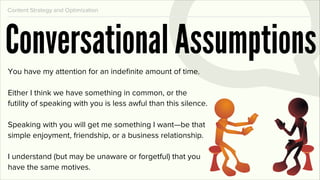
Conversational Assumptions
You have my attention for an indefinite amount of time.

Either I think we have something in common, or the
futility of speaking with you is less awful than this silence.

Speaking with you will get me something I want—be that
simple enjoyment, friendship, or a business relationship.

I understand (but may be unaware or forgetful) that you
have the same motives.
Content Strategy and Optimization


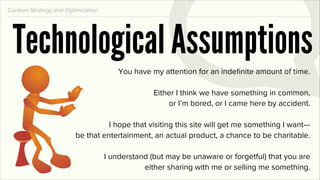
 Technological Assumptions
                                        You have my attention for an indefinite amount of time.

                                                  Either I think we have something in common,
                                                      or I’m bored, or I came here by accident.

                                  I hope that visiting this site will get me something I want—
                        be that entertainment, an actual product, a chance to be charitable.

                                    I understand (but may be unaware or forgetful) that you are
                                               either sharing with me or selling me something.
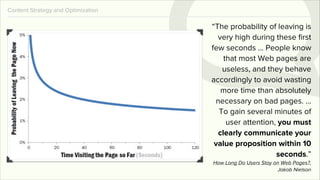
How long do you have?
  Negative Weibull distribution.
Content Strategy and Optimization

                                    “The probability of leaving is
                                      very high during these first
                                    few seconds ... People know
                                        that most Web pages are
                                       useless, and they behave
                                    accordingly to avoid wasting
                                       more time than absolutely
                                     necessary on bad pages. ...
                                      To gain several minutes of
                                         user attention, you must
                                      clearly communicate your
                                     value proposition within 10
                                                        seconds.”
                                    How Long Do Users Stay on Web Pages?,
                                                            Jakob Nielson
Content Strategy and Optimization

“On an average visit, users
read half the information
only on those pages with 111
words or less. In the full
dataset, the average page
view contained 593 words.
So, on average, users will
have time to read 28% of
the words if they devote all
of their time to reading.
More realistically, users will
read about 20% of the text
on the average page.”
            How Little Do Users Read?,
                         Jakob Nielson
Content Strategy and Optimization


The Problem of Judgment             “Researchers found that the brain makes decisions in
                                    just a 20th of a second of viewing a webpage.”

                                    “The researchers also believe that these quickly
                                    formed first impressions last because of ... the ‘halo
                                    effect’. [...] Since people like to be right, they will
                                    continue to use the website that made a good first
                                    impression, as this will further confirm that their initial
                                    decision was a good one.”
                                                                     First impressions count for web,
                                                                                          BBC News
Content Strategy and Optimization


Cognitive Bias (Halo Effect)
“The halo effect or halo error is a cognitive bias in which our judgments of a person’s
character can be influenced by our overall impression...” (Wikipedia)

“A cognitive bias is a pattern of deviation in judgment that occurs in particular
situations, which may sometimes lead to perceptual distortion, inaccurate judgment,
illogical interpretation, or what is broadly called irrationality.” (Wikipedia)

“‘Unless the first impression is favorable, visitors will be out of your site before they
even know that you might be offering more than your competitors...’”
                                                                   First impressions count for web,
                                                                                        BBC News
“In the absence of detailed information, we all work from
assumptions about who the user is, what he or she does, and
 what type of system would meet his or her needs. Following
  these assumptions, we tend to design for ourselves, not for
                                               other people.”
                             Human Factor: Designing Computer Systems for People,
                                               Richard Rubinstein and Harry Hersh
Grok your
     users’
experience.
grok
“Grok means to understand so thoroughly that the observer
        becomes a part of the observed—to merge, blend,
             intermarry, lose identity in group experience.”
                                            Stranger in a Strange Land,
                                                     Robert A. Heinlein
Content Strategy and Optimization


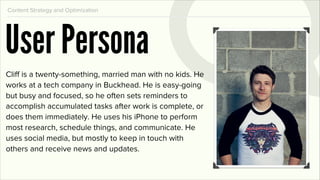
User Persona
Cliff is a twenty-something, married man with no kids. He
works at a tech company in Buckhead. He is easy-going
but busy and focused, so he often sets reminders to
accomplish accumulated tasks after work is complete, or
does them immediately. He uses his iPhone to perform
most research, schedule things, and communicate. He
uses social media, but mostly to keep in touch with
others and receive news and updates.
Content Strategy and Optimization


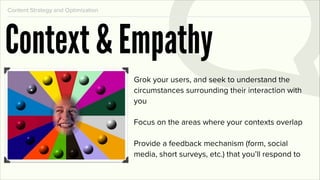
Context & Empathy
                                    Grok your users, and seek to understand the
                                    circumstances surrounding their interaction with
                                    you

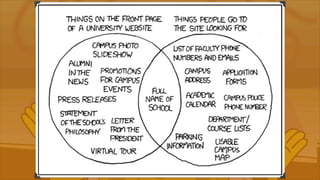
                                    Focus on the areas where your contexts overlap

                                    Provide a feedback mechanism (form, social
                                    media, short surveys, etc.) that you’ll respond to
Content Strategy and Optimization


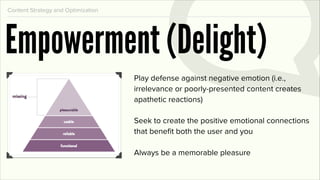
Empowerment (Delight)
                                    Play defense against negative emotion (i.e.,
                                    irrelevance or poorly-presented content creates
                                    apathetic reactions)

                                    Seek to create the positive emotional connections
                                    that benefit both the user and you

                                    Always be a memorable pleasure
Defense
Content Strategy and Optimization


Courtesy in Content
Make your content accessible to everyone through
best practices. This is no longer optional.

Stop with the ‘click here’. Tell the user what to expect
when they click to avoid negative surprise, and use
title tags. You might get an SEO boost as well. You can
read one of countless articles and opinions on this.

Avoid ‘dirty magnets’ like “Resources”, unless it links
to exactly what it states.
Offense
Content Strategy and Optimization


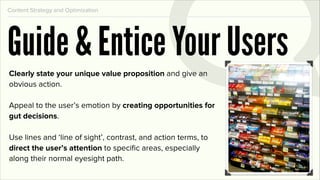
Guide & Entice Your Users
Clearly state your unique value proposition and give an
obvious action.

Appeal to the user’s emotion by creating opportunities for
gut decisions.

Use lines and ‘line of sight’, contrast, and action terms, to
direct the user’s attention to specific areas, especially
along their normal eyesight path.
You’re good.
 Get better.
Test all the things!
Content Strategy and Optimization


Test All Your Assumptions
                                    Make a list of assumptions about your target user,
                                    and argue and update that list often.

                                    Test calls-to-action and headlines using A/B
                                    testing or multi-armed bandit algorithms. Then,
                                    optimize and re-test.

                                    Constantly challenge the assumption that you
                                    know what you are assuming and that you’re
                                    correct in those assumptions.
Content Strategy and Optimization


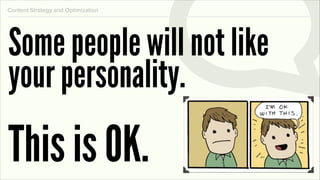
Some people will not like
your personality.
This is OK.
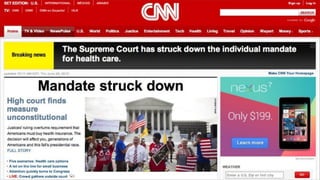
Don’t get hasty.
Y U NO TALK SEO YET
Content Strategy and Optimization


Social media conversations
   are the backlinks of the
            future (today).
    You can use these same techniques on various social media networks. Immerse
yourself in them, engage others in the way they want to be engaged, test, and adapt.
Questions?
Content Strategy and Optimization


                                    @cliffseal
                                    cliff.seal
                                    @pardot.com

Hitting Your Mark - Content Strategy & Optimization

  • 1.
    Hitting Your Mark: ContentStrategy & Optimization A friendly PSA from Cliff Seal, UX Designer at
  • 2.
    Content Strategy andOptimization @cliffseal #pardotwebinar cliff.seal@pardot.com
  • 3.
  • 4.
    logos “In ordinary, non-technicalGreek, logos had a semantic field extending beyond “word” to notions such as, on the one hand, language, talk, statement, speech, conversation, tale, story, prose, proposition, and principle; and on the other hand, thought, reason, account, consideration, esteem, due relation, proportion, and analogy.” Wikipedia
  • 5.
    Content Strategy andOptimization Hi, I’m Cliff. • I work at Pardot as a UX Designer • I’m an Atlanta native and live here with (among other things). my wife, April. • I’ve been working with non-profits and small businesses consistently for about • I’m honored and excited to speak with four years, doing identities, web design you today about making more efficient and development, and more. connections between people and the things that they love.
  • 6.
    Content Strategy andOptimization Hi, I’m Cliff. • I work at Pardot as a UX Designer • I’m an Atlanta native and live here with (among other things). I know what I’m my wife, April. I’m a normal human being talking about. who’s invested in others and my community. • I’ve been working with non-profits and small businesses consistently for about • I’m honored and excited to speak with four years, doing identities, web design you today about making more efficient and development, and more. I have connections between people and the experience in the area I’m talking about. things that they love. I’m passionate about this.
  • 7.
    “If we’re doingour job well, the computer recedes into the background, and personalities rise to the surface. To achieve this goal, we must consider how we interact with one another in real life.” Designing for Emotion, Aarron Walter
  • 8.
    Content Strategy andOptimization A Structure of Conversation Greeting: “Hello.” or “Hi!”, or “Hayyyyyyyyyyy!” or *head tilt* Common Ground: “It’s nice to see you again.” or “It’s great to finally meet you.” or “You work with Ted, right?” or weird catchphrase Circumstance: “What are you up to these days?” or “How is that girlfriend of yours?” or “How’s the new job?” or awkward personal questions Eventually, Ending: “It was nice to meet you.” or “It was great to see you again.” or “Thanks so much for your time.” or “Please don’t operate a motor vehicle right now.”
  • 9.
    Content Strategy andOptimization Conversational Assumptions You have my attention for an indefinite amount of time. Either I think we have something in common, or the futility of speaking with you is less awful than this silence. Speaking with you will get me something I want—be that simple enjoyment, friendship, or a business relationship. I understand (but may be unaware or forgetful) that you have the same motives.
  • 10.
    Content Strategy andOptimization Technological Assumptions You have my attention for an indefinite amount of time. Either I think we have something in common, or I’m bored, or I came here by accident. I hope that visiting this site will get me something I want— be that entertainment, an actual product, a chance to be charitable. I understand (but may be unaware or forgetful) that you are either sharing with me or selling me something.
  • 11.
    How long doyou have? Negative Weibull distribution.
  • 12.
    Content Strategy andOptimization “The probability of leaving is very high during these first few seconds ... People know that most Web pages are useless, and they behave accordingly to avoid wasting more time than absolutely necessary on bad pages. ... To gain several minutes of user attention, you must clearly communicate your value proposition within 10 seconds.” How Long Do Users Stay on Web Pages?, Jakob Nielson
  • 13.
    Content Strategy andOptimization “On an average visit, users read half the information only on those pages with 111 words or less. In the full dataset, the average page view contained 593 words. So, on average, users will have time to read 28% of the words if they devote all of their time to reading. More realistically, users will read about 20% of the text on the average page.” How Little Do Users Read?, Jakob Nielson
  • 14.
    Content Strategy andOptimization The Problem of Judgment “Researchers found that the brain makes decisions in just a 20th of a second of viewing a webpage.” “The researchers also believe that these quickly formed first impressions last because of ... the ‘halo effect’. [...] Since people like to be right, they will continue to use the website that made a good first impression, as this will further confirm that their initial decision was a good one.” First impressions count for web, BBC News
  • 15.
    Content Strategy andOptimization Cognitive Bias (Halo Effect) “The halo effect or halo error is a cognitive bias in which our judgments of a person’s character can be influenced by our overall impression...” (Wikipedia) “A cognitive bias is a pattern of deviation in judgment that occurs in particular situations, which may sometimes lead to perceptual distortion, inaccurate judgment, illogical interpretation, or what is broadly called irrationality.” (Wikipedia) “‘Unless the first impression is favorable, visitors will be out of your site before they even know that you might be offering more than your competitors...’” First impressions count for web, BBC News
  • 16.
    “In the absenceof detailed information, we all work from assumptions about who the user is, what he or she does, and what type of system would meet his or her needs. Following these assumptions, we tend to design for ourselves, not for other people.” Human Factor: Designing Computer Systems for People, Richard Rubinstein and Harry Hersh
  • 17.
    Grok your users’ experience.
  • 18.
    grok “Grok means tounderstand so thoroughly that the observer becomes a part of the observed—to merge, blend, intermarry, lose identity in group experience.” Stranger in a Strange Land, Robert A. Heinlein
  • 19.
    Content Strategy andOptimization User Persona Cliff is a twenty-something, married man with no kids. He works at a tech company in Buckhead. He is easy-going but busy and focused, so he often sets reminders to accomplish accumulated tasks after work is complete, or does them immediately. He uses his iPhone to perform most research, schedule things, and communicate. He uses social media, but mostly to keep in touch with others and receive news and updates.
  • 20.
    Content Strategy andOptimization Context & Empathy Grok your users, and seek to understand the circumstances surrounding their interaction with you Focus on the areas where your contexts overlap Provide a feedback mechanism (form, social media, short surveys, etc.) that you’ll respond to
  • 21.
    Content Strategy andOptimization Empowerment (Delight) Play defense against negative emotion (i.e., irrelevance or poorly-presented content creates apathetic reactions) Seek to create the positive emotional connections that benefit both the user and you Always be a memorable pleasure
  • 22.
  • 24.
    Content Strategy andOptimization Courtesy in Content Make your content accessible to everyone through best practices. This is no longer optional. Stop with the ‘click here’. Tell the user what to expect when they click to avoid negative surprise, and use title tags. You might get an SEO boost as well. You can read one of countless articles and opinions on this. Avoid ‘dirty magnets’ like “Resources”, unless it links to exactly what it states.
  • 25.
  • 26.
    Content Strategy andOptimization Guide & Entice Your Users Clearly state your unique value proposition and give an obvious action. Appeal to the user’s emotion by creating opportunities for gut decisions. Use lines and ‘line of sight’, contrast, and action terms, to direct the user’s attention to specific areas, especially along their normal eyesight path.
  • 27.
  • 28.
    Test all thethings!
  • 29.
    Content Strategy andOptimization Test All Your Assumptions Make a list of assumptions about your target user, and argue and update that list often. Test calls-to-action and headlines using A/B testing or multi-armed bandit algorithms. Then, optimize and re-test. Constantly challenge the assumption that you know what you are assuming and that you’re correct in those assumptions.
  • 30.
    Content Strategy andOptimization Some people will not like your personality. This is OK.
  • 31.
  • 33.
    Y U NOTALK SEO YET
  • 34.
    Content Strategy andOptimization Social media conversations are the backlinks of the future (today). You can use these same techniques on various social media networks. Immerse yourself in them, engage others in the way they want to be engaged, test, and adapt.
  • 35.
  • 36.
    Content Strategy andOptimization @cliffseal cliff.seal @pardot.com