Becoming a Successful
 Community Weaver


    PT Meeting Thursday, July 26
               ●
As a Network Weaver
• Help people SEE OPPORTUNITIES
• Support initiation of COLLABORATIVE
  projects, i.e. the Elul Project
• Help DEEPEN THE QUALITY of relationships
  • Who is our audience?
  • What do they really want and need in
    their lives?
  • How can we connect them to
    other audiences?
Steps to Network Weaving
•   Shift in leadership mindset
•   Know your network
•   Socialize
•   Listen and Engage
•   Connect
Traditional Mindset: Hub &
                     Spokes
                           New                       Seniors
                           Members
           BAW
                                                                     BAM

Adult                            Synagogue
Students                             Program Team                          Teens
                                      Admin. Staff
             Families w/              Committees
             Young                       Board
             Children
                                                                  Émigré


    Young                       B’nei                Interfaith
    Adults                      Mitzvah              Couples
                                Students
Network Leadership
Organizational Leadership              Network Leadership


Few Leaders                            Everyone is a Leader

Leader Broadcasts                      Leader Engages

Leader Controls                        Leader Facilitates and Supports

Top Down                               Bottom Up

Planning                               Innovation & Experimentation

Provides Service                       Supports Self-organization


                            Adapted from June Holley’s Network Weaving Handbook, pg. 29
Mapping Networks
                                                Know the Net –
                                                see the map of how
                                                things really work

                                                Knit the Net –
                                                adjust the network
                                                for improvements


 Mapping can
illuminate key
opportunities
for action and
  investment


 http://ccc.georgkolb.com/
Temple Beth
                       Abraham in
                     Tarrytown, NY


SOCIALIZE


 Here’s an idea:
 Post questions to promote
 social culture, even if you
 know the answer.
Build and Engage the Network
          • Develop more
            relation-based rather than
            institutionally-based
            communications
          • We tend to send out
            broadcast messages
            – OK, but good to activate
              more social interactions
As You
Socialize

BE YOUR
TRUE SELF!
Listening & Engaging:
   You have to BE
 IN the conversation

          Rabbi Danny
          Burkeman on Twitter
          (@Rabbi_Danny)
          shares his
          professional
          activities, reflections,
          thought leadership,
          hobbies and more in
          conversation with his
          local community and
          beyond.
People Want to Hear From
 and Engage With Clergy
Beth Am FB
Postings from
May 2-June 11,
    2012
These are postings which went
unanswered – lost opportunities for
potential conversations.
Make Connections
Be Responsive!
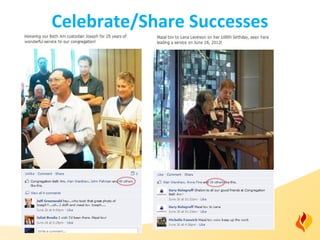
Celebrate/Share Successes
Celebrate Successes & Grow


                                        Beth Am Members who probably “Liked”
    our page after hearing about postings that they relate to, directly or indirectly.
Beth Kanter
• Make it personal. Ask audience for stories,
  input, thoughts! Emphasize their
  importance to the community and allow
  them to run with projects and to be creative.
  Everyone wants to contribute and to make
  something better/leave a lasting mark.
• Humanize your leaders. Make them
  available. If the members feel like the
  community is very hierarchical they may
  never feel like they belong on the “inside”. Use your position to
  energize your community.
• Play matchmaker. The leaders in the community should focus on
  putting people together with ideas, interests, etc. Help them
  bridge the social interaction gap.
Humanize
Your Leaders
Some Ideas for Posts
• It’s Friday! What have we learned this week?
• What does the shofar
  call you to do?
• Comment/ask questions
  about Parshah
• Instagram/video postings
• Sermon link to article on Facebook
• Get creative
Facebook
• It’s NOT interruption technology!
  – It’s a listserve without the interruption
• Fundraisers: For every event “Like” get a $
• Where are you? Include location if taking
  place “offsite”
• Who are you with?
• Schedule a post: set a posting to reveal itself
  on a future date
• Add “Like” button to footer/
  signature of email
Demographics
• Check out demographics
  – Overviews / “Likes” / Reach / Talking About
  – Plan content and see what is effective
Social Sermon


Sweet Spot
What is a “Social Sermon”?
• Opportunities to engage in LEARNING and
  COMMUNITY BUILDING using online tools

• Weaving this content and these relationships back
  into the FACE TO FACE community in our local
  communities  talk about what was discussed online

• Inviting ACTIVE participation, rather than passive
  attendance
Social Sermon
• Assumption: There are audiences who are interested in
  Jewish learning, but unable or unwilling to come to regular
  adult education classes.

• Objective: Torah study and community building don't have
  to happen in the building, at a set time, face to face.

• Strategy: Getting more people to participate in education
  and community more often doesn't mean market it more.
  Time to rethink our design.
Six-Word Story
•   Finding the words to capture our stories and reflect on our
    legacies is a quintessential Jewish project. (Moses, apparently,
    did not get the memo about the six-word limit, since he spent
    all 34 chapters of the book of Devarim--the Book of Words--
    recalling his journey with the Jewish people.)
•   At this season, in which we assess the year gone by and make
    promises for the year ahead, I'd like to invite each of us to
    share your own Six-Word Jewish Story.
•   And then what? These stories, our stories, the words of our
    community, will shape a "Social Sermon" for Shabbat Shuvah.
    A "social sermon" is a deeply participatory experience,
    capturing and building on an online dialogue that begins
    here, now. New Year, fresh start, six words.


                             Shir Imagination: Rabbi Lisa Levenberg’s blog:
                                     http://shir-imagination.blogspot.com/
Creating a Social Sermon
Risk Taking
                    Sharing and giving              Value errors
  Allowing for                                      and mistakes
  emergence, surprises,
  experiments                                       Transparency


Listening
                                                Valuing diversity
                                                and inclusiveness
Not putting
people into boxes         Permeable boundaries


                                     Coming soon: 10-page Social media
                                     policy workbook from Darim Online
Novel Ideas
• Skype Forums
• Google/virtual “handouts”
• Twitter chat at an appointed
  time each week
• Streaming videos of
  services/classes/lectures
Key Building Blocks
for Success
• Be social, not a bullhorn
• Be helpful, and
  people will help you
• Find your voice, and
  have personality
• Be a good listener,
  participate regularly
• Thank people!
Action Steps
• Articles
• URJ Webinar Archive
• Thoughts? Ideas? Suggestions?

Beth Am Social Networking Program Team Presentation

  • 1.
    Becoming a Successful Community Weaver PT Meeting Thursday, July 26 ●
  • 2.
    As a NetworkWeaver • Help people SEE OPPORTUNITIES • Support initiation of COLLABORATIVE projects, i.e. the Elul Project • Help DEEPEN THE QUALITY of relationships • Who is our audience? • What do they really want and need in their lives? • How can we connect them to other audiences?
  • 3.
    Steps to NetworkWeaving • Shift in leadership mindset • Know your network • Socialize • Listen and Engage • Connect
  • 4.
    Traditional Mindset: Hub& Spokes New Seniors Members BAW BAM Adult Synagogue Students Program Team Teens Admin. Staff Families w/ Committees Young Board Children Émigré Young B’nei Interfaith Adults Mitzvah Couples Students
  • 5.
    Network Leadership Organizational Leadership Network Leadership Few Leaders Everyone is a Leader Leader Broadcasts Leader Engages Leader Controls Leader Facilitates and Supports Top Down Bottom Up Planning Innovation & Experimentation Provides Service Supports Self-organization Adapted from June Holley’s Network Weaving Handbook, pg. 29
  • 6.
    Mapping Networks Know the Net – see the map of how things really work Knit the Net – adjust the network for improvements Mapping can illuminate key opportunities for action and investment http://ccc.georgkolb.com/
  • 7.
    Temple Beth Abraham in Tarrytown, NY SOCIALIZE Here’s an idea: Post questions to promote social culture, even if you know the answer.
  • 8.
    Build and Engagethe Network • Develop more relation-based rather than institutionally-based communications • We tend to send out broadcast messages – OK, but good to activate more social interactions
  • 9.
  • 10.
    Listening & Engaging: You have to BE IN the conversation Rabbi Danny Burkeman on Twitter (@Rabbi_Danny) shares his professional activities, reflections, thought leadership, hobbies and more in conversation with his local community and beyond.
  • 11.
    People Want toHear From and Engage With Clergy
  • 12.
    Beth Am FB Postingsfrom May 2-June 11, 2012 These are postings which went unanswered – lost opportunities for potential conversations.
  • 13.
  • 14.
  • 15.
  • 16.
    Celebrate Successes &Grow Beth Am Members who probably “Liked” our page after hearing about postings that they relate to, directly or indirectly.
  • 17.
    Beth Kanter • Makeit personal. Ask audience for stories, input, thoughts! Emphasize their importance to the community and allow them to run with projects and to be creative. Everyone wants to contribute and to make something better/leave a lasting mark. • Humanize your leaders. Make them available. If the members feel like the community is very hierarchical they may never feel like they belong on the “inside”. Use your position to energize your community. • Play matchmaker. The leaders in the community should focus on putting people together with ideas, interests, etc. Help them bridge the social interaction gap.
  • 18.
  • 19.
    Some Ideas forPosts • It’s Friday! What have we learned this week? • What does the shofar call you to do? • Comment/ask questions about Parshah • Instagram/video postings • Sermon link to article on Facebook • Get creative
  • 20.
    Facebook • It’s NOTinterruption technology! – It’s a listserve without the interruption • Fundraisers: For every event “Like” get a $ • Where are you? Include location if taking place “offsite” • Who are you with? • Schedule a post: set a posting to reveal itself on a future date • Add “Like” button to footer/ signature of email
  • 21.
    Demographics • Check outdemographics – Overviews / “Likes” / Reach / Talking About – Plan content and see what is effective
  • 22.
  • 23.
    What is a“Social Sermon”? • Opportunities to engage in LEARNING and COMMUNITY BUILDING using online tools • Weaving this content and these relationships back into the FACE TO FACE community in our local communities  talk about what was discussed online • Inviting ACTIVE participation, rather than passive attendance
  • 24.
    Social Sermon • Assumption:There are audiences who are interested in Jewish learning, but unable or unwilling to come to regular adult education classes. • Objective: Torah study and community building don't have to happen in the building, at a set time, face to face. • Strategy: Getting more people to participate in education and community more often doesn't mean market it more. Time to rethink our design.
  • 25.
    Six-Word Story • Finding the words to capture our stories and reflect on our legacies is a quintessential Jewish project. (Moses, apparently, did not get the memo about the six-word limit, since he spent all 34 chapters of the book of Devarim--the Book of Words-- recalling his journey with the Jewish people.) • At this season, in which we assess the year gone by and make promises for the year ahead, I'd like to invite each of us to share your own Six-Word Jewish Story. • And then what? These stories, our stories, the words of our community, will shape a "Social Sermon" for Shabbat Shuvah. A "social sermon" is a deeply participatory experience, capturing and building on an online dialogue that begins here, now. New Year, fresh start, six words. Shir Imagination: Rabbi Lisa Levenberg’s blog: http://shir-imagination.blogspot.com/
  • 26.
  • 27.
  • 28.
    Risk Taking Sharing and giving Value errors Allowing for and mistakes emergence, surprises, experiments Transparency Listening Valuing diversity and inclusiveness Not putting people into boxes Permeable boundaries Coming soon: 10-page Social media policy workbook from Darim Online
  • 29.
    Novel Ideas • SkypeForums • Google/virtual “handouts” • Twitter chat at an appointed time each week • Streaming videos of services/classes/lectures
  • 30.
    Key Building Blocks forSuccess • Be social, not a bullhorn • Be helpful, and people will help you • Find your voice, and have personality • Be a good listener, participate regularly • Thank people!
  • 31.
    Action Steps • Articles •URJ Webinar Archive • Thoughts? Ideas? Suggestions?