By
Magdy Shafik Ramadan
Ph.D, MS of pediatric
 Autistic Disorder.
 Asperger syndrome .
 Childhood disintegrative disorder.
 Rett syndrome.
 PDD-NOS.
is a pervasive developmental
disorder characterized by a triad deficit:
qualitative impairments in social interactions,
communication deficits & repetitive and
stereotyped pattern of behavior.
‫التوحد‬‫طريق‬ ‫يصيب‬ ‫اضطراب‬ ‫هو‬ ‫الطفل‬ ‫عند‬‫ة‬
‫في‬ ‫الطفل‬‫م‬ ‫التفاعل‬ ‫و‬ ‫االتصال‬ ‫و‬ ‫التفكير‬ ‫و‬ ‫التصرف‬‫اآلخرين‬ ‫ع‬
 Prevalence: 10 to 20 per 10,000 children; .
now 1 of every 150 children..
 Age: Onset before 36 months of age.
 Sex: Male: Female = 3-4: 1.
 Socioeconomic Status: No association .
Deficits in Social Behavior:
 Autistic infants tend to avoid eye contact.
 Indifferent to affection.
 Do not want to be cuddled or kissed.
 Do not show normal separation or stranger anxiety.
 Lack interest in playing group games.
 Unable to form peer relationships.
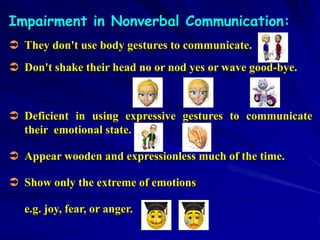
Impairment in Nonverbal Communication:
 They don't use body gestures to communicate.
 Don't shake their head no or nod yes or wave good-bye.
 Deficient in using expressive gestures to communicate
their emotional state.
 Appear wooden and expressionless much of the time.
 Show only the extreme of emotions
e.g. joy, fear, or anger.
Impairment in Verbal Communication:
 40% of individuals with autism never speak.
 Echolalia and grammatical immaturities.
 No imagination, abstraction or subtle emotions.
 Robot or staccato speech.
 Chanting or singsong speech.
Unusual Patterns of Behavior:
 Resistance to Change.
 Ritualistic or Compulsive Behaviors.
 Abnormal Attachments.
 Unusual Responses to Sensory Experiences.
 Abnormal Eating Behavior.
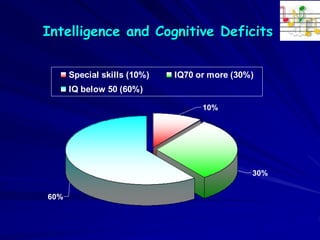
Intelligence and Cognitive Deficits
60%
30%
10%
Special skills (10%) IQ70 or more (30%)
IQ below 50 (60%)
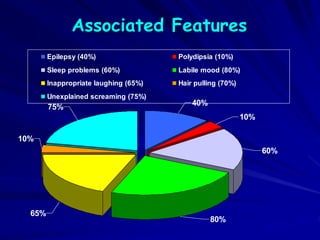
Associated Features
75%
10%
65%
80%
60%
10%
40%
Epilepsy (40%) Polydipsia (10%)
Sleep problems (60%) Labile mood (80%)
Inappropriate laughing (65%) Hair pulling (70%)
Unexplained screaming (75%)
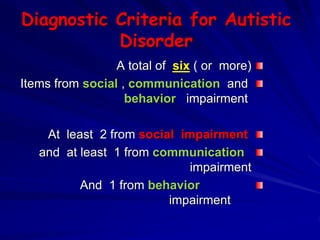
Diagnostic Criteria for Autistic
Disorder
A total of six ( or more)
Items from social , communication and
behavior impairment
At least 2 from social impairment
and at least 1 from communication
impairment
And 1 from behavior
impairment
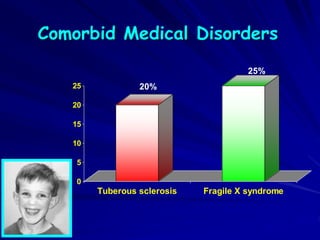
Comorbid Medical Disorders
20%
25%
0
5
10
15
20
25
Tuberous sclerosis Fragile X syndrome
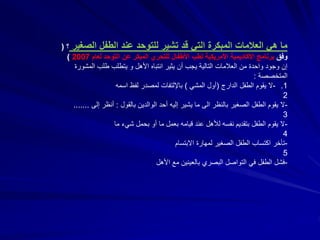
‫الص‬ ‫الطفل‬ ‫عند‬ ‫للتوحد‬ ‫تشير‬ ‫قد‬ ‫التي‬ ‫المبكرة‬ ‫العالمات‬ ‫هي‬ ‫ما‬‫غير‬‫؟‬(
‫وفق‬‫لعام‬ ‫التوحد‬ ‫عن‬ ‫المبكر‬ ‫للتحري‬ ‫األطفال‬ ‫لطب‬ ‫األمريكية‬ ‫األكاديمية‬ ‫برنامج‬2007)
‫األهل‬ ‫انتباه‬ ‫يثير‬ ‫أن‬ ‫يجب‬ ‫التالية‬ ‫العالمات‬ ‫من‬ ‫واحدة‬ ‫وجود‬ ‫إن‬‫و‬‫المش‬ ‫طلب‬ ‫يتطلب‬‫ورة‬
‫المتخصصة‬:
.1-‫الدارج‬ ‫الطفل‬ ‫يقوم‬ ‫ال‬(‫المشي‬ ‫أول‬)‫باإللتفات‬‫اسمه‬ ‫لفظ‬ ‫لمصدر‬
2
-‫بالنظر‬ ‫الصغير‬ ‫الطفل‬ ‫يقوم‬ ‫ال‬‫الى‬‫بالقول‬ ‫الوالدين‬ ‫أحد‬ ‫إليه‬ ‫يشير‬ ‫ما‬:‫إل‬ ‫أنظر‬‫ى‬.......
3
-‫ما‬ ‫شيء‬ ‫بحمل‬ ‫أو‬ ‫ما‬ ‫بعمل‬ ‫قيامه‬ ‫عند‬ ‫لألهل‬ ‫نفسه‬ ‫بتقديم‬ ‫الطفل‬ ‫يقوم‬ ‫ال‬
4
-‫االبتسام‬ ‫لمهارة‬ ‫الصغير‬ ‫الطفل‬ ‫اكتساب‬ ‫تأخر‬
5
-‫األهل‬ ‫مع‬ ‫بالعينين‬ ‫البصري‬ ‫التواصل‬ ‫في‬ ‫الطفل‬ ‫فشل‬
Higher-functioning form of autism.
Not evident until the third year of life.
No serious delay in language
development.
Average or higher intelligence.
Aloof, distant and lacking empathy with
others.
Good pronosis.
 X-linked dominant disorder.
 Affecting girls almost exclusively .
 Development normally :6 m to 2 years.
 Acquired microcephaly.
 Stereotypic hand wringing.
 Loss of purposeful hand movements.
 Normal up to at least 2 years of age.
 Loss of previously acquired skills.
 loss of bowel or bladder control.
 Poor Prognosis.
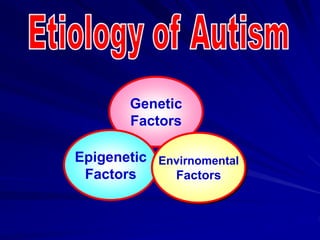
Genetic
Factors
Epigenetic
Factors
Envirnomental
Factors
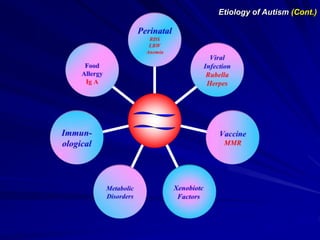
Etiology of Autism (Cont.)
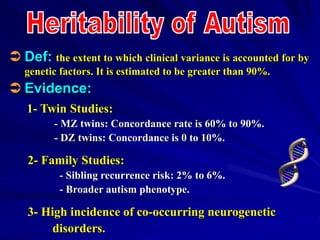
 Def: the extent to which clinical variance is accounted for by
genetic factors. It is estimated to be greater than 90%.
 Evidence:
1- Twin Studies:
- MZ twins: Concordance rate is 60% to 90%.
- DZ twins: Concordance is 0 to 10%.
2- Family Studies:
- Sibling recurrence risk: 2% to 6%.
- Broader autism phenotype.
3- High incidence of co-occurring neurogenetic
disorders.
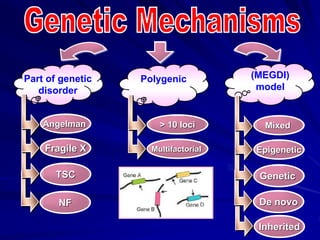
Part of genetic
disorder
Polygenic (MEGDI)
model
Angelman
Fragile X
TSC
NF
> 10 loci
Multifactorial
Mixed
Epigenetic
Genetic
De novo
Inherited
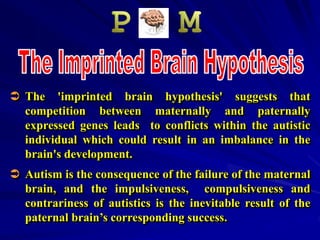
 The 'imprinted brain hypothesis' suggests that
competition between maternally and paternally
expressed genes leads to conflicts within the autistic
individual which could result in an imbalance in the
brain's development.
 Autism is the consequence of the failure of the maternal
brain, and the impulsiveness, compulsiveness and
contrariness of autistics is the inevitable result of the
paternal brain’s corresponding success.
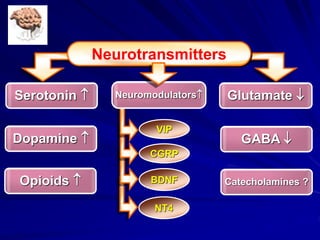
Neurotransmitters
Serotonin  Glutamate 
Dopamine  GABA 
Opioids  Catecholamines ?
VIP
CGRP
BDNF
Neuromodulators
NT4
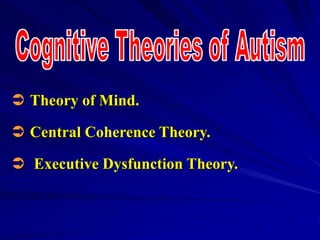
 Theory of Mind.
 Central Coherence Theory.
 Executive Dysfunction Theory.
 Mixed Receptive- Expressive Language Disorder .
 Childhood Schizophrenia.
 Mental Retardation.
 Congenital Deafness or Severe Hearing Impairment.
 Congenital Peripheral Blindness.
 Landau Kleffner Syndrome.
 Obsessive Compulsive Disorder.
 Tourette's Disorder.
 Selective Mutism.
 Psychosocial Deprivation.
 Full clinical evaluation including physical and
mental state .
 Specific developmental, psychometric and
educational assessment.
 Rating scales:
Autism Behavior Checklist (ABC).
Childhood Autism Rating Scales
(CARS).
Are we have any
modalities of
treatment to cure
autism?
 Special Education Intervention.
 Behavior Therapy .
 Speech and Language Therapies.
 Social Skills Training .
 Sensory Integration Therapy .
 Auditory Integration Training.
 Pharmacotherapy.
 Complementary Medicine.
‫بالت‬ ‫المصابين‬ ‫لألطفال‬ ‫العالج‬ ‫طرق‬‫وحد‬
‫لوفاس‬ ‫طريقة‬
‫طريقة‬‫تيتش‬
‫طريقة‬‫فاست‬‫فورورد‬
‫السمعي‬ ‫التكامل‬ ‫على‬ ‫التدريب‬
‫كذلك‬ ‫وتسمى‬‫السلوكي‬ ‫بالعالج‬‫جي‬ ‫سلوك‬ ‫كل‬ ‫على‬ ‫الطفل‬ ‫مكافأة‬ ‫يتم‬‫أو‬ ،‫د‬
‫عقابه‬ ‫يتم‬ ‫كما‬ ،‫السيئ‬ ‫السلوك‬ ‫ارتكاب‬ ‫عدم‬ ‫على‬(‫إع‬ ‫عدم‬ ‫أو‬ ،‫قف‬ ‫كقول‬‫طائه‬
‫يحبه‬ ً‫ا‬‫شيئ‬)‫سيئ‬ ‫سلوك‬ ‫كل‬ ‫على‬.
‫لوفاس‬ ‫طريقة‬
‫عن‬ ‫السلوكي‬ ‫العالج‬ ‫مدة‬ ‫تقل‬ ‫ال‬ ‫أن‬ ‫يجب‬40‫األسبوع‬ ‫في‬ ‫ساعة‬‫غير‬ ‫ولمدة‬ ،
‫محددة‬
‫الطريقة‬ ‫هذه‬ ‫وتعتبر‬ً‫ا‬‫جد‬ ‫مكلفة‬
‫قد‬ ‫العيادة‬ ‫في‬ ‫جيد‬ ‫بشكل‬ ‫يؤدون‬ ‫الذين‬ ‫األطفال‬ ‫من‬ ً‫ا‬‫كثير‬
‫العادية‬ ‫حياتهم‬ ‫في‬ ‫اكتسبوها‬ ‫التي‬ ‫المهارات‬ ‫يستخدمون‬ ‫ال‬
‫تيتش‬ ‫طريقة‬:
‫تيتش‬ ‫طريقة‬ ‫وتمتاز‬‫شاملة‬ ‫تعليمية‬ ‫طريقة‬ ‫بأنها‬‫جان‬ ‫مع‬ ‫تتعامل‬ ‫ال‬‫واحد‬ ‫ب‬
‫تقدم‬ ‫بل‬ ،‫السلوك‬ ‫أو‬ ‫كاللغة‬‫للطفل‬ ً‫ال‬‫متكام‬ ً‫ال‬‫تأهي‬‫تمتاز‬ ‫أنها‬ ‫كما‬ ،‫بأن‬
‫طفل‬ ‫كل‬ ‫احتياجات‬ ‫حسب‬ ‫على‬ ‫فردي‬ ‫بشكل‬ ‫مصممة‬ ‫العالج‬ ‫طريقة‬.‫حي‬‫ال‬ ‫ث‬
‫الفصل‬ ‫في‬ ‫األطفال‬ ‫عدد‬ ‫يتجاوز‬‫الواحد‬5-7‫ومساعدة‬ ‫مدرسة‬ ‫مقابل‬ ‫أطفال‬
‫مدرسة‬‫تصميم‬ ‫ويتم‬ ،‫طفل‬ ‫لكل‬ ‫منفصل‬ ‫تعليمي‬ ‫برنامج‬
‫الطفل‬ ‫هذا‬ ‫احتياجات‬ ‫يلبي‬ ‫بحيث‬
‫طريقة‬‫فورورد‬ ‫فاست‬
‫جانب‬ ‫هو‬ ‫واحد‬ ‫جانب‬ ‫على‬ ‫يركز‬ ‫البرنامج‬ ‫وهذا‬‫واالنتباه‬ ‫واالستماع‬ ‫اللغة‬
‫وضع‬ ‫على‬ ‫البرنامج‬ ‫هذا‬ ‫فكرة‬ ‫وتقوم‬‫الطف‬ ‫أذني‬ ‫على‬ ‫سماعات‬‫ل‬،
‫أمام‬ ‫يجلس‬ ‫هو‬ ‫بينما‬‫الكمبيوتر‬ ‫شاشة‬‫لأل‬ ‫ويستمع‬ ‫ويلعب‬‫صوات‬
‫اللعب‬ ‫هذه‬ ‫من‬ ‫الصادرة‬.
‫السمعي‬ ‫التكامل‬ ‫على‬ ‫التدريب‬
‫بالتو‬ ‫المصابين‬ ‫األشخاص‬ ‫بأن‬ ‫الطريقة‬ ‫لهذه‬ ‫المؤيدين‬ ‫آراء‬ ‫وتقوم‬‫حد‬
‫السمع‬ ‫في‬ ‫بحساسية‬ ‫مصابون‬(‫إما‬ ‫فهم‬‫أو‬ ‫الحساسية‬ ‫في‬ ‫مفرطون‬
‫السمعية‬ ‫الحساسية‬ ‫في‬ ‫نقص‬ ‫عندهم‬)‫تق‬ ‫العالج‬ ‫طرق‬ ‫فإن‬ ‫ولذلك‬ ،‫وم‬
‫عمل‬ ‫طريق‬ ‫عن‬ ‫هؤالء‬ ‫لدى‬ ‫السمع‬ ‫قدرة‬ ‫تحسين‬ ‫على‬ً‫ال‬‫أو‬ ‫سمع‬ ‫فحص‬‫ثم‬
‫بحيث‬ ‫التوحديين‬ ‫األشخاص‬ ‫آذان‬ ‫إلى‬ ‫سماعات‬ ‫وضع‬ ‫يتم‬‫يستمعون‬
‫رقمي‬ ‫بشكل‬ ‫تركيبها‬ ‫تم‬ ‫لموسيقى‬(‫ديجيتا‬‫ل‬)‫ت‬ ‫إلى‬ ‫تؤدي‬ ‫بحيث‬‫قليل‬
‫نقصها‬ ‫حالة‬ ‫في‬ ‫الحساسية‬ ‫زيادة‬ ‫أو‬ ، ‫المفرطة‬ ‫الحساسية‬.
 Initiation as soon as possible.
 Systematic activities at least 25 hours/week, 12
months/year.
 Low student-to-teacher ratio.
 Family involvement.
 Peer interaction.
 Measurement of progress and program
adjustment.
 Structured routine and physical boundaries.
 Generalization of skills to new situations.
 Curricula for communication; reduction of
maladaptive behavior; social, adaptive,
cognitive, and academic skills.
1- Neuroleptics.
2- SSRI.
3- Stimulants.
4- Anticonvulsants.
5- Natural and Synthetic Hormones.
6- Other Medications and Supplements.
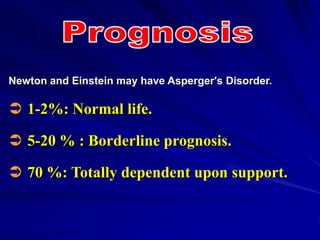
Newton and Einstein may have Asperger's Disorder.
 1-2%: Normal life.
 5-20 % : Borderline prognosis.
 70 %: Totally dependent upon support.
Thank YouThank You

Pd ds

  • 2.
  • 3.
     Autistic Disorder. Asperger syndrome .  Childhood disintegrative disorder.  Rett syndrome.  PDD-NOS.
  • 4.
    is a pervasivedevelopmental disorder characterized by a triad deficit: qualitative impairments in social interactions, communication deficits & repetitive and stereotyped pattern of behavior.
  • 5.
    ‫التوحد‬‫طريق‬ ‫يصيب‬ ‫اضطراب‬‫هو‬ ‫الطفل‬ ‫عند‬‫ة‬ ‫في‬ ‫الطفل‬‫م‬ ‫التفاعل‬ ‫و‬ ‫االتصال‬ ‫و‬ ‫التفكير‬ ‫و‬ ‫التصرف‬‫اآلخرين‬ ‫ع‬
  • 6.
     Prevalence: 10to 20 per 10,000 children; . now 1 of every 150 children..  Age: Onset before 36 months of age.  Sex: Male: Female = 3-4: 1.  Socioeconomic Status: No association .
  • 7.
    Deficits in SocialBehavior:  Autistic infants tend to avoid eye contact.  Indifferent to affection.  Do not want to be cuddled or kissed.  Do not show normal separation or stranger anxiety.  Lack interest in playing group games.  Unable to form peer relationships.
  • 8.
    Impairment in NonverbalCommunication:  They don't use body gestures to communicate.  Don't shake their head no or nod yes or wave good-bye.  Deficient in using expressive gestures to communicate their emotional state.  Appear wooden and expressionless much of the time.  Show only the extreme of emotions e.g. joy, fear, or anger.
  • 9.
    Impairment in VerbalCommunication:  40% of individuals with autism never speak.  Echolalia and grammatical immaturities.  No imagination, abstraction or subtle emotions.  Robot or staccato speech.  Chanting or singsong speech.
  • 10.
    Unusual Patterns ofBehavior:  Resistance to Change.  Ritualistic or Compulsive Behaviors.  Abnormal Attachments.  Unusual Responses to Sensory Experiences.  Abnormal Eating Behavior.
  • 11.
    Intelligence and CognitiveDeficits 60% 30% 10% Special skills (10%) IQ70 or more (30%) IQ below 50 (60%)
  • 12.
    Associated Features 75% 10% 65% 80% 60% 10% 40% Epilepsy (40%)Polydipsia (10%) Sleep problems (60%) Labile mood (80%) Inappropriate laughing (65%) Hair pulling (70%) Unexplained screaming (75%)
  • 13.
    Diagnostic Criteria forAutistic Disorder A total of six ( or more) Items from social , communication and behavior impairment At least 2 from social impairment and at least 1 from communication impairment And 1 from behavior impairment
  • 14.
  • 15.
    ‫الص‬ ‫الطفل‬ ‫عند‬‫للتوحد‬ ‫تشير‬ ‫قد‬ ‫التي‬ ‫المبكرة‬ ‫العالمات‬ ‫هي‬ ‫ما‬‫غير‬‫؟‬( ‫وفق‬‫لعام‬ ‫التوحد‬ ‫عن‬ ‫المبكر‬ ‫للتحري‬ ‫األطفال‬ ‫لطب‬ ‫األمريكية‬ ‫األكاديمية‬ ‫برنامج‬2007) ‫األهل‬ ‫انتباه‬ ‫يثير‬ ‫أن‬ ‫يجب‬ ‫التالية‬ ‫العالمات‬ ‫من‬ ‫واحدة‬ ‫وجود‬ ‫إن‬‫و‬‫المش‬ ‫طلب‬ ‫يتطلب‬‫ورة‬ ‫المتخصصة‬: .1-‫الدارج‬ ‫الطفل‬ ‫يقوم‬ ‫ال‬(‫المشي‬ ‫أول‬)‫باإللتفات‬‫اسمه‬ ‫لفظ‬ ‫لمصدر‬ 2 -‫بالنظر‬ ‫الصغير‬ ‫الطفل‬ ‫يقوم‬ ‫ال‬‫الى‬‫بالقول‬ ‫الوالدين‬ ‫أحد‬ ‫إليه‬ ‫يشير‬ ‫ما‬:‫إل‬ ‫أنظر‬‫ى‬....... 3 -‫ما‬ ‫شيء‬ ‫بحمل‬ ‫أو‬ ‫ما‬ ‫بعمل‬ ‫قيامه‬ ‫عند‬ ‫لألهل‬ ‫نفسه‬ ‫بتقديم‬ ‫الطفل‬ ‫يقوم‬ ‫ال‬ 4 -‫االبتسام‬ ‫لمهارة‬ ‫الصغير‬ ‫الطفل‬ ‫اكتساب‬ ‫تأخر‬ 5 -‫األهل‬ ‫مع‬ ‫بالعينين‬ ‫البصري‬ ‫التواصل‬ ‫في‬ ‫الطفل‬ ‫فشل‬
  • 16.
    Higher-functioning form ofautism. Not evident until the third year of life. No serious delay in language development. Average or higher intelligence. Aloof, distant and lacking empathy with others. Good pronosis.
  • 17.
     X-linked dominantdisorder.  Affecting girls almost exclusively .  Development normally :6 m to 2 years.  Acquired microcephaly.  Stereotypic hand wringing.  Loss of purposeful hand movements.
  • 18.
     Normal upto at least 2 years of age.  Loss of previously acquired skills.  loss of bowel or bladder control.  Poor Prognosis.
  • 19.
  • 20.
  • 21.
     Def: theextent to which clinical variance is accounted for by genetic factors. It is estimated to be greater than 90%.  Evidence: 1- Twin Studies: - MZ twins: Concordance rate is 60% to 90%. - DZ twins: Concordance is 0 to 10%. 2- Family Studies: - Sibling recurrence risk: 2% to 6%. - Broader autism phenotype. 3- High incidence of co-occurring neurogenetic disorders.
  • 22.
    Part of genetic disorder Polygenic(MEGDI) model Angelman Fragile X TSC NF > 10 loci Multifactorial Mixed Epigenetic Genetic De novo Inherited
  • 23.
     The 'imprintedbrain hypothesis' suggests that competition between maternally and paternally expressed genes leads to conflicts within the autistic individual which could result in an imbalance in the brain's development.  Autism is the consequence of the failure of the maternal brain, and the impulsiveness, compulsiveness and contrariness of autistics is the inevitable result of the paternal brain’s corresponding success.
  • 24.
    Neurotransmitters Serotonin  Glutamate Dopamine  GABA  Opioids  Catecholamines ? VIP CGRP BDNF Neuromodulators NT4
  • 25.
     Theory ofMind.  Central Coherence Theory.  Executive Dysfunction Theory.
  • 26.
     Mixed Receptive-Expressive Language Disorder .  Childhood Schizophrenia.  Mental Retardation.  Congenital Deafness or Severe Hearing Impairment.  Congenital Peripheral Blindness.  Landau Kleffner Syndrome.  Obsessive Compulsive Disorder.  Tourette's Disorder.  Selective Mutism.  Psychosocial Deprivation.
  • 27.
     Full clinicalevaluation including physical and mental state .  Specific developmental, psychometric and educational assessment.  Rating scales: Autism Behavior Checklist (ABC). Childhood Autism Rating Scales (CARS).
  • 29.
    Are we haveany modalities of treatment to cure autism?
  • 30.
     Special EducationIntervention.  Behavior Therapy .  Speech and Language Therapies.  Social Skills Training .  Sensory Integration Therapy .  Auditory Integration Training.  Pharmacotherapy.  Complementary Medicine.
  • 31.
    ‫بالت‬ ‫المصابين‬ ‫لألطفال‬‫العالج‬ ‫طرق‬‫وحد‬ ‫لوفاس‬ ‫طريقة‬ ‫طريقة‬‫تيتش‬ ‫طريقة‬‫فاست‬‫فورورد‬ ‫السمعي‬ ‫التكامل‬ ‫على‬ ‫التدريب‬
  • 32.
    ‫كذلك‬ ‫وتسمى‬‫السلوكي‬ ‫بالعالج‬‫جي‬‫سلوك‬ ‫كل‬ ‫على‬ ‫الطفل‬ ‫مكافأة‬ ‫يتم‬‫أو‬ ،‫د‬ ‫عقابه‬ ‫يتم‬ ‫كما‬ ،‫السيئ‬ ‫السلوك‬ ‫ارتكاب‬ ‫عدم‬ ‫على‬(‫إع‬ ‫عدم‬ ‫أو‬ ،‫قف‬ ‫كقول‬‫طائه‬ ‫يحبه‬ ً‫ا‬‫شيئ‬)‫سيئ‬ ‫سلوك‬ ‫كل‬ ‫على‬. ‫لوفاس‬ ‫طريقة‬ ‫عن‬ ‫السلوكي‬ ‫العالج‬ ‫مدة‬ ‫تقل‬ ‫ال‬ ‫أن‬ ‫يجب‬40‫األسبوع‬ ‫في‬ ‫ساعة‬‫غير‬ ‫ولمدة‬ ، ‫محددة‬ ‫الطريقة‬ ‫هذه‬ ‫وتعتبر‬ً‫ا‬‫جد‬ ‫مكلفة‬ ‫قد‬ ‫العيادة‬ ‫في‬ ‫جيد‬ ‫بشكل‬ ‫يؤدون‬ ‫الذين‬ ‫األطفال‬ ‫من‬ ً‫ا‬‫كثير‬ ‫العادية‬ ‫حياتهم‬ ‫في‬ ‫اكتسبوها‬ ‫التي‬ ‫المهارات‬ ‫يستخدمون‬ ‫ال‬
  • 33.
    ‫تيتش‬ ‫طريقة‬: ‫تيتش‬ ‫طريقة‬‫وتمتاز‬‫شاملة‬ ‫تعليمية‬ ‫طريقة‬ ‫بأنها‬‫جان‬ ‫مع‬ ‫تتعامل‬ ‫ال‬‫واحد‬ ‫ب‬ ‫تقدم‬ ‫بل‬ ،‫السلوك‬ ‫أو‬ ‫كاللغة‬‫للطفل‬ ً‫ال‬‫متكام‬ ً‫ال‬‫تأهي‬‫تمتاز‬ ‫أنها‬ ‫كما‬ ،‫بأن‬ ‫طفل‬ ‫كل‬ ‫احتياجات‬ ‫حسب‬ ‫على‬ ‫فردي‬ ‫بشكل‬ ‫مصممة‬ ‫العالج‬ ‫طريقة‬.‫حي‬‫ال‬ ‫ث‬ ‫الفصل‬ ‫في‬ ‫األطفال‬ ‫عدد‬ ‫يتجاوز‬‫الواحد‬5-7‫ومساعدة‬ ‫مدرسة‬ ‫مقابل‬ ‫أطفال‬ ‫مدرسة‬‫تصميم‬ ‫ويتم‬ ،‫طفل‬ ‫لكل‬ ‫منفصل‬ ‫تعليمي‬ ‫برنامج‬ ‫الطفل‬ ‫هذا‬ ‫احتياجات‬ ‫يلبي‬ ‫بحيث‬
  • 34.
    ‫طريقة‬‫فورورد‬ ‫فاست‬ ‫جانب‬ ‫هو‬‫واحد‬ ‫جانب‬ ‫على‬ ‫يركز‬ ‫البرنامج‬ ‫وهذا‬‫واالنتباه‬ ‫واالستماع‬ ‫اللغة‬ ‫وضع‬ ‫على‬ ‫البرنامج‬ ‫هذا‬ ‫فكرة‬ ‫وتقوم‬‫الطف‬ ‫أذني‬ ‫على‬ ‫سماعات‬‫ل‬، ‫أمام‬ ‫يجلس‬ ‫هو‬ ‫بينما‬‫الكمبيوتر‬ ‫شاشة‬‫لأل‬ ‫ويستمع‬ ‫ويلعب‬‫صوات‬ ‫اللعب‬ ‫هذه‬ ‫من‬ ‫الصادرة‬.
  • 35.
    ‫السمعي‬ ‫التكامل‬ ‫على‬‫التدريب‬ ‫بالتو‬ ‫المصابين‬ ‫األشخاص‬ ‫بأن‬ ‫الطريقة‬ ‫لهذه‬ ‫المؤيدين‬ ‫آراء‬ ‫وتقوم‬‫حد‬ ‫السمع‬ ‫في‬ ‫بحساسية‬ ‫مصابون‬(‫إما‬ ‫فهم‬‫أو‬ ‫الحساسية‬ ‫في‬ ‫مفرطون‬ ‫السمعية‬ ‫الحساسية‬ ‫في‬ ‫نقص‬ ‫عندهم‬)‫تق‬ ‫العالج‬ ‫طرق‬ ‫فإن‬ ‫ولذلك‬ ،‫وم‬ ‫عمل‬ ‫طريق‬ ‫عن‬ ‫هؤالء‬ ‫لدى‬ ‫السمع‬ ‫قدرة‬ ‫تحسين‬ ‫على‬ً‫ال‬‫أو‬ ‫سمع‬ ‫فحص‬‫ثم‬ ‫بحيث‬ ‫التوحديين‬ ‫األشخاص‬ ‫آذان‬ ‫إلى‬ ‫سماعات‬ ‫وضع‬ ‫يتم‬‫يستمعون‬ ‫رقمي‬ ‫بشكل‬ ‫تركيبها‬ ‫تم‬ ‫لموسيقى‬(‫ديجيتا‬‫ل‬)‫ت‬ ‫إلى‬ ‫تؤدي‬ ‫بحيث‬‫قليل‬ ‫نقصها‬ ‫حالة‬ ‫في‬ ‫الحساسية‬ ‫زيادة‬ ‫أو‬ ، ‫المفرطة‬ ‫الحساسية‬.
  • 36.
     Initiation assoon as possible.  Systematic activities at least 25 hours/week, 12 months/year.  Low student-to-teacher ratio.  Family involvement.  Peer interaction.  Measurement of progress and program adjustment.  Structured routine and physical boundaries.  Generalization of skills to new situations.  Curricula for communication; reduction of maladaptive behavior; social, adaptive, cognitive, and academic skills.
  • 37.
    1- Neuroleptics. 2- SSRI. 3-Stimulants. 4- Anticonvulsants. 5- Natural and Synthetic Hormones. 6- Other Medications and Supplements.
  • 38.
    Newton and Einsteinmay have Asperger's Disorder.  1-2%: Normal life.  5-20 % : Borderline prognosis.  70 %: Totally dependent upon support.
  • 39.