Autism Spectrum Disorder
299.00 (F84.0)
Dimaporo, Fatmah
Gozon, Romeo
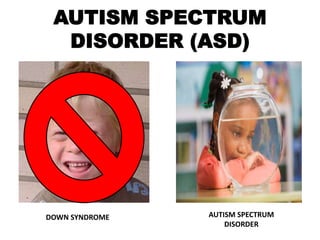
AUTISM SPECTRUM
DISORDER (ASD)
DOWN SYNDROME AUTISM SPECTRUM
DISORDER
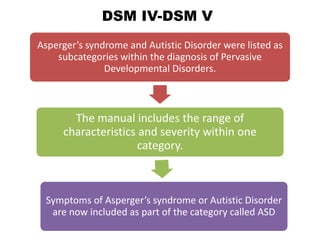
DSM IV-DSM V
Asperger’s syndrome and Autistic Disorder were listed as
subcategories within the diagnosis of Pervasive
Developmental Disorders.
The manual includes the range of
characteristics and severity within one
category.
Symptoms of Asperger’s syndrome or Autistic Disorder
are now included as part of the category called ASD
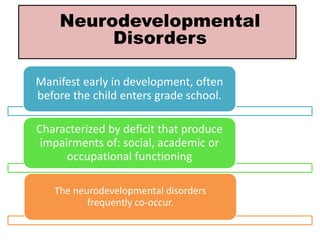
Neurodevelopmental
Disorders
Manifest early in development, often
before the child enters grade school.
Characterized by deficit that produce
impairments of: social, academic or
occupational functioning
The neurodevelopmental disorders
frequently co-occur.
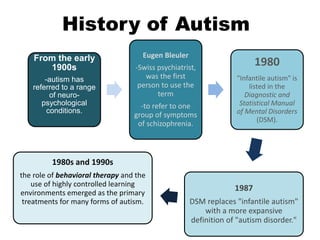
History of Autism
From the early
1900s
-autism has
referred to a range
of neuro-
psychological
conditions.
Eugen Bleuler
-Swiss psychiatrist,
was the first
person to use the
term
-to refer to one
group of symptoms
of schizophrenia.
1980
"Infantile autism" is
listed in the
Diagnostic and
Statistical Manual
of Mental Disorders
(DSM).
1987
DSM replaces "infantile autism"
with a more expansive
definition of "autism disorder."
1980s and 1990s
the role of behavioral therapy and the
use of highly controlled learning
environments emerged as the primary
treatments for many forms of autism.
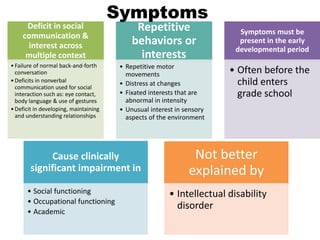
Deficit in social
communication &
interest across
multiple context
•Failure of normal back-and-forth
conversation
•Deficits in nonverbal
communication used for social
interaction such as: eye contact,
body language & use of gestures
•Deficit in developing, maintaining
and understanding relationships
Repetitive
behaviors or
interests
• Repetitive motor
movements
• Distress at changes
• Fixated interests that are
abnormal in intensity
• Unusual interest in sensory
aspects of the environment
Symptoms must be
present in the early
developmental period
• Often before the
child enters
grade school
Symptoms
Cause clinically
significant impairment in
• Social functioning
• Occupational functioning
• Academic
Not better
explained by
• Intellectual disability
disorder
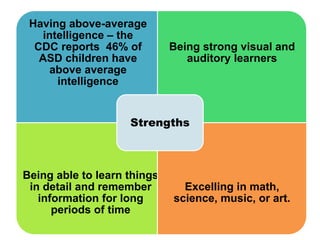
Having above-average
intelligence – the
CDC reports 46% of
ASD children have
above average
intelligence
Being strong visual and
auditory learners
Being able to learn things
in detail and remember
information for long
periods of time
Excelling in math,
science, music, or art.
Strengths
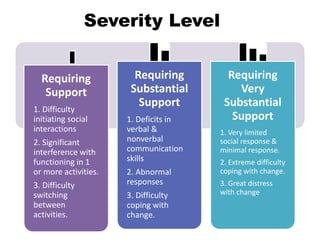
Severity Level
Requiring
Support
1. Difficulty
initiating social
interactions
2. Significant
interference with
functioning in 1
or more activities.
3. Difficulty
switching
between
activities.
Requiring
Substantial
Support
1. Deficits in
verbal &
nonverbal
communication
skills
2. Abnormal
responses
3. Difficulty
coping with
change.
Requiring
Very
Substantial
Support
1. Very limited
social response &
minimal response.
2. Extreme difficulty
coping with change.
3. Great distress
with change
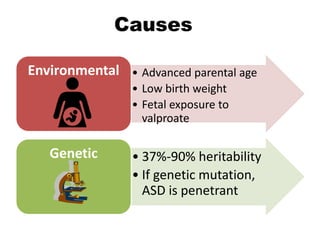
Causes
• Advanced parental age
• Low birth weight
• Fetal exposure to
valproate
Environmental
• 37%-90% heritability
• If genetic mutation,
ASD is penetrant
Genetic
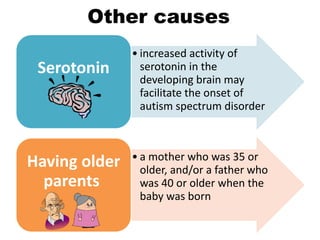
Other causes
• increased activity of
serotonin in the
developing brain may
facilitate the onset of
autism spectrum disorder
Serotonin
• a mother who was 35 or
older, and/or a father who
was 40 or older when the
baby was born
Having older
parents
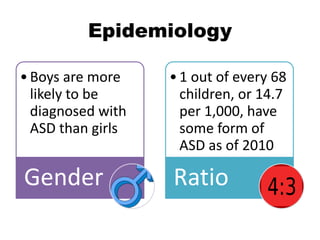
•Boys are more
likely to be
diagnosed with
ASD than girls
Gender
•1 out of every 68
children, or 14.7
per 1,000, have
some form of
ASD as of 2010
Ratio
Epidemiology
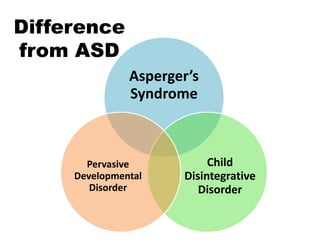
Difference
from ASD
Asperger’s
Syndrome
Child
Disintegrative
Disorder
Pervasive
Developmental
Disorder
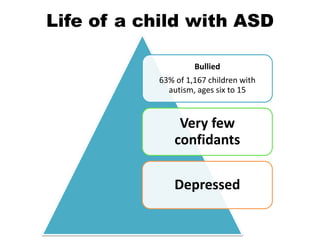
Life of a child with ASD
Bullied
63% of 1,167 children with
autism, ages six to 15
Very few
confidants
Depressed
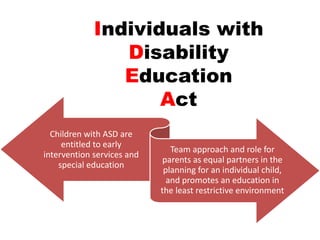
Children with ASD are
entitled to early
intervention services and
special education
Team approach and role for
parents as equal partners in the
planning for an individual child,
and promotes an education in
the least restrictive environment
Individuals with
Disability
Education
Act
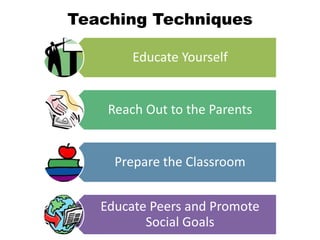
Educate Yourself
Reach Out to the Parents
Prepare the Classroom
Educate Peers and Promote
Social Goals
Teaching Techniques
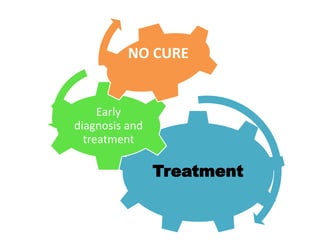
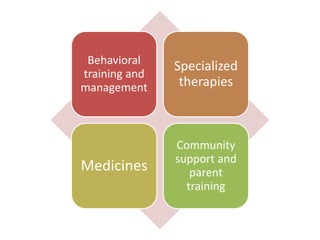
Treatment
Early
diagnosis and
treatment
NO CURE
Behavioral
training and
management
Specialized
therapies
Medicines
Community
support and
parent
training
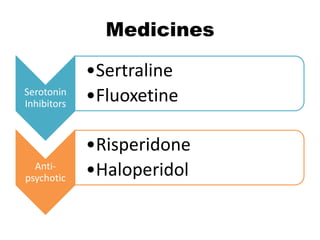
Medicines
Serotonin
Inhibitors
•Sertraline
•Fluoxetine
Anti-
psychotic
•Risperidone
•Haloperidol
References
• http://www.nimh.nih.gov/health/topics/autism-spectrum-disorders-
asd/index.shtml
• http://www.webmd.com/brain/autism/development-disorder#1
• https://en.wikipedia.org/wiki/Pervasive_developmental_disorder
• http://www.independent.co.uk/voices/its-no-surprise-that-people-with-
autism-have-a-low-life-expectancy-our-needs-as-adults-are-being-
a6964751.html
• http://www.webmd.com/brain/autism/medications-for-autism
• DSM-V

Autism Spectrum Disorder

  • 1.
    Autism Spectrum Disorder 299.00(F84.0) Dimaporo, Fatmah Gozon, Romeo
  • 2.
    AUTISM SPECTRUM DISORDER (ASD) DOWNSYNDROME AUTISM SPECTRUM DISORDER
  • 3.
    DSM IV-DSM V Asperger’ssyndrome and Autistic Disorder were listed as subcategories within the diagnosis of Pervasive Developmental Disorders. The manual includes the range of characteristics and severity within one category. Symptoms of Asperger’s syndrome or Autistic Disorder are now included as part of the category called ASD
  • 4.
    Neurodevelopmental Disorders Manifest early indevelopment, often before the child enters grade school. Characterized by deficit that produce impairments of: social, academic or occupational functioning The neurodevelopmental disorders frequently co-occur.
  • 5.
    History of Autism Fromthe early 1900s -autism has referred to a range of neuro- psychological conditions. Eugen Bleuler -Swiss psychiatrist, was the first person to use the term -to refer to one group of symptoms of schizophrenia. 1980 "Infantile autism" is listed in the Diagnostic and Statistical Manual of Mental Disorders (DSM). 1987 DSM replaces "infantile autism" with a more expansive definition of "autism disorder." 1980s and 1990s the role of behavioral therapy and the use of highly controlled learning environments emerged as the primary treatments for many forms of autism.
  • 6.
    Deficit in social communication& interest across multiple context •Failure of normal back-and-forth conversation •Deficits in nonverbal communication used for social interaction such as: eye contact, body language & use of gestures •Deficit in developing, maintaining and understanding relationships Repetitive behaviors or interests • Repetitive motor movements • Distress at changes • Fixated interests that are abnormal in intensity • Unusual interest in sensory aspects of the environment Symptoms must be present in the early developmental period • Often before the child enters grade school Symptoms Cause clinically significant impairment in • Social functioning • Occupational functioning • Academic Not better explained by • Intellectual disability disorder
  • 7.
    Having above-average intelligence –the CDC reports 46% of ASD children have above average intelligence Being strong visual and auditory learners Being able to learn things in detail and remember information for long periods of time Excelling in math, science, music, or art. Strengths
  • 8.
    Severity Level Requiring Support 1. Difficulty initiatingsocial interactions 2. Significant interference with functioning in 1 or more activities. 3. Difficulty switching between activities. Requiring Substantial Support 1. Deficits in verbal & nonverbal communication skills 2. Abnormal responses 3. Difficulty coping with change. Requiring Very Substantial Support 1. Very limited social response & minimal response. 2. Extreme difficulty coping with change. 3. Great distress with change
  • 9.
    Causes • Advanced parentalage • Low birth weight • Fetal exposure to valproate Environmental • 37%-90% heritability • If genetic mutation, ASD is penetrant Genetic
  • 10.
    Other causes • increasedactivity of serotonin in the developing brain may facilitate the onset of autism spectrum disorder Serotonin • a mother who was 35 or older, and/or a father who was 40 or older when the baby was born Having older parents
  • 11.
    •Boys are more likelyto be diagnosed with ASD than girls Gender •1 out of every 68 children, or 14.7 per 1,000, have some form of ASD as of 2010 Ratio Epidemiology
  • 12.
  • 13.
    Life of achild with ASD Bullied 63% of 1,167 children with autism, ages six to 15 Very few confidants Depressed
  • 14.
    Children with ASDare entitled to early intervention services and special education Team approach and role for parents as equal partners in the planning for an individual child, and promotes an education in the least restrictive environment Individuals with Disability Education Act
  • 15.
    Educate Yourself Reach Outto the Parents Prepare the Classroom Educate Peers and Promote Social Goals Teaching Techniques
  • 16.
  • 17.
  • 18.
  • 19.
    References • http://www.nimh.nih.gov/health/topics/autism-spectrum-disorders- asd/index.shtml • http://www.webmd.com/brain/autism/development-disorder#1 •https://en.wikipedia.org/wiki/Pervasive_developmental_disorder • http://www.independent.co.uk/voices/its-no-surprise-that-people-with- autism-have-a-low-life-expectancy-our-needs-as-adults-are-being- a6964751.html • http://www.webmd.com/brain/autism/medications-for-autism • DSM-V