Autism 101:
An Introduction to
Understanding Autism
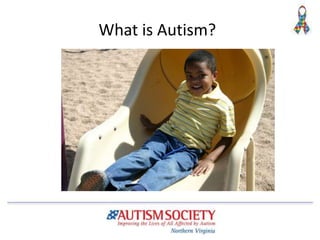
What is Autism?
“Autism is a disorder that affects the brain’s
normal development of social and
communication skills.”
~ Autism Society of Northern Virginia
The Autism Spectrum
Severely Affected High Functioning
There are similarities found across the spectrum including:
- Difficulty in communications
- Deficits in social functioning
- Restricted interests
- Repetitive behaviors
Autism is a spectrum disorder, meaning that it can range in severity
and won’t look exactly the same in any two people with autism
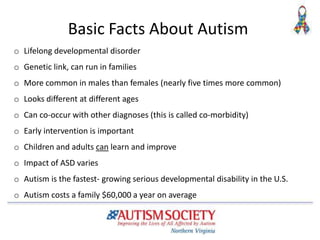
Basic Facts About Autism
o Lifelong developmental disorder
o Genetic link, can run in families
o More common in males than females (nearly five times more common)
o Looks different at different ages
o Can co-occur with other diagnoses (this is called co-morbidity)
o Early intervention is important
o Children and adults can learn and improve
o Impact of ASD varies
o Autism is the fastest- growing serious developmental disability in the U.S.
o Autism costs a family $60,000 a year on average
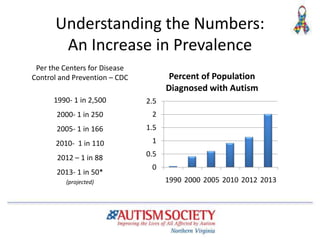
Understanding the Numbers:
An Increase in Prevalence
Per the Centers for Disease
Control and Prevention – CDC
1990- 1 in 2,500
2000- 1 in 250
2005- 1 in 166
2010- 1 in 110
2012 – 1 in 88
2013- 1 in 50*
(projected)
0
0.5
1
1.5
2
2.5
1990 2000 2005 2010 2012 2013
Percent of Population
Diagnosed with Autism
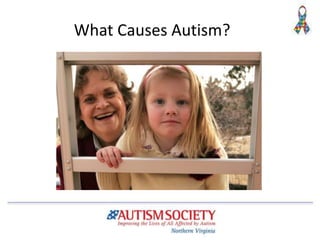
What Causes Autism?
Possible Causes of Autism
• Right now, not everyone agrees on what causes autism.
• Possible causes that people have suggested include genetics, unusual
neural (brain) development, environmental factors, bad
parenting, traumatic childhood experiences, and vaccines
• Most researchers agree that autism definitely is partly genetic, meaning
that if you have autism, it’s more likely that your children or your siblings
will also have autism. No one is sure exactly how strong the link is, or
details about how it works.
• We encourage you to learn the facts for yourself and then form your own
opinion!
• More research is definitely needed.
What we DO know for sure is that individuals with
autism, their families, and their communities need:
 SUPPORT
 RESOURCES
 ACCEPTANCE
 KNOWLEDGE
 UNDERSTANDING
 FUNDING & MEDICAL ASSISTANCE
 THERAPY AND BEHAVIORAL HELP THAT’S SHOWN TO WORK
This is what ASNV strives to provide. We especially think that
more work should be done to find more
effective, safe, inexpensive, local, and easily available therapy to
support individuals in achieving their goals.
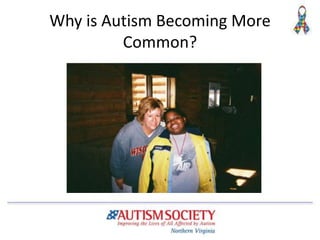
Why is Autism Becoming More
Common?
Why is Autism Becoming More
Common?
o Better awareness: doctors and parents think to have
children and adults evaluated
o Better diagnostic tools: We have a better understanding
of how to tell if someone has autism
o Other proposed theories:
o Awareness has caused autism to be over-diagnosed
o Environmental changes have caused an increase
The Importance of Early Detection
American Academy of Pediatrics recommends for all children
Developmental Screen - 9, 18, & 30 months
Autism Screen - 18 & 24 months
“Pediatricians could diagnose children with autism earlier by asking parents to
fill out a simple, five-minute checklist when they take their babies in for their
first-year checkups.”
(Journal of Pediatrics, April 27, 2011)
The earlier the diagnosis, the earlier supports can be provided! A lot of
frustration, worry, social discomfort, and exclusion can be avoided.
Possible Signs of Autism
o Avoids eye contact
o Stares at lights, ceiling fans, hands
o Prefers “dangly” things to toys
o Repetitive body movements, flapping
o Unusual vocalizations
o Inappropriate laughing or giggling
o Doesn’t smile back
o Spins objects or self
o Doesn’t want to be cuddled
Every individuals shows
different symptoms, and
having some of these
symptoms doesn’t necessarily
mean the person has autism.
It’s very important to get an
official diagnosis from a
licensed professional!
Warning!
Possible Signs of Autism
o No fear of danger
o Doesn’t seem to feel pain
o Doesn’t respond to his/her name
(can appear deaf)
o Sustained, unusual or repetitive play
o Prefers to play alone
o Prefers objects to people
o Meltdowns
o Eats only a small selection of foods
and resists new foods
o Stuffs mouth with food
Every individuals shows
different symptoms, and
having some of these
symptoms doesn’t necessarily
mean the person has autism.
It’s very important to get an
official diagnosis from a
licensed professional!
Warning!
Possible Signs of Autism
o Stops using speech or sign language
(regressive autism)
o May be non-verbal or hyper-verbal
o Echoes words or phrases (echolalia)
o Thinks literally, uses literal language
o May not understand joking or sarcasm
o Strong responses to
pain, sound, light, smell temperature
or touch
o Insists on routine, sameness
o Great difficulty with transitions
o Restricted interests
Every individuals shows
different symptoms, and
having some of these
symptoms doesn’t necessarily
mean the person has autism.
It’s very important to get an
official diagnosis from a
licensed professional!
Warning!
Possible Signs of Autism
o Extreme giftedness
o Socially awkward
o Does not pick up on social cues
o Anxious, agitated, withdrawn, de
pressed
o Obsessive/Compulsive
o Sleep problems
o Aggressiveness/rages
o Self injury
Every individuals shows
different symptoms, and
having some of these
symptoms doesn’t necessarily
mean the person has autism.
It’s very important to get an
official diagnosis from a
licensed professional!
Warning!
How Are We Doing in Virginia?
o In 2012, Virginia ranked 17th in cases of ASD (HeadStartVA.org)
o VA ranks 47th on disability inclusion, which includes everything from
spending to community involvement (United Cerebral Palsy, 2011 data)
o VA ranks 12th in state spending on special education (Census Bureau, 2011)
o Per-pupil spending shows a different story: VA spends less than $12,000 per
pupil, ranking 27th among the states (for comparison, DC spends over
$29,000, Census Bureau, 2011)
o So does spending as a percentage of income – VA spends less than $40 on
special education per $1,000 of personal income, ranking 46th
o 43rd in per pupil spending if adjusted for regional cost differences (Ed
Week, 2014 Quality Counts, 2010-11 data)
10 Completely Ridiculous Myths about
People with Autism
All people with autism
1. Are savants (Rainman stereotype)
2. Don’t have feelings, have no empathy
3. Don’t build relationships, can’t get married or
have families
4. Are violent and a danger to society
5. Have no language skills
6. Can’t have jobs
7. Can’t go to school or be in standard classrooms
8. Are entirely dependent on a caretaker
9. Are miserable and suffering
10. Need help and want a cure for autism
The truth? Every
person with autism
is a unique
individual. Everyone
has different
needs, wants, abiliti
es, strengths, lifestyl
es, and goals.
Famous People with Autism
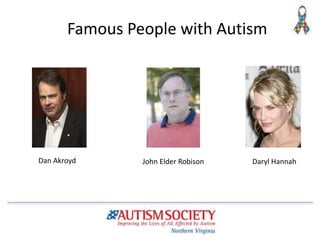
Dan Akroyd John Elder Robison Daryl Hannah
Famous People with Autism
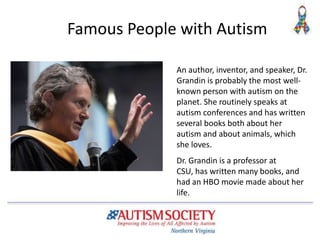
An author, inventor, and speaker, Dr.
Grandin is probably the most well-
known person with autism on the
planet. She routinely speaks at
autism conferences and has written
several books both about her
autism and about animals, which
she loves.
Dr. Grandin is a professor at
CSU, has written many books, and
had an HBO movie made about her
life.
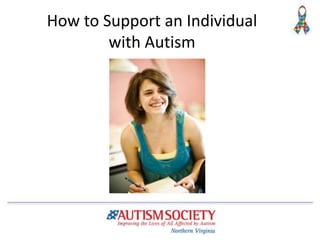
How to Support an Individual
with Autism
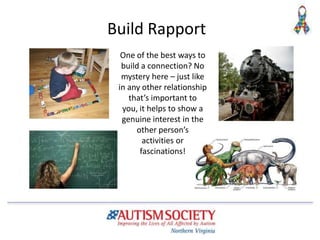
Build Rapport
One of the best ways to
build a connection? No
mystery here – just like
in any other relationship
that’s important to
you, it helps to show a
genuine interest in the
other person’s
activities or
fascinations!
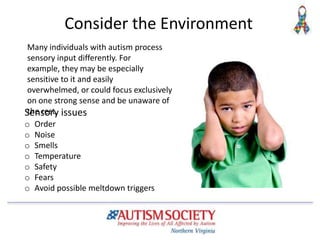
Consider the Environment
Sensory issues
o Order
o Noise
o Smells
o Temperature
o Safety
o Fears
o Avoid possible meltdown triggers
Many individuals with autism process
sensory input differently. For
example, they may be especially
sensitive to it and easily
overwhelmed, or could focus exclusively
on one strong sense and be unaware of
the rest.
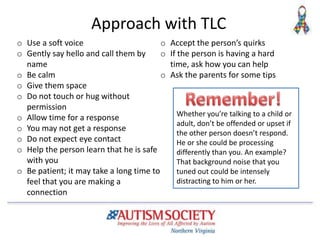
Approach with TLC
o Use a soft voice
o Gently say hello and call them by
name
o Be calm
o Give them space
o Do not touch or hug without
permission
o Allow time for a response
o You may not get a response
o Do not expect eye contact
o Help the person learn that he is safe
with you
o Be patient; it may take a long time to
feel that you are making a
connection
o Accept the person’s quirks
o If the person is having a hard
time, ask how you can help
o Ask the parents for some tips
Whether you’re talking to a child or
adult, don’t be offended or upset if
the other person doesn’t respond.
He or she could be processing
differently than you. An example?
That background noise that you
tuned out could be intensely
distracting to him or her.
Practice Conscious Communication
o Is the individual verbal? Non-verbal?
o Can the individual make his/her
needs known?
o What has worked best in the past?
o What hasn’t worked so well?
o Try to find the meaning behind
behaviors
Try considering these questions:
Consistency is Important
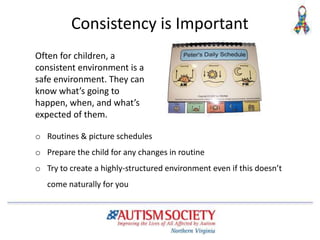
o Routines & picture schedules
o Prepare the child for any changes in routine
o Try to create a highly-structured environment even if this doesn’t
come naturally for you
Often for children, a
consistent environment is a
safe environment. They can
know what’s going to
happen, when, and what’s
expected of them.
Behavior
Tantrum
o A power play
o Child is aware and in control, but
doesn’t want you to know that
o Looks to see if people are noticing
o May make sure they are safe or
move from danger
o If they get what they want the
tantrum ends abruptly
Meltdown
o Total loss of behavioral control
o Not a manipulative ploy
o Doesn’t look to see who’s watching
o Does not consider her own safety
o After a certain point, nothing can
appease: it’s not that the child won’t
stop, it’s that he or she can’t stop.
o Punishments and ultimatums aren’t
effective – you have to wait it out.
Children with autism can sometimes have what’s called a ‘meltdown’.
But for people who don’t know a lot about autism, it can look a lot like
your run-of-the-mill temper tantrum. What’s the difference?
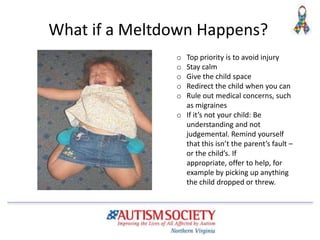
What if a Meltdown Happens?
o Top priority is to avoid injury
o Stay calm
o Give the child space
o Redirect the child when you can
o Rule out medical concerns, such
as migraines
o If it’s not your child: Be
understanding and not
judgemental. Remind yourself
that this isn’t the parent’s fault –
or the child’s. If
appropriate, offer to help, for
example by picking up anything
the child dropped or threw.
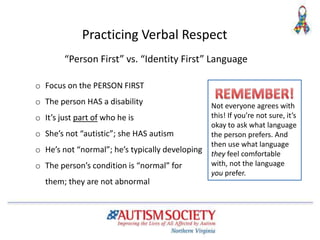
“Person First” vs. “Identity First” Language
o Focus on the PERSON FIRST
o The person HAS a disability
o It’s just part of who he is
o She’s not “autistic”; she HAS autism
o He’s not “normal”; he’s typically developing
o The person’s condition is “normal” for
them; they are not abnormal
Practicing Verbal Respect
Not everyone agrees with
this! If you’re not sure, it’s
okay to ask what language
the person prefers. And
then use what language
they feel comfortable
with, not the language
you prefer.
Avoid Dehumanizing Words
o R-word (“Spread the Word to End the Word” www.r-word.org)
o Suffers from, victim, burdened with
o Avoid stereotypes and generalizations, even if you think they’re
positive, such as “they are all so loving” or “they are all so
difficult”
o Focus on the individual’s attributes and don’t make assumptions
Practicing Verbal Respect
Don’t Forget…
o Relax, don’t be afraid and certainly don’t ignore him or her
o Speak in a normal tone of voice – you’re not talking to an infant! Don’t talk
down to the other person
o Speak to the person, not about the person
o If it’s something that a non-autistic (sometimes called ‘neurotypical’) adult
would find rude in conversation, don’t do it in this conversation!
o Be patient and allow time for response
o Refer to their disability only when pertinent
o Be supportive and considerate
o Individuals with ASD have made meaningful, lasting contributions to society
o Embrace diversity & Inclusion is a basic human right
The Autism Society of Virginia is here for YOU!
We advocate, inform and…share the journey
Contact us
info@asnv.org
703-495-8444
www.asnv.org
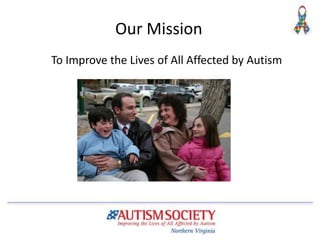
Our Mission
To Improve the Lives of All Affected by Autism
History & Vision
The Autism Society of Northern Virginia was founded in 1970 by
parents fighting for the right for their children to attend public schools.
ALL individuals affected by autism deserve ready access to the services
and supports needed to:
o Be safe,
o educated,
o healthy,
o productive and
o have happy and fulfilling lives
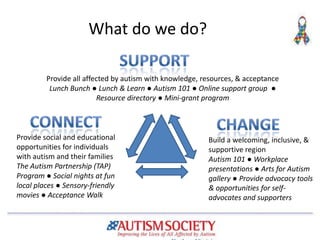
What do we do?
Provide all affected by autism with knowledge, resources, & acceptance
Lunch Bunch ● Lunch & Learn ● Autism 101 ● Online support group ●
Resource directory ● Mini-grant program
Provide social and educational
opportunities for individuals
with autism and their families
The Autism Partnership (TAP)
Program ● Social nights at fun
local places ● Sensory-friendly
movies ● Acceptance Walk
Build a welcoming, inclusive, &
supportive region
Autism 101 ● Workplace
presentations ● Arts for Autism
gallery ● Provide advocacy tools
& opportunities for self-
advocates and supporters

Autism 101 by ASNV

  • 1.
    Autism 101: An Introductionto Understanding Autism
  • 2.
  • 3.
    “Autism is adisorder that affects the brain’s normal development of social and communication skills.” ~ Autism Society of Northern Virginia
  • 4.
    The Autism Spectrum SeverelyAffected High Functioning There are similarities found across the spectrum including: - Difficulty in communications - Deficits in social functioning - Restricted interests - Repetitive behaviors Autism is a spectrum disorder, meaning that it can range in severity and won’t look exactly the same in any two people with autism
  • 5.
    Basic Facts AboutAutism o Lifelong developmental disorder o Genetic link, can run in families o More common in males than females (nearly five times more common) o Looks different at different ages o Can co-occur with other diagnoses (this is called co-morbidity) o Early intervention is important o Children and adults can learn and improve o Impact of ASD varies o Autism is the fastest- growing serious developmental disability in the U.S. o Autism costs a family $60,000 a year on average
  • 6.
    Understanding the Numbers: AnIncrease in Prevalence Per the Centers for Disease Control and Prevention – CDC 1990- 1 in 2,500 2000- 1 in 250 2005- 1 in 166 2010- 1 in 110 2012 – 1 in 88 2013- 1 in 50* (projected) 0 0.5 1 1.5 2 2.5 1990 2000 2005 2010 2012 2013 Percent of Population Diagnosed with Autism
  • 7.
  • 8.
    Possible Causes ofAutism • Right now, not everyone agrees on what causes autism. • Possible causes that people have suggested include genetics, unusual neural (brain) development, environmental factors, bad parenting, traumatic childhood experiences, and vaccines • Most researchers agree that autism definitely is partly genetic, meaning that if you have autism, it’s more likely that your children or your siblings will also have autism. No one is sure exactly how strong the link is, or details about how it works. • We encourage you to learn the facts for yourself and then form your own opinion! • More research is definitely needed.
  • 9.
    What we DOknow for sure is that individuals with autism, their families, and their communities need:  SUPPORT  RESOURCES  ACCEPTANCE  KNOWLEDGE  UNDERSTANDING  FUNDING & MEDICAL ASSISTANCE  THERAPY AND BEHAVIORAL HELP THAT’S SHOWN TO WORK This is what ASNV strives to provide. We especially think that more work should be done to find more effective, safe, inexpensive, local, and easily available therapy to support individuals in achieving their goals.
  • 10.
    Why is AutismBecoming More Common?
  • 11.
    Why is AutismBecoming More Common? o Better awareness: doctors and parents think to have children and adults evaluated o Better diagnostic tools: We have a better understanding of how to tell if someone has autism o Other proposed theories: o Awareness has caused autism to be over-diagnosed o Environmental changes have caused an increase
  • 12.
    The Importance ofEarly Detection American Academy of Pediatrics recommends for all children Developmental Screen - 9, 18, & 30 months Autism Screen - 18 & 24 months “Pediatricians could diagnose children with autism earlier by asking parents to fill out a simple, five-minute checklist when they take their babies in for their first-year checkups.” (Journal of Pediatrics, April 27, 2011) The earlier the diagnosis, the earlier supports can be provided! A lot of frustration, worry, social discomfort, and exclusion can be avoided.
  • 13.
    Possible Signs ofAutism o Avoids eye contact o Stares at lights, ceiling fans, hands o Prefers “dangly” things to toys o Repetitive body movements, flapping o Unusual vocalizations o Inappropriate laughing or giggling o Doesn’t smile back o Spins objects or self o Doesn’t want to be cuddled Every individuals shows different symptoms, and having some of these symptoms doesn’t necessarily mean the person has autism. It’s very important to get an official diagnosis from a licensed professional! Warning!
  • 14.
    Possible Signs ofAutism o No fear of danger o Doesn’t seem to feel pain o Doesn’t respond to his/her name (can appear deaf) o Sustained, unusual or repetitive play o Prefers to play alone o Prefers objects to people o Meltdowns o Eats only a small selection of foods and resists new foods o Stuffs mouth with food Every individuals shows different symptoms, and having some of these symptoms doesn’t necessarily mean the person has autism. It’s very important to get an official diagnosis from a licensed professional! Warning!
  • 15.
    Possible Signs ofAutism o Stops using speech or sign language (regressive autism) o May be non-verbal or hyper-verbal o Echoes words or phrases (echolalia) o Thinks literally, uses literal language o May not understand joking or sarcasm o Strong responses to pain, sound, light, smell temperature or touch o Insists on routine, sameness o Great difficulty with transitions o Restricted interests Every individuals shows different symptoms, and having some of these symptoms doesn’t necessarily mean the person has autism. It’s very important to get an official diagnosis from a licensed professional! Warning!
  • 16.
    Possible Signs ofAutism o Extreme giftedness o Socially awkward o Does not pick up on social cues o Anxious, agitated, withdrawn, de pressed o Obsessive/Compulsive o Sleep problems o Aggressiveness/rages o Self injury Every individuals shows different symptoms, and having some of these symptoms doesn’t necessarily mean the person has autism. It’s very important to get an official diagnosis from a licensed professional! Warning!
  • 17.
    How Are WeDoing in Virginia? o In 2012, Virginia ranked 17th in cases of ASD (HeadStartVA.org) o VA ranks 47th on disability inclusion, which includes everything from spending to community involvement (United Cerebral Palsy, 2011 data) o VA ranks 12th in state spending on special education (Census Bureau, 2011) o Per-pupil spending shows a different story: VA spends less than $12,000 per pupil, ranking 27th among the states (for comparison, DC spends over $29,000, Census Bureau, 2011) o So does spending as a percentage of income – VA spends less than $40 on special education per $1,000 of personal income, ranking 46th o 43rd in per pupil spending if adjusted for regional cost differences (Ed Week, 2014 Quality Counts, 2010-11 data)
  • 18.
    10 Completely RidiculousMyths about People with Autism All people with autism 1. Are savants (Rainman stereotype) 2. Don’t have feelings, have no empathy 3. Don’t build relationships, can’t get married or have families 4. Are violent and a danger to society 5. Have no language skills 6. Can’t have jobs 7. Can’t go to school or be in standard classrooms 8. Are entirely dependent on a caretaker 9. Are miserable and suffering 10. Need help and want a cure for autism The truth? Every person with autism is a unique individual. Everyone has different needs, wants, abiliti es, strengths, lifestyl es, and goals.
  • 19.
    Famous People withAutism Dan Akroyd John Elder Robison Daryl Hannah
  • 20.
    Famous People withAutism An author, inventor, and speaker, Dr. Grandin is probably the most well- known person with autism on the planet. She routinely speaks at autism conferences and has written several books both about her autism and about animals, which she loves. Dr. Grandin is a professor at CSU, has written many books, and had an HBO movie made about her life.
  • 21.
    How to Supportan Individual with Autism
  • 22.
    Build Rapport One ofthe best ways to build a connection? No mystery here – just like in any other relationship that’s important to you, it helps to show a genuine interest in the other person’s activities or fascinations!
  • 23.
    Consider the Environment Sensoryissues o Order o Noise o Smells o Temperature o Safety o Fears o Avoid possible meltdown triggers Many individuals with autism process sensory input differently. For example, they may be especially sensitive to it and easily overwhelmed, or could focus exclusively on one strong sense and be unaware of the rest.
  • 24.
    Approach with TLC oUse a soft voice o Gently say hello and call them by name o Be calm o Give them space o Do not touch or hug without permission o Allow time for a response o You may not get a response o Do not expect eye contact o Help the person learn that he is safe with you o Be patient; it may take a long time to feel that you are making a connection o Accept the person’s quirks o If the person is having a hard time, ask how you can help o Ask the parents for some tips Whether you’re talking to a child or adult, don’t be offended or upset if the other person doesn’t respond. He or she could be processing differently than you. An example? That background noise that you tuned out could be intensely distracting to him or her.
  • 25.
    Practice Conscious Communication oIs the individual verbal? Non-verbal? o Can the individual make his/her needs known? o What has worked best in the past? o What hasn’t worked so well? o Try to find the meaning behind behaviors Try considering these questions:
  • 26.
    Consistency is Important oRoutines & picture schedules o Prepare the child for any changes in routine o Try to create a highly-structured environment even if this doesn’t come naturally for you Often for children, a consistent environment is a safe environment. They can know what’s going to happen, when, and what’s expected of them.
  • 27.
    Behavior Tantrum o A powerplay o Child is aware and in control, but doesn’t want you to know that o Looks to see if people are noticing o May make sure they are safe or move from danger o If they get what they want the tantrum ends abruptly Meltdown o Total loss of behavioral control o Not a manipulative ploy o Doesn’t look to see who’s watching o Does not consider her own safety o After a certain point, nothing can appease: it’s not that the child won’t stop, it’s that he or she can’t stop. o Punishments and ultimatums aren’t effective – you have to wait it out. Children with autism can sometimes have what’s called a ‘meltdown’. But for people who don’t know a lot about autism, it can look a lot like your run-of-the-mill temper tantrum. What’s the difference?
  • 28.
    What if aMeltdown Happens? o Top priority is to avoid injury o Stay calm o Give the child space o Redirect the child when you can o Rule out medical concerns, such as migraines o If it’s not your child: Be understanding and not judgemental. Remind yourself that this isn’t the parent’s fault – or the child’s. If appropriate, offer to help, for example by picking up anything the child dropped or threw.
  • 29.
    “Person First” vs.“Identity First” Language o Focus on the PERSON FIRST o The person HAS a disability o It’s just part of who he is o She’s not “autistic”; she HAS autism o He’s not “normal”; he’s typically developing o The person’s condition is “normal” for them; they are not abnormal Practicing Verbal Respect Not everyone agrees with this! If you’re not sure, it’s okay to ask what language the person prefers. And then use what language they feel comfortable with, not the language you prefer.
  • 30.
    Avoid Dehumanizing Words oR-word (“Spread the Word to End the Word” www.r-word.org) o Suffers from, victim, burdened with o Avoid stereotypes and generalizations, even if you think they’re positive, such as “they are all so loving” or “they are all so difficult” o Focus on the individual’s attributes and don’t make assumptions Practicing Verbal Respect
  • 31.
    Don’t Forget… o Relax,don’t be afraid and certainly don’t ignore him or her o Speak in a normal tone of voice – you’re not talking to an infant! Don’t talk down to the other person o Speak to the person, not about the person o If it’s something that a non-autistic (sometimes called ‘neurotypical’) adult would find rude in conversation, don’t do it in this conversation! o Be patient and allow time for response o Refer to their disability only when pertinent o Be supportive and considerate o Individuals with ASD have made meaningful, lasting contributions to society o Embrace diversity & Inclusion is a basic human right
  • 32.
    The Autism Societyof Virginia is here for YOU! We advocate, inform and…share the journey Contact us info@asnv.org 703-495-8444 www.asnv.org
  • 33.
    Our Mission To Improvethe Lives of All Affected by Autism
  • 34.
    History & Vision TheAutism Society of Northern Virginia was founded in 1970 by parents fighting for the right for their children to attend public schools. ALL individuals affected by autism deserve ready access to the services and supports needed to: o Be safe, o educated, o healthy, o productive and o have happy and fulfilling lives
  • 35.
    What do wedo? Provide all affected by autism with knowledge, resources, & acceptance Lunch Bunch ● Lunch & Learn ● Autism 101 ● Online support group ● Resource directory ● Mini-grant program Provide social and educational opportunities for individuals with autism and their families The Autism Partnership (TAP) Program ● Social nights at fun local places ● Sensory-friendly movies ● Acceptance Walk Build a welcoming, inclusive, & supportive region Autism 101 ● Workplace presentations ● Arts for Autism gallery ● Provide advocacy tools & opportunities for self- advocates and supporters