Steps for the design of CC pavement thickness as per the IRC guidelines
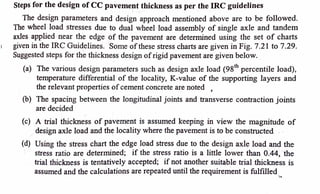
The design parameters and design approach mentioned above are to be followed.
The wheel load stresses due to dual wheel load assembly of single axle and tandem
axles applied near the edge of the pavement are determined using the set of charts
given in the IRC Gui<l:elines. Some of these stress charts are given in Fig. 7.21 to 7.29.
Suggested steps for the thickness design ofrigid pavement are given below. ,
(a) The various design parameters such as design axle load (98th
percentile load),
temperature differential of the locality, K-value of the supporting layers and
the relevant properties ofcementconcrete are noted 1
(b) The spacing between the longitudinal joints and transverse contraction joints
are decided
(c) A trial thiclmess of pavement is ~ssumed keeping in view the magnitude of
design axle load and th~ locality where the pavement is to be constructed ..
(d) Using the stress chart the edge load stress due to the design axle load and the
stress ratio are determined; if the stress ratio is a little lower than 0.44, the
trial thickness is tentatively accepted; if not another suitable trial thickness is
assumed and the calculations are repeated until the requirement is fulfilled
''"
478 DESIGN OF HIGHWAY PAVEMENT
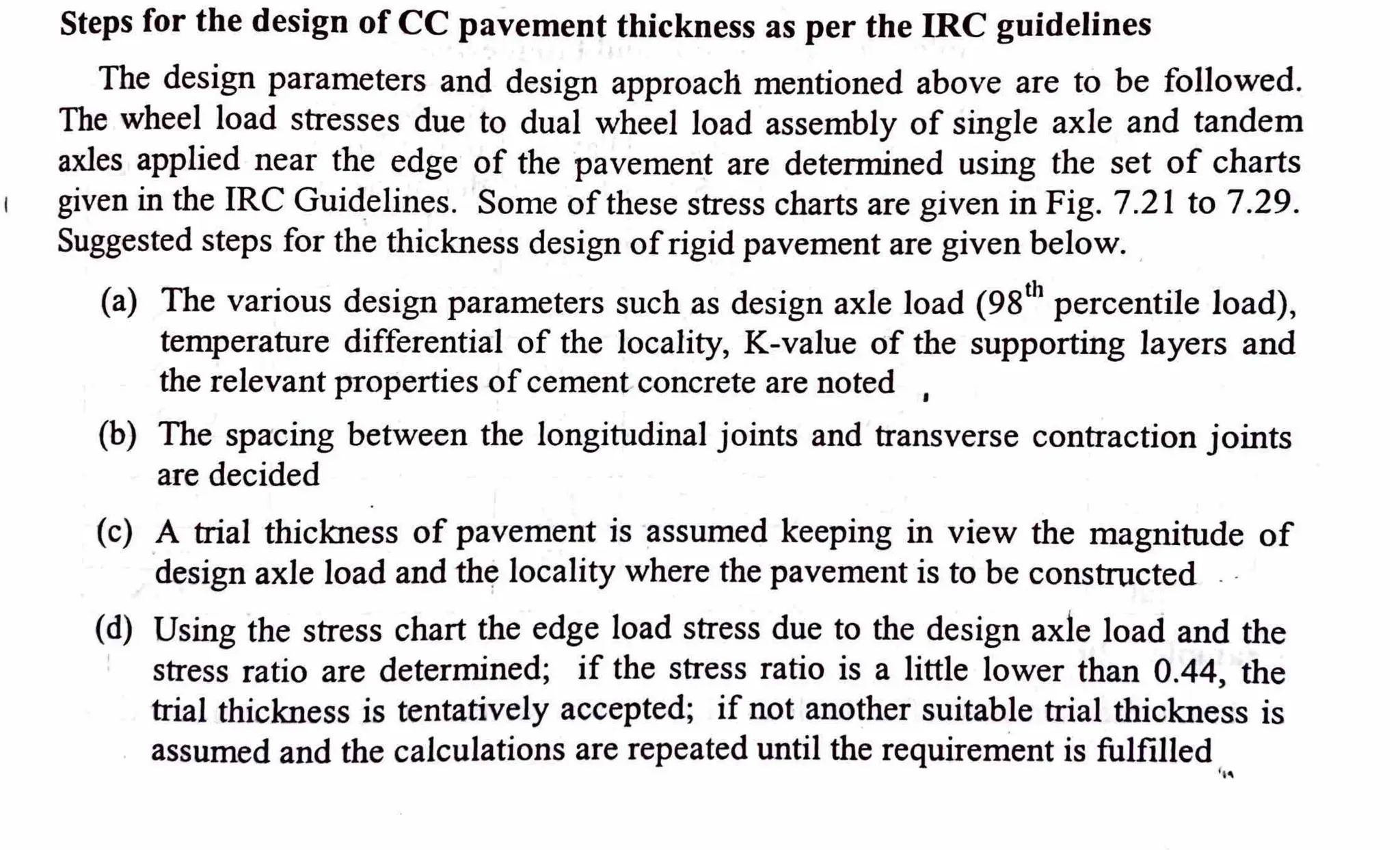
(e) Number of repetition of different axle. loads _
of ~agni~de hi~~er than the
design axle load expected dming the design penod 1s computed/estimated
(f) Stres~es due to the different single arid tandem axle_loads of n:agnitudes higher
than the design axle load on the pavement of tentatively finalised thickness are
determined using the edge load stress charts
(g) The stress ratios, the expected number of repetitions of the respective loads
during the design life and the cumulative damage due to fatigue- life consumed
are tabulated. Fatiaue life consumed or cumulative fatigue damage is total of
(C/N) ratios or :EC/N (see Column 7 of Table 7. 7)
(h) Ifthe cumulative fatigue damage exceeds 1.0, hig~er tri_
al thickness is assumed
and the above exercise of determination of cumulative fatigue ,damage is
repeated until this value is slightly less than 1.0
(i) The warping stress Ste at the ·edge of the slab of selected thickness .is
determined, consid~ring the highest temperature differ-ential at the locality
(j) Let the edge load stress due to the highest magnitude of load Pm expected
during the design life be = Sem and the total flexural stress due to warping and
the highest load be = (Ste + St:m), If the total stress is less than the flexural
strength, the design thickness is aGcepted. If this exceeds the flexural str'ength
the trial is repeated by assuming a still higher pavement thickness until this
requirement is also fulfilled
(k) The final pavement thickness is checked for comer load stress Sc.
({) After designing the pavement thickness requirement, the next requirement is
design of (a) dowel bar system at the expansion joints and (b) tie bars along
_
the longitudinal joints. The design details of dowel b~rs and tie bars are given
in subsequent paragraphs
.
The loads based on the axle load distribution studies may be multiplied by a safety
factor of 1.2, to take care of further possible overloading. '- ·
Table 7.7 Stress ratios and fatigue analysis
~
Axle load Axle
Edge load
Stress
Expected No.
·Fatigue life
stress, Se Fatigue of repetitions
type load, t 2 ratio, Se/Sr life, N during desig~
consumed,
kg/cm C/N
life, C
. 0) (2) (3) (4) (5) (6) (7)
Single Pi Se1 Se1/Sr N1 C1 C1/N1
P2 Se2 Se2/Sr N2 C2 C2/N2
P3 St3 Se3/Sr N3 C3 C3/N3
-- -- ---- -~ -- ----
Tandem Ps Ses Ses/Sr Ns Cs Cs/Ns
-- -- ---- -- ----
-- -
Total
.tCFN .
Example 7.20
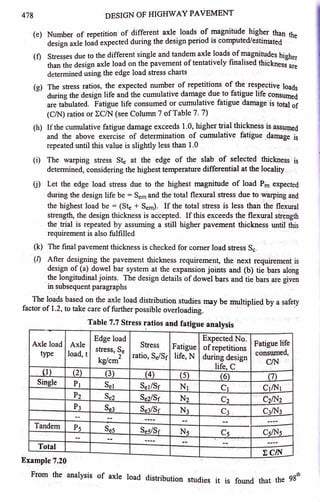
From the analysis of axle load distribution studies it is found that the 9g'h
RIGID PAVEMENT DESIGN METHODS
479
ercentile load
0
~ sin~le _axles is 12 _
t and that on tandem axles is 20 t._ The number of
P·er loaded v_
e
4hicles e
stl
rnated dunng the design life of 30 years are (a) on single
0'° · · f 4 '
xtes: 32 x lO repetitions
O 14 t load and 8 x 10 repetitions of 16 t load and (b) on
:;ndent axles: I
8
x
104
repetitio~ of 24 I load and 3 x 10⁴ repetitions of 28 t load.
'[be contact_ p~essure is
7
-
5 kg/cm • The spacing between the longitudinal joints and
contractionJomts are 3.5 m and 4.2 m respectively.
The maximum tem~era~e differential on concrete pavements of thickness 20, 25
and 30 cm in the location 1s found t? be 1~-6, 17.4 and 18.0 °c. The supporting layer
consists of GSB a
nd
DLC layers with ~timated modulus K value of 30 kg/cm3• The
flexural strength ofconcrete is 45 kg/cm .
Design the ~ickness of CC pavement as per IRC Guidelines, using the edge load
stress charts (Figs. 7.21 to 7.29) and Bardbury's warping stress coefficient chart (Fig.
7.20). Assume other data suitably.
Solution
Design load on single axle = 12 t
Design load on tandem axles = 20 t
Assume a trial thickness, h1= 24 cm
Edge load stress:
From the stress chart (Fig. 7.23}, corresponding to h = 24 and K = 30 kg/cm3, edge
load stress dtte to single axle load of12 t, Se= 17 kg/cm2.
From stress chart (Fig. 7.27}, corresponding to h = 24 and K = 30 kg/cm3, edge
2
load stress due to total load of20 ton tandem axles, Se= 12 kg/cm
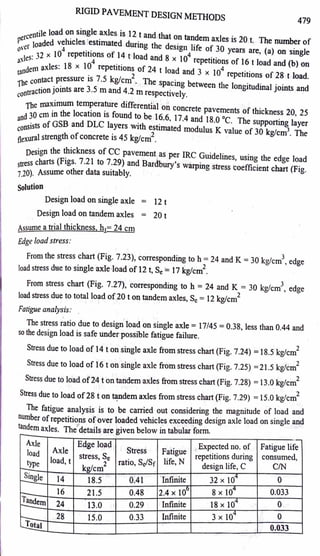
Fatigue analysis: .
The stress ratio due to design load on single axle= l7/45 = 0.38, less than 0.44 and
so the design load is safe under possible fatigue failure.
Stress due to load of 14 ton single axle from stress chart (Fig. 7.24) = 18.5 kg/cm2
Stress due to load of 16 ton single axle from stress chart (Fig. 7.25) =21.5 kg/cm2
Stress due to load of24 ton tandem axles from stress chart (Fig. 7.28) =13.0 kg/cm2
Stress due to load of28 ton t~dem axles from stress chart (Fig. 7.29) =15.0 kg/cm2
The fatigue analysis is to be carried out considering t~e magnitude of !oad and
number ofrepetitions ofover loaded vehicles exceeding design axle load on smgle and
tandem axles. The
11
details are given below in tabular form.
Axle Edge load
Stress Fatigue
Expected no. of Fatigue life
load Axle
stress, Se repetitions during consumed,
tyPe load, t 2 ratio, Se/Sr life, N
design life, C CIN
- kg/cm
_Single 14 18.5 0.41 'Infinite 32 X 10
4
0
,o
8 X 10
4
0.033
- 16 21.5 0.48 2.4 X lQ
Tandem 24 13.0 0.29 Infinite 18 X 10
4
0
- 3 X 10
4
28 15.0 0.33 Infinite 0
--
Total 0.033
480 DESIGN OF 1-llGHWAY PAVEMENT
Since total fatigue life consumed or cumulative_ fati~e damag~ due ~o axle loads
exceeding design load is only 0.033 or 3.3 % of f~ttgue hfe ~e d_eSlgn t~ckness of24
cm is safe due to repeated application ofloads durmg the design hfe.
Warping stress:
Temperature differential, t for 24 cm pavement thickness (by interpolation) = 17.24 °c
Length ofslab, Lx = 4.2 m = 420 cm, thickness, h = 24 cm, K
3
= 30 kg/cm
Assuming E = 3 x 10⁵
kg/cm
2
, Poisson's ratio,µ= 0.15
Radius ofrelative stiffness, I = [ Eh3 ]
114
12K(l-µ2
)
= 58.6 cm (substituting the ~alues)
Corresponding to Lx = 420 cm, Lxf/ = 420/58.6 =7.17; from
warping stress coefficient chart (Fig. 7.20),
Cx =0.98
Corresponding to LJI = 350/58.6 = 5.97, Cy= 0.9
Considering higher ofthe two values, adopt warping stress coefficient of0.98.
Therefore maximum warping stress at pavement edge,
Ste =
Total stress
Cx Eet = (0.98 x 3 x 105
x 1 x 10-5
x 17.24)/2
2
2
= 25.34 kg/cm
Highest load stress at pavement edge · = 21.5 kg/cm
2
Total (load stress+ warping stress) at edge = 46.84 kg/cm
2
As the total stress exceeds the flexural strength of 45 kg/cm
2
, the design is to be
revised, assuming a higher pavement thickness in order to fulfil this criterion.
In trial no. 2, assume pavement thickness h = 30 cm
Radius ofrelative stiffness, (substituting the values) l = [ Eh
3
]
114
= 69.27 cm
· 12K(l-µ2)
Highest edge load stress due to single axle load of 16 t for h == 30 cm (from Fig. 7.25)
= 15.3 kg/cm
2
Temperature differential, t for pavement thickness of 30 cm (by interpolation== 18.0 °C
Lxf/ = 420/69.27 = 6.06, Cx =0.90
Maximum warping stress at edge = (0.90 x 3 x 105
x 1 x 10-s x 18.0)/2 = 24.3 kg/cm
2
Total (load stress + tarping stress) = 15.3 + 24.3 = 39.6 kg/cm2, less than flexural
strength of45 kg/cm , hence safe.
RIGID PAVEMENT DESIGN METHODS 481
The factor of safety available for the maximum stress d t th hi h
· - 45139 6 - 1 1 ue O e g est load and
warping stress - · - • 4, may be accepted
Check for comer load stress, Sc = !~[1-(a-;2r2
]
Substituting design load P = 16 / 2 =8.0 t =8,000 kg h =30 / =69 27
3
== J(8000/ 7.5,r) = 18.43 cm ' cm, · cm,
Substituting, the values in the equation Sc= 18 4 kg/cm2 and so th d · · "
. , • e es1gn 1s sa1e.
Adopt design thickness ofCC pavement =30 cm
7.9.4 De~ign ofDowel Bars at Load Transfer Joints
Objectiv~s of dowel bars
As mentioned in Art. 7.6.3, expansion joints and construction joints are formed as
thro~gh joints acr~ss ~~ full depth of the slab. A small gap of about 20 mm is
provided at expans10~ JOmts to allow for expansion of long CC pavement slabs during
s~er seaso~. This gap or joint width helps to relieve the compressive stresses
dunng expansion and also helps to prevent buckling of the slab near the joint Steel
dowel bars are embedded at mid depth during construction as specified in the design in
order to strengthen these weak locations and to provide desired load transfer to the
adjoining slab across the joint. Though it is not considered very essential to provide
expansion joints in CC pavements at regular intervals, they should invariably be
provided wh~re the pavement is designed to abut structures like b~dges. /
Functioning
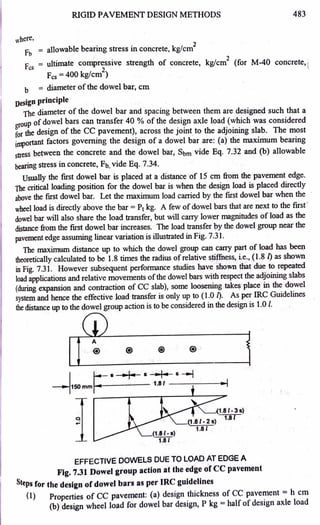
Figure 7.30 (a) illustrates that there is no load transfer across the expansion joint
without dowel bars as each slab deflects independently under the axle load. The
functioning of an expansion joint with dowel bar is illustrated in Fig. 7.30 (b). When
wheel load is placed at the edge ofthe slab adjoining the expansion joint, a part ofthe
deflection and load are transferred across to the adjoining slab with the help ofa group
ofdowel bars. The load stress diagram in dowel bar is shown in Fig. 7.30 (c).
Rounded steel bars ofdiameter 25 to 32 mm and length about 500 mm are placed at
intervals of 250 to 300 mm as per the design. About 50 mm less t1ian half lengtli of
. the rounded steel dowel bars are embedded during concreting along one slab, so as to
develop bond with the concrete. The other halflength ofthe dowel bars (plus 50 mm)
are covered with a suitable plastic sheathing to prevent development ofbond between
the dowel bars and the concrete of the adjoining slab. This de-bonded half length of
the dowel bars can slide into the adjoining slab. The construction details are given in
Art. 8.5.5 of Chapter 8, 'Highway Construction'.
Stresses in dowel bars
The maximum bearing stress developed in the.dowel bar.and the allowable bearing
stress in cement concrete are to be considered dunng the design.
Maximum bearing stress
The bearing stress between concrete and dowel ba~ depends ~inly on diameter of
the dowel bar and spacing between them. The maximum beanng stress between the
concrete and the dowel bar is given by the equation:
482 DESIGN OF HIGHWAY PAVEMENT
3
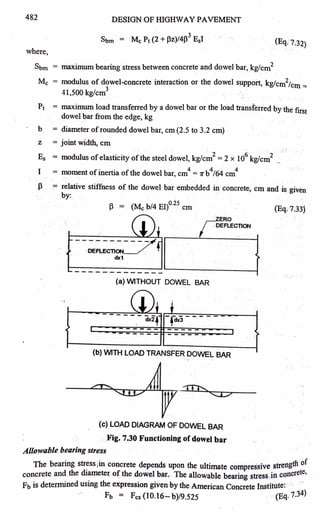
Sbm = Mc Pt (2 + Pz)/4(3- EsI (Eq. 7.32)
where,
Sbm = maximum bearing stress between concrete and dowel bar, kgfcm
2
Mc = modulus of dowel-concrete interaction or the dowel sµppoit, kg/cm
2
/cm ==
41,500 kg/cm
3
P1 = maximum load transferred by a dowel bar or the load transferred by the first
dowel bar from the edge, kg
b = diameter ofrounqed dowel bar, cm (2.5 to 3.2 cm)
z = joint width, cm
Es = modulus ofelasticity of the steel dowel, kg/cm
2
= 2 x 10
6
kg/cm
2
_
I = moment of inertia ofthe dowe1bar, cm
4
= 7r b
4
I64 cm
4
p = relative stiffness of the dowel bar embedded in concrete, cm and is given
by: .
J3 = (Mc b/4 EI)°·
25
cm (Eq. 7.331
roERO
I DEFLECTION
--------
-DEFLECTION
dx1
(a) WITHOUT DOWEL BAR
. I
(b) WITH LOAD TRANSFER DOWEL BAR
(c) LOAD DIAGRAM OF DOWEL BAR
Fig. 7.30 Functioning of dowel bar
Allowable bearing stress
b
. . tlt of
The eanng stress 1
m concrete depends upon the ultimate compressive streng
concrete and the diameter of the dowel bar. The allowable bearing stress in concrete,
Fb is determined using the expression given by the American Concrete Institute:
- Fb = Fcs (10.16- b)/9.525 (Eq. 7.3
4
)
RIGID PAVEMENT DESIGN METHODS 483
where,
Fb = allowable bearing stress in concrete, kg/cm
2
Fcs = ultimate compressiv~ strength of concrete, kg/cm
2
(for M-40 concrete, j
Fcs =400 kg/cm
2
)
b = diameter of the qowel bar, cm
Design principle
The diameter of the dowel bar and spacing between them are designed such that a
group of dowel bars can transfer 40 % of the design axle load (which was considered
for the design of the CC pavement), across the joint to the adjoining slab. The most
unportant factors governing the design of a dowel bar are: (a) the maximum bearing
stress be~een the concre~e and the dowel bar, Sbm vide Eq. 7.32 and (b) allowable
bearing stress in concrete, Fb, vide Eq. 7.34.
Usually the first dowel bar is placed at a distance of 15 cm from the pavement edge.
The critical loading position for the dowel bar is when the design load is placed directly
above the first dowel bar. Let the maximum load carried by ~e first dowel bar when the
wheel load is directly above the bar= Pt kg. A few ofdowel bars that are next to the first '
dowel bar will also share the load transfer, but will carry lower magnitudes of load as the
distance from the first dowel bar increases. The load transfer py the dowel group near the
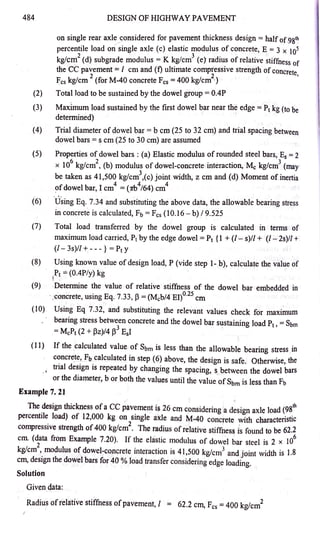
pavement edge assuming linear variation is illustrated in Fig. 7.31.
The maximum distance up to which the dowel group can carry part of load has be~
theoretically calculated to be 1.8 times the radius ofrelative stiflhess, i.e., (1.8 [) as shown
in Fig. 7.31. However subsequent performance studies have shown that due to repeated
load applications and relative movements ofthe dowel bars with respect the adjoining slabs
(during expansion and contraction of CC slab), some loosening take~ place in the dowel
system and hence the effective load transfer is only up to (1.0 [). As per IRC Guidelines
the distance up to the dowel group action is to be considered in the design is 1.0 /.
A
@ ® ®
I ~- •I• ...,. •----t
~150 mm'""'~----- 1-81 ------1►
-I
~1.81- 3 s)
1.8 I
EFFECTIVE DOWELS DUE TO LOAD AT EDGE A
Fig. 7.31 Dowel group action at the edge of CC pavement
8teps for the design of dowel bars as per IRC guidelines
(1) Properties of CC pavement: (a) design thickness of CC pavement = h cm
(b) design wheel load for dowel bar design, P kg = half of design axle load
484
(2)
(3)
(4)
(5)
(6)
(7)
DESIGN OF HIGHWAY PAVEMENT
on single rear axle <;_onsidered for pavement thickness design =half of.9&'h
percentile load on~ingle axle (c) elastic modulus of concrete, E = 3 x 10⁵
kg/cm
2
(d) subgrade modulus = K kg/cm
3
( e)' radius of relative stiffness of
the CC pavement=/ cm and (0 ultimate compressive strength of concrete
2 2 '
I:cs kg/cm (for M-40 concrete Fcs = 400 kg/cm ·)
Total Joad to be sustained by the dowel group= 0.4P
MaXJ.mum load sustained by the first dowel bar near the edge= Pt kg (to be
' '
determined)
Trial diameter of dowel bar= b cm (25 to 32 cm) and trial spacing between
dowel bars = s cm (25 to 30 cm) are assumed
Properties of dowel bars: (a) Elastic modulus of rounded steel bars, Es= 2
6 2 . . Mk/ 3(
x 10 kg/cm , (b) modulus of dowel-concrete mteraction, c g cm may
be taken as 41,500 kg/cm
3
,(c) joint widt.p., z cm and (d) Moment of inertia
4 4 4
of dowel bar, I cm = (7rb /64) cm
' . '
·using Eq. 7.34 and substituting the above data, the allowable bearing stress
in concrete is calculated, Fb = Fcs (10.16- b) / 9.525
Total load transferred by the dowel group is calculated m terms of
maximum load carried, Pt'by the edge dowel= Pt {1 + (/'- s)/l + (/ - 2s)/l +
(/- 3s)/l + - - - } = Pt y
(8) Using known value of design load, P (vide step 1- b), calculate the value of
r~== (0.4P/y) kg
(9) -Determine the value of relative stiffness of the dowel bar embedded in
·;concrete, using Eq. 7.33, p= (Mcb/4 El)0
·
25
cm
'
(10) Using Eq 7.32, and substituting the relevant values check for maximum
bearing stress betw~en concrete and the dowel bar sustaining load Pt, =Sbm
.=McPt (2 + Pz)/4 f3 Esl
(11) If the calculated value of Sbm is less than the allowable bearing stress _
in
concrete, Fb calculated in step (6) above, the design is safe. Otherwise,.the
trial design is repeated by changing the spacing, s between the dowel bars
, 1
or the diameter, b or both the values until the value of Sbm is less than Fb
Example 7. 21
The design thickness of a CC pavement is 26 cm considering a design axle load (981
h
percentile load) of 12,000 Jc:g on single axle and M-40 concrete with characteristic
compressive strength of 400 kg/cm
2
. The radius ofrelative stiff~1ess i:s found to be 62.2
' ' 6
cm. (data from Example 7.20). If the elastic modulus of dowel bar steel is 2 x 10
kg/cm
2
, modulus of dowel-concrete interaction is 41,500 kg/cm3 and joint width is 1.8
cm, design the dowel bars for 40 % load transfer considering edge loading.
Solution
Given data:
Radius ofrelative stiffness ofpavement,/ = 62.2 cm, Fcs =400 kg/cm2
RIGID PAVEMENT DESIGN METHODS
485
Elastic modulus of dowel bar steel, Es = 2 x 1'06 kg/cm2,
modulus ofdowel - concrete interaction, u = 41 500 kg/ J d • • .dth
1
• "'"C , cm an Jomt w1 z = .8 cm
Design load (98t11 percentile axle load) on single axle ~ 12,000 kg
Therefore design wheel load for dowel bar design, p =
6000
kg
Total load to be sustained by dowel g.roup
= 0,4 p =0,4 X 6000
= 2400 kg
Let the maximum load s~stained by the first dowel bar near the edge = P1 kg
Assume diameter of dowel bar b = 3 ocm and sp · b
in the first trial , . acmg etween dowel bars, s =25 cm
Substituting the relevant values,
Moment of inertia of dowel bar, I = (7rb4/64) cm4 =3_
976 cm4
Allowable bearing stress in conc_
rete is calculated using Eq. 7.34
ie., Fb = Fcs (10.16- b)/9,525 = 300.7 kg/cm2
T~tal ~oad transferre~ by the dowel group for the assumed dowel diameter and
spacmg m terms of maximum load carried,
Pt = P1 {l +(/-s)//+(/-2s)//+(/ - 3s)//+---}
= Pt Y = Pt {l + (62.2-25)/62.2 + (62.2-50)/62.2} = 1.794 P1
= 2400
Pt = 2400/1.794 = 1337.8 kg
Relative stiffness of the dowel bar embedded·in concrete, p=(Mcb/4 El)o.25 cm
(substituting the relevant values from above) = 0.25
Check for maximum bearing stress between concrete and the dowel bar sustaining
load Pt(vide Eq. 7.32), Sbm = McPt (2 + Pz)/4 p3
E5I = (substituting the relevant
. 2
values from above)= 273.7 kg/cm .
As the maximum bearing stress between concrete and the dowel bar (273.7 kg/en/)
is less than the allowable bearing strength in concrete (300.7 kg/cm
2
) the dowel bar
design is safe and therefore may be accepted. Rounded dowel bars of diameter 3.0 cm
and spacing 25 cm may. be provided at expansion joints.
(Note: In case it is necessary to reduce some quantity of steel, the trial may be repeated assuming
ahigher spacing of 27 or 30 cm)
7.9.5 Design ofTie Bars at Longitudinal Joints
Objectives oftie bars
Tie bars are used across the longitudinal joints of cement concrete p_avements. Tie
bars are embedded at mid depth during concreting ensure th~ two adJacent sl~bs on
either side of the longitudinal joint to remain firmly to~et~er a~d to_prev~nt opem~g up
oftheJ·o· t S F. 7 17 and 7.32. The ]ongitudinalJomts with tie bars act as lunges
m . ee ig. . Tl . b t
and help to relieve part of warping stresses in CC pavement. 1e tie ars are no
designed to act as load tran~_fer devices.
486 DESIGN OF HIGHWAY PAVEMENT
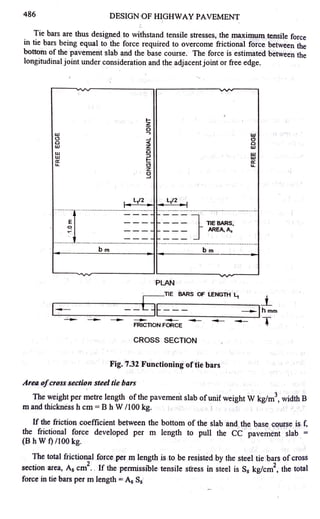
Tie bars are thus designed to withstand tensile stresses, the maximum tensile force
in tie bars being equal to the force required to overcome frictional force between the
bottom of the pavement slab and the base course. The force is estimated between the
longitudinal joint under consideration and the adjacent joint or free edge.
I-
z
0
w -,
w
C) ~ Cl
0 <( 0
w z w
w 0 w
w ::, w
a: I- a:
u. <3 u.
z
0
~
bm bm
~v-
PLAN
~-TIE BARS OF LENGTH ½ _i_
=i--=======[=3,--E----_------ihmm
- - -- - - - -
FRICTION FORCE
CROSS SECTION
Fig. 7.32 Functioning of tie bars
Area ofcross section steel tie bars
- T
The weight per ~etre length ofthe pavement slab ofunit weight W kg/m
3
, width B
m and thickness h cm = B h W /100 kg.
If the friction coefficient between the bottom of the slab and the base course is f,
the frictional force developed per m length to pull the CC pavement slab =
(B h W t) /100 kg.
The total frictional force per m length is to be resisted by the steel tie bars of cross
section area, As cm
2
. . If the permissible tensile stress in steel is S5 kg/cm
2
, the total
force in tie bars per m length =A5 S5
r1terefore,
RIGID PAVEMENT DESIGN METHODS
As Ss = BhWf/100
487
As = BhWf/100S5 (Eq. 7.35)
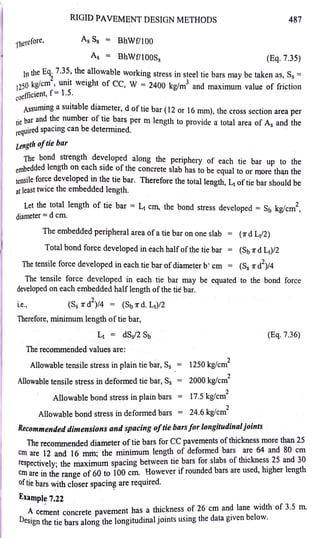
In the Eq. 7.35, the allowable working stress in steel tie bars may be taken as, S5 =
2 · · h 3
1250 kg/cm , umt weig t of CC, W = 2400 kg/m and maximum value of friction
fficient, f = 1.5.
coe
Assuming a suitable diameter, d of tie bar (12 or 16 mm), the cross section area per
•e bar and the number of tie bars per m length to provide a total area of As and the
:~quired spacing can be determined.
Length oftie bar
The bond strength developed along the periphery of each tie bar up to the
embedded length on each side of the concrete slab has to be equal to or more tha.n the
tensile force developed in the tie bar. Therefore the total length, Lt of tie bar should be
at }east twice the embedded length.
Let the total length of tie bar = Lt cm, the bond stress developed = Sb kg/cm2
,
diameter =d cm.
The embeddec:l peripheral area ofa tie bar on one slab = (11' d Lt/2)
Total bond force developed in each halfofthe tie bar = (Sb 11' d Lt)/2
The tensile force developed in each tie bar ofdiameter b'. cm = (Ss 11' d2)/4
The tensile force developed in each tie bar may be equated to the bond force
developed on each embedded halflength of the tie bar.
2
i.e., (Ss 11' d )/4 = (Sb 11' d. Lt)/2
Therefore, minimum length of tie bar,
Lt = dSs/2 Sb
The recommended values are:
Allowable tensile stress in plain tie bar, Ss
Allowable tensile stress in deformed tie bar, Ss
Allowable bond stress in plain bars
Allowable bond stress in deformed bars
2
= 1250 kg/cm
,
= 2000 kg/cm-
2
= 17.5 kg/cm
2
= 24.6 kg/cm
Recommended dimeQsions and spacing oftie bars/or longit11dinaljoints
(Eq. 7.36)
Th . d d d. t r ofti
·e bars for CC pavements ofthickness more than 25
e recommen e 1ame e
cm are 12 and 16 mm; the minimum length of deformed bars ~re 64 and 80 cm
respectivel . the maximum spacing between tie bars for slabs of thicknes~ 25 and 30
. yh, f 60 t 100 cm However if rounded bars are used, higher length
cm are m t e range o o · .
oftie bars '-':'ith closer spacin~ are reqmred.
Example 7.22 .
, h thickness of 26'cm and lane width of 3.5 m.
A cement concrete pavement as a . . . b 1
Design the tie bars along the longitudinal jomts usmg the data given e ow.
488 DESIGN OF HIGHWAY PAVEMENT
Allowable working stress in steel tie bars, Ss - 1250 kg/cm
2
Unit weight ofCC, W - 2400 kg/m
3
Maximum value offriction coefficient, f - 1.2
Allowable tensile stress in deformed tie bar, S5 - 2000 kg/cm
2
.  ~ 2
Allowable bond stress in deformed bars, Sb - 24.6 kg/cm
Solution
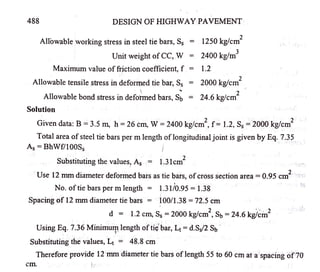
Given data: B = 3.5 m, h = 26 cm, W = 2400 kg/cm
2
, f= 1.2, S5 = 2000 kg/cm
2
Total area ofsteel tie bars perm length of longitudinal joint is given by Eq. 7.35
As= BhWf/I00S5 /
Substituting the values, As · l .3 lcm
2
Use 12 mm diameter deformed bars as tie qars, ofcross section area= 0.95 cm
2
1
I
No. oftie bars perm length = 1.31/0.95 = 1.38
I
Spacing of 12 mm diameter tie bars = 100/1.38 = 72.5 cm
I
2 · - 2
d = 1.2 cm, S5 = 2000 kg/cm , Sb = 24.6 kg/cin
Using Eq. 7.36 Minimurp length of ti~'~ar, Lt = d.Ss/2 Sb , ·
Substituting the values, Lt = 48.8 cm
The~efore provide 12 mm diameter tie bars of length 55 to 60 cm at a spacing of70
cm.

Pavement Design - Rigid Pavement Design.pdf

  • 1.
    Steps for thedesign of CC pavement thickness as per the IRC guidelines The design parameters and design approach mentioned above are to be followed. The wheel load stresses due to dual wheel load assembly of single axle and tandem axles applied near the edge of the pavement are determined using the set of charts given in the IRC Gui<l:elines. Some of these stress charts are given in Fig. 7.21 to 7.29. Suggested steps for the thickness design ofrigid pavement are given below. , (a) The various design parameters such as design axle load (98th percentile load), temperature differential of the locality, K-value of the supporting layers and the relevant properties ofcementconcrete are noted 1 (b) The spacing between the longitudinal joints and transverse contraction joints are decided (c) A trial thiclmess of pavement is ~ssumed keeping in view the magnitude of design axle load and th~ locality where the pavement is to be constructed .. (d) Using the stress chart the edge load stress due to the design axle load and the stress ratio are determined; if the stress ratio is a little lower than 0.44, the trial thickness is tentatively accepted; if not another suitable trial thickness is assumed and the calculations are repeated until the requirement is fulfilled ''"
  • 2.
    478 DESIGN OFHIGHWAY PAVEMENT (e) Number of repetition of different axle. loads _ of ~agni~de hi~~er than the design axle load expected dming the design penod 1s computed/estimated (f) Stres~es due to the different single arid tandem axle_loads of n:agnitudes higher than the design axle load on the pavement of tentatively finalised thickness are determined using the edge load stress charts (g) The stress ratios, the expected number of repetitions of the respective loads during the design life and the cumulative damage due to fatigue- life consumed are tabulated. Fatiaue life consumed or cumulative fatigue damage is total of (C/N) ratios or :EC/N (see Column 7 of Table 7. 7) (h) Ifthe cumulative fatigue damage exceeds 1.0, hig~er tri_ al thickness is assumed and the above exercise of determination of cumulative fatigue ,damage is repeated until this value is slightly less than 1.0 (i) The warping stress Ste at the ·edge of the slab of selected thickness .is determined, consid~ring the highest temperature differ-ential at the locality (j) Let the edge load stress due to the highest magnitude of load Pm expected during the design life be = Sem and the total flexural stress due to warping and the highest load be = (Ste + St:m), If the total stress is less than the flexural strength, the design thickness is aGcepted. If this exceeds the flexural str'ength the trial is repeated by assuming a still higher pavement thickness until this requirement is also fulfilled (k) The final pavement thickness is checked for comer load stress Sc. ({) After designing the pavement thickness requirement, the next requirement is design of (a) dowel bar system at the expansion joints and (b) tie bars along _ the longitudinal joints. The design details of dowel b~rs and tie bars are given in subsequent paragraphs . The loads based on the axle load distribution studies may be multiplied by a safety factor of 1.2, to take care of further possible overloading. '- · Table 7.7 Stress ratios and fatigue analysis ~ Axle load Axle Edge load Stress Expected No. ·Fatigue life stress, Se Fatigue of repetitions type load, t 2 ratio, Se/Sr life, N during desig~ consumed, kg/cm C/N life, C . 0) (2) (3) (4) (5) (6) (7) Single Pi Se1 Se1/Sr N1 C1 C1/N1 P2 Se2 Se2/Sr N2 C2 C2/N2 P3 St3 Se3/Sr N3 C3 C3/N3 -- -- ---- -~ -- ---- Tandem Ps Ses Ses/Sr Ns Cs Cs/Ns -- -- ---- -- ---- -- - Total .tCFN . Example 7.20 From the analysis of axle load distribution studies it is found that the 9g'h
  • 3.
    RIGID PAVEMENT DESIGNMETHODS 479 ercentile load 0 ~ sin~le _axles is 12 _ t and that on tandem axles is 20 t._ The number of P·er loaded v_ e 4hicles e stl rnated dunng the design life of 30 years are (a) on single 0'° · · f 4 ' xtes: 32 x lO repetitions O 14 t load and 8 x 10 repetitions of 16 t load and (b) on :;ndent axles: I 8 x 10⁴ repetitio~ of 24 I load and 3 x 10⁴ repetitions of 28 t load. '[be contact_ p~essure is 7 - 5 kg/cm • The spacing between the longitudinal joints and contractionJomts are 3.5 m and 4.2 m respectively. The maximum tem~era~e differential on concrete pavements of thickness 20, 25 and 30 cm in the location 1s found t? be 1~-6, 17.4 and 18.0 °c. The supporting layer consists of GSB a nd DLC layers with ~timated modulus K value of 30 kg/cm3• The flexural strength ofconcrete is 45 kg/cm . Design the ~ickness of CC pavement as per IRC Guidelines, using the edge load stress charts (Figs. 7.21 to 7.29) and Bardbury's warping stress coefficient chart (Fig. 7.20). Assume other data suitably. Solution Design load on single axle = 12 t Design load on tandem axles = 20 t Assume a trial thickness, h1= 24 cm Edge load stress: From the stress chart (Fig. 7.23}, corresponding to h = 24 and K = 30 kg/cm3, edge load stress dtte to single axle load of12 t, Se= 17 kg/cm2. From stress chart (Fig. 7.27}, corresponding to h = 24 and K = 30 kg/cm3, edge 2 load stress due to total load of20 ton tandem axles, Se= 12 kg/cm Fatigue analysis: . The stress ratio due to design load on single axle= l7/45 = 0.38, less than 0.44 and so the design load is safe under possible fatigue failure. Stress due to load of 14 ton single axle from stress chart (Fig. 7.24) = 18.5 kg/cm2 Stress due to load of 16 ton single axle from stress chart (Fig. 7.25) =21.5 kg/cm2 Stress due to load of24 ton tandem axles from stress chart (Fig. 7.28) =13.0 kg/cm2 Stress due to load of28 ton t~dem axles from stress chart (Fig. 7.29) =15.0 kg/cm2 The fatigue analysis is to be carried out considering t~e magnitude of !oad and number ofrepetitions ofover loaded vehicles exceeding design axle load on smgle and tandem axles. The 11 details are given below in tabular form. Axle Edge load Stress Fatigue Expected no. of Fatigue life load Axle stress, Se repetitions during consumed, tyPe load, t 2 ratio, Se/Sr life, N design life, C CIN - kg/cm _Single 14 18.5 0.41 'Infinite 32 X 10 4 0 ,o 8 X 10 4 0.033 - 16 21.5 0.48 2.4 X lQ Tandem 24 13.0 0.29 Infinite 18 X 10 4 0 - 3 X 10 4 28 15.0 0.33 Infinite 0 -- Total 0.033
  • 4.
    480 DESIGN OF1-llGHWAY PAVEMENT Since total fatigue life consumed or cumulative_ fati~e damag~ due ~o axle loads exceeding design load is only 0.033 or 3.3 % of f~ttgue hfe ~e d_eSlgn t~ckness of24 cm is safe due to repeated application ofloads durmg the design hfe. Warping stress: Temperature differential, t for 24 cm pavement thickness (by interpolation) = 17.24 °c Length ofslab, Lx = 4.2 m = 420 cm, thickness, h = 24 cm, K 3 = 30 kg/cm Assuming E = 3 x 10⁵ kg/cm 2 , Poisson's ratio,µ= 0.15 Radius ofrelative stiffness, I = [ Eh3 ] 114 12K(l-µ2 ) = 58.6 cm (substituting the ~alues) Corresponding to Lx = 420 cm, Lxf/ = 420/58.6 =7.17; from warping stress coefficient chart (Fig. 7.20), Cx =0.98 Corresponding to LJI = 350/58.6 = 5.97, Cy= 0.9 Considering higher ofthe two values, adopt warping stress coefficient of0.98. Therefore maximum warping stress at pavement edge, Ste = Total stress Cx Eet = (0.98 x 3 x 105 x 1 x 10-5 x 17.24)/2 2 2 = 25.34 kg/cm Highest load stress at pavement edge · = 21.5 kg/cm 2 Total (load stress+ warping stress) at edge = 46.84 kg/cm 2 As the total stress exceeds the flexural strength of 45 kg/cm 2 , the design is to be revised, assuming a higher pavement thickness in order to fulfil this criterion. In trial no. 2, assume pavement thickness h = 30 cm Radius ofrelative stiffness, (substituting the values) l = [ Eh 3 ] 114 = 69.27 cm · 12K(l-µ2) Highest edge load stress due to single axle load of 16 t for h == 30 cm (from Fig. 7.25) = 15.3 kg/cm 2 Temperature differential, t for pavement thickness of 30 cm (by interpolation== 18.0 °C Lxf/ = 420/69.27 = 6.06, Cx =0.90 Maximum warping stress at edge = (0.90 x 3 x 105 x 1 x 10-s x 18.0)/2 = 24.3 kg/cm 2 Total (load stress + tarping stress) = 15.3 + 24.3 = 39.6 kg/cm2, less than flexural strength of45 kg/cm , hence safe.
  • 5.
    RIGID PAVEMENT DESIGNMETHODS 481 The factor of safety available for the maximum stress d t th hi h · - 45139 6 - 1 1 ue O e g est load and warping stress - · - • 4, may be accepted Check for comer load stress, Sc = !~[1-(a-;2r2 ] Substituting design load P = 16 / 2 =8.0 t =8,000 kg h =30 / =69 27 3 == J(8000/ 7.5,r) = 18.43 cm ' cm, · cm, Substituting, the values in the equation Sc= 18 4 kg/cm2 and so th d · · " . , • e es1gn 1s sa1e. Adopt design thickness ofCC pavement =30 cm 7.9.4 De~ign ofDowel Bars at Load Transfer Joints Objectiv~s of dowel bars As mentioned in Art. 7.6.3, expansion joints and construction joints are formed as thro~gh joints acr~ss ~~ full depth of the slab. A small gap of about 20 mm is provided at expans10~ JOmts to allow for expansion of long CC pavement slabs during s~er seaso~. This gap or joint width helps to relieve the compressive stresses dunng expansion and also helps to prevent buckling of the slab near the joint Steel dowel bars are embedded at mid depth during construction as specified in the design in order to strengthen these weak locations and to provide desired load transfer to the adjoining slab across the joint. Though it is not considered very essential to provide expansion joints in CC pavements at regular intervals, they should invariably be provided wh~re the pavement is designed to abut structures like b~dges. / Functioning Figure 7.30 (a) illustrates that there is no load transfer across the expansion joint without dowel bars as each slab deflects independently under the axle load. The functioning of an expansion joint with dowel bar is illustrated in Fig. 7.30 (b). When wheel load is placed at the edge ofthe slab adjoining the expansion joint, a part ofthe deflection and load are transferred across to the adjoining slab with the help ofa group ofdowel bars. The load stress diagram in dowel bar is shown in Fig. 7.30 (c). Rounded steel bars ofdiameter 25 to 32 mm and length about 500 mm are placed at intervals of 250 to 300 mm as per the design. About 50 mm less t1ian half lengtli of . the rounded steel dowel bars are embedded during concreting along one slab, so as to develop bond with the concrete. The other halflength ofthe dowel bars (plus 50 mm) are covered with a suitable plastic sheathing to prevent development ofbond between the dowel bars and the concrete of the adjoining slab. This de-bonded half length of the dowel bars can slide into the adjoining slab. The construction details are given in Art. 8.5.5 of Chapter 8, 'Highway Construction'. Stresses in dowel bars The maximum bearing stress developed in the.dowel bar.and the allowable bearing stress in cement concrete are to be considered dunng the design. Maximum bearing stress The bearing stress between concrete and dowel ba~ depends ~inly on diameter of the dowel bar and spacing between them. The maximum beanng stress between the concrete and the dowel bar is given by the equation:
  • 6.
    482 DESIGN OFHIGHWAY PAVEMENT 3 Sbm = Mc Pt (2 + Pz)/4(3- EsI (Eq. 7.32) where, Sbm = maximum bearing stress between concrete and dowel bar, kgfcm 2 Mc = modulus of dowel-concrete interaction or the dowel sµppoit, kg/cm 2 /cm == 41,500 kg/cm 3 P1 = maximum load transferred by a dowel bar or the load transferred by the first dowel bar from the edge, kg b = diameter ofrounqed dowel bar, cm (2.5 to 3.2 cm) z = joint width, cm Es = modulus ofelasticity of the steel dowel, kg/cm 2 = 2 x 10 6 kg/cm 2 _ I = moment of inertia ofthe dowe1bar, cm 4 = 7r b 4 I64 cm 4 p = relative stiffness of the dowel bar embedded in concrete, cm and is given by: . J3 = (Mc b/4 EI)°· 25 cm (Eq. 7.331 roERO I DEFLECTION -------- -DEFLECTION dx1 (a) WITHOUT DOWEL BAR . I (b) WITH LOAD TRANSFER DOWEL BAR (c) LOAD DIAGRAM OF DOWEL BAR Fig. 7.30 Functioning of dowel bar Allowable bearing stress b . . tlt of The eanng stress 1 m concrete depends upon the ultimate compressive streng concrete and the diameter of the dowel bar. The allowable bearing stress in concrete, Fb is determined using the expression given by the American Concrete Institute: - Fb = Fcs (10.16- b)/9.525 (Eq. 7.3 4 )
  • 7.
    RIGID PAVEMENT DESIGNMETHODS 483 where, Fb = allowable bearing stress in concrete, kg/cm 2 Fcs = ultimate compressiv~ strength of concrete, kg/cm 2 (for M-40 concrete, j Fcs =400 kg/cm 2 ) b = diameter of the qowel bar, cm Design principle The diameter of the dowel bar and spacing between them are designed such that a group of dowel bars can transfer 40 % of the design axle load (which was considered for the design of the CC pavement), across the joint to the adjoining slab. The most unportant factors governing the design of a dowel bar are: (a) the maximum bearing stress be~een the concre~e and the dowel bar, Sbm vide Eq. 7.32 and (b) allowable bearing stress in concrete, Fb, vide Eq. 7.34. Usually the first dowel bar is placed at a distance of 15 cm from the pavement edge. The critical loading position for the dowel bar is when the design load is placed directly above the first dowel bar. Let the maximum load carried by ~e first dowel bar when the wheel load is directly above the bar= Pt kg. A few ofdowel bars that are next to the first ' dowel bar will also share the load transfer, but will carry lower magnitudes of load as the distance from the first dowel bar increases. The load transfer py the dowel group near the pavement edge assuming linear variation is illustrated in Fig. 7.31. The maximum distance up to which the dowel group can carry part of load has be~ theoretically calculated to be 1.8 times the radius ofrelative stiflhess, i.e., (1.8 [) as shown in Fig. 7.31. However subsequent performance studies have shown that due to repeated load applications and relative movements ofthe dowel bars with respect the adjoining slabs (during expansion and contraction of CC slab), some loosening take~ place in the dowel system and hence the effective load transfer is only up to (1.0 [). As per IRC Guidelines the distance up to the dowel group action is to be considered in the design is 1.0 /. A @ ® ® I ~- •I• ...,. •----t ~150 mm'""'~----- 1-81 ------1► -I ~1.81- 3 s) 1.8 I EFFECTIVE DOWELS DUE TO LOAD AT EDGE A Fig. 7.31 Dowel group action at the edge of CC pavement 8teps for the design of dowel bars as per IRC guidelines (1) Properties of CC pavement: (a) design thickness of CC pavement = h cm (b) design wheel load for dowel bar design, P kg = half of design axle load
  • 8.
    484 (2) (3) (4) (5) (6) (7) DESIGN OF HIGHWAYPAVEMENT on single rear axle <;_onsidered for pavement thickness design =half of.9&'h percentile load on~ingle axle (c) elastic modulus of concrete, E = 3 x 10⁵ kg/cm 2 (d) subgrade modulus = K kg/cm 3 ( e)' radius of relative stiffness of the CC pavement=/ cm and (0 ultimate compressive strength of concrete 2 2 ' I:cs kg/cm (for M-40 concrete Fcs = 400 kg/cm ·) Total Joad to be sustained by the dowel group= 0.4P MaXJ.mum load sustained by the first dowel bar near the edge= Pt kg (to be ' ' determined) Trial diameter of dowel bar= b cm (25 to 32 cm) and trial spacing between dowel bars = s cm (25 to 30 cm) are assumed Properties of dowel bars: (a) Elastic modulus of rounded steel bars, Es= 2 6 2 . . Mk/ 3( x 10 kg/cm , (b) modulus of dowel-concrete mteraction, c g cm may be taken as 41,500 kg/cm 3 ,(c) joint widt.p., z cm and (d) Moment of inertia 4 4 4 of dowel bar, I cm = (7rb /64) cm ' . ' ·using Eq. 7.34 and substituting the above data, the allowable bearing stress in concrete is calculated, Fb = Fcs (10.16- b) / 9.525 Total load transferred by the dowel group is calculated m terms of maximum load carried, Pt'by the edge dowel= Pt {1 + (/'- s)/l + (/ - 2s)/l + (/- 3s)/l + - - - } = Pt y (8) Using known value of design load, P (vide step 1- b), calculate the value of r~== (0.4P/y) kg (9) -Determine the value of relative stiffness of the dowel bar embedded in ·;concrete, using Eq. 7.33, p= (Mcb/4 El)0 · 25 cm ' (10) Using Eq 7.32, and substituting the relevant values check for maximum bearing stress betw~en concrete and the dowel bar sustaining load Pt, =Sbm .=McPt (2 + Pz)/4 f3 Esl (11) If the calculated value of Sbm is less than the allowable bearing stress _ in concrete, Fb calculated in step (6) above, the design is safe. Otherwise,.the trial design is repeated by changing the spacing, s between the dowel bars , 1 or the diameter, b or both the values until the value of Sbm is less than Fb Example 7. 21 The design thickness of a CC pavement is 26 cm considering a design axle load (981 h percentile load) of 12,000 Jc:g on single axle and M-40 concrete with characteristic compressive strength of 400 kg/cm 2 . The radius ofrelative stiff~1ess i:s found to be 62.2 ' ' 6 cm. (data from Example 7.20). If the elastic modulus of dowel bar steel is 2 x 10 kg/cm 2 , modulus of dowel-concrete interaction is 41,500 kg/cm3 and joint width is 1.8 cm, design the dowel bars for 40 % load transfer considering edge loading. Solution Given data: Radius ofrelative stiffness ofpavement,/ = 62.2 cm, Fcs =400 kg/cm2
  • 9.
    RIGID PAVEMENT DESIGNMETHODS 485 Elastic modulus of dowel bar steel, Es = 2 x 1'06 kg/cm2, modulus ofdowel - concrete interaction, u = 41 500 kg/ J d • • .dth 1 • "'"C , cm an Jomt w1 z = .8 cm Design load (98t11 percentile axle load) on single axle ~ 12,000 kg Therefore design wheel load for dowel bar design, p = 6000 kg Total load to be sustained by dowel g.roup = 0,4 p =0,4 X 6000 = 2400 kg Let the maximum load s~stained by the first dowel bar near the edge = P1 kg Assume diameter of dowel bar b = 3 ocm and sp · b in the first trial , . acmg etween dowel bars, s =25 cm Substituting the relevant values, Moment of inertia of dowel bar, I = (7rb4/64) cm4 =3_ 976 cm4 Allowable bearing stress in conc_ rete is calculated using Eq. 7.34 ie., Fb = Fcs (10.16- b)/9,525 = 300.7 kg/cm2 T~tal ~oad transferre~ by the dowel group for the assumed dowel diameter and spacmg m terms of maximum load carried, Pt = P1 {l +(/-s)//+(/-2s)//+(/ - 3s)//+---} = Pt Y = Pt {l + (62.2-25)/62.2 + (62.2-50)/62.2} = 1.794 P1 = 2400 Pt = 2400/1.794 = 1337.8 kg Relative stiffness of the dowel bar embedded·in concrete, p=(Mcb/4 El)o.25 cm (substituting the relevant values from above) = 0.25 Check for maximum bearing stress between concrete and the dowel bar sustaining load Pt(vide Eq. 7.32), Sbm = McPt (2 + Pz)/4 p3 E5I = (substituting the relevant . 2 values from above)= 273.7 kg/cm . As the maximum bearing stress between concrete and the dowel bar (273.7 kg/en/) is less than the allowable bearing strength in concrete (300.7 kg/cm 2 ) the dowel bar design is safe and therefore may be accepted. Rounded dowel bars of diameter 3.0 cm and spacing 25 cm may. be provided at expansion joints. (Note: In case it is necessary to reduce some quantity of steel, the trial may be repeated assuming ahigher spacing of 27 or 30 cm) 7.9.5 Design ofTie Bars at Longitudinal Joints Objectives oftie bars Tie bars are used across the longitudinal joints of cement concrete p_avements. Tie bars are embedded at mid depth during concreting ensure th~ two adJacent sl~bs on either side of the longitudinal joint to remain firmly to~et~er a~d to_prev~nt opem~g up oftheJ·o· t S F. 7 17 and 7.32. The ]ongitudinalJomts with tie bars act as lunges m . ee ig. . Tl . b t and help to relieve part of warping stresses in CC pavement. 1e tie ars are no designed to act as load tran~_fer devices.
  • 10.
    486 DESIGN OFHIGHWAY PAVEMENT Tie bars are thus designed to withstand tensile stresses, the maximum tensile force in tie bars being equal to the force required to overcome frictional force between the bottom of the pavement slab and the base course. The force is estimated between the longitudinal joint under consideration and the adjacent joint or free edge. I- z 0 w -, w C) ~ Cl 0 <( 0 w z w w 0 w w ::, w a: I- a: u. <3 u. z 0 ~ bm bm ~v- PLAN ~-TIE BARS OF LENGTH ½ _i_ =i--=======[=3,--E----_------ihmm - - -- - - - - FRICTION FORCE CROSS SECTION Fig. 7.32 Functioning of tie bars Area ofcross section steel tie bars - T The weight per ~etre length ofthe pavement slab ofunit weight W kg/m 3 , width B m and thickness h cm = B h W /100 kg. If the friction coefficient between the bottom of the slab and the base course is f, the frictional force developed per m length to pull the CC pavement slab = (B h W t) /100 kg. The total frictional force per m length is to be resisted by the steel tie bars of cross section area, As cm 2 . . If the permissible tensile stress in steel is S5 kg/cm 2 , the total force in tie bars per m length =A5 S5
  • 11.
    r1terefore, RIGID PAVEMENT DESIGNMETHODS As Ss = BhWf/100 487 As = BhWf/100S5 (Eq. 7.35) In the Eq. 7.35, the allowable working stress in steel tie bars may be taken as, S5 = 2 · · h 3 1250 kg/cm , umt weig t of CC, W = 2400 kg/m and maximum value of friction fficient, f = 1.5. coe Assuming a suitable diameter, d of tie bar (12 or 16 mm), the cross section area per •e bar and the number of tie bars per m length to provide a total area of As and the :~quired spacing can be determined. Length oftie bar The bond strength developed along the periphery of each tie bar up to the embedded length on each side of the concrete slab has to be equal to or more tha.n the tensile force developed in the tie bar. Therefore the total length, Lt of tie bar should be at }east twice the embedded length. Let the total length of tie bar = Lt cm, the bond stress developed = Sb kg/cm2 , diameter =d cm. The embeddec:l peripheral area ofa tie bar on one slab = (11' d Lt/2) Total bond force developed in each halfofthe tie bar = (Sb 11' d Lt)/2 The tensile force developed in each tie bar ofdiameter b'. cm = (Ss 11' d2)/4 The tensile force developed in each tie bar may be equated to the bond force developed on each embedded halflength of the tie bar. 2 i.e., (Ss 11' d )/4 = (Sb 11' d. Lt)/2 Therefore, minimum length of tie bar, Lt = dSs/2 Sb The recommended values are: Allowable tensile stress in plain tie bar, Ss Allowable tensile stress in deformed tie bar, Ss Allowable bond stress in plain bars Allowable bond stress in deformed bars 2 = 1250 kg/cm , = 2000 kg/cm- 2 = 17.5 kg/cm 2 = 24.6 kg/cm Recommended dimeQsions and spacing oftie bars/or longit11dinaljoints (Eq. 7.36) Th . d d d. t r ofti ·e bars for CC pavements ofthickness more than 25 e recommen e 1ame e cm are 12 and 16 mm; the minimum length of deformed bars ~re 64 and 80 cm respectivel . the maximum spacing between tie bars for slabs of thicknes~ 25 and 30 . yh, f 60 t 100 cm However if rounded bars are used, higher length cm are m t e range o o · . oftie bars '-':'ith closer spacin~ are reqmred. Example 7.22 . , h thickness of 26'cm and lane width of 3.5 m. A cement concrete pavement as a . . . b 1 Design the tie bars along the longitudinal jomts usmg the data given e ow.
  • 12.
    488 DESIGN OFHIGHWAY PAVEMENT Allowable working stress in steel tie bars, Ss - 1250 kg/cm 2 Unit weight ofCC, W - 2400 kg/m 3 Maximum value offriction coefficient, f - 1.2 Allowable tensile stress in deformed tie bar, S5 - 2000 kg/cm 2 . ~ 2 Allowable bond stress in deformed bars, Sb - 24.6 kg/cm Solution Given data: B = 3.5 m, h = 26 cm, W = 2400 kg/cm 2 , f= 1.2, S5 = 2000 kg/cm 2 Total area ofsteel tie bars perm length of longitudinal joint is given by Eq. 7.35 As= BhWf/I00S5 / Substituting the values, As · l .3 lcm 2 Use 12 mm diameter deformed bars as tie qars, ofcross section area= 0.95 cm 2 1 I No. oftie bars perm length = 1.31/0.95 = 1.38 I Spacing of 12 mm diameter tie bars = 100/1.38 = 72.5 cm I 2 · - 2 d = 1.2 cm, S5 = 2000 kg/cm , Sb = 24.6 kg/cin Using Eq. 7.36 Minimurp length of ti~'~ar, Lt = d.Ss/2 Sb , · Substituting the values, Lt = 48.8 cm The~efore provide 12 mm diameter tie bars of length 55 to 60 cm at a spacing of70 cm.