UNDERSTANDING PARAGRAPH
AND PATTERNS OF ORGANIZATION
Critical Reading
Group 2 Class 3C English Department
 Riska Lestari
 Eko Kresna Bayu
 May Sulistyaningsih
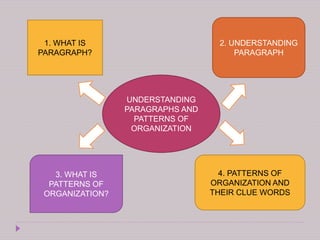
UNDERSTANDING
PARAGRAPHS AND
PATTERNS OF
ORGANIZATION
1. WHAT IS
PARAGRAPH?
2. UNDERSTANDING
PARAGRAPH
3. WHAT IS
PATTERNS OF
ORGANIZATION?
4. PATTERNS OF
ORGANIZATION AND
THEIR CLUE WORDS
1. What is Paragraph?
 A paragraph is made up of sentences grouped
together for a reason—usually to present and
support a single main idea.
 Paragraphs are used in much the same way—to
divide an essay or article into blocks of separate
thoughts or to divide a story into a series of events.
2. Understanding Paragraph
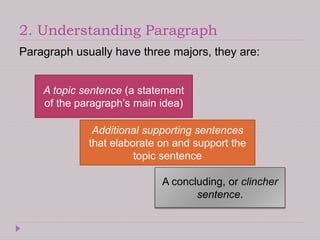
Paragraph usually have three majors, they are:
A topic sentence (a statement
of the paragraph’s main idea)
Additional supporting sentences
that elaborate on and support the
topic sentence
A concluding, or clincher
sentence.
 Topic Sentence; usually located at the beginning of
paragraph. It helps reader to know what to expect in
the rest of paragraph.
 Supporting Sentences; these sentences elaborate
the topic sentence to make it clear and detail. Also
give specific details or information to support the
topic sentences of the paragraph.
 The clincher sentence; it pulls all the details
together and signals that the end of the paragraph
has come.
3. What is Patterns of Organization?
 Patterns of organization is how is information is
organized in writing.
 It is important to identify with the author's perspective
by discovering the way the message is being sent.
 Every writer has a purpose for writing and some plan
of action for getting a message across. This plan of
action is the order in which the material will be
presented in the text.
4. Patterns of Organization and Their Clue
Words
 Every writer has a purpose for writing and some plan
of action for getting a message across. This plan of
action is the order in which the material will be
presented in the text.
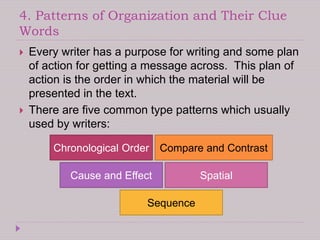
 There are five common type patterns which usually
used by writers:
Chronological Order Compare and Contrast
Cause and Effect Spatial
Sequence
a. Chronological Order
 When information in a passage is organized by the
time in which each event occurred, it is organized
chronologically.
 A chronological pattern of organization arranges
information according to a progression of time, either
forward or backward.
 The clue words are: first, before, after, when,
later, at last, etc.
Example of Chronological Order
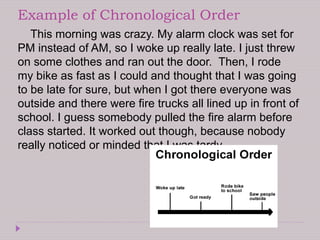
This morning was crazy. My alarm clock was set for
PM instead of AM, so I woke up really late. I just threw
on some clothes and ran out the door. Then, I rode
my bike as fast as I could and thought that I was going
to be late for sure, but when I got there everyone was
outside and there were fire trucks all lined up in front of
school. I guess somebody pulled the fire alarm before
class started. It worked out though, because nobody
really noticed or minded that I was tardy.
b. Compare and Contrast
 Compare and Contrast is a text structure or pattern
of organization where the similarities and differences
of two or more things are explored.
 It is important to remember that with the compare
and contrast text structure the text should be
discussing similarities and differences. The text must
do both to be considered compare and contrast.
 The clue words are: similiar, different, on the
other hand, but, however, in the same way, like,
unlike, etc.
Example of Compare and Contrast
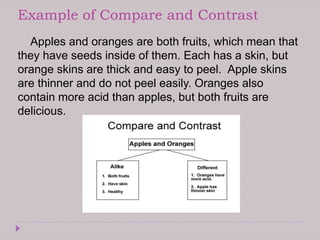
Apples and oranges are both fruits, which mean that
they have seeds inside of them. Each has a skin, but
orange skins are thick and easy to peel. Apple skins
are thinner and do not peel easily. Oranges also
contain more acid than apples, but both fruits are
delicious.
c. Cause and Effect
 This pattern is used to show the different causes and
effects of various conditions.
 Paragraphs structured as cause and effect explains
reasons why something happened or the effects of
something.
 The clue words are: for this reason,
consequently, because, on that account, as a
result, therefore, however.
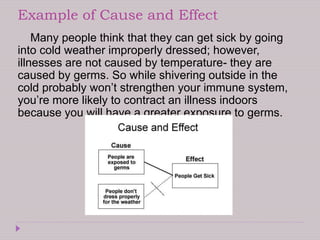
Example of Cause and Effect
Many people think that they can get sick by going
into cold weather improperly dressed; however,
illnesses are not caused by temperature- they are
caused by germs. So while shivering outside in the
cold probably won’t strengthen your immune system,
you’re more likely to contract an illness indoors
because you will have a greater exposure to germs.
d. Spatial
 Spatial organization is when information in a
passage is organized in order of space or location.
 A spatial pattern of organization arranges information
according to how things fit together in physical
space.
 If we were to describe the room in which we were
sitting right now, we would be using spatial
organization.
 The clue words are: next to, behind, accross
from, below that, above that, the right of, etc.
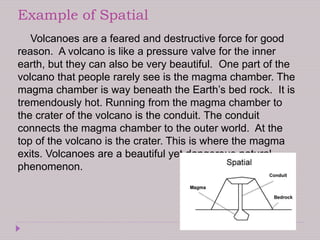
Example of Spatial
Volcanoes are a feared and destructive force for good
reason. A volcano is like a pressure valve for the inner
earth, but they can also be very beautiful. One part of the
volcano that people rarely see is the magma chamber. The
magma chamber is way beneath the Earth’s bed rock. It is
tremendously hot. Running from the magma chamber to
the crater of the volcano is the conduit. The conduit
connects the magma chamber to the outer world. At the
top of the volcano is the crater. This is where the magma
exits. Volcanoes are a beautiful yet dangerous natural
phenomenon.
e. Sequence
 Sequential order, or process writing as it is
sometimes called, is when information in a passage
is organized by the order in which it occurs.
 Sequential organization is frequently confused with
chronological order.
 Text organized chronologically occur at a specific
time and setting, whereas texts describing processes
or sequences do not occur at any specific time and
place.
 The clue words are: first, next, before, lastly,
then, etc.
Example of Sequence
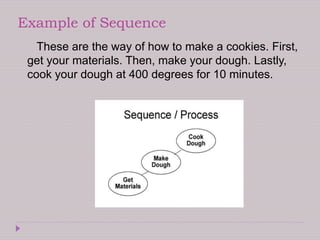
These are the way of how to make a cookies. First,
get your materials. Then, make your dough. Lastly,
cook your dough at 400 degrees for 10 minutes.
Analyze the
paragraphs and
decide the right
patterns for each
paragraph!
Number 1
As you might already know, there is no direct
intermixing of blood between a mother and her
unborn child. However, some substances—
especially drugs—can still have a powerful effect
on the fetus. If, for example, the mother is
addicted to morphine, heroin, or methadone, the
baby may be born with the same addiction. For
that matter, even high doses of aspirin appear to
have some effect on the fetus. In at least one
study, high doses of aspirin have been linked to
lower IQs in infants.
The pattern is.......
The pattern is cause and effect
The paragraph describes how taking of drugs by a
pregnant woman may negatively affect the well-
being of her baby.
Number 2
In a study of happiness, researcher Jonathan
freedman asked a hundred people to give their
definitions of happiness. The results of Freedman’s
study suggest that people really do differ in how they
define happiness. About half of Freedman’s subjects
spoke of happiness in terms of excitement and good
times. To them, happiness was a life full of fun. The
other half, however, thought of happiness in terms of
contentment, satisfaction, or freedom from worries. For
these people, happiness was peace of mind. Yet while
some stressed pleasurable activity and others stressed
quiet contentment, the difference was really a matter of
emphasis. Almost everyone agreed that both good
times and peace of mind are central to being happy.
The pattern is.......
The pattern is compare and contrast
As the topic sentence (sentence 2) states, the
paragraph contrasts two different definitions of
happiness people gave in a study.
Number 3
After opening the door to the pantry, which
measures five feet by five feet, there are five shelves
spaced evenly apart, one above the other. On the
lowest shelf, heavier items have been placed. The
sugar is to the left, and the flour is situated to the right
of it. On the next shelf up there are many canned
goods which cover that entire shelf. On the next shelf
above that, many different varieties of bottled water
and juices are present. The next shelf up contains
assorted types of dried pasta which are stacked in
rows next to each other. On the shelf above the pasta
are jars of pasta sauce pushed to the left of the shelf.
On that same shelf are foods like muffins and other
treats. There are also some larger bottles of water
sitting on the floor under the lowest shelf.The pattern is.......
The pattern is spatial
The paragraph describes the view of pantry clearly,
and also we can find the spatial clue words.
Are those clear? Do you have a question?
No? Thank you ^^

patterns of organization

  • 1.
    UNDERSTANDING PARAGRAPH AND PATTERNSOF ORGANIZATION Critical Reading
  • 2.
    Group 2 Class3C English Department  Riska Lestari  Eko Kresna Bayu  May Sulistyaningsih
  • 3.
    UNDERSTANDING PARAGRAPHS AND PATTERNS OF ORGANIZATION 1.WHAT IS PARAGRAPH? 2. UNDERSTANDING PARAGRAPH 3. WHAT IS PATTERNS OF ORGANIZATION? 4. PATTERNS OF ORGANIZATION AND THEIR CLUE WORDS
  • 4.
    1. What isParagraph?  A paragraph is made up of sentences grouped together for a reason—usually to present and support a single main idea.  Paragraphs are used in much the same way—to divide an essay or article into blocks of separate thoughts or to divide a story into a series of events.
  • 5.
    2. Understanding Paragraph Paragraphusually have three majors, they are: A topic sentence (a statement of the paragraph’s main idea) Additional supporting sentences that elaborate on and support the topic sentence A concluding, or clincher sentence.
  • 6.
     Topic Sentence;usually located at the beginning of paragraph. It helps reader to know what to expect in the rest of paragraph.  Supporting Sentences; these sentences elaborate the topic sentence to make it clear and detail. Also give specific details or information to support the topic sentences of the paragraph.  The clincher sentence; it pulls all the details together and signals that the end of the paragraph has come.
  • 7.
    3. What isPatterns of Organization?  Patterns of organization is how is information is organized in writing.  It is important to identify with the author's perspective by discovering the way the message is being sent.  Every writer has a purpose for writing and some plan of action for getting a message across. This plan of action is the order in which the material will be presented in the text.
  • 8.
    4. Patterns ofOrganization and Their Clue Words  Every writer has a purpose for writing and some plan of action for getting a message across. This plan of action is the order in which the material will be presented in the text.  There are five common type patterns which usually used by writers: Chronological Order Compare and Contrast Cause and Effect Spatial Sequence
  • 9.
    a. Chronological Order When information in a passage is organized by the time in which each event occurred, it is organized chronologically.  A chronological pattern of organization arranges information according to a progression of time, either forward or backward.  The clue words are: first, before, after, when, later, at last, etc.
  • 10.
    Example of ChronologicalOrder This morning was crazy. My alarm clock was set for PM instead of AM, so I woke up really late. I just threw on some clothes and ran out the door. Then, I rode my bike as fast as I could and thought that I was going to be late for sure, but when I got there everyone was outside and there were fire trucks all lined up in front of school. I guess somebody pulled the fire alarm before class started. It worked out though, because nobody really noticed or minded that I was tardy.
  • 11.
    b. Compare andContrast  Compare and Contrast is a text structure or pattern of organization where the similarities and differences of two or more things are explored.  It is important to remember that with the compare and contrast text structure the text should be discussing similarities and differences. The text must do both to be considered compare and contrast.  The clue words are: similiar, different, on the other hand, but, however, in the same way, like, unlike, etc.
  • 12.
    Example of Compareand Contrast Apples and oranges are both fruits, which mean that they have seeds inside of them. Each has a skin, but orange skins are thick and easy to peel. Apple skins are thinner and do not peel easily. Oranges also contain more acid than apples, but both fruits are delicious.
  • 13.
    c. Cause andEffect  This pattern is used to show the different causes and effects of various conditions.  Paragraphs structured as cause and effect explains reasons why something happened or the effects of something.  The clue words are: for this reason, consequently, because, on that account, as a result, therefore, however.
  • 14.
    Example of Causeand Effect Many people think that they can get sick by going into cold weather improperly dressed; however, illnesses are not caused by temperature- they are caused by germs. So while shivering outside in the cold probably won’t strengthen your immune system, you’re more likely to contract an illness indoors because you will have a greater exposure to germs.
  • 15.
    d. Spatial  Spatialorganization is when information in a passage is organized in order of space or location.  A spatial pattern of organization arranges information according to how things fit together in physical space.  If we were to describe the room in which we were sitting right now, we would be using spatial organization.  The clue words are: next to, behind, accross from, below that, above that, the right of, etc.
  • 16.
    Example of Spatial Volcanoesare a feared and destructive force for good reason. A volcano is like a pressure valve for the inner earth, but they can also be very beautiful. One part of the volcano that people rarely see is the magma chamber. The magma chamber is way beneath the Earth’s bed rock. It is tremendously hot. Running from the magma chamber to the crater of the volcano is the conduit. The conduit connects the magma chamber to the outer world. At the top of the volcano is the crater. This is where the magma exits. Volcanoes are a beautiful yet dangerous natural phenomenon.
  • 17.
    e. Sequence  Sequentialorder, or process writing as it is sometimes called, is when information in a passage is organized by the order in which it occurs.  Sequential organization is frequently confused with chronological order.  Text organized chronologically occur at a specific time and setting, whereas texts describing processes or sequences do not occur at any specific time and place.  The clue words are: first, next, before, lastly, then, etc.
  • 18.
    Example of Sequence Theseare the way of how to make a cookies. First, get your materials. Then, make your dough. Lastly, cook your dough at 400 degrees for 10 minutes.
  • 19.
    Analyze the paragraphs and decidethe right patterns for each paragraph!
  • 20.
    Number 1 As youmight already know, there is no direct intermixing of blood between a mother and her unborn child. However, some substances— especially drugs—can still have a powerful effect on the fetus. If, for example, the mother is addicted to morphine, heroin, or methadone, the baby may be born with the same addiction. For that matter, even high doses of aspirin appear to have some effect on the fetus. In at least one study, high doses of aspirin have been linked to lower IQs in infants. The pattern is.......
  • 21.
    The pattern iscause and effect The paragraph describes how taking of drugs by a pregnant woman may negatively affect the well- being of her baby.
  • 22.
    Number 2 In astudy of happiness, researcher Jonathan freedman asked a hundred people to give their definitions of happiness. The results of Freedman’s study suggest that people really do differ in how they define happiness. About half of Freedman’s subjects spoke of happiness in terms of excitement and good times. To them, happiness was a life full of fun. The other half, however, thought of happiness in terms of contentment, satisfaction, or freedom from worries. For these people, happiness was peace of mind. Yet while some stressed pleasurable activity and others stressed quiet contentment, the difference was really a matter of emphasis. Almost everyone agreed that both good times and peace of mind are central to being happy. The pattern is.......
  • 23.
    The pattern iscompare and contrast As the topic sentence (sentence 2) states, the paragraph contrasts two different definitions of happiness people gave in a study.
  • 24.
    Number 3 After openingthe door to the pantry, which measures five feet by five feet, there are five shelves spaced evenly apart, one above the other. On the lowest shelf, heavier items have been placed. The sugar is to the left, and the flour is situated to the right of it. On the next shelf up there are many canned goods which cover that entire shelf. On the next shelf above that, many different varieties of bottled water and juices are present. The next shelf up contains assorted types of dried pasta which are stacked in rows next to each other. On the shelf above the pasta are jars of pasta sauce pushed to the left of the shelf. On that same shelf are foods like muffins and other treats. There are also some larger bottles of water sitting on the floor under the lowest shelf.The pattern is.......
  • 25.
    The pattern isspatial The paragraph describes the view of pantry clearly, and also we can find the spatial clue words.
  • 26.
    Are those clear?Do you have a question? No? Thank you ^^