EXPOSITORY TEXT
ORGANIZATIONAL PATTERNS
NONFICTION WRITING
Organizational Patterns
• Used to present information in a
clear and logical way
• Develops the main idea
• We will learn about the 5 most
common Organizational Patterns
• Explain reasons why something happened and
the effects of something.
• THE CAUSES MAKE THE EFFECTS HAPPEN.
• USE A MULTI-FLOW MAP.
• CAN START WITH EITHER THE CAUSES OR
EFFECTS-DOESN’T MATTER.
• Transitional Words= because, as a result,
resulted, caused, affected, since, due to, effect.
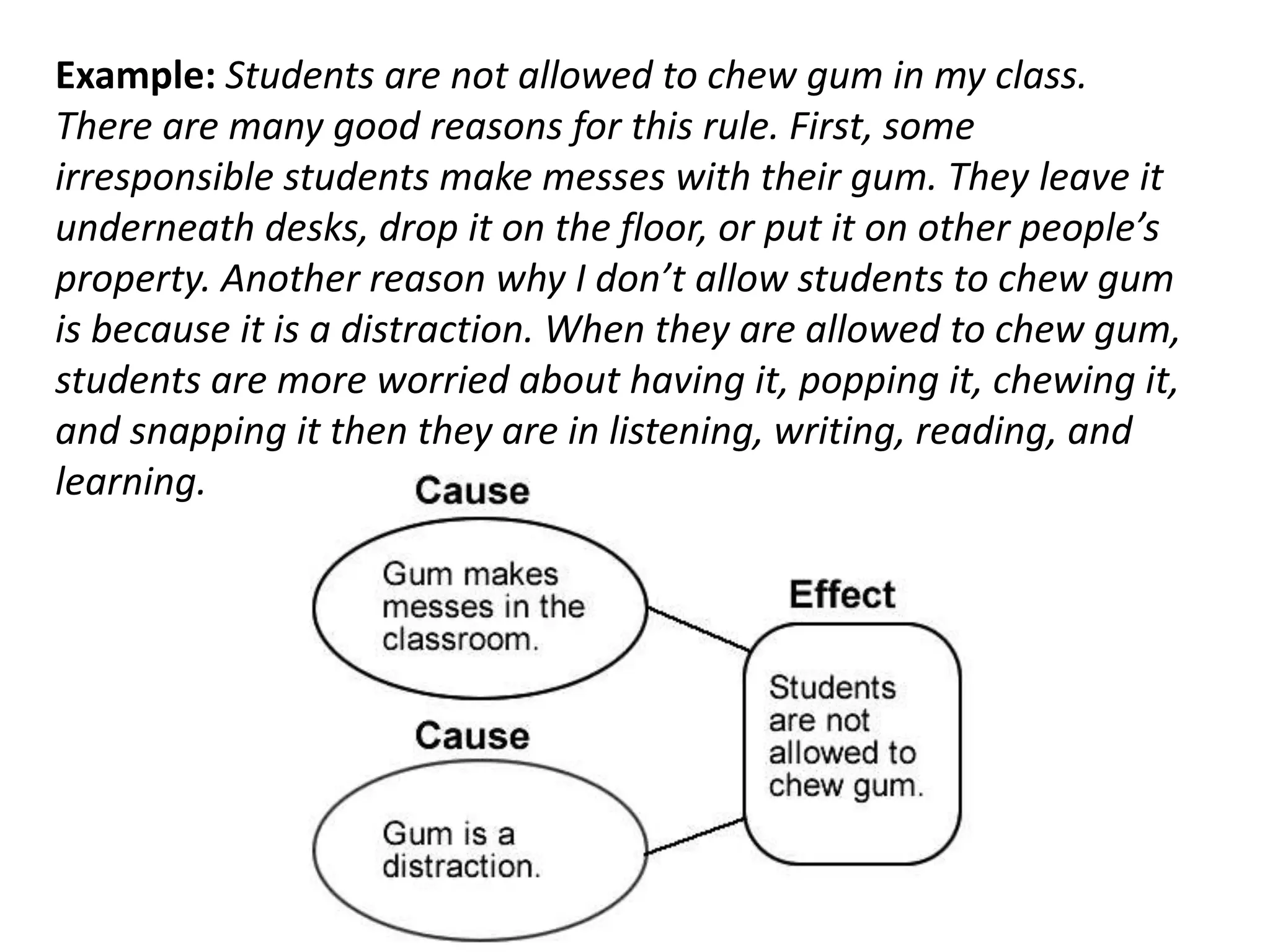
Example: Students are not allowed to chew gum in my class.
There are many good reasons for this rule. First, some
irresponsible students make messes with their gum. They leave it
underneath desks, drop it on the floor, or put it on other people’s
property. Another reason why I don’t allow students to chew gum
is because it is a distraction. When they are allowed to chew gum,
students are more worried about having it, popping it, chewing it,
and snapping it then they are in listening, writing, reading, and
learning.
Turn & Talk
• Partner 1: What is the most important thing
to remember about the Cause & Effect
organizational pattern?
• Partner 2: Give a cause & effect example.
– (Effect=I got sick Cause=I didn’t wash my hands.)
• Used to find BOTH the similarities &
differences
• Use a double bubble map.
• signal words : like, unlike, both,
neither, similar, and different.
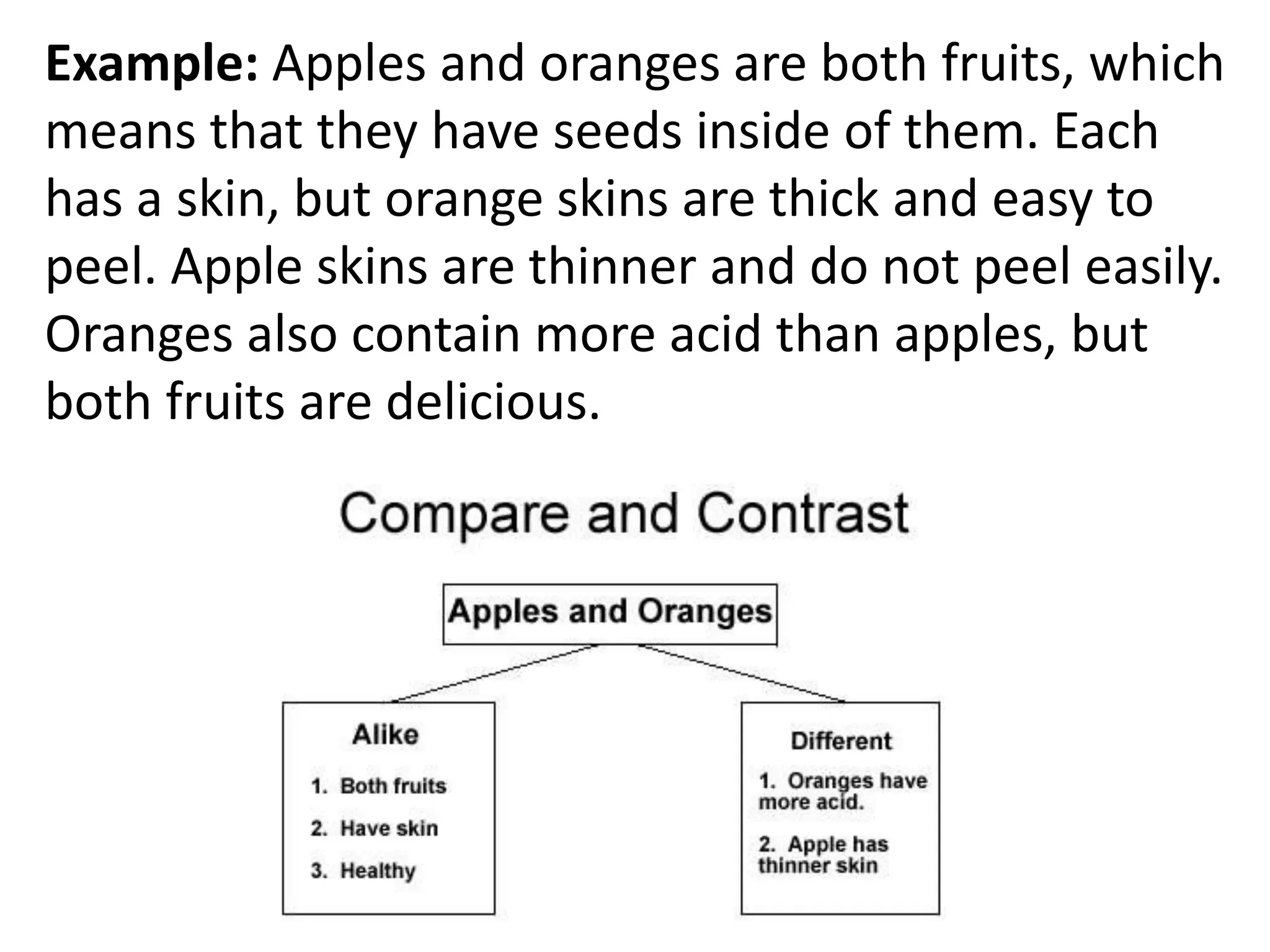
Example: Apples and oranges are both fruits, which
means that they have seeds inside of them. Each
has a skin, but orange skins are thick and easy to
peel. Apple skins are thinner and do not peel easily.
Oranges also contain more acid than apples, but
both fruits are delicious.
Turn & Talk
• Partner 2: Summarize what you learned
about the compare & contrast organizational
pattern.
• Partner 1: Add something that your partner
forgot.
PROBLEM & SOLUTION
• A concerning issue is presented &
discussion on what could/should be done
to fix it.
• Is frequently confused with cause and effect, but
look specifically for both a problem and a solution
to the problem.
• Often Answers the question, “Why”.
• Transitional/Signal Words : propose, solution,
answer, issue, problem, problematic, remedy,
prevention, and fix.
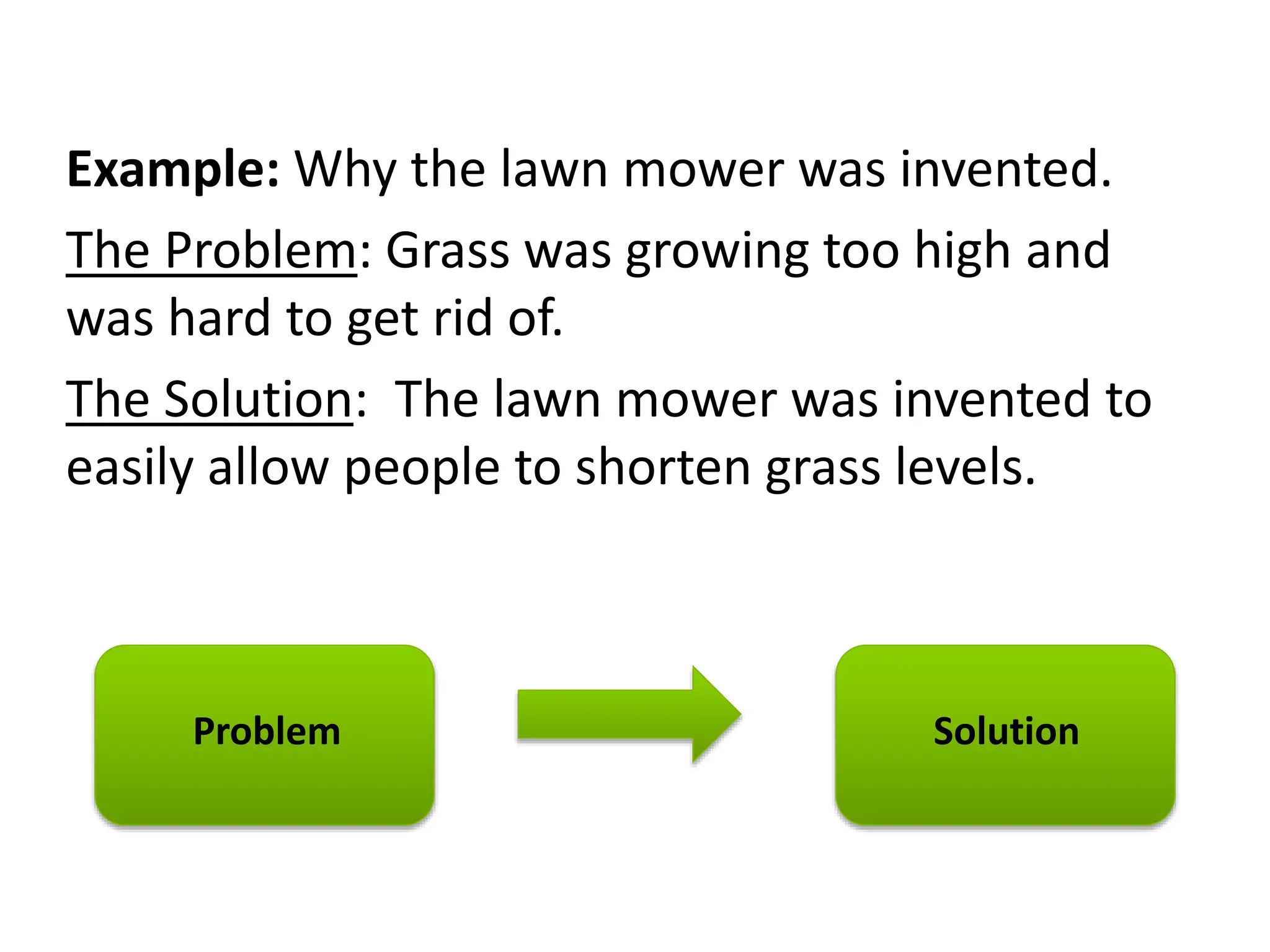
Example: Why the lawn mower was invented.
The Problem: Grass was growing too high and
was hard to get rid of.
The Solution: The lawn mower was invented to
easily allow people to shorten grass levels.
Problem Solution
Turn & Talk
• Partner 1: What types of problems might be
presented in news articles?
• Partner 2: What solutions might be suggested
to some of the problems your partner
mentioned?
Process/Sequential/Chronological
• Organized in the order that it happens.
• Instructions, Directions, to Explain a Process,
or recounted events
– (process of electing a president)
• Chronological order has a TIME component. (date, years,
5pm)
• Process/Sequence concerned with order only. (Can complete
the steps any time, but must be in a certain sequence)
• Use the Flow Map to show the steps in order.
• Transitional Words: First, next, before, lastly, then
• Example: How to Make Cookies. First, get your
materials. Then, make your dough. Lastly,
cook your dough at 400 degrees for 10
minutes.
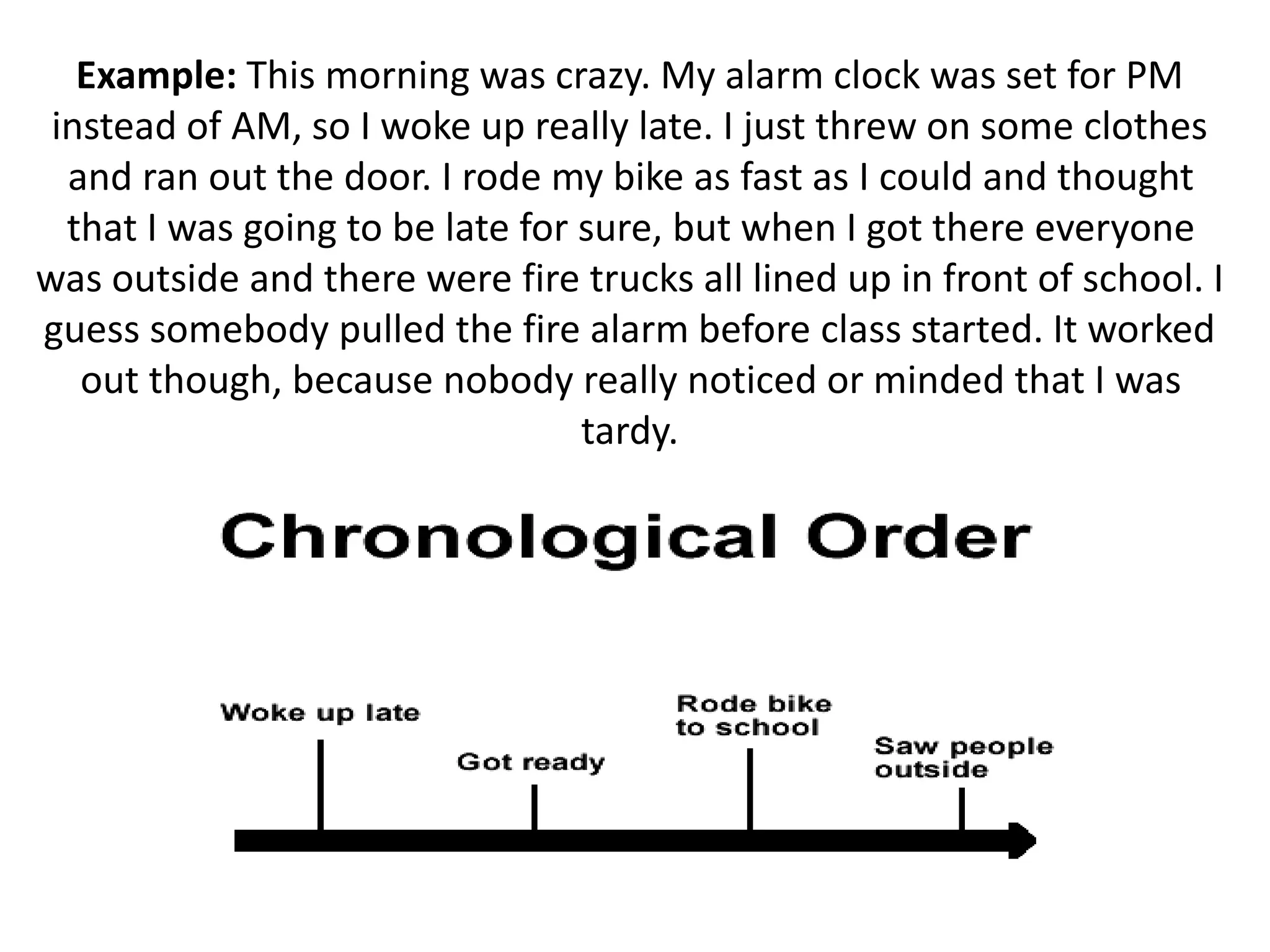
Example: This morning was crazy. My alarm clock was set for PM
instead of AM, so I woke up really late. I just threw on some clothes
and ran out the door. I rode my bike as fast as I could and thought
that I was going to be late for sure, but when I got there everyone
was outside and there were fire trucks all lined up in front of school. I
guess somebody pulled the fire alarm before class started. It worked
out though, because nobody really noticed or minded that I was
tardy.
Turn & Talk
• Partner 2: What is the difference between
Sequential & Chronological Order?
• Partner 1: Give an example of something that
has to be completed in a certain order.
• Presents a topic and provides details
about it.
• Use either a bubble map or circle map
(Or Both)
• Examples: Books about Bats, Planets, Global
Warming, Bullying, Magic Johnson, etc.
Turn & Talk
• Partner 2: Which thinking map would you
prefer to use if you were taking notes over a
descriptive text? Why?
• Partner 1: Discuss some topics that you might
find in a descriptive text.
Check your notes while watching to see
if you missed any important details.
• https://www.youtube.com/watch?v=50GwjM
XhSjU

Expository Text ppt 2017.pptx

  • 1.
  • 2.
    Organizational Patterns • Usedto present information in a clear and logical way • Develops the main idea • We will learn about the 5 most common Organizational Patterns
  • 3.
    • Explain reasonswhy something happened and the effects of something. • THE CAUSES MAKE THE EFFECTS HAPPEN. • USE A MULTI-FLOW MAP. • CAN START WITH EITHER THE CAUSES OR EFFECTS-DOESN’T MATTER. • Transitional Words= because, as a result, resulted, caused, affected, since, due to, effect.
  • 4.
    Example: Students arenot allowed to chew gum in my class. There are many good reasons for this rule. First, some irresponsible students make messes with their gum. They leave it underneath desks, drop it on the floor, or put it on other people’s property. Another reason why I don’t allow students to chew gum is because it is a distraction. When they are allowed to chew gum, students are more worried about having it, popping it, chewing it, and snapping it then they are in listening, writing, reading, and learning.
  • 5.
    Turn & Talk •Partner 1: What is the most important thing to remember about the Cause & Effect organizational pattern? • Partner 2: Give a cause & effect example. – (Effect=I got sick Cause=I didn’t wash my hands.)
  • 6.
    • Used tofind BOTH the similarities & differences • Use a double bubble map. • signal words : like, unlike, both, neither, similar, and different.
  • 7.
    Example: Apples andoranges are both fruits, which means that they have seeds inside of them. Each has a skin, but orange skins are thick and easy to peel. Apple skins are thinner and do not peel easily. Oranges also contain more acid than apples, but both fruits are delicious.
  • 8.
    Turn & Talk •Partner 2: Summarize what you learned about the compare & contrast organizational pattern. • Partner 1: Add something that your partner forgot.
  • 9.
    PROBLEM & SOLUTION •A concerning issue is presented & discussion on what could/should be done to fix it. • Is frequently confused with cause and effect, but look specifically for both a problem and a solution to the problem. • Often Answers the question, “Why”. • Transitional/Signal Words : propose, solution, answer, issue, problem, problematic, remedy, prevention, and fix.
  • 10.
    Example: Why thelawn mower was invented. The Problem: Grass was growing too high and was hard to get rid of. The Solution: The lawn mower was invented to easily allow people to shorten grass levels. Problem Solution
  • 11.
    Turn & Talk •Partner 1: What types of problems might be presented in news articles? • Partner 2: What solutions might be suggested to some of the problems your partner mentioned?
  • 12.
    Process/Sequential/Chronological • Organized inthe order that it happens. • Instructions, Directions, to Explain a Process, or recounted events – (process of electing a president) • Chronological order has a TIME component. (date, years, 5pm) • Process/Sequence concerned with order only. (Can complete the steps any time, but must be in a certain sequence) • Use the Flow Map to show the steps in order. • Transitional Words: First, next, before, lastly, then
  • 13.
    • Example: Howto Make Cookies. First, get your materials. Then, make your dough. Lastly, cook your dough at 400 degrees for 10 minutes.
  • 14.
    Example: This morningwas crazy. My alarm clock was set for PM instead of AM, so I woke up really late. I just threw on some clothes and ran out the door. I rode my bike as fast as I could and thought that I was going to be late for sure, but when I got there everyone was outside and there were fire trucks all lined up in front of school. I guess somebody pulled the fire alarm before class started. It worked out though, because nobody really noticed or minded that I was tardy.
  • 15.
    Turn & Talk •Partner 2: What is the difference between Sequential & Chronological Order? • Partner 1: Give an example of something that has to be completed in a certain order.
  • 16.
    • Presents atopic and provides details about it. • Use either a bubble map or circle map (Or Both) • Examples: Books about Bats, Planets, Global Warming, Bullying, Magic Johnson, etc.
  • 17.
    Turn & Talk •Partner 2: Which thinking map would you prefer to use if you were taking notes over a descriptive text? Why? • Partner 1: Discuss some topics that you might find in a descriptive text.
  • 18.
    Check your noteswhile watching to see if you missed any important details. • https://www.youtube.com/watch?v=50GwjM XhSjU