INFORMATIVE TEXT
WHAT IS AN INFORMATIVE WRITING?
•Informative/Explanatory writing
explains something or gives facts.
•It gives information, explains how to do
something, or tells readers about real
people, places, things, and events
EXAMPLE:
Pope Francis teaches his people
by example. He is an epitome of
humanity and fairness. He was
the 1st Non-European Pope of
the Catholic church.
EXAMPLE:
Owls are known as the bird
of prey. They are nocturnal,
which means they sleep
during the day and hunt at
night.
EXAMPLE:
Tyrannosaurus Rex (also known
as T-Rex) was one of the largest
dinosaurs that ever walked the
earth. It lived around 66 million
years ago in an area now known
as North America.
YOU CAN FIND INFORMATIVE WRITING IN
MANY DIFFERENT PLACES:
• Non-fiction books
• Textbooks
• Newspapers
• Encyclopedias
• Magazines
• Websites
INFORMATIVE WRITING TRAITS
IDEAS
• A clear, focused topic
• Supporting details that are complete and accurate
ORGANIZATION
• A strong introduction, body, and conclusion
• Transition words that connect ideas
VOICE
• A voice that is appropriate for the purpose and audience
WORD CHOICE
• Topic-related words that are used effectively
• Definitions for words that the reader may not know
SENTENCE FLUENCY
• Clear, direct sentences
• Different sentence types and lengths to make the writing
CONVENTIONS
• Correct spelling, punctuation, and capitalization
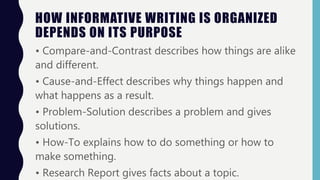
HOW INFORMATIVE WRITING IS ORGANIZED
DEPENDS ON ITS PURPOSE
• Compare-and-Contrast describes how things are alike
and different.
• Cause-and-Effect describes why things happen and
what happens as a result.
• Problem-Solution describes a problem and gives
solutions.
• How-To explains how to do something or how to
make something.
• Research Report gives facts about a topic.
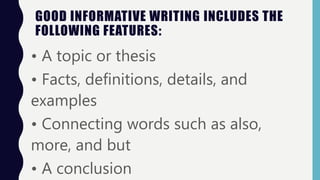
GOOD INFORMATIVE WRITING INCLUDES THE
FOLLOWING FEATURES:
• A topic or thesis
• Facts, definitions, details, and
examples
• Connecting words such as also,
more, and but
• A conclusion
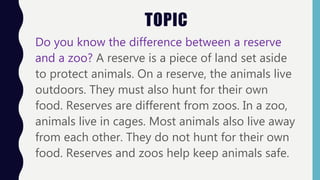
TOPIC
Do you know the difference between a reserve
and a zoo? A reserve is a piece of land set aside
to protect animals. On a reserve, the animals live
outdoors. They must also hunt for their own
food. Reserves are different from zoos. In a zoo,
animals live in cages. Most animals also live away
from each other. They do not hunt for their own
food. Reserves and zoos help keep animals safe.
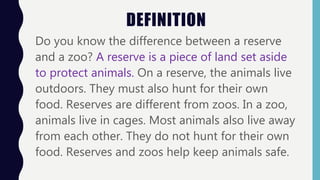
DEFINITION
Do you know the difference between a reserve
and a zoo? A reserve is a piece of land set aside
to protect animals. On a reserve, the animals live
outdoors. They must also hunt for their own
food. Reserves are different from zoos. In a zoo,
animals live in cages. Most animals also live away
from each other. They do not hunt for their own
food. Reserves and zoos help keep animals safe.
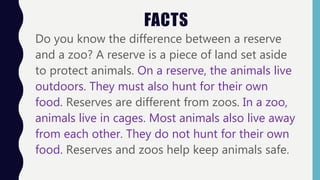
FACTS
Do you know the difference between a reserve
and a zoo? A reserve is a piece of land set aside
to protect animals. On a reserve, the animals live
outdoors. They must also hunt for their own
food. Reserves are different from zoos. In a zoo,
animals live in cages. Most animals also live away
from each other. They do not hunt for their own
food. Reserves and zoos help keep animals safe.
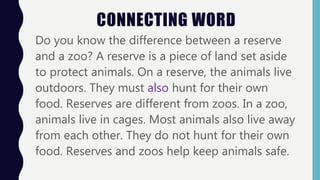
CONNECTING WORD
Do you know the difference between a reserve
and a zoo? A reserve is a piece of land set aside
to protect animals. On a reserve, the animals live
outdoors. They must also hunt for their own
food. Reserves are different from zoos. In a zoo,
animals live in cages. Most animals also live away
from each other. They do not hunt for their own
food. Reserves and zoos help keep animals safe.
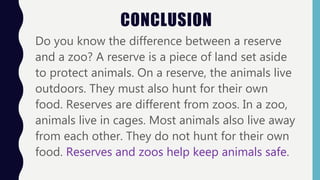
CONCLUSION
Do you know the difference between a reserve
and a zoo? A reserve is a piece of land set aside
to protect animals. On a reserve, the animals live
outdoors. They must also hunt for their own
food. Reserves are different from zoos. In a zoo,
animals live in cages. Most animals also live away
from each other. They do not hunt for their own
food. Reserves and zoos help keep animals safe.
ENRICHMENT ACTIVITY:
Directions: Write 1 example of an
informative text. Think about a certain topic
and write facts or information's related to
the topic. Use ¼ sheet of paper.
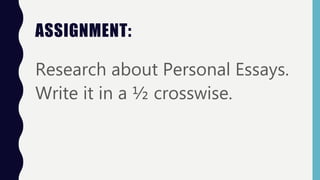
ASSIGNMENT:
Research about Personal Essays.
Write it in a ½ crosswise.
R
U
B
R
I
C
S
R
U
B
R
I
C
S
FIN

Informative text G7

  • 3.
  • 4.
    WHAT IS ANINFORMATIVE WRITING? •Informative/Explanatory writing explains something or gives facts. •It gives information, explains how to do something, or tells readers about real people, places, things, and events
  • 5.
    EXAMPLE: Pope Francis teacheshis people by example. He is an epitome of humanity and fairness. He was the 1st Non-European Pope of the Catholic church.
  • 6.
    EXAMPLE: Owls are knownas the bird of prey. They are nocturnal, which means they sleep during the day and hunt at night.
  • 7.
    EXAMPLE: Tyrannosaurus Rex (alsoknown as T-Rex) was one of the largest dinosaurs that ever walked the earth. It lived around 66 million years ago in an area now known as North America.
  • 8.
    YOU CAN FINDINFORMATIVE WRITING IN MANY DIFFERENT PLACES: • Non-fiction books • Textbooks • Newspapers • Encyclopedias • Magazines • Websites
  • 9.
    INFORMATIVE WRITING TRAITS IDEAS •A clear, focused topic • Supporting details that are complete and accurate ORGANIZATION • A strong introduction, body, and conclusion • Transition words that connect ideas VOICE • A voice that is appropriate for the purpose and audience
  • 10.
    WORD CHOICE • Topic-relatedwords that are used effectively • Definitions for words that the reader may not know SENTENCE FLUENCY • Clear, direct sentences • Different sentence types and lengths to make the writing CONVENTIONS • Correct spelling, punctuation, and capitalization
  • 11.
    HOW INFORMATIVE WRITINGIS ORGANIZED DEPENDS ON ITS PURPOSE • Compare-and-Contrast describes how things are alike and different. • Cause-and-Effect describes why things happen and what happens as a result. • Problem-Solution describes a problem and gives solutions. • How-To explains how to do something or how to make something. • Research Report gives facts about a topic.
  • 12.
    GOOD INFORMATIVE WRITINGINCLUDES THE FOLLOWING FEATURES: • A topic or thesis • Facts, definitions, details, and examples • Connecting words such as also, more, and but • A conclusion
  • 13.
    TOPIC Do you knowthe difference between a reserve and a zoo? A reserve is a piece of land set aside to protect animals. On a reserve, the animals live outdoors. They must also hunt for their own food. Reserves are different from zoos. In a zoo, animals live in cages. Most animals also live away from each other. They do not hunt for their own food. Reserves and zoos help keep animals safe.
  • 14.
    DEFINITION Do you knowthe difference between a reserve and a zoo? A reserve is a piece of land set aside to protect animals. On a reserve, the animals live outdoors. They must also hunt for their own food. Reserves are different from zoos. In a zoo, animals live in cages. Most animals also live away from each other. They do not hunt for their own food. Reserves and zoos help keep animals safe.
  • 15.
    FACTS Do you knowthe difference between a reserve and a zoo? A reserve is a piece of land set aside to protect animals. On a reserve, the animals live outdoors. They must also hunt for their own food. Reserves are different from zoos. In a zoo, animals live in cages. Most animals also live away from each other. They do not hunt for their own food. Reserves and zoos help keep animals safe.
  • 16.
    CONNECTING WORD Do youknow the difference between a reserve and a zoo? A reserve is a piece of land set aside to protect animals. On a reserve, the animals live outdoors. They must also hunt for their own food. Reserves are different from zoos. In a zoo, animals live in cages. Most animals also live away from each other. They do not hunt for their own food. Reserves and zoos help keep animals safe.
  • 17.
    CONCLUSION Do you knowthe difference between a reserve and a zoo? A reserve is a piece of land set aside to protect animals. On a reserve, the animals live outdoors. They must also hunt for their own food. Reserves are different from zoos. In a zoo, animals live in cages. Most animals also live away from each other. They do not hunt for their own food. Reserves and zoos help keep animals safe.
  • 18.
    ENRICHMENT ACTIVITY: Directions: Write1 example of an informative text. Think about a certain topic and write facts or information's related to the topic. Use ¼ sheet of paper.
  • 19.
    ASSIGNMENT: Research about PersonalEssays. Write it in a ½ crosswise.
  • 20.
  • 21.
  • 22.