Welcome!
  Language Arts


Ms. Marek
Tuesday-Wednesday, February
7-8, 2012
Independent Reading

      Retrieve your library book


 READ READ READ READ
    READ READ READ
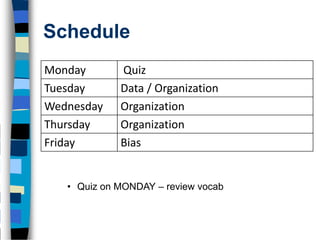
Schedule
Monday       Quiz
Tuesday      Data / Organization
Wednesday    Organization
Thursday     Organization
Friday       Bias


   • Quiz on MONDAY – review vocab
OBJECTIVE


            SWBAT identify
            organizational patterns
            in a text and analyze
            author’s use of
            organizational pattern
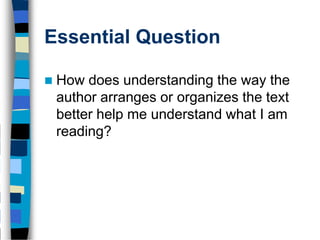
Essential Question

   How does understanding the way the
    author arranges or organizes the text
    better help me understand what I am
    reading?
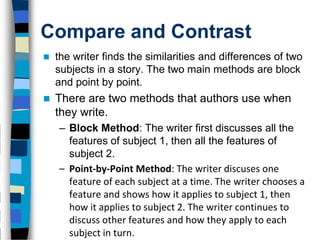
Compare and Contrast
   the writer finds the similarities and differences of two
    subjects in a story. The two main methods are block
    and point by point.
   There are two methods that authors use when
    they write.
    – Block Method: The writer first discusses all the
      features of subject 1, then all the features of
      subject 2.
    – Point-by-Point Method: The writer discuses one
      feature of each subject at a time. The writer chooses a
      feature and shows how it applies to subject 1, then
      how it applies to subject 2. The writer continues to
      discuss other features and how they apply to each
      subject in turn.
Compare and Contrast

Ask yourself these questions
 “How are two items similar?”
 “How are two items different?”
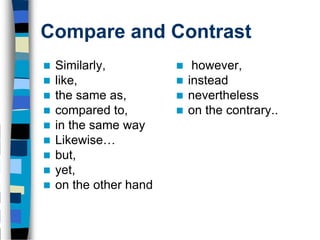
Compare and Contrast
   Similarly,              however,
   like,                  instead
   the same as,           nevertheless
   compared to,           on the contrary..
   in the same way
   Likewise…
   but,
   yet,
   on the other hand
Cause and Effect

 An organizational pattern that is built
  around a series of causes and effects.
  Each event causes another event to
  happen. The event it causes is called an
  effect.
 Ask yourself these questions …
    – Why did something happen?”
    – What were the results of a particular
      event?
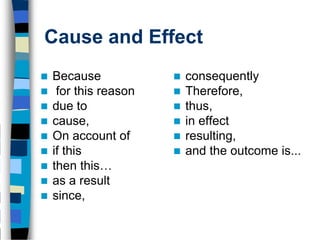
Cause and Effect
   Because               consequently
    for this reason      Therefore,
   due to                thus,
   cause,                in effect
   On account of         resulting,
   if this               and the outcome is...
   then this…
   as a result
   since,
Chronological Order

 An organizational pattern that begins
  with the earliest events and continues in
  the order that the events happened.
 Ask yourself these questions …
    – “When did it happen?”
    – “In what order did it happen?”
Chronological Order

 First
 Second
 Next
 then
 Finally
 Eventually
 Following this
Logical Order / Spatial Order

   An organizational pattern in which the
    writer tells the story in the order that
    makes the most sense.
Main Idea / Details

 The author includes a main idea and then
  supports this idea with details
 This is the most common of all our
  organizational structures
Example 1

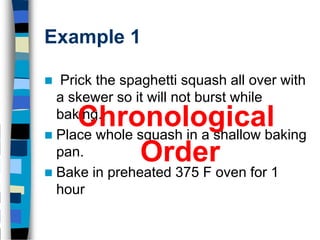
 Prick the spaghetti squash all over with
  a skewer so it will not burst while
     Chronological
  baking.
 Place whole squash in a shallow baking
  pan.   Order
 Bake in preheated 375 F oven for 1
  hour
Example 2

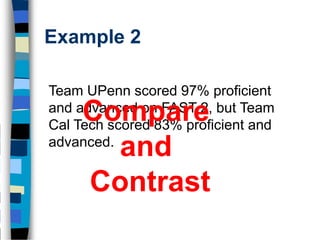
Team UPenn scored 97% proficient
     Compare
and advanced on FAST 2, but Team
Cal Tech scored 83% proficient and
       and
advanced.


     Contrast
Example 3

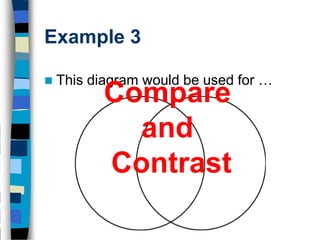
   This diagram would be used for …
           Compare
             and
           Contrast
Example 4
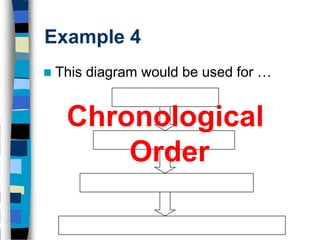
   This diagram would be used for …


     Chronological
         Order
Example 5
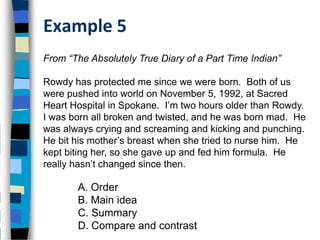
From “The Absolutely True Diary of a Part Time Indian”

Rowdy has protected me since we were born. Both of us
were pushed into world on November 5, 1992, at Sacred
Heart Hospital in Spokane. I’m two hours older than Rowdy.
I was born all broken and twisted, and he was born mad. He
was always crying and screaming and kicking and punching.
He bit his mother’s breast when she tried to nurse him. He
kept biting her, so she gave up and fed him formula. He
really hasn’t changed since then.

       A. Order
       B. Main idea
       C. Summary
       D. Compare and contrast
Example 6
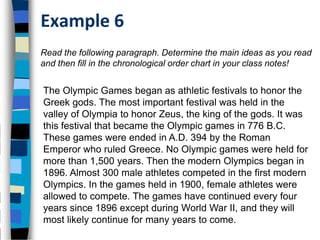
Read the following paragraph. Determine the main ideas as you read
and then fill in the chronological order chart in your class notes!


The Olympic Games began as athletic festivals to honor the
Greek gods. The most important festival was held in the
valley of Olympia to honor Zeus, the king of the gods. It was
this festival that became the Olympic games in 776 B.C.
These games were ended in A.D. 394 by the Roman
Emperor who ruled Greece. No Olympic games were held for
more than 1,500 years. Then the modern Olympics began in
1896. Almost 300 male athletes competed in the first modern
Olympics. In the games held in 1900, female athletes were
allowed to compete. The games have continued every four
years since 1896 except during World War II, and they will
most likely continue for many years to come.
Example 7
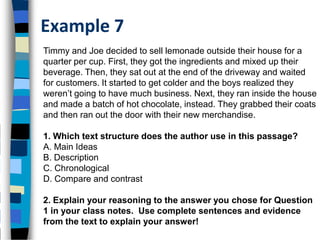
Timmy and Joe decided to sell lemonade outside their house for a
quarter per cup. First, they got the ingredients and mixed up their
beverage. Then, they sat out at the end of the driveway and waited
for customers. It started to get colder and the boys realized they
weren’t going to have much business. Next, they ran inside the house
and made a batch of hot chocolate, instead. They grabbed their coats
and then ran out the door with their new merchandise.

1. Which text structure does the author use in this passage?
A. Main Ideas
B. Description
C. Chronological
D. Compare and contrast

2. Explain your reasoning to the answer you chose for Question
1 in your class notes. Use complete sentences and evidence
from the text to explain your answer!
Election 2012
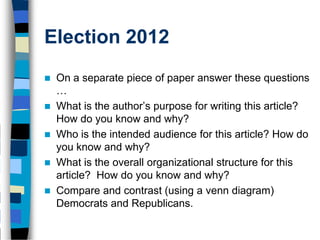
   On a separate piece of paper answer these questions
    …
   What is the author’s purpose for writing this article?
    How do you know and why?
   Who is the intended audience for this article? How do
    you know and why?
   What is the overall organizational structure for this
    article? How do you know and why?
   Compare and contrast (using a venn diagram)
    Democrats and Republicans.
REMINDERS

READ READ READ!


Start thinking about a book you
want to read.


READ READ READ!

M. marek dfms lp 75 organizational structures a

  • 1.
    Welcome! LanguageArts Ms. Marek Tuesday-Wednesday, February 7-8, 2012
  • 2.
    Independent Reading Retrieve your library book READ READ READ READ READ READ READ
  • 3.
    Schedule Monday Quiz Tuesday Data / Organization Wednesday Organization Thursday Organization Friday Bias • Quiz on MONDAY – review vocab
  • 4.
    OBJECTIVE SWBAT identify organizational patterns in a text and analyze author’s use of organizational pattern
  • 5.
    Essential Question  How does understanding the way the author arranges or organizes the text better help me understand what I am reading?
  • 6.
    Compare and Contrast  the writer finds the similarities and differences of two subjects in a story. The two main methods are block and point by point.  There are two methods that authors use when they write. – Block Method: The writer first discusses all the features of subject 1, then all the features of subject 2. – Point-by-Point Method: The writer discuses one feature of each subject at a time. The writer chooses a feature and shows how it applies to subject 1, then how it applies to subject 2. The writer continues to discuss other features and how they apply to each subject in turn.
  • 7.
    Compare and Contrast Askyourself these questions  “How are two items similar?”  “How are two items different?”
  • 8.
    Compare and Contrast  Similarly,  however,  like,  instead  the same as,  nevertheless  compared to,  on the contrary..  in the same way  Likewise…  but,  yet,  on the other hand
  • 9.
    Cause and Effect An organizational pattern that is built around a series of causes and effects. Each event causes another event to happen. The event it causes is called an effect.  Ask yourself these questions … – Why did something happen?” – What were the results of a particular event?
  • 10.
    Cause and Effect  Because  consequently  for this reason  Therefore,  due to  thus,  cause,  in effect  On account of  resulting,  if this  and the outcome is...  then this…  as a result  since,
  • 11.
    Chronological Order  Anorganizational pattern that begins with the earliest events and continues in the order that the events happened.  Ask yourself these questions … – “When did it happen?” – “In what order did it happen?”
  • 12.
    Chronological Order  First Second  Next  then  Finally  Eventually  Following this
  • 13.
    Logical Order /Spatial Order  An organizational pattern in which the writer tells the story in the order that makes the most sense.
  • 14.
    Main Idea /Details  The author includes a main idea and then supports this idea with details  This is the most common of all our organizational structures
  • 15.
    Example 1  Prickthe spaghetti squash all over with a skewer so it will not burst while Chronological baking.  Place whole squash in a shallow baking pan. Order  Bake in preheated 375 F oven for 1 hour
  • 16.
    Example 2 Team UPennscored 97% proficient Compare and advanced on FAST 2, but Team Cal Tech scored 83% proficient and and advanced. Contrast
  • 17.
    Example 3  This diagram would be used for … Compare and Contrast
  • 18.
    Example 4  This diagram would be used for … Chronological Order
  • 19.
    Example 5 From “TheAbsolutely True Diary of a Part Time Indian” Rowdy has protected me since we were born. Both of us were pushed into world on November 5, 1992, at Sacred Heart Hospital in Spokane. I’m two hours older than Rowdy. I was born all broken and twisted, and he was born mad. He was always crying and screaming and kicking and punching. He bit his mother’s breast when she tried to nurse him. He kept biting her, so she gave up and fed him formula. He really hasn’t changed since then. A. Order B. Main idea C. Summary D. Compare and contrast
  • 20.
    Example 6 Read thefollowing paragraph. Determine the main ideas as you read and then fill in the chronological order chart in your class notes! The Olympic Games began as athletic festivals to honor the Greek gods. The most important festival was held in the valley of Olympia to honor Zeus, the king of the gods. It was this festival that became the Olympic games in 776 B.C. These games were ended in A.D. 394 by the Roman Emperor who ruled Greece. No Olympic games were held for more than 1,500 years. Then the modern Olympics began in 1896. Almost 300 male athletes competed in the first modern Olympics. In the games held in 1900, female athletes were allowed to compete. The games have continued every four years since 1896 except during World War II, and they will most likely continue for many years to come.
  • 21.
    Example 7 Timmy andJoe decided to sell lemonade outside their house for a quarter per cup. First, they got the ingredients and mixed up their beverage. Then, they sat out at the end of the driveway and waited for customers. It started to get colder and the boys realized they weren’t going to have much business. Next, they ran inside the house and made a batch of hot chocolate, instead. They grabbed their coats and then ran out the door with their new merchandise. 1. Which text structure does the author use in this passage? A. Main Ideas B. Description C. Chronological D. Compare and contrast 2. Explain your reasoning to the answer you chose for Question 1 in your class notes. Use complete sentences and evidence from the text to explain your answer!
  • 22.
    Election 2012  On a separate piece of paper answer these questions …  What is the author’s purpose for writing this article? How do you know and why?  Who is the intended audience for this article? How do you know and why?  What is the overall organizational structure for this article? How do you know and why?  Compare and contrast (using a venn diagram) Democrats and Republicans.
  • 23.
    REMINDERS READ READ READ! Startthinking about a book you want to read. READ READ READ!

Editor's Notes