Making Information
Clear
• Authorschoose structure to organize
information and make their meaning
clear.
• Readers use strategies to support
interpretation of text.
3.
Writing Clarity
• Authorsuse organization to develop
their point of view
• They use different approaches to
support their purposes
• They pick an organization format that will
help make their ideas clear to the
reader
4.
Readers ask…
• CanI see a pattern
to the writing?
• How are the ideas
divided and
presented?
• Why has the author chosen this
particular organization pattern?
Description
Example 1
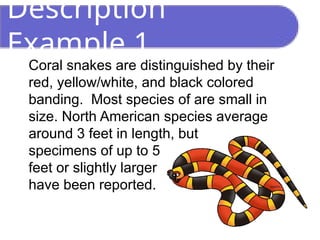
Coral snakesare distinguished by their
red, yellow/white, and black colored
banding. Most species of are small in
size. North American species average
around 3 feet in length, but
specimens of up to 5
feet or slightly larger
have been reported.
9.
Description
Example 2
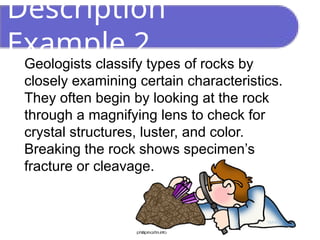
Geologists classifytypes of rocks by
closely examining certain characteristics.
They often begin by looking at the rock
through a magnifying lens to check for
crystal structures, luster, and color.
Breaking the rock shows specimen’s
fracture or cleavage.
10.
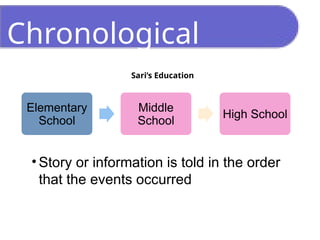
Chronological
• Story orinformation is told in the order
that the events occurred
Elementary
School
Middle
School
High School
Sari’s Education
11.
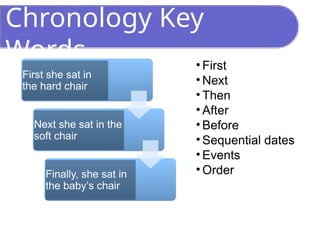
Chronology Key
Words •First
• Next
• Then
• After
• Before
• Sequential dates
• Events
• Order
First she sat in
the hard chair
Next she sat in the
soft chair
Finally, she sat in
the baby’s chair
12.
Chronological Example (1)
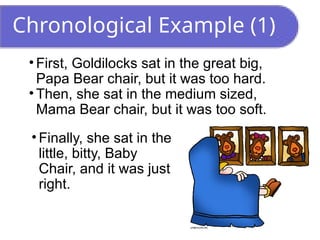
•First, Goldilocks sat in the great big,
Papa Bear chair, but it was too hard.
• Then, she sat in the medium sized,
Mama Bear chair, but it was too soft.
• Finally, she sat in the
little, bitty, Baby
Chair, and it was just
right.
13.
Chronological Example (2)
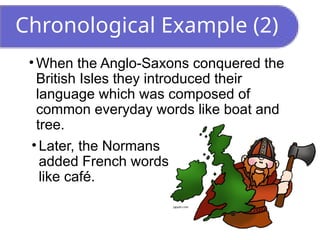
•When the Anglo-Saxons conquered the
British Isles they introduced their
language which was composed of
common everyday words like boat and
tree.
• Later, the Normans
added French words
like café.
14.
Cause and Effect
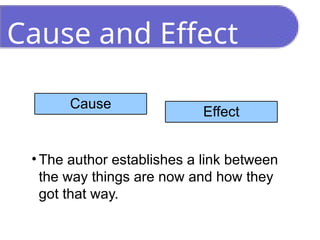
•The author establishes a link between
the way things are now and how they
got that way.
Cause
Effect
15.
Cause and EffectKey
Words
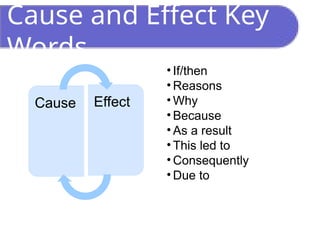
• If/then
• Reasons
• Why
• Because
• As a result
• This led to
• Consequently
• Due to
Cause Effect
16.
Order doesn’t matter
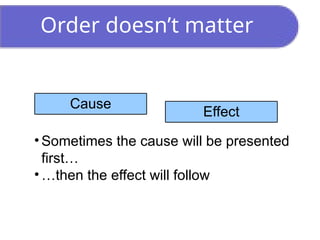
•Sometimes the cause will be presented
first…
• …then the effect will follow
Cause
Effect
17.
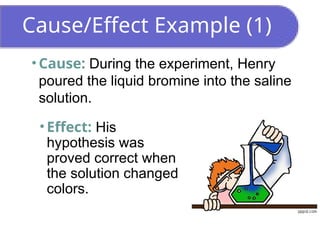
Cause/Effect Example (1)
•Cause: During the experiment, Henry
poured the liquid bromine into the saline
solution.
• Effect: His
hypothesis was
proved correct when
the solution changed
colors.
18.
Order still doesn’tmatter
• Sometimes the issues are presented
with the effects sited first…
• …then the causes are offered as
explanation
Cause
Effect
19.
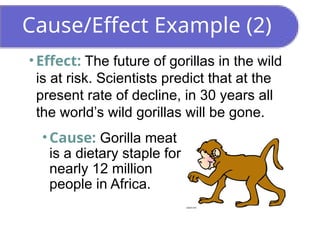
Cause/Effect Example (2)
•Effect: The future of gorillas in the wild
is at risk. Scientists predict that at the
present rate of decline, in 30 years all
the world’s wild gorillas will be gone.
• Cause: Gorilla meat
is a dietary staple for
nearly 12 million
people in Africa.
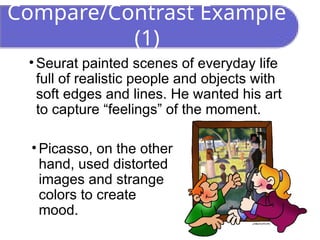
Compare/Contrast Example
(1)
• Seuratpainted scenes of everyday life
full of realistic people and objects with
soft edges and lines. He wanted his art
to capture “feelings” of the moment.
• Picasso, on the other
hand, used distorted
images and strange
colors to create
mood.
23.
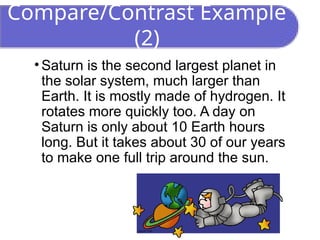
Compare/Contrast Example
(2)
• Saturnis the second largest planet in
the solar system, much larger than
Earth. It is mostly made of hydrogen. It
rotates more quickly too. A day on
Saturn is only about 10 Earth hours
long. But it takes about 30 of our years
to make one full trip around the sun.
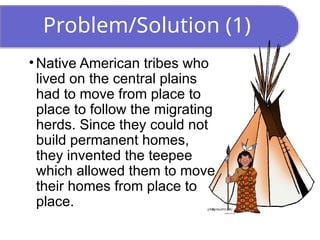
Problem/Solution (1)
• NativeAmerican tribes who
lived on the central plains
had to move from place to
place to follow the migrating
herds. Since they could not
build permanent homes,
they invented the teepee
which allowed them to move
their homes from place to
place.
27.
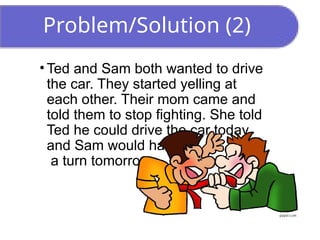
Problem/Solution (2)
• Tedand Sam both wanted to drive
the car. They started yelling at
each other. Their mom came and
told them to stop fighting. She told
Ted he could drive the car today,
and Sam would have
a turn tomorrow.
28.
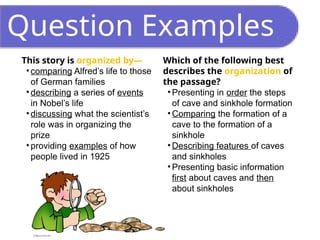
Question Examples
This storyis organized by—
• comparing Alfred’s life to those
of German families
• describing a series of events
in Nobel’s life
• discussing what the scientist’s
role was in organizing the
prize
• providing examples of how
people lived in 1925
Which of the following best
describes the organization of
the passage?
• Presenting in order the steps
of cave and sinkhole formation
• Comparing the formation of a
cave to the formation of a
sinkhole
• Describing features of caves
and sinkholes
• Presenting basic information
first about caves and then
about sinkholes
29.
REVIEW
• What arethe 5 organizational
patterns?
• Why do author’s use different
types of organization?
• What clues will help you
determine the pattern?
Resources
Comprehension Strategies byKeene, Ellin Oliver, 2002.
When Kids Can’t Read by Kylene Beers, 1998
Graphics
Phillip Martin Clip Art
http://www.phillipmartin.info/clipart/homepage.htm
A Reading and Writing Out Loud Presentation
Barbara Yardley, M.Ed.
For additional activities, worksheets and a complete Common Core
teaching unit on Text Structure
visit
http://www.teacherspayteachers.com/Store/Barbara-Yardley/
Editor's Notes
#2 Readers who are familiar with text structures expect the information to unfold in certain ways (RAND Reading Study Group, 2002). Understanding text structure helps comprehension by supporting a reader’s interpretation of the text. It helps with making prediction, understanding how things are related to one another and what is important in the text, and helps them to remember and summarize information.
2
#5 Many other organizational pattern exist. For the purposes of this unit, students will concentrate on just these five which are commonly used in informational text.
5
#6 Description is meant to help the reader envision a particular topic and often appeals to the five senses. Description organization is often used in connection with other types of text structure. For example, a problem/solution piece might given a vivid description of the original problem,
6
#10 Can be represented with a timeline or with a vertical graphic organizer
10
#20 Another graphic organizer that is commonly used is a three column graphic where the middle column is labeled “both”
20
#24 The author poses a problem or question and then gives the answer.
24
#25 , so that, question-answer, problem is solved
25
#28 Questions about organization often contain the word in the question stem. Highlight key words in the answer choices that indicate types of organization patterns.
28