




allan kelly
allan@allankelly.net
Twitter: @allankellynet
http://www.allankelly.net
Patterns and Pattern Thinking
for Analysis and Innovation
IRM Business Analysis Conference
London, September 2013
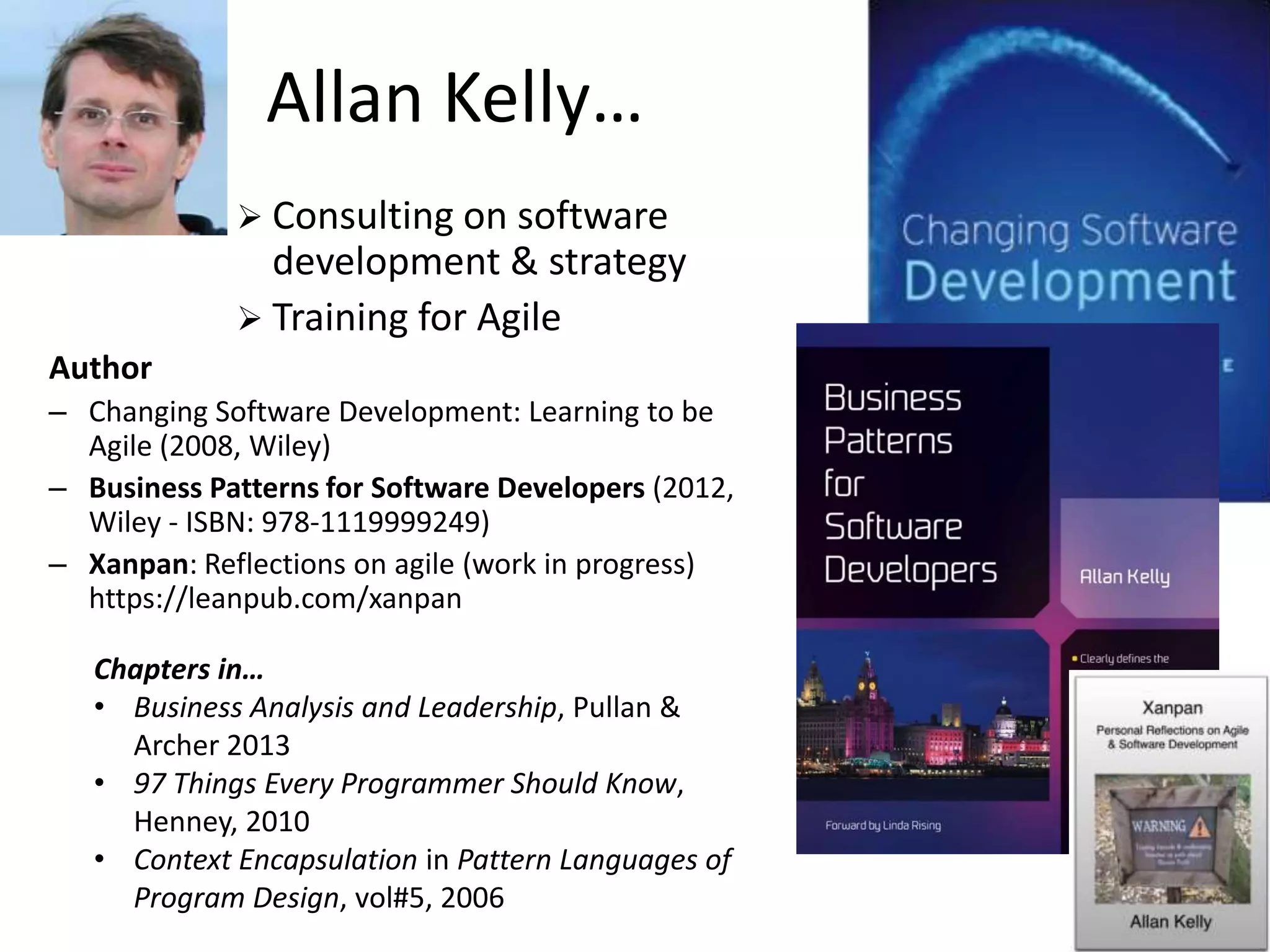
Allan Kelly…
Chapters in…
• Business Analysis and Leadership, Pullan &
Archer 2013
• 97 Things Every Programmer Should Know,
Henney, 2010
• Context Encapsulation in Pattern Languages of
Program Design, vol#5, 2006
 Consulting on software
development & strategy
 Training for Agile
Author
– Changing Software Development: Learning to be
Agile (2008, Wiley)
– Business Patterns for Software Developers (2012,
Wiley - ISBN: 978-1119999249)
– Xanpan: Reflections on agile (work in progress)
https://leanpub.com/xanpan
BAs! Do you?
• Think
– “Someone must have done this before”
• Struggle to identify the real
problem?
• And … if…
– Everyone else does something similar
– Does innovation lie in doing it
differently?
Patterns might help
• Learn to…
– See patterns
– Apply pattern thinking/analysis
• Use patterns from others
– Build on the work of others
So what is a
“pattern” ?
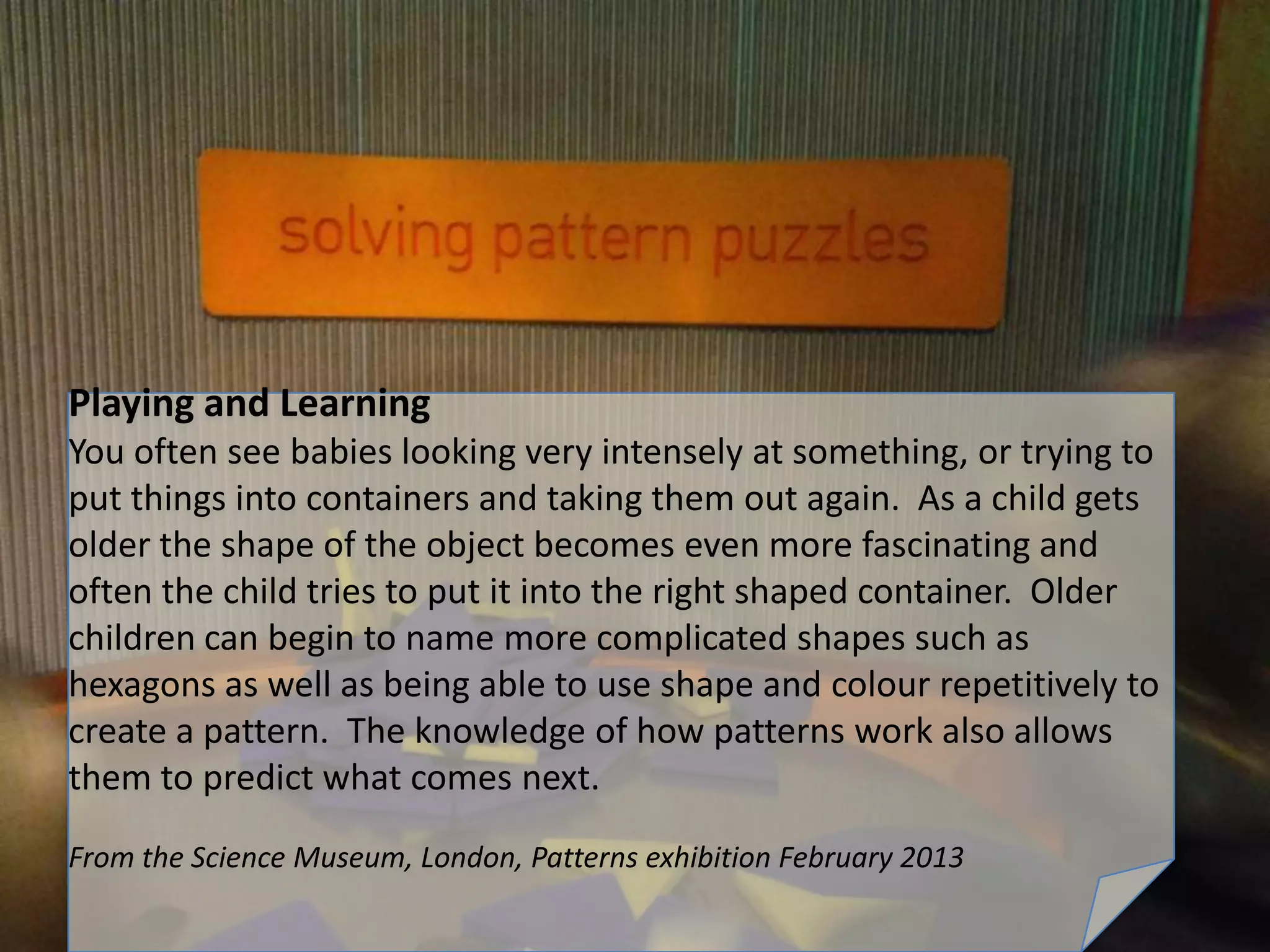
Playing and Learning
You often see babies looking very intensely at something, or trying to
put things into containers and taking them out again. As a child gets
older the shape of the object becomes even more fascinating and
often the child tries to put it into the right shaped container. Older
children can begin to name more complicated shapes such as
hexagons as well as being able to use shape and colour repetitively to
create a pattern. The knowledge of how patterns work also allows
them to predict what comes next.
From the Science Museum, London, Patterns exhibition February 2013
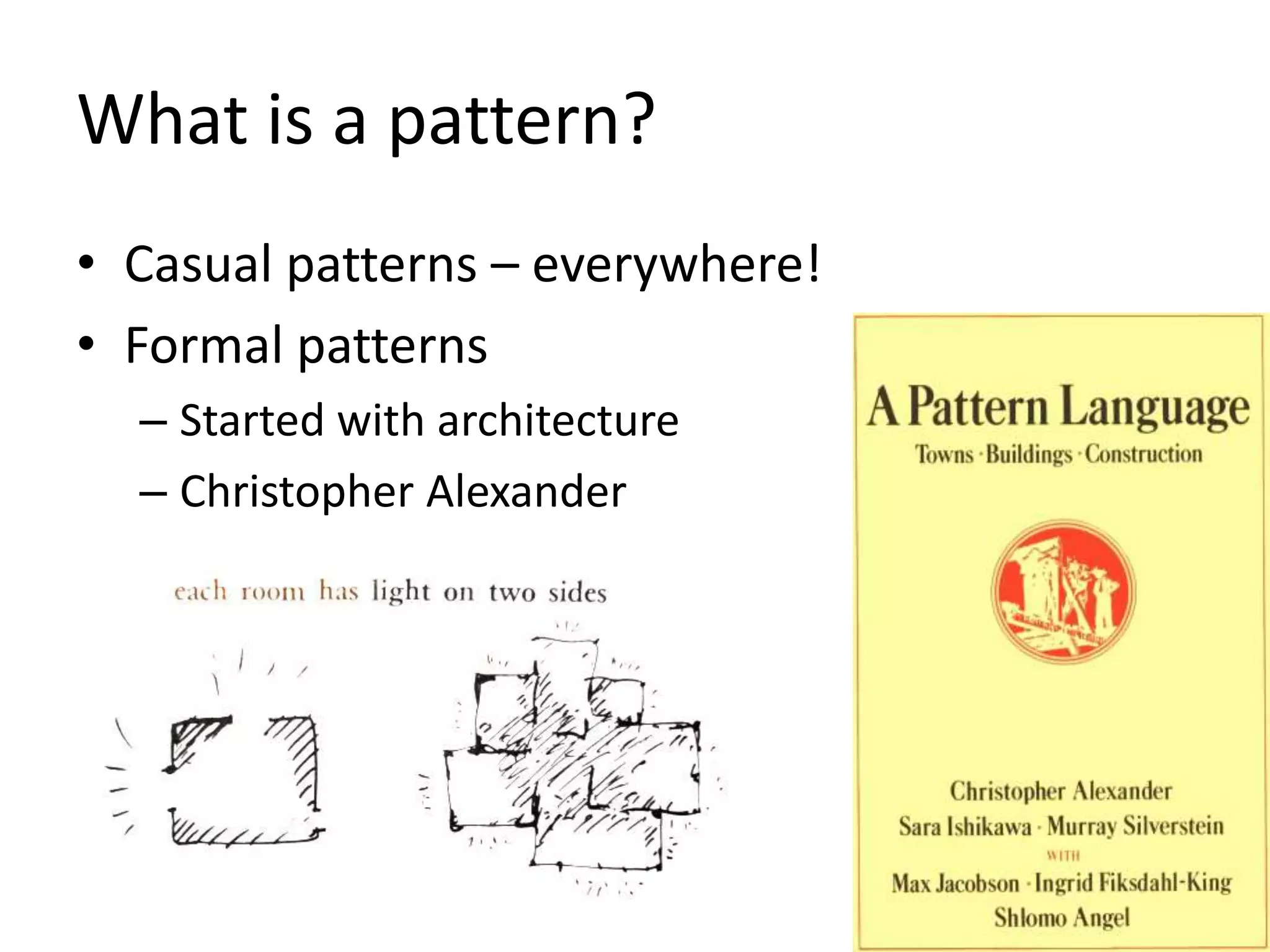
What is a pattern?
• Casual patterns – everywhere!
• Formal patterns
– Started with architecture
– Christopher Alexander
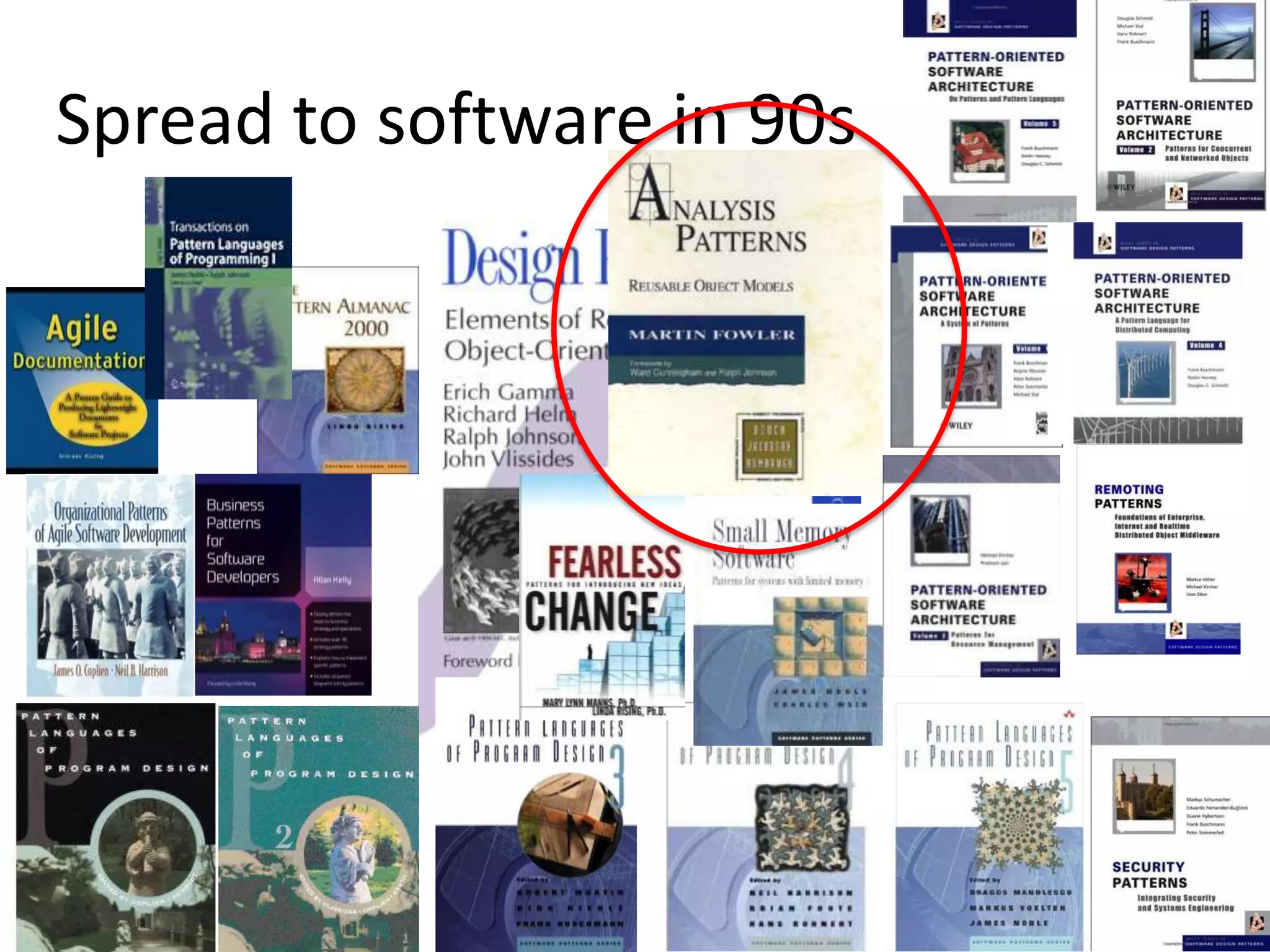
Spread to software in 90s
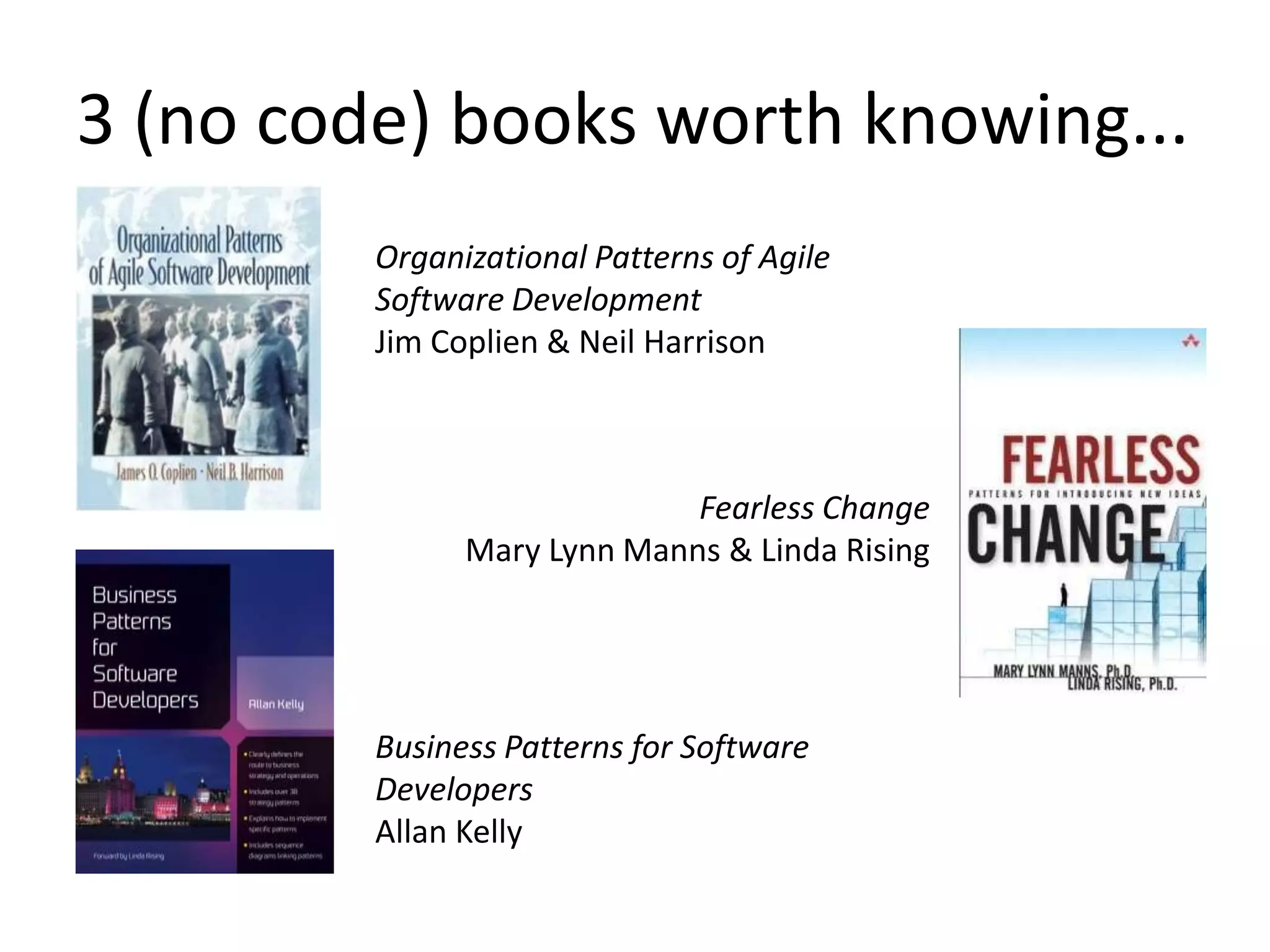
3 (no code) books worth knowing...
Organizational Patterns of Agile
Software Development
Jim Coplien & Neil Harrison
Business Patterns for Software
Developers
Allan Kelly
Fearless Change
Mary Lynn Manns & Linda Rising
What is a pattern?
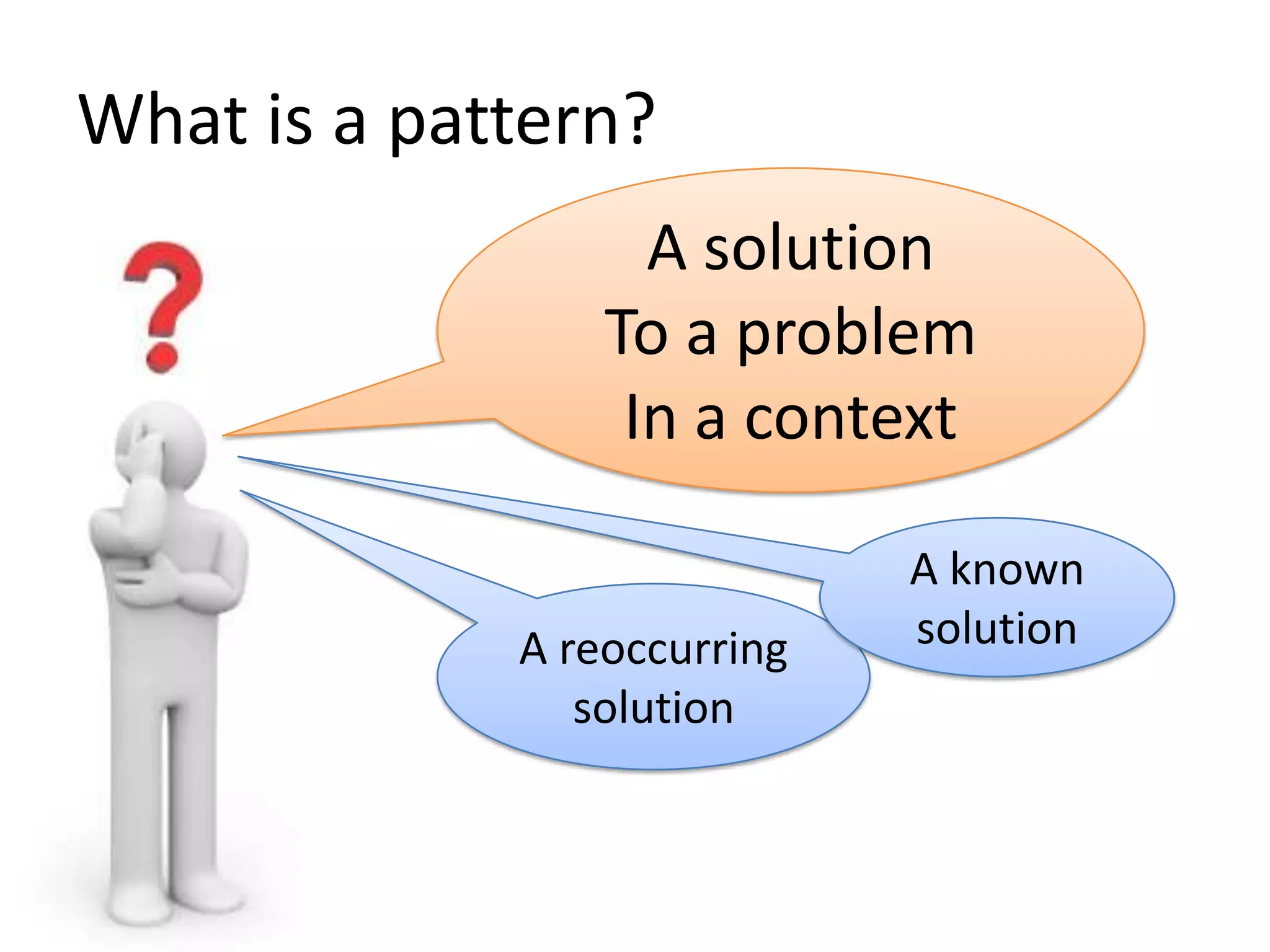
A solution
To a problem
In a context
A reoccurring
solution
A known
solution
An example
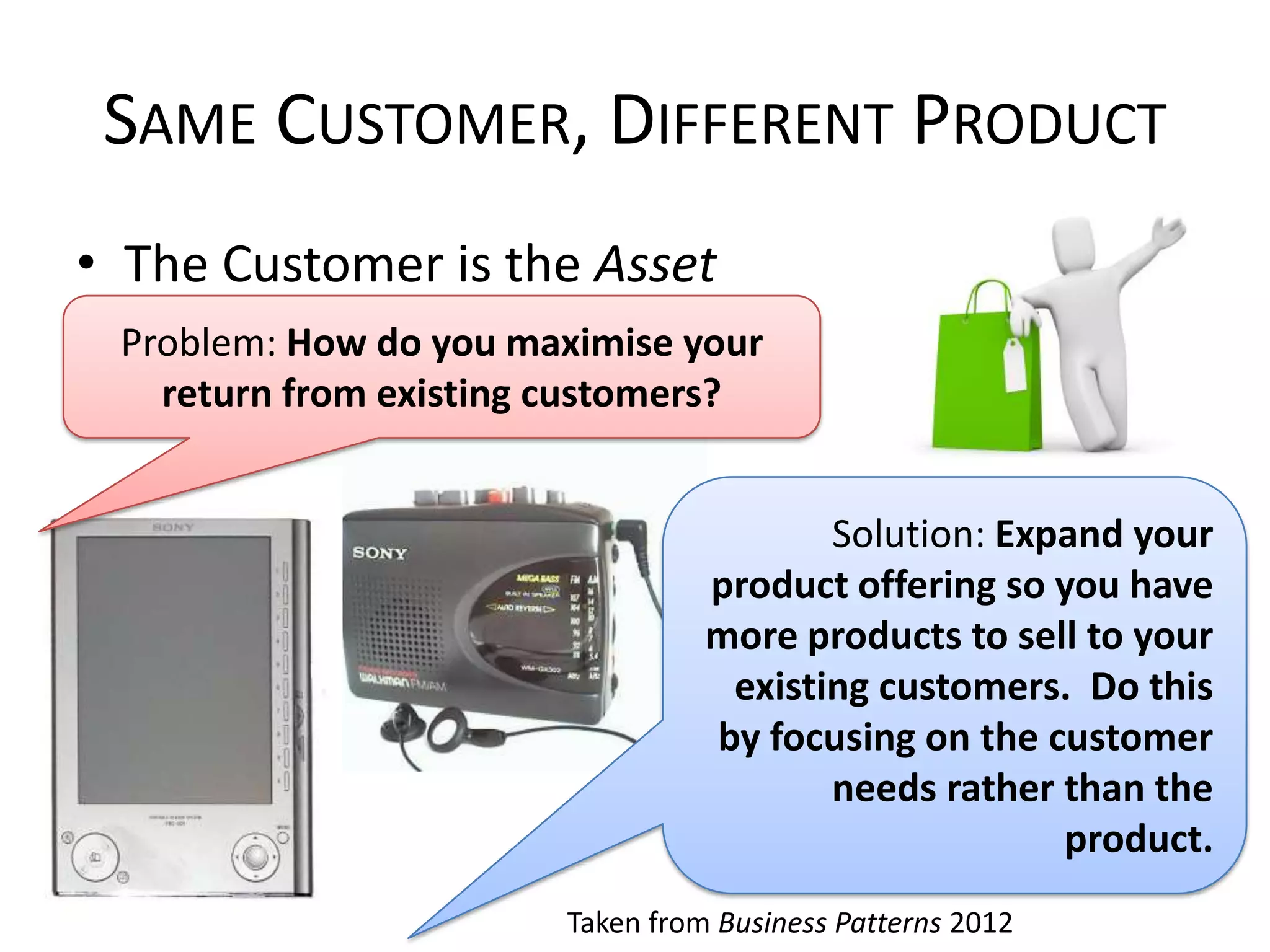
SAME CUSTOMER, DIFFERENT PRODUCT
• The Customer is the Asset
Solution: Expand your
product offering so you have
more products to sell to your
existing customers. Do this
by focusing on the customer
needs rather than the
product.
Problem: How do you maximise your
return from existing customers?
Taken from Business Patterns 2012
Pattern v. pattern
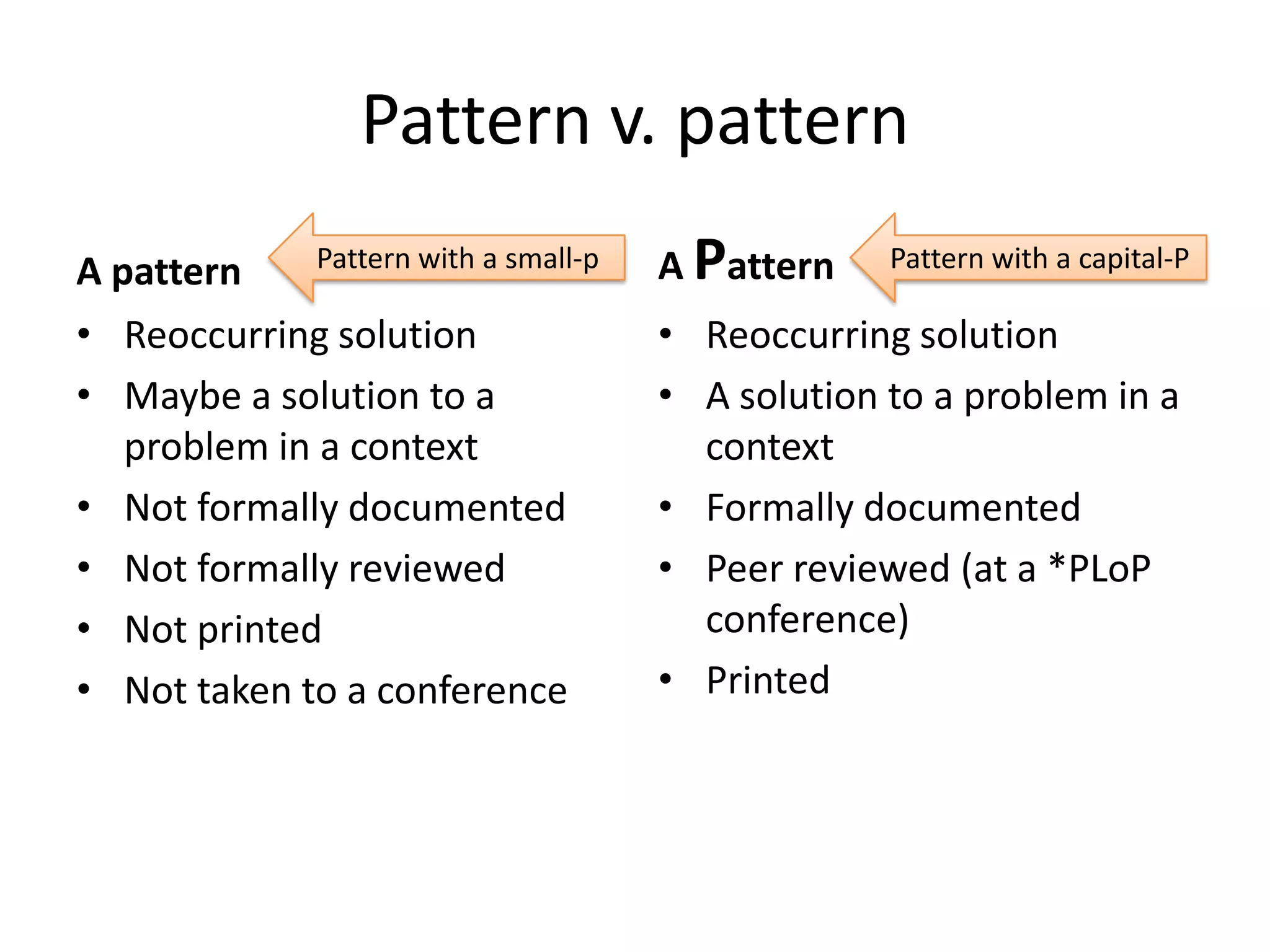
A pattern
• Reoccurring solution
• Maybe a solution to a
problem in a context
• Not formally documented
• Not formally reviewed
• Not printed
• Not taken to a conference
A Pattern
• Reoccurring solution
• A solution to a problem in a
context
• Formally documented
• Peer reviewed (at a *PLoP
conference)
• Printed
Pattern with a small-p Pattern with a capital-P
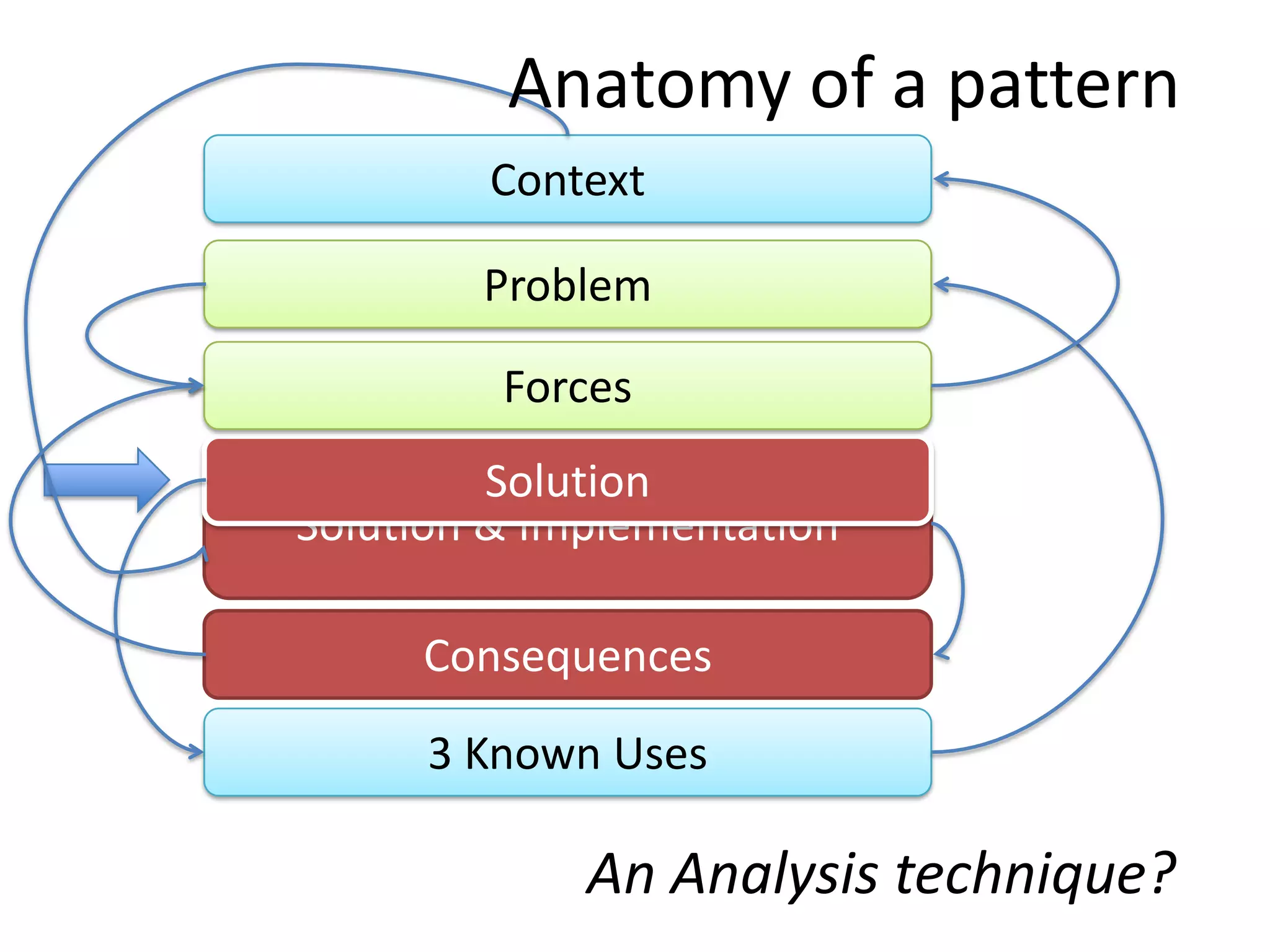
Solution & Implementation
Solution
3 Known Uses
Problem
Forces
Consequences
Context
Anatomy of a pattern
An Analysis technique?
Solution & Implementation
Solution
3 Known Uses
Problem
Forces
Consequences
Context
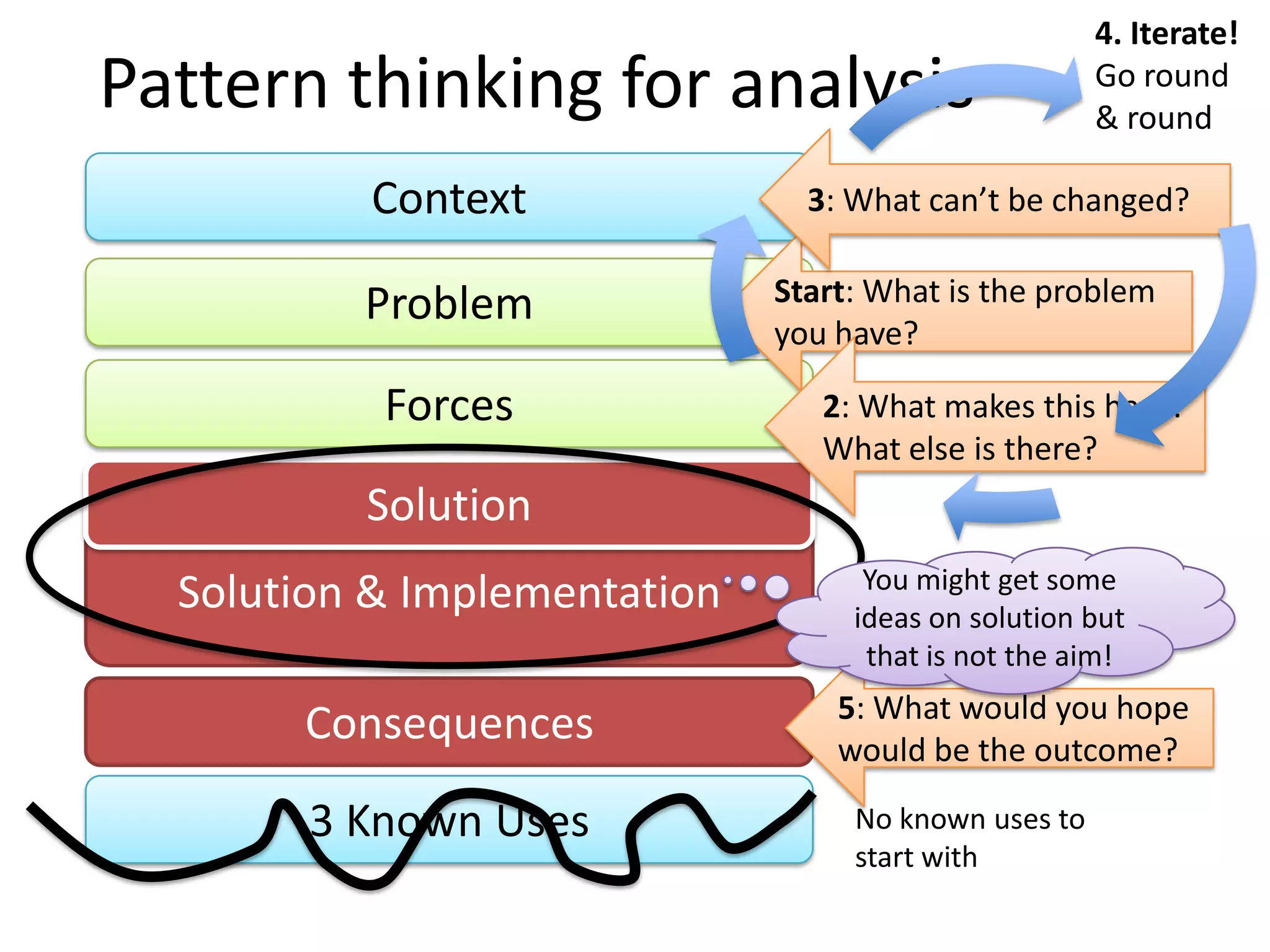
Pattern thinking for analysis
No known uses to
start with
Start: What is the problem
you have?
2: What makes this hard?
What else is there?
3: What can’t be changed?
4. Iterate!
Go round
& round
5: What would you hope
would be the outcome?
You might get some
ideas on solution but
that is not the aim!
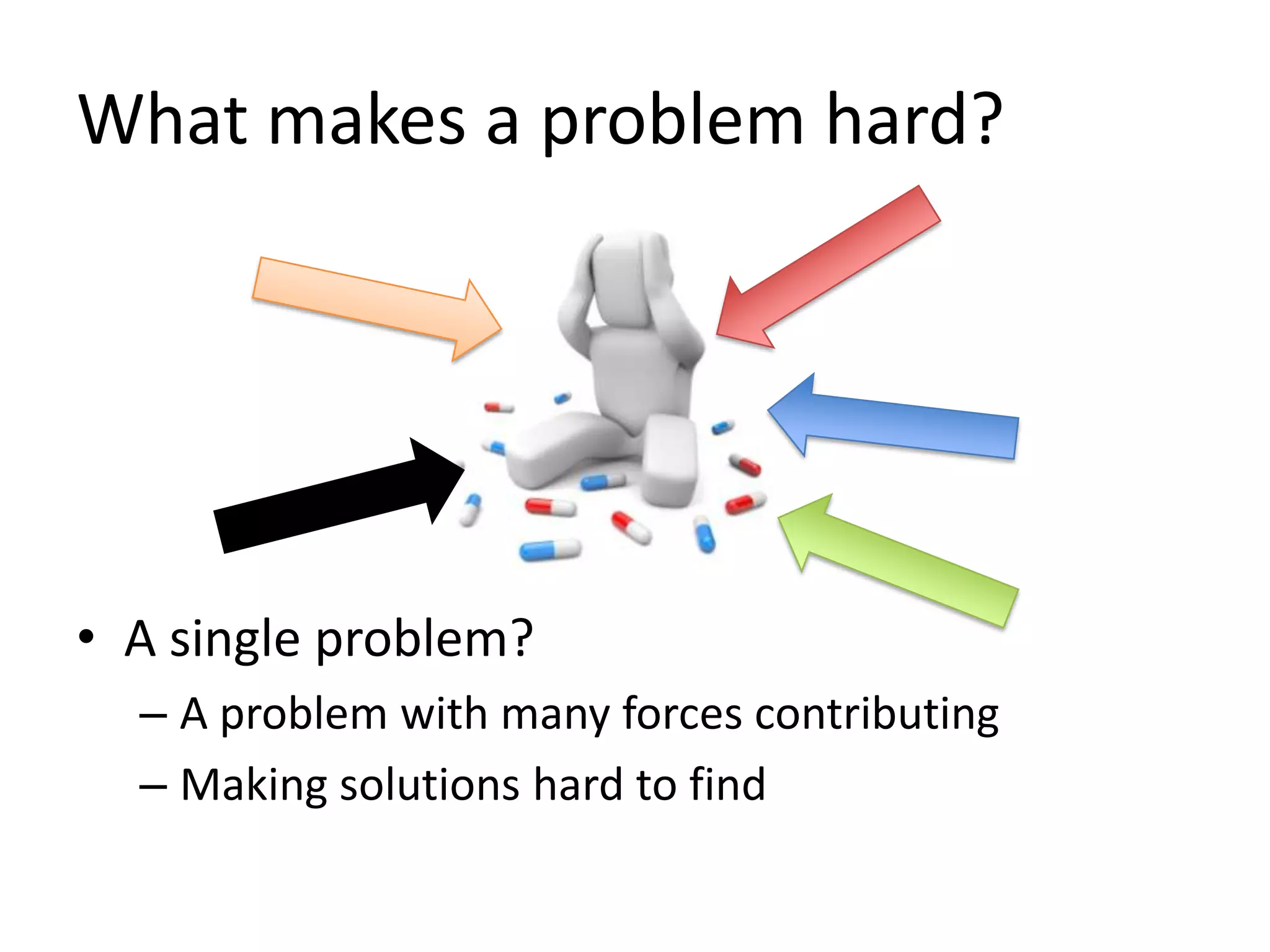
What makes a problem hard?
• A single problem?
– A problem with many forces contributing
– Making solutions hard to find
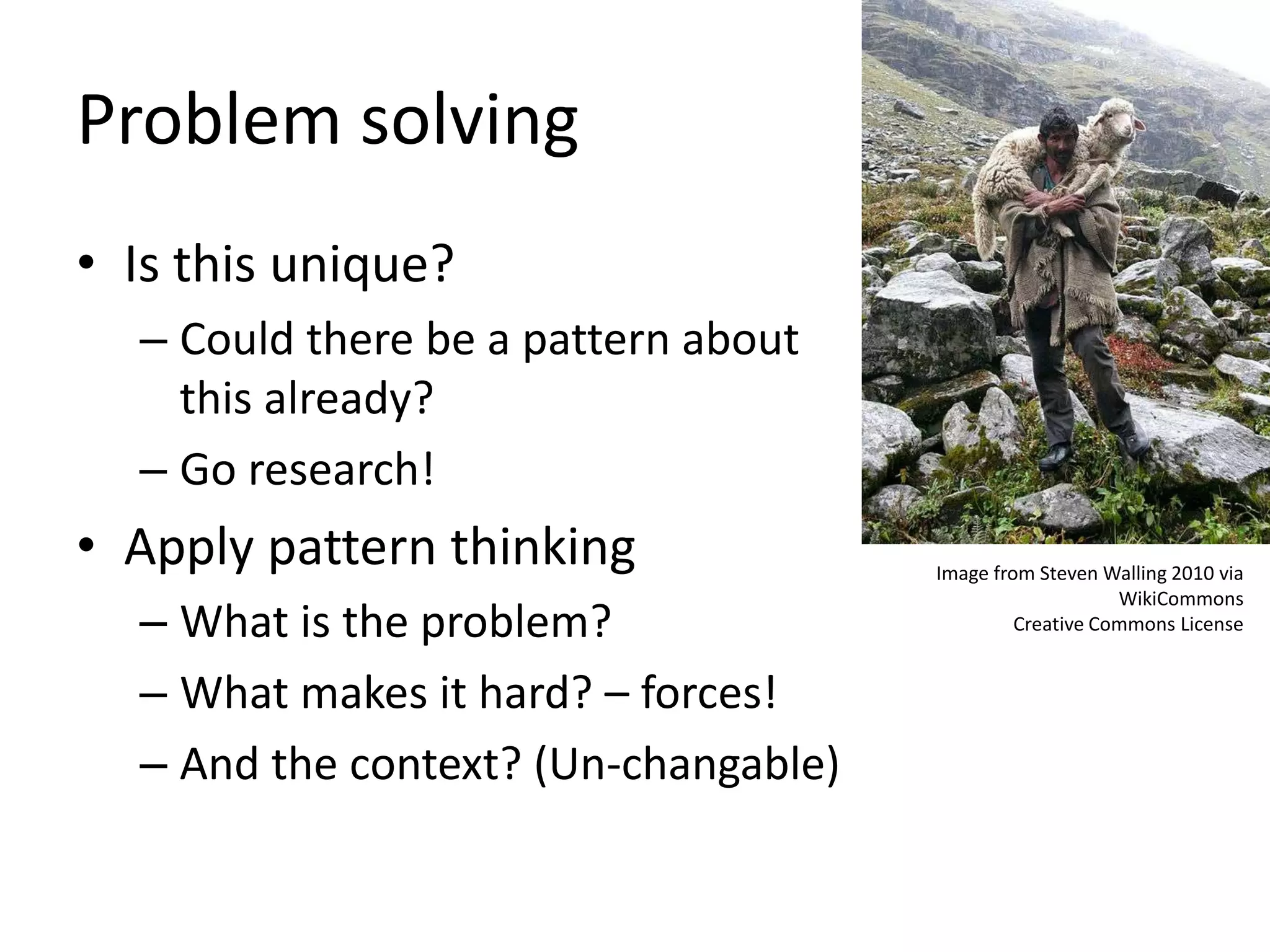
Problem solving
• Is this unique?
– Could there be a pattern about
this already?
– Go research!
• Apply pattern thinking
– What is the problem?
– What makes it hard? – forces!
– And the context? (Un-changable)
Image from Steven Walling 2010 via
WikiCommons
Creative Commons License
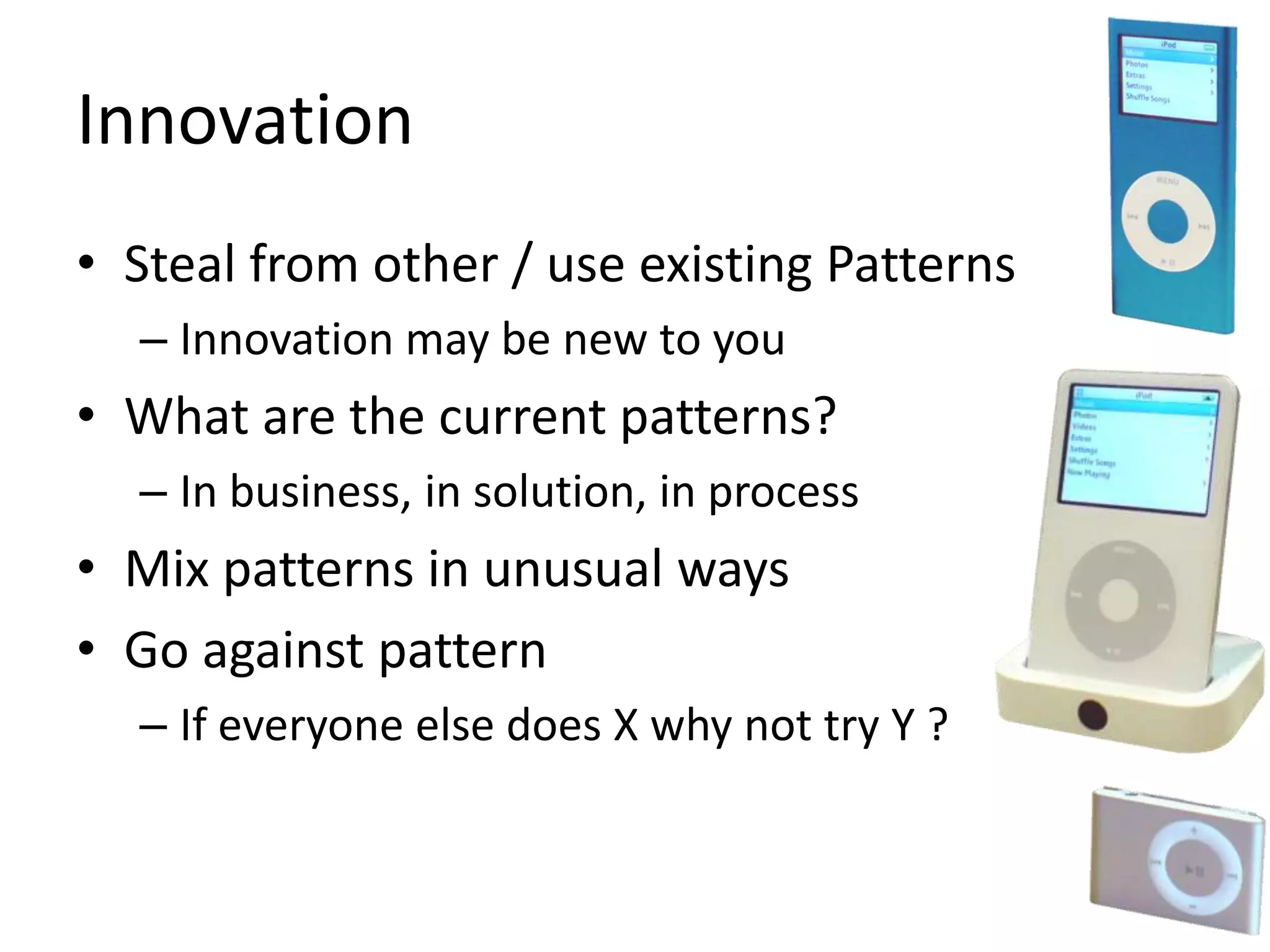
Innovation
• Steal from other / use existing Patterns
– Innovation may be new to you
• What are the current patterns?
– In business, in solution, in process
• Mix patterns in unusual ways
• Go against pattern
– If everyone else does X why not try Y ?
More about patterns
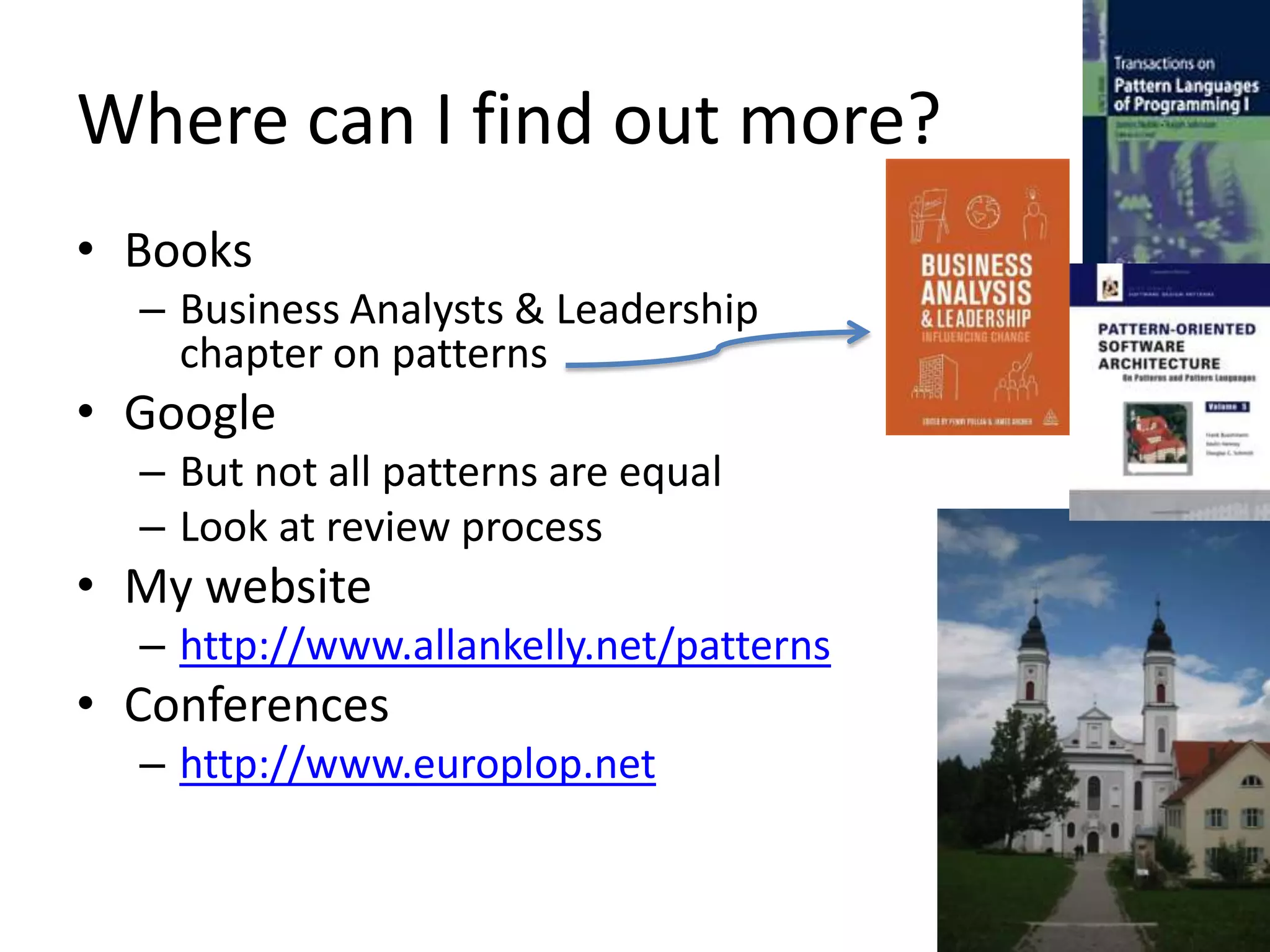
Where can I find out more?
• Books
– Business Analysts & Leadership
chapter on patterns
• Google
– But not all patterns are equal
– Look at review process
• My website
– http://www.allankelly.net/patterns
• Conferences
– http://www.europlop.net
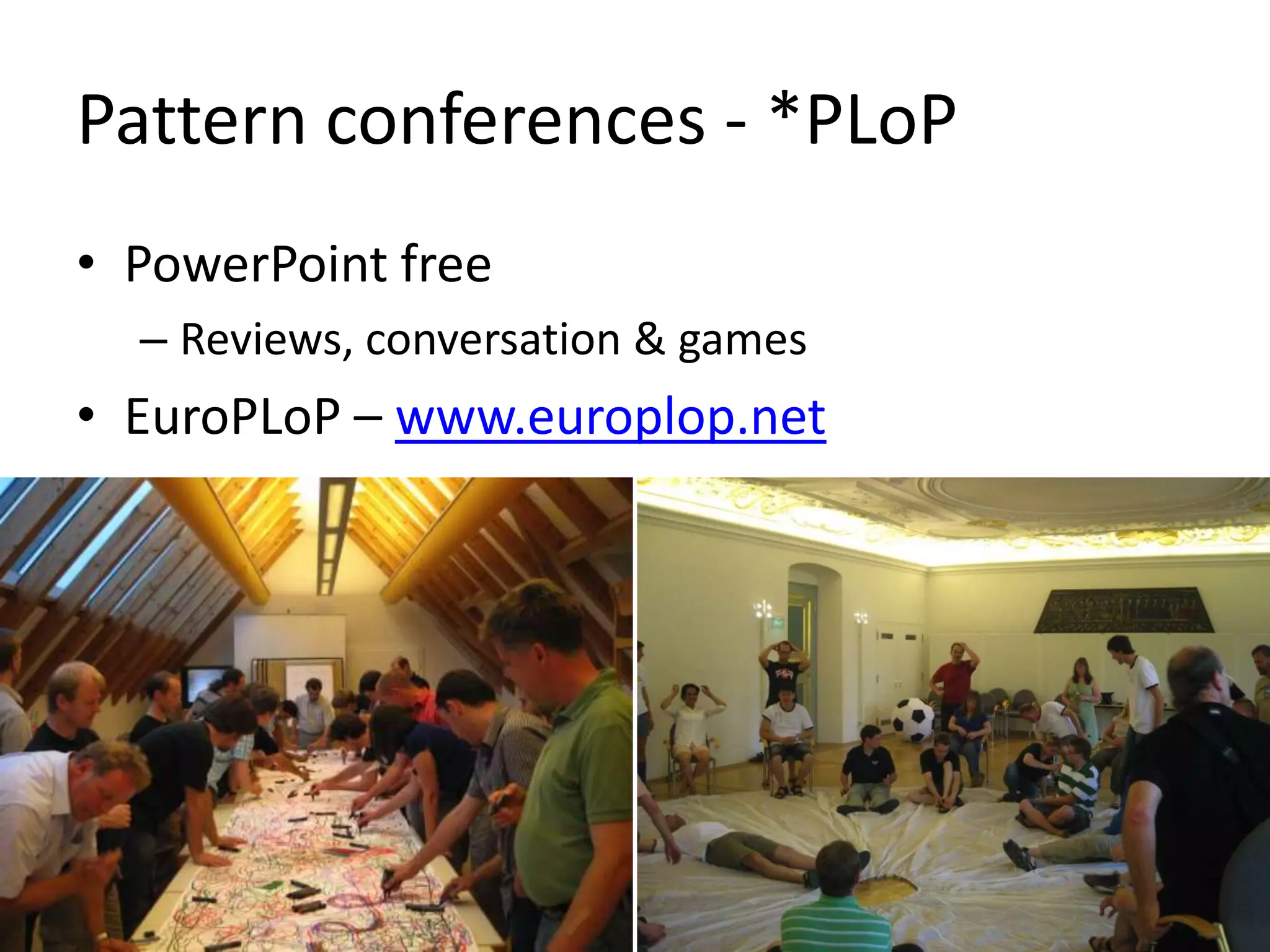
Pattern conferences - *PLoP
• PowerPoint free
– Reviews, conversation & games
• EuroPLoP – www.europlop.net
Questions
Allan Kelly
Software Strategy Ltd.
allan@allankelly.net
www.softwarestrategy.co.uk
blog.allankelly.net
Twitter: @allankellynet
Patterns and Pattern Thinking for Analysis and Innovation

Patterns and Pattern Thinking for Analysis and Innovation

  • 1.
    allan kelly allan@allankelly.net Twitter: @allankellynet http://www.allankelly.net Patternsand Pattern Thinking for Analysis and Innovation IRM Business Analysis Conference London, September 2013
  • 2.
    Allan Kelly… Chapters in… •Business Analysis and Leadership, Pullan & Archer 2013 • 97 Things Every Programmer Should Know, Henney, 2010 • Context Encapsulation in Pattern Languages of Program Design, vol#5, 2006  Consulting on software development & strategy  Training for Agile Author – Changing Software Development: Learning to be Agile (2008, Wiley) – Business Patterns for Software Developers (2012, Wiley - ISBN: 978-1119999249) – Xanpan: Reflections on agile (work in progress) https://leanpub.com/xanpan
  • 3.
    BAs! Do you? •Think – “Someone must have done this before” • Struggle to identify the real problem? • And … if… – Everyone else does something similar – Does innovation lie in doing it differently?
  • 4.
    Patterns might help •Learn to… – See patterns – Apply pattern thinking/analysis • Use patterns from others – Build on the work of others
  • 5.
    So what isa “pattern” ?
  • 6.
    Playing and Learning Youoften see babies looking very intensely at something, or trying to put things into containers and taking them out again. As a child gets older the shape of the object becomes even more fascinating and often the child tries to put it into the right shaped container. Older children can begin to name more complicated shapes such as hexagons as well as being able to use shape and colour repetitively to create a pattern. The knowledge of how patterns work also allows them to predict what comes next. From the Science Museum, London, Patterns exhibition February 2013
  • 7.
    What is apattern? • Casual patterns – everywhere! • Formal patterns – Started with architecture – Christopher Alexander
  • 8.
  • 9.
    3 (no code)books worth knowing... Organizational Patterns of Agile Software Development Jim Coplien & Neil Harrison Business Patterns for Software Developers Allan Kelly Fearless Change Mary Lynn Manns & Linda Rising
  • 10.
    What is apattern? A solution To a problem In a context A reoccurring solution A known solution
  • 11.
  • 12.
    SAME CUSTOMER, DIFFERENTPRODUCT • The Customer is the Asset Solution: Expand your product offering so you have more products to sell to your existing customers. Do this by focusing on the customer needs rather than the product. Problem: How do you maximise your return from existing customers? Taken from Business Patterns 2012
  • 13.
    Pattern v. pattern Apattern • Reoccurring solution • Maybe a solution to a problem in a context • Not formally documented • Not formally reviewed • Not printed • Not taken to a conference A Pattern • Reoccurring solution • A solution to a problem in a context • Formally documented • Peer reviewed (at a *PLoP conference) • Printed Pattern with a small-p Pattern with a capital-P
  • 14.
    Solution & Implementation Solution 3Known Uses Problem Forces Consequences Context Anatomy of a pattern An Analysis technique?
  • 15.
    Solution & Implementation Solution 3Known Uses Problem Forces Consequences Context Pattern thinking for analysis No known uses to start with Start: What is the problem you have? 2: What makes this hard? What else is there? 3: What can’t be changed? 4. Iterate! Go round & round 5: What would you hope would be the outcome? You might get some ideas on solution but that is not the aim!
  • 16.
    What makes aproblem hard? • A single problem? – A problem with many forces contributing – Making solutions hard to find
  • 17.
    Problem solving • Isthis unique? – Could there be a pattern about this already? – Go research! • Apply pattern thinking – What is the problem? – What makes it hard? – forces! – And the context? (Un-changable) Image from Steven Walling 2010 via WikiCommons Creative Commons License
  • 18.
    Innovation • Steal fromother / use existing Patterns – Innovation may be new to you • What are the current patterns? – In business, in solution, in process • Mix patterns in unusual ways • Go against pattern – If everyone else does X why not try Y ?
  • 19.
  • 20.
    Where can Ifind out more? • Books – Business Analysts & Leadership chapter on patterns • Google – But not all patterns are equal – Look at review process • My website – http://www.allankelly.net/patterns • Conferences – http://www.europlop.net
  • 21.
    Pattern conferences -*PLoP • PowerPoint free – Reviews, conversation & games • EuroPLoP – www.europlop.net
  • 22.
    Questions Allan Kelly Software StrategyLtd. allan@allankelly.net www.softwarestrategy.co.uk blog.allankelly.net Twitter: @allankellynet