Institut Latihan Kementerian Kesihatan Malaysia (ILKKM)
Prog : Diploma in Medical And Health Science (DPMH)
Year 1 Sem I
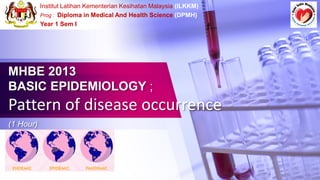
MHBE 2013
BASIC EPIDEMIOLOGY ;
Pattern of disease occurrence
(1 Hour)
Learning outcome (LO) ;
i. Compare occurrence of the endemic, epidemic,
and pandemic.
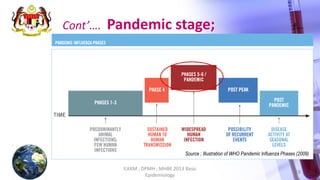
ii. Describe WHO phase of pandemic stages.
ILKKM ; DPMH ; MHBE 2013 Basic Epidemiology 2
Content outline;
i. Overview level of infectious disease.
ii. Endemic.
iii. Epidemic.
iv. Pandemic and phases pandemic by
WHO.
ILKKM ; DPMH ; MHBE 2013 Basic Epidemiology 3
Overview level of disease ;
• The amount of a particular disease that is usually present in
a community is referred to as the baseline or endemic level
of the disease.
• This level is not necessarily the desired level, which may in
fact be zero, but rather is the observed level.
• In the absence of intervention and assuming that the level is
not high enough to deplete the pool of susceptible persons,
the disease may continue to occur at this level indefinitely.
ILKKM ; DPMH ; MHBE 2013 Basic
Epidemiology
4
Definition of terminology ;
i. Endemic
ii. Epidemic
iii. Pandemic
ILKKM ; DPMH ; MHBE 2013 Basic
Epidemiology
5
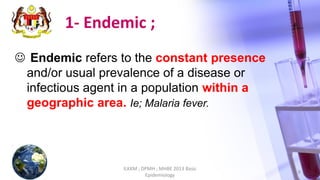
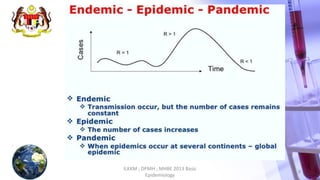
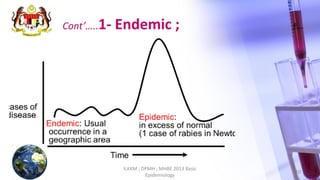
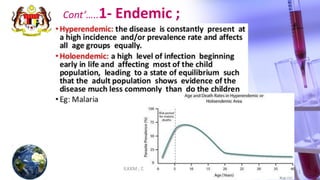
1- Endemic ;
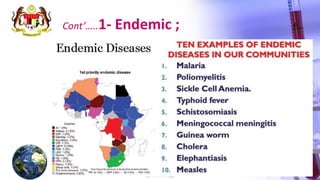
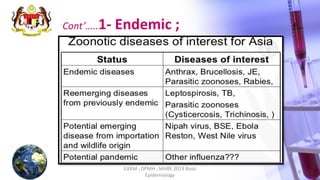
 Endemic refers to the constant presence
and/or usual prevalence of a disease or
infectious agent in a population within a
geographic area. Ie; Malaria fever.
ILKKM ; DPMH ; MHBE 2013 Basic
Epidemiology
6
Cont’…..1- Endemic ;
ILKKM ; DPMH ; MHBE 2013 Basic
Epidemiology
7
ILKKM ; DPMH ; MHBE 2013 Basic
Epidemiology
8
Cont’…..1- Endemic ;
ILKKM ; DPMH ; MHBE 2013 Basic
Epidemiology
9
ILKKM ; DPMH ; MHBE 2013 Basic
Epidemiology
10
Cont’…..1- Endemic ;
ILKKM ; DPMH ; MHBE 2013 Basic
Epidemiology
11
Cont’…..1- Endemic ;
ILKKM ; DPMH ; MHBE 2013 Basic
Epidemiology
12
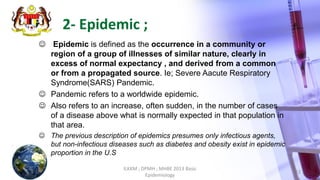
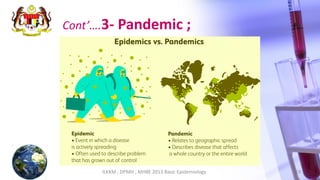
2- Epidemic ;
 Epidemic is defined as the occurrence in a community or
region of a group of illnesses of similar nature, clearly in
excess of normal expectancy , and derived from a common
or from a propagated source. Ie; Severe Aacute Respiratory
Syndrome(SARS) Pandemic.
 Pandemic refers to a worldwide epidemic.
 Also refers to an increase, often sudden, in the number of cases
of a disease above what is normally expected in that population in
that area.
 The previous description of epidemics presumes only infectious agents,
but non-infectious diseases such as diabetes and obesity exist in epidemic
proportion in the U.S
Cont’ …. 2- Epidemic ;
• Epidemics occur when an agent and susceptible hosts are present
in adequate numbers, and the agent can be effectively conveyed
from a source to the susceptible hosts.
• Outbreak carries the same definition of epidemic, but is often
used for a more limited geographic area. ie; cholera outbreak
at penang.
• Cluster refers to an aggregation of cases grouped in place and
time that are suspected to be greater than the number expected,
even though the expected number may not be known. Ie; Cholera
outbreak in London (large population).
ILKKM ; DPMH ; MHBE 2013 Basic
Epidemiology
13
More specifically, an epidemic may result from:
1. A recent increase in amount or virulence of the agent,
2. The recent introduction of the agent into a setting where it has
not been before,
3. An enhanced mode of transmission so that more susceptible
persons are exposed,
4. A change in the susceptibility of the host response to the agent,
and/or
5. Factors that increase host exposure or involve introduction
through new portals of entry
ILKKM ; DPMH ; MHBE 2013 Basic
Epidemiology
14
Cont’ …. 2- Epidemic ;
ILKKM ; DPMH ; MHBE 2013 Basic
Epidemiology
15
3- Pandemic ;
Pandemic refers to an
epidemic that has spread
over several countries or
continents, usually affecting
a large number of people.
ILKKM ; DPMH ; MHBE 2013 Basic
Epidemiology
16
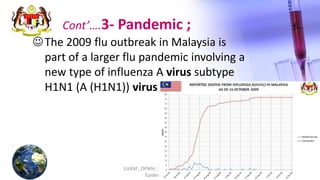
Cont’….3- Pandemic ;
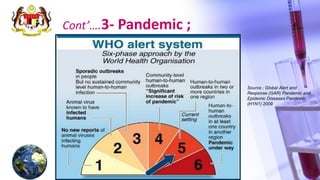
The 2009 flu outbreak in Malaysia is
part of a larger flu pandemic involving a
new type of influenza A virus subtype
H1N1 (A (H1N1)) virus.
ILKKM ; DPMH ; MHBE 2013 Basic
Epidemiology
17
Cont’….3- Pandemic ;
Source ; Global Alert and
Response (GAR) Pandemic and
Epidemic Diseases Pandemic
(H1N1) 2009
ILKKM ; DPMH ; MHBE 2013 Basic
Epidemiology
18
Cont’…. Pandemic stage;
Source ; Illustration of WHO Pandemic Influenza Phases (2009)
ILKKM ; DPMH ; MHBE 2013 Basic Epidemiology 19
Cont’….3- Pandemic ;
The best reading include ;
1. Global Outbreak Alert and Response Network
(GOARN)
2. The International Health Regulations (2005) or
"IHR (2005)"
ILKKM ; DPMH ; MHBE 2013 Basic
Epidemiology
20
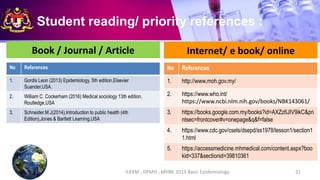
Student reading/ priority references :
Book / Journal / Article
No References
1. Gordis Leon (2013) Epidemiology, 5th edition,Elsevier
Suander,USA.
2. William C. Cockerham (2016) Medical sociology 13th edition,
Routledge,USA
3. Schneider.M.J(2014),Introduction to public health (4th
Edition),Jones & Bartlett Learning,USA
9/10/2020 ILKKM ; DPMH ; MHBE 2013 Basic Epidemiology 21
Internet/ e book/ online
No References
1. http://www.moh.gov.my/
2. https://www.who.int/
https://www.ncbi.nlm.nih.gov/books/NBK143061/
3. https://books.google.com.my/books?id=AXZz6JIV9ikC&pri
ntsec=frontcover#v=onepage&q&f=false
4. https://www.cdc.gov/csels/dsepd/ss1978/lesson1/section1
1.html
5. https://accessmedicine.mhmedical.com/content.aspx?boo
kid=337&sectionid=39810361
ILKKM ; DPMH ; MHBE 2013 Basic
Epidemiology
22
Recommendation for student Independent Learning (IL) ;
Activities Source
1. Search and
download
• https://www.cdc.gov/csels/dsepd/ss1978/lesson1/section8.html
2. Reading, making
short note on
related topic
As above and,
• https://www.cdc.gov/csels/dsepd/ss1978/lesson1/section11.html
• https://www.who.int/csr/disease/swineflu/phase/en/
• https://www.who.int/csr/alertresponse/en/
3. Discus and
answer
Exercise 1.10
• https://www.cdc.gov/csels/dsepd/ss1978/lesson1/section11.html
9/10/2020
ILKKM ; DPMH ; MHBE 2013 Basic
Epidemiology
23

Pattern of disease occurance.pdf

  • 1.
    Institut Latihan KementerianKesihatan Malaysia (ILKKM) Prog : Diploma in Medical And Health Science (DPMH) Year 1 Sem I MHBE 2013 BASIC EPIDEMIOLOGY ; Pattern of disease occurrence (1 Hour)
  • 2.
    Learning outcome (LO); i. Compare occurrence of the endemic, epidemic, and pandemic. ii. Describe WHO phase of pandemic stages. ILKKM ; DPMH ; MHBE 2013 Basic Epidemiology 2
  • 3.
    Content outline; i. Overviewlevel of infectious disease. ii. Endemic. iii. Epidemic. iv. Pandemic and phases pandemic by WHO. ILKKM ; DPMH ; MHBE 2013 Basic Epidemiology 3
  • 4.
    Overview level ofdisease ; • The amount of a particular disease that is usually present in a community is referred to as the baseline or endemic level of the disease. • This level is not necessarily the desired level, which may in fact be zero, but rather is the observed level. • In the absence of intervention and assuming that the level is not high enough to deplete the pool of susceptible persons, the disease may continue to occur at this level indefinitely. ILKKM ; DPMH ; MHBE 2013 Basic Epidemiology 4
  • 5.
    Definition of terminology; i. Endemic ii. Epidemic iii. Pandemic ILKKM ; DPMH ; MHBE 2013 Basic Epidemiology 5
  • 6.
    1- Endemic ; Endemic refers to the constant presence and/or usual prevalence of a disease or infectious agent in a population within a geographic area. Ie; Malaria fever. ILKKM ; DPMH ; MHBE 2013 Basic Epidemiology 6
  • 7.
    Cont’…..1- Endemic ; ILKKM; DPMH ; MHBE 2013 Basic Epidemiology 7
  • 8.
    ILKKM ; DPMH; MHBE 2013 Basic Epidemiology 8 Cont’…..1- Endemic ;
  • 9.
    ILKKM ; DPMH; MHBE 2013 Basic Epidemiology 9
  • 10.
    ILKKM ; DPMH; MHBE 2013 Basic Epidemiology 10 Cont’…..1- Endemic ;
  • 11.
    ILKKM ; DPMH; MHBE 2013 Basic Epidemiology 11 Cont’…..1- Endemic ;
  • 12.
    ILKKM ; DPMH; MHBE 2013 Basic Epidemiology 12 2- Epidemic ;  Epidemic is defined as the occurrence in a community or region of a group of illnesses of similar nature, clearly in excess of normal expectancy , and derived from a common or from a propagated source. Ie; Severe Aacute Respiratory Syndrome(SARS) Pandemic.  Pandemic refers to a worldwide epidemic.  Also refers to an increase, often sudden, in the number of cases of a disease above what is normally expected in that population in that area.  The previous description of epidemics presumes only infectious agents, but non-infectious diseases such as diabetes and obesity exist in epidemic proportion in the U.S
  • 13.
    Cont’ …. 2-Epidemic ; • Epidemics occur when an agent and susceptible hosts are present in adequate numbers, and the agent can be effectively conveyed from a source to the susceptible hosts. • Outbreak carries the same definition of epidemic, but is often used for a more limited geographic area. ie; cholera outbreak at penang. • Cluster refers to an aggregation of cases grouped in place and time that are suspected to be greater than the number expected, even though the expected number may not be known. Ie; Cholera outbreak in London (large population). ILKKM ; DPMH ; MHBE 2013 Basic Epidemiology 13
  • 14.
    More specifically, anepidemic may result from: 1. A recent increase in amount or virulence of the agent, 2. The recent introduction of the agent into a setting where it has not been before, 3. An enhanced mode of transmission so that more susceptible persons are exposed, 4. A change in the susceptibility of the host response to the agent, and/or 5. Factors that increase host exposure or involve introduction through new portals of entry ILKKM ; DPMH ; MHBE 2013 Basic Epidemiology 14 Cont’ …. 2- Epidemic ;
  • 15.
    ILKKM ; DPMH; MHBE 2013 Basic Epidemiology 15 3- Pandemic ; Pandemic refers to an epidemic that has spread over several countries or continents, usually affecting a large number of people.
  • 16.
    ILKKM ; DPMH; MHBE 2013 Basic Epidemiology 16 Cont’….3- Pandemic ; The 2009 flu outbreak in Malaysia is part of a larger flu pandemic involving a new type of influenza A virus subtype H1N1 (A (H1N1)) virus.
  • 17.
    ILKKM ; DPMH; MHBE 2013 Basic Epidemiology 17 Cont’….3- Pandemic ; Source ; Global Alert and Response (GAR) Pandemic and Epidemic Diseases Pandemic (H1N1) 2009
  • 18.
    ILKKM ; DPMH; MHBE 2013 Basic Epidemiology 18 Cont’…. Pandemic stage; Source ; Illustration of WHO Pandemic Influenza Phases (2009)
  • 19.
    ILKKM ; DPMH; MHBE 2013 Basic Epidemiology 19 Cont’….3- Pandemic ;
  • 20.
    The best readinginclude ; 1. Global Outbreak Alert and Response Network (GOARN) 2. The International Health Regulations (2005) or "IHR (2005)" ILKKM ; DPMH ; MHBE 2013 Basic Epidemiology 20
  • 21.
    Student reading/ priorityreferences : Book / Journal / Article No References 1. Gordis Leon (2013) Epidemiology, 5th edition,Elsevier Suander,USA. 2. William C. Cockerham (2016) Medical sociology 13th edition, Routledge,USA 3. Schneider.M.J(2014),Introduction to public health (4th Edition),Jones & Bartlett Learning,USA 9/10/2020 ILKKM ; DPMH ; MHBE 2013 Basic Epidemiology 21 Internet/ e book/ online No References 1. http://www.moh.gov.my/ 2. https://www.who.int/ https://www.ncbi.nlm.nih.gov/books/NBK143061/ 3. https://books.google.com.my/books?id=AXZz6JIV9ikC&pri ntsec=frontcover#v=onepage&q&f=false 4. https://www.cdc.gov/csels/dsepd/ss1978/lesson1/section1 1.html 5. https://accessmedicine.mhmedical.com/content.aspx?boo kid=337&sectionid=39810361
  • 22.
    ILKKM ; DPMH; MHBE 2013 Basic Epidemiology 22
  • 23.
    Recommendation for studentIndependent Learning (IL) ; Activities Source 1. Search and download • https://www.cdc.gov/csels/dsepd/ss1978/lesson1/section8.html 2. Reading, making short note on related topic As above and, • https://www.cdc.gov/csels/dsepd/ss1978/lesson1/section11.html • https://www.who.int/csr/disease/swineflu/phase/en/ • https://www.who.int/csr/alertresponse/en/ 3. Discus and answer Exercise 1.10 • https://www.cdc.gov/csels/dsepd/ss1978/lesson1/section11.html 9/10/2020 ILKKM ; DPMH ; MHBE 2013 Basic Epidemiology 23