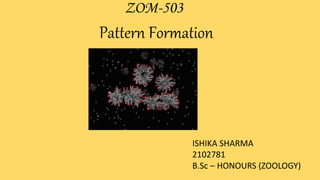
Pattern Formation
ZOM-503
ISHIKA SHARMA
2102781
B.Sc – HONOURS (ZOOLOGY)
about
overview
mechanism
genes
Vertebrate
limb
Vertebrate
limb
Axes
formation
Axes
formation
limb
development
drosophila  Embryonic development is the process by
which a single fertilized egg transforms into a
complex organism.
 It involves several changes including
fertilization, clevage, gastrulation and
organogenesis.
 Precise pattern formation during development
is crucial for the formation of organs and
body structures.
 The formation of the pattern is generally assumed to
result form a primary pattern of morphogen
concentration.
 Embryonic pattern arises from the spatial and
about
overview
mechanism
genes
Vertebrate
limb
Vertebrate
limb
Axes
formation
Axes
formation
Limb
development
drosophila
Pattern formation arises from the
coordination and interplay of several
mechanisms and processes across
molecular, cellular and tissue scales.
Exact mechanisms differ from
organism to organism, but few
fundamental principles involved are-
 Molcecular signalling.
 Cell cell communication.
 Gene expression.
 Cell fate determination.
 Cell migration.
 Feedback loops
 Environmental influence.
about
overview
mechanism
genes
Vertebrate
limb
Vertebrate
limb
Axes
formation
Axes
formation
Limb
development
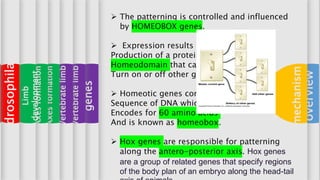
drosophila  The patterning is controlled and influenced
by HOMEOBOX genes.
 Expression results in
Production of a protein,
Homeodomain that can
Turn on or off other genes
 Homeotic genes contain
Sequence of DNA which
Encodes for 60 amino acids
And is known as homeobox.
 Hox genes are responsible for patterning
along the antero-posterior axis. Hox genes
are a group of related genes that specify regions
of the body plan of an embryo along the head-tail
about
overview
mechanism
genes
Vertebrate
limb
Vertebrate
limb
Axes
formation
Axes
formation
Axes
formation
drosophila
drosophila
Formation of vertebrate limb functions in a
three dimensional coordinate system.
 first dimension- proximal distal axis
(shoulder-
finger or hip-toe).
 second dimension- anterior-posterior
axis (thumb to
pinkie).
 third dimension- dorsal ventral axis
(palm to
knuckles).
Proliferation of mesenchymal cells from
somatic
Region of lateral plate mesoderm causes the
limb
Bud to bulge outwards.
about
overview
mechanism
genes
Vertebrate
limb
Vertebrate
limb
Axes
formation
Axes
formation
Limb
development
drosophila
drosophila
Tbx 5 transcription factors- forelimbs.
Tbx 4 transcription factors- hindlimbs.
about
overview
mechanism
genes
Vertebrate
limb
Vertebrate
limb
Axes
formation
Axes
formation
Limb
development
drosophila
drosophila
1. PROXIMAL- DISTAL AXIS.
 AER secretes fibroblast growth factors-
FGF4 & FGF8 which promotes elongation of
limb.
 FGF signalling activates expression of
specific transcription factors, including Hox
genes(Hoxd 13 & Hoxa 13) which are
responsible for patterning and determining
identity of different segments.
2. ANTERIOR- POSTERIOR AXIS.
 ZPA produces sonic hedgehog (SHH) a
signalling molecule.
 SHH establishes a gradient that influences
the expression of transcription factors like
Hoxd 13, which helps in determining digit
about
overview
mechanism
genes
Vertebrate
limb
Vertebrate
limb
Axes
formation
Limb
development
drosophila 3. DORSAL- VENTRAL AXIS-
 Dorsal and ventral ectoderm produces
signaling molecules including Wnts and
BMPs.
 High BMP activity promotes dorsal identity
and low BMP activity allows for ventral
identity.
 LMX1B is a transcription factor involved in
dorsal development while Engrailed 1 in
ventral formation.
FORMATION OF DIGITS AND JOINTS-
 Mesenchymal cells condense into distinct
digital plates.
 Apoptosis and interdigital tissue regression
create spaces between digits and form
joints.
 Chondrogenesis leads to the formation of
about
overview
mechanism
genes
Vertebtate
limb
Vertebrate
limb
Axes
formation
Axes
formation
development
drosophila
about
overview
mechanism
genes
Vertebrate
limb
Vertrebrate
limb
Axes
formation
Axes
formation
Limb
development
drosophila  Maternal genes like bicoid and nanos
establish the initial front to back axis.
 Gap genes divide the embryo into regions.
 Hox genes provide the final identity to each
segment along the axis.
 Morphogens like Dpp and Wnt create
concentration gradients guiding cell
differentiation.
 Notch delta signalling defines boundaries and
maintains segment identity.
 Hedgehog and notch pathways coordinate
cell fate and tissue differentiation.
about
overview
mechanism
genes
Vertebrate
limb
Vertebrate
limb
Axes
formation
Axes
formation
Limb
development
drosophila
about
overview
mechanism
preparation
preparation
Sanger’s
method
Sanger’s
method
Edman’s
method
Edman’s
method
limitations
Mass
spectrometry
references
DAV university open study material.
Articles from frontiers’ website.
Developmental biology – scott and gilbert.
Animation videos by - rethink biology(youtube)
- medizzy medicos(website).
THANK YOU.

Pattern formation