Metal casting and joining process


 Avoid turbulent entrainment
 (the critical velocity requirement)

                 Papineni.Satheesh                      BVB0911002
                 Bushan Yadav.B                         BVB0911003


Module leader:
M.r. K.N. Ganapathi
MSRSAS, Bangalore
                           M. S. Ramaiah School of Advanced Studies   1
Contents

 Maximum velocity requirement
 The `no fall' requirement
 Surface tension controlled Filling
 Filling system design
    Gravity pouring of open-top moulds
    Gravity pouring of closed Moulds
 Pouring basin and down sprue design
 Horizontal transfer Casting


                      M. S. Ramaiah School of Advanced Studies   2
Maximum velocity requirement


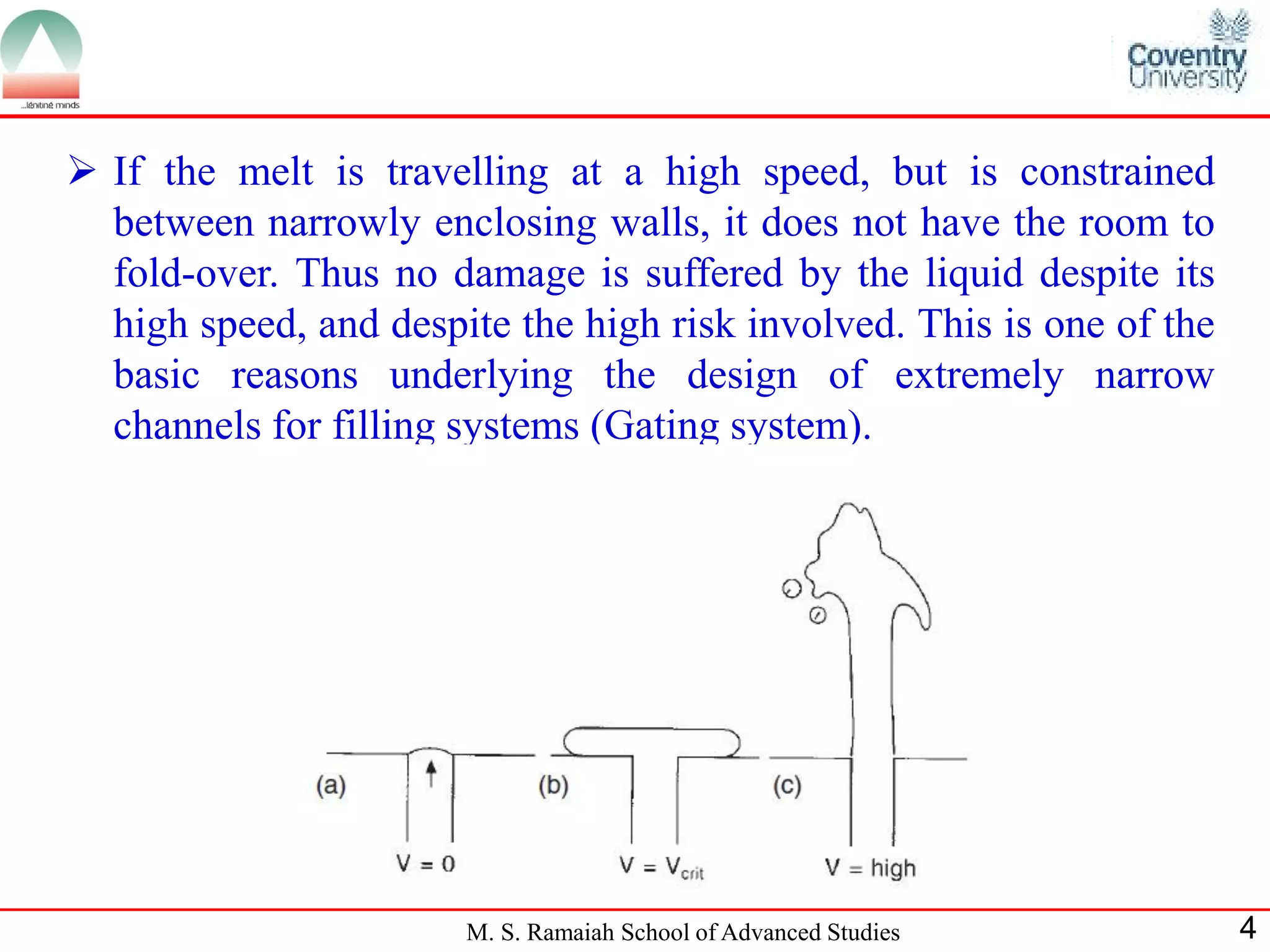
 The key aspect of the critical velocity is that at velocities
  less than the critical velocity the surface is safe. Above the
  critical velocity there is the danger of entrainment damage.
  The criterion is a necessary but not sufficient condition for
  entrainment damage.
 If the whole, extensive surface of a liquid were moving
  upwards at a uniform speed, but exceeding the critical
  velocity, clearly no entrainment would occur.


                      M. S. Ramaiah School of Advanced Studies     3
 If the melt is travelling at a high speed, but is constrained
  between narrowly enclosing walls, it does not have the room to
  fold-over. Thus no damage is suffered by the liquid despite its
  high speed, and despite the high risk involved. This is one of the
  basic reasons underlying the design of extremely narrow
  channels for filling systems (Gating system).


                       M. S. Ramaiah School of Advanced Studies        4
The `no fall' requirement

 the no-fall requirement applies to the design of the
  filling system downstream of the base of the sprue.
 The critical fall heights for all liquid metals are in the
  range 3 to 15 mm.
 For example, if liquid aluminium is allowed to fall
  more than 12.5mm then it exceeds the critical 0.5m/s.
 with a good sprue and pouring basin design this initial
  fall damage can be reduced to a minimum.
 The `no fall' requirement may also exclude some of
  those filling methods in which the metal slides down a
  face inside the mould cavity, such as some tilt casting
  type operations.
                    M. S. Ramaiah School of Advanced Studies   5
 Narrow filling system geometries are valuable in their
  action to conserve the liquid as a coherent mass, and so
  acting to push the air out of the system ahead of the
  liquid.
 A good filling action, pushing the air ahead of the
  liquid front as a piston in a cylinder, is a critically
  valuable action. Such systems deserve a special name
  such as perhaps `one pass filling (OPF) designs'


                    M. S. Ramaiah School of Advanced Studies   6
Surface tension controlled filling
 This is interesting situation that the liquid may not be able to enter the
   mould at all.
 This is to be expected if the pressure is too low to force melt into a narrow
   section. It is an effect due to surface tension.
 If the liquid surface is forced to take up a sharp curvature to enter a non-
   wetted mould then it will be subject to a repulsive force that will resist the
   entry of the metal.
 Even if the metal enters, it will still be subject to the continuing resistance
   of surface tension, which will tend to reverse the flow of metal, causing it
   to empty out of the mould if there is any reduction in the filling pressure.
   These are important effects in narrow section moulds (i.e. thin-section
   castings) and have to be taken into account.

                             M. S. Ramaiah School of Advanced Studies               7
Filling system design

 The liquid metal as it travels through the filling system
  indicates that most of the damage is done to castings by
  poor filling system design.

 The filling system design can be of two types:
      Gravity pouring of open-top moulds.

       Gravity pouring of closed moulds.


                    M. S. Ramaiah School of Advanced Studies   8
Gravity pouring of open-top moulds

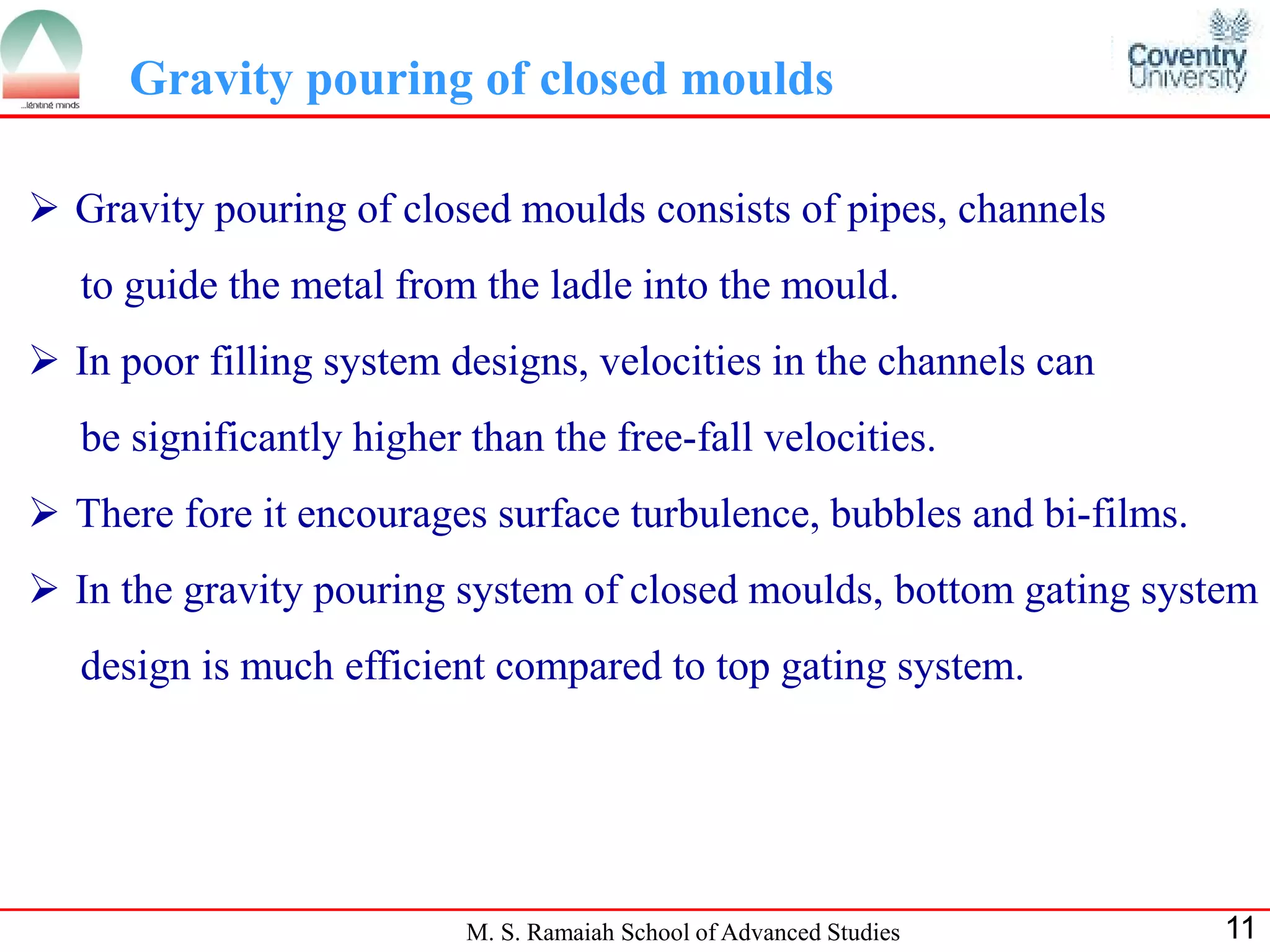
 Generally moulds consists of cope and drag but in open-top moulds
   only drag is required. This means the mould cavity is open so that
   metal can be poured directly.


 The skill of the foundry man plays vital role in the gravity
   pouring system


                         M. S. Ramaiah School of Advanced Studies       9
M. S. Ramaiah School of Advanced Studies   10
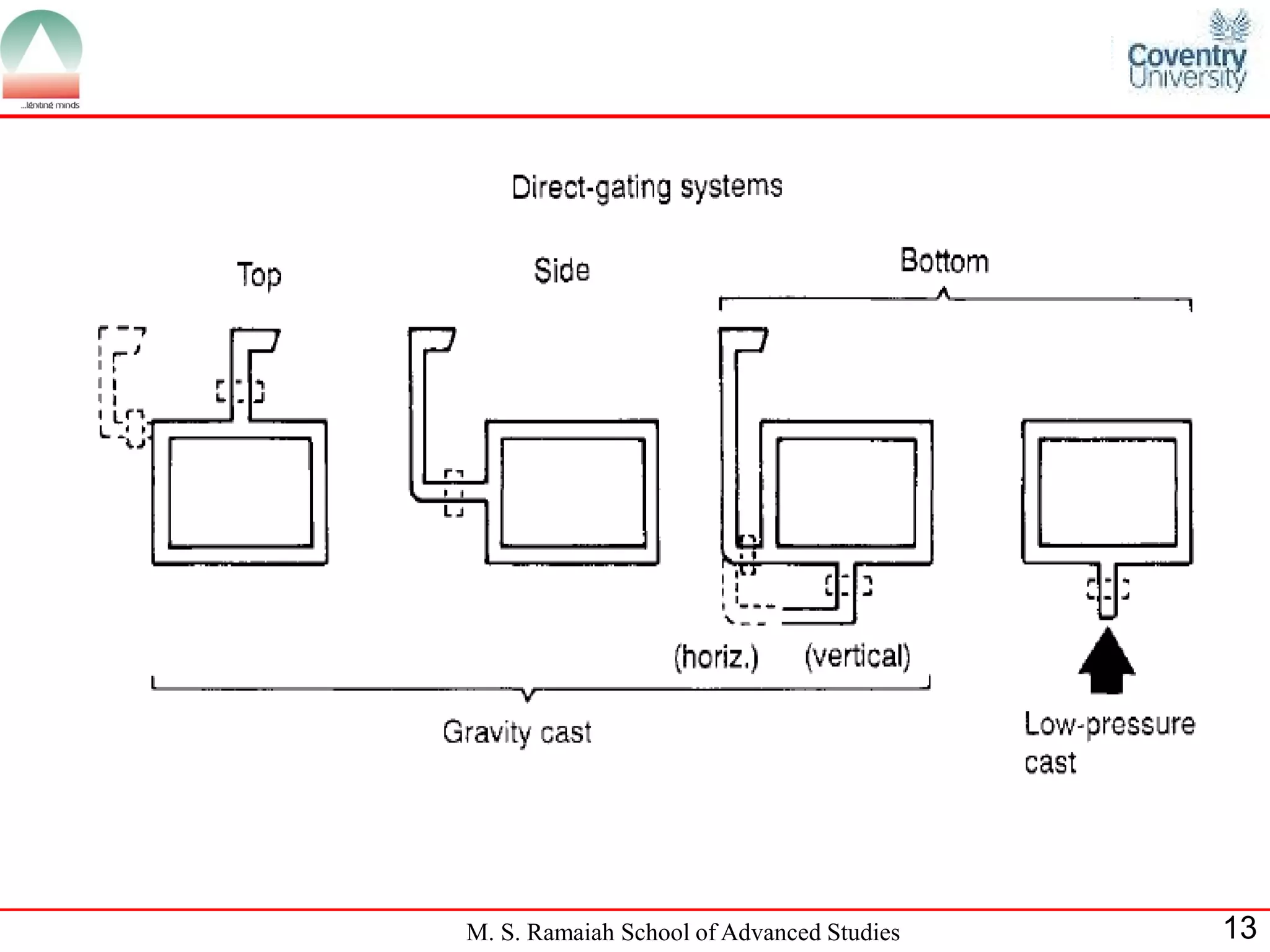
Gravity pouring of closed moulds

 Gravity pouring of closed moulds consists of pipes, channels
   to guide the metal from the ladle into the mould.
 In poor filling system designs, velocities in the channels can
   be significantly higher than the free-fall velocities.
 There fore it encourages surface turbulence, bubbles and bi-films.
 In the gravity pouring system of closed moulds, bottom gating system
   design is much efficient compared to top gating system.


                           M. S. Ramaiah School of Advanced Studies    11
M. S. Ramaiah School of Advanced Studies   12
M. S. Ramaiah School of Advanced Studies   13
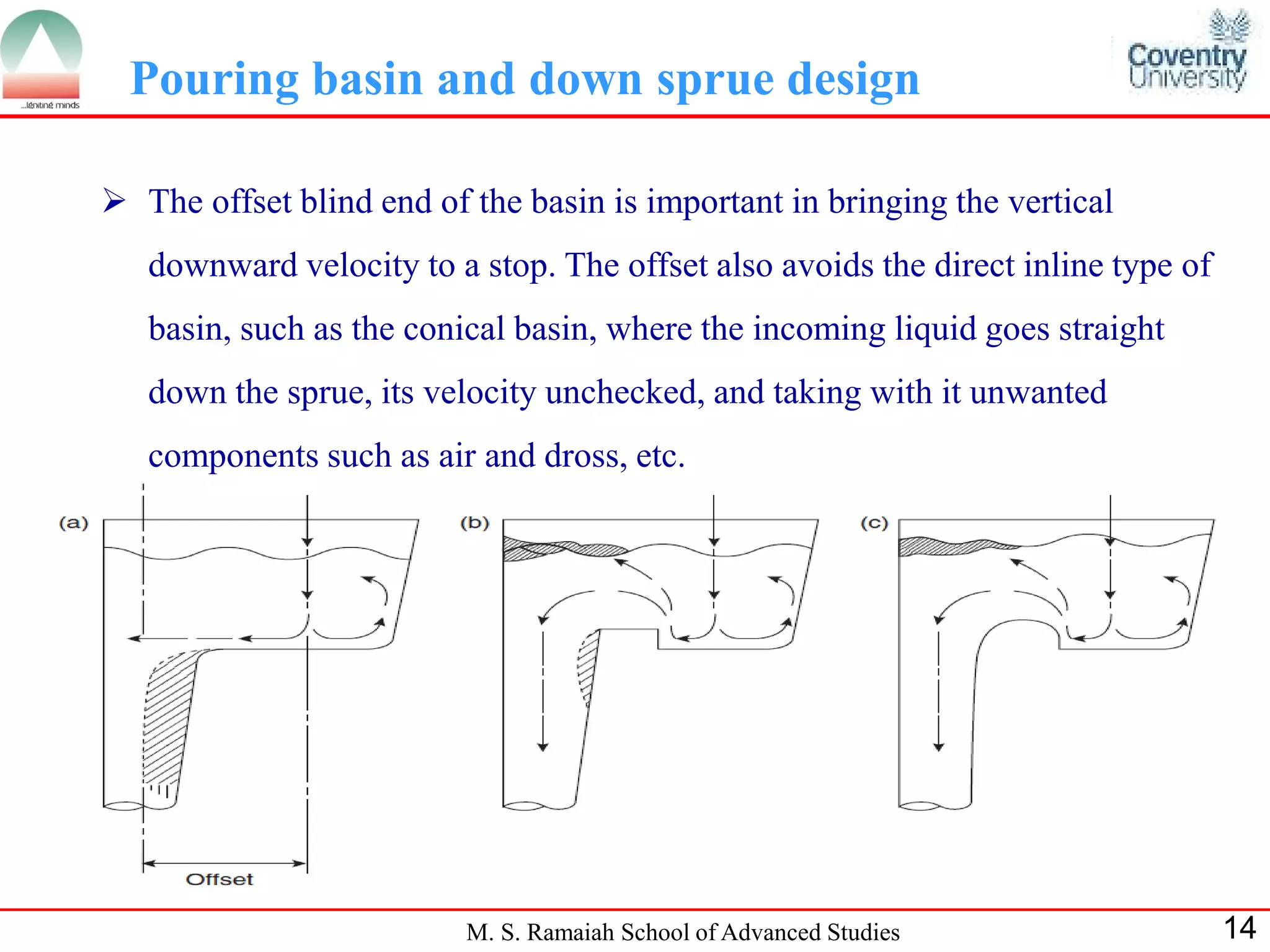
Pouring basin and down sprue design

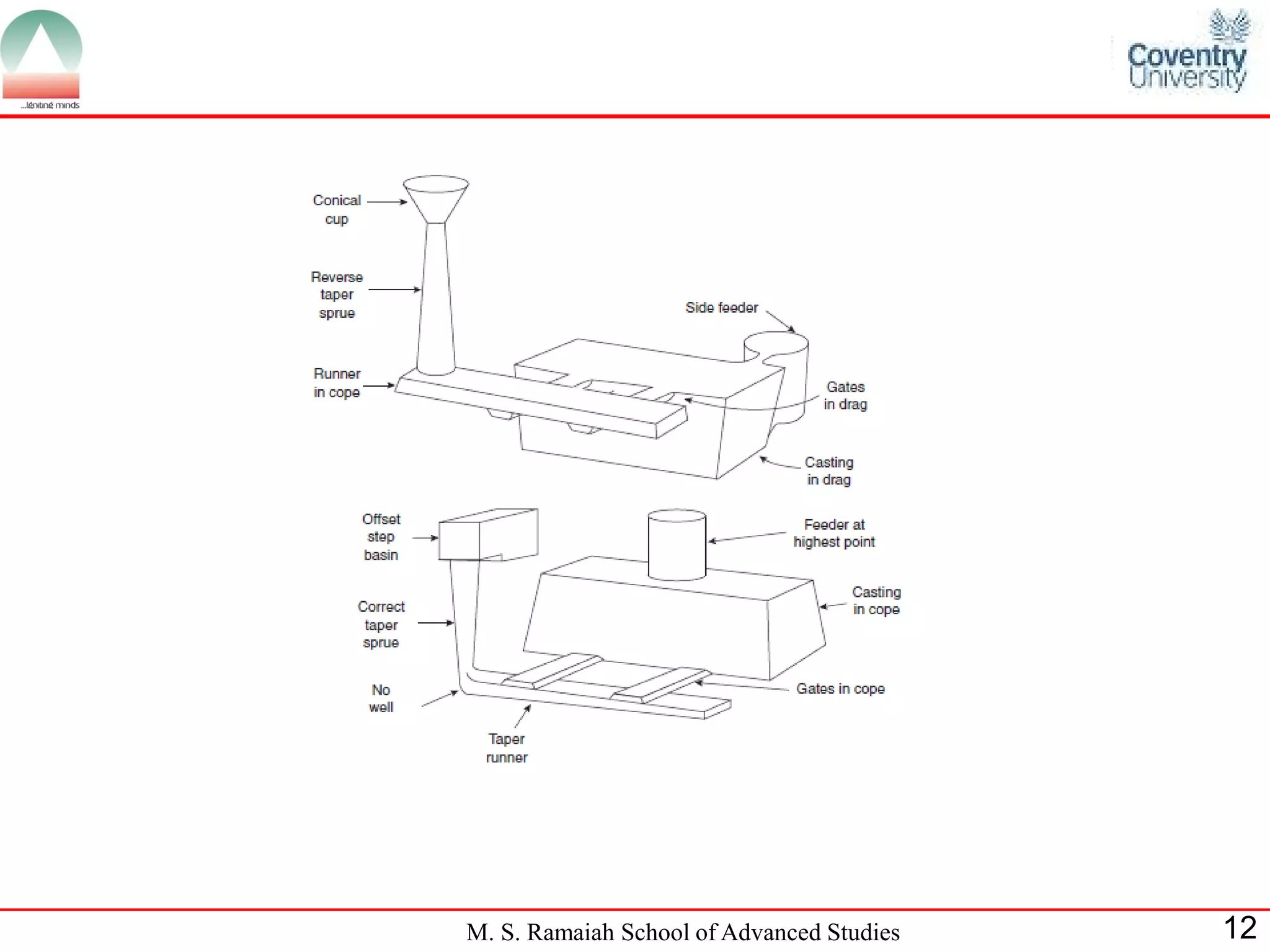
 The offset blind end of the basin is important in bringing the vertical
   downward velocity to a stop. The offset also avoids the direct inline type of
   basin, such as the conical basin, where the incoming liquid goes straight
   down the sprue, its velocity unchecked, and taking with it unwanted
   components such as air and dross, etc.


                          M. S. Ramaiah School of Advanced Studies                 14
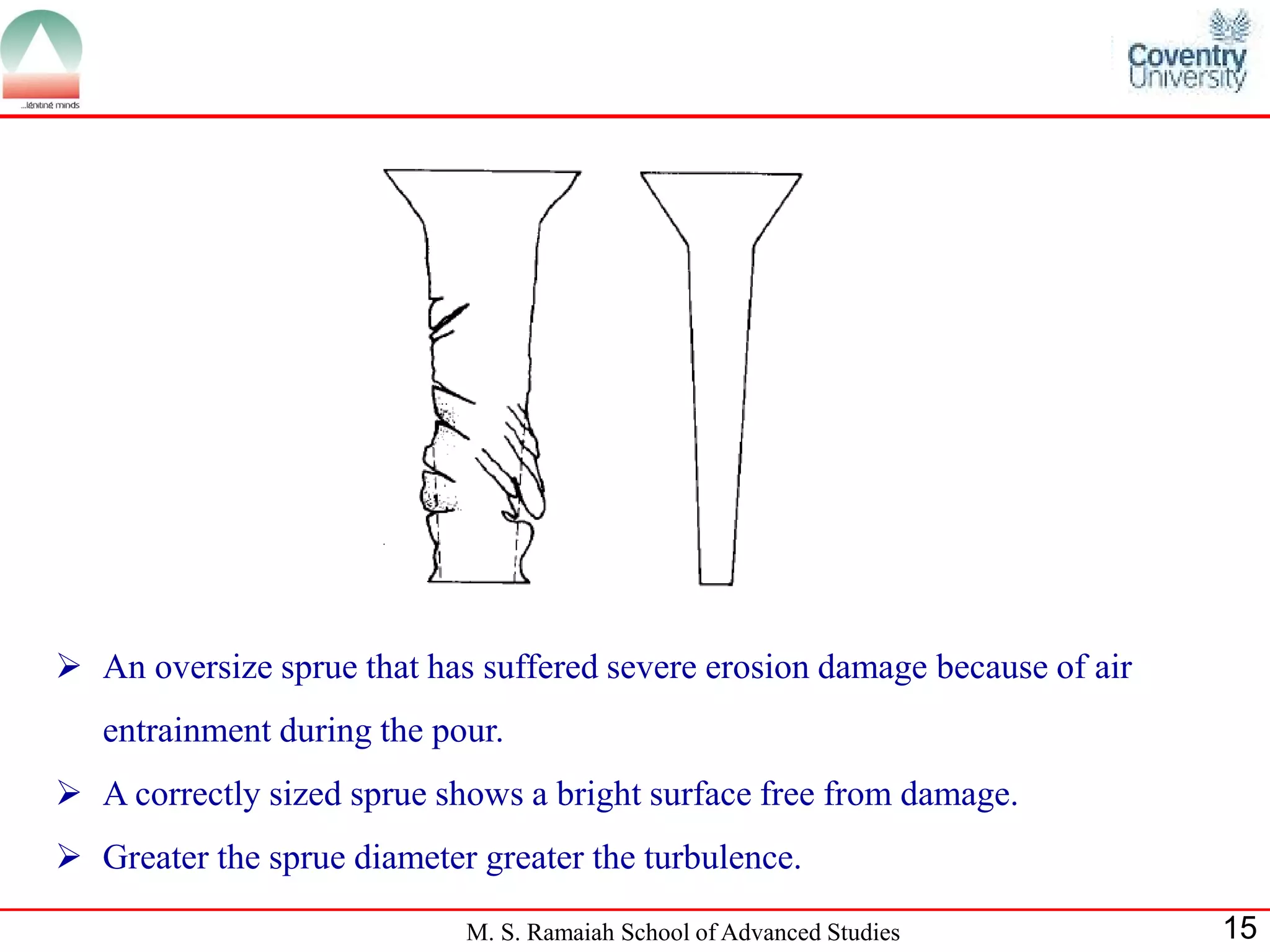
 An oversize sprue that has suffered severe erosion damage because of air
   entrainment during the pour.
 A correctly sized sprue shows a bright surface free from damage.
 Greater the sprue diameter greater the turbulence.

                            M. S. Ramaiah School of Advanced Studies         15
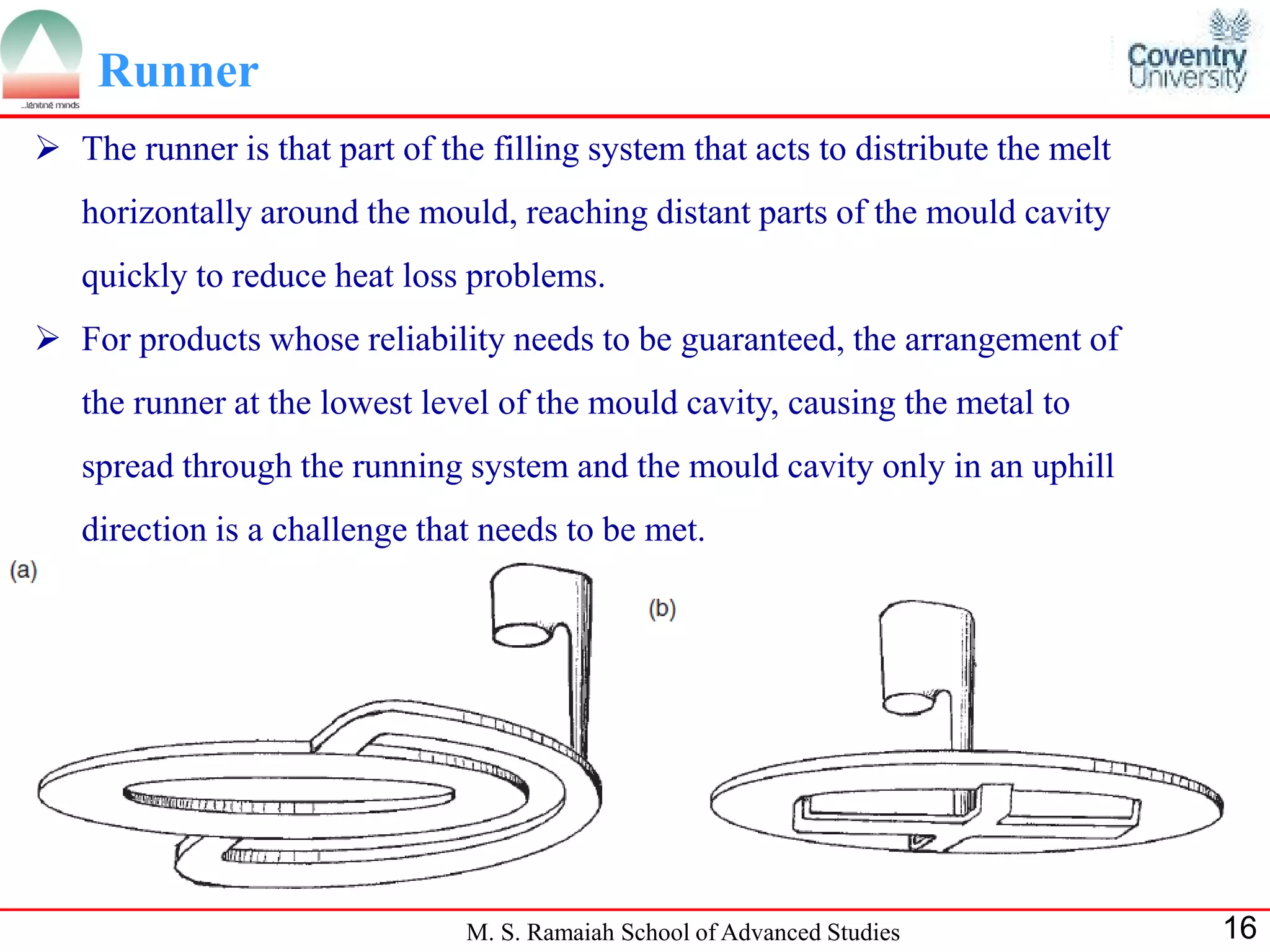
Runner
 The runner is that part of the filling system that acts to distribute the melt
   horizontally around the mould, reaching distant parts of the mould cavity
   quickly to reduce heat loss problems.
 For products whose reliability needs to be guaranteed, the arrangement of
   the runner at the lowest level of the mould cavity, causing the metal to
   spread through the running system and the mould cavity only in an uphill
   direction is a challenge that needs to be met.


                                M. S. Ramaiah School of Advanced Studies           16
Horizontal transfer Casting
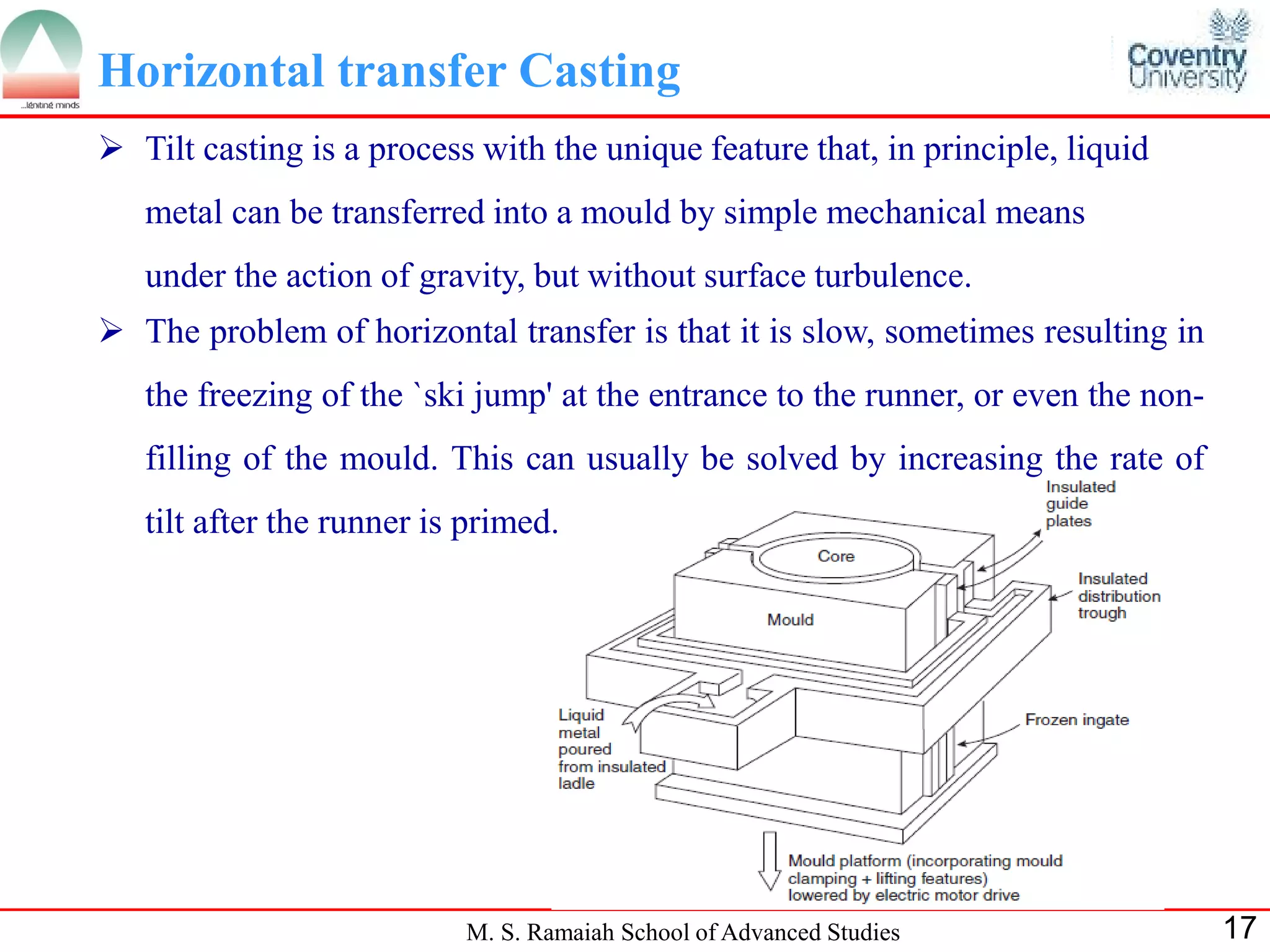
 Tilt casting is a process with the unique feature that, in principle, liquid
   metal can be transferred into a mould by simple mechanical means
   under the action of gravity, but without surface turbulence.
 The problem of horizontal transfer is that it is slow, sometimes resulting in
   the freezing of the `ski jump' at the entrance to the runner, or even the non-
   filling of the mould. This can usually be solved by increasing the rate of
   tilt after the runner is primed.


                           M. S. Ramaiah School of Advanced Studies                 17
References


1. John Campbell, Castings Practice, The 10 Rules of Castings,
   published 2004.


                       M. S. Ramaiah School of Advanced Studies   18

Avoid turbulent entrainment

  • 1.
    Metal casting andjoining process Avoid turbulent entrainment (the critical velocity requirement) Papineni.Satheesh BVB0911002 Bushan Yadav.B BVB0911003 Module leader: M.r. K.N. Ganapathi MSRSAS, Bangalore M. S. Ramaiah School of Advanced Studies 1
  • 2.
    Contents  Maximum velocityrequirement  The `no fall' requirement  Surface tension controlled Filling  Filling system design  Gravity pouring of open-top moulds  Gravity pouring of closed Moulds  Pouring basin and down sprue design  Horizontal transfer Casting M. S. Ramaiah School of Advanced Studies 2
  • 3.
    Maximum velocity requirement The key aspect of the critical velocity is that at velocities less than the critical velocity the surface is safe. Above the critical velocity there is the danger of entrainment damage. The criterion is a necessary but not sufficient condition for entrainment damage.  If the whole, extensive surface of a liquid were moving upwards at a uniform speed, but exceeding the critical velocity, clearly no entrainment would occur. M. S. Ramaiah School of Advanced Studies 3
  • 4.
     If themelt is travelling at a high speed, but is constrained between narrowly enclosing walls, it does not have the room to fold-over. Thus no damage is suffered by the liquid despite its high speed, and despite the high risk involved. This is one of the basic reasons underlying the design of extremely narrow channels for filling systems (Gating system). M. S. Ramaiah School of Advanced Studies 4
  • 5.
    The `no fall'requirement  the no-fall requirement applies to the design of the filling system downstream of the base of the sprue.  The critical fall heights for all liquid metals are in the range 3 to 15 mm.  For example, if liquid aluminium is allowed to fall more than 12.5mm then it exceeds the critical 0.5m/s.  with a good sprue and pouring basin design this initial fall damage can be reduced to a minimum.  The `no fall' requirement may also exclude some of those filling methods in which the metal slides down a face inside the mould cavity, such as some tilt casting type operations. M. S. Ramaiah School of Advanced Studies 5
  • 6.
     Narrow fillingsystem geometries are valuable in their action to conserve the liquid as a coherent mass, and so acting to push the air out of the system ahead of the liquid.  A good filling action, pushing the air ahead of the liquid front as a piston in a cylinder, is a critically valuable action. Such systems deserve a special name such as perhaps `one pass filling (OPF) designs' M. S. Ramaiah School of Advanced Studies 6
  • 7.
    Surface tension controlledfilling  This is interesting situation that the liquid may not be able to enter the mould at all.  This is to be expected if the pressure is too low to force melt into a narrow section. It is an effect due to surface tension.  If the liquid surface is forced to take up a sharp curvature to enter a non- wetted mould then it will be subject to a repulsive force that will resist the entry of the metal.  Even if the metal enters, it will still be subject to the continuing resistance of surface tension, which will tend to reverse the flow of metal, causing it to empty out of the mould if there is any reduction in the filling pressure. These are important effects in narrow section moulds (i.e. thin-section castings) and have to be taken into account. M. S. Ramaiah School of Advanced Studies 7
  • 8.
    Filling system design The liquid metal as it travels through the filling system indicates that most of the damage is done to castings by poor filling system design.  The filling system design can be of two types:  Gravity pouring of open-top moulds.  Gravity pouring of closed moulds. M. S. Ramaiah School of Advanced Studies 8
  • 9.
    Gravity pouring ofopen-top moulds  Generally moulds consists of cope and drag but in open-top moulds only drag is required. This means the mould cavity is open so that metal can be poured directly.  The skill of the foundry man plays vital role in the gravity pouring system M. S. Ramaiah School of Advanced Studies 9
  • 10.
    M. S. RamaiahSchool of Advanced Studies 10
  • 11.
    Gravity pouring ofclosed moulds  Gravity pouring of closed moulds consists of pipes, channels to guide the metal from the ladle into the mould.  In poor filling system designs, velocities in the channels can be significantly higher than the free-fall velocities.  There fore it encourages surface turbulence, bubbles and bi-films.  In the gravity pouring system of closed moulds, bottom gating system design is much efficient compared to top gating system. M. S. Ramaiah School of Advanced Studies 11
  • 12.
    M. S. RamaiahSchool of Advanced Studies 12
  • 13.
    M. S. RamaiahSchool of Advanced Studies 13
  • 14.
    Pouring basin anddown sprue design  The offset blind end of the basin is important in bringing the vertical downward velocity to a stop. The offset also avoids the direct inline type of basin, such as the conical basin, where the incoming liquid goes straight down the sprue, its velocity unchecked, and taking with it unwanted components such as air and dross, etc. M. S. Ramaiah School of Advanced Studies 14
  • 15.
     An oversizesprue that has suffered severe erosion damage because of air entrainment during the pour.  A correctly sized sprue shows a bright surface free from damage.  Greater the sprue diameter greater the turbulence. M. S. Ramaiah School of Advanced Studies 15
  • 16.
    Runner  The runneris that part of the filling system that acts to distribute the melt horizontally around the mould, reaching distant parts of the mould cavity quickly to reduce heat loss problems.  For products whose reliability needs to be guaranteed, the arrangement of the runner at the lowest level of the mould cavity, causing the metal to spread through the running system and the mould cavity only in an uphill direction is a challenge that needs to be met. M. S. Ramaiah School of Advanced Studies 16
  • 17.
    Horizontal transfer Casting Tilt casting is a process with the unique feature that, in principle, liquid metal can be transferred into a mould by simple mechanical means under the action of gravity, but without surface turbulence.  The problem of horizontal transfer is that it is slow, sometimes resulting in the freezing of the `ski jump' at the entrance to the runner, or even the non- filling of the mould. This can usually be solved by increasing the rate of tilt after the runner is primed. M. S. Ramaiah School of Advanced Studies 17
  • 18.
    References 1. John Campbell,Castings Practice, The 10 Rules of Castings, published 2004. M. S. Ramaiah School of Advanced Studies 18