Financial Forecasting and Planning Summit, IE Group
Patrick Peters-Buhler, Director GBS, BofAML
Omni Hotel, 24 February 2012, San Diego, California
2
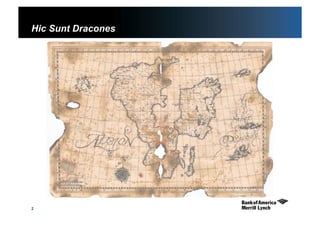
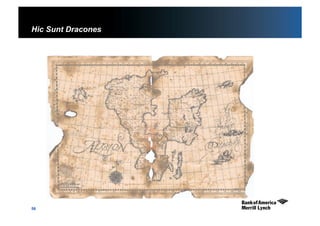
Hic Sunt Dracones
3
….Hic Sunt Dracones… … Here Be Dragons!
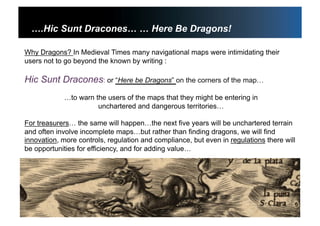
Why Dragons? In Medieval Times many navigational maps were intimidating their
users not to go beyond the known by writing :
Hic Sunt Dracones: or “Here be Dragons” on the corners of the map…
…to warn the users of the maps that they might be entering in
unchartered and dangerous territories…
For treasurers… the same will happen…the next five years will be unchartered terrain
and often involve incomplete maps…but rather than finding dragons, we will find
innovation, more controls, regulation and compliance, but even in regulations there will
be opportunities for efficiency, and for adding value…
4
What are we talking about today?
Short Introduction – Speaker and GBS
Where is cash management heading in the next 5 years?
Two Broad Trends in Treasury ….(and many imaginary Dragons)
Trend 1. The Developments in Innovation
I.  SWIFT… the internationalization continues,
II.  Mobile Payments & Receivables
III.  STP and HTH
IV.  Decisions on Centralization and Outsourcing
Trend 2. The Developments in Regulation
I.  SEPA and other standardization
II.  Digitalization and Electronic Invoicing
III.  The IRS enters Cash Management
Managing the Future … is Managing Innovation and Managing Regulation.
Don’t be intimidated by the unchartered roadmap of the next 5 years!
5
Introduction Patrick Peters-Buhler
Patrick has been involved in treasury management and capital markets for over 15 years. His
experiences includes positions as a CFO, Director of Finance, Interim Manager, General Manager and
as a Corporate Treasurer in 8 countries in global industries including Pharmaceuticals, Food
Ingredients, Consumer Products, (Retail and Direct Selling) Manufacturing, and Financial Services.
Patrick joined BofAML in 2011 after a Career in the US and several Latin American Countries, Including
Mexico, Argentina, Uruguay, Peru, Chile and Colombia.
He is a Certified Treasury Professional by the AFP. He has been chairing and participating in
Conferences in LATAM, USA and Europe on issues of Treasury, Liquidity Management, Cash and Risk
Management, among others with Eurofinance, EI Group, FIBA and IQPC. He is a Senior Tutor for
Eurofinance for Treasury and Risk management Courses in the Americas and Europe. He was a
contributor to the Economist Intelligence Unit (EIU), and taught at Universities in New York, Lima,
Buenos Aires and Mexico City. He has been the President of the Latin America Treasury Association.
Patrick, a native of the Netherlands, has lived 25 years abroad, holding Degrees from The Free
University of Amsterdam, Johns Hopkins University (SAIS - School of Advanced International Studies)
and has attended Post Graduate Studies at the London School of Economics, London, UK, and The
“Instituto Universitario Europeo in Florence, Italy.
He is based at the Miami and Mexico City Offices of BofAML.
6
Introduction GBS
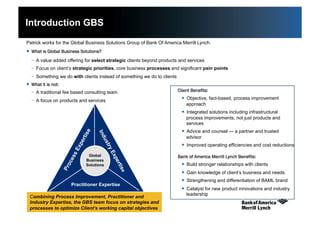
Patrick works for the Global Business Solutions Group of Bank Of America Merrill Lynch.
  What is Global Business Solutions?
-  A value added offering for select strategic clients beyond products and services
-  Focus on client’s strategic priorities, core business processes and significant pain points
-  Something we do with clients instead of something we do to clients
  What it is not:
-  A traditional fee based consulting team
-  A focus on products and services
Combining Process Improvement, Practitioner and
Industry Expertise, the GBS team focus on strategies and
processes to optimize Client’s working capital objectives
Practitioner Expertise
Global
Business
Solutions
  Client Benefits:
  Objective, fact-based, process improvement
approach
  Integrated solutions including infrastructural
process improvements, not just products and
services
  Advice and counsel — a partner and trusted
advisor
  Improved operating efficiencies and cost reductions
  Bank of America Merrill Lynch Benefits:
  Build stronger relationships with clients
  Gain knowledge of client’s business and needs
  Strengthening and differentiation of BAML brand
  Catalyst for new product innovations and industry
leadership
7
Where is Cash Management heading in the next 5 years?
… more Innovation and Regulation.
8
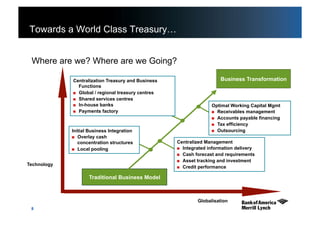
Where are we? Where are we Going?
Traditional Business ModelTraditional Business Model
Business Transformation
Globalisation
Centralization Treasury and Business
Functions
■  Global / regional treasury centres
■  Shared services centres
■  In-house banks
■  Payments factory
Technology
Initial Business Integration
■  Overlay cash
concentration structures
■  Local pooling
Centralized Management
■  Integrated information delivery
■  Cash forecast and requirements
■  Asset tracking and investment
■  Credit performance
Optimal Working Capital Mgmt
■  Receivables management
■  Accounts payable financing
■  Tax efficiency
■  Outsourcing
Towards a World Class Treasury…
9
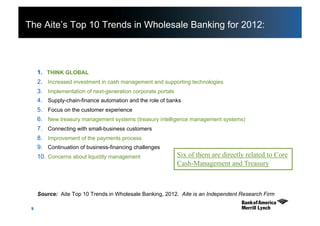
The Aite’s Top 10 Trends in Wholesale Banking for 2012:
1.  THINK GLOBAL
2.  Increased investment in cash management and supporting technologies
3.  Implementation of next-generation corporate portals
4.  Supply-chain-finance automation and the role of banks
5.  Focus on the customer experience
6.  New treasury management systems (treasury intelligence management systems)
7.  Connecting with small-business customers
8.  Improvement of the payments process
9.  Continuation of business-financing challenges
10.  Concerns about liquidity management
Source: Aite Top 10 Trends in Wholesale Banking, 2012. Aite is an Independent Research Firm
Six of them are directly related to Core
Cash-Management and Treasury
10
Trend 1. The Development in Innovation,
(and the transformation of Communication.
We see several tendencies in innovation that will become
important for Treasury over the next years. The main ones are :
1.  SWIFT … the standardization continues.
2.  Mobile Payments and Receivables
3.  STP and HTH
4.  Decisions on Centralization and Outsourcing
1. SWIFT … the Standardization continues.
12
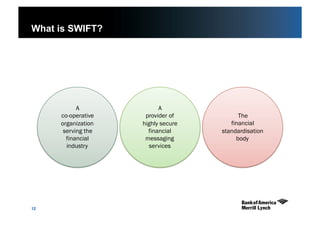
What is SWIFT?
A
co-operative
organization
serving the
financial
industry
A
provider of
highly secure
financial
messaging
services
The
financial
standardisation
body
13
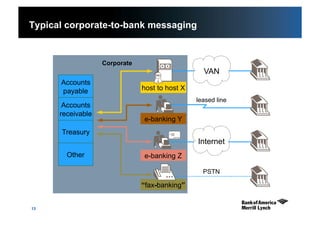
e-banking Y
host to host X
e-banking Z
VAN
“fax-banking”
Internet
leased line
PSTN
Corporate
Accounts
payable
Accounts
receivable
Treasury
Other
Typical corporate-to-bank messaging
14
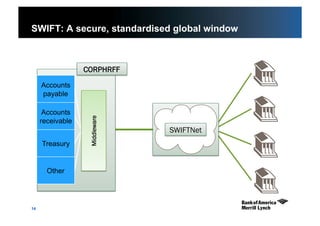
SWIFT: A secure, standardised global window
Accounts
payable
Accounts
receivable
Treasury
Other
CORPHRFF
Middleware
SWIFTNet
15
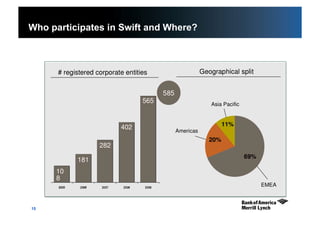
Who participates in Swift and Where?
2. Mobile Payments & Receivables
17
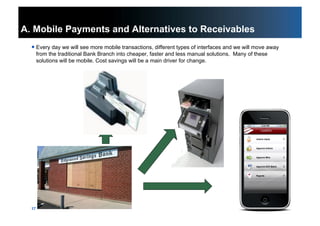
A. Mobile Payments and Alternatives to Receivables
 Every day we will see more mobile transactions, different types of interfaces and we will move away
from the traditional Bank Branch into cheaper, faster and less manual solutions. Many of these
solutions will be mobile. Cost savings will be a main driver for change.
18
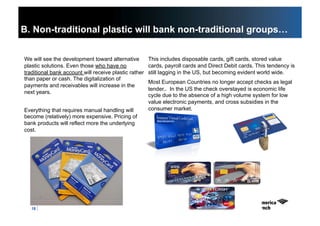
B. Non-traditional plastic will bank non-traditional groups…
We will see the development toward alternative
plastic solutions. Even those who have no
traditional bank account will receive plastic rather
than paper or cash. The digitalization of
payments and receivables will increase in the
next years.
Everything that requires manual handling will
become (relatively) more expensive. Pricing of
bank products will reflect more the underlying
cost.
This includes disposable cards, gift cards, stored value
cards, payroll cards and Direct Debit cards. This tendency is
still lagging in the US, but becoming evident world wide.
Most European Countries no longer accept checks as legal
tender.. In the US the check overstayed is economic life
cycle due to the absence of a high volume system for low
value electronic payments, and cross subsidies in the
consumer market.
19
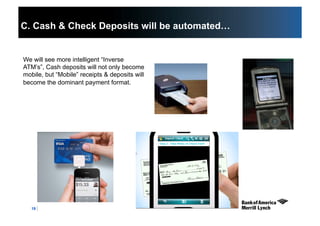
C. Cash & Check Deposits will be automated…
We will see more intelligent “Inverse
ATM’s”, Cash deposits will not only become
mobile, but “Mobile” receipts & deposits will
become the dominant payment format.
20
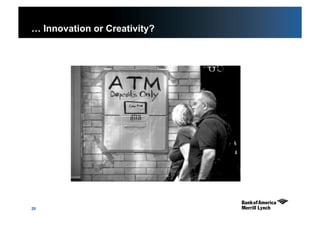
… Innovation or Creativity?
3. Straight-Trough-Processing and Host-to-Host
22
How do we improve security of transactions
and obtain better information?
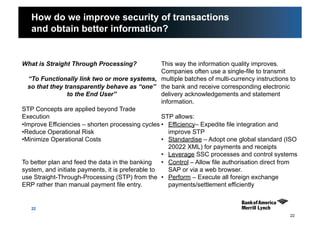
What is Straight Through Processing?
“To Functionally link two or more systems,
so that they transparently behave as “one”
to the End User”
STP Concepts are applied beyond Trade
Execution
• Improve Efficiencies – shorten processing cycles
• Reduce Operational Risk
• Minimize Operational Costs
To better plan and feed the data in the banking
system, and initiate payments, it is preferable to
use Straight-Through-Processing (STP) from the
ERP rather than manual payment file entry.
This way the information quality improves.
Companies often use a single-file to transmit
multiple batches of multi-currency instructions to
the bank and receive corresponding electronic
delivery acknowledgements and statement
information.
STP allows:
•  Efficiency– Expedite file integration and
improve STP
•  Standardise – Adopt one global standard (ISO
20022 XML) for payments and receipts
•  Leverage SSC processes and control systems
•  Control – Allow file authorisation direct from
SAP or via a web browser.
•  Perform – Execute all foreign exchange
payments/settlement efficiently
22
23
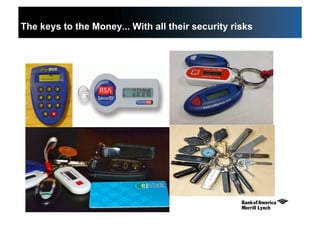
The keys to the Money... With all their security risks
24
Retail
broker
HTML/XML, Streaming, Wireless
Private
investor
Corporate
treasurer
Clearing
& settlement
Order mgmt Market data mgmt
Accounting
Trade
capture
Proprietary
systems
Risk mgmt
Credit mgmt
Portfolio
mgmt
In-house dealers
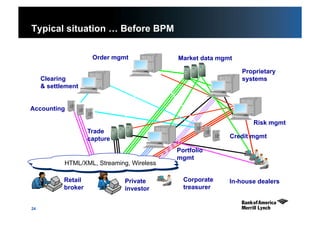
Typical situation … Before BPM
25
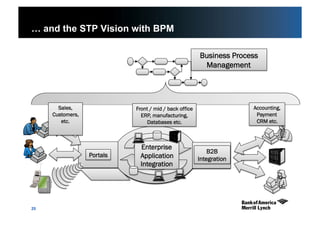
… and the STP Vision with BPM
Enterprise
Application
Integration
Portals
B2B
Integration
Business Process
Management
Sales,
Customers,
etc.
Front / mid / back office
ERP, manufacturing,
Databases etc.
Accounting,
Payment
CRM etc.
26
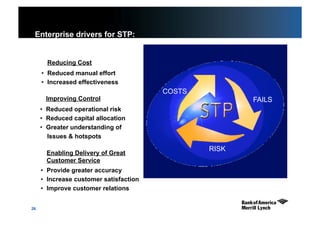
Enterprise drivers for STP:
FAILS
RISK
COSTS
Improving Control
•  Reduced operational risk
•  Reduced capital allocation
•  Greater understanding of
Issues & hotspots
Reducing Cost
•  Reduced manual effort
•  Increased effectiveness
Enabling Delivery of Great
Customer Service
•  Provide greater accuracy
•  Increase customer satisfaction
•  Improve customer relations
27
The STP Vision
 Seamless communication among parties
 Concurrent, not sequential, exchange of information
 Significant real-time processing, less batch processing
 Virtual processing, not physical processing
 Reduces operational risk
  Reduces settlement risk
  A catalyst for change
 improvement of lower cost structure
 more efficient market process and infrastructure
4. Centralization and Outsourcing
29
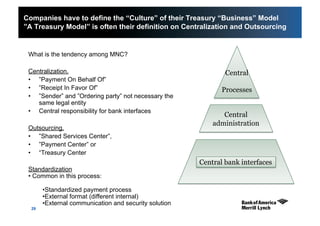
Companies have to define the “Culture” of their Treasury “Business” Model
”A Treasury Model” is often their definition on Centralization and Outsourcing
What is the tendency among MNC?
Centralization.
•  ”Payment On Behalf Of”
•  ”Receipt In Favor Of”
•  ”Sender” and ”Ordering party” not necessary the
same legal entity
•  Central responsibility for bank interfaces
Outsourcing.
•  ”Shared Services Center”,
•  ”Payment Center” or
•  “Treasury Center
Standardization
• Common in this process:
• Standardized payment process
• External format (different internal)
• External communication and security solution
Central
administration
Central
Processes
Central bank interfaces
30
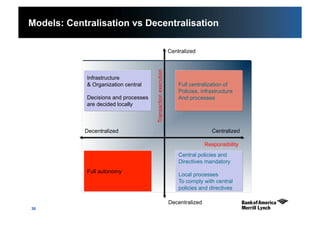
Models: Centralisation vs Decentralisation
CentralizedDecentralized
Decentralized
Centralized
Responsibility
Transactionexecution
Infrastructure
& Organization central
Decisions and processes
are decided locally
Full autonomy
Central policies and
Directives mandatory
Local processes
To comply with central
policies and directives
Full centralization of
Policies, infrastructure
And processes
31
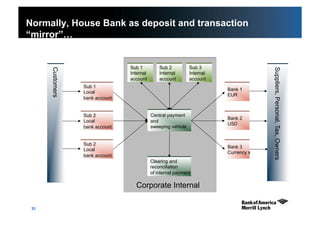
Normally, House Bank as deposit and transaction
“mirror”…
Sub 1
Local
bank account
Sub 2
Local
bank account
Sub 2
Local
bank account
Bank 1
EUR
Bank 2
USD
Bank 3
Currency x
Customers
Suppliers,Personal,Tax,Owners
Corporate Internal
Clearing and
reconciliation
of internal payment
Sub 1
Internal
account
Sub 2
Internal
account
Sub 3
Internal
account
Central payment
and
sweeping vehicle
32
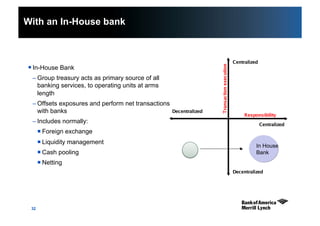
With an In-House bank
 In-House Bank
– Group treasury acts as primary source of all
banking services, to operating units at arms
length
– Offsets exposures and perform net transactions
with banks
– Includes normally:
 Foreign exchange
 Liquidity management
 Cash pooling
 Netting
In House
Bank
33
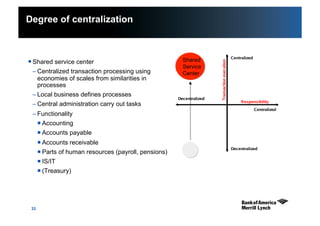
Degree of centralization
 Shared service center
– Centralized transaction processing using
economies of scales from similarities in
processes
– Local business defines processes
– Central administration carry out tasks
– Functionality
 Accounting
 Accounts payable
 Accounts receivable
 Parts of human resources (payroll, pensions)
 IS/IT
 (Treasury)
Shared
Service
Center
Second Trend:
The Developments in Regulation
Why regulation might help Treasury in the Next Five years..
35
Trend 2. The Developments in Regulation
1. SEPA
European Standardization might just work….
37
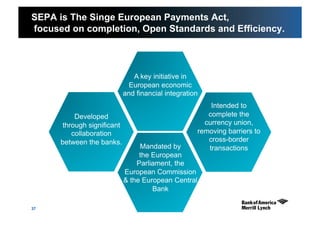
SEPA is The Singe European Payments Act,
focused on completion, Open Standards and Efficiency.
Mandated by
the European
Parliament, the
European Commission
& the European Central
Bank
Intended to
complete the
currency union,
removing barriers to
cross-border
transactions
A key initiative in
European economic
and financial integration
Developed
through significant
collaboration
between the banks.
38
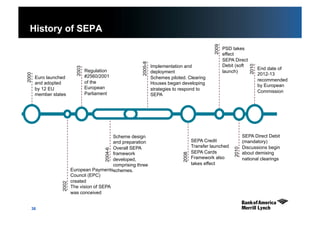
History of SEPA
Regulation
#2560/2001
of the
European
Parliament
Implementation and
deployment
Schemes piloted. Clearing
Houses began developing
strategies to respond to
SEPA
Euro launched
and adopted
by 12 EU
member states
European Payments
Council (EPC)
created
The vision of SEPA
was conceived
Scheme design
and preparation
Overall SEPA
framework
developed,
comprising three
schemes.
SEPA Credit
Transfer launched
SEPA Cards
Framework also
takes effect
PSD takes
effect
SEPA Direct
Debit (soft
launch)
SEPA Direct Debit
(mandatory)
Discussions begin
about demising
national clearings
End date of
2012-13
recommended
by European
Commission
2000
2003
2002
2004-6
2005-8
2008
2010
2010
2009
39
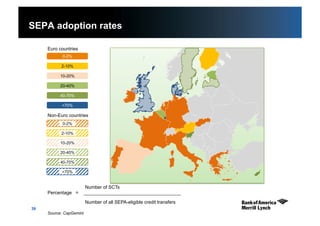
SEPA adoption rates
0-2%
2-10%
10-20%
20-40%
40-70%
>70%
0-2%
2-10%
10-20%
20-40%
40-70%
>70%
Euro countries
Non-Euro countries
Number of SCTs
Percentage = _____________________________________
Number of all SEPA-eligible credit transfers
Source: CapGemini
40
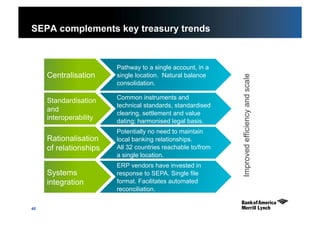
SEPA complements key treasury trends
Centralisation
Standardisation
and
interoperability
Rationalisation
of relationships
Systems
integration
Pathway to a single account, in a
single location. Natural balance
consolidation.
Common instruments and
technical standards, standardised
clearing, settlement and value
dating; harmonised legal basis.
Potentially no need to maintain
local banking relationships.
All 32 countries reachable to/from
a single location.
ERP vendors have invested in
response to SEPA. Single file
format. Facilitates automated
reconciliation.
Improvedefficiencyandscale
41
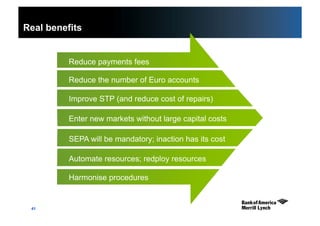
Real benefits
Reduce the number of Euro accounts
Reduce payments fees
Enter new markets without large capital costs
Automate resources; redploy resources
Harmonise procedures
Improve STP (and reduce cost of repairs)
SEPA will be mandatory; inaction has its cost
42
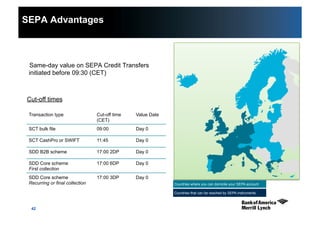
SEPA Advantages
Same-day value on SEPA Credit Transfers
initiated before 09:30 (CET)
Countries where you can domicile your SEPA account
Countries that can be reached by SEPA instruments
Cut-off times
Transaction type Cut-off time
(CET)
Value Date
SCT bulk file 09:00 Day 0
SCT CashPro or SWIFT 11:45 Day 0
SDD B2B scheme 17:00 2DP Day 0
SDD Core scheme
First collection
17:00 6DP Day 0
SDD Core scheme
Recurring or final collection
17:00 3DP Day 0
2. Digitalization of Payments and Electronic
Invoicing
How EIPP might help treasury in the next Five years..
44
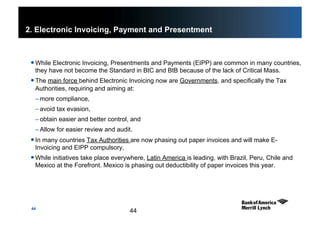
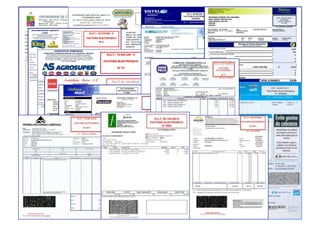
2. Electronic Invoicing, Payment and Presentment
 While Electronic Invoicing, Presentments and Payments (EIPP) are common in many countries,
they have not become the Standard in BtC and BtB because of the lack of Critical Mass.
 The main force behind Electronic Invoicing now are Governments, and specifically the Tax
Authorities, requiring and aiming at:
– more compliance,
– avoid tax evasion,
– obtain easier and better control, and
– Allow for easier review and audit.
 In many countries Tax Authorities are now phasing out paper invoices and will make E-
Invoicing and EIPP compulsory,
 While initiatives take place everywhere, Latin America is leading, with Brazil, Peru, Chile and
Mexico at the Forefront. Mexico is phasing out deductibility of paper invoices this year.
44
45
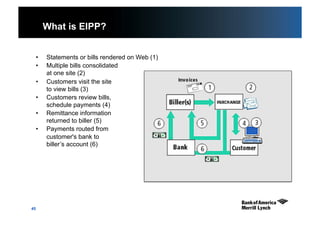
What is EIPP?
•  Statements or bills rendered on Web (1)
•  Multiple bills consolidated
at one site (2)
•  Customers visit the site
to view bills (3)
•  Customers review bills,
schedule payments (4)
•  Remittance information
returned to biller (5)
•  Payments routed from
customer's bank to
biller’s account (6)
46
AOP,
Payment
Invoice
No.Payment
No.
Ship &
Invoice
PO
No.Invoice
No.
Purch
Order
PO
No.
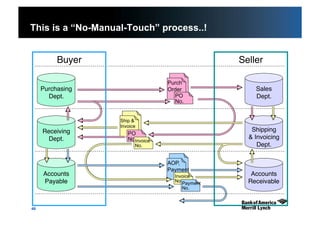
This is a “No-Manual-Touch” process..!
Purchasing"
Dept."
Accounts"
Payable"
Receiving"
Dept."
Sales"
Dept."
Accounts"
Receivable"
Shipping

& Invoicing"
Dept."
Buyer" Seller"
47
3. The Tax Authority enters cash management*…
*actually they have always been there and never left…
49
The IRS enters cash management..
Actually it has always been involved in Treasury..…
So, what should a Treasurer look for in the next years…
1. Withholding Tax on Interest, Dividends and Royalty.
- The Fear for tax havens and under-taxation -
2. Capital Control and Convertibility issues
3. Money Laundering Compliance.
4. Financial Transaction Tax:
The recently intensified discussions about taxing financial transactions,
(which is increasingly politically popular, but very disruptive to Cash Management….)
49
50
1. Withholding Tax on Interest, Dividend and Royalty
 Tax and Treasury always work together…
 With Liberalization of Trade, and general acceptance of Transfer Price Studies based on OECD
Guidelines, more countries are now focusing on multinational tax income rather then on import
duties. TPS are annual obligations for MNC in most countries.
 Withholding Tax Planning, and Compliance, is an important part of treasury work, including
setting up systems to obtain evidence of credits for parents or subsidiaries. This remains often
paper based, and labor intensive.
 Tax Departments often direct Interest, Dividend and Royalty to different jurisdictions, based on
preferential treatment and Tax Treaties for each category.
 Most of these withholdings are subject to Thin Capitalization, Transfer Prices, Arms Length
Rules, Marked to Market Rules and Residency or Non-Residency.
 The Treasurer has to comply and provide a paper or digital trail. With governments short on cash
worldwide, audit’s will become more sophisticated.
51
2. Capital Controls, Convertibility
 Many Currencies are not Convertible.
 You can not cash pool into Cash Concentration non
convertible currencies, like the Chinese Yuan, Indian
Rupees or Brazilian Real.
 There are even serious restrictions in pooling US
Dollars in Cash Pools, when located in ZBA or
“Notional Pooling Restricted Countries” (Like LATAM)
 Non-Convertibility. The currency has no transaction
value outside the country. Payment abroad with this
currency is not allowed.
 Sometimes it’s restricted and you can only under
certain condition export, pay or trade in these
currencies. Non-Convertible Currencies do not
necessarily have to be pegged currencies, they can
be floating.
  Capital Controls are different, and also possible with
convertible currencies. Basically it means you have to
ask the central bank permission to export the
domestic currency, or give a reason for requiring
foreign currency.
 Both issues are becoming more important with an
internationalizing world, while governments have the
last 5 years become more restrictive.
 All require enhanced Liquidity Planning.
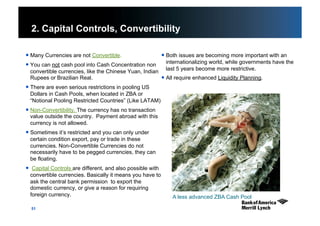
A less advanced ZBA Cash Pool
52
3. Money Laundering
 The Office of Foreign Asset Control is based in the Department of Treasury.
 Banks, not only US banks, are required to report any international transaction over 10.000 and
suspicions transaction under that amount (…say 2 x 5,000 or 9,999).
 Normally MNC are not suspected of drugs of terrorism money, or money laundering, but many
transactions can be scrutinized for Tax Reasons.
–  Not only focused on Terrorism Money or Drugs Money… Tax Evasion is as important.
–  In foreign countries incoming Intercompany Money has to declared within a certain category:
–  Capital, Dividends, Short and Long term IC Loans, and Commercial Intercompany Transactions.
–  All categories have Different Taxation.
 Main solution for treasury of any normal MNC: Compliance.
–  Have always all documentation in order
–  Prepare to comply with Audits
–  Be able to show the legal or commercial reason behind any IC transaction.
–  Especially non-commercial intercompany transaction sare subject to scrutiny
Bottom-line: your obligation is to know what your paying, and why. …and have a paper or electronic trail.
The good news is that this obliges companies to have their processes in order…which is good business anyway!
53
4. The Financial Transaction Tax
54
4. Financial Transaction Tax.
 Financial Transaction Tax (FTT) are not new. They started in the United Kingdom as the Stamp Tax in 1694,
and existed in the UK until 2003. Keynes Proposed in the 1930’s to lessen speculation on Wall Street.
 However they become commonplace in the last 10 years, as a new source of revenue, especially outside the
OECD. Many countries currently have a kind of FTT, Stamp Tax, or Tax on Cash, Checks or Electronic
Transactions.
 For treasurers it effectively kills the benefits of a zero Balance cash pool. (Notional pooling is not affected)!
Especially in an environment were interest rates are very low and liquidity is abundant.
 A Tobin tax, suggested by Nobel Laureate economist James Tobin, was originally defined as a tax on all spot
conversions of one currency into another. The tax is intended to put a penalty on short-term financial round-trip
excursions into another currency.
 In many countries the tax is a credit to general income tax. In Mexico this is the case on the “Cash Deposit
Tax”, in Peru on the “Debit and Credit” transactions tax. In other countries the tax is eliminated when the money
becomes long term rather then speculative or short term. (often after 1 year)
 In many jurisdictions where an FTT is introduced you see increased payments in Cash and Netting.
 The FTT is likely to become a mayor issue for treasurers in the next 5 years.
 Although the cost can easily be back charged to customers, the accountancy issues, the compliance issue and
the planning issues will require to be involved in detail.
55
Summary
 Regulation: The future is bright: even Regulation and government intervention bring new
standards and opportunities like the SEPA and the Electronic Invoicing EIPP.
 Strengthen Compliance, and fiscal regulation requires good housekeeping, improved and
streamlined processes and further innovation in the next years.
 Innovation will be Mobile, will be Host to Host, and only core value added activities will stay in-
house, all others will be Outsourced or Standardized.
For Treasurers the Future looks Bright, there should not be uncertainties to
navigate in uncharted waters….
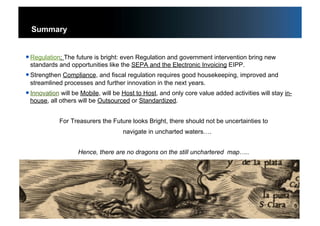
Hence, there are no dragons on the still unchartered map…..
55
56
Hic Sunt Dracones
57
“Bank of America Merrill Lynch” is the marketing name for the global banking and global markets businesses of Bank of America Corporation. Lending, derivatives, and other commercial banking activities are
performed globally by banking affiliates of Bank of America Corporation, including Bank of America, N.A., member FDIC. Securities, strategic advisory, and other investment banking activities are performed
globally by investment banking affiliates of Bank of America Corporation (“Investment Banking Affiliates”), including, in the United States, Merrill Lynch, Pierce, Fenner & Smith Incorporated and Merrill Lynch
Professional Clearing Corp., all of which are registered broker‑dealers and members of FINRA and SIPC, and, in other jurisdictions, by locally registered entities. Investment products offered by Investment
Banking Affiliates: Are Not FDIC Insured * May Lose Value * Are Not Bank Guaranteed.
These materials have been prepared by one or more subsidiaries of Bank of America Corporation for the client or potential client to whom such materials are directly addressed and delivered (the “Company”) in
connection with an actual or potential mandate or engagement and may not be used or relied upon for any purpose other than as specifically contemplated by a written agreement with us. These materials are
based on information provided by or on behalf of the Company and/or other potential transaction participants, from public sources or otherwise reviewed by us. We assume no responsibility for independent
investigation or verification of such information (including, without limitation, data from third party suppliers) and have relied on such information being complete and accurate in all material respects. To the extent
such information includes estimates and forecasts of future financial performance prepared by or reviewed with the managements of the Company and/or other potential transaction participants or obtained from
public sources, we have assumed that such estimates and forecasts have been reasonably prepared on bases reflecting the best currently available estimates and judgments of such managements (or, with
respect to estimates and forecasts obtained from public sources, represent reasonable estimates). No representation or warranty, express or implied, is made as to the accuracy or completeness of such
information and nothing contained herein is, or shall be relied upon as, a representation, whether as to the past, the present or the future. These materials were designed for use by specific persons familiar with
the business and affairs of the Company and are being furnished and should be considered only in connection with other information, oral or written, being provided by us in connection herewith. These materials
are not intended to provide the sole basis for evaluating, and should not be considered a recommendation with respect to, any transaction or other matter. These materials do not constitute an offer or solicitation
to sell or purchase any securities and are not a commitment by Bank of America Corporation or any of its affiliates to provide or arrange any financing for any transaction or to purchase any security in connection
therewith. These materials are for discussion purposes only and are subject to our review and assessment from a legal, compliance, accounting policy and risk perspective, as appropriate, following our
discussion with the Company. We assume no obligation to update or otherwise revise these materials. These materials have not been prepared with a view toward public disclosure under applicable securities
laws or otherwise, are intended for the benefit and use of the Company, and may not be reproduced, disseminated, quoted or referred to, in whole or in part, without our prior written consent. These materials
may not reflect information known to other professionals in other business areas of Bank of America Corporation and its affiliates.
Bank of America Corporation and its affiliates (collectively, the “BAC Group”) comprise a full service securities firm and commercial bank engaged in securities, commodities and derivatives trading, foreign
exchange and other brokerage activities, and principal investing as well as providing investment, corporate and private banking, asset and investment management, financing and strategic advisory services and
other commercial services and products to a wide range of corporations, governments and individuals, domestically and offshore, from which conflicting interests or duties, or a perception thereof, may arise. In
the ordinary course of these activities, parts of the BAC Group at any time may invest on a principal basis or manage funds that invest, make or hold long or short positions, finance positions or trade or otherwise
effect transactions, for their own accounts or the accounts of customers, in debt, equity or other securities or financial instruments (including derivatives, bank loans or other obligations) of the Company, potential
counterparties or any other company that may be involved in a transaction. Products and services that may be referenced in the accompanying materials may be provided through one or more affiliates of Bank
of America Corporation. We have adopted policies and guidelines designed to preserve the independence of our research analysts. These policies prohibit employees from offering research coverage, a
favorable research rating or a specific price target or offering to change a research rating or price target as consideration for or an inducement to obtain business or other compensation. We are required to
obtain, verify and record certain information that identifies the Company, which information includes the name and address of the Company and other information that will allow us to identify the Company in
accordance, as applicable, with the USA Patriot Act (Title III of Pub. L. 107-56 (signed into law October 26, 2001)) and such other laws, rules and regulations as applicable within and outside the United States.
We do not provide legal, compliance, tax or accounting advice. Accordingly, any statements contained herein as to tax matters were neither written nor intended by us to be used and cannot be used by any
taxpayer for the purpose of avoiding tax penalties that may be imposed on such taxpayer. If any person uses or refers to any such tax statement in promoting, marketing or recommending a partnership or other
entity, investment plan or arrangement to any taxpayer, then the statement expressed herein is being delivered to support the promotion or marketing of the transaction or matter addressed and the recipient
should seek advice based on its particular circumstances from an independent tax advisor. Notwithstanding anything that may appear herein or in other materials to the contrary, the Company shall be permitted
to disclose the tax treatment and tax structure of a transaction (including any materials, opinions or analyses relating to such tax treatment or tax structure, but without disclosure of identifying information or,
except to the extent relating to such tax structure or tax treatment, any nonpublic commercial or financial information) on and after the earliest to occur of the date of (i) public announcement of discussions relating
to such transaction, (ii) public announcement of such transaction or (iii) execution of a definitive agreement (with or without conditions) to enter into such transaction; provided, however, that if such transaction is
not consummated for any reason, the provisions of this sentence shall cease to apply. Copyright 2012 Bank of America Corporation.
Notice to Recipient

The Next 5 Years: Innovation in Treasury and Finance, "Where are the Dragons?", Bank of America Merrill Lynch

  • 1.
    Financial Forecasting andPlanning Summit, IE Group Patrick Peters-Buhler, Director GBS, BofAML Omni Hotel, 24 February 2012, San Diego, California
  • 2.
  • 3.
    3 ….Hic Sunt Dracones…… Here Be Dragons! Why Dragons? In Medieval Times many navigational maps were intimidating their users not to go beyond the known by writing : Hic Sunt Dracones: or “Here be Dragons” on the corners of the map… …to warn the users of the maps that they might be entering in unchartered and dangerous territories… For treasurers… the same will happen…the next five years will be unchartered terrain and often involve incomplete maps…but rather than finding dragons, we will find innovation, more controls, regulation and compliance, but even in regulations there will be opportunities for efficiency, and for adding value…
  • 4.
    4 What are wetalking about today? Short Introduction – Speaker and GBS Where is cash management heading in the next 5 years? Two Broad Trends in Treasury ….(and many imaginary Dragons) Trend 1. The Developments in Innovation I.  SWIFT… the internationalization continues, II.  Mobile Payments & Receivables III.  STP and HTH IV.  Decisions on Centralization and Outsourcing Trend 2. The Developments in Regulation I.  SEPA and other standardization II.  Digitalization and Electronic Invoicing III.  The IRS enters Cash Management Managing the Future … is Managing Innovation and Managing Regulation. Don’t be intimidated by the unchartered roadmap of the next 5 years!
  • 5.
    5 Introduction Patrick Peters-Buhler Patrickhas been involved in treasury management and capital markets for over 15 years. His experiences includes positions as a CFO, Director of Finance, Interim Manager, General Manager and as a Corporate Treasurer in 8 countries in global industries including Pharmaceuticals, Food Ingredients, Consumer Products, (Retail and Direct Selling) Manufacturing, and Financial Services. Patrick joined BofAML in 2011 after a Career in the US and several Latin American Countries, Including Mexico, Argentina, Uruguay, Peru, Chile and Colombia. He is a Certified Treasury Professional by the AFP. He has been chairing and participating in Conferences in LATAM, USA and Europe on issues of Treasury, Liquidity Management, Cash and Risk Management, among others with Eurofinance, EI Group, FIBA and IQPC. He is a Senior Tutor for Eurofinance for Treasury and Risk management Courses in the Americas and Europe. He was a contributor to the Economist Intelligence Unit (EIU), and taught at Universities in New York, Lima, Buenos Aires and Mexico City. He has been the President of the Latin America Treasury Association. Patrick, a native of the Netherlands, has lived 25 years abroad, holding Degrees from The Free University of Amsterdam, Johns Hopkins University (SAIS - School of Advanced International Studies) and has attended Post Graduate Studies at the London School of Economics, London, UK, and The “Instituto Universitario Europeo in Florence, Italy. He is based at the Miami and Mexico City Offices of BofAML.
  • 6.
    6 Introduction GBS Patrick worksfor the Global Business Solutions Group of Bank Of America Merrill Lynch.   What is Global Business Solutions? -  A value added offering for select strategic clients beyond products and services -  Focus on client’s strategic priorities, core business processes and significant pain points -  Something we do with clients instead of something we do to clients   What it is not: -  A traditional fee based consulting team -  A focus on products and services Combining Process Improvement, Practitioner and Industry Expertise, the GBS team focus on strategies and processes to optimize Client’s working capital objectives Practitioner Expertise Global Business Solutions   Client Benefits:   Objective, fact-based, process improvement approach   Integrated solutions including infrastructural process improvements, not just products and services   Advice and counsel — a partner and trusted advisor   Improved operating efficiencies and cost reductions   Bank of America Merrill Lynch Benefits:   Build stronger relationships with clients   Gain knowledge of client’s business and needs   Strengthening and differentiation of BAML brand   Catalyst for new product innovations and industry leadership
  • 7.
    7 Where is CashManagement heading in the next 5 years? … more Innovation and Regulation.
  • 8.
    8 Where are we?Where are we Going? Traditional Business ModelTraditional Business Model Business Transformation Globalisation Centralization Treasury and Business Functions ■  Global / regional treasury centres ■  Shared services centres ■  In-house banks ■  Payments factory Technology Initial Business Integration ■  Overlay cash concentration structures ■  Local pooling Centralized Management ■  Integrated information delivery ■  Cash forecast and requirements ■  Asset tracking and investment ■  Credit performance Optimal Working Capital Mgmt ■  Receivables management ■  Accounts payable financing ■  Tax efficiency ■  Outsourcing Towards a World Class Treasury…
  • 9.
    9 The Aite’s Top10 Trends in Wholesale Banking for 2012: 1.  THINK GLOBAL 2.  Increased investment in cash management and supporting technologies 3.  Implementation of next-generation corporate portals 4.  Supply-chain-finance automation and the role of banks 5.  Focus on the customer experience 6.  New treasury management systems (treasury intelligence management systems) 7.  Connecting with small-business customers 8.  Improvement of the payments process 9.  Continuation of business-financing challenges 10.  Concerns about liquidity management Source: Aite Top 10 Trends in Wholesale Banking, 2012. Aite is an Independent Research Firm Six of them are directly related to Core Cash-Management and Treasury
  • 10.
    10 Trend 1. TheDevelopment in Innovation, (and the transformation of Communication. We see several tendencies in innovation that will become important for Treasury over the next years. The main ones are : 1.  SWIFT … the standardization continues. 2.  Mobile Payments and Receivables 3.  STP and HTH 4.  Decisions on Centralization and Outsourcing
  • 11.
    1. SWIFT …the Standardization continues.
  • 12.
    12 What is SWIFT? A co-operative organization servingthe financial industry A provider of highly secure financial messaging services The financial standardisation body
  • 13.
    13 e-banking Y host tohost X e-banking Z VAN “fax-banking” Internet leased line PSTN Corporate Accounts payable Accounts receivable Treasury Other Typical corporate-to-bank messaging
  • 14.
    14 SWIFT: A secure,standardised global window Accounts payable Accounts receivable Treasury Other CORPHRFF Middleware SWIFTNet
  • 15.
    15 Who participates inSwift and Where?
  • 16.
    2. Mobile Payments& Receivables
  • 17.
    17 A. Mobile Paymentsand Alternatives to Receivables  Every day we will see more mobile transactions, different types of interfaces and we will move away from the traditional Bank Branch into cheaper, faster and less manual solutions. Many of these solutions will be mobile. Cost savings will be a main driver for change.
  • 18.
    18 B. Non-traditional plasticwill bank non-traditional groups… We will see the development toward alternative plastic solutions. Even those who have no traditional bank account will receive plastic rather than paper or cash. The digitalization of payments and receivables will increase in the next years. Everything that requires manual handling will become (relatively) more expensive. Pricing of bank products will reflect more the underlying cost. This includes disposable cards, gift cards, stored value cards, payroll cards and Direct Debit cards. This tendency is still lagging in the US, but becoming evident world wide. Most European Countries no longer accept checks as legal tender.. In the US the check overstayed is economic life cycle due to the absence of a high volume system for low value electronic payments, and cross subsidies in the consumer market.
  • 19.
    19 C. Cash &Check Deposits will be automated… We will see more intelligent “Inverse ATM’s”, Cash deposits will not only become mobile, but “Mobile” receipts & deposits will become the dominant payment format.
  • 20.
  • 21.
  • 22.
    22 How do weimprove security of transactions and obtain better information? What is Straight Through Processing? “To Functionally link two or more systems, so that they transparently behave as “one” to the End User” STP Concepts are applied beyond Trade Execution • Improve Efficiencies – shorten processing cycles • Reduce Operational Risk • Minimize Operational Costs To better plan and feed the data in the banking system, and initiate payments, it is preferable to use Straight-Through-Processing (STP) from the ERP rather than manual payment file entry. This way the information quality improves. Companies often use a single-file to transmit multiple batches of multi-currency instructions to the bank and receive corresponding electronic delivery acknowledgements and statement information. STP allows: •  Efficiency– Expedite file integration and improve STP •  Standardise – Adopt one global standard (ISO 20022 XML) for payments and receipts •  Leverage SSC processes and control systems •  Control – Allow file authorisation direct from SAP or via a web browser. •  Perform – Execute all foreign exchange payments/settlement efficiently 22
  • 23.
    23 The keys tothe Money... With all their security risks
  • 24.
    24 Retail broker HTML/XML, Streaming, Wireless Private investor Corporate treasurer Clearing &settlement Order mgmt Market data mgmt Accounting Trade capture Proprietary systems Risk mgmt Credit mgmt Portfolio mgmt In-house dealers Typical situation … Before BPM
  • 25.
    25 … and theSTP Vision with BPM Enterprise Application Integration Portals B2B Integration Business Process Management Sales, Customers, etc. Front / mid / back office ERP, manufacturing, Databases etc. Accounting, Payment CRM etc.
  • 26.
    26 Enterprise drivers forSTP: FAILS RISK COSTS Improving Control •  Reduced operational risk •  Reduced capital allocation •  Greater understanding of Issues & hotspots Reducing Cost •  Reduced manual effort •  Increased effectiveness Enabling Delivery of Great Customer Service •  Provide greater accuracy •  Increase customer satisfaction •  Improve customer relations
  • 27.
    27 The STP Vision  Seamlesscommunication among parties  Concurrent, not sequential, exchange of information  Significant real-time processing, less batch processing  Virtual processing, not physical processing  Reduces operational risk   Reduces settlement risk   A catalyst for change  improvement of lower cost structure  more efficient market process and infrastructure
  • 28.
  • 29.
    29 Companies have todefine the “Culture” of their Treasury “Business” Model ”A Treasury Model” is often their definition on Centralization and Outsourcing What is the tendency among MNC? Centralization. •  ”Payment On Behalf Of” •  ”Receipt In Favor Of” •  ”Sender” and ”Ordering party” not necessary the same legal entity •  Central responsibility for bank interfaces Outsourcing. •  ”Shared Services Center”, •  ”Payment Center” or •  “Treasury Center Standardization • Common in this process: • Standardized payment process • External format (different internal) • External communication and security solution Central administration Central Processes Central bank interfaces
  • 30.
    30 Models: Centralisation vsDecentralisation CentralizedDecentralized Decentralized Centralized Responsibility Transactionexecution Infrastructure & Organization central Decisions and processes are decided locally Full autonomy Central policies and Directives mandatory Local processes To comply with central policies and directives Full centralization of Policies, infrastructure And processes
  • 31.
    31 Normally, House Bankas deposit and transaction “mirror”… Sub 1 Local bank account Sub 2 Local bank account Sub 2 Local bank account Bank 1 EUR Bank 2 USD Bank 3 Currency x Customers Suppliers,Personal,Tax,Owners Corporate Internal Clearing and reconciliation of internal payment Sub 1 Internal account Sub 2 Internal account Sub 3 Internal account Central payment and sweeping vehicle
  • 32.
    32 With an In-Housebank  In-House Bank – Group treasury acts as primary source of all banking services, to operating units at arms length – Offsets exposures and perform net transactions with banks – Includes normally:  Foreign exchange  Liquidity management  Cash pooling  Netting In House Bank
  • 33.
    33 Degree of centralization  Sharedservice center – Centralized transaction processing using economies of scales from similarities in processes – Local business defines processes – Central administration carry out tasks – Functionality  Accounting  Accounts payable  Accounts receivable  Parts of human resources (payroll, pensions)  IS/IT  (Treasury) Shared Service Center
  • 34.
    Second Trend: The Developmentsin Regulation Why regulation might help Treasury in the Next Five years..
  • 35.
    35 Trend 2. TheDevelopments in Regulation
  • 36.
  • 37.
    37 SEPA is TheSinge European Payments Act, focused on completion, Open Standards and Efficiency. Mandated by the European Parliament, the European Commission & the European Central Bank Intended to complete the currency union, removing barriers to cross-border transactions A key initiative in European economic and financial integration Developed through significant collaboration between the banks.
  • 38.
    38 History of SEPA Regulation #2560/2001 ofthe European Parliament Implementation and deployment Schemes piloted. Clearing Houses began developing strategies to respond to SEPA Euro launched and adopted by 12 EU member states European Payments Council (EPC) created The vision of SEPA was conceived Scheme design and preparation Overall SEPA framework developed, comprising three schemes. SEPA Credit Transfer launched SEPA Cards Framework also takes effect PSD takes effect SEPA Direct Debit (soft launch) SEPA Direct Debit (mandatory) Discussions begin about demising national clearings End date of 2012-13 recommended by European Commission 2000 2003 2002 2004-6 2005-8 2008 2010 2010 2009
  • 39.
    39 SEPA adoption rates 0-2% 2-10% 10-20% 20-40% 40-70% >70% 0-2% 2-10% 10-20% 20-40% 40-70% >70% Eurocountries Non-Euro countries Number of SCTs Percentage = _____________________________________ Number of all SEPA-eligible credit transfers Source: CapGemini
  • 40.
    40 SEPA complements keytreasury trends Centralisation Standardisation and interoperability Rationalisation of relationships Systems integration Pathway to a single account, in a single location. Natural balance consolidation. Common instruments and technical standards, standardised clearing, settlement and value dating; harmonised legal basis. Potentially no need to maintain local banking relationships. All 32 countries reachable to/from a single location. ERP vendors have invested in response to SEPA. Single file format. Facilitates automated reconciliation. Improvedefficiencyandscale
  • 41.
    41 Real benefits Reduce thenumber of Euro accounts Reduce payments fees Enter new markets without large capital costs Automate resources; redploy resources Harmonise procedures Improve STP (and reduce cost of repairs) SEPA will be mandatory; inaction has its cost
  • 42.
    42 SEPA Advantages Same-day valueon SEPA Credit Transfers initiated before 09:30 (CET) Countries where you can domicile your SEPA account Countries that can be reached by SEPA instruments Cut-off times Transaction type Cut-off time (CET) Value Date SCT bulk file 09:00 Day 0 SCT CashPro or SWIFT 11:45 Day 0 SDD B2B scheme 17:00 2DP Day 0 SDD Core scheme First collection 17:00 6DP Day 0 SDD Core scheme Recurring or final collection 17:00 3DP Day 0
  • 43.
    2. Digitalization ofPayments and Electronic Invoicing How EIPP might help treasury in the next Five years..
  • 44.
    44 2. Electronic Invoicing,Payment and Presentment  While Electronic Invoicing, Presentments and Payments (EIPP) are common in many countries, they have not become the Standard in BtC and BtB because of the lack of Critical Mass.  The main force behind Electronic Invoicing now are Governments, and specifically the Tax Authorities, requiring and aiming at: – more compliance, – avoid tax evasion, – obtain easier and better control, and – Allow for easier review and audit.  In many countries Tax Authorities are now phasing out paper invoices and will make E- Invoicing and EIPP compulsory,  While initiatives take place everywhere, Latin America is leading, with Brazil, Peru, Chile and Mexico at the Forefront. Mexico is phasing out deductibility of paper invoices this year. 44
  • 45.
    45 What is EIPP? • Statements or bills rendered on Web (1) •  Multiple bills consolidated at one site (2) •  Customers visit the site to view bills (3) •  Customers review bills, schedule payments (4) •  Remittance information returned to biller (5) •  Payments routed from customer's bank to biller’s account (6)
  • 46.
    46 AOP, Payment Invoice No.Payment No. Ship & Invoice PO No.Invoice No. Purch Order PO No. This isa “No-Manual-Touch” process..! Purchasing" Dept." Accounts" Payable" Receiving" Dept." Sales" Dept." Accounts" Receivable" Shipping
 & Invoicing" Dept." Buyer" Seller"
  • 47.
  • 48.
    3. The TaxAuthority enters cash management*… *actually they have always been there and never left…
  • 49.
    49 The IRS enterscash management.. Actually it has always been involved in Treasury..… So, what should a Treasurer look for in the next years… 1. Withholding Tax on Interest, Dividends and Royalty. - The Fear for tax havens and under-taxation - 2. Capital Control and Convertibility issues 3. Money Laundering Compliance. 4. Financial Transaction Tax: The recently intensified discussions about taxing financial transactions, (which is increasingly politically popular, but very disruptive to Cash Management….) 49
  • 50.
    50 1. Withholding Taxon Interest, Dividend and Royalty  Tax and Treasury always work together…  With Liberalization of Trade, and general acceptance of Transfer Price Studies based on OECD Guidelines, more countries are now focusing on multinational tax income rather then on import duties. TPS are annual obligations for MNC in most countries.  Withholding Tax Planning, and Compliance, is an important part of treasury work, including setting up systems to obtain evidence of credits for parents or subsidiaries. This remains often paper based, and labor intensive.  Tax Departments often direct Interest, Dividend and Royalty to different jurisdictions, based on preferential treatment and Tax Treaties for each category.  Most of these withholdings are subject to Thin Capitalization, Transfer Prices, Arms Length Rules, Marked to Market Rules and Residency or Non-Residency.  The Treasurer has to comply and provide a paper or digital trail. With governments short on cash worldwide, audit’s will become more sophisticated.
  • 51.
    51 2. Capital Controls,Convertibility  Many Currencies are not Convertible.  You can not cash pool into Cash Concentration non convertible currencies, like the Chinese Yuan, Indian Rupees or Brazilian Real.  There are even serious restrictions in pooling US Dollars in Cash Pools, when located in ZBA or “Notional Pooling Restricted Countries” (Like LATAM)  Non-Convertibility. The currency has no transaction value outside the country. Payment abroad with this currency is not allowed.  Sometimes it’s restricted and you can only under certain condition export, pay or trade in these currencies. Non-Convertible Currencies do not necessarily have to be pegged currencies, they can be floating.   Capital Controls are different, and also possible with convertible currencies. Basically it means you have to ask the central bank permission to export the domestic currency, or give a reason for requiring foreign currency.  Both issues are becoming more important with an internationalizing world, while governments have the last 5 years become more restrictive.  All require enhanced Liquidity Planning. A less advanced ZBA Cash Pool
  • 52.
    52 3. Money Laundering  TheOffice of Foreign Asset Control is based in the Department of Treasury.  Banks, not only US banks, are required to report any international transaction over 10.000 and suspicions transaction under that amount (…say 2 x 5,000 or 9,999).  Normally MNC are not suspected of drugs of terrorism money, or money laundering, but many transactions can be scrutinized for Tax Reasons. –  Not only focused on Terrorism Money or Drugs Money… Tax Evasion is as important. –  In foreign countries incoming Intercompany Money has to declared within a certain category: –  Capital, Dividends, Short and Long term IC Loans, and Commercial Intercompany Transactions. –  All categories have Different Taxation.  Main solution for treasury of any normal MNC: Compliance. –  Have always all documentation in order –  Prepare to comply with Audits –  Be able to show the legal or commercial reason behind any IC transaction. –  Especially non-commercial intercompany transaction sare subject to scrutiny Bottom-line: your obligation is to know what your paying, and why. …and have a paper or electronic trail. The good news is that this obliges companies to have their processes in order…which is good business anyway!
  • 53.
    53 4. The FinancialTransaction Tax
  • 54.
    54 4. Financial TransactionTax.  Financial Transaction Tax (FTT) are not new. They started in the United Kingdom as the Stamp Tax in 1694, and existed in the UK until 2003. Keynes Proposed in the 1930’s to lessen speculation on Wall Street.  However they become commonplace in the last 10 years, as a new source of revenue, especially outside the OECD. Many countries currently have a kind of FTT, Stamp Tax, or Tax on Cash, Checks or Electronic Transactions.  For treasurers it effectively kills the benefits of a zero Balance cash pool. (Notional pooling is not affected)! Especially in an environment were interest rates are very low and liquidity is abundant.  A Tobin tax, suggested by Nobel Laureate economist James Tobin, was originally defined as a tax on all spot conversions of one currency into another. The tax is intended to put a penalty on short-term financial round-trip excursions into another currency.  In many countries the tax is a credit to general income tax. In Mexico this is the case on the “Cash Deposit Tax”, in Peru on the “Debit and Credit” transactions tax. In other countries the tax is eliminated when the money becomes long term rather then speculative or short term. (often after 1 year)  In many jurisdictions where an FTT is introduced you see increased payments in Cash and Netting.  The FTT is likely to become a mayor issue for treasurers in the next 5 years.  Although the cost can easily be back charged to customers, the accountancy issues, the compliance issue and the planning issues will require to be involved in detail.
  • 55.
    55 Summary  Regulation: The futureis bright: even Regulation and government intervention bring new standards and opportunities like the SEPA and the Electronic Invoicing EIPP.  Strengthen Compliance, and fiscal regulation requires good housekeeping, improved and streamlined processes and further innovation in the next years.  Innovation will be Mobile, will be Host to Host, and only core value added activities will stay in- house, all others will be Outsourced or Standardized. For Treasurers the Future looks Bright, there should not be uncertainties to navigate in uncharted waters…. Hence, there are no dragons on the still unchartered map….. 55
  • 56.
  • 57.
    57 “Bank of AmericaMerrill Lynch” is the marketing name for the global banking and global markets businesses of Bank of America Corporation. Lending, derivatives, and other commercial banking activities are performed globally by banking affiliates of Bank of America Corporation, including Bank of America, N.A., member FDIC. Securities, strategic advisory, and other investment banking activities are performed globally by investment banking affiliates of Bank of America Corporation (“Investment Banking Affiliates”), including, in the United States, Merrill Lynch, Pierce, Fenner & Smith Incorporated and Merrill Lynch Professional Clearing Corp., all of which are registered broker‑dealers and members of FINRA and SIPC, and, in other jurisdictions, by locally registered entities. Investment products offered by Investment Banking Affiliates: Are Not FDIC Insured * May Lose Value * Are Not Bank Guaranteed. These materials have been prepared by one or more subsidiaries of Bank of America Corporation for the client or potential client to whom such materials are directly addressed and delivered (the “Company”) in connection with an actual or potential mandate or engagement and may not be used or relied upon for any purpose other than as specifically contemplated by a written agreement with us. These materials are based on information provided by or on behalf of the Company and/or other potential transaction participants, from public sources or otherwise reviewed by us. We assume no responsibility for independent investigation or verification of such information (including, without limitation, data from third party suppliers) and have relied on such information being complete and accurate in all material respects. To the extent such information includes estimates and forecasts of future financial performance prepared by or reviewed with the managements of the Company and/or other potential transaction participants or obtained from public sources, we have assumed that such estimates and forecasts have been reasonably prepared on bases reflecting the best currently available estimates and judgments of such managements (or, with respect to estimates and forecasts obtained from public sources, represent reasonable estimates). No representation or warranty, express or implied, is made as to the accuracy or completeness of such information and nothing contained herein is, or shall be relied upon as, a representation, whether as to the past, the present or the future. These materials were designed for use by specific persons familiar with the business and affairs of the Company and are being furnished and should be considered only in connection with other information, oral or written, being provided by us in connection herewith. These materials are not intended to provide the sole basis for evaluating, and should not be considered a recommendation with respect to, any transaction or other matter. These materials do not constitute an offer or solicitation to sell or purchase any securities and are not a commitment by Bank of America Corporation or any of its affiliates to provide or arrange any financing for any transaction or to purchase any security in connection therewith. These materials are for discussion purposes only and are subject to our review and assessment from a legal, compliance, accounting policy and risk perspective, as appropriate, following our discussion with the Company. We assume no obligation to update or otherwise revise these materials. These materials have not been prepared with a view toward public disclosure under applicable securities laws or otherwise, are intended for the benefit and use of the Company, and may not be reproduced, disseminated, quoted or referred to, in whole or in part, without our prior written consent. These materials may not reflect information known to other professionals in other business areas of Bank of America Corporation and its affiliates. Bank of America Corporation and its affiliates (collectively, the “BAC Group”) comprise a full service securities firm and commercial bank engaged in securities, commodities and derivatives trading, foreign exchange and other brokerage activities, and principal investing as well as providing investment, corporate and private banking, asset and investment management, financing and strategic advisory services and other commercial services and products to a wide range of corporations, governments and individuals, domestically and offshore, from which conflicting interests or duties, or a perception thereof, may arise. In the ordinary course of these activities, parts of the BAC Group at any time may invest on a principal basis or manage funds that invest, make or hold long or short positions, finance positions or trade or otherwise effect transactions, for their own accounts or the accounts of customers, in debt, equity or other securities or financial instruments (including derivatives, bank loans or other obligations) of the Company, potential counterparties or any other company that may be involved in a transaction. Products and services that may be referenced in the accompanying materials may be provided through one or more affiliates of Bank of America Corporation. We have adopted policies and guidelines designed to preserve the independence of our research analysts. These policies prohibit employees from offering research coverage, a favorable research rating or a specific price target or offering to change a research rating or price target as consideration for or an inducement to obtain business or other compensation. We are required to obtain, verify and record certain information that identifies the Company, which information includes the name and address of the Company and other information that will allow us to identify the Company in accordance, as applicable, with the USA Patriot Act (Title III of Pub. L. 107-56 (signed into law October 26, 2001)) and such other laws, rules and regulations as applicable within and outside the United States. We do not provide legal, compliance, tax or accounting advice. Accordingly, any statements contained herein as to tax matters were neither written nor intended by us to be used and cannot be used by any taxpayer for the purpose of avoiding tax penalties that may be imposed on such taxpayer. If any person uses or refers to any such tax statement in promoting, marketing or recommending a partnership or other entity, investment plan or arrangement to any taxpayer, then the statement expressed herein is being delivered to support the promotion or marketing of the transaction or matter addressed and the recipient should seek advice based on its particular circumstances from an independent tax advisor. Notwithstanding anything that may appear herein or in other materials to the contrary, the Company shall be permitted to disclose the tax treatment and tax structure of a transaction (including any materials, opinions or analyses relating to such tax treatment or tax structure, but without disclosure of identifying information or, except to the extent relating to such tax structure or tax treatment, any nonpublic commercial or financial information) on and after the earliest to occur of the date of (i) public announcement of discussions relating to such transaction, (ii) public announcement of such transaction or (iii) execution of a definitive agreement (with or without conditions) to enter into such transaction; provided, however, that if such transaction is not consummated for any reason, the provisions of this sentence shall cease to apply. Copyright 2012 Bank of America Corporation. Notice to Recipient